
Quiz Calculating the total noise for ADC systems

- Slides: 12
Quiz: Calculating the total noise for ADC systems TIPL 4204 TI Precision Labs – ADCs Created by Art Kay 1
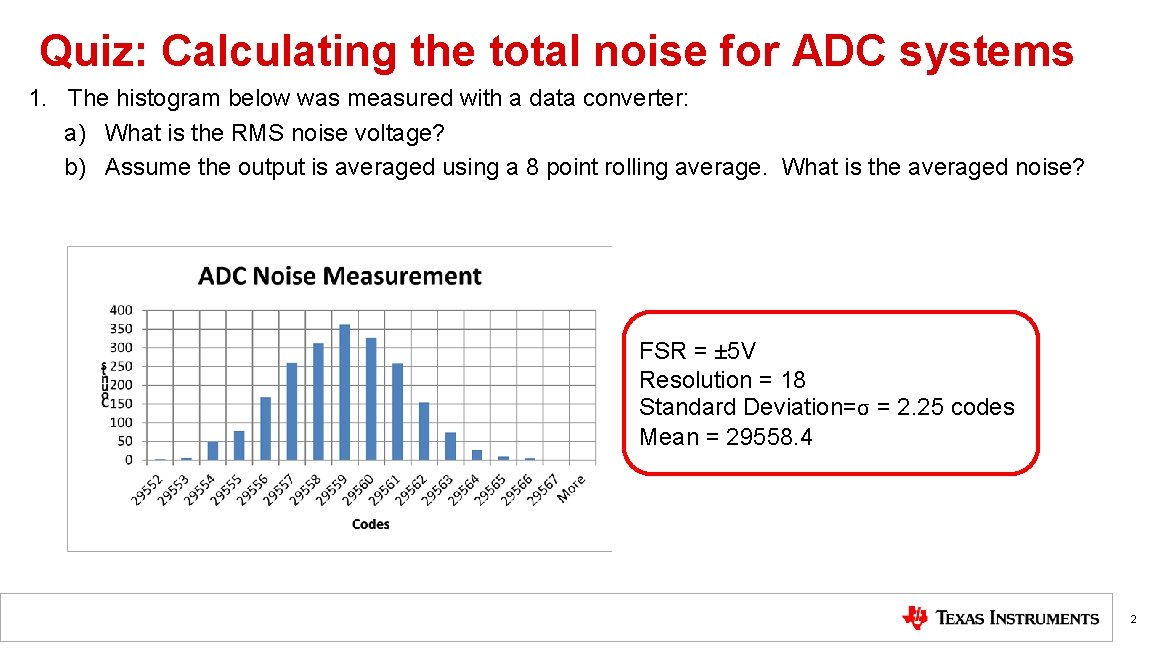
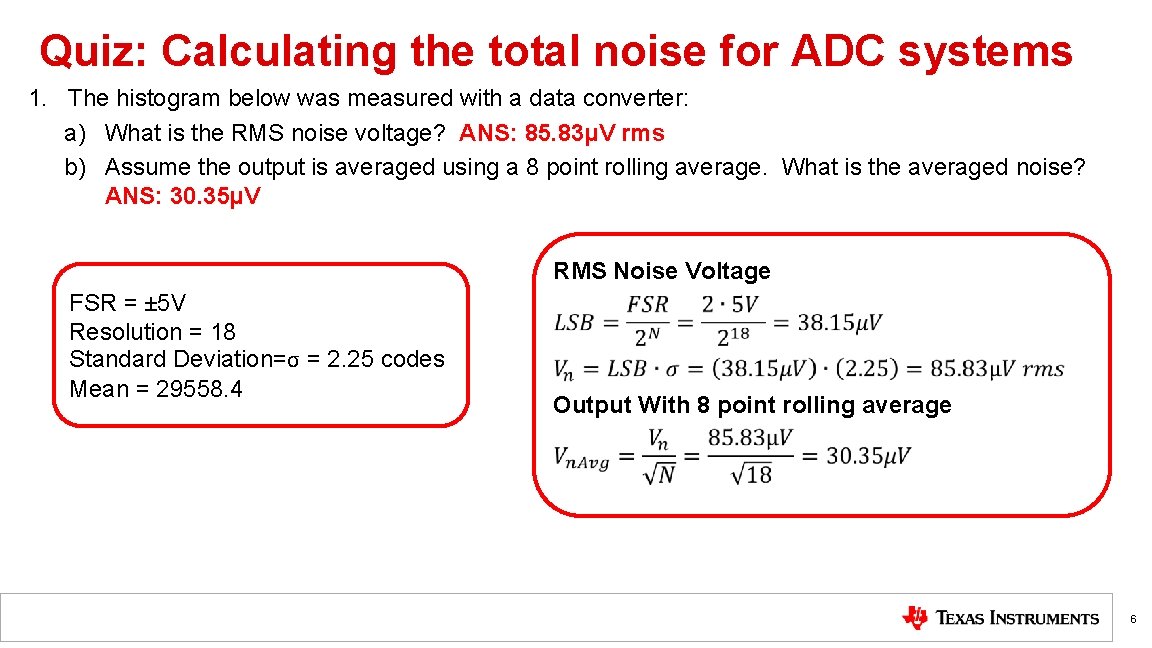
Quiz: Calculating the total noise for ADC systems 1. The histogram below was measured with a data converter: a) What is the RMS noise voltage? b) Assume the output is averaged using a 8 point rolling average. What is the averaged noise? FSR = ± 5 V Resolution = 18 Standard Deviation=σ = 2. 25 codes Mean = 29558. 4 2
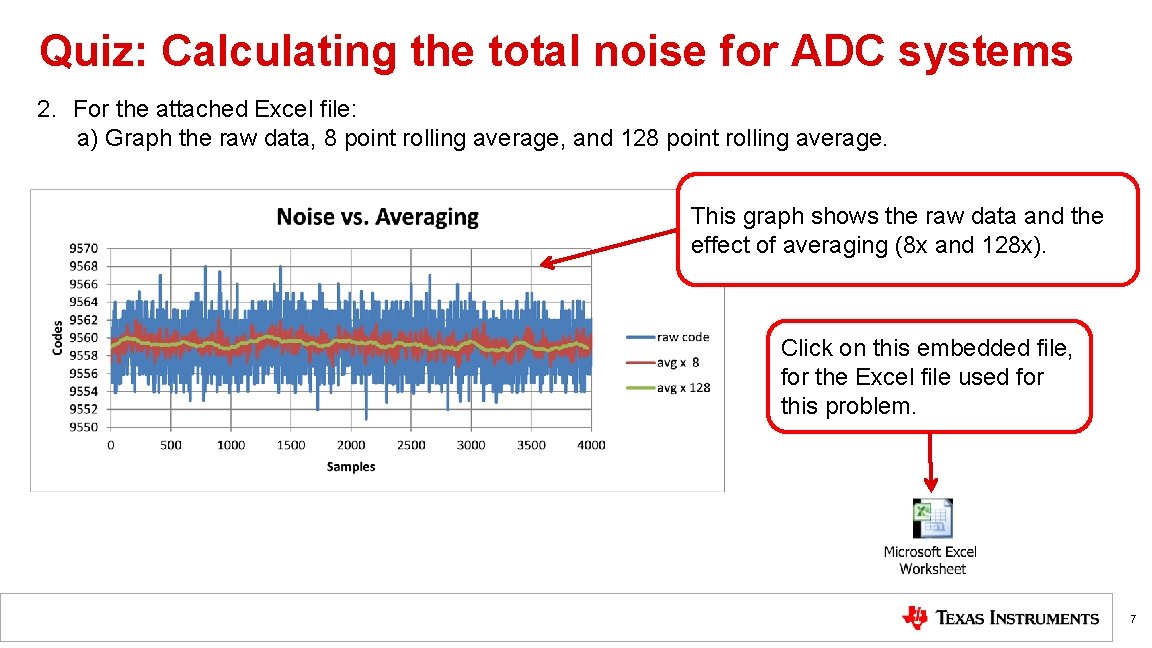
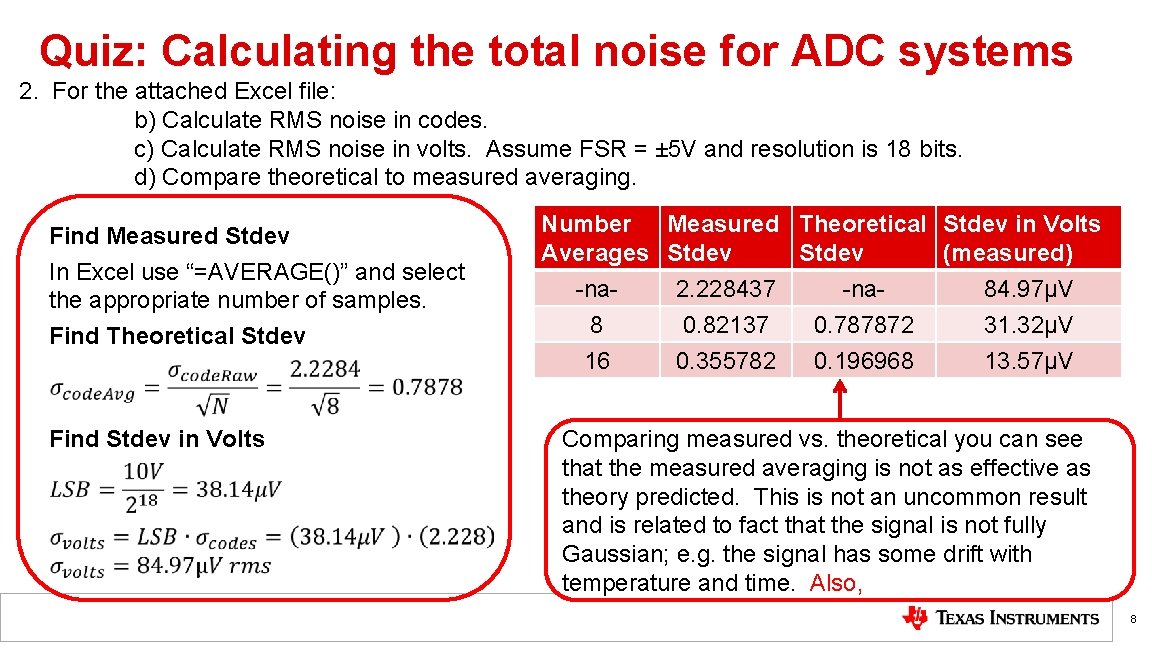
Quiz: Calculating the total noise for ADC systems 2. For the attached Excel file: a) Graph the raw data, 8 point rolling average, and 128 point rolling average. b) Calculate RMS noise in codes. c) Calculate RMS noise in volts. Assume FSR = ± 5 V and resolution is 18 bits. d) Compare theoretical to measured averaging. Click on this embedded file, for the Excel file used for this problem. 3
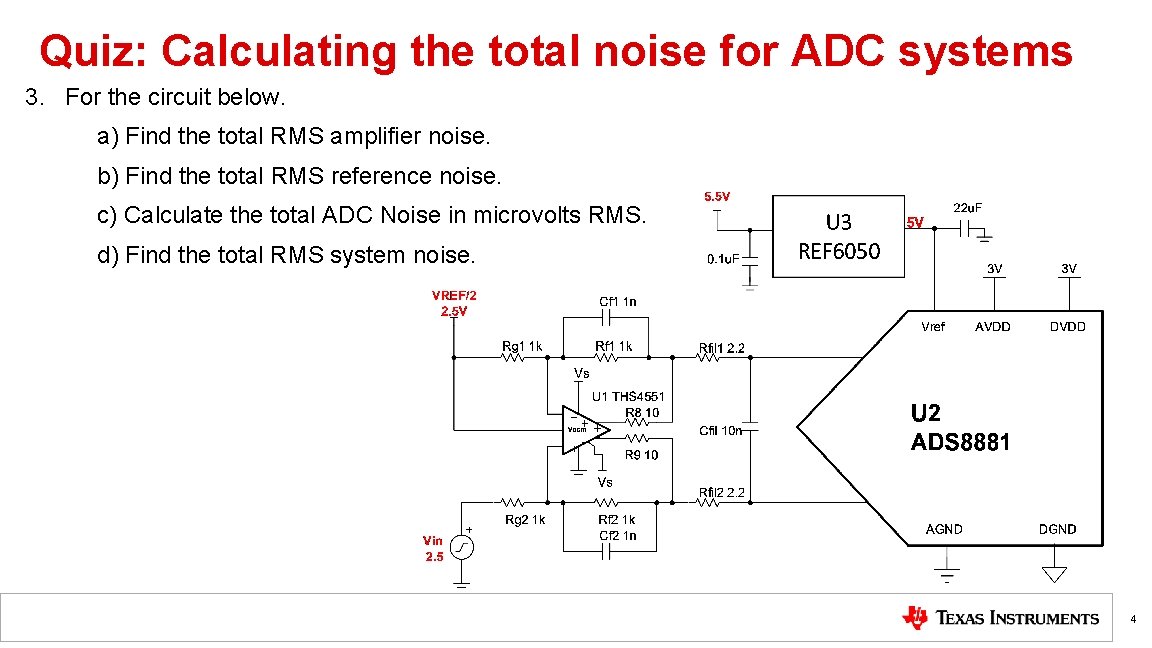
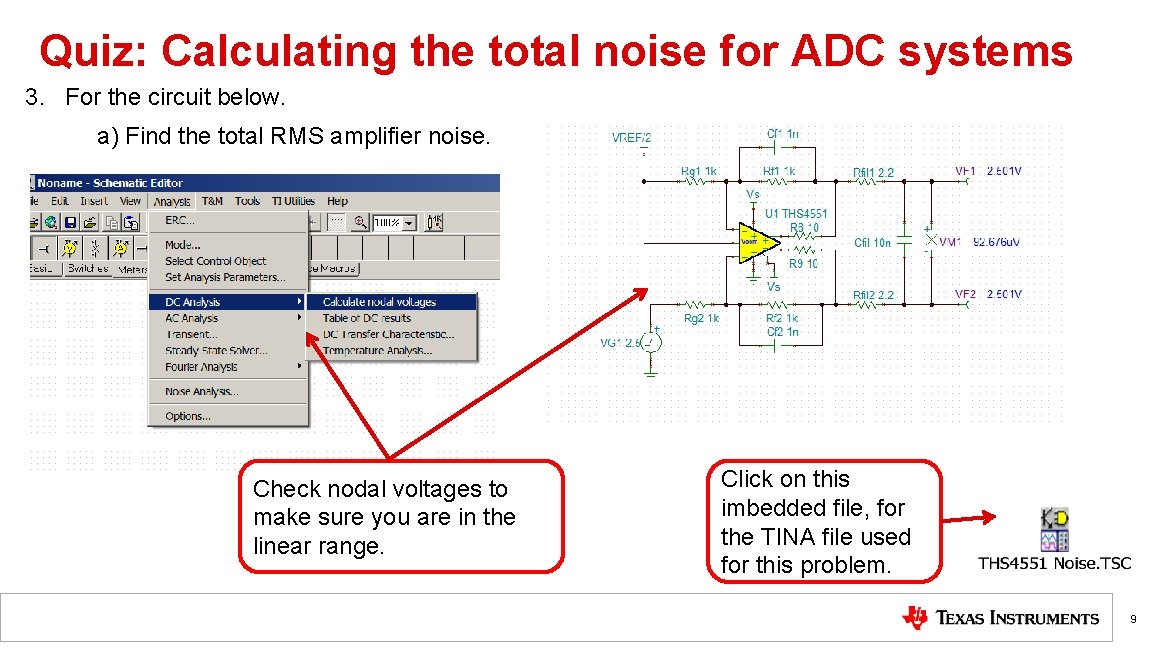
Quiz: Calculating the total noise for ADC systems 3. For the circuit below. a) Find the total RMS amplifier noise. b) Find the total RMS reference noise. c) Calculate the total ADC Noise in microvolts RMS. d) Find the total RMS system noise. 4
Solutions 5
Quiz: Calculating the total noise for ADC systems 1. The histogram below was measured with a data converter: a) What is the RMS noise voltage? ANS: 85. 83µV rms b) Assume the output is averaged using a 8 point rolling average. What is the averaged noise? ANS: 30. 35µV RMS Noise Voltage FSR = ± 5 V Resolution = 18 Standard Deviation=σ = 2. 25 codes Mean = 29558. 4 Output With 8 point rolling average 6
Quiz: Calculating the total noise for ADC systems 2. For the attached Excel file: a) Graph the raw data, 8 point rolling average, and 128 point rolling average. This graph shows the raw data and the effect of averaging (8 x and 128 x). Click on this embedded file, for the Excel file used for this problem. 7
Quiz: Calculating the total noise for ADC systems 2. For the attached Excel file: b) Calculate RMS noise in codes. c) Calculate RMS noise in volts. Assume FSR = ± 5 V and resolution is 18 bits. d) Compare theoretical to measured averaging. Find Measured Stdev In Excel use “=AVERAGE()” and select the appropriate number of samples. Find Theoretical Stdev Find Stdev in Volts Number Measured Theoretical Stdev in Volts Averages Stdev (measured) -na 8 16 2. 228437 0. 82137 0. 355782 -na 0. 787872 0. 196968 84. 97µV 31. 32µV 13. 57µV Comparing measured vs. theoretical you can see that the measured averaging is not as effective as theory predicted. This is not an uncommon result and is related to fact that the signal is not fully Gaussian; e. g. the signal has some drift with temperature and time. Also, 8
Quiz: Calculating the total noise for ADC systems 3. For the circuit below. a) Find the total RMS amplifier noise. Check nodal voltages to make sure you are in the linear range. Click on this imbedded file, for the TINA file used for this problem. 9
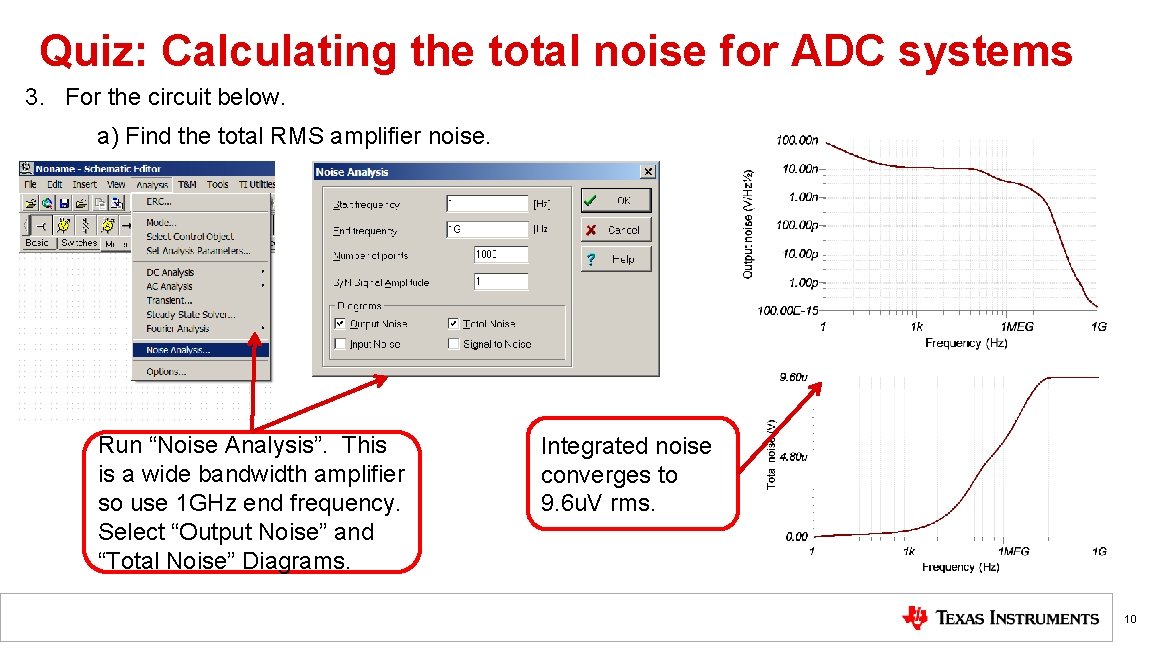
Quiz: Calculating the total noise for ADC systems 3. For the circuit below. a) Find the total RMS amplifier noise. Run “Noise Analysis”. This is a wide bandwidth amplifier so use 1 GHz end frequency. Select “Output Noise” and “Total Noise” Diagrams. Integrated noise converges to 9. 6 u. V rms. 10
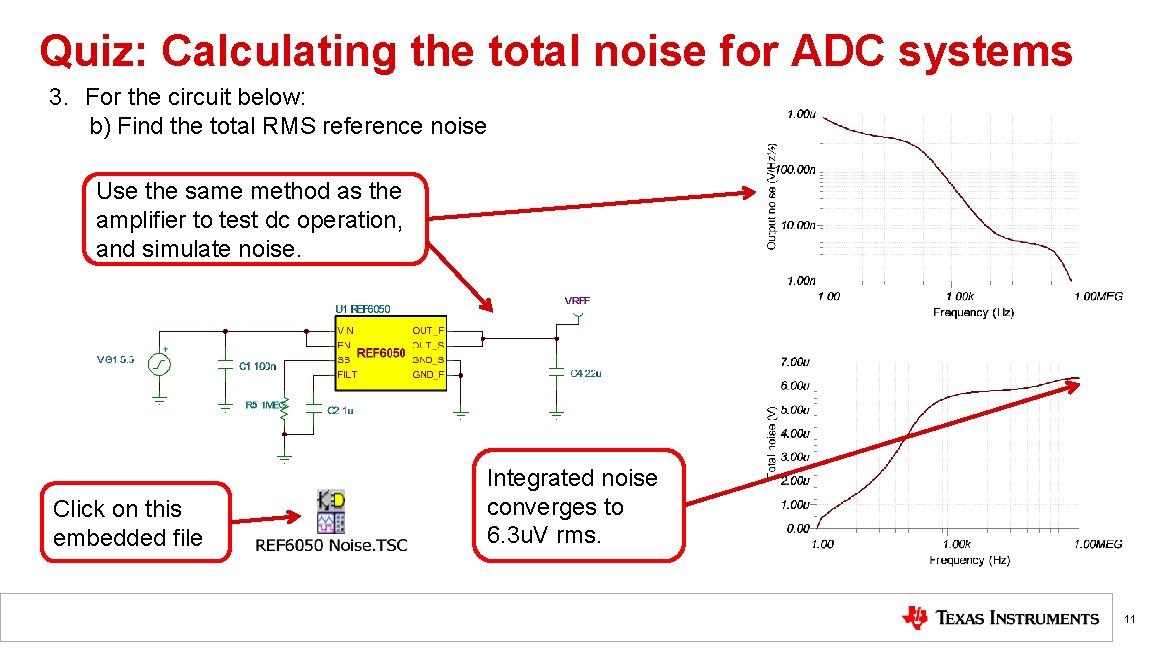
Quiz: Calculating the total noise for ADC systems 3. For the circuit below: b) Find the total RMS reference noise Use the same method as the amplifier to test dc operation, and simulate noise. Click on this embedded file Integrated noise converges to 6. 3 u. V rms. 11
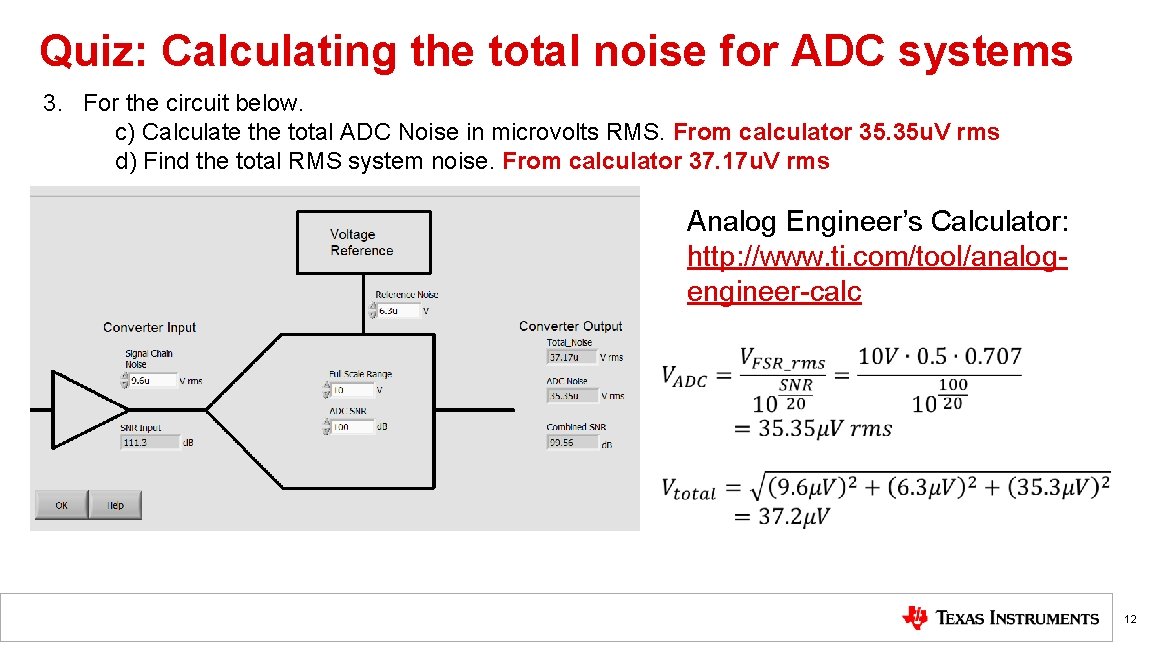
Quiz: Calculating the total noise for ADC systems 3. For the circuit below. c) Calculate the total ADC Noise in microvolts RMS. From calculator 35. 35 u. V rms d) Find the total RMS system noise. From calculator 37. 17 u. V rms Analog Engineer’s Calculator: http: //www. ti. com/tool/analogengineer-calc 12