
QUIZ 3 Calculate the required basic dynamic load
QUIZ 3 Calculate the required basic dynamic load rating, C for a roller bearing to carry a radial load of 2760 N from a shaft rotating at 58. 62 rad/sec that is part of a blower in a manufacturing plant. Design life given is 25 000 hours.
DNT 242 – MACHINE MECHANISM ELEMENTS Chapter 4 FLEXIBLE ELEMENT DRIVE
DNT 242 – MACHINE MECHANISM ELEMENTS v. Describe the basic features of a flexible element drive v Brief about belt drive system and several types of belt drives, applications, selecting belt and belt friction. v Brief about chain and chain style.
Chapter 4: FLEXIBLE ELEMENT DRIVE INTRODUCTION q Belts and chains are the major types of flexible power transmission elements. q Belts operate on sheaves or pulleys, whereas chains operate on toothed wheels called sprockets.
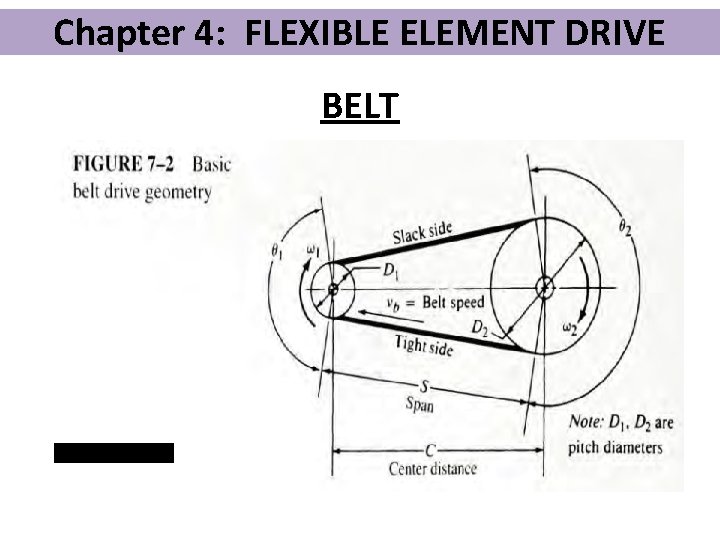
Chapter 4: FLEXIBLE ELEMENT DRIVE BELT • A belt is a flexible power transmission element that seats tightly on a set of pulleys or sheaves. • When the belt is used for speed reduction, the typical case, the smaller sheave is mounted on the high-speed shaft, such as the shaft of an electric motor. • The larger sheave is mounted on the driven machine. • The belt is designed to ride around the two sheaves without slipping.
Chapter 4: FLEXIBLE ELEMENT DRIVE BELT • The belt is installed by placing it around the two sheaves while the centre distance between them is reduced. • Then the sheaves are moved apart, placing the belt in a rather high initial tension. When the belt is transmitting power, friction causes the belt to grip the driving sheave, increasing the tension in one side, called the "tight side, " of the drive.
Chapter 4: FLEXIBLE ELEMENT DRIVE BELT • The tensile force in the belt exerts a tangential force on the driven sheave, and thus a torque is applied to the driven shaft. • The opposite side of the belt is still under tension, but at a smaller value. Thus, it is called the "slack side. "
Chapter 4: FLEXIBLE ELEMENT DRIVE BELT
Chapter 4: FLEXIBLE ELEMENT DRIVE TYPES OF BELTS • Flat belts • Grooved or cogged belts • Standard V-belts • Double-angle V-belts • Others
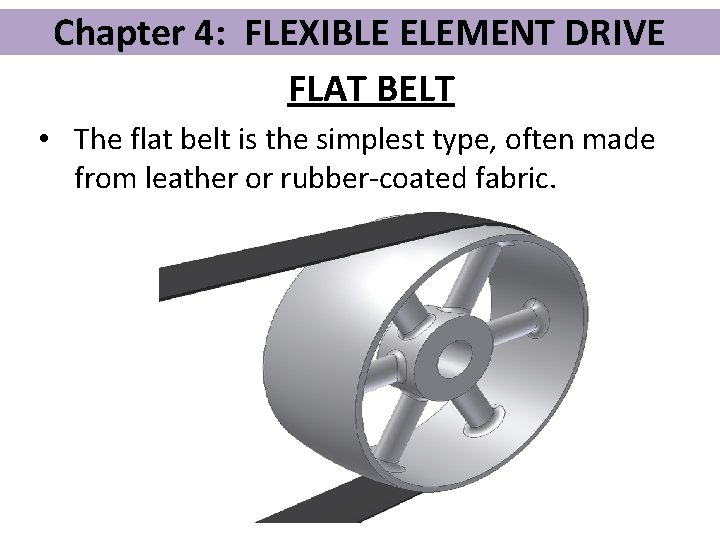
Chapter 4: FLEXIBLE ELEMENT DRIVE FLAT BELT • The flat belt is the simplest type, often made from leather or rubber-coated fabric.
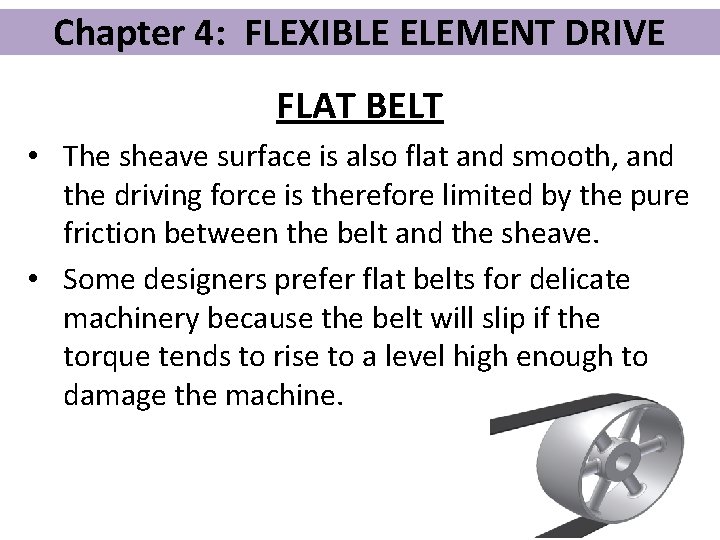
Chapter 4: FLEXIBLE ELEMENT DRIVE FLAT BELT • The sheave surface is also flat and smooth, and the driving force is therefore limited by the pure friction between the belt and the sheave. • Some designers prefer flat belts for delicate machinery because the belt will slip if the torque tends to rise to a level high enough to damage the machine.
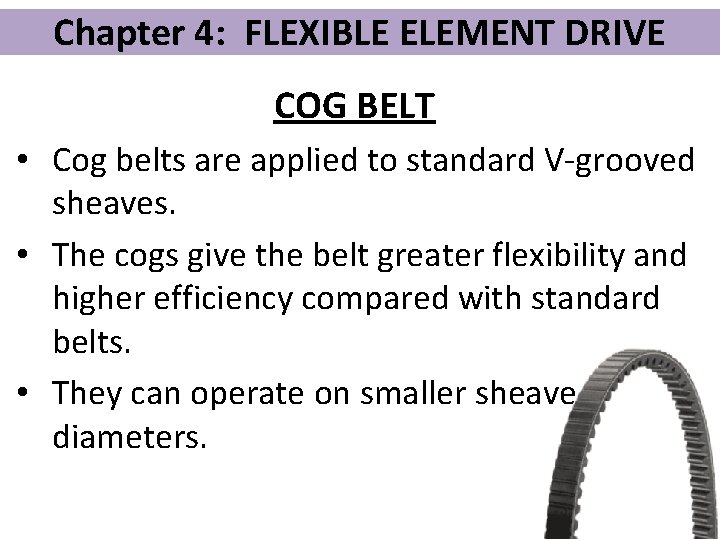
Chapter 4: FLEXIBLE ELEMENT DRIVE COG BELT • Cog belts are applied to standard V-grooved sheaves. • The cogs give the belt greater flexibility and higher efficiency compared with standard belts. • They can operate on smaller sheave diameters.
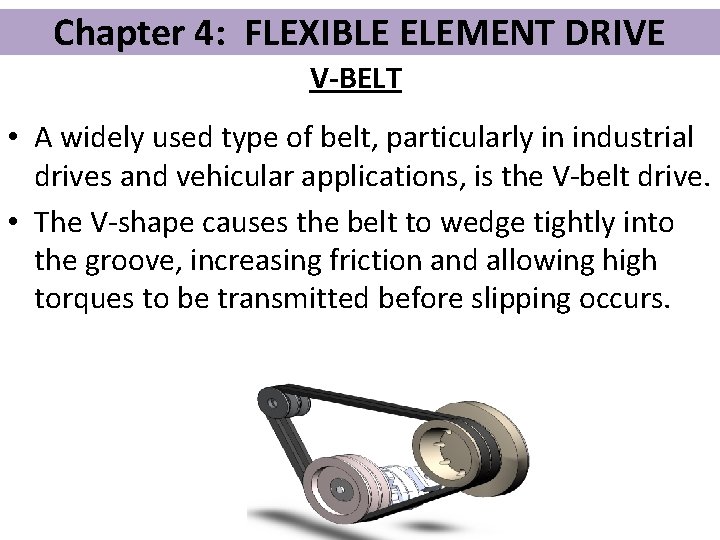
Chapter 4: FLEXIBLE ELEMENT DRIVE V-BELT • A widely used type of belt, particularly in industrial drives and vehicular applications, is the V-belt drive. • The V-shape causes the belt to wedge tightly into the groove, increasing friction and allowing high torques to be transmitted before slipping occurs.
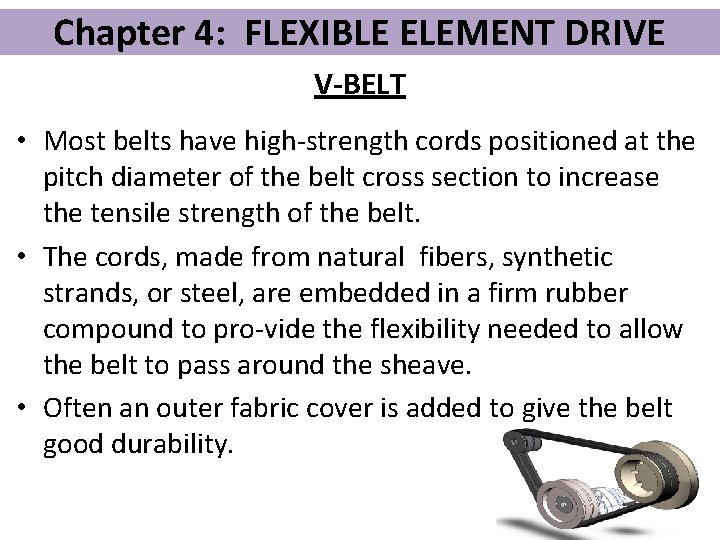
Chapter 4: FLEXIBLE ELEMENT DRIVE V-BELT • Most belts have high-strength cords positioned at the pitch diameter of the belt cross section to increase the tensile strength of the belt. • The cords, made from natural fibers, synthetic strands, or steel, are embedded in a firm rubber compound to pro-vide the flexibility needed to allow the belt to pass around the sheave. • Often an outer fabric cover is added to give the belt good durability.
Chapter 4: FLEXIBLE ELEMENT DRIVE § § Belt Tension The initial tension given to a belt is critical because it ensures that the belt will not slip under the design load. At rest, die two sides of the belt have the same tension. As power is being transmitted, the tension in the tight side increases while the tension in the slack side decreases. Without the initial tension, the slack side would go totally loose, and the belt would not seat in the groove; thus, it would slip.
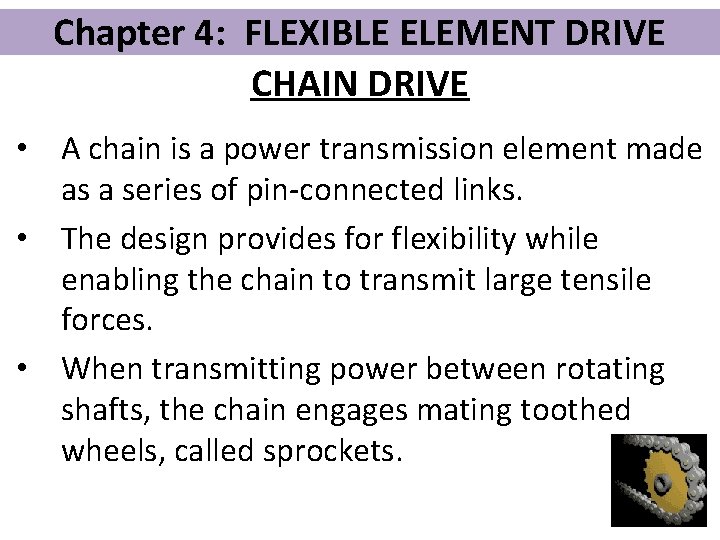
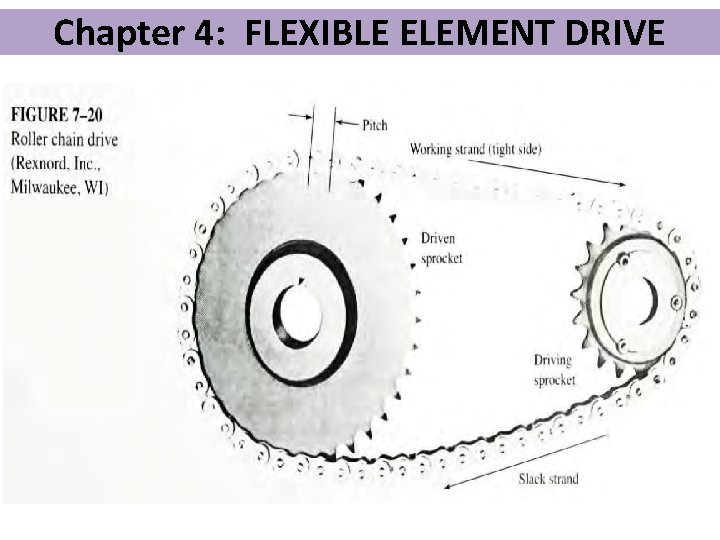
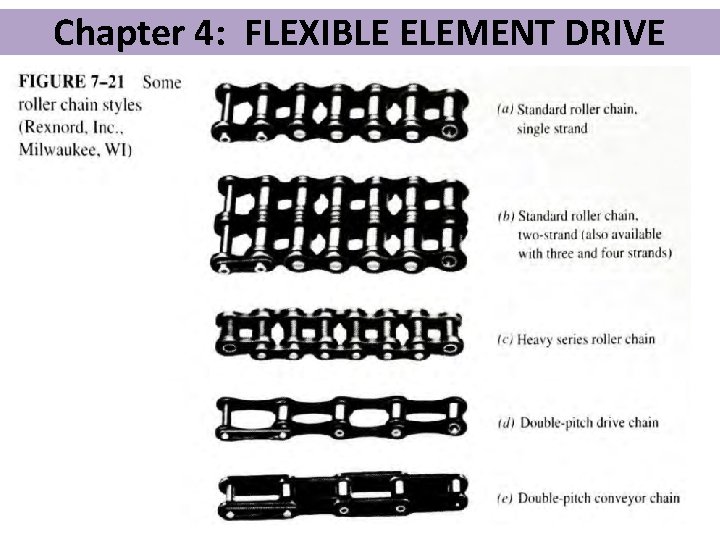
Chapter 4: FLEXIBLE ELEMENT DRIVE CHAIN DRIVE • A chain is a power transmission element made as a series of pin-connected links. • The design provides for flexibility while enabling the chain to transmit large tensile forces. • When transmitting power between rotating shafts, the chain engages mating toothed wheels, called sprockets.
Chapter 4: FLEXIBLE ELEMENT DRIVE
Chapter 4: FLEXIBLE ELEMENT DRIVE Objectives

THANK YOU
GROUP ASSESMENT #3 (1) FLAT BELT - GROUP 3 (2) COG BELT - GROUP 5 (3) V-BELT - GROUP 12 (4) CHAIN - GROUP 16 • Brief explain about the belt / chain • Application of the belt / chain • Figure / sketching of belt / chain
- Slides: 20