
Quiz 12 Keq calculations and ICE charts May
- Slides: 13
Quiz #12: Keq calculations and ICE charts May 2016
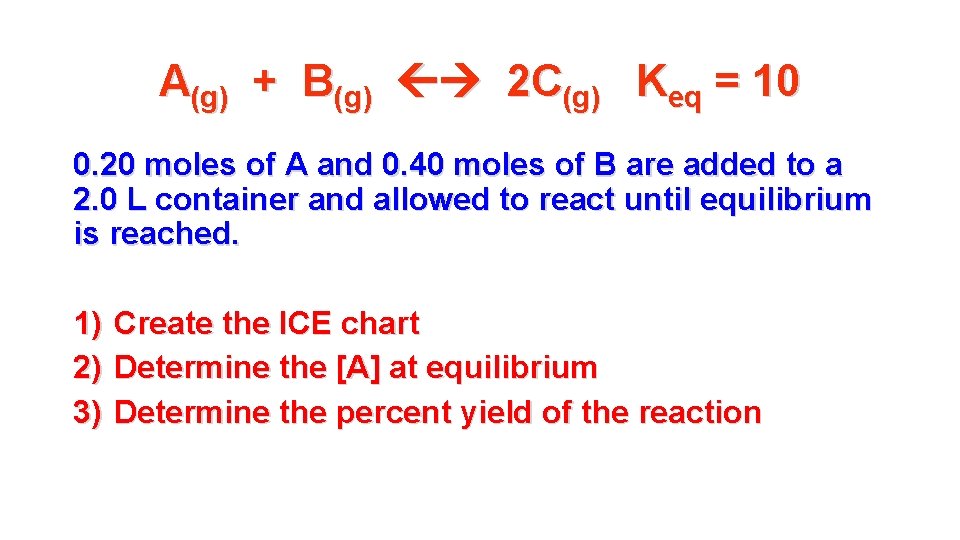
A(g) + B(g) 2 C(g) Keq = 10 0. 20 moles of A and 0. 40 moles of B are added to a 2. 0 L container and allowed to react until equilibrium is reached. 1) 2) 3) Create the ICE chart Determine the [A] at equilibrium Determine the percent yield of the reaction
Quiz #12: Keq calculations and ICE charts. Rewrite May 2016
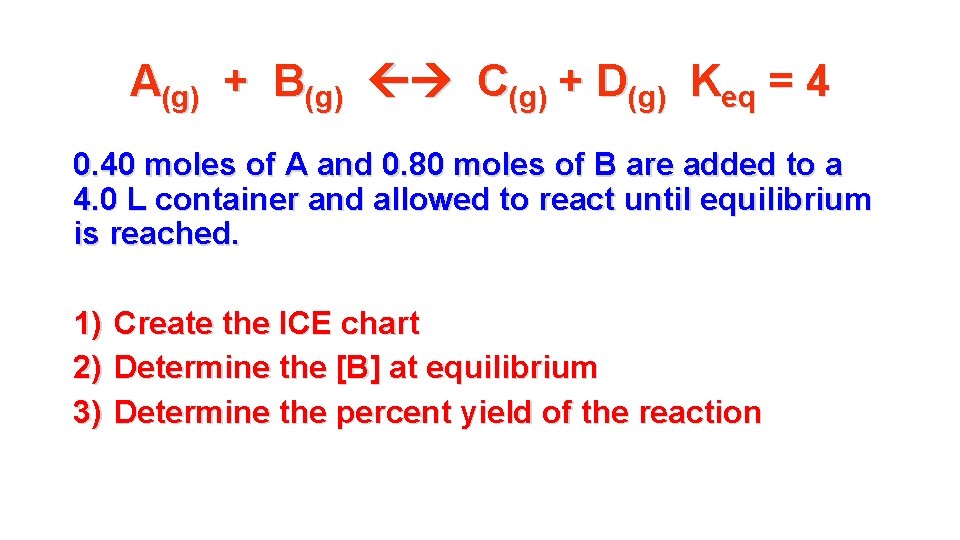
A(g) + B(g) C(g) + D(g) Keq = 4 0. 40 moles of A and 0. 80 moles of B are added to a 4. 0 L container and allowed to react until equilibrium is reached. 1) 2) 3) Create the ICE chart Determine the [B] at equilibrium Determine the percent yield of the reaction
Quiz #13: Q May 2016
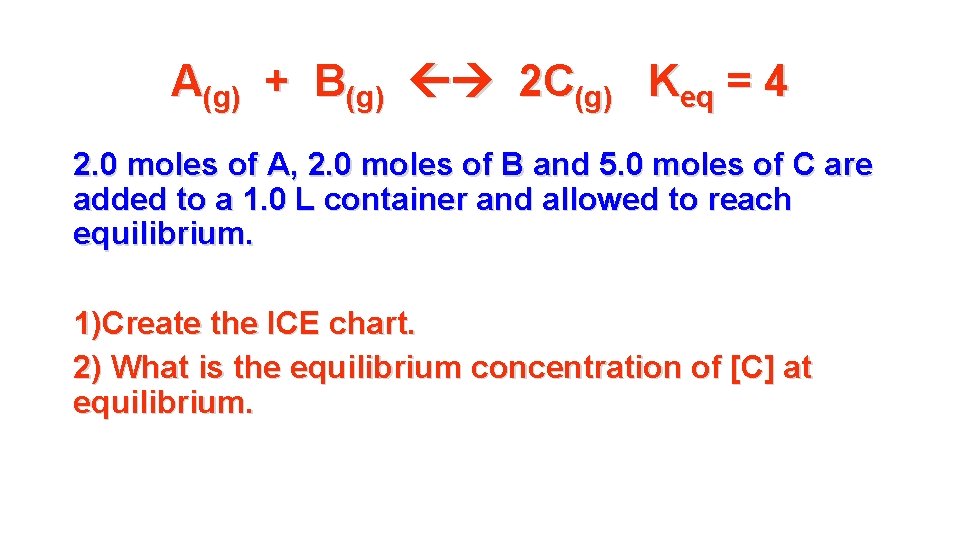
A(g) + B(g) 2 C(g) Keq = 4 2. 0 moles of A, 2. 0 moles of B and 5. 0 moles of C are added to a 1. 0 L container and allowed to reach equilibrium. 1)Create the ICE chart. 2) What is the equilibrium concentration of [C] at equilibrium.
Quiz #14: Le. Chatelier’s Principle May 2016
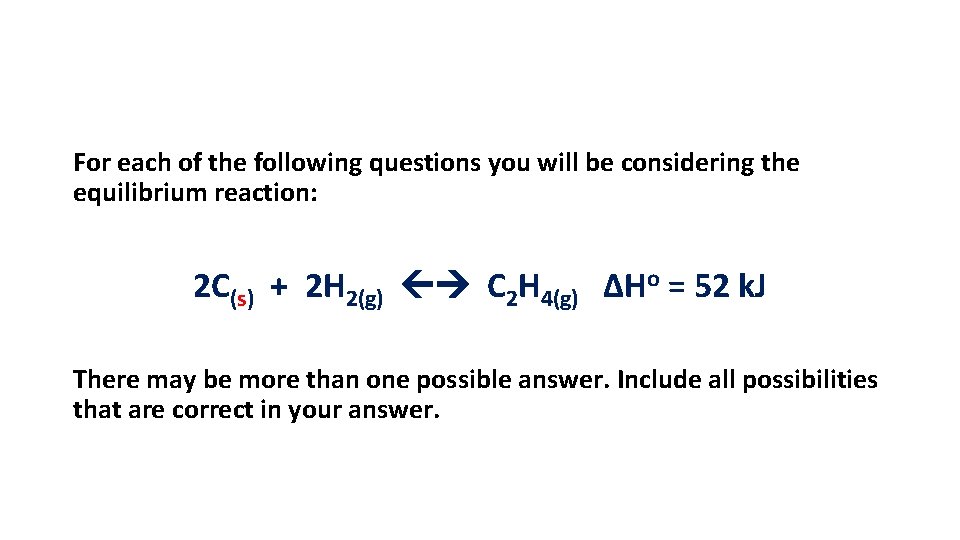
For each of the following questions you will be considering the equilibrium reaction: 2 C(s) + 2 H 2(g) C 2 H 4(g) ΔHo = 52 k. J There may be more than one possible answer. Include all possibilities that are correct in your answer.
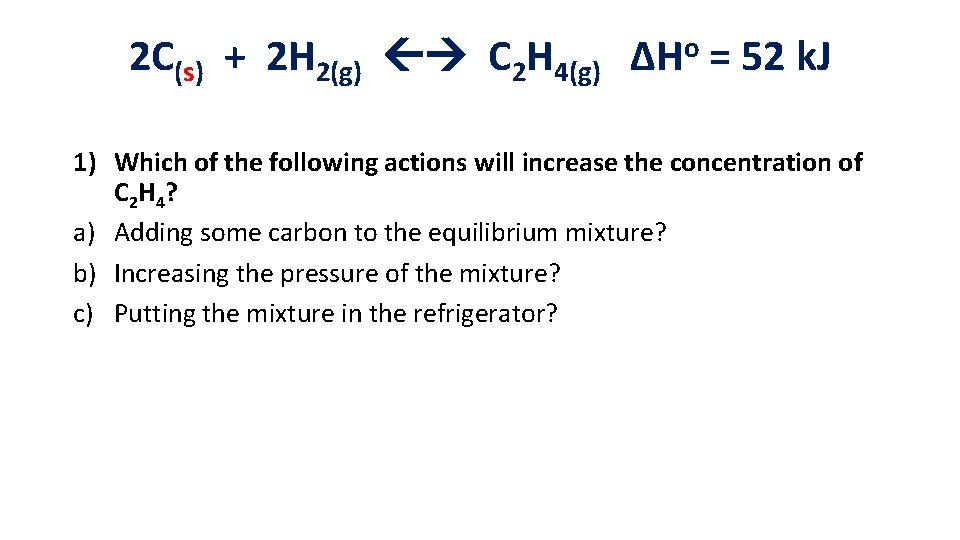
2 C(s) + 2 H 2(g) C 2 H 4(g) ΔHo = 52 k. J 1) Which of the following actions will increase the concentration of C 2 H 4 ? a) Adding some carbon to the equilibrium mixture? b) Increasing the pressure of the mixture? c) Putting the mixture in the refrigerator?
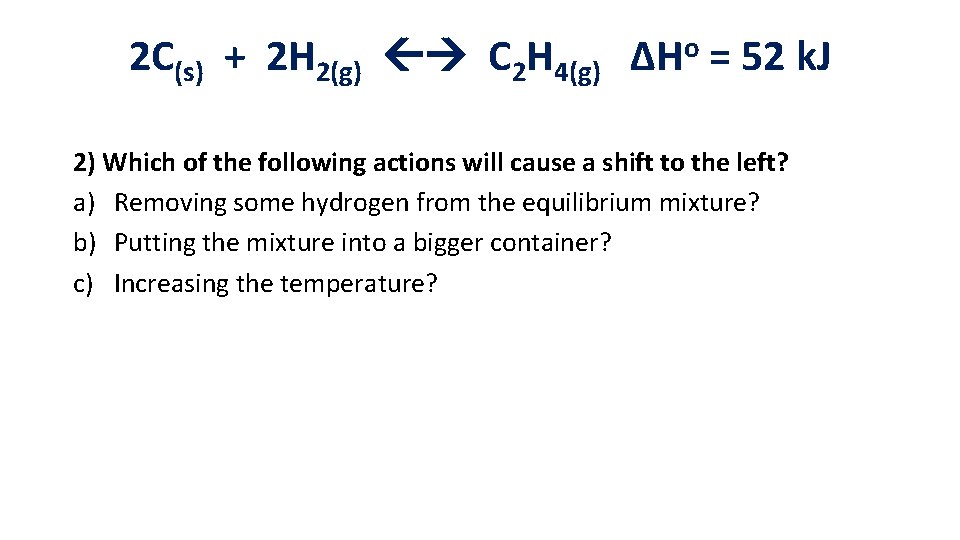
2 C(s) + 2 H 2(g) C 2 H 4(g) ΔHo = 52 k. J 2) Which of the following actions will cause a shift to the left? a) Removing some hydrogen from the equilibrium mixture? b) Putting the mixture into a bigger container? c) Increasing the temperature?
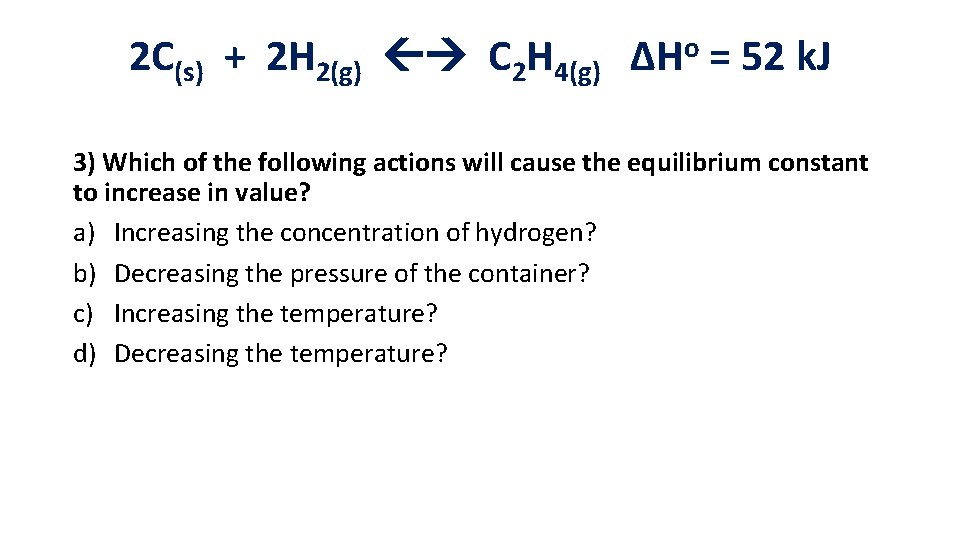
2 C(s) + 2 H 2(g) C 2 H 4(g) ΔHo = 52 k. J 3) Which of the following actions will cause the equilibrium constant to increase in value? a) Increasing the concentration of hydrogen? b) Decreasing the pressure of the container? c) Increasing the temperature? d) Decreasing the temperature?
Quiz #15: Calculations using Le. Chatelier’s Principle May 2016
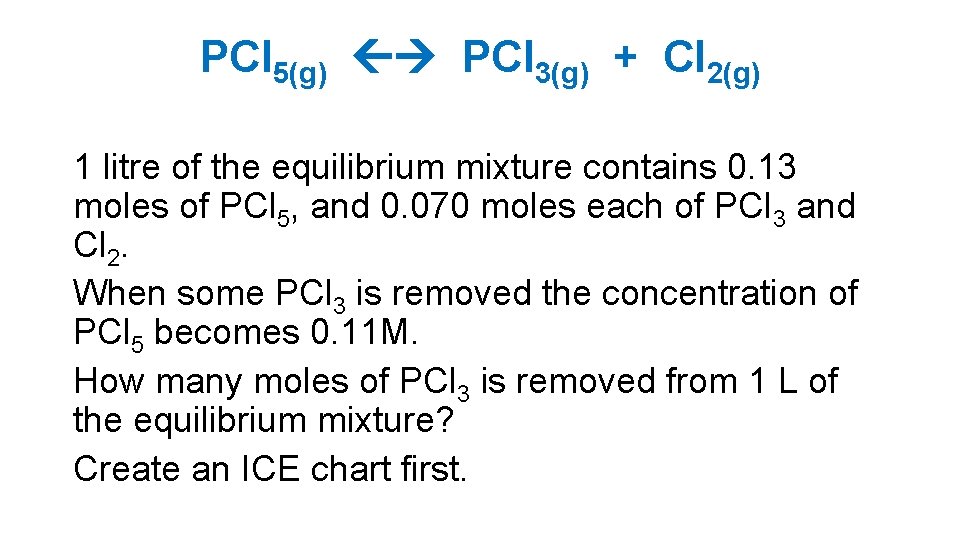
PCl 5(g) PCl 3(g) + Cl 2(g) 1 litre of the equilibrium mixture contains 0. 13 moles of PCl 5, and 0. 070 moles each of PCl 3 and Cl 2. When some PCl 3 is removed the concentration of PCl 5 becomes 0. 11 M. How many moles of PCl 3 is removed from 1 L of the equilibrium mixture? Create an ICE chart first.