
Quiz 1 What sound localization technique do people
![Pilot Test Design • Auditory Stimuli • “[N]on-contextual pair of sentences… spoken by one](https://slidetodoc.com/presentation_image_h2/64a28818fead4b0c5e327070424377e1/image-21.jpg "Pilot Test Design • Auditory Stimuli • “[N]on-contextual pair of sentences… spoken by one")


- Slides: 29
Quiz 1. What sound localization technique do people use to segregate between auditory information? (a) Cuboid Space Differentiation (b) Auditory Super-Normal (c) Equidistant Localization (d) Cocktail Party Effect 2. Head Related Transfer Function or HRTF encodes a sound signal to create sound spatialization. HRTF encodes the signal by simulating the parts of one’s body that filter a sound signal. What parts of the body do this task? (a) head, torso, pinnae (i. e. outer part of ears) (b) inner part of ears, nose, throat (c) head, shoulders, knees, toes (d) inner part of ears, nose, head
Quiz 3. What size relation was the visual space in relation to the auditory space? (a) Both are the same size. (b) The visual space is larger than the auditory space. (c) The auditory space is larger than the visual space. (d) This fact was not mentioned in the paper. 4. Which of the stereo spatial stimuli was least correctly recognized? (a) Depth stimuli (b) Elevation (i. e. vertical deviation) stimuli (c) Azimuth (i. e. horizontal deviation) stimuli (d) Another stimuli not mentioned in (a), (b), or (c)
Mapping an Auditory Space onto a Graphical User Interface Michael J. Evans Presented by Allan Spale EECS 578
Information Presentation • Information presentation typically uses a visual interface • Integration of audio to convey information on the desktop computer • GUI-based file system actions • Speech audio • Teleconferencing and videoconferencing • Computer games
Potential Benefits of Spatial Audio Reproduction • Sound localization plays a role in choosing which audio to listen to • Cocktail Party Effect • Spatial hearing in noisy environments • Applications that could use spatialized sound • Operating system GUIs • Teleconferencing • Interfaces for the blind
System Infrastructure • Model audio signal using Head-Related Transfer Function (HRTF) • Simulates how a person filters audio using the head, torso, and pinnae • Use frontally-placed loudspeakers • Should cancel left-right crosstalk • Keep the user sitting still in an “ideal” area for obtaining sound spatialization
Problems with the Proposed System Infrastructure • Small head movements may disrupt perception of spatial audio • Limited to use by one listener • HRTF measurements • Time-consuming • Requires anechoic chamber • Accurate calculations of azimuth and elevation • HRTFs vary according to an individual
Visual and Auditory Space • Visual Implementation • 15 -inch monitor • Visible display: 0. 28 x 0. 21 meters • Visual space (approx. ): “ 12 above and below horizontal plane and 16 on either side of the median plane”
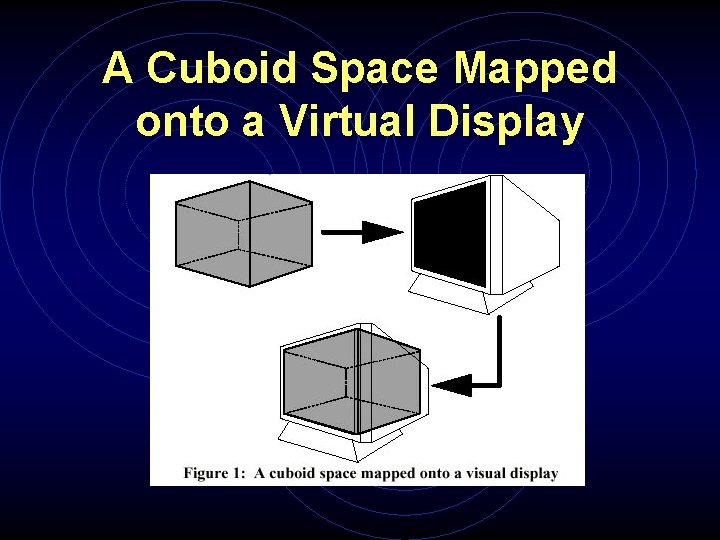
Visual and Auditory Space • Visual Implementation • Virtual cuboid space for subjective depth perception • Resizing items similar to bringing items nearer to or farther away from the user • Active items will be nearest to the user • GUI items can be moved within the cuboid
A Cuboid Space Mapped onto a Virtual Display
Visual and Auditory Space • Audio Implementation • Continuous transaural algorithm • “JBL loudspeakers placed 30 either side of the center of the monitor” • Auditory space mapped on visual cuboid • “[S]ound pressure level has an inverse-square relationship with increasing distance”
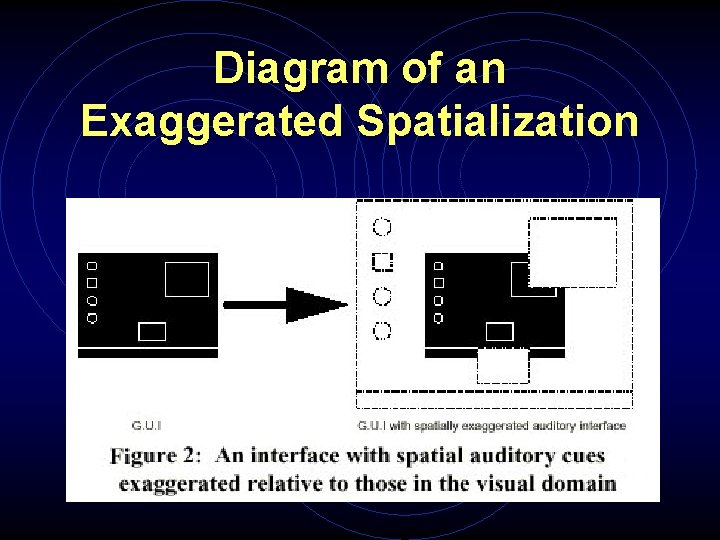
Exaggerated Spatialization • People have a greater auditory acuity than visual acuity • Map display onto an exaggerated auditory space • Benefits of exaggerated spatialization • Permit users to experience a greater range of the intended spatial effect
Diagram of an Exaggerated Spatialization
Problems with Visual and Auditory Conflicts • Large differences in spatial mismatch has user perceive separate events • People are able to tolerate some directional disparity • Conflicts of audio and visual items usually are resolved with considering the location of the visual stimulus
Pilot Test Design • Goal • Perceptual tests will attempt to confirm that “visual and auditory interfaces remain congruent to users, even when the auditory interface space is exaggerated. ”
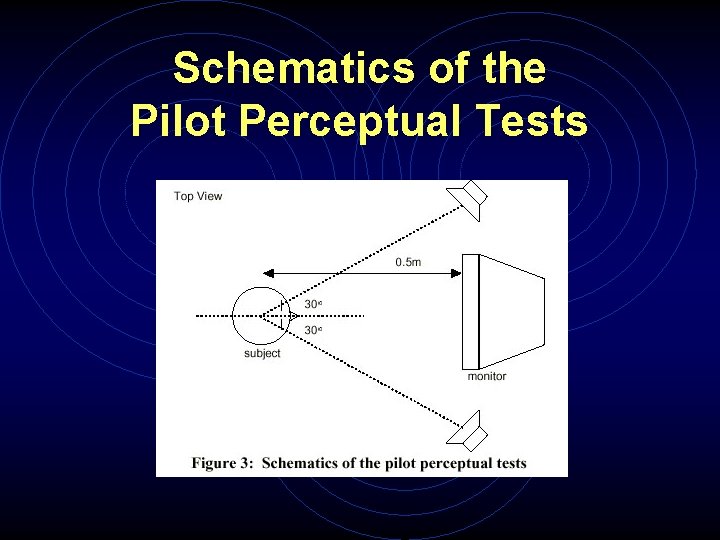
Pilot Test Design • Testing subject • Sat in chair 0. 5 meter away directly facing the screen • Adjustable floor stands hold speakers • Tilted at 30 in relation to the user head’s median plane • Visual area • 0. 28 x 0. 21 meters; ± 16 azimuth, ± 12 elevation • Auditory area (2 x visual area) • 0. 56 x 0. 42 meters; ± 32 azimuth, ± 24 elevation
Schematics of the Pilot Perceptual Tests
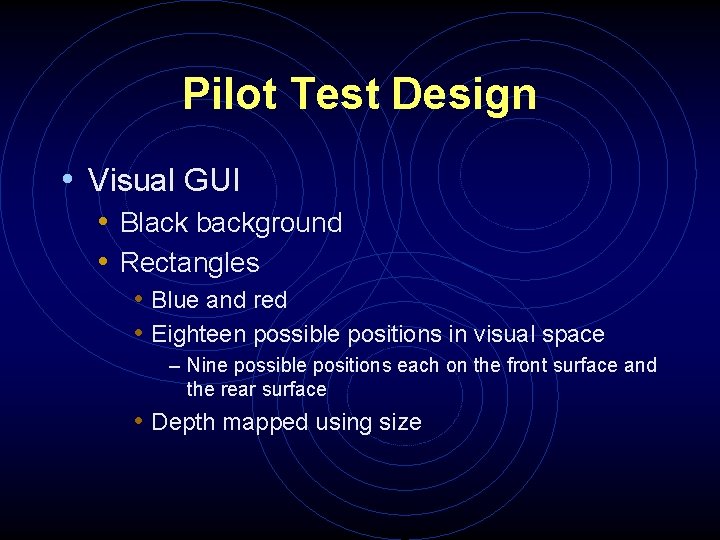
Pilot Test Design • Visual GUI • Black background • Rectangles • Blue and red • Eighteen possible positions in visual space – Nine possible positions each on the front surface and the rear surface • Depth mapped using size
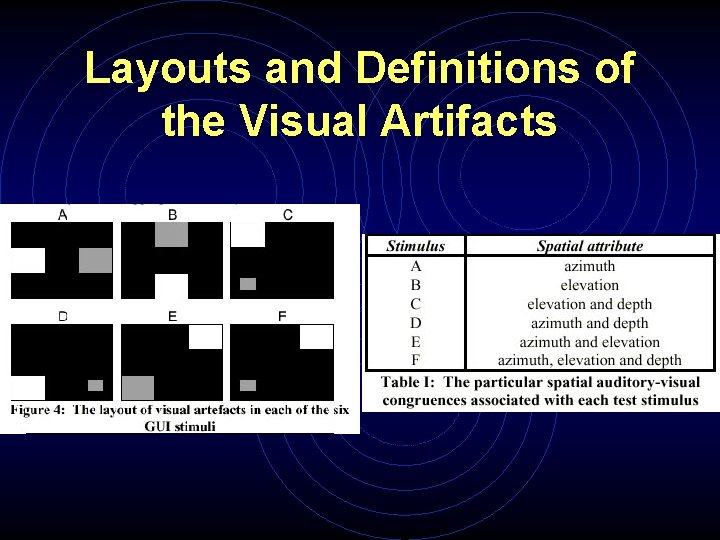
Pilot Test Design • Visual Stimuli • Twelve in total with each containing a red rectangle and a blue rectangle • Six specifued layouts • “[C]hosen to present extremes of variation in each dimension and the combination of dimensions. ”
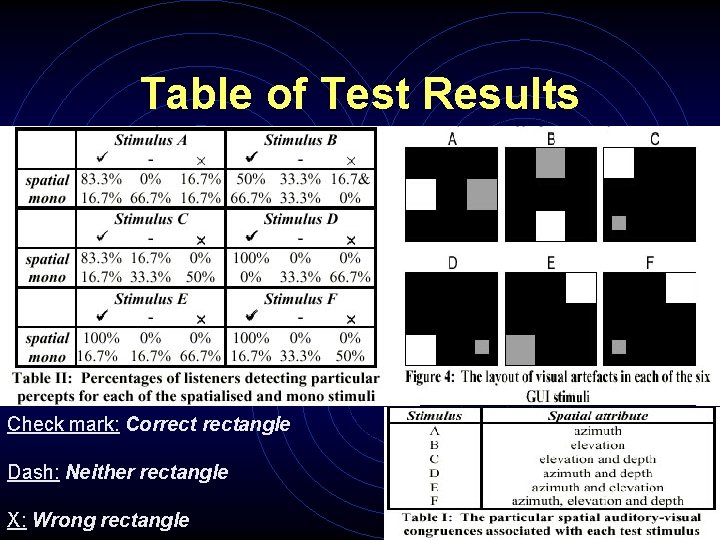
Layouts and Definitions of the Visual Artifacts
Pilot Test Design • Auditory Stimuli • “[N]on-contextual pair of sentences… spoken by one of four talkers. . . ” • Six sentence pairs associated with A’ through F’ produced non-spatialized sounds • Six sentence pairs associated with A through F for produced spatialized sounds • Rectangle usage • Subject had to indicate where the sound was originating, which rectangle or no rectangle at all
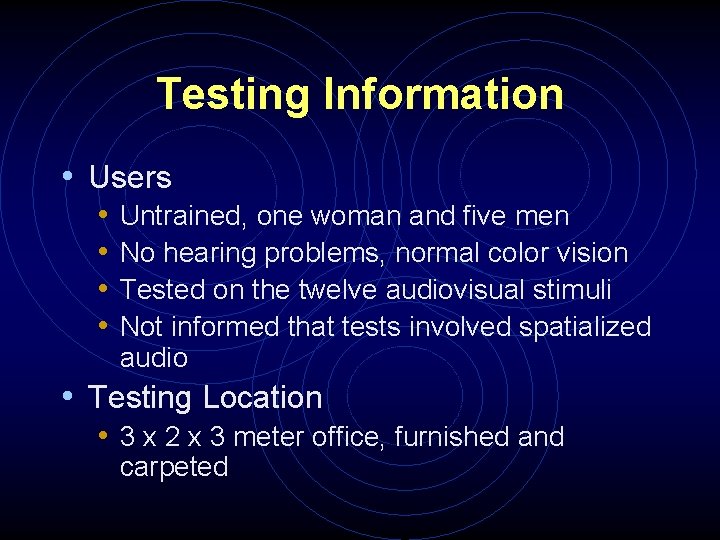
Testing Information • Users • • Untrained, one woman and five men No hearing problems, normal color vision Tested on the twelve audiovisual stimuli Not informed that tests involved spatialized audio • Testing Location • 3 x 2 x 3 meter office, furnished and carpeted
Table of Test Results Check mark: Correctangle Dash: Neither rectangle X: Wrong rectangle
Discussion of Results • Support exaggerating the auditory interface • Mono references varied greatly among subjects • Stimulus B • Reduced success rate compared to others • Elevation-only stimulus related to individual nature of HRTFs • Stimuli in the median plane are unable to use localization cues from the comparison of left and right ear signals
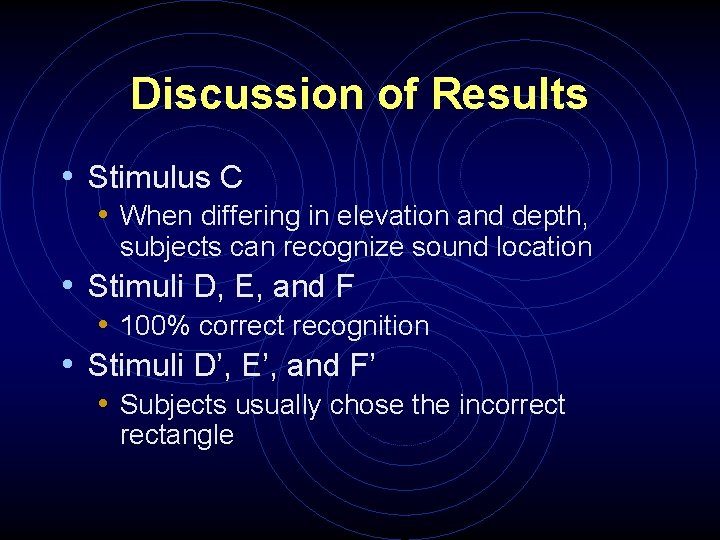
Discussion of Results • Stimulus C • When differing in elevation and depth, subjects can recognize sound location • Stimuli D, E, and F • 100% correct recognition • Stimuli D’, E’, and F’ • Subjects usually chose the incorrectangle
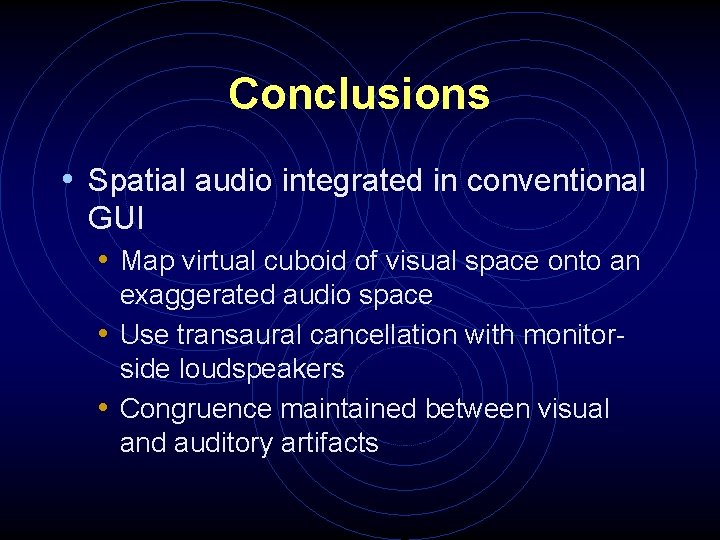
Conclusions • Spatial audio integrated in conventional GUI • Map virtual cuboid of visual space onto an exaggerated audio space • Use transaural cancellation with monitorside loudspeakers • Congruence maintained between visual and auditory artifacts
Conclusions • Problems • Auditory elevation cues are very individualized • More than one artifact in the median plane causes difficulty in sound localization • Future work • Determine limitations of exaggerated auditory interfaces • Use less generalized interfaces • Range of different exaggerated auditory interfaces
Some References Listed in the Paper • Integrating non-speech audio interfaces • Reference 4, 5 • Sound localization in teleconferencing applications • Reference 12 • Transaural technique • Reference 19
Questions and Comments