
QUIT 22 The Vietnam War Years CHAPTER OBJECTIVE
QUIT 22 The Vietnam War Years CHAPTER OBJECTIVE INTERACT WITH HISTORY TIME LINE SECTION 1 Moving Toward Conflict SECTION 2 U. S. Involvement and Escalation SECTION 3 A Nation Divided GRAPH SECTION 4 1968: A Tumultuous Year MAP SECTION 5 The End of the War and Its Legacy VISUAL SUMMARY

HOME 22 The Vietnam War Years CHAPTER OBJECTIVE To understand the military and political events of the Vietnam War in Southeast Asia and its impact on life in the United States
HOME 22 The Vietnam War Years INTERACT WITH HISTORY In 1965, America’s fight against communism has spread to Southeast Asia, where the United States is becoming increasingly involved in another country’s civil war. Unable to claim victory, U. S. generals call for an increase in the number of combat troops. Facing a shortage of volunteers, the president implements a draft. Who should be exempt from the draft? Examine the Issues • Should people who believe the war is wrong be forced to fight? • Should people with special skills be exempt? • How can a draft be made fair?
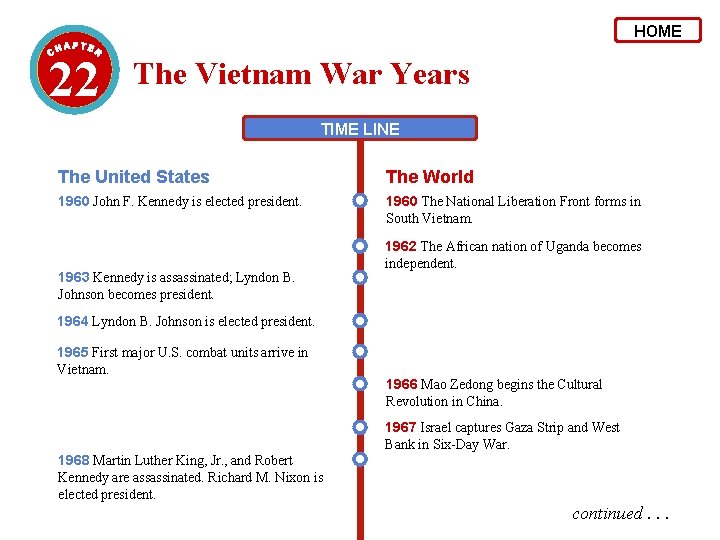
HOME 22 The Vietnam War Years TIME LINE The United States The World 1960 John F. Kennedy is elected president. 1960 The National Liberation Front forms in South Vietnam. 1963 Kennedy is assassinated; Lyndon B. Johnson becomes president. 1962 The African nation of Uganda becomes independent. 1964 Lyndon B. Johnson is elected president. 1965 First major U. S. combat units arrive in Vietnam. 1966 Mao Zedong begins the Cultural Revolution in China. 1967 Israel captures Gaza Strip and West Bank in Six-Day War. 1968 Martin Luther King, Jr. , and Robert Kennedy are assassinated. Richard M. Nixon is elected president. continued. . .
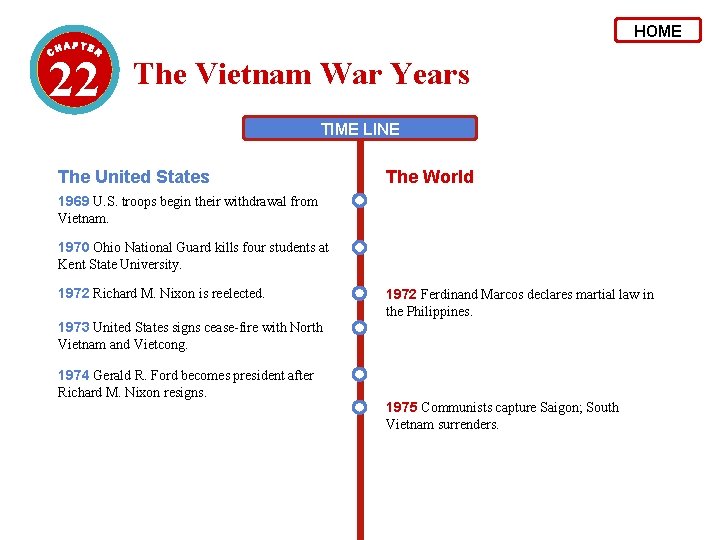
HOME 22 The Vietnam War Years TIME LINE The United States The World 1969 U. S. troops begin their withdrawal from Vietnam. 1970 Ohio National Guard kills four students at Kent State University. 1972 Richard M. Nixon is reelected. 1972 Ferdinand Marcos declares martial law in the Philippines. 1973 United States signs cease-fire with North Vietnam and Vietcong. 1974 Gerald R. Ford becomes president after Richard M. Nixon resigns. 1975 Communists capture Saigon; South Vietnam surrenders.
HOME 1 Moving Toward Conflict KEY IDEA America slowly involves itself in the war in Vietnam as it seeks to halt the spread of communism. OVERVIEW ASSESSMENT
HOME 1 Moving Toward Conflict OVERVIEW MAIN IDEA WHY IT MATTERS NOW To stop the spread of communism in Southeast Asia, the United States used its military to support South Vietnam. The United States’ support role in Vietnam began what would become America’s longest and most controversial war in its history. TERMS & NAMES • Ho Chi Minh • Vietminh • Tonkin Gulf Resolution • Dien Bien Phu • domino theory • Ho Chi Minh Trail • Geneva Accords • Vietcong • Ngo Dinh Diem ASSESSMENT
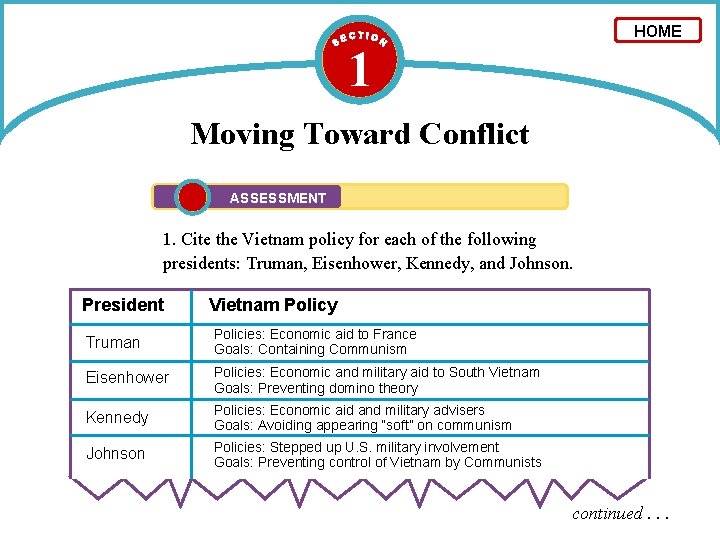
HOME 1 Moving Toward Conflict ASSESSMENT 1. Cite the Vietnam policy for each of the following presidents: Truman, Eisenhower, Kennedy, and Johnson. President Vietnam Policy Truman Policies: Economic aid to France Goals: Containing Communism Eisenhower Policies: Economic and military aid to South Vietnam Goals: Preventing domino theory Kennedy Policies: Economic aid and military advisers Goals: Avoiding appearing “soft” on communism Johnson Policies: Stepped up U. S. military involvement Goals: Preventing control of Vietnam by Communists continued. . .
1 HOME Moving Toward Conflict ASSESSMENT 2. How did the United States become more involved in the war? ANSWER The United States provided France with support when France was trying to reestablish its rule in Vietnam. After the French were forced to surrender, the United States began supplying aid directly to South Vietnam’s non-communist regime. continued. . .
HOME 1 Moving Toward Conflict ASSESSMENT 3. In what ways was America’s support of the Diem government a conflict of interests? ANSWER The Diem government was corrupt and unstable. Diem cancelled elections and attacked Buddhism. Nonetheless, the United States continued to support the regime. continued. . .
1 HOME Moving Toward Conflict ASSESSMENT 4. Do you think Congress was justified in passing the Tonkin Gulf Resolution? Think About: • the questionable report of torpedo attacks on two U. S. destroyers • the powers that the resolution would give the president • the fact that the resolution was not a declaration of war ANSWER Yes–Presidential authority should be broadened in response to emergency situations. No–The circumstances surrounding the North Vietnamese attack were not adequately verified. End of Section 1
HOME 2 U. S. Involvement and Escalation KEY IDEA The United States sends troops to fight in Vietnam, but the war quickly turns into a stalemate. OVERVIEW ASSESSMENT
HOME 2 U. S. Involvement and Escalation OVERVIEW MAIN IDEA WHY IT MATTERS NOW The United States sent troops to fight in Vietnam, but the war quickly turned into a stalemate. Since Vietnam, Americans are more aware of the positive and negative effects of using U. S. troops in foreign conflicts. TERMS & NAMES • William Westmoreland • credibility gap • Robert Mc. Namara • Dean Rusk • Agent Orange • napalm • Army of the Republic of Vietnam (ARVN) • search-and-destroy mission ASSESSMENT
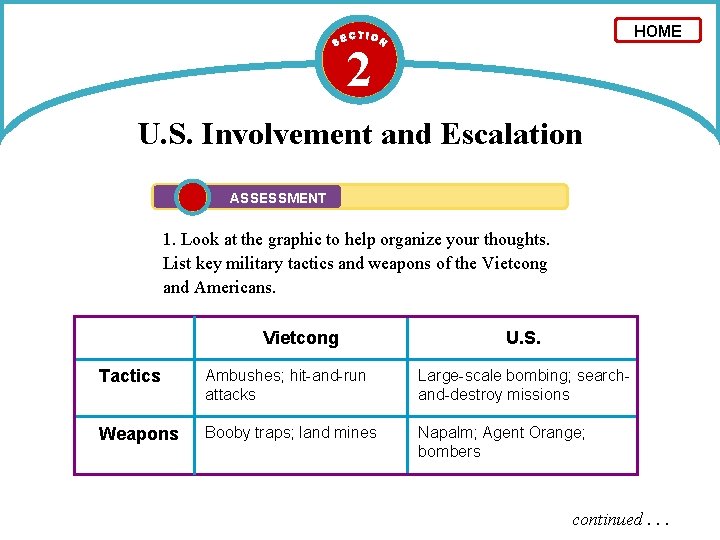
HOME 2 U. S. Involvement and Escalation ASSESSMENT 1. Look at the graphic to help organize your thoughts. List key military tactics and weapons of the Vietcong and Americans. Vietcong U. S. Tactics Ambushes; hit-and-run attacks Large-scale bombing; searchand-destroy missions Weapons Booby traps; land mines Napalm; Agent Orange; bombers continued. . .
HOME 2 U. S. Involvement and Escalation ASSESSMENT 2. Why did Americans fail to win the “hearts and minds” of the Vietnamese? ANSWER Use of napalm and Agent Orange harmed civilians; U. S. search-and-destroy missions uprooted civilians and burned their villages, creating millions of refugees. continued. . .
HOME 2 U. S. Involvement and Escalation ASSESSMENT 3. Contrast the morale of the U. S. troops with that of the Vietcong. ANSWER U. S. troops were frustrated by the jungle terrain of Vietnam, guerilla-style warfare, and by the instability of the South Vietnamese government. The Vietcong were fighting on familiar terrain and were determined to win, whatever the cost. continued. . .
HOME 2 U. S. Involvement and Escalation ASSESSMENT 4. What were the effects of the nightly TV coverage of the Vietnam War? Think About: • television images of Americans in body bags • the Johnson administration’s credibility gap ANSWER Watching the graphic TV images of the Vietnam war caused many Americans to question the war. They began to doubt the Johnson administration’s reports that the enemy was near defeat. End of Section 2
HOME 3 A Nation Divided KEY IDEA An antiwar movement emerges in the United States, pitting those who oppose the government’s war policy against those who support it. OVERVIEW ASSESSMENT
HOME 3 A Nation Divided OVERVIEW MAIN IDEA WHY IT MATTERS NOW An antiwar movement in the U. S. pitted supporters of the government’s war policy against those who opposed it. The painful process of healing a divided nation continues today. TERMS & NAMES • Free Speech Movement • dove • New Left • hawk • Students for a Democratic Society (SDS) • draft ASSESSMENT
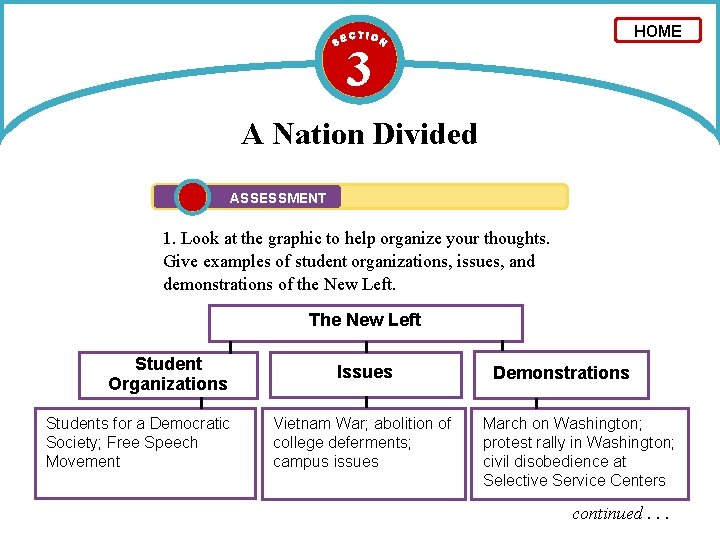
HOME 3 A Nation Divided ASSESSMENT 1. Look at the graphic to help organize your thoughts. Give examples of student organizations, issues, and demonstrations of the New Left. The New Left Student Organizations Students for a Democratic Society; Free Speech Movement Issues Vietnam War; abolition of college deferments; campus issues Demonstrations March on Washington; protest rally in Washington; civil disobedience at Selective Service Centers continued. . .
3 HOME A Nation Divided ASSESSMENT 2. Imagine it is 1967. Do you think you would ally yourself with the hawks or the doves? ANSWER Hawks: The way to win is to increase U. S. military strength. The U. S. must stop the spread of communism. Doves: The U. S. should not fight another country’s war. continued. . .
3 HOME A Nation Divided ASSESSMENT 3. Do you agree that antiwar protests were “acts of disloyalty”? Why or why not? ANSWER Agree: Americans have the patriotic duty to support soldiers fighting for their country; protests demoralized U. S. soldiers and the American public. Disagree: The people condemning the protesters did not examine the reasons for fighting the war; suppressing dissent is undemocratic. End of Section 3

HOME GRAPH 4 1968: A Tumultuous Year KEY IDEA A shocking enemy attack in Vietnam, two assassinations, and a chaotic political convention help make 1968 the most explosive year of the decade. OVERVIEW ASSESSMENT
HOME GRAPH 4 1968: A Tumultuous Year OVERVIEW MAIN IDEA WHY IT MATTERS NOW An enemy attack in Vietnam, two assassinations, and a chaotic political convention made 1968 an explosive year. Disturbing events in 1968 accentuated the nation’s divisions, which are still healing in the 21 st century. TERMS & NAMES • Robert Kennedy • Tet offensive • Eugene Mc. Carthy • George Wallace • Clark Clifford • Hubert Humphrey ASSESSMENT

HOME GRAPH 4 1968: A Tumultuous Year ASSESSMENT 1. Look at the graphic to help organize your thoughts. List five major events that occurred in 1968. Use the months already plotted on the time line below as a guide. January April Tet Offensive August King’s assassination March Johnson’s withdrawal from presidential race Democratic National Convention June Robert Kennedy’s assassination continued. . .
GRAPH 4 HOME 1968: A Tumultuous Year ASSESSMENT 2. Why do you think the Tet offensive turned so many Americans against the war? ANSWER It widened the Johnson administration’s credibility gap and prompted mainstream media to criticize the war. continued. . .
GRAPH 4 HOME 1968: A Tumultuous Year ASSESSMENT 3. What do you think President Johnson meant when he said “If I’ve lost Walter [Cronkite], then it’s over. I’ve lost Mr. Average Citizen”? Explain. ANSWER Johnson believed that once Cronkite took a pessimistic stance on the war, any remaining supporters in the viewing audience would lose faith in Johnson’s Vietnam policy. continued. . .
HOME GRAPH 4 1968: A Tumultuous Year ASSESSMENT 4. Do you think there might have been a relationship between the violence of the Vietnam War and the growing climate of violence in the United States during 1968? ANSWER POSSIBLE RESPONSE: People were angry about U. S. involvement in the war and protests became increasingly violent. Much of the violence in the United States was sparked by the assassinations of King and Robert Kennedy. End of Section 4
HOME MAP 5 The End of the War and Its Legacy KEY IDEA The nation’s longest war ends after nearly ten years and leaves a lasting impact on U. S. policy and American society. OVERVIEW ASSESSMENT
HOME MAP 5 The End of the War and Its Legacy OVERVIEW MAIN IDEA WHY IT MATTERS NOW President Nixon instituted his Vietnamization policy, and America’s longest war finally came to an end. Since Vietnam, the United States considers more carefully the risks to its own interests before intervening in foreign affairs. TERMS & NAMES • Richard Nixon • War Powers Act • Kent State University • Henry Kissinger • silent majority • Pentagon Papers • Vietnamization • My Lai ASSESSMENT
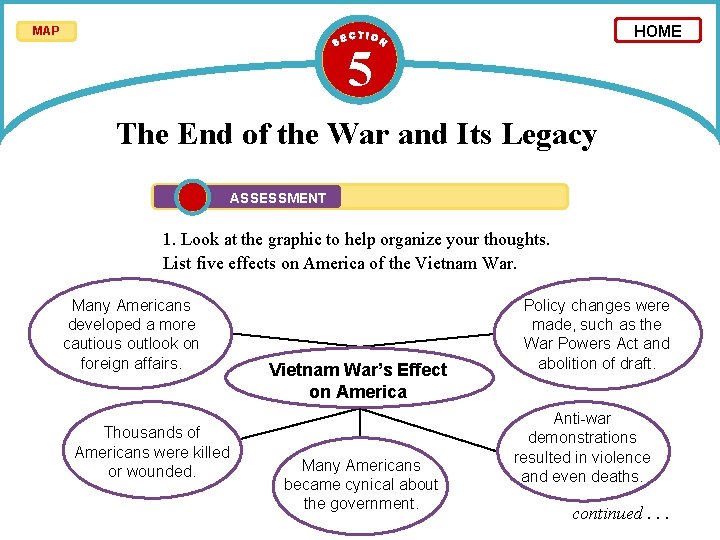
HOME MAP 5 The End of the War and Its Legacy ASSESSMENT 1. Look at the graphic to help organize your thoughts. List five effects on America of the Vietnam War. Many Americans developed a more cautious outlook on foreign affairs. Thousands of Americans were killed or wounded. Vietnam War’s Effect on America Many Americans became cynical about the government. Policy changes were made, such as the War Powers Act and abolition of draft. Anti-war demonstrations resulted in violence and even deaths. continued. . .
HOME MAP 5 The End of the War and Its Legacy ASSESSMENT 2. In your opinion, what was the main effect of the U. S. government’s deception about its policies and military conduct in Vietnam? Think About: • the contents of the Pentagon Papers • Nixon’s secrecy in authorizing military maneuvers ANSWER Americans became increasingly distrustful of the government. Examples include responses to the Pentagon Papers and Congressional repeal of the Gulf of Tonkin Resolution. continued. . .
MAP 5 HOME The End of the War and Its Legacy ASSESSMENT 3. How would you account for the cold homecoming American soldiers received when they returned from Vietnam? ANSWER Some Americans blamed the war’s failure on the soldiers; the My Lai massacre might have tarnished the image of all U. S. soldiers. continued. . .
MAP 5 HOME The End of the War and Its Legacy ASSESSMENT 4. In the end, do you think the United States’ withdrawal from Vietnam was a victory for the United States or a defeat? ANSWER Victory–The United States withdrew on its own terms. U. S. withdrawal curtailed American military and economic losses. Defeat–The United States was unable to claim victory because North Vietnam did not surrender. End of Section 5
- Slides: 34