
Quick Sort COP 3502 Motivation of Sorting Sorting



- Slides: 16
Quick Sort COP 3502
Motivation of Sorting �Sorting algorithms contain interesting and important ideas for code optimization as well as algorithm design.
Merge Sort § Last time we talked about Merge Sort § Recursively calls: Merge. Sort(1 st half of list) Merge. Sort(2 nd half of list) Then Merges results
Quick Sort § This probably the most common sort used in practice, since it is usually the quickest in practice. It uses the idea of a partition, without using an additional array, and recursion to achieve this efficiency.
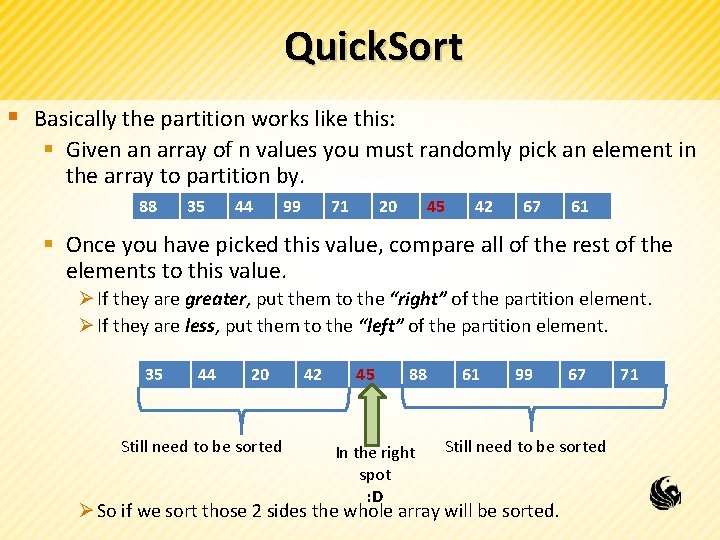
Quick. Sort § Basically the partition works like this: § Given an array of n values you must randomly pick an element in the array to partition by. 88 35 44 99 71 20 45 42 67 61 § Once you have picked this value, compare all of the rest of the elements to this value. Ø If they are greater, put them to the “right” of the partition element. Ø If they are less, put them to the “left” of the partition element. 35 44 20 Still need to be sorted 42 45 88 In the right spot : D 61 99 67 Still need to be sorted Ø So if we sort those 2 sides the whole array will be sorted. 71
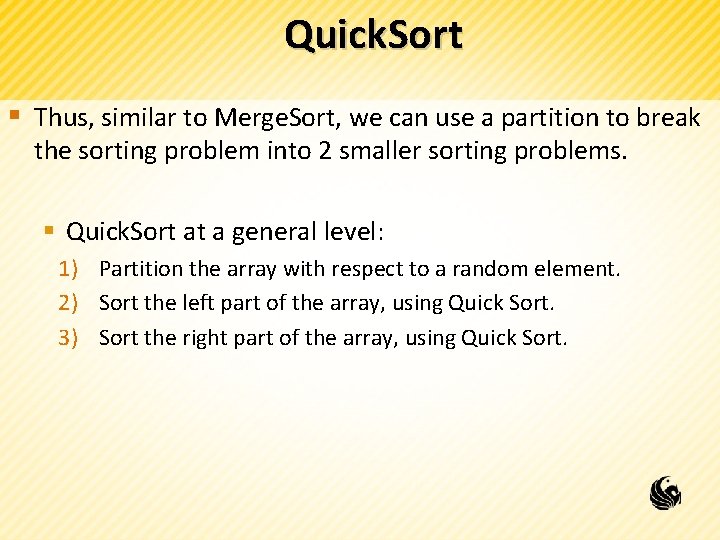
Quick. Sort § Thus, similar to Merge. Sort, we can use a partition to break the sorting problem into 2 smaller sorting problems. § Quick. Sort at a general level: 1) Partition the array with respect to a random element. 2) Sort the left part of the array, using Quick Sort. 3) Sort the right part of the array, using Quick Sort.
Quick. Sort § It should be clear that this algorithm will work § But it may not be clear why it is faster than Merge. Sort. Ø Like Merge. Sort it recursively solves 2 sub problems and requires linear additional work. Ø BUT unlike Merge. Sort the sub problems are NOT guaranteed to be of equal size. § The reason that Quick. Sort is faster is that the partitioning step can actually be performed in place and very efficiently. Ø This efficiency can more than make up for the lack of equal sized recursive calls.
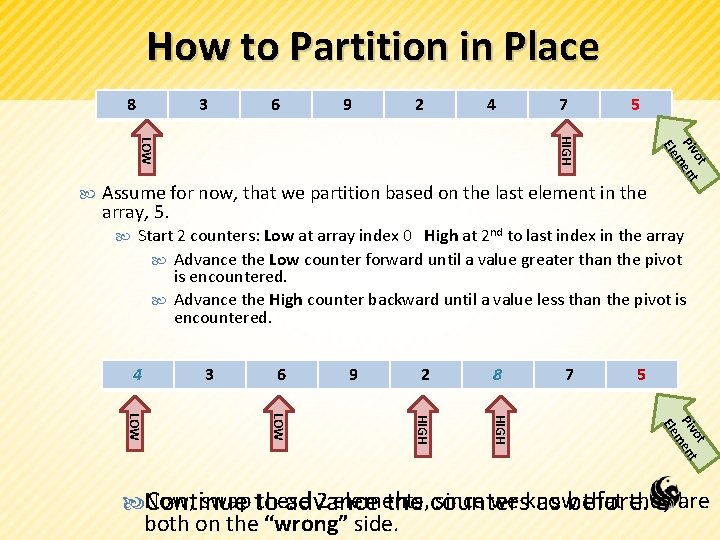
How to Partition in Place 8 3 6 9 2 4 5 Assume for now, that we partition based on the last element in the array, 5. ot Piv ent m Ele HIGH LOW 7 Start 2 counters: Low at array index 0 High at 2 nd to last index in the array Advance the Low counter forward until a value greater than the pivot is encountered. Advance the High counter backward until a value less than the pivot is encountered. 6 9 4 8 7 5 ot Piv ent m Ele LOW 2 HIGH 3 HIGH 8 4 swap to these 2 elements, since we know that they are Now, Continue advance the counters as before. both on the “wrong” side.
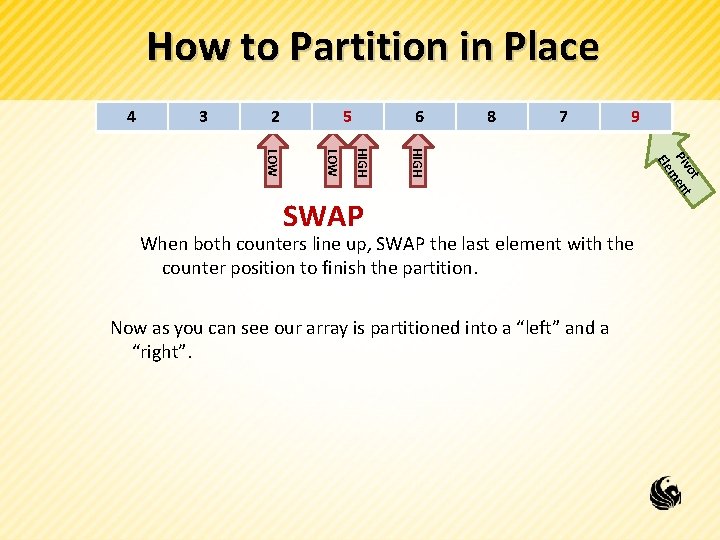
How to Partition in Place 4 3 26 9 5 62 8 7 5 9 When both counters line up, SWAP the last element with the counter position to finish the partition. Now as you can see our array is partitioned into a “left” and a “right”. ot Piv ent m Ele HIGH LOW SWAP
Picking the Pivot § Although the Partition algorithm works no matter which element is chosen as the pivot, some choices are better than others. § Wrong Choice: ØJust use the first element in the list – If the input is random, this is acceptable. – BUT, what if the list is already sorted or in reverse order? » Then all the elements go into S 1 or S 2, consistently throughout recursive calls. – So it would take O(n 2) to do nothing at all! (If presorted) » EMBARRASSING!
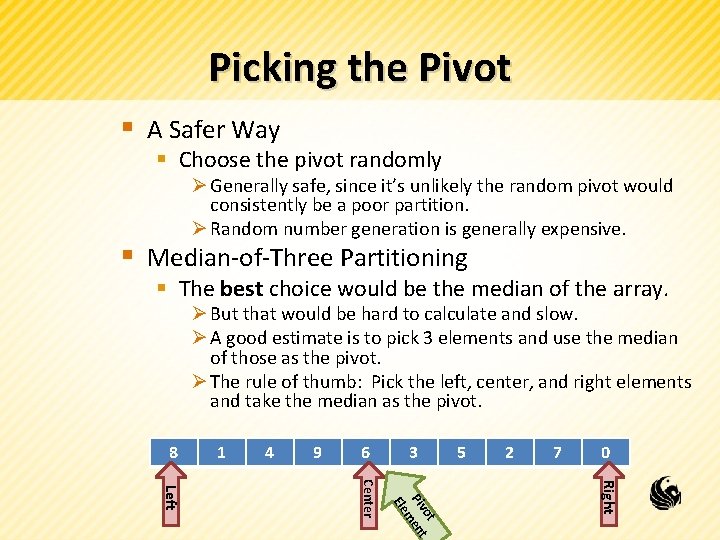
Picking the Pivot § A Safer Way § Choose the pivot randomly Ø Generally safe, since it’s unlikely the random pivot would consistently be a poor partition. Ø Random number generation is generally expensive. § Median-of-Three Partitioning § The best choice would be the median of the array. Ø But that would be hard to calculate and slow. Ø A good estimate is to pick 3 elements and use the median of those as the pivot. Ø The rule of thumb: Pick the left, center, and right elements and take the median as the pivot. 8 1 4 9 6 3 5 2 7 0 Right ot Piv ent m Ele Center Left
Analysis of Quicksort § Shown on the board
Quickselect § Given an array of n elements, determine the kth smallest element. § Clearly k must lie in between 1 and n inclusive § The selection problem is different, but related to the sorting problem.
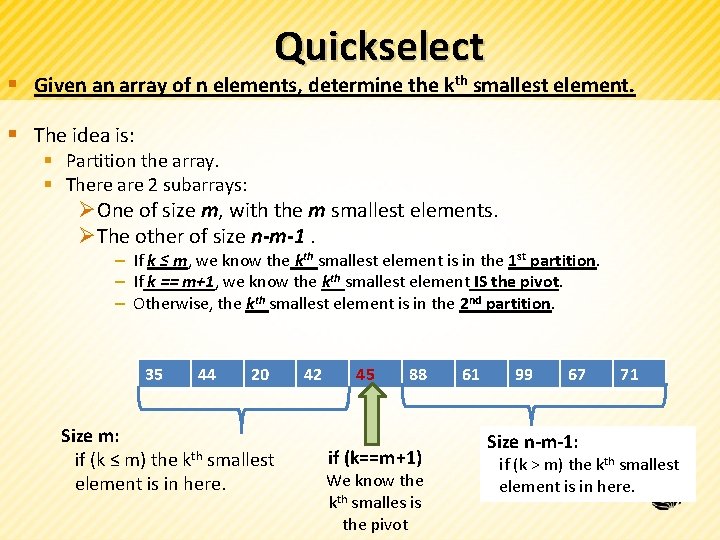
Quickselect § Given an array of n elements, determine the kth smallest element. § The idea is: § Partition the array. § There are 2 subarrays: ØOne of size m, with the m smallest elements. ØThe other of size n-m-1. – If k ≤ m, we know the kth smallest element is in the 1 st partition. – If k == m+1, we know the kth smallest element IS the pivot. – Otherwise, the kth smallest element is in the 2 nd partition. 35 44 20 Size m: if (k ≤ m) the kth smallest element is in here. 42 45 88 if (k==m+1) We know the kth smalles is the pivot 61 99 67 Size n-m-1: 71 if (k > m) the kth smallest element is in here.
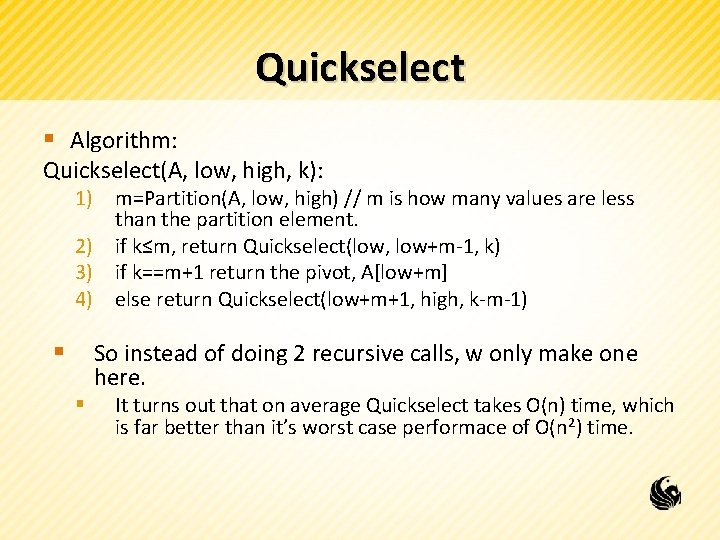
Quickselect § Algorithm: Quickselect(A, low, high, k): 1) m=Partition(A, low, high) // m is how many values are less than the partition element. 2) if k≤m, return Quickselect(low, low+m-1, k) 3) if k==m+1 return the pivot, A[low+m] 4) else return Quickselect(low+m+1, high, k-m-1) § So instead of doing 2 recursive calls, w only make one here. § It turns out that on average Quickselect takes O(n) time, which is far better than it’s worst case performace of O(n 2) time.
Quickselect Analysis § Shown on the board