
QUICK REVIEW OF AM MODULATION HF propagation skywaves
- Slides: 17
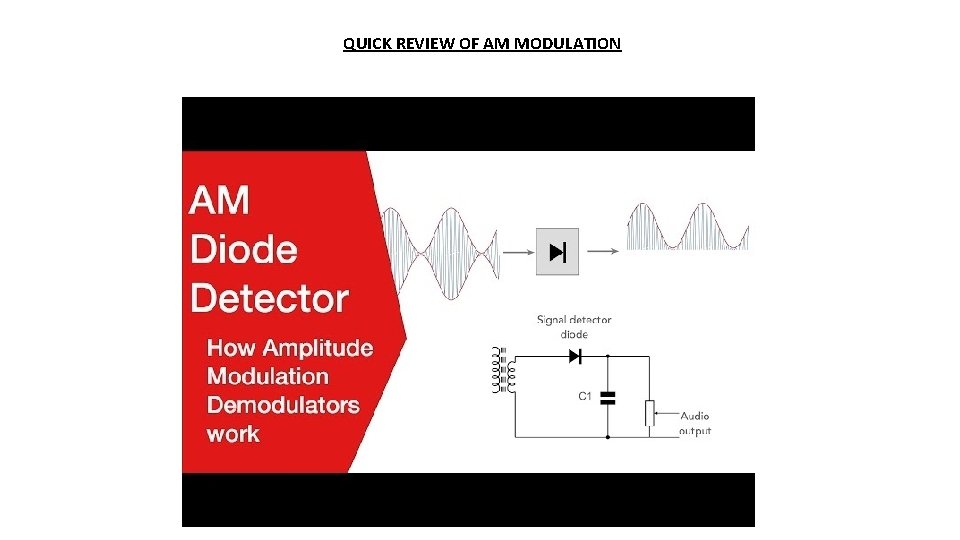
QUICK REVIEW OF AM MODULATION
HF propagation & skywaves
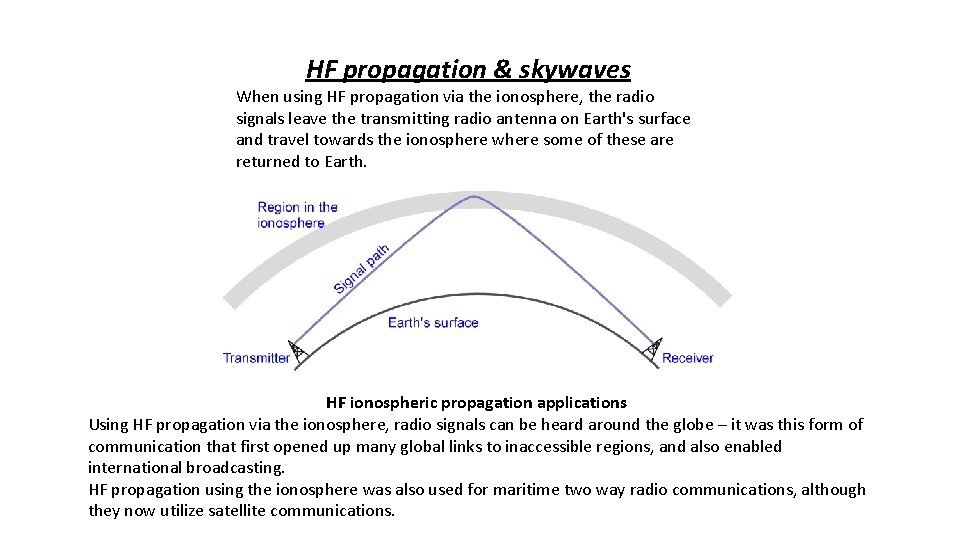
HF propagation & skywaves When using HF propagation via the ionosphere, the radio signals leave the transmitting radio antenna on Earth's surface and travel towards the ionosphere where some of these are returned to Earth. HF ionospheric propagation applications Using HF propagation via the ionosphere, radio signals can be heard around the globe – it was this form of communication that first opened up many global links to inaccessible regions, and also enabled international broadcasting. HF propagation using the ionosphere was also used for maritime two way radio communications, although they now utilize satellite communications.
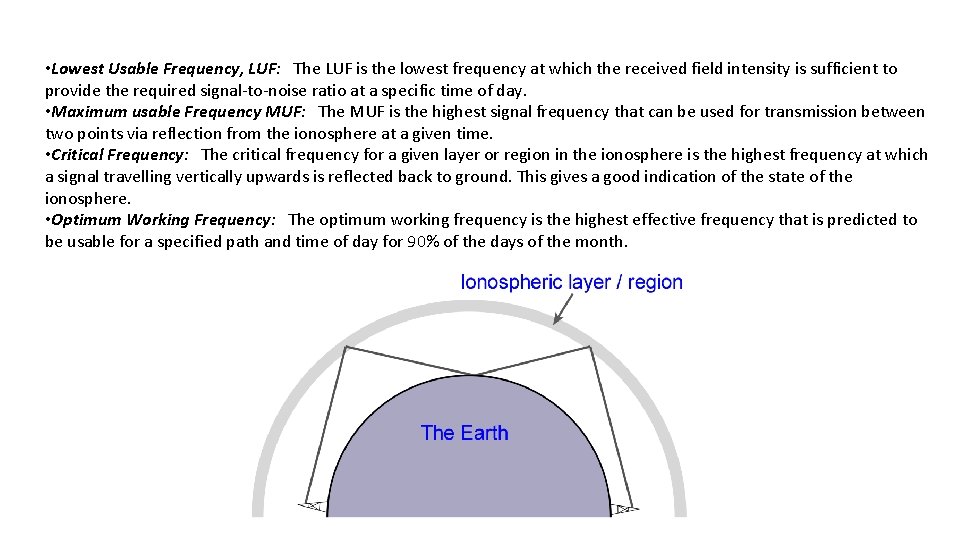
• Lowest Usable Frequency, LUF: The LUF is the lowest frequency at which the received field intensity is sufficient to provide the required signal-to-noise ratio at a specific time of day. • Maximum usable Frequency MUF: The MUF is the highest signal frequency that can be used for transmission between two points via reflection from the ionosphere at a given time. • Critical Frequency: The critical frequency for a given layer or region in the ionosphere is the highest frequency at which a signal travelling vertically upwards is reflected back to ground. This gives a good indication of the state of the ionosphere. • Optimum Working Frequency: The optimum working frequency is the highest effective frequency that is predicted to be usable for a specified path and time of day for 90% of the days of the month.
The Sun and HF propagation The ionization in the ionosphere is chiefly caused by radiation from the Sun. As a result the state of the Sun and the radiation received from it governs the state of the ionosphere and HF propagation. There are several key topics concerning the Sun and the radiation received from it. Sunspots & sunspot cycle: Sunspots areas on the surface of the Sun that are a little cooler than the surrounding areas. Their presence leads to higher levels of radiation being emitted and therefore this affects HF propagation. Sunspots have been recognised in the surface of the Sun for very many years, and their affect of radio propagation was noted once the way in which signals travelled over long distances started to be understood. It was found that there was a correlation between sunspots and the conditions for HF radio propagation and radio communications. Solar disturbances: From time to time, massive disturbances occur on the surface of the Sun. Solar flares, and coronal mass ejections, CMEs also give rise to increased levels of radiation which in turn affects HF propagation. Smaller increases in radiation level can improve the HF radio conditions, but as they increase, it can even lead to a radio blackout on HF. Visible signs of solar disturbances can be visible auroras at the poles. For large solar disturbances, ionisation levels at the poles increase significantly and can allow some specialist propagation modes at VHF allowing radio communications to be established at these frequencies. Here stations point their antennas northwards and reflections can often be heard over reasonably long distances.
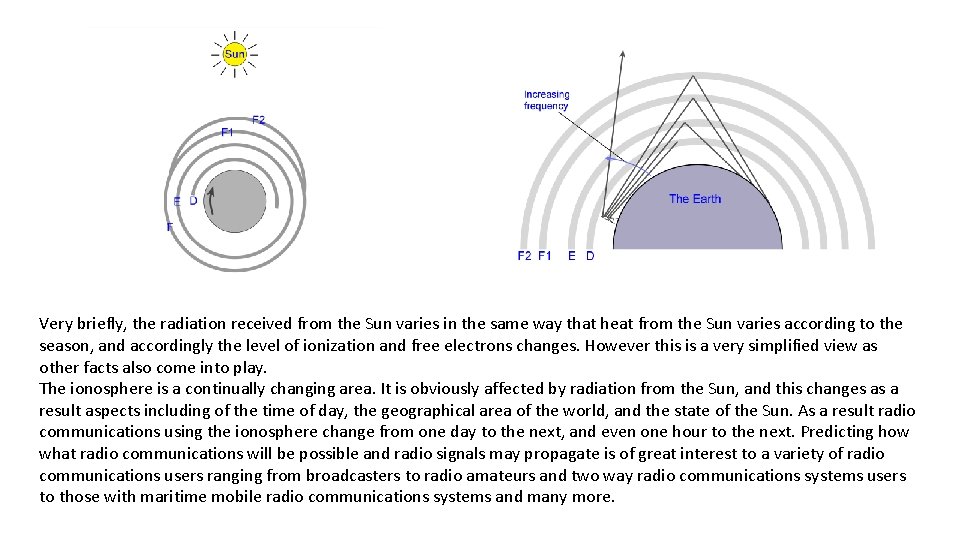
Very briefly, the radiation received from the Sun varies in the same way that heat from the Sun varies according to the season, and accordingly the level of ionization and free electrons changes. However this is a very simplified view as other facts also come into play. The ionosphere is a continually changing area. It is obviously affected by radiation from the Sun, and this changes as a result aspects including of the time of day, the geographical area of the world, and the state of the Sun. As a result radio communications using the ionosphere change from one day to the next, and even one hour to the next. Predicting how what radio communications will be possible and radio signals may propagate is of great interest to a variety of radio communications users ranging from broadcasters to radio amateurs and two way radio communications systems users to those with maritime mobile radio communications systems and many more.
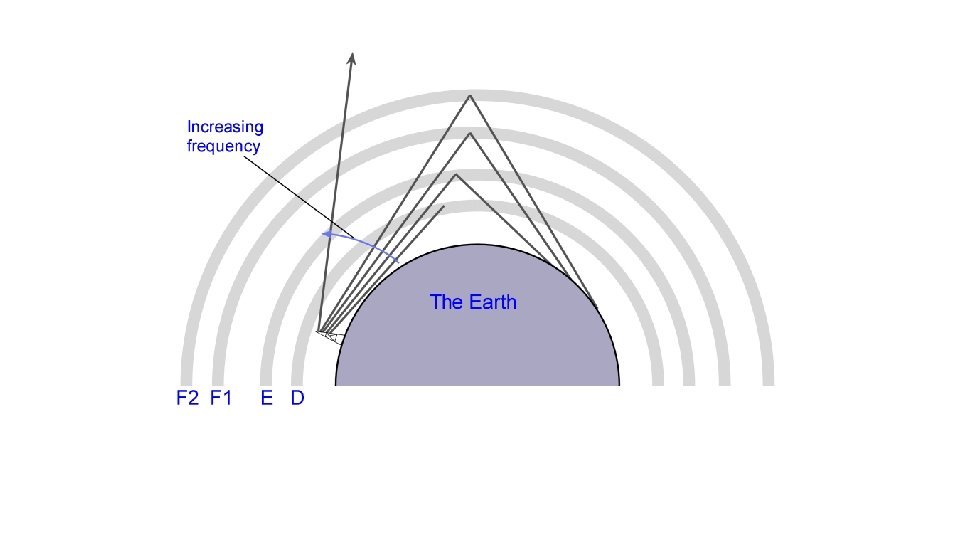
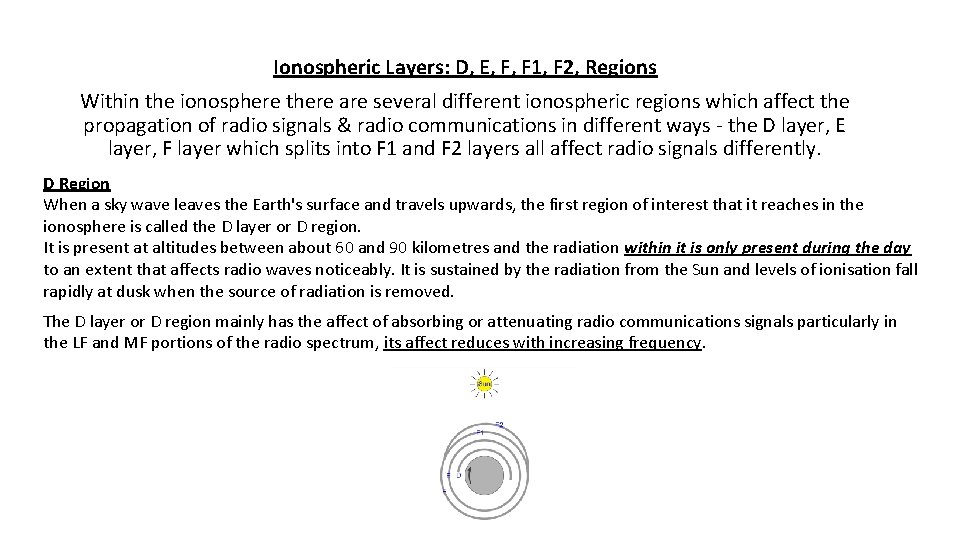
Ionospheric Layers: D, E, F, F 1, F 2, Regions Within the ionosphere there are several different ionospheric regions which affect the propagation of radio signals & radio communications in different ways - the D layer, E layer, F layer which splits into F 1 and F 2 layers all affect radio signals differently. D Region When a sky wave leaves the Earth's surface and travels upwards, the first region of interest that it reaches in the ionosphere is called the D layer or D region. It is present at altitudes between about 60 and 90 kilometres and the radiation within it is only present during the day to an extent that affects radio waves noticeably. It is sustained by the radiation from the Sun and levels of ionisation fall rapidly at dusk when the source of radiation is removed. The D layer or D region mainly has the affect of absorbing or attenuating radio communications signals particularly in the LF and MF portions of the radio spectrum, its affect reduces with increasing frequency.
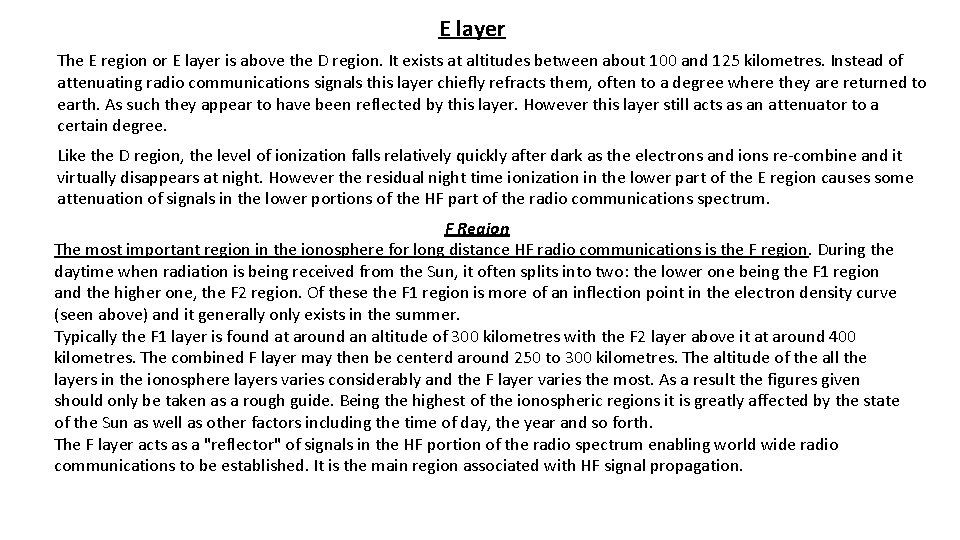
E layer The E region or E layer is above the D region. It exists at altitudes between about 100 and 125 kilometres. Instead of attenuating radio communications signals this layer chiefly refracts them, often to a degree where they are returned to earth. As such they appear to have been reflected by this layer. However this layer still acts as an attenuator to a certain degree. Like the D region, the level of ionization falls relatively quickly after dark as the electrons and ions re-combine and it virtually disappears at night. However the residual night time ionization in the lower part of the E region causes some attenuation of signals in the lower portions of the HF part of the radio communications spectrum. F Region The most important region in the ionosphere for long distance HF radio communications is the F region. During the daytime when radiation is being received from the Sun, it often splits into two: the lower one being the F 1 region and the higher one, the F 2 region. Of these the F 1 region is more of an inflection point in the electron density curve (seen above) and it generally only exists in the summer. Typically the F 1 layer is found at around an altitude of 300 kilometres with the F 2 layer above it at around 400 kilometres. The combined F layer may then be centerd around 250 to 300 kilometres. The altitude of the all the layers in the ionosphere layers varies considerably and the F layer varies the most. As a result the figures given should only be taken as a rough guide. Being the highest of the ionospheric regions it is greatly affected by the state of the Sun as well as other factors including the time of day, the year and so forth. The F layer acts as a "reflector" of signals in the HF portion of the radio spectrum enabling world wide radio communications to be established. It is the main region associated with HF signal propagation.
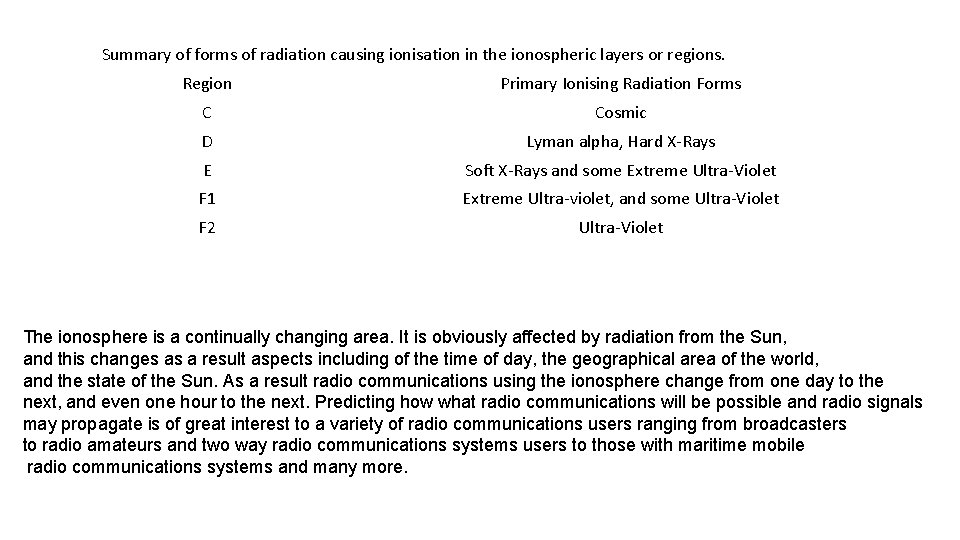
Summary of forms of radiation causing ionisation in the ionospheric layers or regions. Region Primary Ionising Radiation Forms C Cosmic D Lyman alpha, Hard X-Rays E Soft X-Rays and some Extreme Ultra-Violet F 1 Extreme Ultra-violet, and some Ultra-Violet F 2 Ultra-Violet The ionosphere is a continually changing area. It is obviously affected by radiation from the Sun, and this changes as a result aspects including of the time of day, the geographical area of the world, and the state of the Sun. As a result radio communications using the ionosphere change from one day to the next, and even one hour to the next. Predicting how what radio communications will be possible and radio signals may propagate is of great interest to a variety of radio communications users ranging from broadcasters to radio amateurs and two way radio communications systems users to those with maritime mobile radio communications systems and many more.
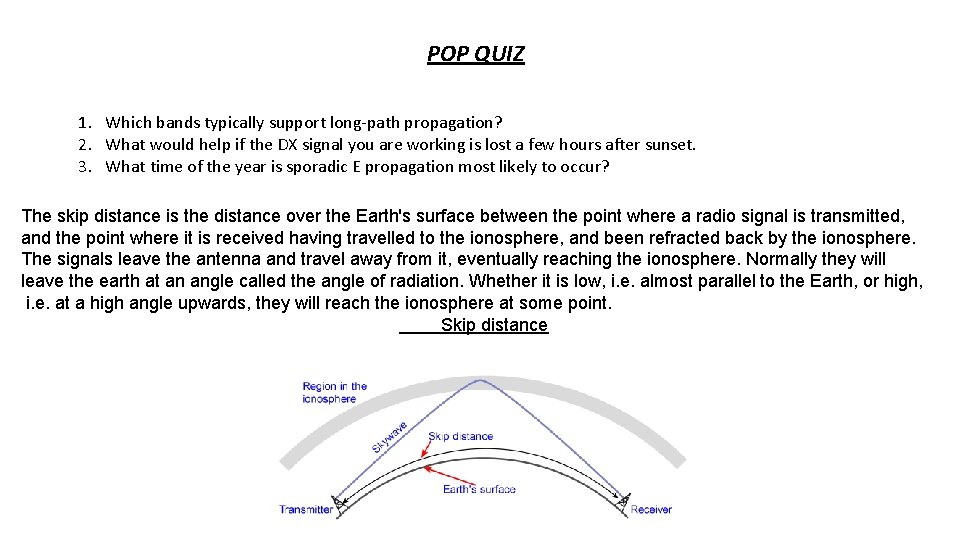
POP QUIZ 1. Which bands typically support long-path propagation? 2. What would help if the DX signal you are working is lost a few hours after sunset. 3. What time of the year is sporadic E propagation most likely to occur? The skip distance is the distance over the Earth's surface between the point where a radio signal is transmitted, and the point where it is received having travelled to the ionosphere, and been refracted back by the ionosphere. The signals leave the antenna and travel away from it, eventually reaching the ionosphere. Normally they will leave the earth at an angle called the angle of radiation. Whether it is low, i. e. almost parallel to the Earth, or high, i. e. at a high angle upwards, they will reach the ionosphere at some point. Skip distance
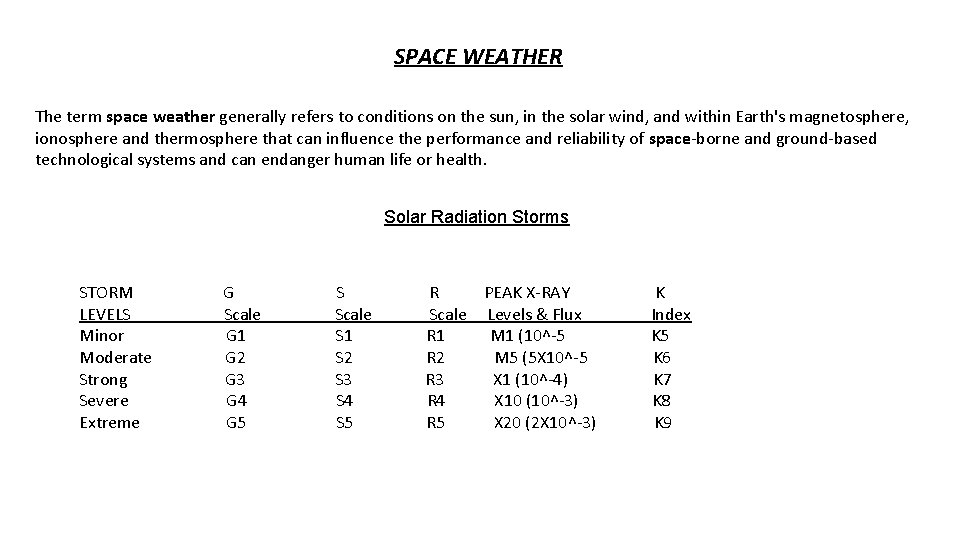
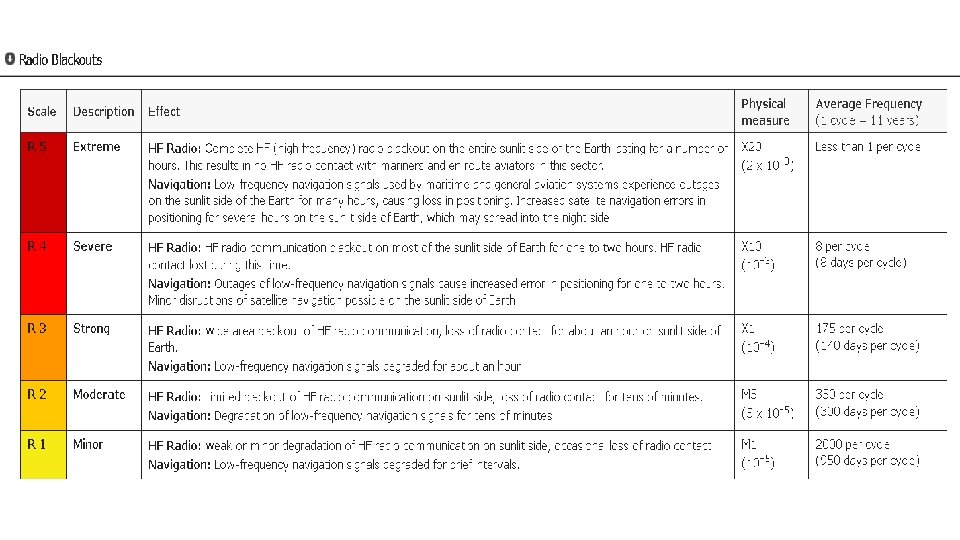
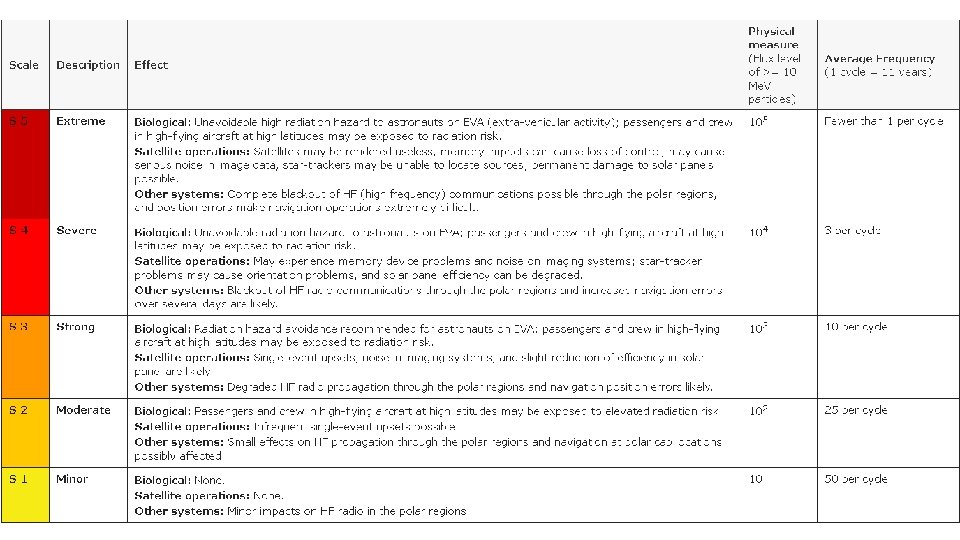
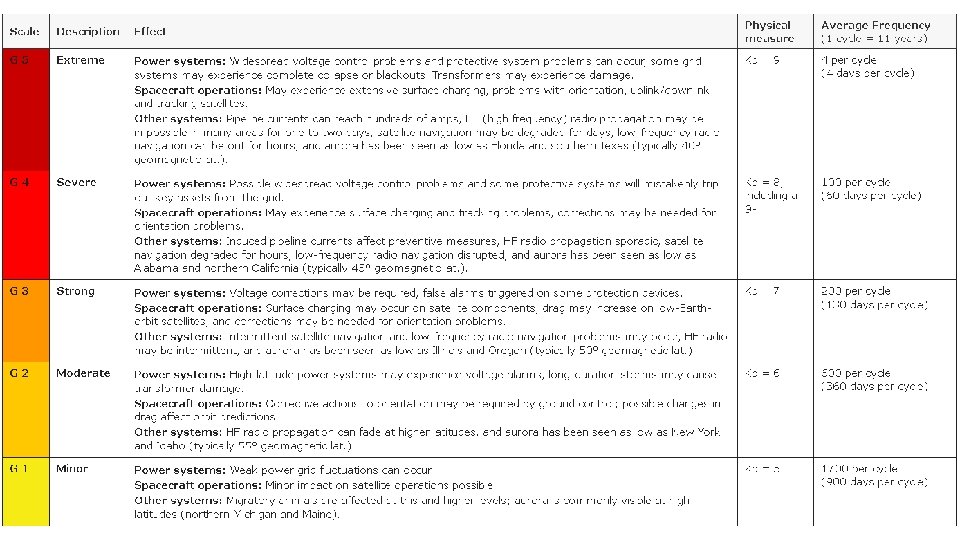
SPACE WEATHER The term space weather generally refers to conditions on the sun, in the solar wind, and within Earth's magnetosphere, ionosphere and thermosphere that can influence the performance and reliability of space-borne and ground-based technological systems and can endanger human life or health. Solar Radiation Storms STORM LEVELS Minor Moderate Strong Severe Extreme G Scale G 1 G 2 G 3 G 4 G 5 S Scale S 1 S 2 S 3 S 4 S 5 R PEAK X-RAY Scale Levels & Flux R 1 M 1 (10^-5 R 2 M 5 (5 X 10^-5 R 3 X 1 (10^-4) R 4 X 10 (10^-3) R 5 X 20 (2 X 10^-3) K Index K 5 K 6 K 7 K 8 K 9
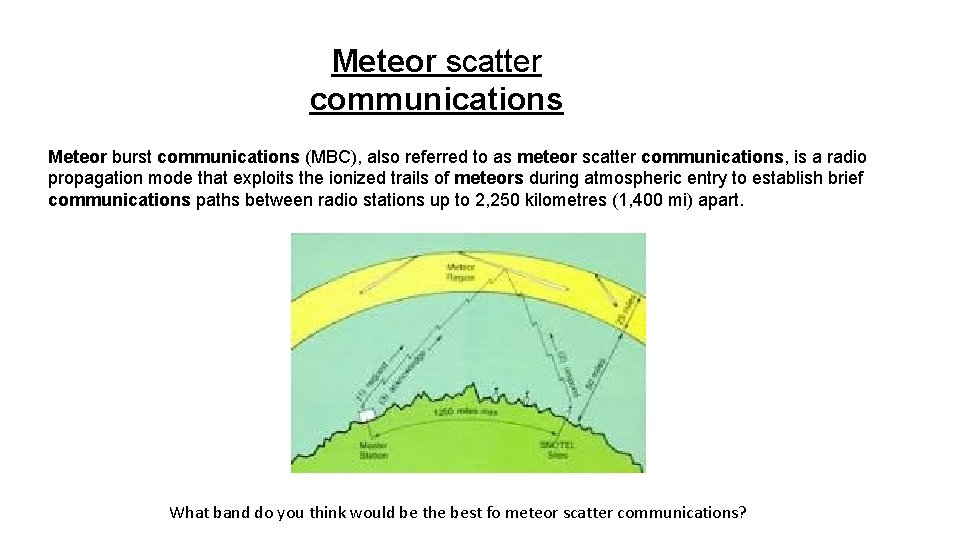
Meteor scatter communications Meteor burst communications (MBC), also referred to as meteor scatter communications, is a radio propagation mode that exploits the ionized trails of meteors during atmospheric entry to establish brief communications paths between radio stations up to 2, 250 kilometres (1, 400 mi) apart. What band do you think would be the best fo meteor scatter communications?
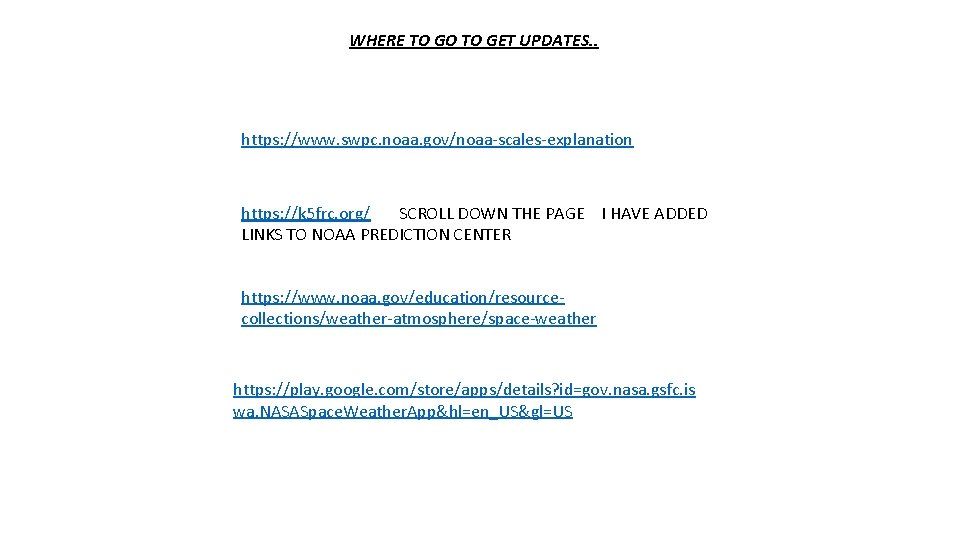
WHERE TO GO TO GET UPDATES. . https: //www. swpc. noaa. gov/noaa-scales-explanation https: //k 5 frc. org/ SCROLL DOWN THE PAGE I HAVE ADDED LINKS TO NOAA PREDICTION CENTER https: //www. noaa. gov/education/resourcecollections/weather-atmosphere/space-weather https: //play. google. com/store/apps/details? id=gov. nasa. gsfc. is wa. NASASpace. Weather. App&hl=en_US&gl=US