
Quick Recap of Lecture 12 Roles and Competencies


- Slides: 51
Quick Recap of Lecture 12
Roles and Competencies • Role A set of task related behaviors required of a person by his or her position in the organization. • Competency A competency is an area of knowledge, ability, skill and other characteristics which an individual must possess in order to produce the outputs for his/her roles.
Senior Executives Roles in HRD • Instill a corporate HRD philosophy • Develop a leadership style congruent with this philosophy • Develop HRD strategies and plans • Create organizational status for HRD function • Staff HRD department with competent people • Ensure availability of adequate resources • Develop a positive climate for HRD • Develop professional competencies in HRD managers • Do not expect immediate and visible results
HRD Managers’ General Roles • • Develop HRD policies and programmes Plan HRD functions Implement HRD mechanisms and processes Monitor and evaluate HRD practices Provide specialist/professional services Advocate HRD philosophy and approaches Establish linkage and coordination with managers and outside consultants
HRD Managers’ Specific Roles • Manager • Facilitator of learning • Consultant • Researcher
Lecture 13
“Learning” and “HRD”
Learning • Focus is upon change • Change must be long-lasting • The focus of learning can be cognitive, behavioral, or affective • Results from the individual’s interaction with the learning environment
Learning Outcomes can be: • Cognitive (Knowledge) • Psychomotor (Skill- or behavior-based) • Affective (Attitude)
Basic Learning Principles • Contiguity – things taught together become associated with each other • Law of Effect – a behavior followed by pleasurable experience is likely to be repeated • Practice – repetition increases association and knowledge
Limitations in the Foregoing • Based on strictly controlled tests (“lab studies”) • Practice doesn’t always make perfect
Improved Training Design • Task Analysis • Component Task Achievement • Task Sequencing
Task Analysis • Break each task down into a series of distinct component tasks • Keep breaking tasks down to the simplest level possible • Remember “K. I. S. S. ”
Component Task Achievement • Each task must be completed fully before the entire task may be performed correctly • You have to specify what is to be done, under what conditions, and how it is to be evaluated
Task Sequencing • Each component task should be arranged in the proper sequence • Some are serial tasks • Some can be done in parallel
Instructional Psychology • What must be done before learning can take place • Describe the learning goal to be achieved • Analyze the initial state of the learner • Identify the conditions allowing the learner to gain competence • Assess and monitor the learning process
Maximizing Learning (Training) • Trainee Characteristics • Training Design • Transfer of Training
Trainee Characteristics • Trainability – – Motivation – Ability – Perception of the work environment • Personality and attitudes
Training Design Issues • Conditions of practice • Retention of what is learned
Conditions of Practice • Active practice • Spaced versus massed practice • Whole versus part learning • Overlearning • Knowledge of results (feedback) • Task sequencing
Retention of What is Learned • Meaningfulness of the material • Degree of original learning • Interference – Knowledge before training – Changes after training
Transfer of Training • Does training make it to the job? • Positive transfer – – Job performance improves after training • Zero transfer – – No measurable changes • Negative transfer – – Performance becomes worse after training
Other Types of Transfer • Near Transfer – Ability to directly apply back to the job • Far Transfer – Expanding upon or using in new and creative ways
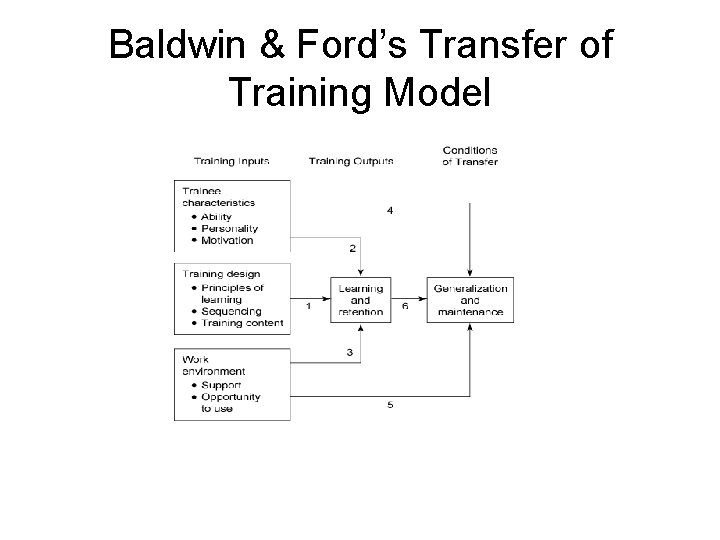
Baldwin & Ford’s Transfer of Training Model
Maximizing Transfer • Identical elements • Physical fidelity • Psychological fidelity
Identical Elements • The closer the training is to the job, the easier it is to achieve transfer • Direct relationship to the job • Example: Customer service and angry customers • Role playing, business games, etc.
Physical Fidelity • Same physically • Same procedurally • Example: Flight and submarine simulators
Psychological Fidelity • Trainee experiences same stresses and conditions as he/she is being trained for • Example: MS Flight Simulator
Support in Work Environment • • • Transfer of training into workplace is supported A continuous learning environment Supervisors support and help develop training Training leads to promotion/better pay Trainee has opportunity to perform
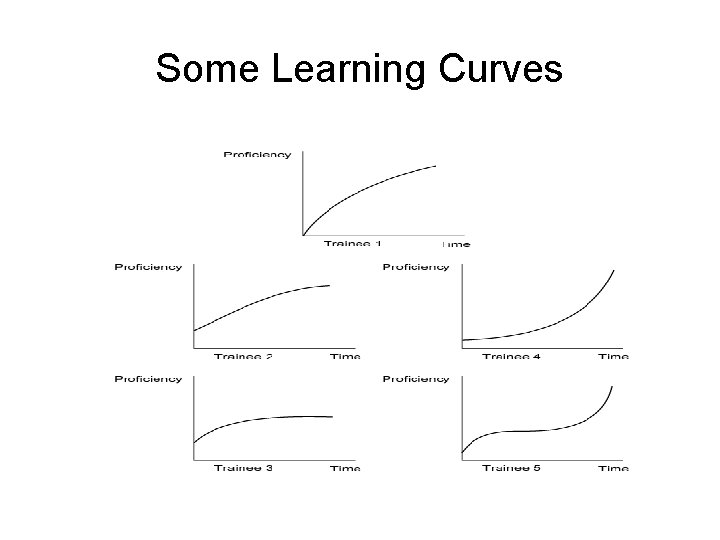
Individual Differences • Rate of Progress – Learning charts/curves • Chart learning proficiency against time – Measure proficiency with standardized tests • Charts show plateaus in learning as well as progress
Some Learning Curves
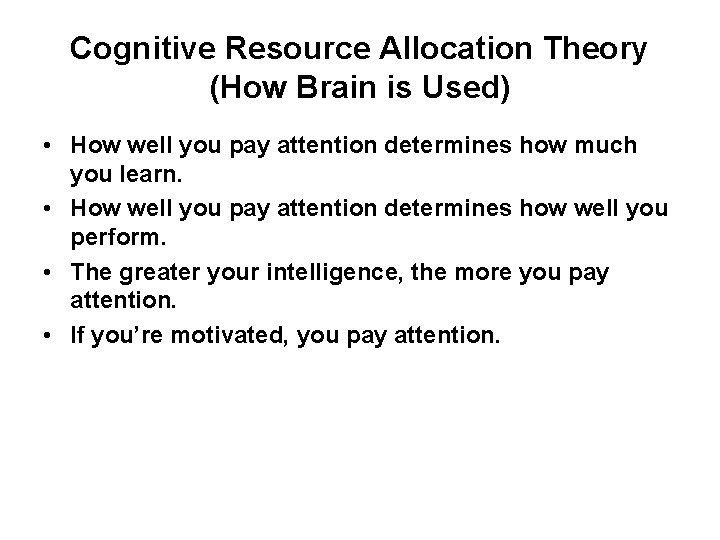
Cognitive Resource Allocation Theory (How Brain is Used) • How well you pay attention determines how much you learn. • How well you pay attention determines how well you perform. • The greater your intelligence, the more you pay attention. • If you’re motivated, you pay attention.
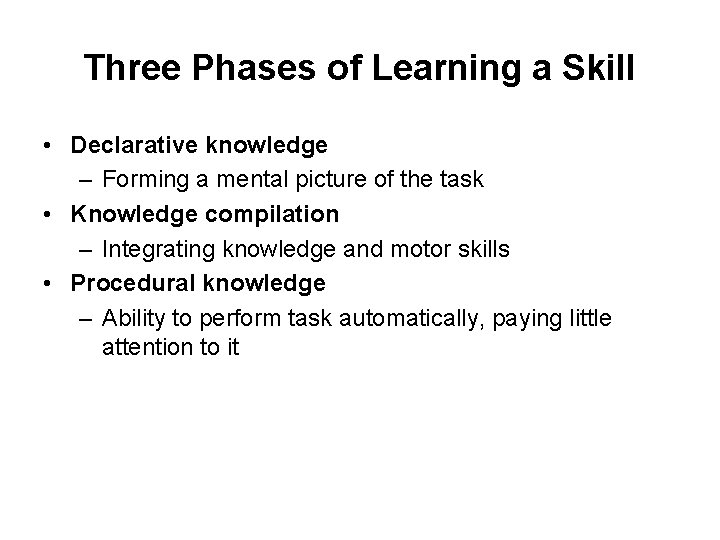
Three Phases of Learning a Skill • Declarative knowledge – Forming a mental picture of the task • Knowledge compilation – Integrating knowledge and motor skills • Procedural knowledge – Ability to perform task automatically, paying little attention to it
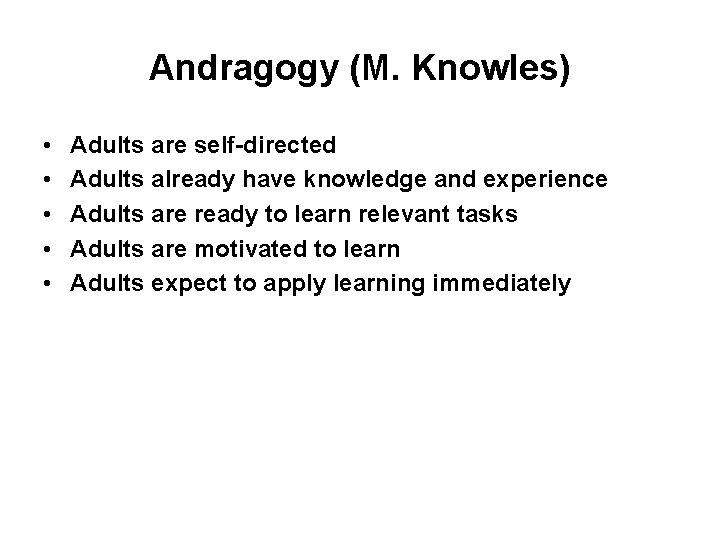
Andragogy (M. Knowles) • • • Adults are self-directed Adults already have knowledge and experience Adults are ready to learn relevant tasks Adults are motivated to learn Adults expect to apply learning immediately
How to Assess Trainee Differences • Instrumentality – Does trainee think training is applicable? • Skepticism – Degree trainee questions and demands facts. • Resistance to Change – How well is change accepted?
How to Assess Trainee Differences – 2 • Attention Span – How long can trainee focus on the lesson? • Expectation Level – What does trainee expect from the trainer/training? • Dominant Needs – What drives/motivates the trainee?
How to Assess Trainee Differences – 3 • Absorption Level – How fast is new information accepted? • Topical Interest – How interested is trainee in topic? • Self-Confidence – Degree of independence and self-regard • Locus of Control – Can trainee implement training on job?
Gerontology • • • Working with older people Older people can and do develop Older people should not be excluded from training Training must be geared for adults, not children Organizations must reward training Look at overall career patterns
Learning Styles • Lots of research in this area • Many different tests are available to measure: – Learning ability – Individual learning preferences • It’s NOT all psychobabble!
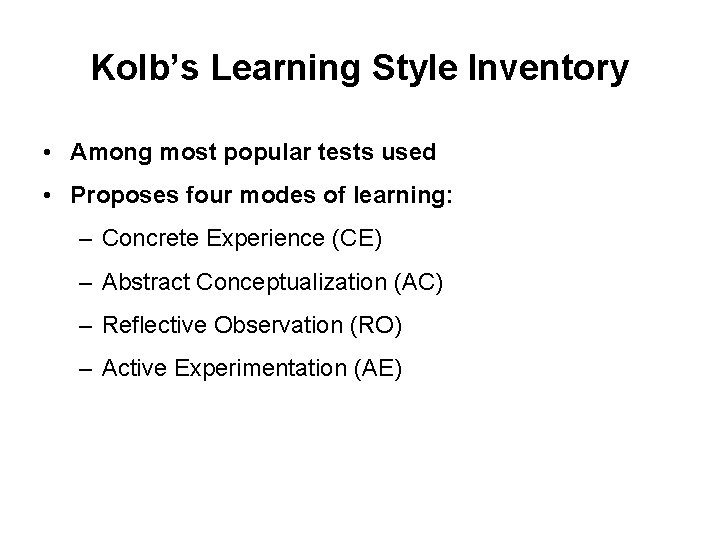
Kolb’s Learning Style Inventory • Among most popular tests used • Proposes four modes of learning: – Concrete Experience (CE) – Abstract Conceptualization (AC) – Reflective Observation (RO) – Active Experimentation (AE)
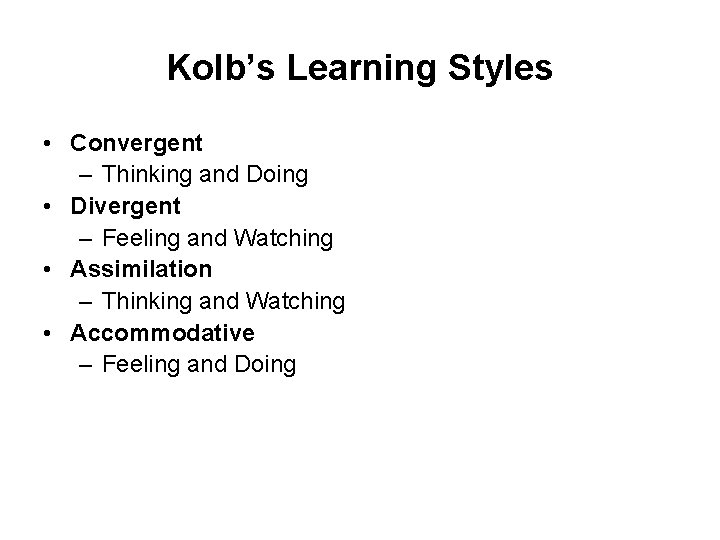
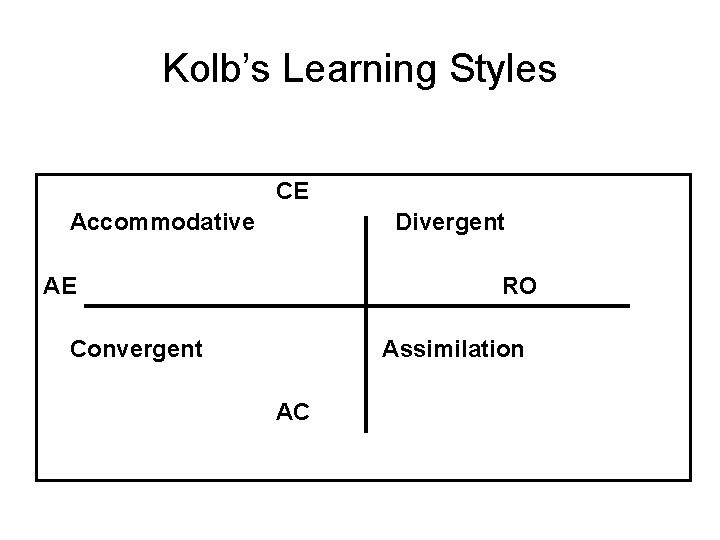
Kolb’s Learning Styles • Convergent – Thinking and Doing • Divergent – Feeling and Watching • Assimilation – Thinking and Watching • Accommodative – Feeling and Doing
Kolb’s Learning Styles CE Accommodative Divergent AE RO Convergent Assimilation AC
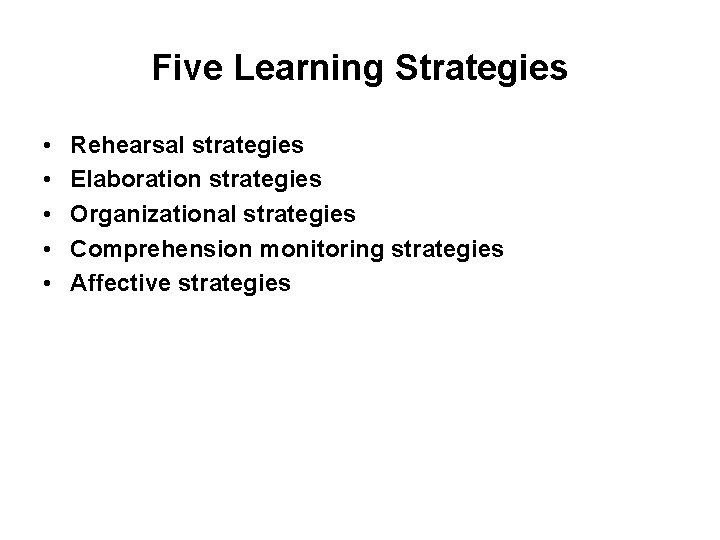
Five Learning Strategies • • • Rehearsal strategies Elaboration strategies Organizational strategies Comprehension monitoring strategies Affective strategies
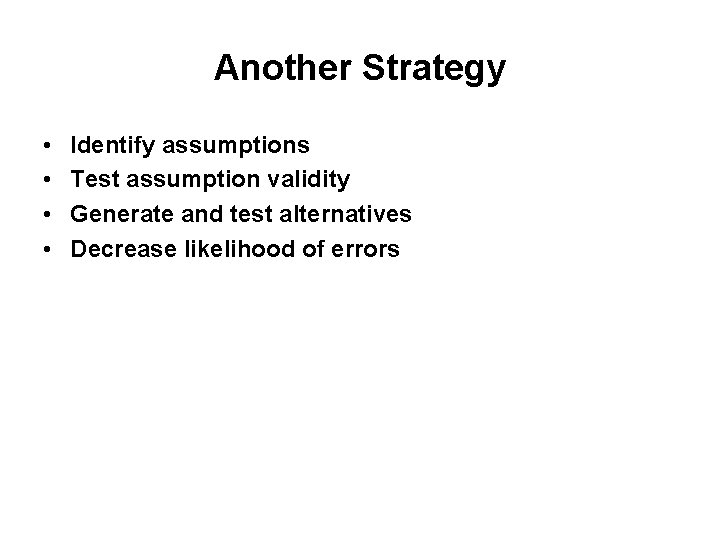
Another Strategy • • Identify assumptions Test assumption validity Generate and test alternatives Decrease likelihood of errors
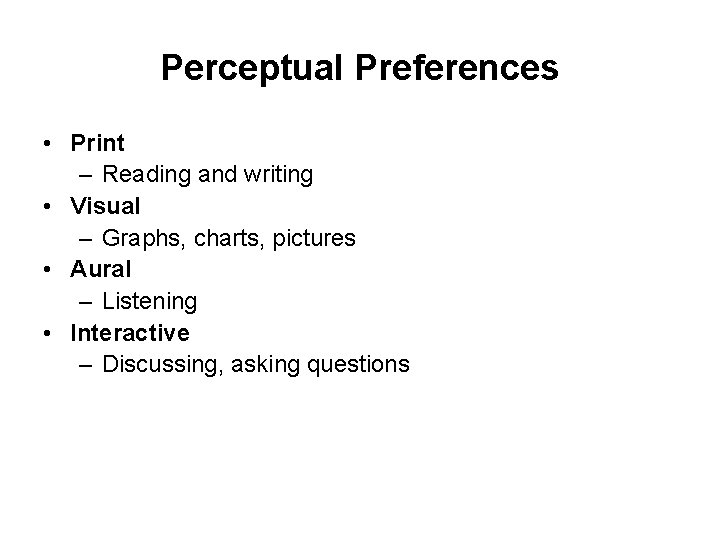
Perceptual Preferences • Print – Reading and writing • Visual – Graphs, charts, pictures • Aural – Listening • Interactive – Discussing, asking questions
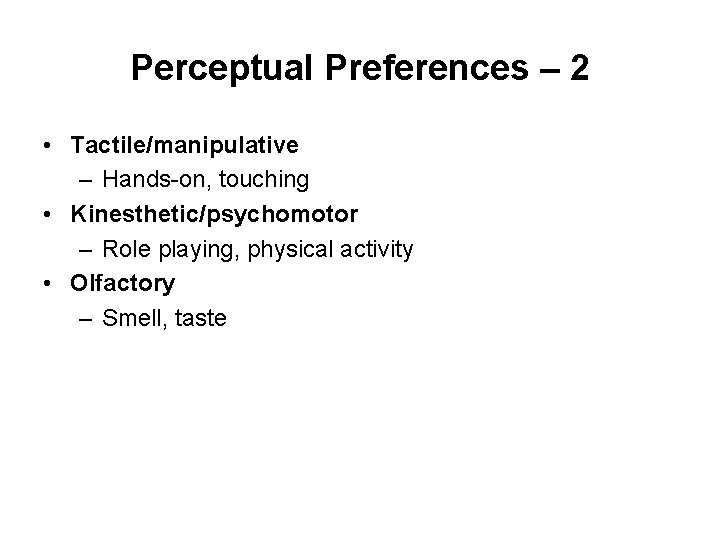
Perceptual Preferences – 2 • Tactile/manipulative – Hands-on, touching • Kinesthetic/psychomotor – Role playing, physical activity • Olfactory – Smell, taste
Actual Preferences • • Adults – generally prefer visual Females – all sources Males – selected sources Young Adults – interactive, visual • CONCLUSION: Tailor your method to your audience.
Expert Performance Definition: • Consistently superior performance on a specified set of representative tasks for a domain
Gagne’s Theory of Instruction • • • Verbal information Intellectual skills Cognitive strategies Motor skills Attitudes ALL ARE LEARNED IN DIFFERENT WAYS!
Instructional Events 1. 2. 3. 4. 5. 6. 7. 8. 9. Gain attention. State the learning objective. Stimulate recall of earlier lessons. Present new material. Provide learning guidance. Have student perform. Provide feedback. Assess performance. Enhance retention and training transfer.
Summary • Without learning, there would be no field of human resource development • To increase learning, we must consider: – Trainee characteristics/individual differences – Training design issues – Retention and transfer of training issues