
Quick Guide for Using Commas in English Dividing
- Slides: 8
Quick Guide for Using Commas in English
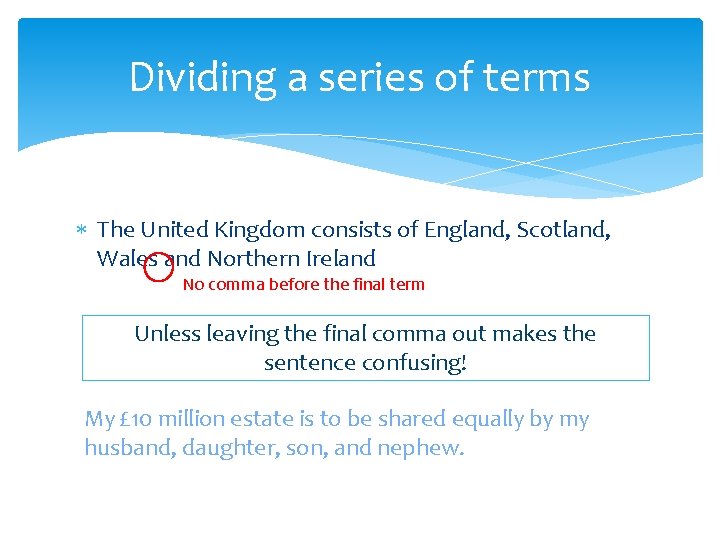
Dividing a series of terms The United Kingdom consists of England, Scotland, Wales and Northern Ireland No comma before the final term Unless leaving the final comma out makes the sentence confusing! My £ 10 million estate is to be shared equally by my husband, daughter, son, and nephew.
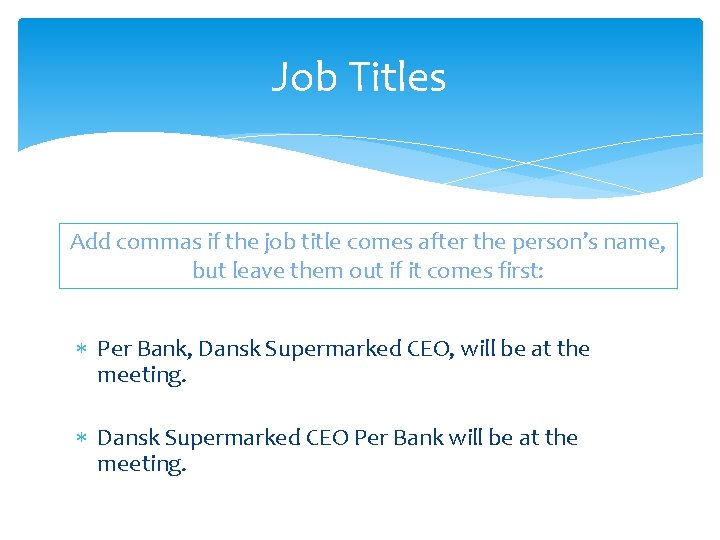
Job Titles Add commas if the job title comes after the person’s name, but leave them out if it comes first: Per Bank, Dansk Supermarked CEO, will be at the meeting. Dansk Supermarked CEO Per Bank will be at the meeting.
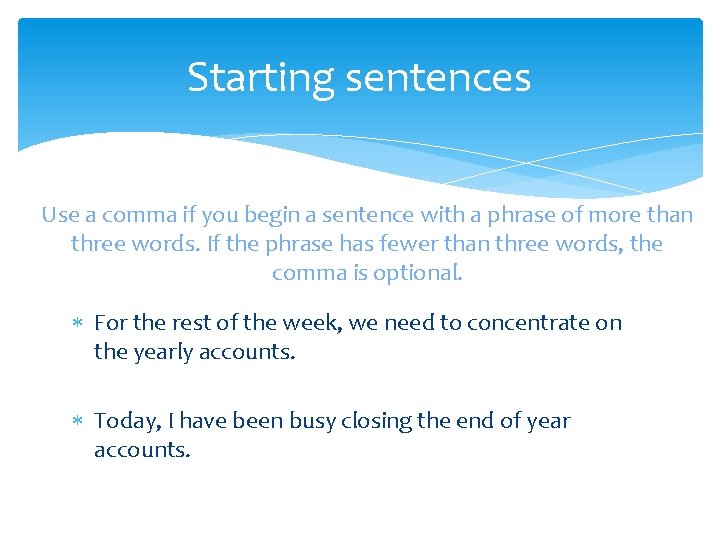
Starting sentences Use a comma if you begin a sentence with a phrase of more than three words. If the phrase has fewer than three words, the comma is optional. For the rest of the week, we need to concentrate on the yearly accounts. Today, I have been busy closing the end of year accounts.
Conjunctions Use a comma to separate two strong clauses joined by a coordinating conjunction (and, or, but, for, nor). You can omit the comma if the clauses are both short. I have been working hard all week, but I still haven’t finished the report. He called but I was out.
Introductory words Use either a comma or a semicolon before introductory words such as namely, that is, i. e. , for example or e. g. when they are followed by a series of items. Use a comma after the introductory word. Good IT skills are essential, e. g. , proficiency in Word and Excel. There is one simple system improvement that we could make; namely, automate the data calculation.
However and therefore Use commas surrounding words such as therefore and however when they interrupt a sentence. I would be delighted, however, to make a donation. I think it is important, therefore, to get this situation resolved as soon as possible.
Extra information Usa commas to separate an extra information clause My sister, who has just moved to Australia, used to live in York. My car, which keeps costing me money, has just been clamped for being illegally parked.