
QUEUING THEORY EXPONENTIAL DISTRIBUTION Describing traffic How can
QUEUING THEORY: EXPONENTIAL DISTRIBUTION
Describing traffic ■ How can we describe traffic? Cars, pedestrian, internet, etc. ■ Also: how can we describe how traffic is processed? ■ What are some metrics? – Rate at which people arrive somewhere, e. g. “customer arrival rate per hour” – Average “downtime” – Time between people arriving ■ In Queuing Theory, we use stochastic systems to model events – Probability of an event occurring (counts) – Always over a period of time (continuous)
Random Variables ■ “Randomness can be described as unpredictable in the short term, but predictable in the long term“ -Prof. Pruim, (pronounced “prime”) Meneely’s favorite Math Professor ■ Random Variables are a mathematical construct used to abstract away a complex system that behaves stochastically – Represent the complex physics of rolling a die with 1 variable – Flipping a coin ■ Random variables can be discrete or continuous – e. g. flipping a coin ■ Random variables are described by distributions
Distributions You Might Know ■ Most distributions have at least one parameter define the whole distribution ■ Every distribution has an input ■ Uniform distribution – Parameter: n (number of sides on the die) – Can be discrete or continuous – Fair die, e. g. f 6(x=1) is 1/6 ■ Binomial distribution – Discrete – Parameter: p (probability of an event) – Input: number of events ■ Normal distribution – Parameters: mean, variance – Input: a continuous variable ■ Or, you can define them piecewise, e. g. unfair die
Poisson Process ■ A type of random variable that models arrival events ■ Each event is independently and identically distributed ■ In Queuing Theory, we define it along the real number line to model the series of incoming events over time ■ Poisson processes can be described by the Poisson distribution – But! We won’t be using that distribution very much, because we need another property…
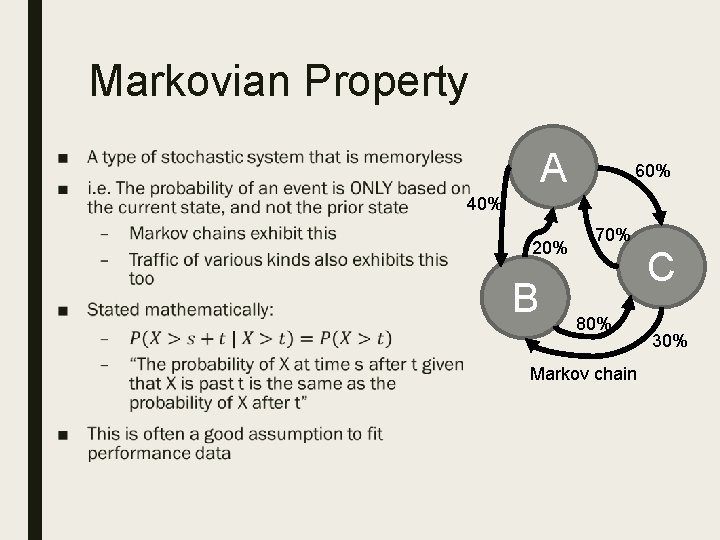
Markovian Property ■ A 60% 40% 20% B 70% C 80% Markov chain 30%
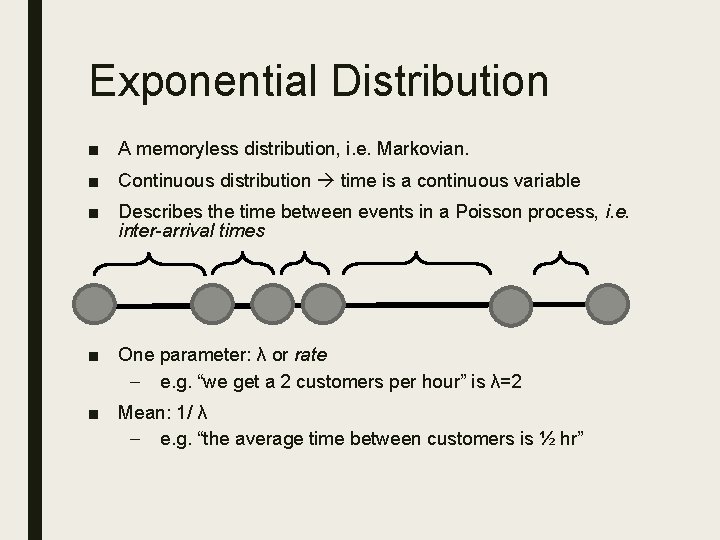
Exponential Distribution ■ A memoryless distribution, i. e. Markovian. ■ Continuous distribution time is a continuous variable ■ Describes the time between events in a Poisson process, i. e. inter-arrival times ■ One parameter: λ or rate – e. g. “we get a 2 customers per hour” is λ=2 ■ Mean: 1/ λ – e. g. “the average time between customers is ½ hr”
Coffee Shop Example ■ Suppose we have a coffee shop that, on average, takes 5 minutes to process a customer ■ Mean: 1/ λ = 5 – (minutes per customer) ■ Thus: λ = 1/5 customers per minute (c/m) – This is the rate, because it’s a speed. ■ (keep this example in mind)
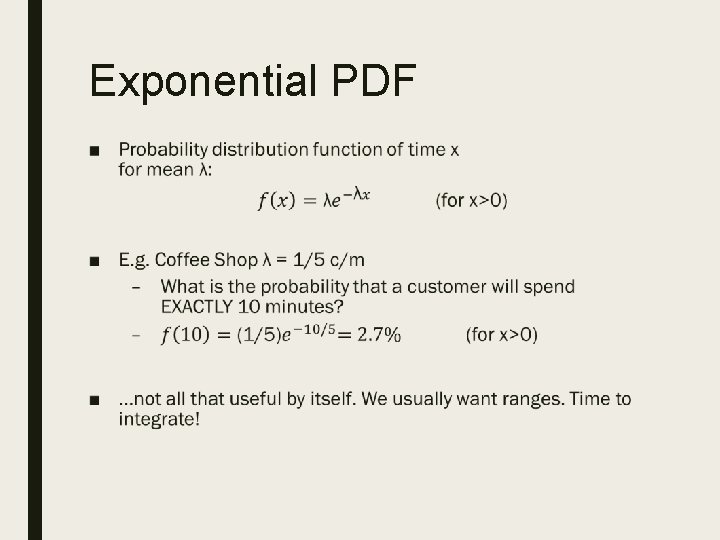
Exponential PDF ■
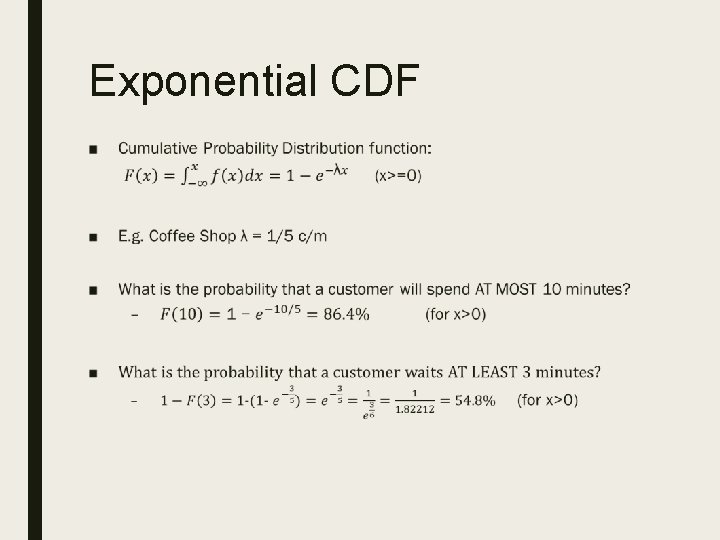
Exponential CDF ■

A Note About Units ■
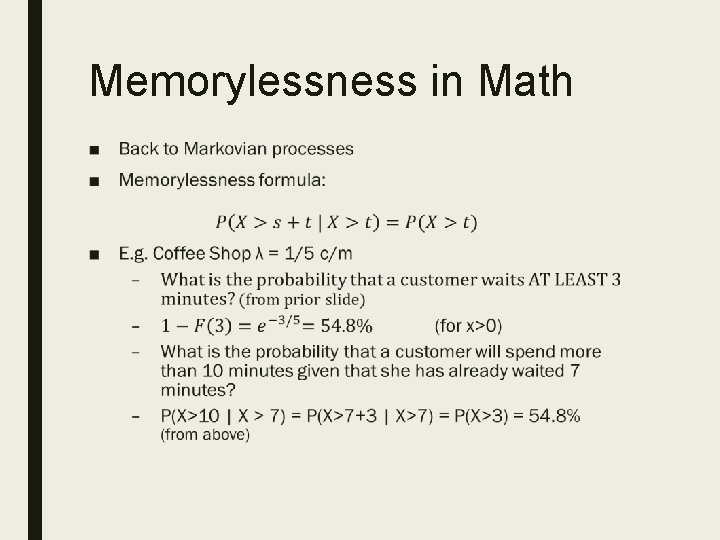
Memorylessness in Math ■
Let’s work on some problems ■ Go to my. Courses and check out Queuing Theory Distributions ■ Feel free to work with your neighbors on this, but! – Each “quiz” question will have different inputs, so… – You will need to fill out your own answers. ■ These kinds of questions will be on the first exam. ■ You will get plenty of time to work on these questions in class as we go through Queuing Theory
- Slides: 13