
Queuing Model Queue Length Lq The average number
Queuing Model
• Queue Length (Lq): The average number of customers in the queue waiting to get service. This excludes the customers being served. • System Length (Ls): The average number of customers in the system including those waiting as well as those being served. • Waiting time in the queue (Wq): The average time customer has to wait in the queue to get service. • Total time in the system (Ws): The average total time spent by the customer in the system from the moment he arrives till he leaves the system. It is the summation of waiting time and service time. • Utilization Factor (ρ): It is the proportions of time a server actually spends with the customers. It is also called traffic intensity.
Elements of a Queuing System (Structure of a Queuing System) A queuing system is specified completely by seven main elements • Arrival Distribution: It represents the pattern in which the numbers of customer arrive at the service facility. Arrival may also be represented by the inter-arrival time, which is the period between successive arrivals. Management scientists have demonstrated that the random arrival is often being described by Poisson distribution.
• Service (departure) Distribution: It represents the pattern in which the numbers of customer leave the service facility. Departures may also be represented by the service time, which is the period between successive services. The service times are best described by exponential distribution. • Service channel: The queuing system may be single channel (one server) or multichannel (two or more server). Example of single channel is doctor’s clinic and of multichannel is railway reservation counter.
• Service Discipline: Service discipline or order of service is the rule by which customers are selected from queue for service. ‘First come First Served (FCFS)’ , as in ticket counter ‘Last come First Served’, as in big warehouse (godown) and ‘Service in Random Order (SIRO)’ are some of the service discipline. • Maximum number of customers allowed in the queue: It may be finite or infinite.
• Calling source or Population: The arrival pattern of the customers depends upon the source which generates them. If there are few potential customers, the calling source is called finite, if there are 40 to 50 customers it is said to be infinite. • Customer’s Behaviour: The customer may behave in the following manner, balking ( does not join the queue since it is too long), reneging (enters the queue but after some time loses patience and leave it) and jockeying (customer move from one queue to another).
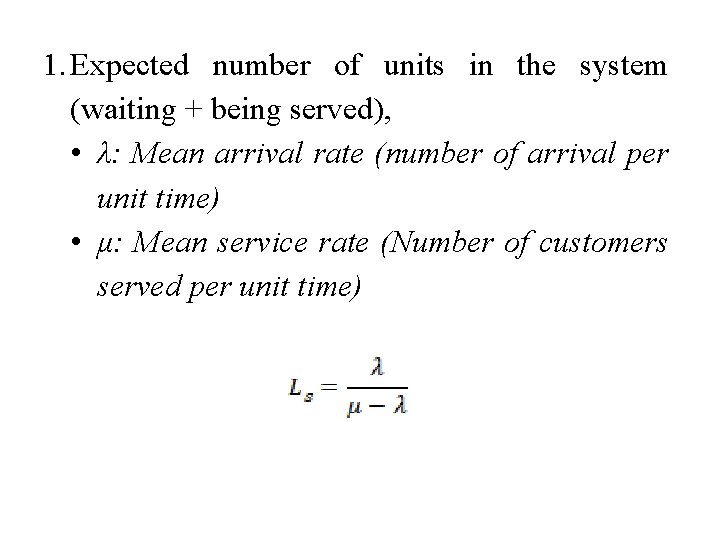
1. Expected number of units in the system (waiting + being served), • λ: Mean arrival rate (number of arrival per unit time) • μ: Mean service rate (Number of customers served per unit time)
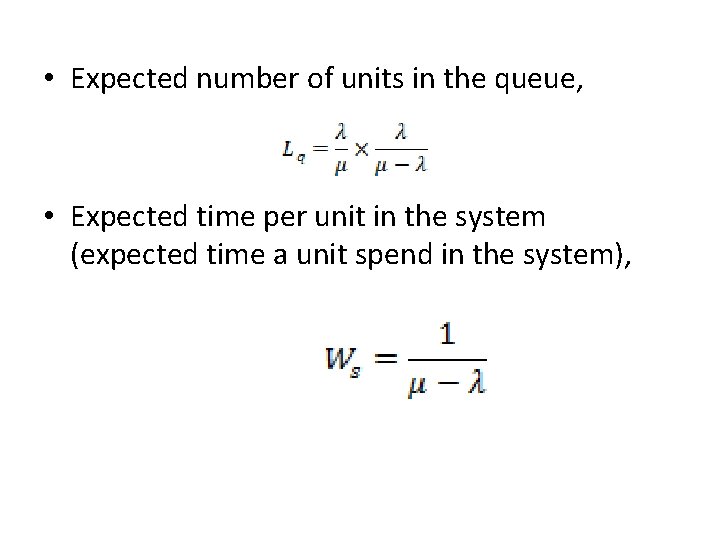
• Expected number of units in the queue, • Expected time per unit in the system (expected time a unit spend in the system),
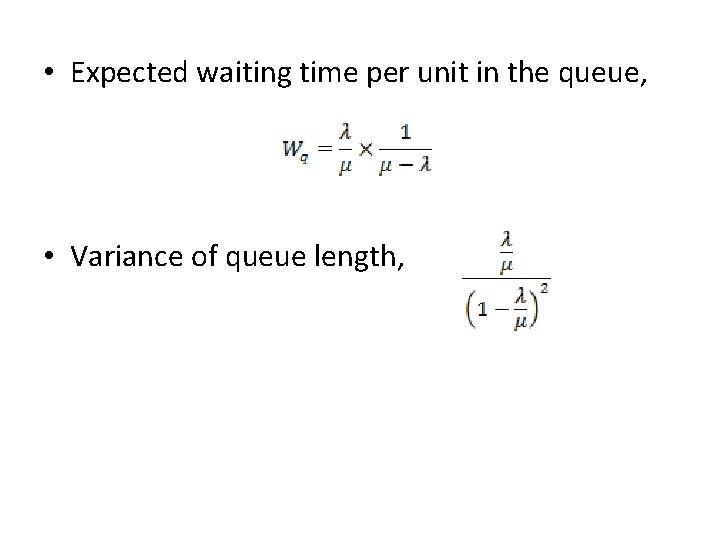
• Expected waiting time per unit in the queue, • Variance of queue length,
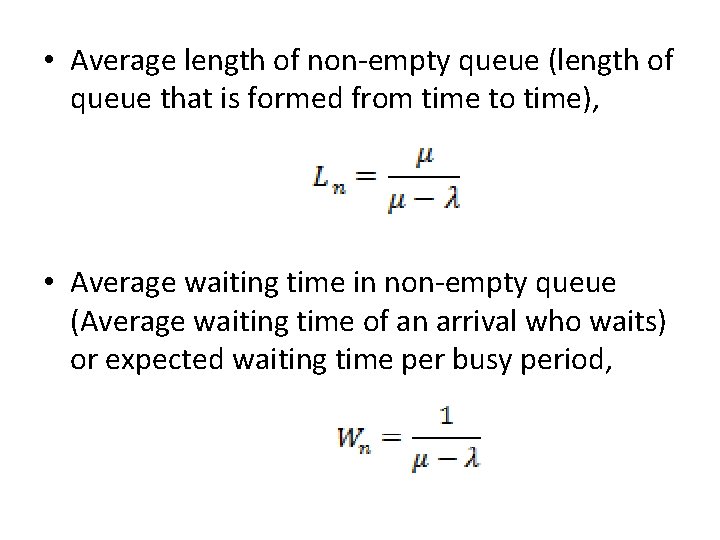
• Average length of non-empty queue (length of queue that is formed from time to time), • Average waiting time in non-empty queue (Average waiting time of an arrival who waits) or expected waiting time per busy period,
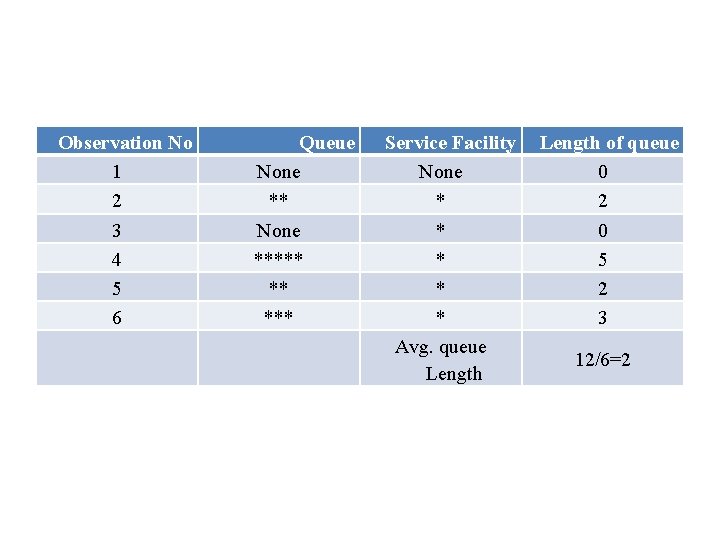
Observation No 1 2 3 4 5 6 Queue None ***** ** *** Service Facility None * * * Avg. queue Length of queue 0 2 0 5 2 3 12/6=2
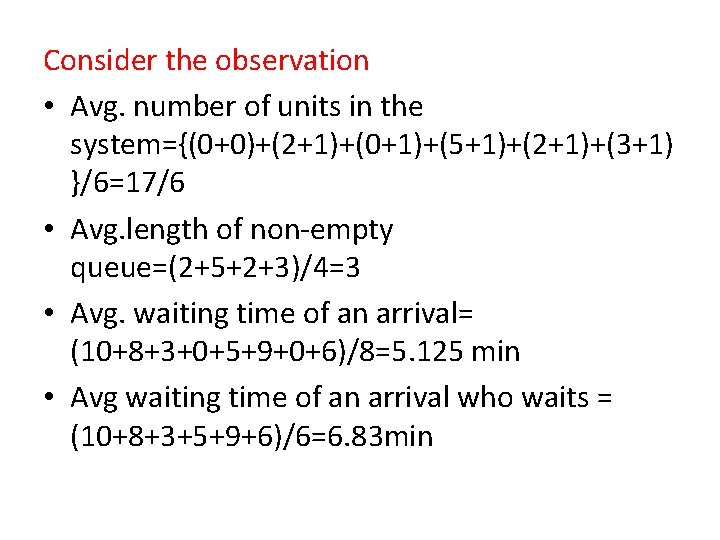
Consider the observation • Avg. number of units in the system={(0+0)+(2+1)+(0+1)+(5+1)+(2+1)+(3+1) }/6=17/6 • Avg. length of non-empty queue=(2+5+2+3)/4=3 • Avg. waiting time of an arrival= (10+8+3+0+5+9+0+6)/8=5. 125 min • Avg waiting time of an arrival who waits = (10+8+3+5+9+6)/6=6. 83 min
- Slides: 12