
Queues CS 367 Introduction to Data Structures Queue




![Queue Class (array based) class Queue. Array { private Object[ ] queue; private int](https://slidetodoc.com/presentation_image_h/d9dbe47ea7e52a203bcf9c88c8d87b02/image-13.jpg "Queue Class (array based) class Queue. Array { private Object[ ] queue; private int")
![public static void main(String[] args) { Queue. Priority disk. Queue = new Queue. Priority();](https://slidetodoc.com/presentation_image_h/d9dbe47ea7e52a203bcf9c88c8d87b02/image-28.jpg "public static void main(String[] args) { Queue. Priority disk. Queue = new Queue. Priority();")
- Slides: 28
Queues CS 367 – Introduction to Data Structures
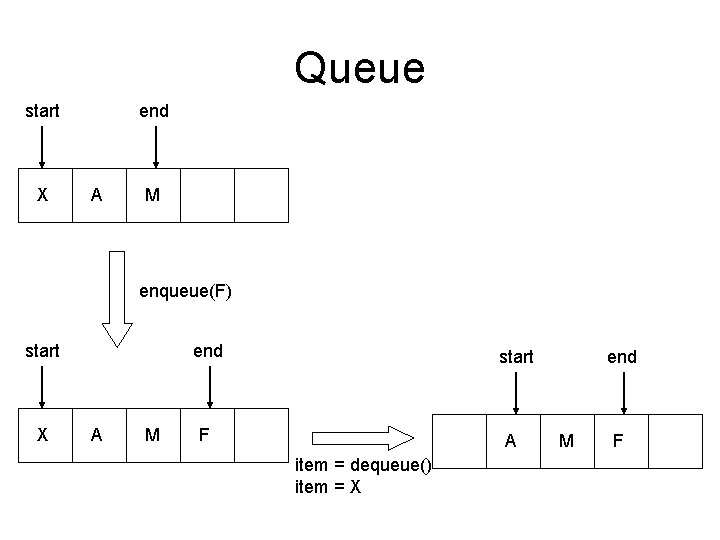
Queue • A queue is a data structure that stores data in such a way that the last piece of data stored, is the last one retrieved – also called First-In, First-Out (FIFO) • Only access to the stack is the first and last element – consider people standing in line • they get service in the order that they arrive
Queues • Enque – operation to place a new item at the tail of the queue • Dequeue – operation to remove the next item from the head of the queue
Queue start X end A M enqueue(F) start X end A M start F A item = dequeue() item = X end M F
Implementing a Queue • At least two common methods for implementing a queue – array – linked list • Which method to use depends on the application – advantages? disadvantages?
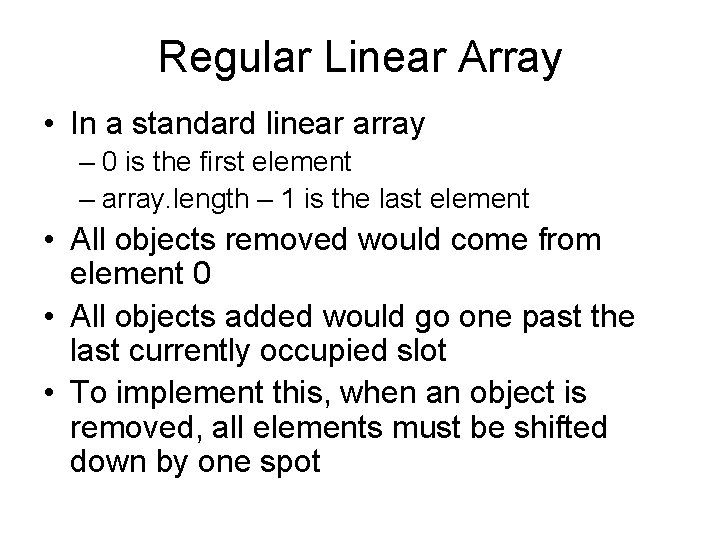
Regular Linear Array • In a standard linear array – 0 is the first element – array. length – 1 is the last element • All objects removed would come from element 0 • All objects added would go one past the last currently occupied slot • To implement this, when an object is removed, all elements must be shifted down by one spot
Regular Linear Array start A end B F D K dequeue() start B F S D M end D shift start B S K end K M M
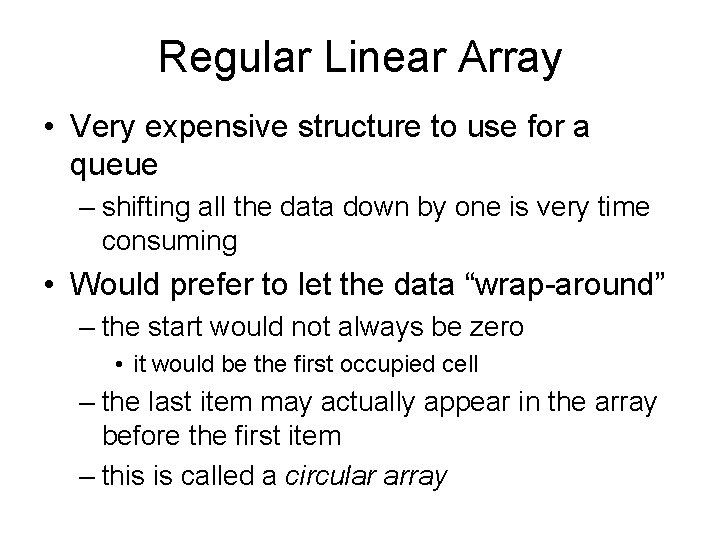
Regular Linear Array • Very expensive structure to use for a queue – shifting all the data down by one is very time consuming • Would prefer to let the data “wrap-around” – the start would not always be zero • it would be the first occupied cell – the last item may actually appear in the array before the first item – this is called a circular array
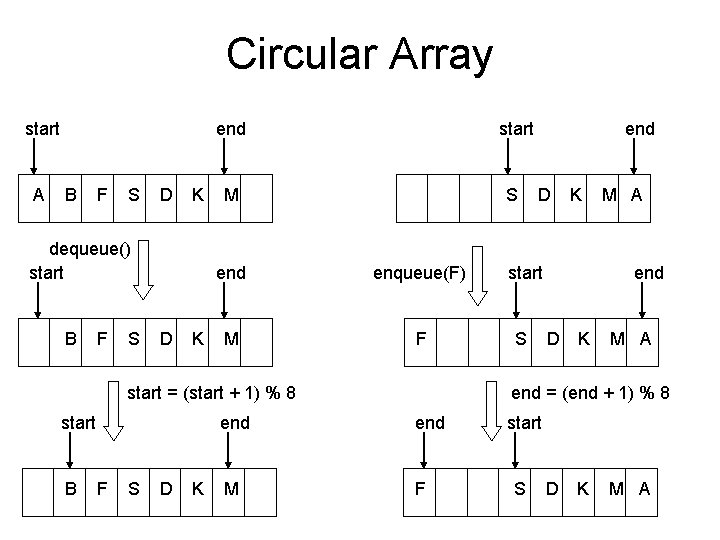
Circular Array • Need to keep track of the index that holds the first item • Need to keep track of the index that holds the last item • The “wrap-around” is accomplished through the use of the mod operator (%) – index = (end + 1) % array. length • assume array. length = 5 and end = 4 • then: index = (4 + 1) % 5 = 0
Circular Array start A B F S D K dequeue() start B F S D K end start M S B F S D K D end enqueue(F) start M F S start = (start + 1) % 8 start end K M A end D K M A end = (end + 1) % 8 end M F start S D K M A
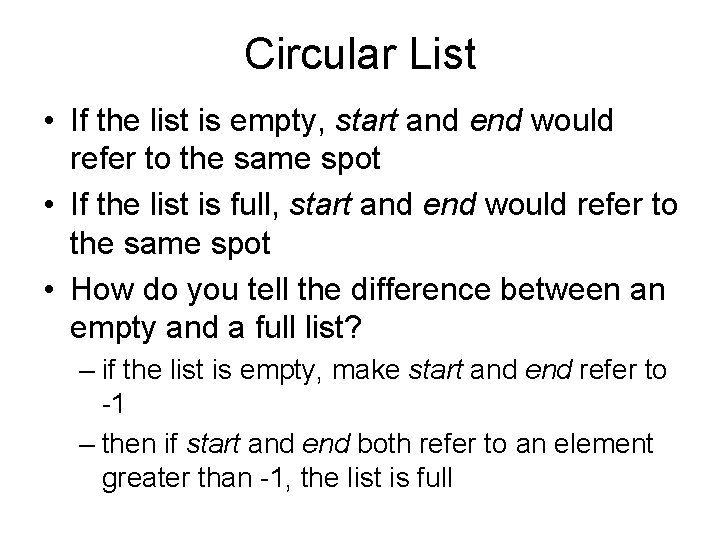
Circular List • If the list is empty, start and end would refer to the same spot • If the list is full, start and end would refer to the same spot • How do you tell the difference between an empty and a full list? – if the list is empty, make start and end refer to -1 – then if start and end both refer to an element greater than -1, the list is full
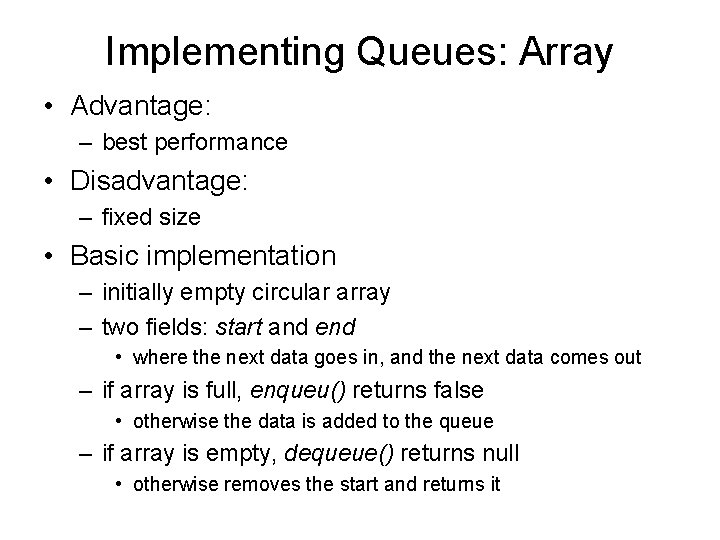
Implementing Queues: Array • Advantage: – best performance • Disadvantage: – fixed size • Basic implementation – initially empty circular array – two fields: start and end • where the next data goes in, and the next data comes out – if array is full, enqueu() returns false • otherwise the data is added to the queue – if array is empty, dequeue() returns null • otherwise removes the start and returns it
Queue Class (array based) class Queue. Array { private Object[ ] queue; private int start, end; public Queue. Array(int size) { queue = new Object[size]; start = end = -1; } public boolean enqueue(Object data); public Object dequeue(); public void clear(); public boolean is. Empty(); public boolean is. Full(); }
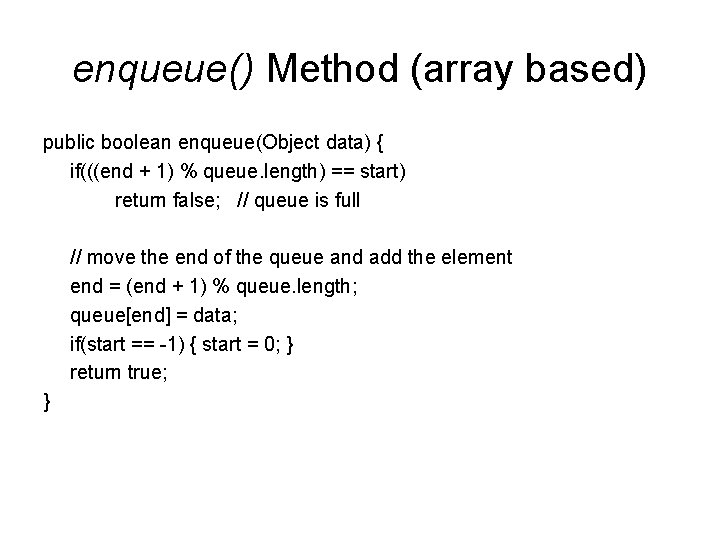
enqueue() Method (array based) public boolean enqueue(Object data) { if(((end + 1) % queue. length) == start) return false; // queue is full // move the end of the queue and add the element end = (end + 1) % queue. length; queue[end] = data; if(start == -1) { start = 0; } return true; }
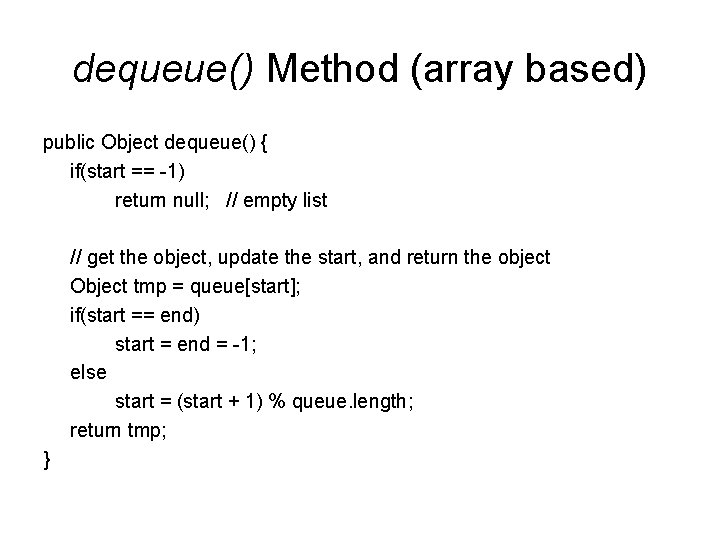
dequeue() Method (array based) public Object dequeue() { if(start == -1) return null; // empty list // get the object, update the start, and return the object Object tmp = queue[start]; if(start == end) start = end = -1; else start = (start + 1) % queue. length; return tmp; }
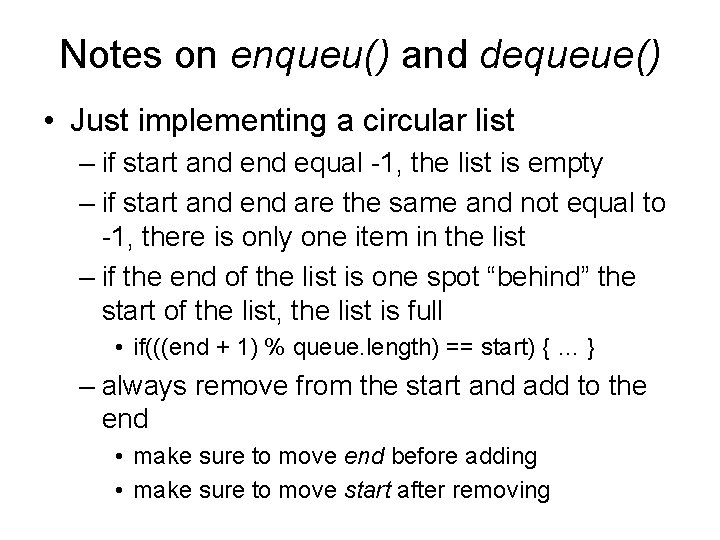
Notes on enqueu() and dequeue() • Just implementing a circular list – if start and equal -1, the list is empty – if start and end are the same and not equal to -1, there is only one item in the list – if the end of the list is one spot “behind” the start of the list, the list is full • if(((end + 1) % queue. length) == start) { … } – always remove from the start and add to the end • make sure to move end before adding • make sure to move start after removing
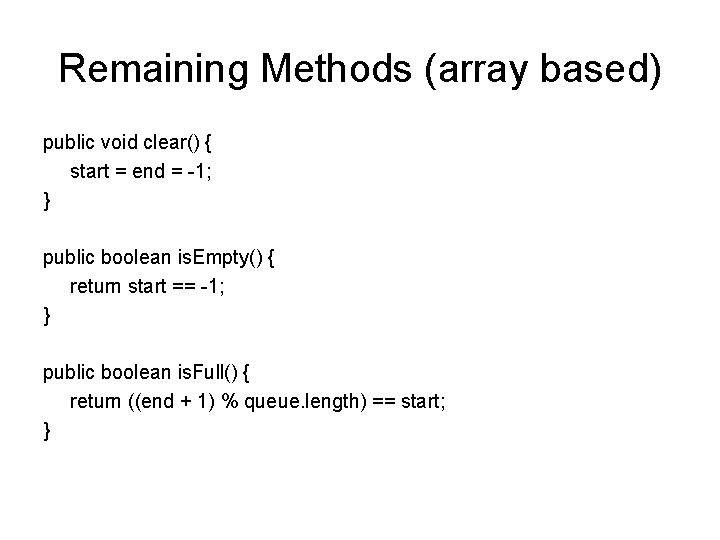
Remaining Methods (array based) public void clear() { start = end = -1; } public boolean is. Empty() { return start == -1; } public boolean is. Full() { return ((end + 1) % queue. length) == start; }
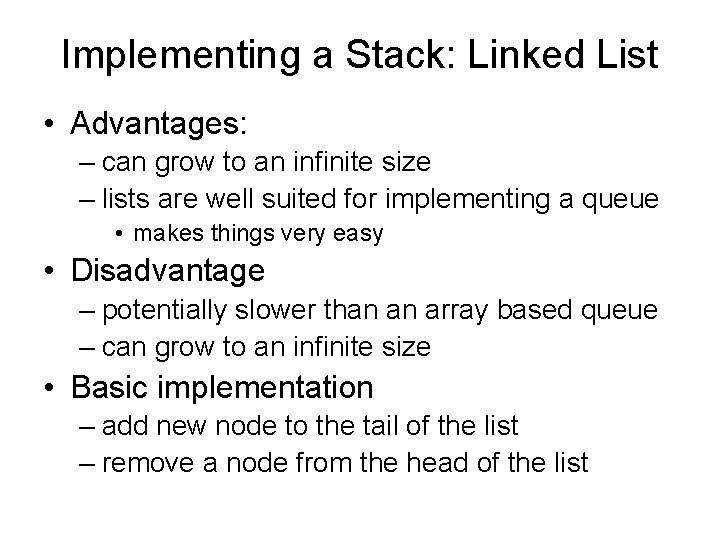
Implementing a Stack: Linked List • Advantages: – can grow to an infinite size – lists are well suited for implementing a queue • makes things very easy • Disadvantage – potentially slower than an array based queue – can grow to an infinite size • Basic implementation – add new node to the tail of the list – remove a node from the head of the list
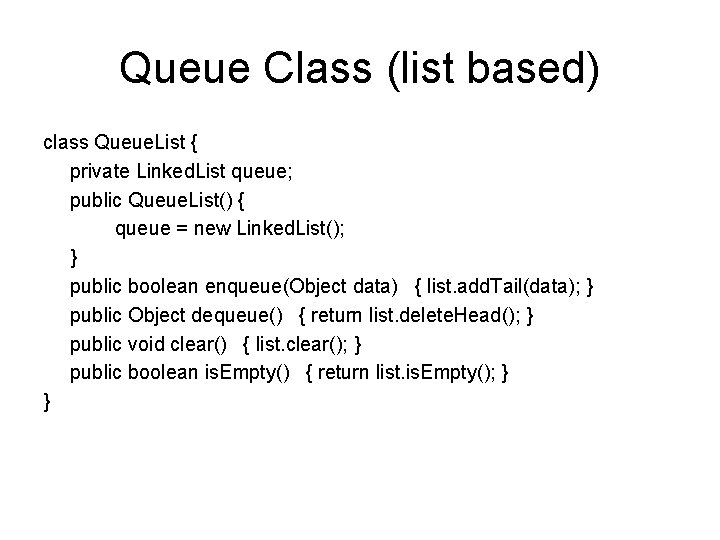
Queue Class (list based) class Queue. List { private Linked. List queue; public Queue. List() { queue = new Linked. List(); } public boolean enqueue(Object data) { list. add. Tail(data); } public Object dequeue() { return list. delete. Head(); } public void clear() { list. clear(); } public boolean is. Empty() { return list. is. Empty(); } }
Additional Notes • It should appear obvious that linked lists are very well suited for queues – add. Tail() and delete. Head() are basically the enque() and dequeue() methods, respectively • Our original list implementation did not have a clear() method – all it has to do is set the head and tail to null • Again, no need for the is. Full() method – list can grow to an infinite size
Priority Queue • Sometimes it is not enough just do FIFO ordering – may want to give some items a higher priority than other items • these should be serviced before lower priority even if they arrived later • Two major ways to implement a priority queue – insert items in a sorted order • always remove the head – insert in unordered order and search list on remove • always add to the tail – either way, time is O(n) • either adding data takes time and removing is quick, or • adding data is quick and removing takes time
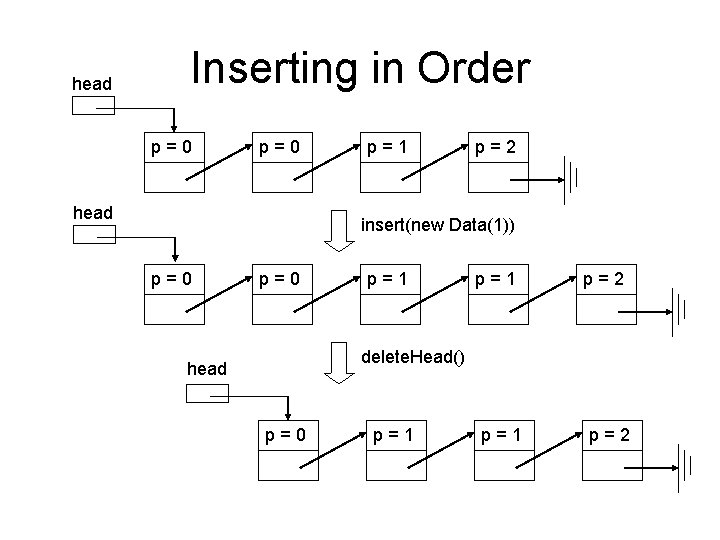
Inserting in Order • Use the very first linked list class shown – only need to use the add() and remove. Head() methods • add() method puts things in the list in order – the compare. To() method (implemented by your data class) should return a value based on priority • usually consider lower number a higher priority – Performance • O(n) to add • O(1) to remove
head Inserting in Order p=0 head p=1 p=2 insert(new Data(1)) p=0 p=1 p=2 delete. Head() head p=0 p=1 p=2
Queue Applications • As with stacks, queues are very common – networking • routers queue packets before sending them out – operating systems • disk scheduling, pipes, sockets, etc. – system modeling and simulation • queueing theory • Any of these queues can be done as a priority queue – consider a disk scheduler • higher priority is given to a job closer to the current position of the disk head • next request done is that closest to the current position
Disk Scheduler • Requests for disk sectors arrive randomly • Disk requests are completed at a much slower rate than disk requests arrive – need to place waiting jobs in a queue • All requests should be placed in a priority queue – jobs closest to the current position get placed closer to the front of the queue • When the current job finishes, the next job is removed from the head of the queue
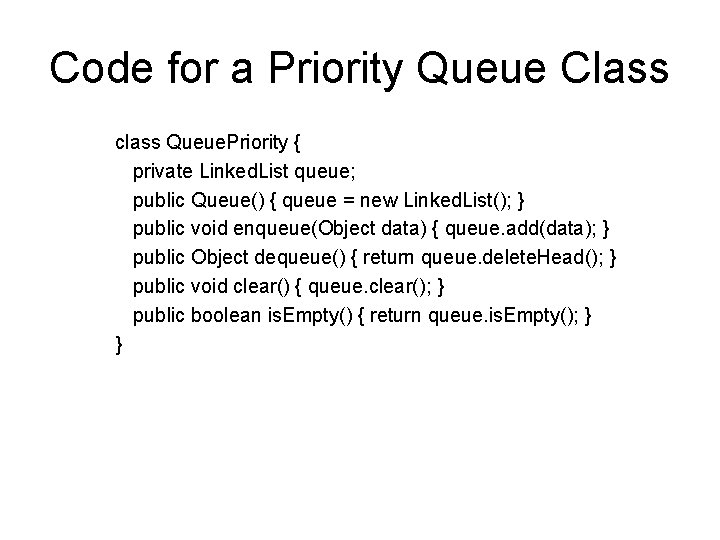
Code for a Priority Queue Class class Queue. Priority { private Linked. List queue; public Queue() { queue = new Linked. List(); } public void enqueue(Object data) { queue. add(data); } public Object dequeue() { return queue. delete. Head(); } public void clear() { queue. clear(); } public boolean is. Empty() { return queue. is. Empty(); } }
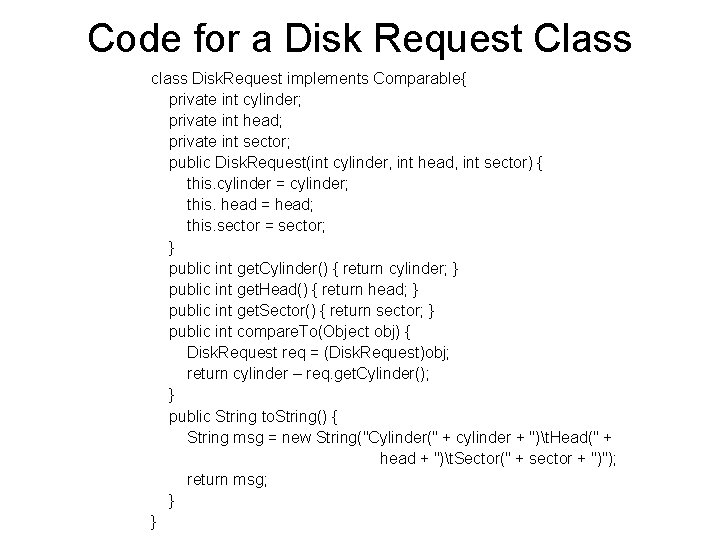
Code for a Disk Request Class class Disk. Request implements Comparable{ private int cylinder; private int head; private int sector; public Disk. Request(int cylinder, int head, int sector) { this. cylinder = cylinder; this. head = head; this. sector = sector; } public int get. Cylinder() { return cylinder; } public int get. Head() { return head; } public int get. Sector() { return sector; } public int compare. To(Object obj) { Disk. Request req = (Disk. Request)obj; return cylinder – req. get. Cylinder(); } public String to. String() { String msg = new String("Cylinder(" + cylinder + ")t. Head(" + head + ")t. Sector(" + sector + ")"); return msg; } }
public static void main(String[] args) { Queue. Priority disk. Queue = new Queue. Priority(); int option = get. Option(); Disk. Request req; while(option != 3) { switch(option) { case 1: req = get. Request(); disk. Queue. enqueue(req); break; case 2: if(disk. Queue. is. Empty()) System. out. println("Disk queue is empty. "); else { req = (Disk. Request)disk. Queue. dequeue(); System. out. println("Removed request: " + req. to. String()); } break; case 3: break; default: System. out. println("Error: invalid entry. "); } option = get. Option(); } }