
QUEUES CICS Training Class08 Introduction to QUEUES Queues

- Slides: 15
QUEUES CICS Training Class-08
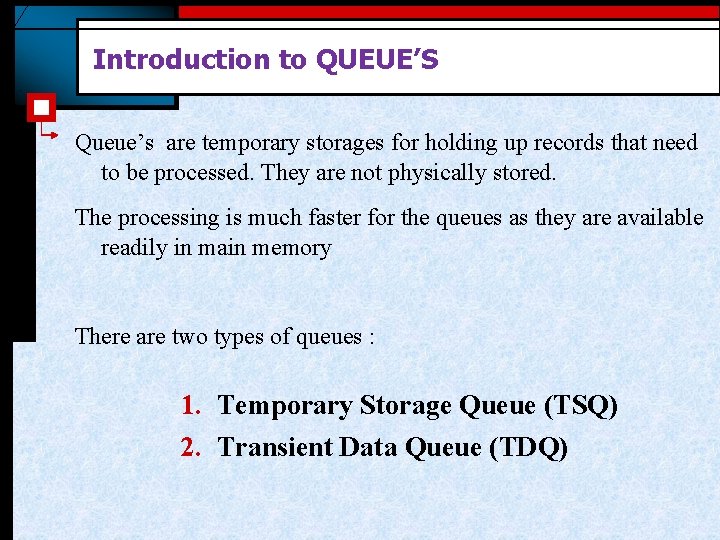
Introduction to QUEUE’S Queue’s are temporary storages for holding up records that need to be processed. They are not physically stored. The processing is much faster for the queues as they are available readily in main memory There are two types of queues : 1. Temporary Storage Queue (TSQ) 2. Transient Data Queue (TDQ)
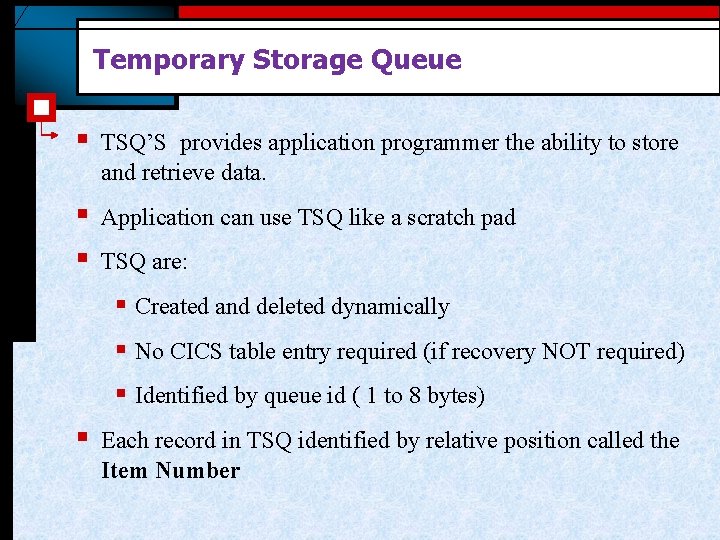
Temporary Storage Queue § TSQ’S provides application programmer the ability to store and retrieve data. § § Application can use TSQ like a scratch pad TSQ are: § Created and deleted dynamically § No CICS table entry required (if recovery NOT required) § Identified by queue id ( 1 to 8 bytes) § Each record in TSQ identified by relative position called the Item Number
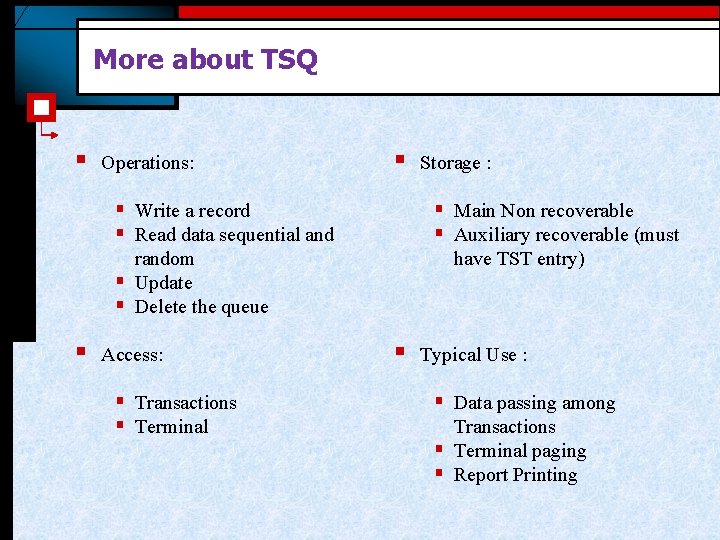
More about TSQ § Operations: § § Write a record § Read data sequential and § Main Non recoverable § Auxiliary recoverable (must random § Update § Delete the queue § Access: § Transactions § Terminal Storage : have TST entry) § Typical Use : § Data passing among Transactions § Terminal paging § Report Printing
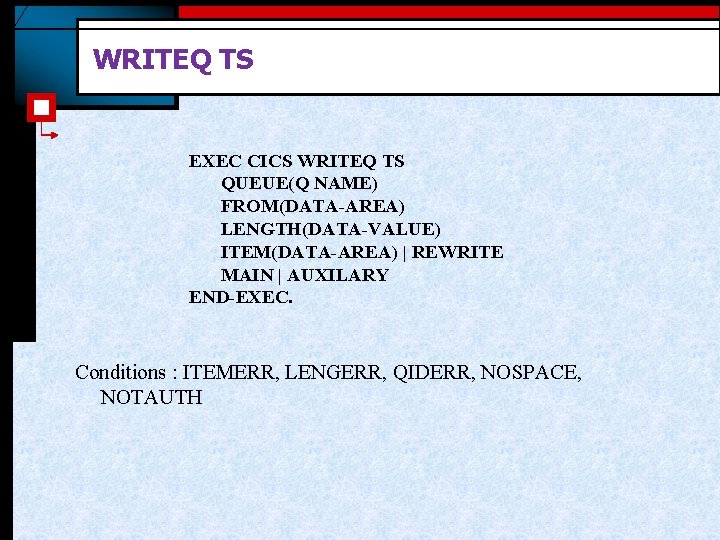
WRITEQ TS EXEC CICS WRITEQ TS QUEUE(Q NAME) FROM(DATA-AREA) LENGTH(DATA-VALUE) ITEM(DATA-AREA) | REWRITE MAIN | AUXILARY END-EXEC. Conditions : ITEMERR, LENGERR, QIDERR, NOSPACE, NOTAUTH
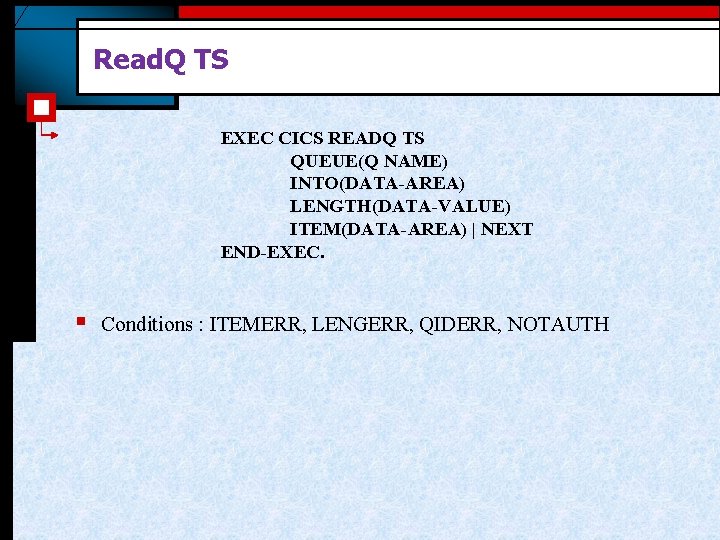
Read. Q TS EXEC CICS READQ TS QUEUE(Q NAME) INTO(DATA-AREA) LENGTH(DATA-VALUE) ITEM(DATA-AREA) | NEXT END-EXEC. § Conditions : ITEMERR, LENGERR, QIDERR, NOTAUTH
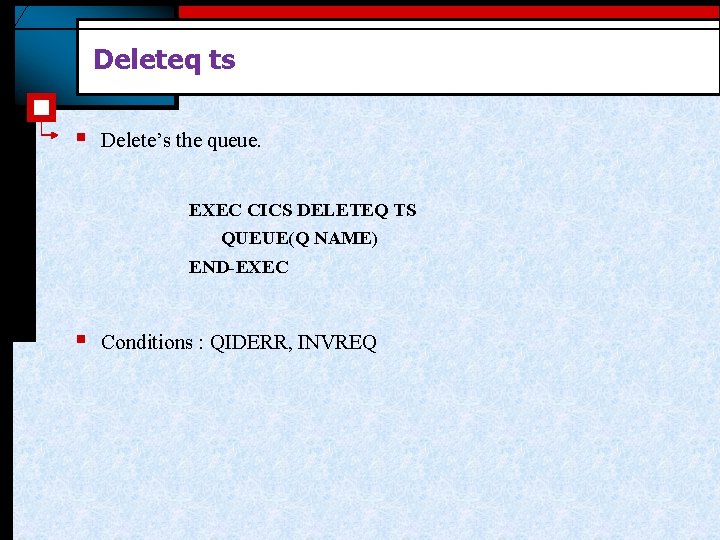
Deleteq ts § Delete’s the queue. EXEC CICS DELETEQ TS QUEUE(Q NAME) END-EXEC § Conditions : QIDERR, INVREQ
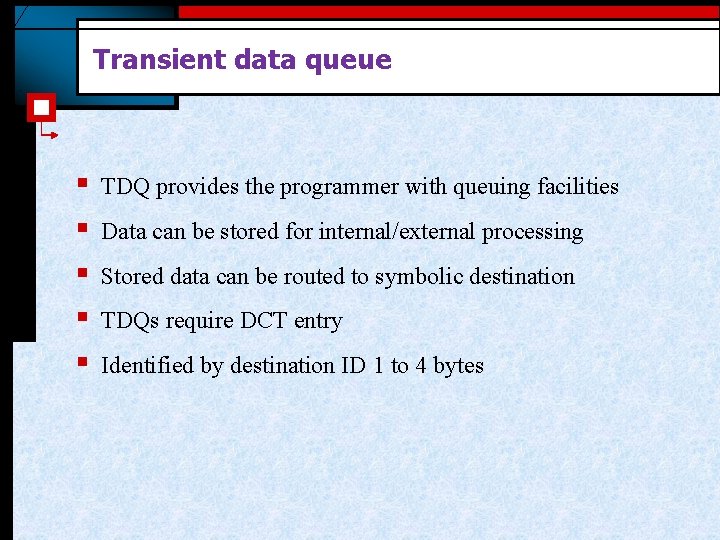
Transient data queue § § § TDQ provides the programmer with queuing facilities Data can be stored for internal/external processing Stored data can be routed to symbolic destination TDQs require DCT entry Identified by destination ID 1 to 4 bytes
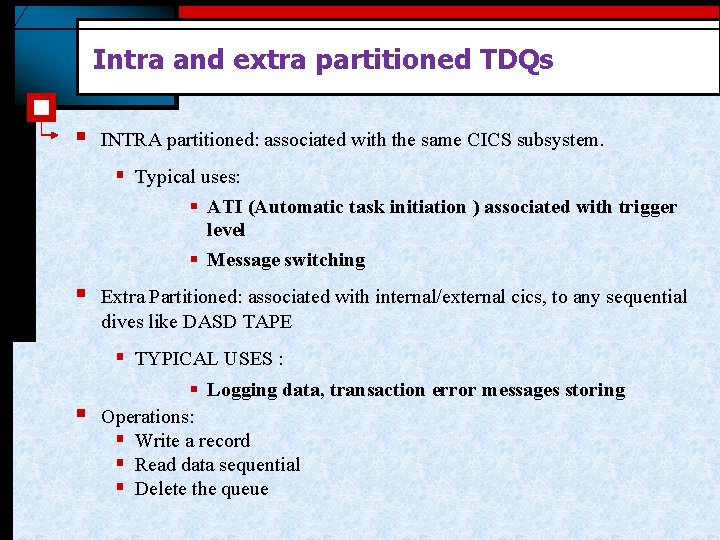
Intra and extra partitioned TDQs § INTRA partitioned: associated with the same CICS subsystem. § Typical uses: § ATI (Automatic task initiation ) associated with trigger level § Message switching § Extra Partitioned: associated with internal/external cics, to any sequential dives like DASD TAPE § TYPICAL USES : § § Logging data, transaction error messages storing Operations: § Write a record § Read data sequential § Delete the queue
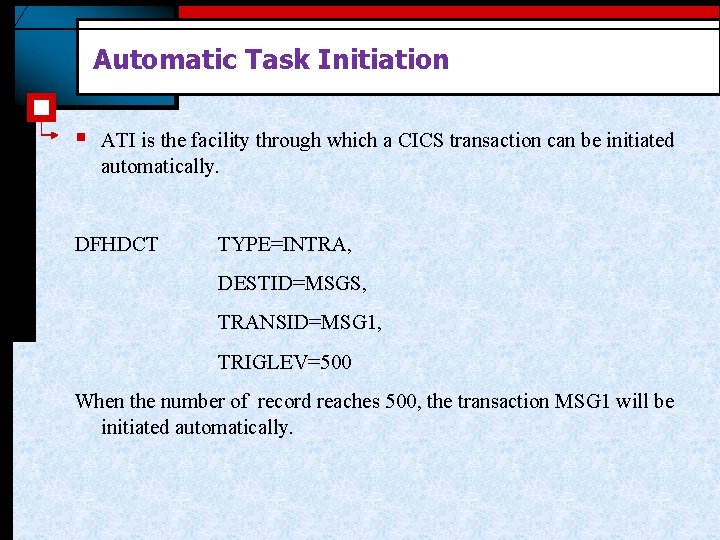
Automatic Task Initiation § ATI is the facility through which a CICS transaction can be initiated automatically. DFHDCT TYPE=INTRA, DESTID=MSGS, TRANSID=MSG 1, TRIGLEV=500 When the number of record reaches 500, the transaction MSG 1 will be initiated automatically.
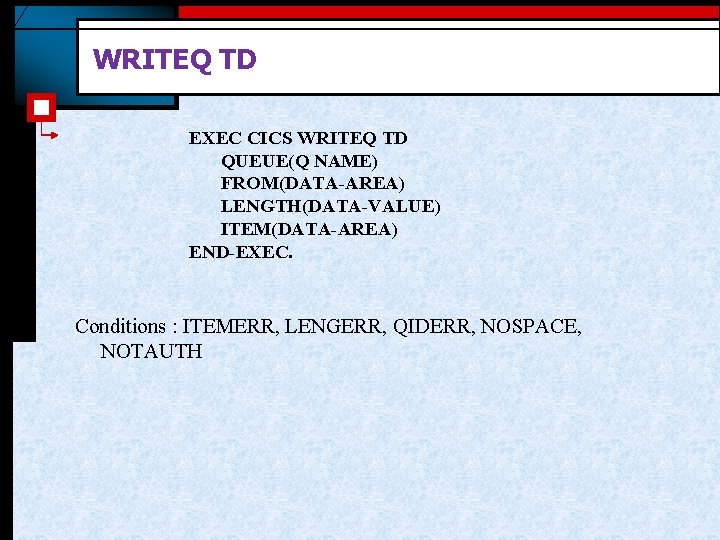
WRITEQ TD EXEC CICS WRITEQ TD QUEUE(Q NAME) FROM(DATA-AREA) LENGTH(DATA-VALUE) ITEM(DATA-AREA) END-EXEC. Conditions : ITEMERR, LENGERR, QIDERR, NOSPACE, NOTAUTH
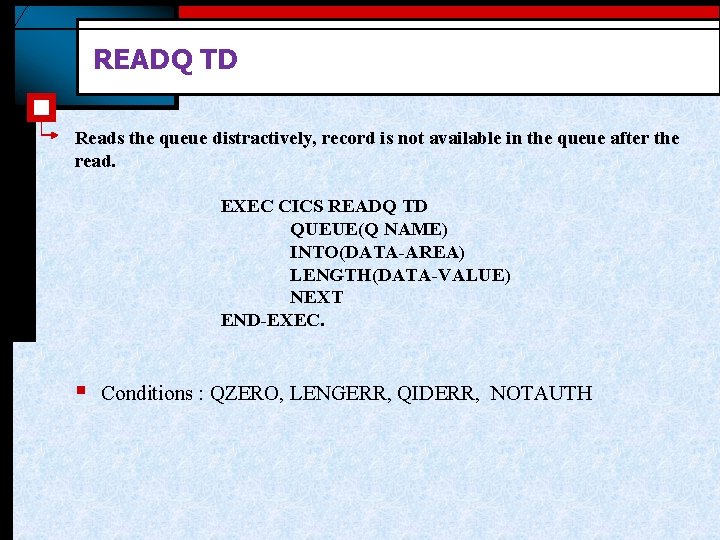
READQ TD Reads the queue distractively, record is not available in the queue after the read. EXEC CICS READQ TD QUEUE(Q NAME) INTO(DATA-AREA) LENGTH(DATA-VALUE) NEXT END-EXEC. § Conditions : QZERO, LENGERR, QIDERR, NOTAUTH
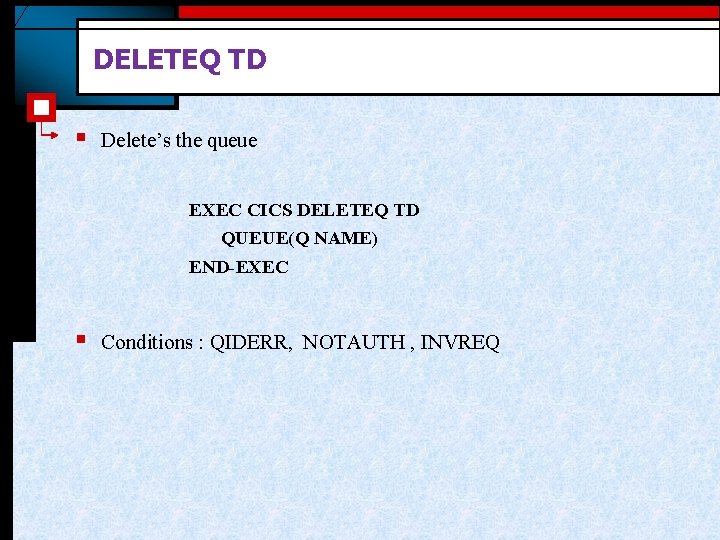
DELETEQ TD § Delete’s the queue EXEC CICS DELETEQ TD QUEUE(Q NAME) END-EXEC § Conditions : QIDERR, NOTAUTH , INVREQ
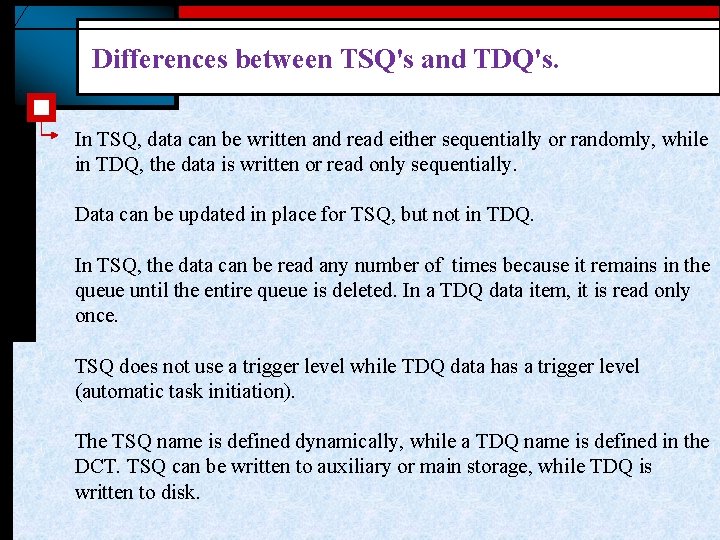
Differences between TSQ's and TDQ's. In TSQ, data can be written and read either sequentially or randomly, while in TDQ, the data is written or read only sequentially. Data can be updated in place for TSQ, but not in TDQ. In TSQ, the data can be read any number of times because it remains in the queue until the entire queue is deleted. In a TDQ data item, it is read only once. TSQ does not use a trigger level while TDQ data has a trigger level (automatic task initiation). The TSQ name is defined dynamically, while a TDQ name is defined in the DCT. TSQ can be written to auxiliary or main storage, while TDQ is written to disk.
Thank You Polsani Anil Kumar