
Queues 2014 Goodrich Tamassia Goldwasser Queues 1 The
- Slides: 15
Queues © 2014 Goodrich, Tamassia, Goldwasser Queues 1
The Queue ADT q q q The Queue ADT stores arbitrary objects Insertions and deletions follow the first-in first-out scheme (FIFO) Insertions are at the rear of the queue and removals are at the front of the queue © 2014 Goodrich, Tamassia, Goldwasser Queues 2
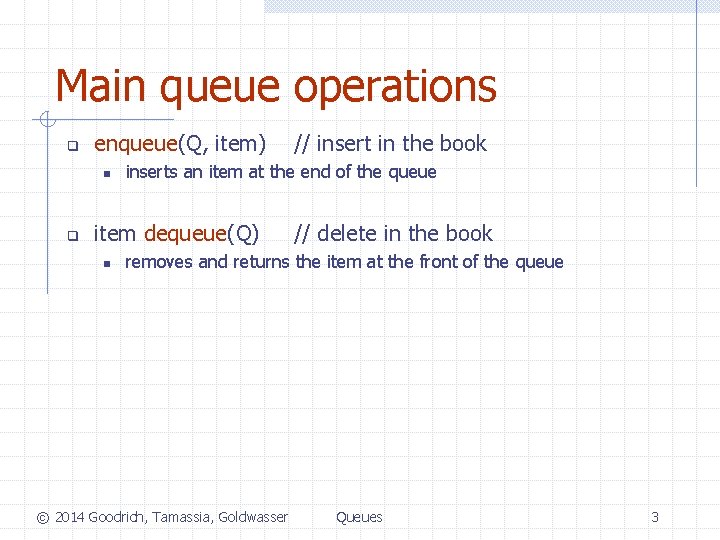
Main queue operations q enqueue(Q, item) n q inserts an item at the end of the queue item dequeue(Q) n // insert in the book // delete in the book removes and returns the item at the front of the queue © 2014 Goodrich, Tamassia, Goldwasser Queues 3
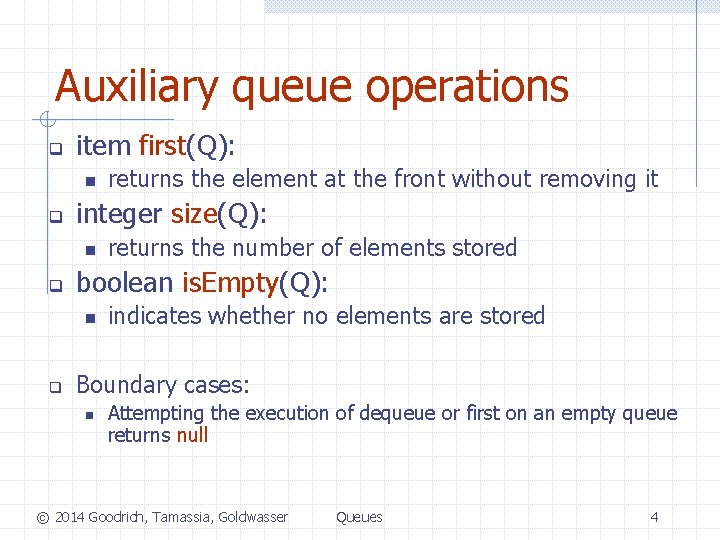
Auxiliary queue operations q item first(Q): n q integer size(Q): n q returns the number of elements stored boolean is. Empty(Q): n q returns the element at the front without removing it indicates whether no elements are stored Boundary cases: n Attempting the execution of dequeue or first on an empty queue returns null © 2014 Goodrich, Tamassia, Goldwasser Queues 4
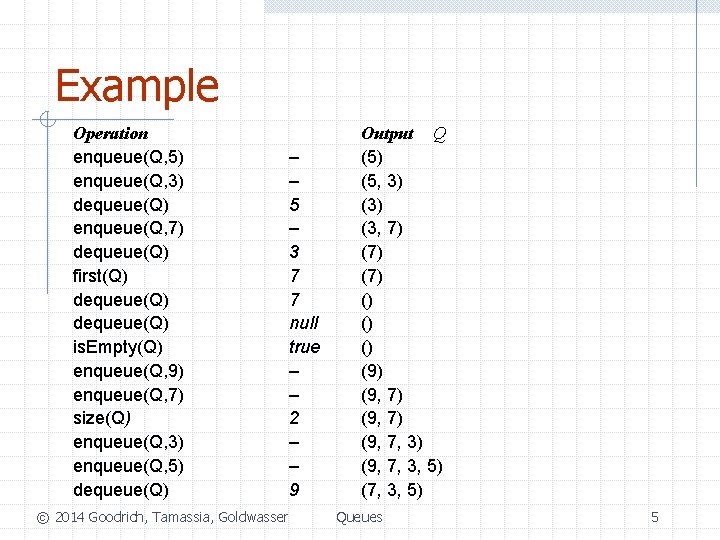
Example Operation enqueue(Q, 5) enqueue(Q, 3) dequeue(Q) enqueue(Q, 7) dequeue(Q) first(Q) dequeue(Q) is. Empty(Q) enqueue(Q, 9) enqueue(Q, 7) size(Q) enqueue(Q, 3) enqueue(Q, 5) dequeue(Q) – – 5 – 3 7 7 null true – – 2 – – 9 © 2014 Goodrich, Tamassia, Goldwasser Output Q (5) (5, 3) (3, 7) (7) () (9) (9, 7) (9, 7, 3, 5) (7, 3, 5) Queues 5
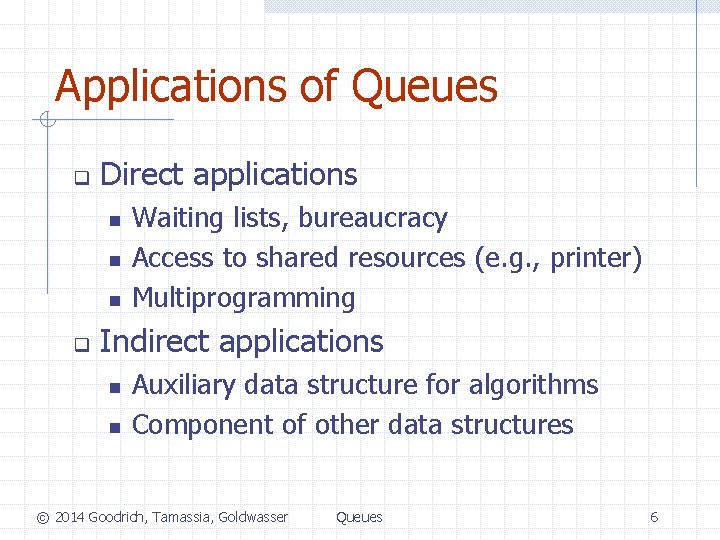
Applications of Queues q Direct applications n n n q Waiting lists, bureaucracy Access to shared resources (e. g. , printer) Multiprogramming Indirect applications n n Auxiliary data structure for algorithms Component of other data structures © 2014 Goodrich, Tamassia, Goldwasser Queues 6
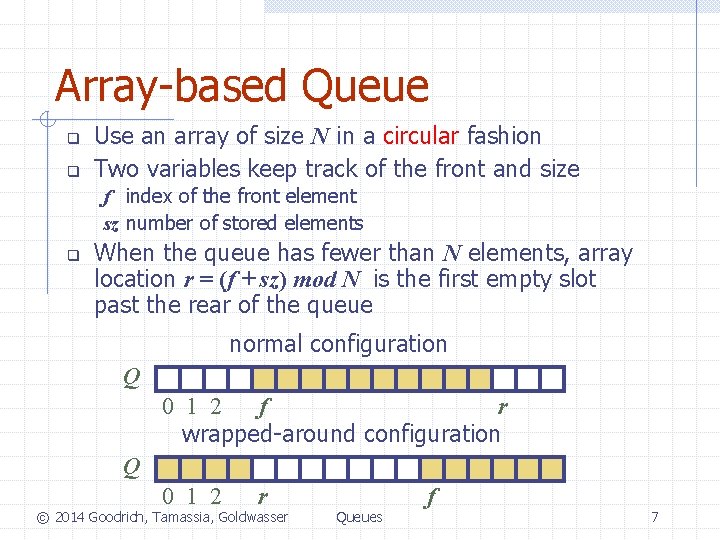
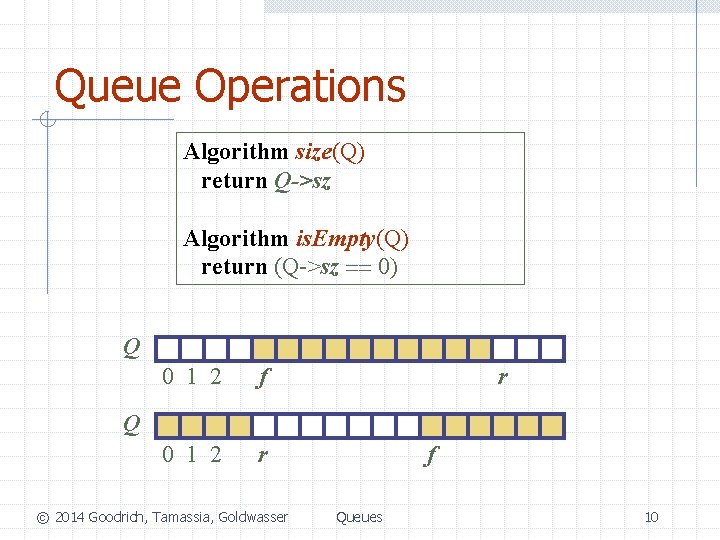
Array-based Queue q q Use an array of size N in a circular fashion Two variables keep track of the front and size f index of the front element sz number of stored elements q When the queue has fewer than N elements, array location r = (f + sz) mod N is the first empty slot past the rear of the queue normal configuration Q 0 1 2 f r wrapped-around configuration Q 0 1 2 r © 2014 Goodrich, Tamassia, Goldwasser Queues f 7
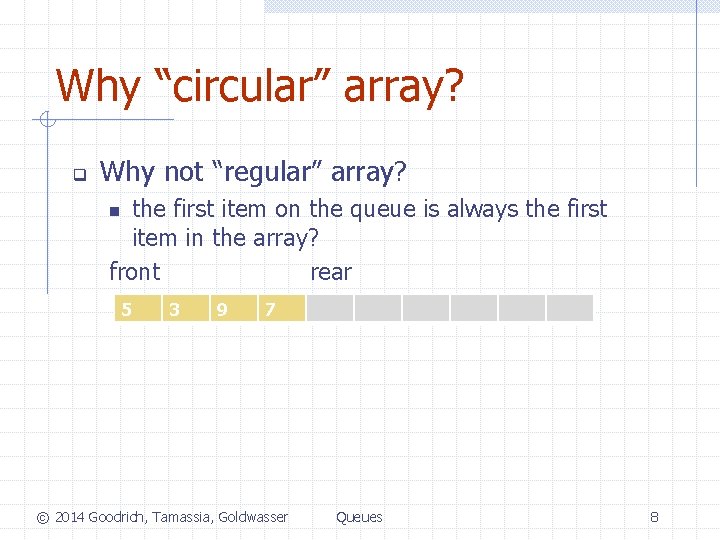
Why “circular” array? q Why not “regular” array? the first item on the queue is always the first item in the array? front rear n 5 3 9 7 © 2014 Goodrich, Tamassia, Goldwasser Queues 8
Can we use a linked list to implement a queue? q What are the tradeoffs? © 2014 Goodrich, Tamassia, Goldwasser Queues 9
Queue Operations Algorithm size(Q) return Q->sz Algorithm is. Empty(Q) return (Q->sz == 0) Q 0 1 2 f 0 1 2 r r Q © 2014 Goodrich, Tamassia, Goldwasser f Queues 10
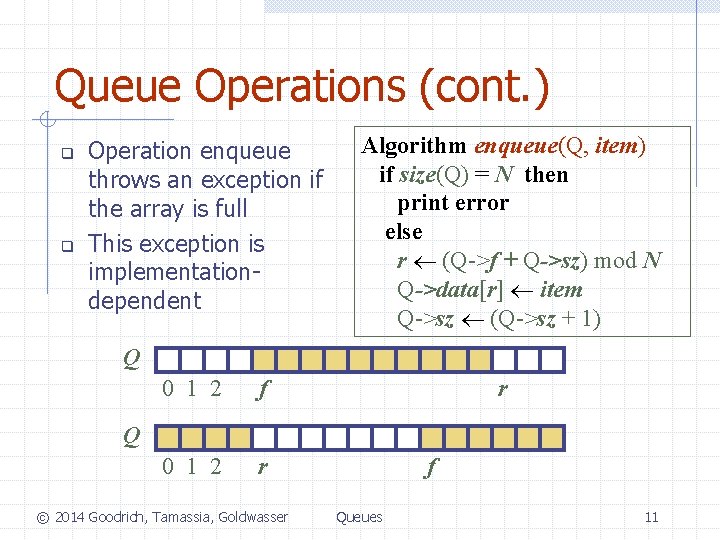
Queue Operations (cont. ) q q Operation enqueue throws an exception if the array is full This exception is implementationdependent Algorithm enqueue(Q, item) if size(Q) = N then print error else r (Q->f + Q->sz) mod N Q->data[r] item Q->sz (Q->sz + 1) Q 0 1 2 f 0 1 2 r r Q © 2014 Goodrich, Tamassia, Goldwasser f Queues 11
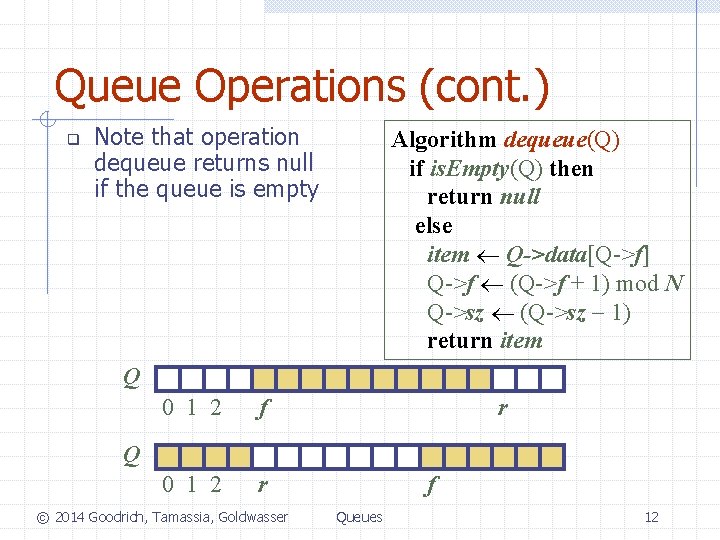
Queue Operations (cont. ) q Note that operation dequeue returns null if the queue is empty Algorithm dequeue(Q) if is. Empty(Q) then return null else item Q->data[Q->f] Q->f (Q->f + 1) mod N Q->sz (Q->sz - 1) return item Q 0 1 2 f 0 1 2 r r Q © 2014 Goodrich, Tamassia, Goldwasser f Queues 12
Worst-case time complexity N items on the queue Operation “Circular Array” “Normal” Array Linked List (head & tail) enqueue dequeue © 2014 Goodrich, Tamassia, Goldwasser Queues 13
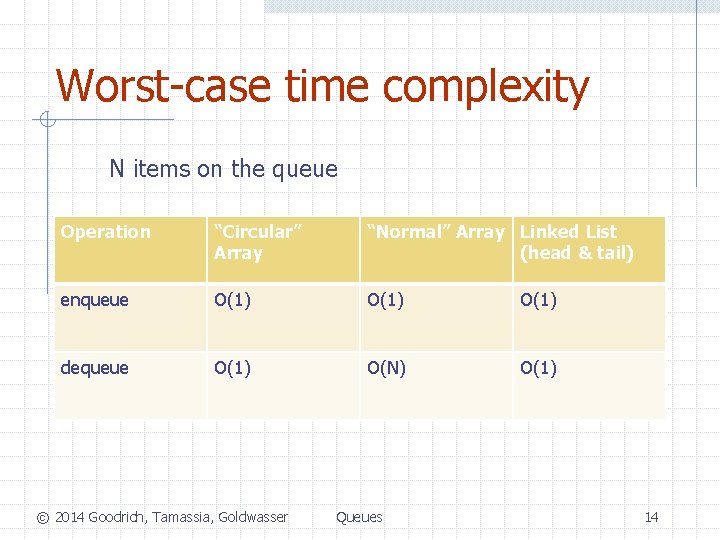
Worst-case time complexity N items on the queue Operation “Circular” Array “Normal” Array Linked List (head & tail) enqueue O(1) dequeue O(1) O(N) O(1) © 2014 Goodrich, Tamassia, Goldwasser Queues 14
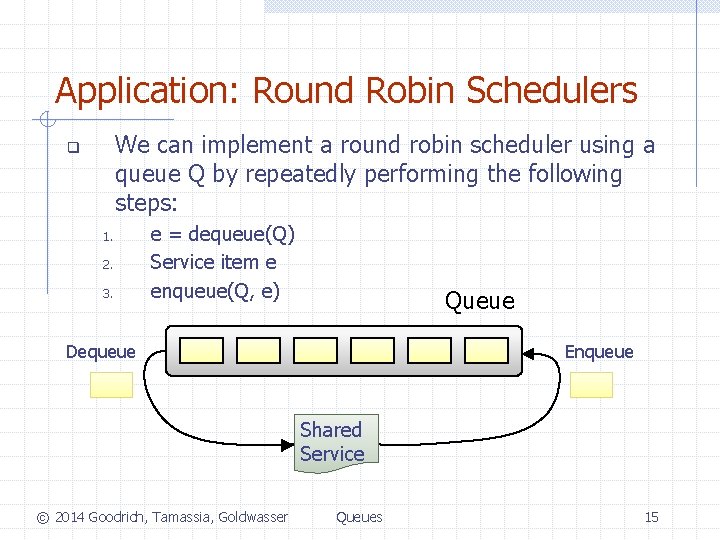
Application: Round Robin Schedulers We can implement a round robin scheduler using a queue Q by repeatedly performing the following steps: q 1. 2. 3. e = dequeue(Q) Service item e enqueue(Q, e) Queue Dequeue Enqueue Shared Service © 2014 Goodrich, Tamassia, Goldwasser Queues 15