
Questions to Consider 1 What is the difference


- Slides: 17
Questions to Consider 1. What is the difference between Insurance and assurance? Please use an example in your answer. 2. Explain the 5 principles of insurance? 3. What are meant by the following key terms: No claims bonus, actuary, insurance broker, insurance agent, excess clause, proposal form, average clause. 1. Work on calculations for average clause, house, motor, life insurance/assurance
Insurance and Assurance • Insurance is the protection against something that might happen, e. g. a car insurance for car crash or house insurance for your house going on fire • Assurance is protection against something that will happen, e. g. life assurance because you will die
Insurance and Assurance • With insurance/ assurance, the worry of the risk is shared in a fund run by the insurance company • The people who suffer a loss claim compensation. This can be in the form of money or replacement item, e. g. € 2000 for car crash injury or replacement phone if you have lost yours
Principles of Insurance • Sometimes, people can make fraudulent claims for insurance. To prevent this from happening, the insurance industry has rules, known as the 5 Principles of Insurance • These principles are: 1. Utmost Good Faith 2. Insurable Interest 3. Indemnity 4. Contribution 5. Subrogation
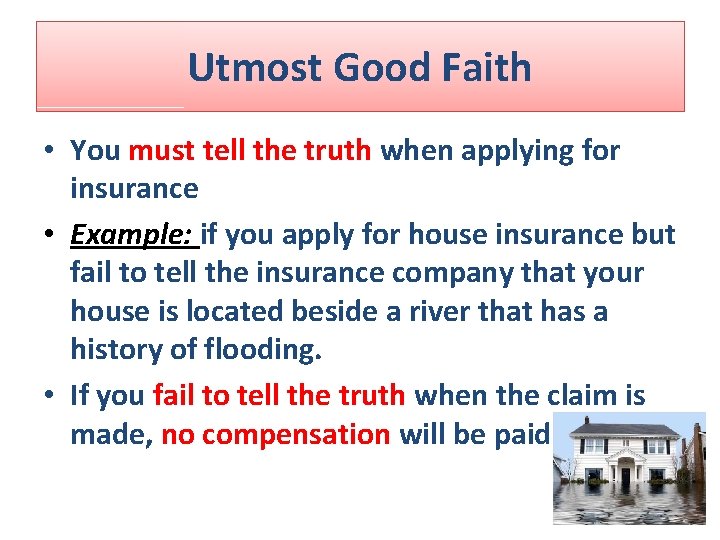
Utmost Good Faith • You must tell the truth when applying for insurance • Example: if you apply for house insurance but fail to tell the insurance company that your house is located beside a river that has a history of flooding. • If you fail to tell the truth when the claim is made, no compensation will be paid
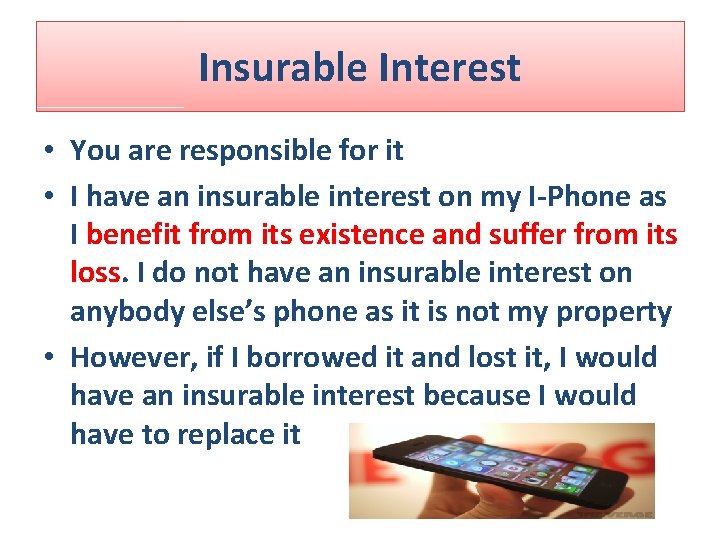
Insurable Interest • You are responsible for it • I have an insurable interest on my I-Phone as I benefit from its existence and suffer from its loss. I do not have an insurable interest on anybody else’s phone as it is not my property • However, if I borrowed it and lost it, I would have an insurable interest because I would have to replace it
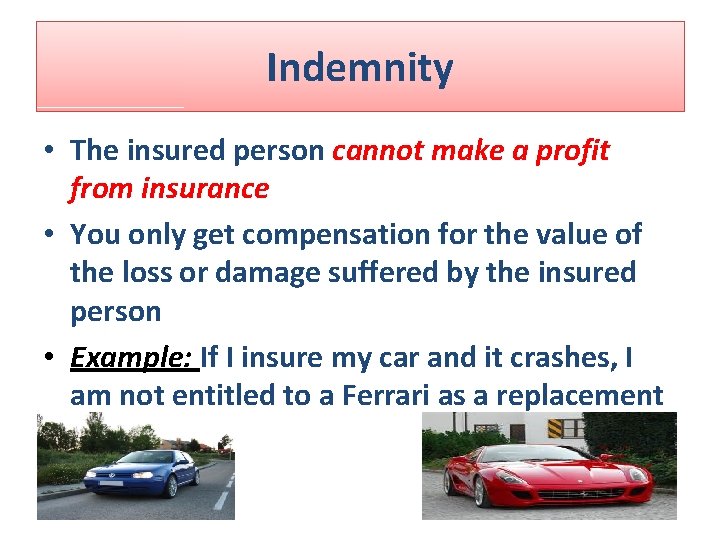
Indemnity • The insured person cannot make a profit from insurance • You only get compensation for the value of the loss or damage suffered by the insured person • Example: If I insure my car and it crashes, I am not entitled to a Ferrari as a replacement
Contribution • The insurance company will share the indemnity between them if somebody fully insures an item between more than one insurance company • Example: I insure my car for its value (€ 2, 000) with Quinn for € 2000 and Aviva for € 1000. I have a crash causing € 1500 damage • Remember: I cannot make a profit on insurance, In the event of a claim, Quinn will pay me 2/3 and Aviva will pay me 1/3.
Subrogation • Once the insurance company fully pays out to the insured person, then all savage rights pass to the insurance company • Example: If your car is written off as a result of a crash, your insurance company fully indemnifies you (put you back in original position before loss occurred). The insurance company now has the right to sell off scraps from the car as otherwise you would have made a profit
Applying For Insurance Actuary: Person who calculates insurance premiums based on risk involved Insurance Policy: The actual contract of insurance which contains all necessary details such as age, medical history etc
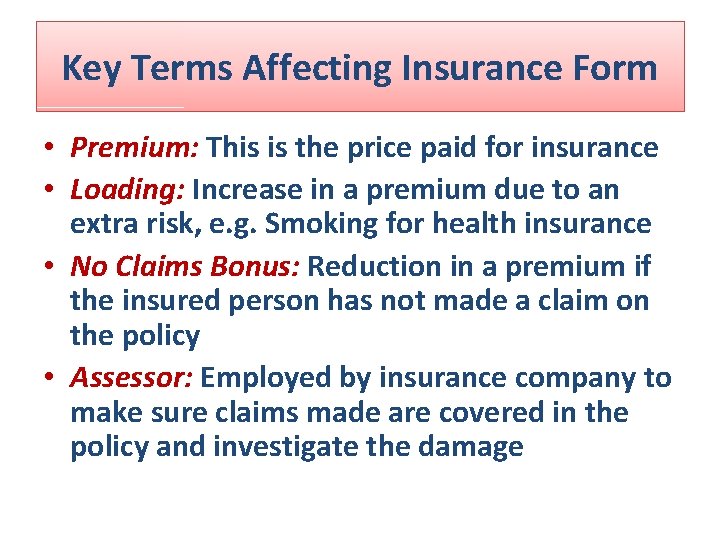
Key Terms Affecting Insurance Form • Premium: This is the price paid for insurance • Loading: Increase in a premium due to an extra risk, e. g. Smoking for health insurance • No Claims Bonus: Reduction in a premium if the insured person has not made a claim on the policy • Assessor: Employed by insurance company to make sure claims made are covered in the policy and investigate the damage
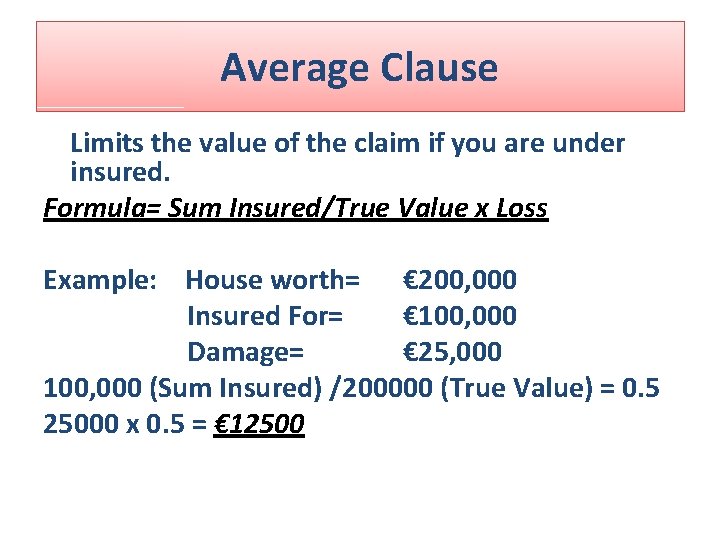
Average Clause Limits the value of the claim if you are under insured. Formula= Sum Insured/True Value x Loss Example: House worth= € 200, 000 Insured For= € 100, 000 Damage= € 25, 000 100, 000 (Sum Insured) /200000 (True Value) = 0. 5 25000 x 0. 5 = € 12500
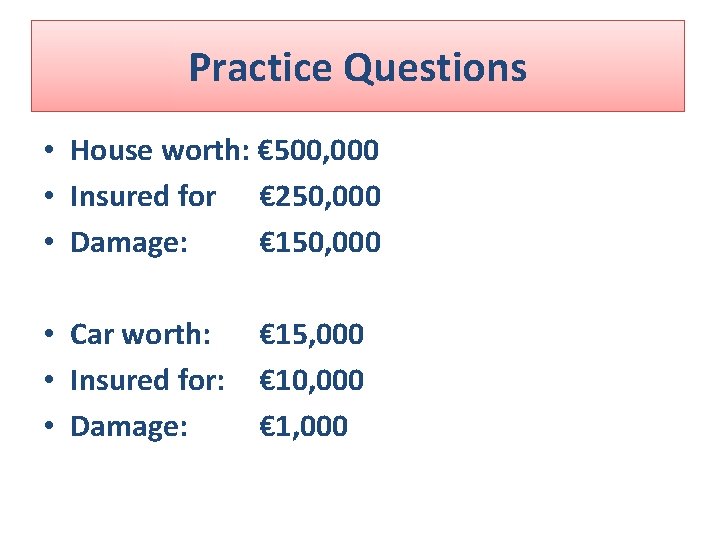
Practice Questions • House worth: € 500, 000 • Insured for € 250, 000 • Damage: € 150, 000 • Car worth: • Insured for: • Damage: € 15, 000 € 10, 000 € 1, 000
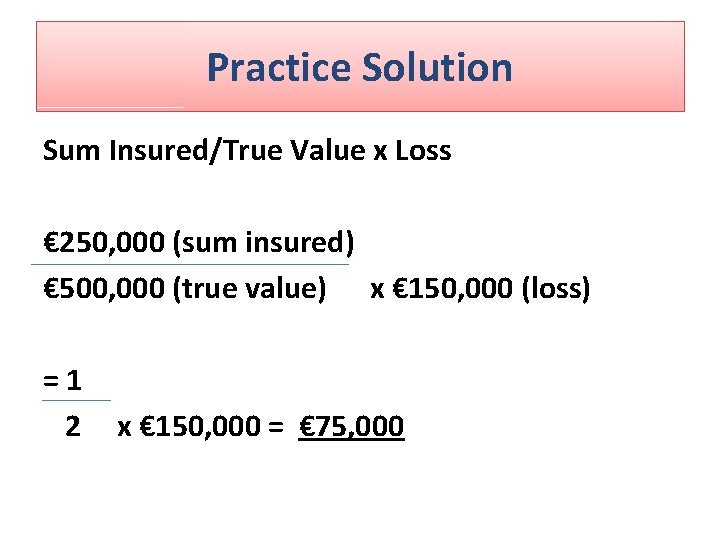
Practice Solution Sum Insured/True Value x Loss € 250, 000 (sum insured) € 500, 000 (true value) x € 150, 000 (loss) =1 2 x € 150, 000 = € 75, 000
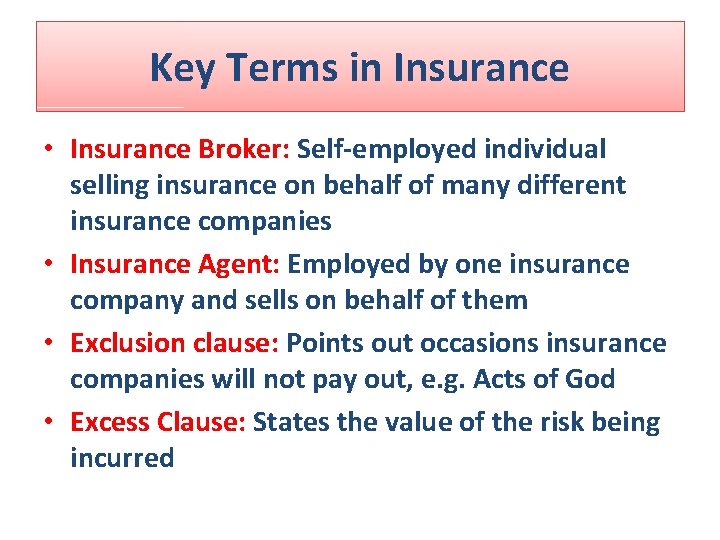
Key Terms in Insurance • Insurance Broker: Self-employed individual selling insurance on behalf of many different insurance companies • Insurance Agent: Employed by one insurance company and sells on behalf of them • Exclusion clause: Points out occasions insurance companies will not pay out, e. g. Acts of God • Excess Clause: States the value of the risk being incurred
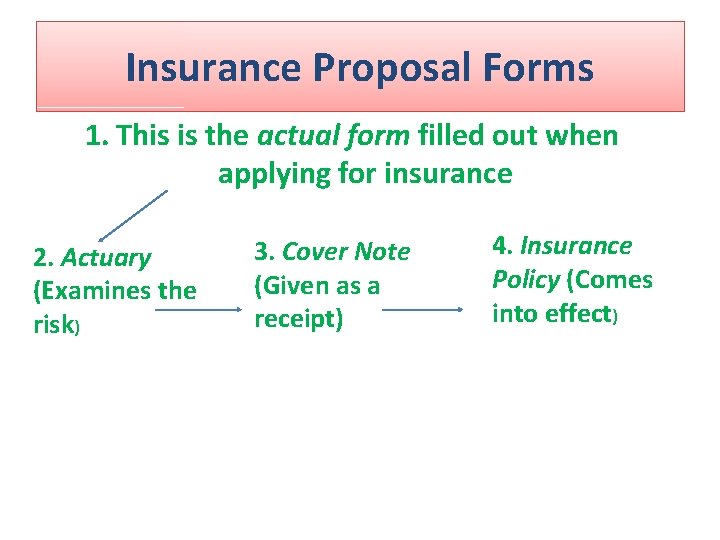
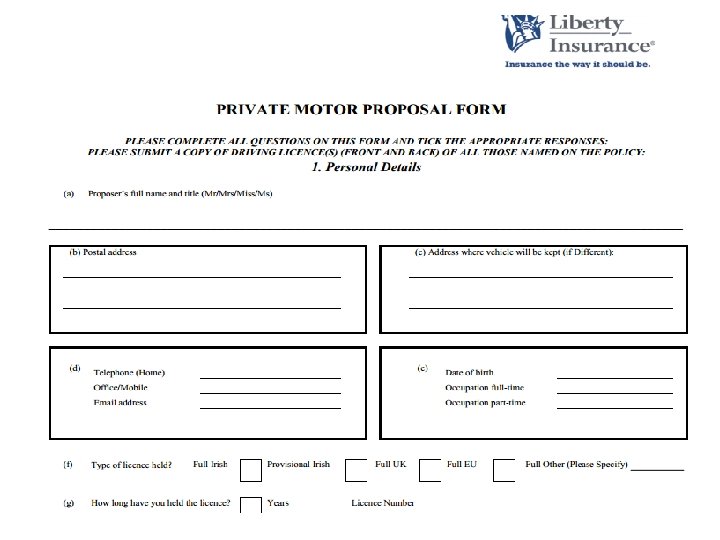
Insurance Proposal Forms 1. This is the actual form filled out when applying for insurance 2. Actuary (Examines the risk) 3. Cover Note (Given as a receipt) 4. Insurance Policy (Comes into effect)