
QUESTIONNAIRES QUESTIONNAIRES Besides face to face interviews questionnaires
QUESTIONNAIRES
QUESTIONNAIRES Besides face to face interviews, questionnaires can also be used to survey attitudes find out opinion or knowledge of large number of people. A questionnaire can be a useful tool for gathering information. It can be used for survey research, gathering data or testing a hypothesis. For a questionnaire to be effective and give you the information you are looking for, you will need to design a survey that is easy to understand easy to complete.
BASIC RULES FOR QUESTIONNAIRE ITEM CONSTRUCTION Use statements which are interpreted in the same way by members of different members of population of interest. Use clear and comprehensible wording, easily understandable for all educational levels Don’t use any jargon or abbreviations which might be unknown to some of your target sample. Use correct spelling, grammar and punctuation. Avoid items that contain more than one question per item e. g. “Do you like strawberries and potatoes? ” Questions should not be biased. Use positive statements and avoid negatives. Do not make assumptions about the respondents.
Keeping your respondents in mind write a brief introduction stating the purpose of the questionnaire and explaining how the results will be used. Clear instructions need to be given on how to answer the questionnaire. Estimate the amount of time that will be taken in filling out the questionnaire and where ever possible pass on this information orally
QUESTION SEQUENCE Questions should flow logically from one to the next. You may group questions wither to form or subject and see that one question lead to another. It is advisable to begin with general questions, gradually moving on to more complicated ones. To achieve the best response rate, questions should flow from the least sensitive to the most sensitive, and from the more general to the more specific. The format of the questionnaire should be attractive. Do not try to save paper and crowd all the questions on one page. As space for answering open ended questions is required, it is advisable to place these questions at the end of the questionnaire.
There typically is a flow that should be followed when constructing a questionnaire in regards to the order that the questions are asked. The order is as follows: Screens Warm-ups Transitions Skips Difficult Classification
Screens are used as a screening method to find out early whether or not someone should complete the questionnaire. Warm-ups are simple to answer, help capture interest in the survey, and may not even pertain to research objectives. Transition questions are used to make different areas flow well together.
Skips include questions similar to "If yes, then answer question 3. If no, then continue to question. Difficult questions are towards the end because the respondent is in "response mode. “ Classification, or demographic question should be at the end because typically they can feel like personal questions which will make respondents uncomfortable and not willing to finish survey.
HOW TO MAKE A QUESTIONNAIRE Figure out what information you are trying to gather from this survey What is your main objective in doing the questionnaire? What information do you need from the respondents in order to meet your objectives? � Think of questions that will address your objectives and get answers for your questions. � You should also make sure that your questions are not redundant or not specific to your topic. � You should not include any questions that do not gather information that is directly useful in your research. � � Decide what you would like to learn from your questionnaire. This will help you come up with questions to ask and the order in which to ask them. � Ask yourself how you will use the data you obtain and set goals from there. �
Start writing out questions that can help you reach your goals. �Start with questions that are easy to understand easy to answer. �Easy questions help encourage your participants to want to finish answering the rest of the questions. �Group like topics together rather than skipping around from topic to topic. �Keep the questions and answers simple, using as few words as possible. �Be careful not to lead your respondents into choosing an answer that doesn't truly match up with their beliefs.
Put the more important questions at the beginning of your questionnaire. � Often, participants can lose interest by the end, especially if the survey is rather lengthy. If there any questions that are of more importance and that you want your respondents to focus on, place them towards the beginning of your questionnaire.
Add a little variety to your questions. � While closed questions are best for ease of answering and analyzing purposes, adding in a couple of open ended questions helps keep respondents from becoming bored. � Open ended questions require respondents to write out their answers and include some detail.
For closed-ended questions, give a list of possible answers; for example, "Strongly agree, neither agree nor disagree, disagree or strongly disagree. " � You can use the same scale with ranking importance, satisfaction or likeliness to do an activity. � Yes or no questions also work well, as do true/false questions. For open-ended questions, make the questions as specific as possible so your respondent doesn't ramble on when trying to give an answer. This type of question is good for getting clarification on a previous question ("Why do you feel this way? ") or getting an opinion without taking the chance that you're leading the respondent to answer in a certain manner.
Avoid leading questions � These are questions which presume a specific response. For example, � Which train company do you use most often? presumes that the respondent travels by train. If they don’t, they can’t answer.
Consider the question of secrecy � If your questionnaire contains sensitive or personal questions, you need to convince potential respondents that their answers will be confidential. If not, they will not respond.
Use follow-up reminders � Your target respondent may have every intention of replying, but has got lots of other important things to do to, so a polite reminder (or two) may be necessary. � This is probably best done by email or phone. � You might have more chance of a response on a Friday than a Monday.
Test your questionnaire before you begin surveying people; friends, employees and family can be good testers. � You may need to reword some things, rearrange questions, make additions or delete questions that don't help you reach your end goal. � After you test, do trial to ensure you can properly collect the data you need; if not, make more adjustments to the questionnaire.
A FEW EXAMPLES OF OPEN QUESTIONS From your experiences with the University Health Center (UHC) what advice would you offer students regarding making appointments with the doctor? ____________________________________
What kind of services do you expect to find at the UHC? ____________________________________
How can the working of the UHC be improved? ____________________________________
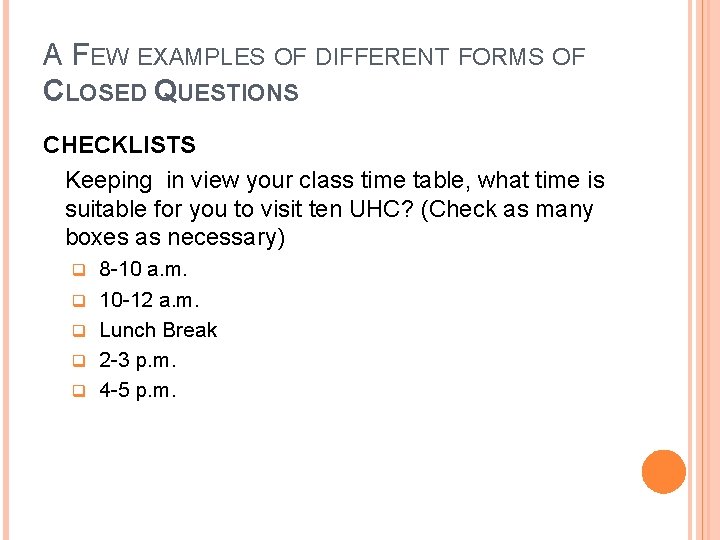
A FEW EXAMPLES OF DIFFERENT FORMS OF CLOSED QUESTIONS CHECKLISTS Keeping in view your class time table, what time is suitable for you to visit ten UHC? (Check as many boxes as necessary) q q q 8 -10 a. m. 10 -12 a. m. Lunch Break 2 -3 p. m. 4 -5 p. m.
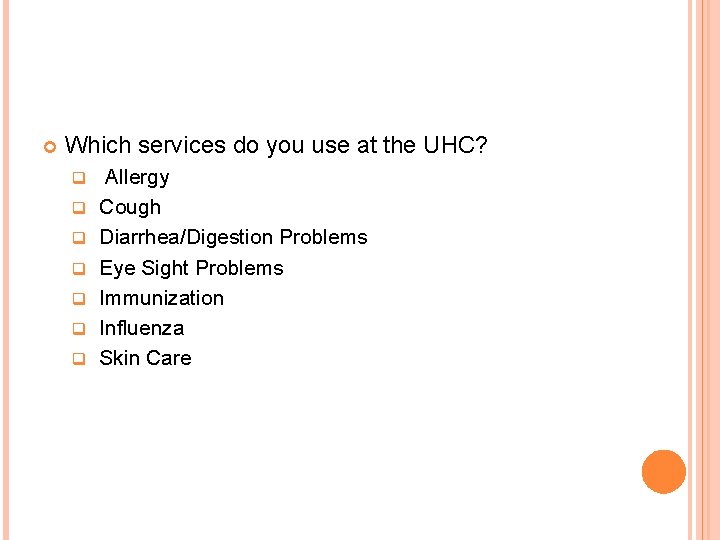
Which services do you use at the UHC? q q q q Allergy Cough Diarrhea/Digestion Problems Eye Sight Problems Immunization Influenza Skin Care
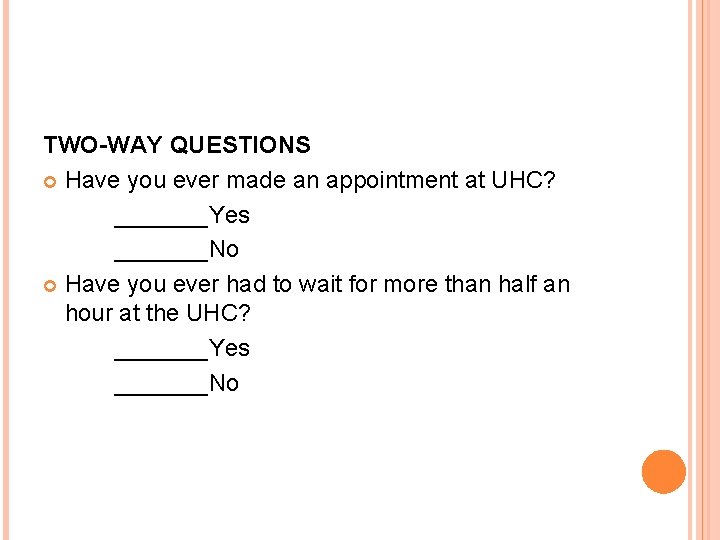
TWO-WAY QUESTIONS Have you ever made an appointment at UHC? _______Yes _______No Have you ever had to wait for more than half an hour at the UHC? _______Yes _______No
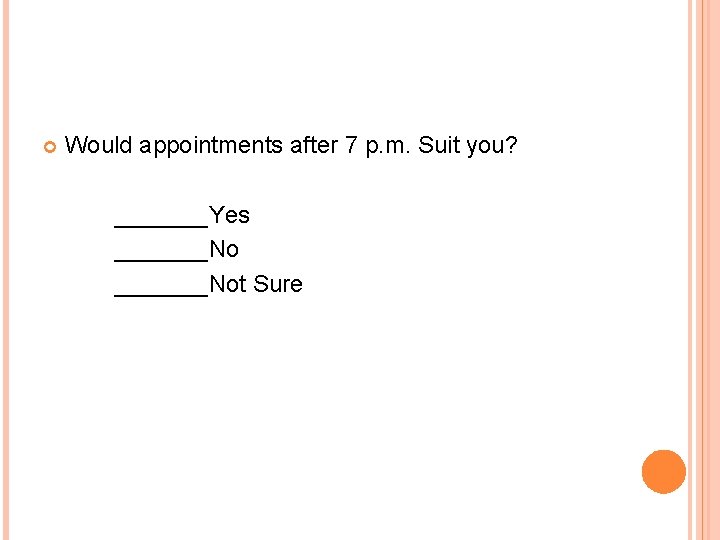
Would appointments after 7 p. m. Suit you? _______Yes _______Not Sure
Multiple Choice Questions How frequently have you had to wait for more than half an hour at the UHC for a scheduled appointment? _______always _______sometimes _______never
How would you rate the services of the UHC? _______adequate _______inadequate _______better than adequate _______excellent
Ranking Scales Keeping in view your class time-table, which times during the day( Monday to Saturday) would be most convenient for you make an appointment at the UHC? Put 1 by the most convenient time, 2 by the next most convenient time and so on until you have ranked all four choices. _______mornings _______afternoons (3 -5 p. m. ) _______evening (5 -7 p. m. ) _______after 7 p. m.
WRITING UP THE RESULTS OF THE QUESTIONNAIRE After collecting the questionnaires you will need to tally the results question by question ad then do write of the results. Begin by first summarizing the results, then organize them in a standardized format. Finally end by giving your interpretation and comments with recommendations and suggestions if necessary.
- Slides: 28