
QUESTIONNAIRE DESIGN QUALITATIVE APPROACH TO TEST VALIDATION Mary

- Slides: 18
QUESTIONNAIRE DESIGN ( QUALITATIVE APPROACH TO TEST VALIDATION) Mary Jo Di Biase & Jana Begovic Kranjska Gora, Slovenia September 4 -6, 2018
WHAT IS A QUESTIONNAIRE? Broad definition: A means by which information is collected (questionnaires are similar to other forms of data collection (interviews/observations/online marketing surveys, etc. )
TYPES OF QUESTIONNAIRES RELATED TO LANGUAGE TRAINING/TESTING Language Needs Analysis ØEstablish training needs by asking training requestors specific questions on tasks to be trained and levels to be attained (linked to jobs in which language will be used) Course evaluation: Ø Investigate student satisfaction with course aspects ØEstablish students’ perceptions of their own abilities post-training & value of their FL learning Course validation: Ø Establish student perception of how FL training prepared them for the job Ø Collect student recommendations on improvement of training aspects
QUESTIONNAIRES IN TEST VALIDATION They provide: ØAnonymity and practical utility of data collection ØMethod of establishing face validity of tests ØOpportunity to ask focused/specific questions ØAmple time for respondents to answer questions ØRelative ease of data analysis and management ØComplementary data to quantitative analysis results
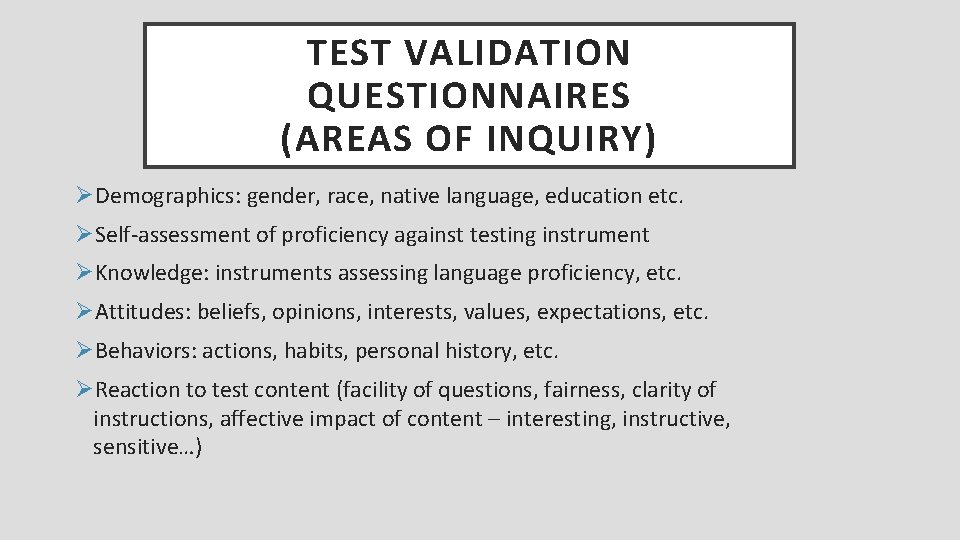
TEST VALIDATION QUESTIONNAIRES (AREAS OF INQUIRY) ØDemographics: gender, race, native language, education etc. ØSelf-assessment of proficiency against testing instrument ØKnowledge: instruments assessing language proficiency, etc. ØAttitudes: beliefs, opinions, interests, values, expectations, etc. ØBehaviors: actions, habits, personal history, etc. ØReaction to test content (facility of questions, fairness, clarity of instructions, affective impact of content – interesting, instructive, sensitive…)
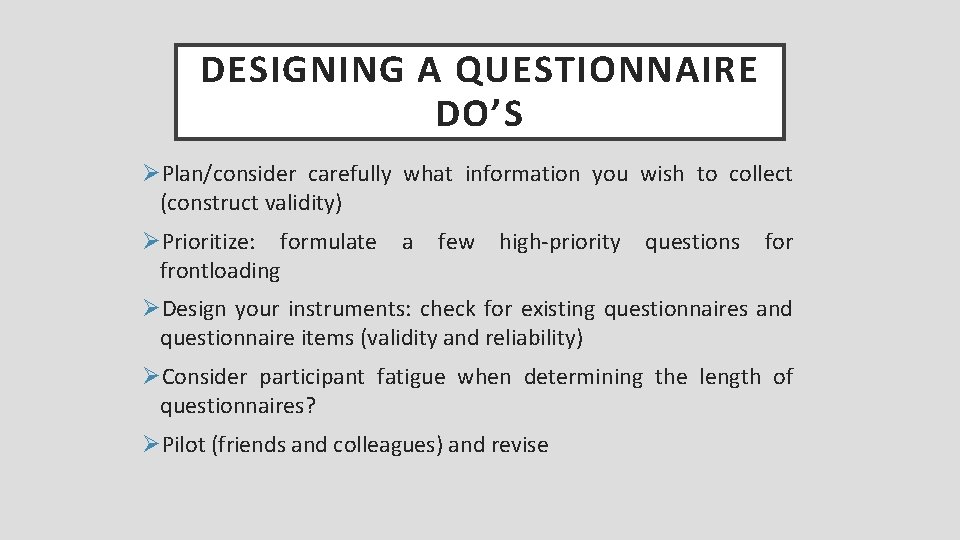
DESIGNING A QUESTIONNAIRE DO’S ØPlan/consider carefully what information you wish to collect (construct validity) ØPrioritize: formulate frontloading a few high-priority questions for ØDesign your instruments: check for existing questionnaires and questionnaire items (validity and reliability) ØConsider participant fatigue when determining the length of questionnaires? ØPilot (friends and colleagues) and revise
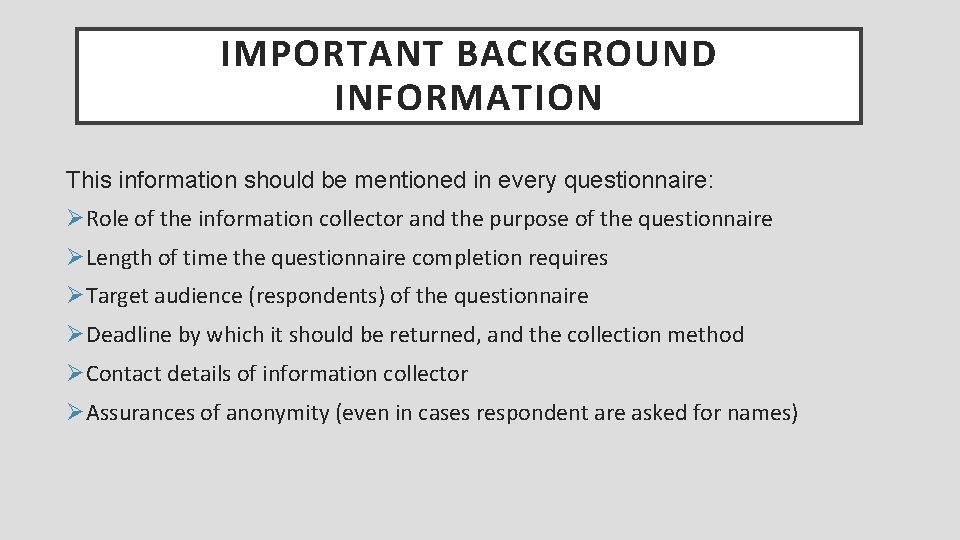
IMPORTANT BACKGROUND INFORMATION This information should be mentioned in every questionnaire: ØRole of the information collector and the purpose of the questionnaire ØLength of time the questionnaire completion requires ØTarget audience (respondents) of the questionnaire ØDeadline by which it should be returned, and the collection method ØContact details of information collector ØAssurances of anonymity (even in cases respondent are asked for names)
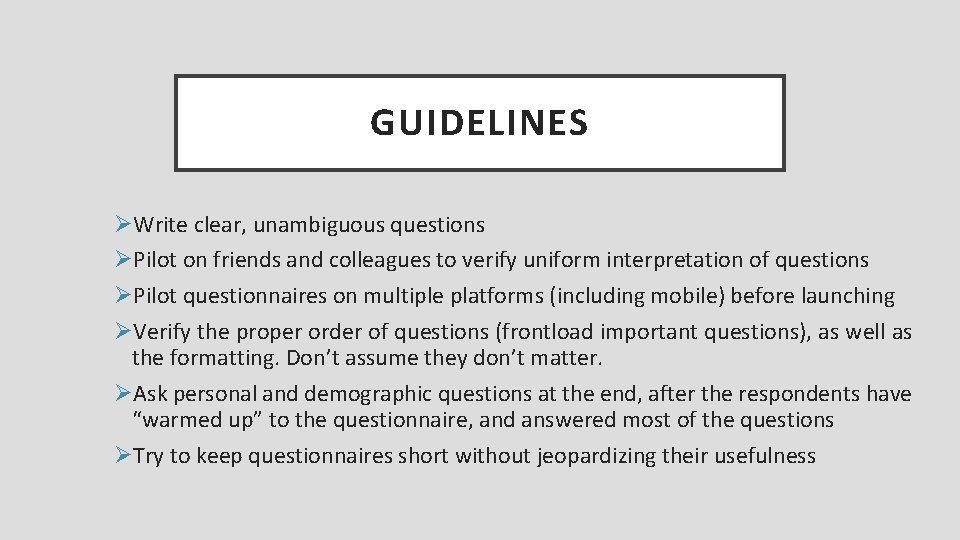
GUIDELINES ØWrite clear, unambiguous questions ØPilot on friends and colleagues to verify uniform interpretation of questions ØPilot questionnaires on multiple platforms (including mobile) before launching ØVerify the proper order of questions (frontload important questions), as well as the formatting. Don’t assume they don’t matter. ØAsk personal and demographic questions at the end, after the respondents have “warmed up” to the questionnaire, and answered most of the questions ØTry to keep questionnaires short without jeopardizing their usefulness
MORE GUIDELINES ØAvoid enforcing binary choices and absolutes, unless you have a good reason to do so. “In your view, was the course/test valuable? ” (Yes/No) ØGenerally: For every yes/no question you are thinking of asking, consider formulating it as an agreement of varying degrees.
EVEN MORE GUIDELINES Preliminary considerations: ØWrite questions with your respondent sample in mind. Use plain language and clear wording ØAvoid technical, complex, highbrow language, and jargon ØConsider carefully how you will analyze and act on data collected
MORE, MORE… (OPEN-ENDED) In open-ended questions, respondents are not presented with options. Example types: ØShort answer: “What aspect of the test did you find most fair in measuring proficiency? ” ØSpecific: “What languages have you studied in the past? ” ØClarification: “If you answered ‘other’ please specify: ” ØSentence completion: “One thing I liked about this course is ____” Considerations: ØCan be useful as starting point and for exploratory purposes ØOffer content for qualitative analysis; can be coded for quantitative analysis ØA bit unwieldy and often require more work to identify patterns
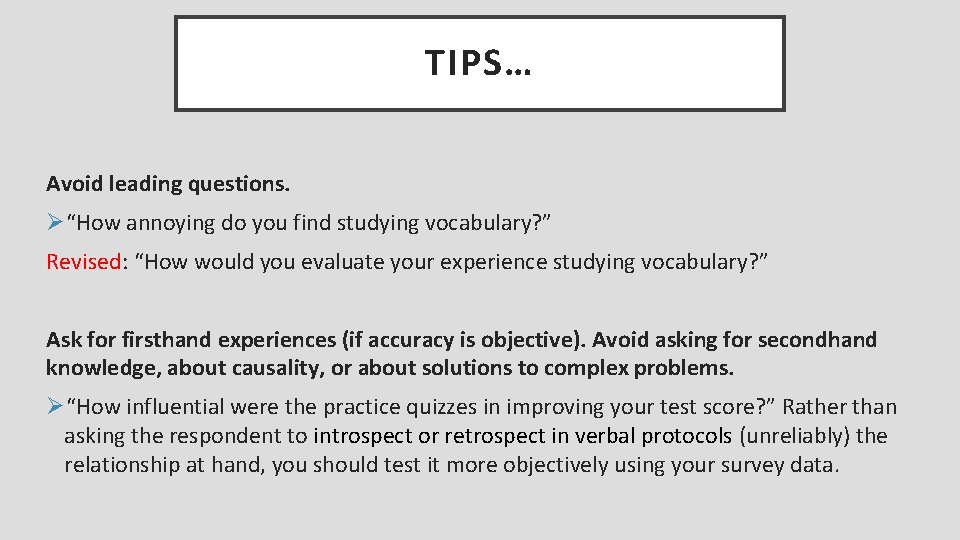
TIPS… Avoid double-barreled questions: Ø“Do you have difficulties following detailed instructions and directions? ” Some people might have difficulty with one and not the other. Avoid imposing unwarranted assumptions or hidden contingencies: Ø“In light of the successful piloting of the current curriculum, how would you evaluate its effectiveness in meeting your language learning needs so far? ” This question asks people to accept the premise that the successful piloting means the curriculum is effective and tailored for everyone’s learning needs. Ø“How helpful is participation in the Tandem Language Café for your French? ” I might study French but not participate in the Tandem Language Café.
TIPS… Avoid leading questions. Ø“How annoying do you find studying vocabulary? ” Revised: “How would you evaluate your experience studying vocabulary? ” Ask for firsthand experiences (if accuracy is objective). Avoid asking for secondhand knowledge, about causality, or about solutions to complex problems. Ø“How influential were the practice quizzes in improving your test score? ” Rather than asking the respondent to introspect or retrospect in verbal protocols (unreliably) the relationship at hand, you should test it more objectively using your survey data.
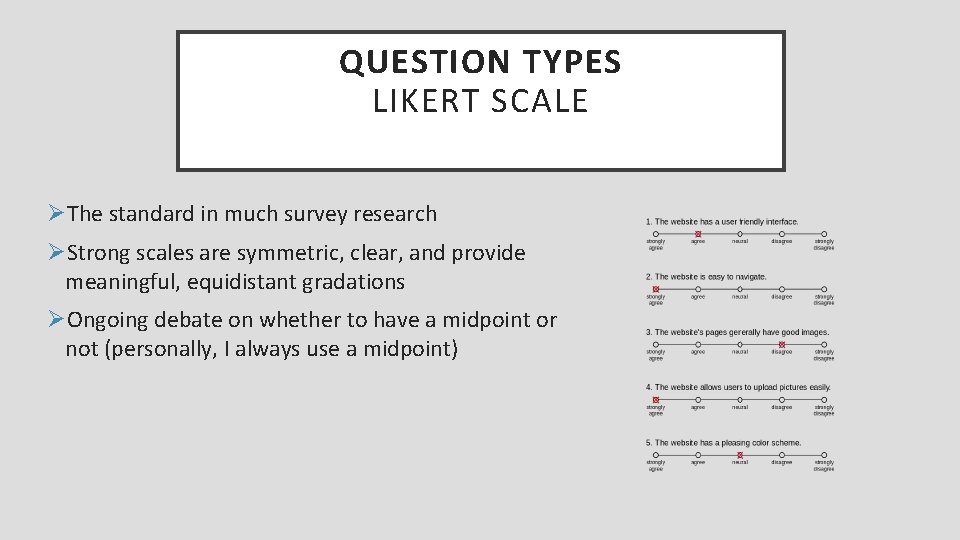
QUESTION TYPES LIKERT SCALE ØThe standard in much survey research ØStrong scales are symmetric, clear, and provide meaningful, equidistant gradations ØOngoing debate on whether to have a midpoint or not (personally, I always use a midpoint)
QUESTIONNAIRE MODES OF ADMINISTRATION • Paper and pencil • Qualtrics®�, Survey Monkey® (https: //www. qualtrics. com/; https: //www. surveymonkey. com/)
References Ø Alderson, J. C. (1992) Validating questionnaires, CRILE Working Paper Series, No. 15, Lancaster: Lancaster University. Ø • Block, D. (1998) Exploring interpretations of questionnaire items, System, 26, 403 – 425. Ø • Converse, J. M. and S. Presser (1986) Survey Questions: Handcrafting the Standardized Questionnaire, Sage University Papers, Series on Quantitative Applications in the Social Sciences, Series No. 07 -063, Newbury Park: Sage Publications, Inc. Ø • Fitz-Gibbon, C. T. and L. L. Morris (1987) How to Analyse Data, Newbury Park: Sage Publications, Inc. Ø • Foddy, W (1993) Constructing Questions for Interviews and Questionnaires: Theory and Practice in Social Research, Cambridge: Cambridge University Press. Ø • Litwin, M. S. (1995) How to Measure Survey Reliability and Validity, Thousand Oaks: Sage Publications, Inc. Ø • Low, G. D. (1988) The semantics of questionnaire rating scales, Evaluation and Research in Education, 2/2, 69 – 79. Ø • Low, G. (1996) Intensifiers and hedges in questionnaire items and the lexical invisibility hypothesis, Applied Linguistics, 17/1, 1 - 37. Ø • Oppenheim, A. N. (1992) Questionnaire Design, Interviewing and Attitude Measurement (New Edition), London: Pinter Publishers Ltd. Ø • Slembrouck, S. (1988) Questions and questionnaires, answers and answerraires, in Research Methods and Processes, A. Littlejohn and M. Melouk (eds), Lancaster University, 76 - 90.
INSTRUCTIONS 1. Appoint someone to capture your discussions and report results; 2. Brainstorm on the categories for which you would want to design questions. For example, one category can be personal information or test-taker’s/respondent’s background; 3. Formulate 1 -2 questions per category; 4. List a few considerations (best practices) when designing questions that would ensure that useful information will be gathered; 5. List suggestions on how to analyze data and act on the results;