
Questioned Documents Handwriting Analysis and Paper Chromatography Graham
- Slides: 25
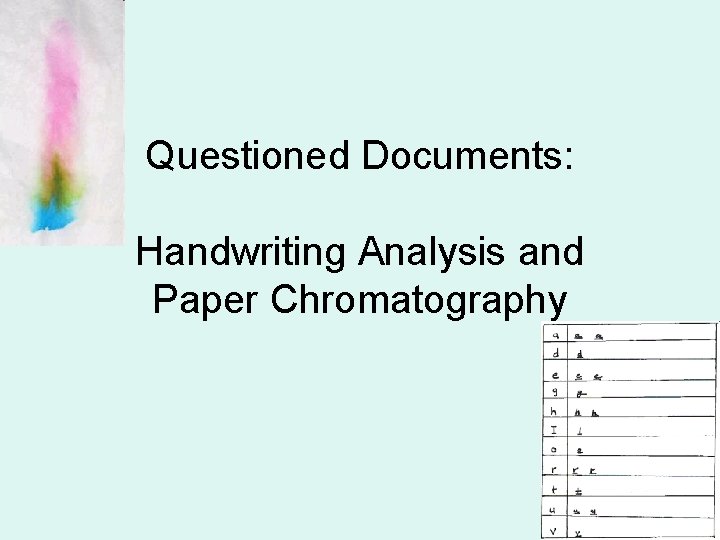
Questioned Documents: Handwriting Analysis and Paper Chromatography
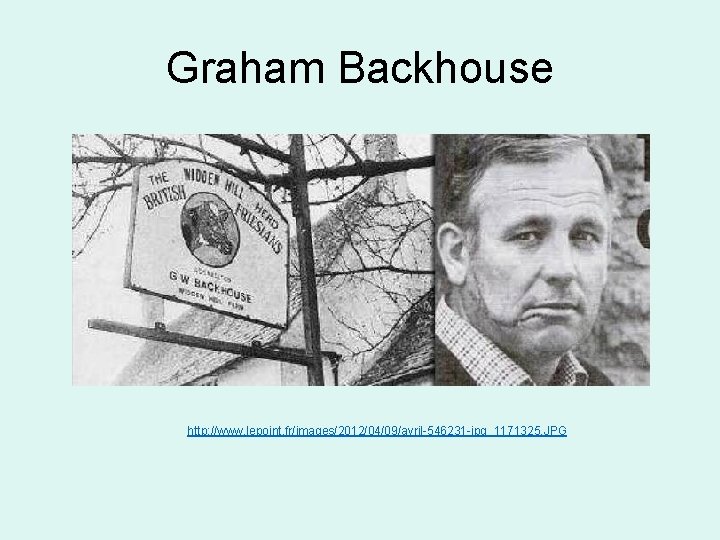
Graham Backhouse http: //www. lepoint. fr/images/2012/04/09/avril-546231 -jpg_1171325. JPG
Graphology • The “science” of discerning personality traits from handwriting.
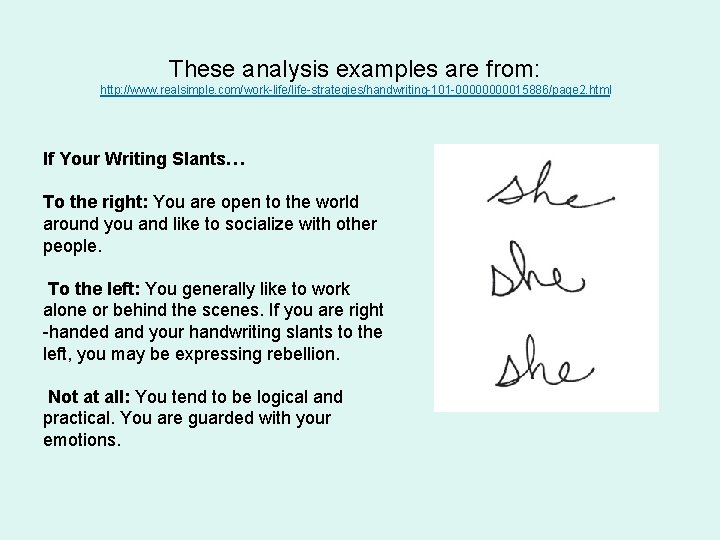
These analysis examples are from: http: //www. realsimple. com/work-life/life-strategies/handwriting-101 -0000015886/page 2. html If Your Writing Slants… To the right: You are open to the world around you and like to socialize with other people. To the left: You generally like to work alone or behind the scenes. If you are right -handed and your handwriting slants to the left, you may be expressing rebellion. Not at all: You tend to be logical and practical. You are guarded with your emotions.
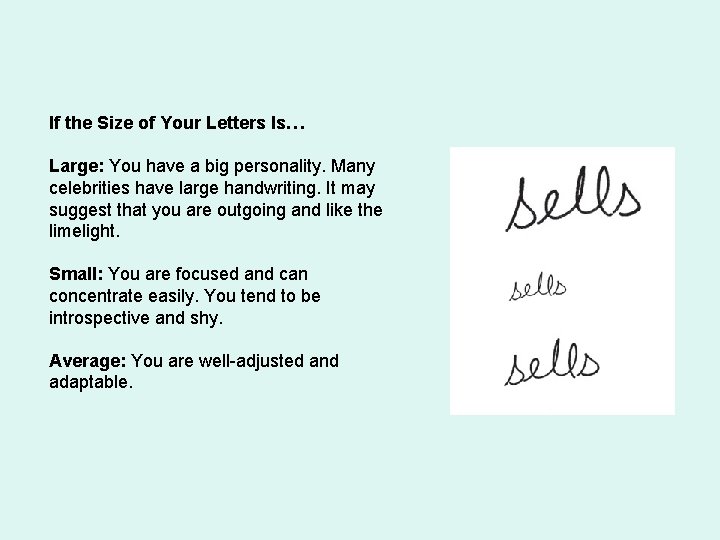
If the Size of Your Letters Is… Large: You have a big personality. Many celebrities have large handwriting. It may suggest that you are outgoing and like the limelight. Small: You are focused and can concentrate easily. You tend to be introspective and shy. Average: You are well-adjusted and adaptable.
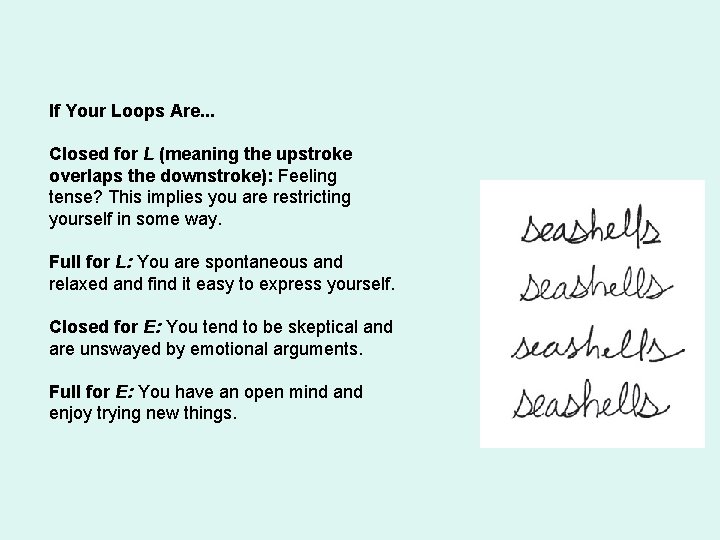
If Your Loops Are. . . Closed for L (meaning the upstroke overlaps the downstroke): Feeling tense? This implies you are restricting yourself in some way. Full for L: You are spontaneous and relaxed and find it easy to express yourself. Closed for E: You tend to be skeptical and are unswayed by emotional arguments. Full for E: You have an open mind and enjoy trying new things.
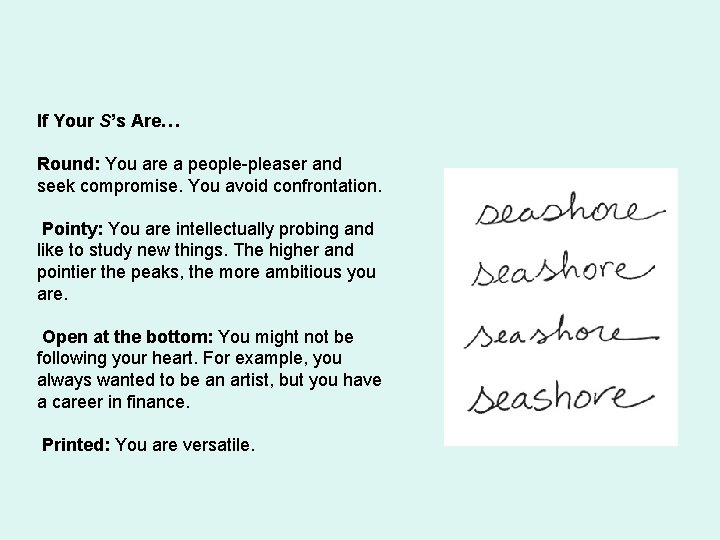
If Your S’s Are… Round: You are a people-pleaser and seek compromise. You avoid confrontation. Pointy: You are intellectually probing and like to study new things. The higher and pointier the peaks, the more ambitious you are. Open at the bottom: You might not be following your heart. For example, you always wanted to be an artist, but you have a career in finance. Printed: You are versatile.
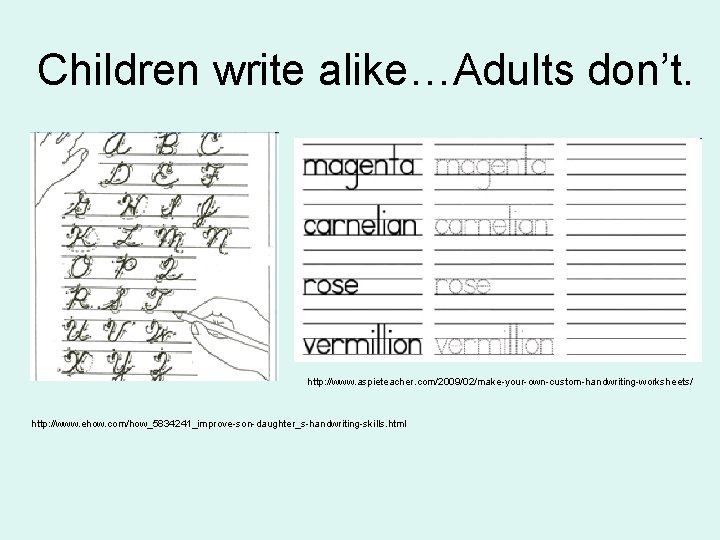
Did you know…. • No two people have exactly the same handwriting although it is hard to tell the writing of children apart. • As people age, their writing is exclusive to them because they incorporate letter forms they find pleasing. • Because of this, it is possible to detect a forgery – the illegal act of reproducing someone’s signature without their permission.
Children write alike…Adults don’t. http: //www. aspieteacher. com/2009/02/make-your-own-custom-handwriting-worksheets/ http: //www. ehow. com/how_5834241_improve-son-daughter_s-handwriting-skills. html
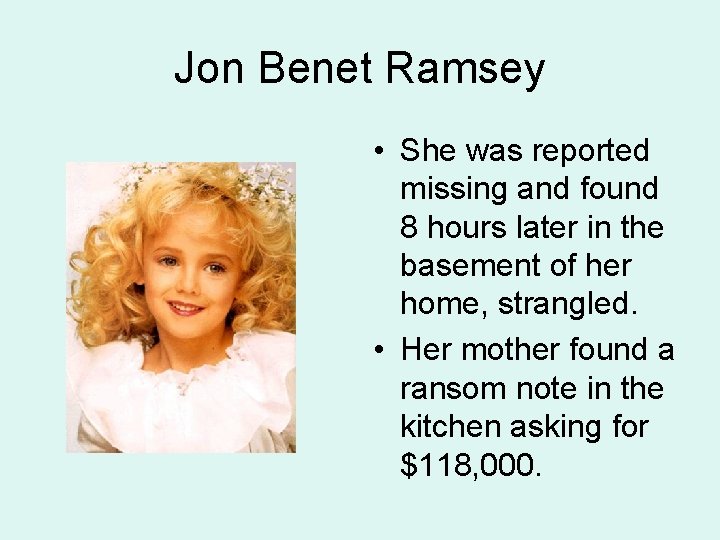
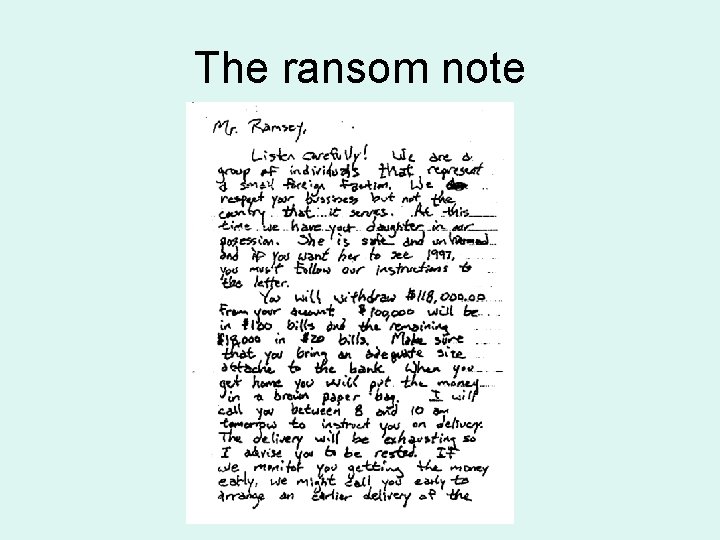
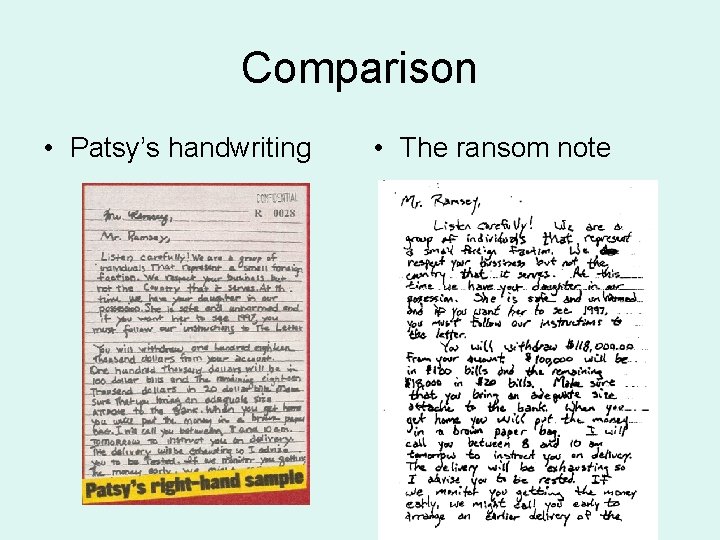
Jon Benet Ramsey • She was reported missing and found 8 hours later in the basement of her home, strangled. • Her mother found a ransom note in the kitchen asking for $118, 000.
The ransom note
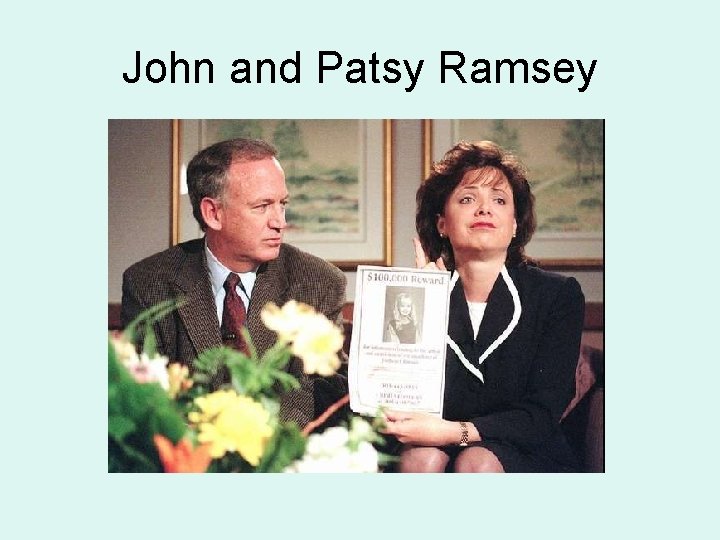
John and Patsy Ramsey
Comparison • Patsy’s handwriting • The ransom note
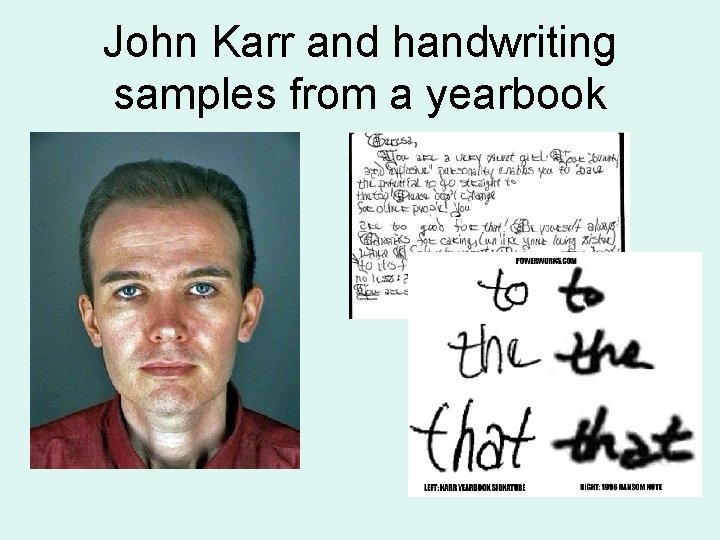
John Karr and handwriting samples from a yearbook
Characteristics analyzed by a document examiner include: • Class – such as the connections of letters to each other, the capitalization, and the punctuation. • Individual – such as the unique features of the letters (is the O open? How do the diacritics look – the way the i’s and t’s are dotted and crossed).
When a document is in question, scientists may ask for A collected sample – a sample taken from before the investigation began (signatures on old checks, writing on old job applications). A requested sample – a sample taken after the investigation began (the person is asked to write a dictated text).
A comparison is made between the questioned document and the known sample and a decision is made as to the document’s authenticity.
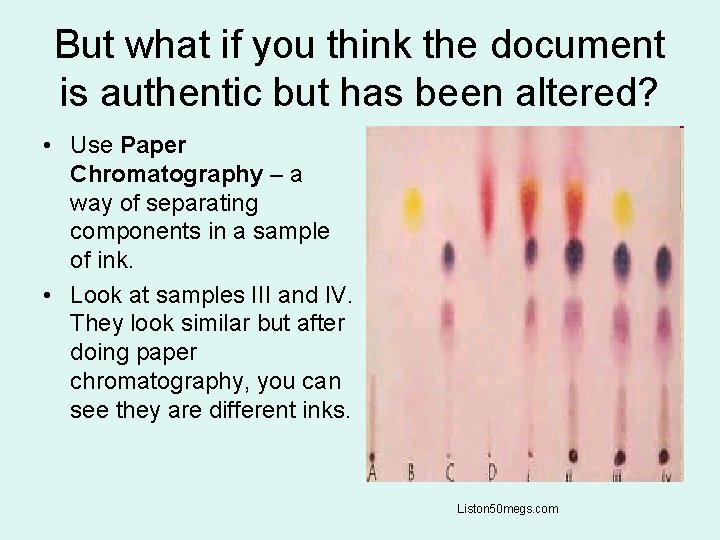
But what if you think the document is authentic but has been altered? • Use Paper Chromatography – a way of separating components in a sample of ink. • Look at samples III and IV. They look similar but after doing paper chromatography, you can see they are different inks. Liston 50 megs. com
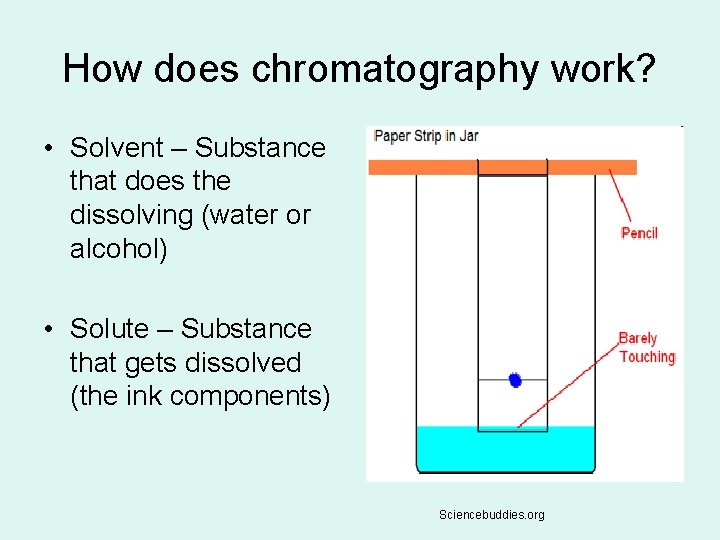
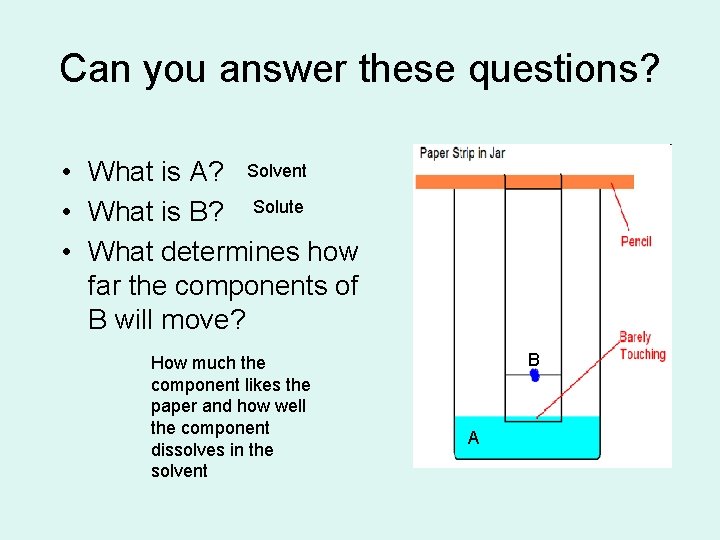
How does chromatography work? • Solvent – Substance that does the dissolving (water or alcohol) • Solute – Substance that gets dissolved (the ink components) Sciencebuddies. org
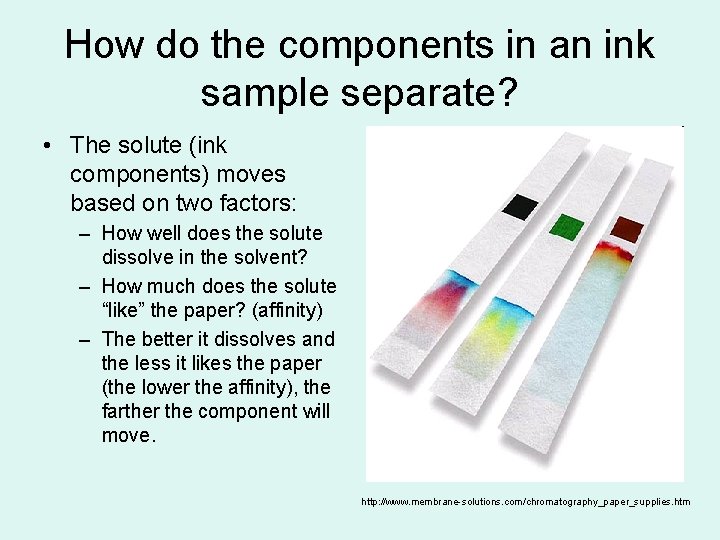
How do the components in an ink sample separate? • The solute (ink components) moves based on two factors: – How well does the solute dissolve in the solvent? – How much does the solute “like” the paper? (affinity) – The better it dissolves and the less it likes the paper (the lower the affinity), the farther the component will move. http: //www. membrane-solutions. com/chromatography_paper_supplies. htm
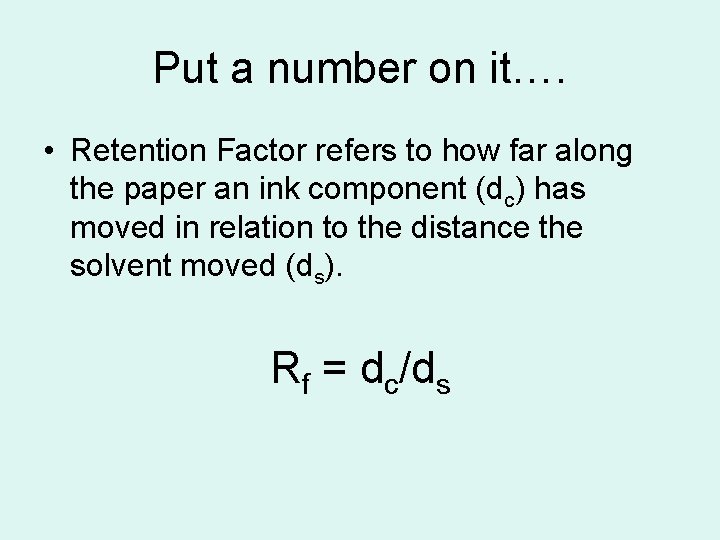
Put a number on it…. • Retention Factor refers to how far along the paper an ink component (dc) has moved in relation to the distance the solvent moved (ds). Rf = dc/ds
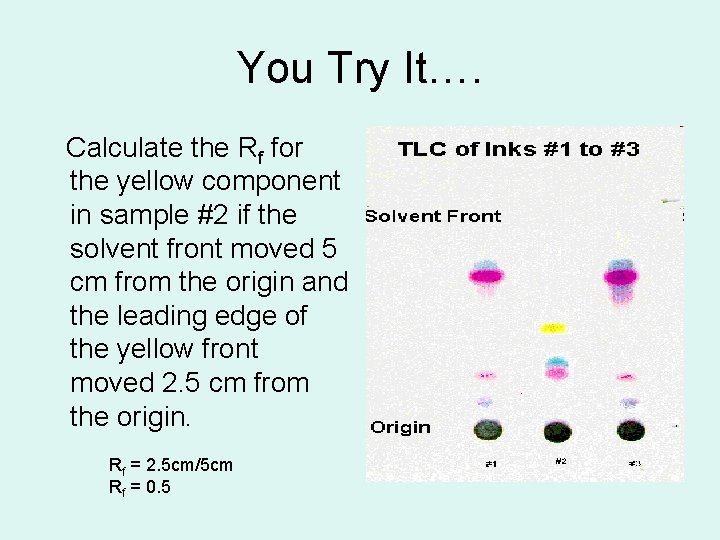
You Try It…. Calculate the Rf for the yellow component in sample #2 if the solvent front moved 5 cm from the origin and the leading edge of the yellow front moved 2. 5 cm from the origin. Rf = 2. 5 cm/5 cm Rf = 0. 5
Ways I will NOT mess this up…. • I will NOT submerge my solute into the solvent. I will suspend it above with just the tip of the paper in the solvent. • I will NOT leave my paper in the solvent too long. I will remove my paper from the solvent as soon as the solvent front is close to the top and I will draw a line showing how far the solvent moved. • I will NOT tip my set-up to get a better look. I will leave it sitting on the lab table.
Can you answer these questions? • What is A? Solvent • What is B? Solute • What determines how far the components of B will move? How much the component likes the paper and how well the component dissolves in the solvent BB A
Now You Are Ready…Can You Determine “Did Pete Cheat”?