
QUESTION TAGS QUESTION TAGS INTRODUCTION A question tag
- Slides: 10
QUESTION TAGS
QUESTION TAGS INTRODUCTION A question tag is a short question at the end of a sentence. We add it to a sentence to transform it into a question. He’s a student, isn’t he? http: //www. voki. com question tag
QUESTION TAGS USE We use question tags to: check if the information in the statement is true and our tone of voice rises; Ex. : You haven’t met Charlie, have you? ask for agreement and our tone of voice falls. http: //www. voki. com Ex. : You won’t tell anyone, will you?
QUESTION TAGS HOW DO YOU FORM QUESTION TAGS? Affirmative statement – negative tag: Students attend state schools, don’t they? Negative statement – positive tag: http: //www. voki. com You aren’t sick, are you?
QUESTION TAGS HOW DO YOU FORM QUESTION TAGS? With auxiliary verbs – we use it in the tag: You have been to summer school, haven’t you? Without auxiliary verbs – we use the appropriate form of do in the tag: http: //www. voki. com She likes her school a lot, doesn’t she?
QUESTION TAGS HOW DO YOU FORM QUESTION TAGS? With modal verbs – we use the same modal verb in the tag: You would like to study in Scotland, wouldn’t you? With “I am” – we use “aren’t I? ” http: //www. voki. com Sorry, I’m being rude, aren’t I?
QUESTION TAGS REMEMBER The subject in the tag is always a pronoun: • Meg studied in the UK last year, didn’t she? • The children are sleeping, aren’t they?
QUESTION TAGS TIME TO PRACTISE
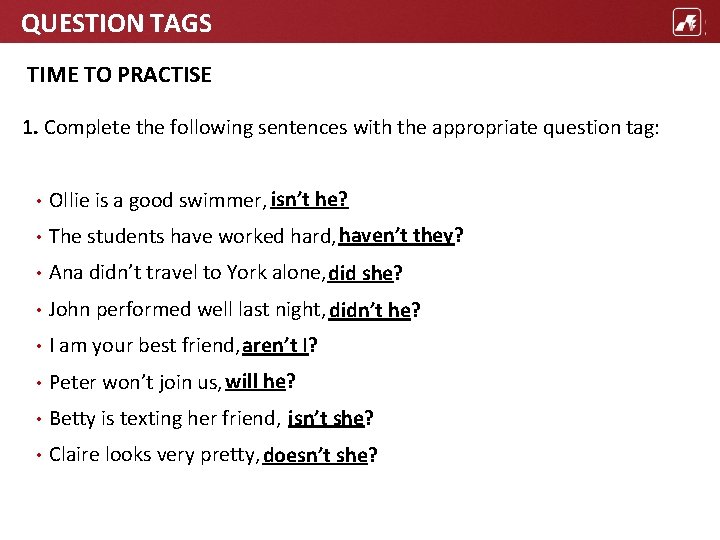
QUESTION TAGS TIME TO PRACTISE 1. Complete the following sentences with the appropriate question tag: • Ollie is a good swimmer, isn’t he? • The students have worked hard, haven’t they? • Ana didn’t travel to York alone, did she? • John performed well last night, didn’t he? • I am your best friend, aren’t I? • Peter won’t join us, will he? • Betty is texting her friend, isn’t she? • Claire looks very pretty, doesn’t she?
QUESTION TAGS