
Question Pluralist theories of the state see the

- Slides: 30
Question • Pluralist theories of the state, see the state in Western democracies as representing the interests of everyone within the state (pressure groups, general elections) therefore…
Option A - Therefore one group dominates – power is concentrated within a power elite B - Therefore no one group dominates – power is dispersed rather than concentrated C - Therefore one group dominates – power is concentrated within a ruling-class elite
Answer A - Therefore one group dominates – power is concentrated within a power elite B - Therefore no one group dominates – power is dispersed rather than concentrated C - Therefore one group dominates – power is concentrated within a ruling-class elite
Question • Two pluralist theorists of the state are…
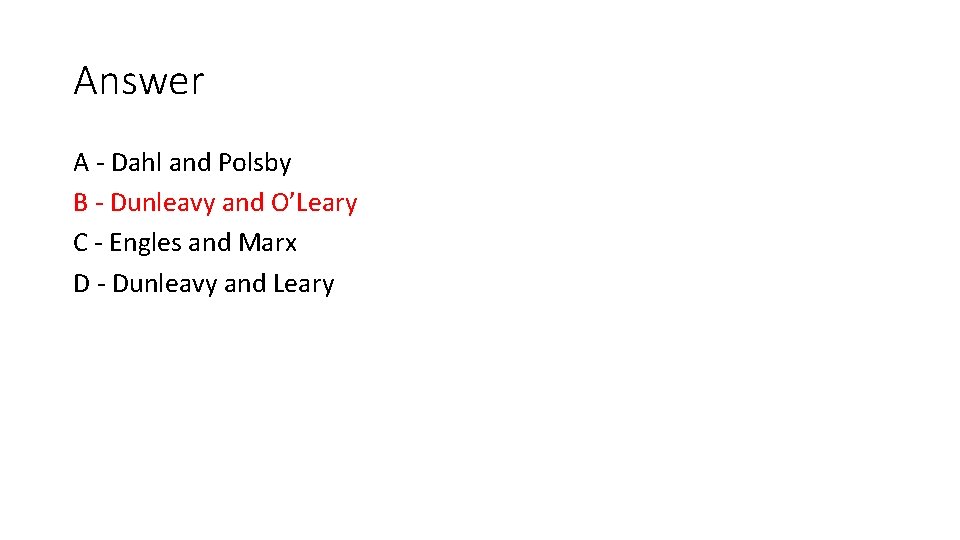
Options A - Dahl and Polsby B - Dunleavy and O’Leary C - Engles and Marx D - Dunleavy and Leary
Answer A - Dahl and Polsby B - Dunleavy and O’Leary C - Engles and Marx D - Dunleavy and Leary
Question • Identify the three main pluralist views of the state
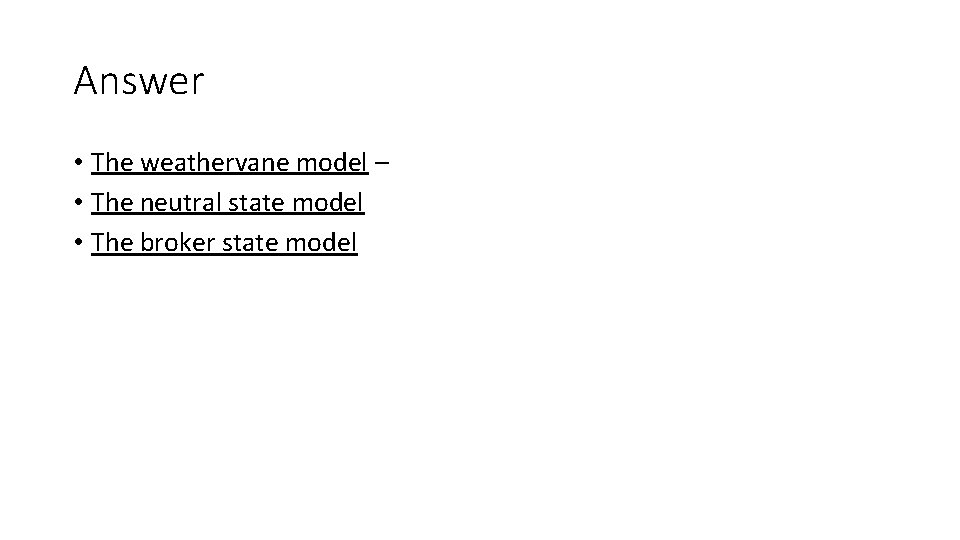
Answer • The weathervane model – • The neutral state model • The broker state model
Question • Briefly explain what you understand by the term broker state model
Answer • Broker state model - the state simply negotiates (brokers) between the vested interests of these groups and creates policies which satisfy these groups
Question • Briefly explain what you understand by Miliband’s view of the state
Answer • Miliband has an instrumentalist view of the state • (this sees the state as being run by a ruling-class elite – elite theory sees the state as being run by a power elite – who run the country in preserve the capitalist system. These people are often connected by their social and educational background (which is similar to C. Wright. Miles’ point)
Question • Milton Friedman and Peter Bauer are both…
Answer • New Right theoriests
Question • Friedman position was governments should only get involved with four areas of the economy, these are…
Answer • Defence • Law and Order • The provision of the necessary public works – (that private enterprise doesn’t find profitable) • Protection from members of the community who ‘cannot be regarded as responsible individuals. ’
Question • Chomsky points out reducing the role of the state (and its size) restricts its capacity to…. .
Answer • …. . improve or assist vulnerable people in society.
Question • What kind of state theorists are Nordlinger & Theda Skocpol?
Answer • State centred theorists
Question • What do state centred theorists argue?
Answer • society-centred theories see the state as an independent entity which can act on its own agendas
Question • What does Theda Skocpol argue?
Answer • She argues that weak states bring their own downfall rather than class struggles
Question • Nordlinger’s argues the state acts independent to its people, to the extent it acts autonomously through three mechanisms - what he termed types. • What are these three mechanisms?
Answer • Type 1 – state autonomy occurs through setting the agenda via decision or non-decision making • Type 2 – state autonomy by manipulating public opinion to support government thus wining the argument • Type 3 - state autonomy when the state supports policies by powerful interest groups in society
Question • Like Nordlinger, Theda Skocpol argues pluralists, Marxists and neo. Marxists all assume the state is shaped by external pressures because state’s are autonomous structures that have interests all of their own which it can act on. To have the power to influence the state these organisations external to the state need to be organised therefore Theda Skocpol argues all the state needs to do is?
Answer • Therefore a state can become more powerful if it stops opposition groups organising or outlaws such opposition groups
Question • But the trouble is states can’t stop all opposition groups forming due to?
Answer • globalisation