
Question on rheology 1 Answer the following parts
- Slides: 6
Question on rheology 1. Answer the following parts a) Give the definition of rheology b) Define what is meant by elasticity and viscosity. c) Are polymers elastic or viscous materials? Explain why 2. Explain the terms storage modulus, loss modulus, phase angle and tangent delta 3. Be prepared to interpret the different regions of an idealized graph of storage modulus as a function of temperature (Idealized DMA measurement) 4. Stress-strain curve 5. Newtonian, dilatant, Bingham and pseudoplastic materials 1. Draw the viscosity vs. shear rate curves
Question on rheology 6. Explain what are thixotropic and rheopectic fluids, and give an example of each 7. How do pressure, temperature and Mw effect the melt viscosity? Explain also the relevance of molecular weight being above or below the critical molecular weight limit. 8. Why does the critical molecular weight vary between different types of polymers? What are the factors that contribute to it? 9. Explain working principles of four different methods that can utilized in measuring viscosity 10. Explain what is meant by die swell and melt fracture, what causes them, and of what relevance are they to polymer processing 11. What is melt flow index, and what is it used for? 12. Explain a) b) c) the utility of Time-temperature superposition (TTS) under which conditions TTS can be done, and The steps in doing the TTS for frequency sweep data 13. Describe the Kelvin-Voigt (4 -element) model for creep and it’s utility
Question on rheology 14. Explain the relationship between Deborah’s number and time-temperature superposition principle. 15. What is the difference between WLF equation and the Arrhenius type of temperature dependency? Find out when you would use either of those alternatives, and for what purpose. 16. Explain what the concept of energy of activation 17. Explain what is meant by zero shear viscosity 18. How do viscosity and complex viscosity differ? 19. If you wanted to determine viscosity over a very large shear rate range using only rotational rheometer, what tools / techniques would you utilize? 20. What is the equation you’d like to utilize in comparing two different polymer sample’s molecular weight based on data of viscosity measured as a function of shear rate? Which shear rate range would you look at in your analysis? What kind of conditions would need to be met to make the comparison possible?
Question on rheology 21. Are polymer melts generally viscoelastic solids or viscoelastic liquids? Justify your answer and give conditions under which the other alternative could be considered viable. 22. A rubber ball appears to be rather elastic, i. e. it returns to its original shape upon bouncing from the floor. Why then does it not jump as high as it was dropped from? (previous question is related to this) 23. Be prepared to interpret a typical polymer frequency sweep and answer what the storage and loss modili, tangent delta and complex viscosity values signify at different angular frequencies. 24. Explain what is meant by angular frequency in rotational rheometry, and how it’s related to time scales different phenomena are occurring at.
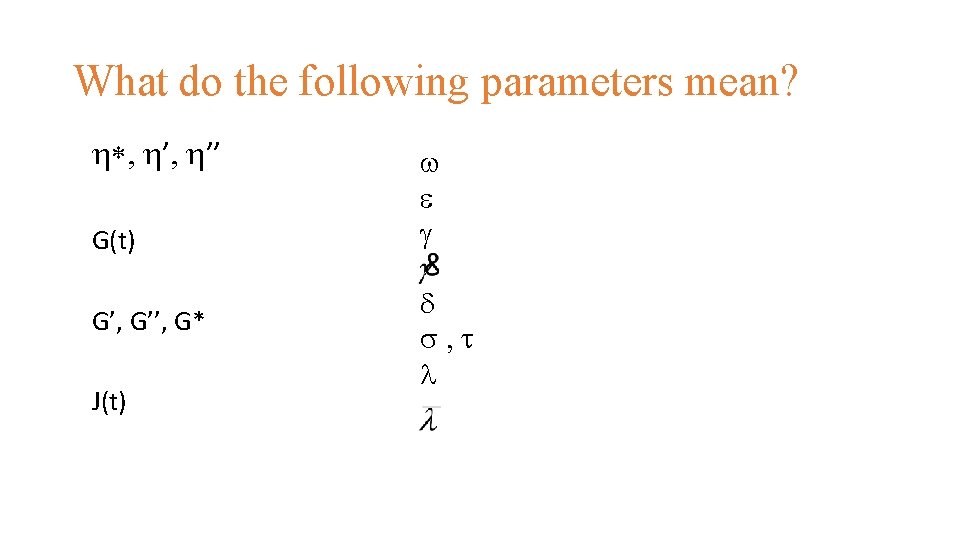
What do the following parameters mean? h*, h’’ G(t) G’, G’’, G* J(t) w e g d s, t l
Book recommendations on rheology & DMA An old classic (theoretical, but also of practical use): Ferry JD, Viscoelastic Properties of Polymers, 3 rd Edition, (1980) ISBN: 978 -0 -471 -04894 -7 Another book heavy on theory: Macosco CW, Rheology: Principles, Measurements, and Applications, (1994) ISBN: 978 -0 -471 -18575 -8 Practical rheology books for doing measurements and understanding the basics of theories: Schramm G, A Practical Approach to Rheology and Rheometry, (1984) Gebrueder HAAKE Gmb. H, Karlsruhe, Germany Mezger TG, The Rheology Handbook (several editions) Vincentz Network Gmb. H & Co. KG, Hannover, Germany Instrument manufacturer’s rheology related free education TAInstruments has rather nice, easy to digest examples of rheology, Thermal analysis (DMA, DSC, …) and whatnot on their website! These work very nicely if you spend a little while browsing their directories for examples that are relevant to your own research. They also explain theory in an approachable way (to be able to better sell you a new scientific instrument…) https: //www. tainstruments. com/applications-library-search/