
Question 1 The distance between successive wave crests
Question 1 The distance between successive wave crests defines the ____ of a wave. 1) wavelength 2) frequency 3) period 4) amplitude 5) energy

Question 1 The distance between successive wave crests defines the ____ of a wave. 1) wavelength 2) frequency 3) period 4) amplitude 5) energy Light can range from shortwavelength gamma rays to long-wavelength radio waves.
Question 2 Which of these is NOT a form of electromagnetic radiation? 1) gamma rays 2) infrared 3) sound 4) visible light 5) radio
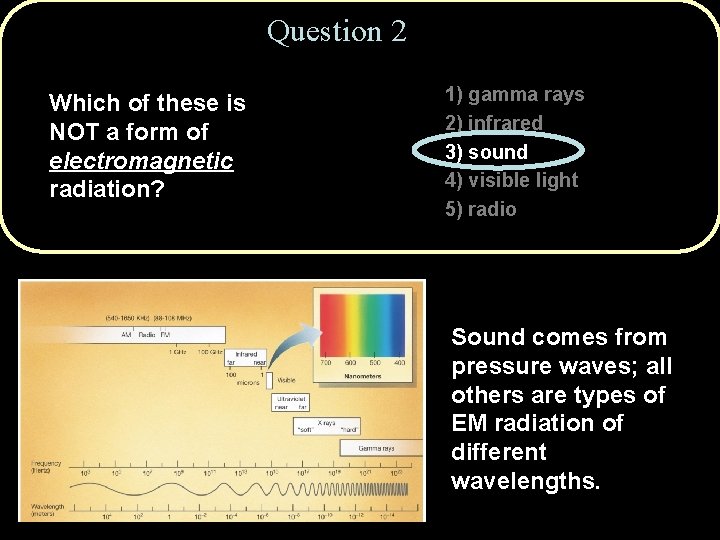
Question 2 Which of these is NOT a form of electromagnetic radiation? 1) gamma rays 2) infrared 3) sound 4) visible light 5) radio Sound comes from pressure waves; all others are types of EM radiation of different wavelengths.
Question 3 What types of Electro. Magnetic Radiation from space reach the surface of Earth? 1) radio & microwaves 2) X rays & ultraviolet light 3) infrared & gamma rays 4) visible light & radio waves 5) visible & ultraviolet light
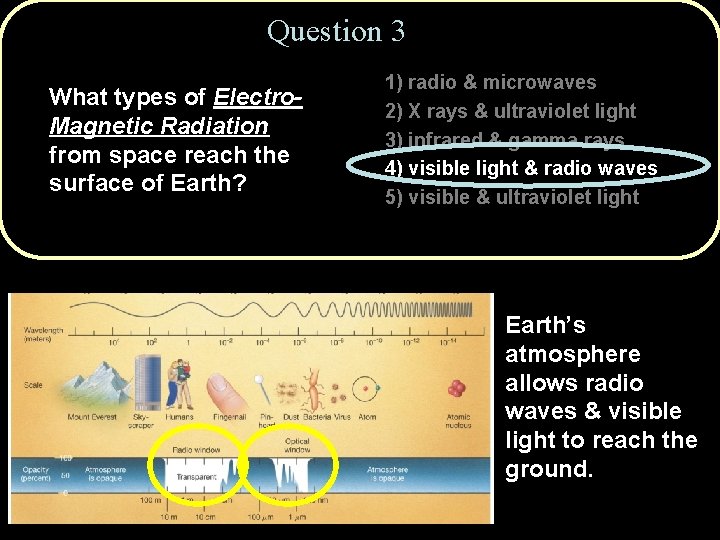
Question 3 What types of Electro. Magnetic Radiation from space reach the surface of Earth? 1) radio & microwaves 2) X rays & ultraviolet light 3) infrared & gamma rays 4) visible light & radio waves 5) visible & ultraviolet light Earth’s atmosphere allows radio waves & visible light to reach the ground.
Question 4 The frequency at which a star’s intensity is greatest depends directly on its 1) radius. 2) mass. 3) magnetic field. 4) temperature. 5) direction of motion.
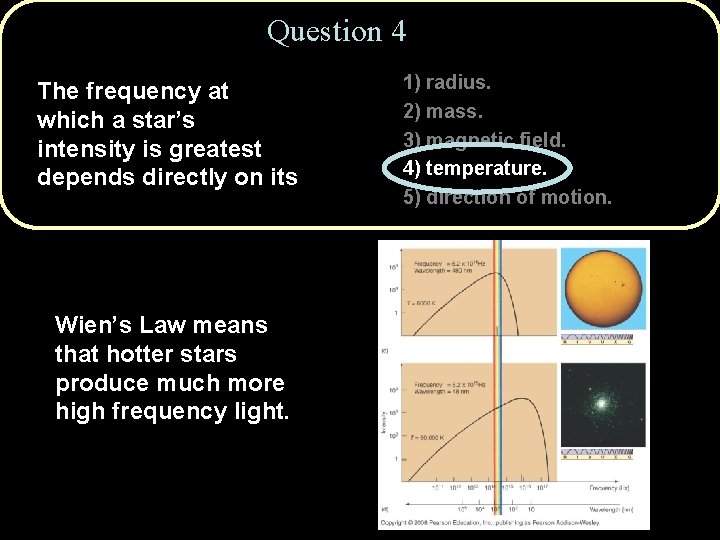
Question 4 The frequency at which a star’s intensity is greatest depends directly on its Wien’s Law means that hotter stars produce much more high frequency light. 1) radius. 2) mass. 3) magnetic field. 4) temperature. 5) direction of motion.
- Slides: 8