
Question 1 1000 Points A unit square is
- Slides: 11
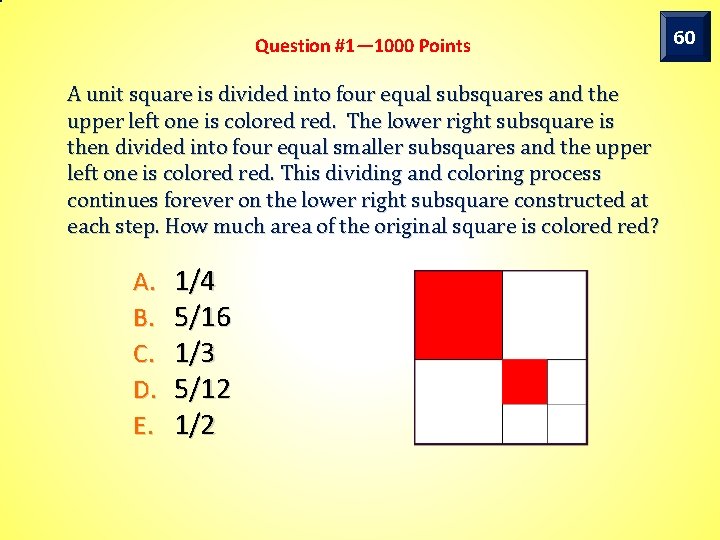
Question #1— 1000 Points A unit square is divided into four equal subsquares and the upper left one is colored red. The lower right subsquare is then divided into four equal smaller subsquares and the upper left one is colored red. This dividing and coloring process continues forever on the lower right subsquare constructed at each step. How much area of the original square is colored ? A. B. C. D. E. 1/4 5/16 1/3 5/12 1/2 60
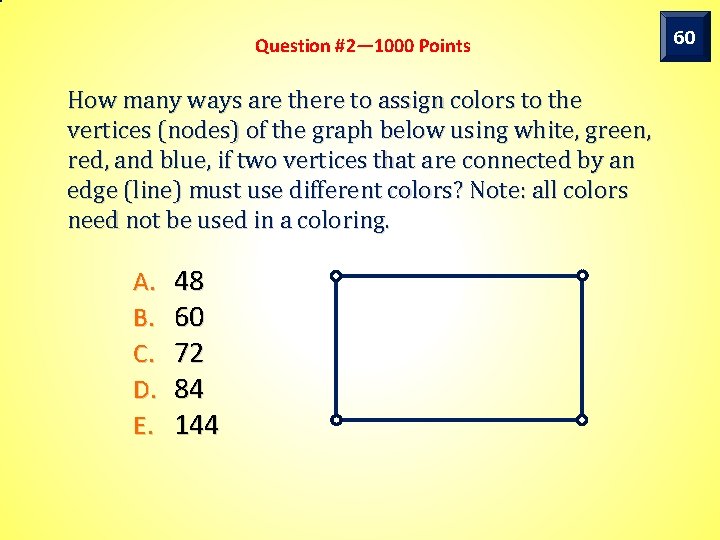
Question #2— 1000 Points How many ways are there to assign colors to the vertices (nodes) of the graph below using white, green, red, and blue, if two vertices that are connected by an edge (line) must use different colors? Note: all colors need not be used in a coloring. A. B. C. D. E. 48 60 72 84 144 60
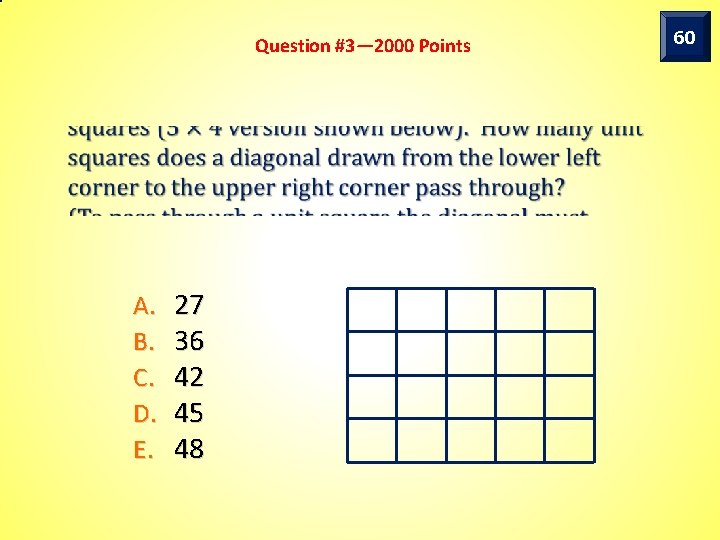
Question #3— 2000 Points A. B. C. D. E. 27 36 42 45 48 60
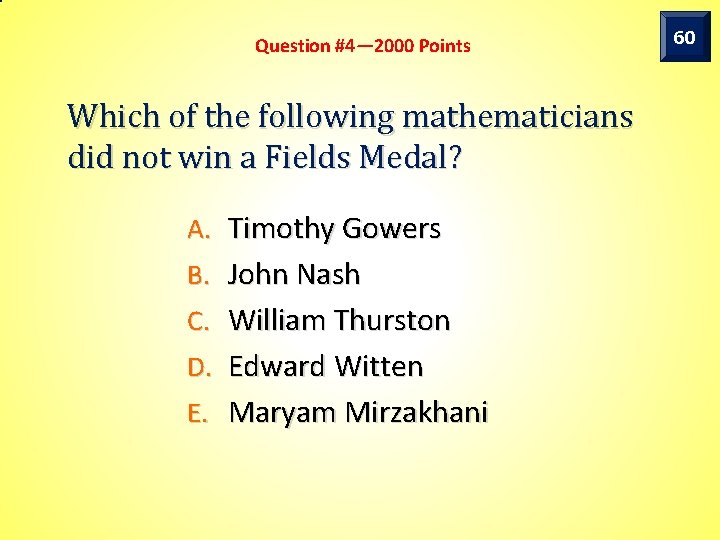
Question #4— 2000 Points Which of the following mathematicians did not win a Fields Medal? A. Timothy Gowers B. John Nash C. William Thurston D. Edward Witten E. Maryam Mirzakhani 60
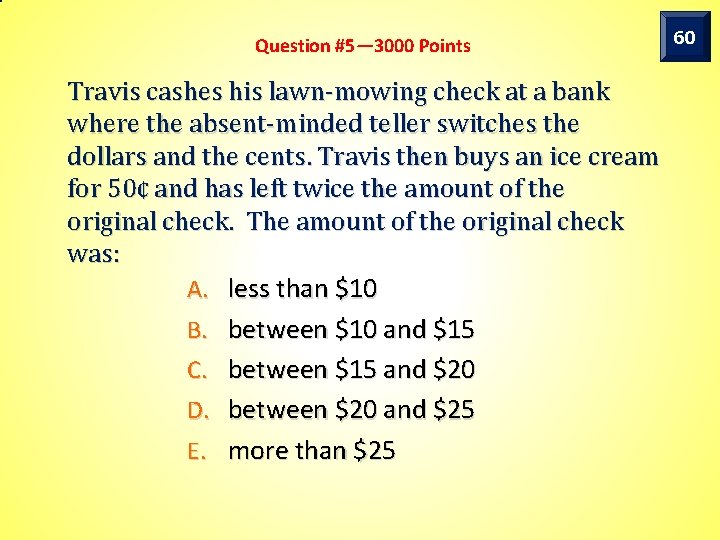
Question #5— 3000 Points Travis cashes his lawn-mowing check at a bank where the absent-minded teller switches the dollars and the cents. Travis then buys an ice cream for 50¢ and has left twice the amount of the original check. The amount of the original check was: A. less than $10 B. between $10 and $15 C. between $15 and $20 D. between $20 and $25 E. more than $25 60
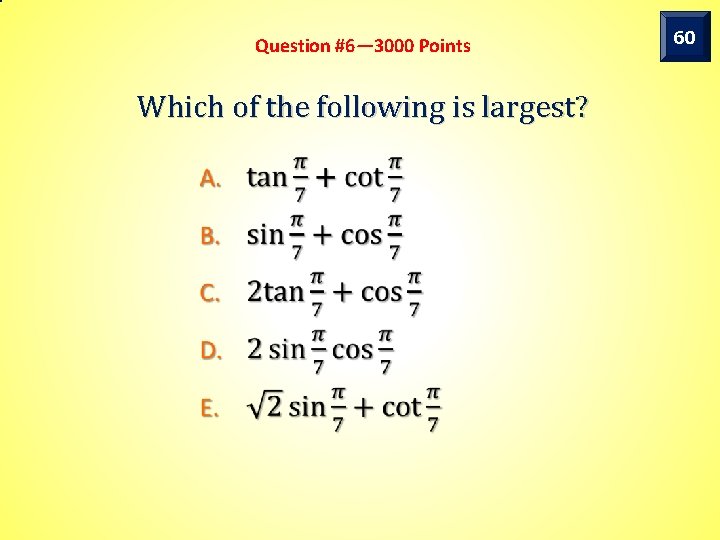
Question #6— 3000 Points Which of the following is largest? • 60
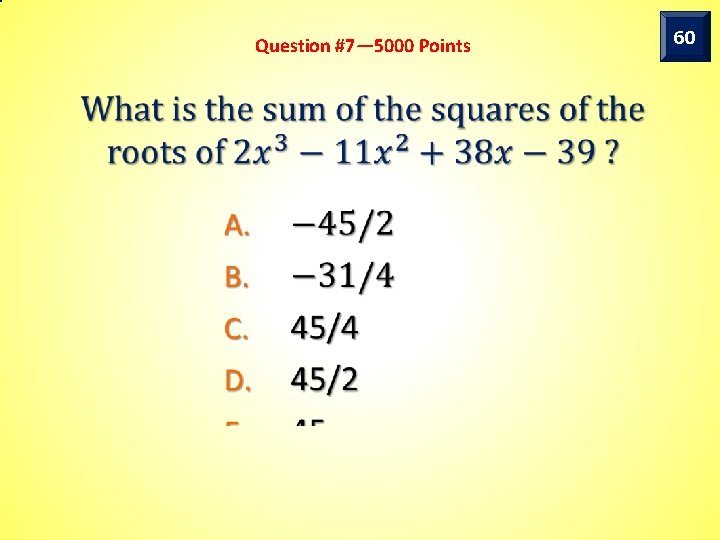
Question #7— 5000 Points • 60
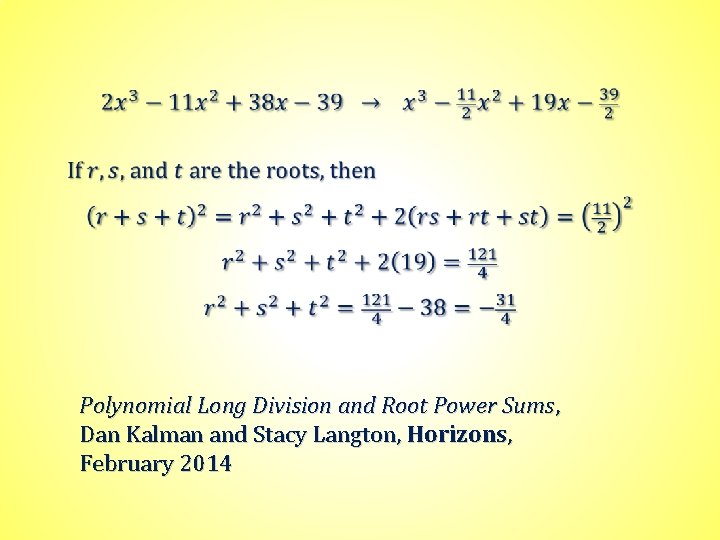
Polynomial Long Division and Root Power Sums, Dan Kalman and Stacy Langton, Horizons, February 2014
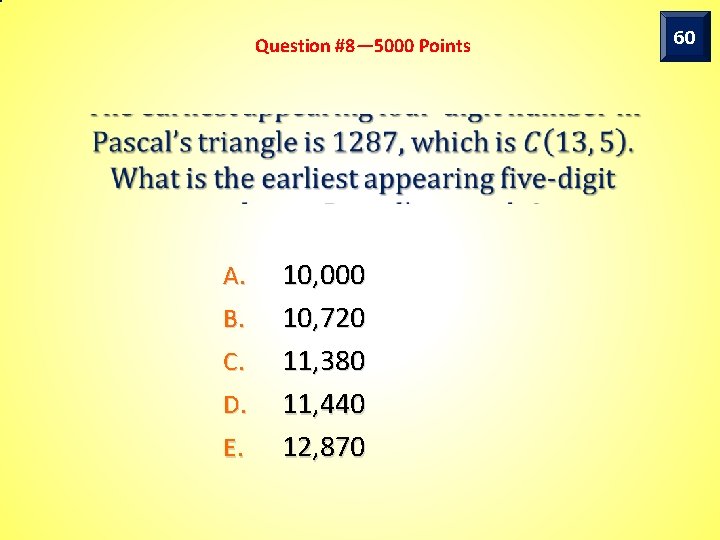
Question #8— 5000 Points A. B. C. D. E. 10, 000 10, 720 11, 380 11, 440 12, 870 60
Presented by The American Mathematical Society www. ams. org/wwtbam/