
Querying and Mining Data Streams You Only Get


![Computing Stream Sample • Reservoir Sampling [Vit 85]: Maintains a sample S of a](https://slidetodoc.com/presentation_image/d35b01b600fee2eddba4504f4c396a6a/image-15.jpg "Computing Stream Sample • Reservoir Sampling [Vit 85]: Maintains a sample S of a")
![Counting Samples [GM 98] • Effective for answering hot list queries (k most frequent](https://slidetodoc.com/presentation_image/d35b01b600fee2eddba4504f4c396a6a/image-16.jpg "Counting Samples [GM 98] • Effective for answering hot list queries (k most frequent")
![Answering Queries using Histograms [IP 99] • (Implicitly) map the histogram back to an](https://slidetodoc.com/presentation_image/d35b01b600fee2eddba4504f4c396a6a/image-19.jpg "Answering Queries using Histograms [IP 99] • (Implicitly) map the histogram back to an")
![Algorithms for Computing Approximate Quantiles • [MRL 98], [MRL 99], [GK 01] propose sophisticated](https://slidetodoc.com/presentation_image/d35b01b600fee2eddba4504f4c396a6a/image-22.jpg "Algorithms for Computing Approximate Quantiles • [MRL 98], [MRL 99], [GK 01] propose sophisticated")
![Single-Pass Quantile Computation Algorithm [MRL 98] • Split memory M into b buffers of](https://slidetodoc.com/presentation_image/d35b01b600fee2eddba4504f4c396a6a/image-23.jpg "Single-Pass Quantile Computation Algorithm [MRL 98] • Split memory M into b buffers of")
![Computing Approximate Quantiles [GK 01] • Synopsis structure S: sequence of tuples Sorted sequence](https://slidetodoc.com/presentation_image/d35b01b600fee2eddba4504f4c396a6a/image-26.jpg "Computing Approximate Quantiles [GK 01] • Synopsis structure S: sequence of tuples Sorted sequence")
![Wavelet-based Histograms [MVW 98] • Problem: Range-query selectivity estimation • Key idea: Use a](https://slidetodoc.com/presentation_image/d35b01b600fee2eddba4504f4c396a6a/image-36.jpg "Wavelet-based Histograms [MVW 98] • Problem: Range-query selectivity estimation • Key idea: Use a")
![Using Wavelet-based Histograms • Selectivity estimation: count(a<= R. e<= b) = C’[b] - C’[a-1]](https://slidetodoc.com/presentation_image/d35b01b600fee2eddba4504f4c396a6a/image-37.jpg "Using Wavelet-based Histograms • Selectivity estimation: count(a<= R. e<= b) = C’[b] - C’[a-1]")
![Dynamic Maintenance of Waveletbased Histograms [MVW 00] • Build Haar-wavelet synopses on the original](https://slidetodoc.com/presentation_image/d35b01b600fee2eddba4504f4c396a6a/image-38.jpg "Dynamic Maintenance of Waveletbased Histograms [MVW 00] • Build Haar-wavelet synopses on the original")
![Maintenance Algorithm [MWV 00] Simplified Version • Histogram H: Top m wavelet coefficients •](https://slidetodoc.com/presentation_image/d35b01b600fee2eddba4504f4c396a6a/image-40.jpg "Maintenance Algorithm [MWV 00] Simplified Version • Histogram H: Top m wavelet coefficients •")
![Clustering Data Streams [GMMO 01] K-median problem definition: • Data stream with points from](https://slidetodoc.com/presentation_image/d35b01b600fee2eddba4504f4c396a6a/image-42.jpg "Clustering Data Streams [GMMO 01] K-median problem definition: • Data stream with points from")
![VFDT/CVFDT [DH 00, DH 01] • VFDT: – Constructs model from data stream instead](https://slidetodoc.com/presentation_image/d35b01b600fee2eddba4504f4c396a6a/image-55.jpg "VFDT/CVFDT [DH 00, DH 01] • VFDT: – Constructs model from data stream instead")
![Sketches for 2 nd Moment Estimation over Streams [AMS 96] • Problem: Tuples of](https://slidetodoc.com/presentation_image/d35b01b600fee2eddba4504f4c396a6a/image-64.jpg "Sketches for 2 nd Moment Estimation over Streams [AMS 96] • Problem: Tuples of")
![Sketches for 2 nd Moment Estimation over Streams [AMS 96] (cont. ) • Key](https://slidetodoc.com/presentation_image/d35b01b600fee2eddba4504f4c396a6a/image-65.jpg "Sketches for 2 nd Moment Estimation over Streams [AMS 96] (cont. ) • Key")
![Sketches for 2 nd Moment Estimation over Streams [AMS 96] (cont. ) • Technique](https://slidetodoc.com/presentation_image/d35b01b600fee2eddba4504f4c396a6a/image-66.jpg "Sketches for 2 nd Moment Estimation over Streams [AMS 96] (cont. ) • Technique")
![Sketches for 2 nd Moment Estimation over Streams [AMS 96] (cont. ) • Boosting](https://slidetodoc.com/presentation_image/d35b01b600fee2eddba4504f4c396a6a/image-67.jpg "Sketches for 2 nd Moment Estimation over Streams [AMS 96] (cont. ) • Boosting")
![Sketches for 2 nd Moment Estimation over Streams [AMS 96] (cont. ) • Total](https://slidetodoc.com/presentation_image/d35b01b600fee2eddba4504f4c396a6a/image-68.jpg "Sketches for 2 nd Moment Estimation over Streams [AMS 96] (cont. ) • Total")
![Sketches for Stream Joins and Multi. Joins [AGM 99, DGG 02] COUNT = SELECT](https://slidetodoc.com/presentation_image/d35b01b600fee2eddba4504f4c396a6a/image-69.jpg "Sketches for Stream Joins and Multi. Joins [AGM 99, DGG 02] COUNT = SELECT")
![Sketches for Stream Joins and Multi. Joins [AGM 99, DGG 02] (cont. ) SELECT](https://slidetodoc.com/presentation_image/d35b01b600fee2eddba4504f4c396a6a/image-70.jpg "Sketches for Stream Joins and Multi. Joins [AGM 99, DGG 02] (cont. ) SELECT")
![Overview of Sketch Partitioning [DGG 02] • Key Intuition: Exploit coarse statistics on the](https://slidetodoc.com/presentation_image/d35b01b600fee2eddba4504f4c396a6a/image-71.jpg "Overview of Sketch Partitioning [DGG 02] • Key Intuition: Exploit coarse statistics on the")
![Overview of Sketch Partitioning [DGG 02] (cont. ) M SELECT COUNT(*) FROM R 1,](https://slidetodoc.com/presentation_image/d35b01b600fee2eddba4504f4c396a6a/image-72.jpg "Overview of Sketch Partitioning [DGG 02] (cont. ) M SELECT COUNT(*) FROM R 1,")
![Overview of Sketch Partitioning [DGG 02] (cont. ) • Space allocation among partitions: Easy](https://slidetodoc.com/presentation_image/d35b01b600fee2eddba4504f4c396a6a/image-73.jpg "Overview of Sketch Partitioning [DGG 02] (cont. ) • Space allocation among partitions: Easy")
![Stream Wavelet Approximation using Sketches [GKM 01] • Single-join approximation with sketches [AGM 99]](https://slidetodoc.com/presentation_image/d35b01b600fee2eddba4504f4c396a6a/image-74.jpg "Stream Wavelet Approximation using Sketches [GKM 01] • Single-join approximation with sketches [AGM 99]")
![Stream Wavelet Approximation using Sketches [GKM 01] (cont. ) • Each (normalized) coefficient ci](https://slidetodoc.com/presentation_image/d35b01b600fee2eddba4504f4c396a6a/image-77.jpg "Stream Wavelet Approximation using Sketches [GKM 01] (cont. ) • Each (normalized) coefficient ci")
![Stream Wavelet Approximation using Sketches [GKM 01]: The Method • Input: “Stream of tuples”](https://slidetodoc.com/presentation_image/d35b01b600fee2eddba4504f4c396a6a/image-78.jpg "Stream Wavelet Approximation using Sketches [GKM 01]: The Method • Input: “Stream of tuples”")
![Multi-d Histograms over Streams using Sketches [TGI 02] • Multi-dimensional histograms: Approximate joint data](https://slidetodoc.com/presentation_image/d35b01b600fee2eddba4504f4c396a6a/image-79.jpg "Multi-d Histograms over Streams using Sketches [TGI 02] • Multi-dimensional histograms: Approximate joint data")
![Multi-d Histograms over Streams using Sketches [TGI 02] (cont. ) • View distribution and](https://slidetodoc.com/presentation_image/d35b01b600fee2eddba4504f4c396a6a/image-80.jpg "Multi-d Histograms over Streams using Sketches [TGI 02] (cont. ) • View distribution and")
![Multi-d Histograms over Streams using Sketches [TGI 02] (cont. ) • Algorithm – Maintain](https://slidetodoc.com/presentation_image/d35b01b600fee2eddba4504f4c396a6a/image-81.jpg "Multi-d Histograms over Streams using Sketches [TGI 02] (cont. ) • Algorithm – Maintain")
![Extensions: Sketching with Stable Distributions [Ind 00] • Idea: Sketch the incoming stream of](https://slidetodoc.com/presentation_image/d35b01b600fee2eddba4504f4c396a6a/image-82.jpg "Extensions: Sketching with Stable Distributions [Ind 00] • Idea: Sketch the incoming stream of")
![Extensions: Sketching with Stable Distributions [Ind 00] (cont. ) • Use independent sketches with](https://slidetodoc.com/presentation_image/d35b01b600fee2eddba4504f4c396a6a/image-83.jpg "Extensions: Sketching with Stable Distributions [Ind 00] (cont. ) • Use independent sketches with")
![Random-Subset-Sums (RSSs) for Quantile Estimation [GKM 02] • Key Idea: Maintain frequency sums for](https://slidetodoc.com/presentation_image/d35b01b600fee2eddba4504f4c396a6a/image-85.jpg "Random-Subset-Sums (RSSs) for Quantile Estimation [GKM 02] • Key Idea: Maintain frequency sums for")
![Random-Subset-Sums (RSSs) for Quantile Estimation [GKM 02] (cont. ) • Each RSS is a](https://slidetodoc.com/presentation_image/d35b01b600fee2eddba4504f4c396a6a/image-86.jpg "Random-Subset-Sums (RSSs) for Quantile Estimation [GKM 02] (cont. ) • Each RSS is a")
![Random-Subset-Sums (RSSs) for Quantile Estimation [GKM 02] (cont. ) Estimating f(I), I = interval](https://slidetodoc.com/presentation_image/d35b01b600fee2eddba4504f4c396a6a/image-87.jpg "Random-Subset-Sums (RSSs) for Quantile Estimation [GKM 02] (cont. ) Estimating f(I), I = interval")
![Random-Subset-Sums (RSSs) for Quantile Estimation [GKM 02] (cont. ) Estimating approximate quantiles • Want](https://slidetodoc.com/presentation_image/d35b01b600fee2eddba4504f4c396a6a/image-88.jpg "Random-Subset-Sums (RSSs) for Quantile Estimation [GKM 02] (cont. ) Estimating approximate quantiles • Want")
![More work on Sketches. . . • Low-distortion vector-space embeddings (JL Lemma) [Ind 01]](https://slidetodoc.com/presentation_image/d35b01b600fee2eddba4504f4c396a6a/image-89.jpg "More work on Sketches. . . • Low-distortion vector-space embeddings (JL Lemma) [Ind 01]")
![Distinct Value Estimation Using Hashing [FM 85] • Assume a hash function h(x) that](https://slidetodoc.com/presentation_image/d35b01b600fee2eddba4504f4c396a6a/image-93.jpg "Distinct Value Estimation Using Hashing [FM 85] • Assume a hash function h(x) that")
![Distinct Value Estimation Using Hashing [FM 85] (cont. ) • By uniformity through h(x):](https://slidetodoc.com/presentation_image/d35b01b600fee2eddba4504f4c396a6a/image-94.jpg "Distinct Value Estimation Using Hashing [FM 85] (cont. ) • By uniformity through h(x):")
![Distinct Value Estimation • [FM 85] assume “ideal” hash functions h(x) (N-wise independence) –](https://slidetodoc.com/presentation_image/d35b01b600fee2eddba4504f4c396a6a/image-95.jpg "Distinct Value Estimation • [FM 85] assume “ideal” hash functions h(x) (N-wise independence) –")
![Distinct Sampling [Gib 01] Key Ideas • Use FM-like technique to collect a specially-tailored](https://slidetodoc.com/presentation_image/d35b01b600fee2eddba4504f4c396a6a/image-97.jpg "Distinct Sampling [Gib 01] Key Ideas • Use FM-like technique to collect a specially-tailored")
![Building a Distinct Sample [Gib 01] • Use FM-like hash function h() for each](https://slidetodoc.com/presentation_image/d35b01b600fee2eddba4504f4c396a6a/image-98.jpg "Building a Distinct Sample [Gib 01] • Use FM-like hash function h() for each")
![Using the Distinct Sample [Gib 01] • If level = l for our sample,](https://slidetodoc.com/presentation_image/d35b01b600fee2eddba4504f4c396a6a/image-99.jpg "Using the Distinct Sample [Gib 01] • If level = l for our sample,")
![Statistics Over Sliding Windows • Bitstream: Count the number of ones [DGIM 02] –](https://slidetodoc.com/presentation_image/d35b01b600fee2eddba4504f4c396a6a/image-104.jpg "Statistics Over Sliding Windows • Bitstream: Count the number of ones [DGIM 02] –")
![References (1) • [AGM 99] N. Alon, P. B. Gibbons, Y. Matias, M. Szegedy.](https://slidetodoc.com/presentation_image/d35b01b600fee2eddba4504f4c396a6a/image-121.jpg "References (1) • [AGM 99] N. Alon, P. B. Gibbons, Y. Matias, M. Szegedy.")
![References (2) • [Gib 01] P. Gibbons. Distinct sampling for highly-accurate answers to distinct](https://slidetodoc.com/presentation_image/d35b01b600fee2eddba4504f4c396a6a/image-122.jpg "References (2) • [Gib 01] P. Gibbons. Distinct sampling for highly-accurate answers to distinct")
![References (3) • [HHW 97] J. M. Hellerstein, P. J. Haas, and H. J.](https://slidetodoc.com/presentation_image/d35b01b600fee2eddba4504f4c396a6a/image-123.jpg "References (3) • [HHW 97] J. M. Hellerstein, P. J. Haas, and H. J.")
![References (4) • [MVW 98] Y. Matias, J. S. Vitter, and M. Wang. “Wavelet-based](https://slidetodoc.com/presentation_image/d35b01b600fee2eddba4504f4c396a6a/image-124.jpg "References (4) • [MVW 98] Y. Matias, J. S. Vitter, and M. Wang. “Wavelet-based")
- Slides: 124
Querying and Mining Data Streams: You Only Get One Look A Tutorial Minos Garofalakis Johannes Gehrke Rajeev Rastogi Bell Laboratories Cornell University Garofalakis, Gehrke, Rastogi, VLDB’ 02 #
Outline • Introduction & Motivation – Stream computation model, Applications • Basic stream synopses computation – Samples, Equi-depth histograms, Wavelets • Mining data streams – Decision trees, clustering, association rules • Sketch-based computation techniques – Self-joins, Joins, Wavelets, V-optimal histograms • Advanced techniques – Sliding windows, Distinct values, Hot lists • Future directions & Conclusions Garofalakis, Gehrke, Rastogi, VLDB’ 02 # 2
Processing Data Streams: Motivation • A growing number of applications generate streams of data – Performance measurements in network monitoring and traffic management – Call detail records in telecommunications – Transactions in retail chains, ATM operations in banks – Log records generated by Web Servers – Sensor network data • Application characteristics – Massive volumes of data (several terabytes) – Records arrive at a rapid rate • Goal: Mine patterns, process queries and compute statistics on data streams in real-time Garofalakis, Gehrke, Rastogi, VLDB’ 02 # 3
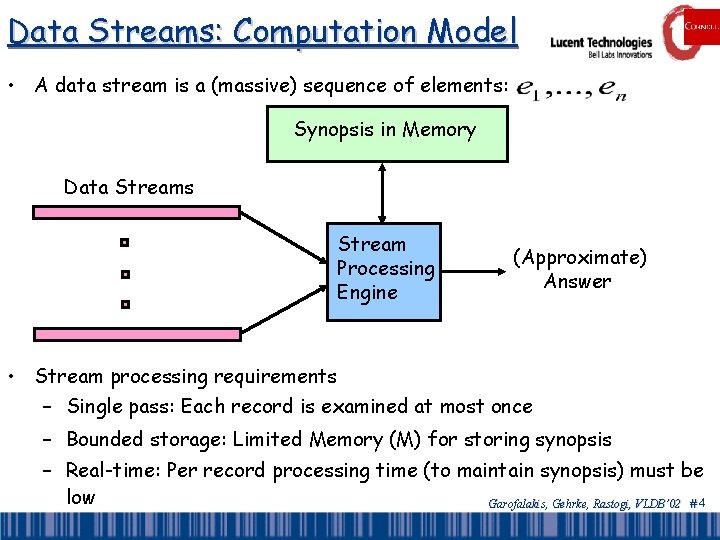
Data Streams: Computation Model • A data stream is a (massive) sequence of elements: Synopsis in Memory Data Streams Stream Processing Engine (Approximate) Answer • Stream processing requirements – Single pass: Each record is examined at most once – Bounded storage: Limited Memory (M) for storing synopsis – Real-time: Per record processing time (to maintain synopsis) must be low Garofalakis, Gehrke, Rastogi, VLDB’ 02 # 4
Network Management Application • Network Management involves monitoring and configuring network hardware and software to ensure smooth operation – Monitor link bandwidth usage, estimate traffic demands – Quickly detect faults, congestion and isolate root cause – Load balancing, improve utilization of network resources Measurements Alarms Network Operations Center Garofalakis, Gehrke, Rastogi, VLDB’ 02 # 5
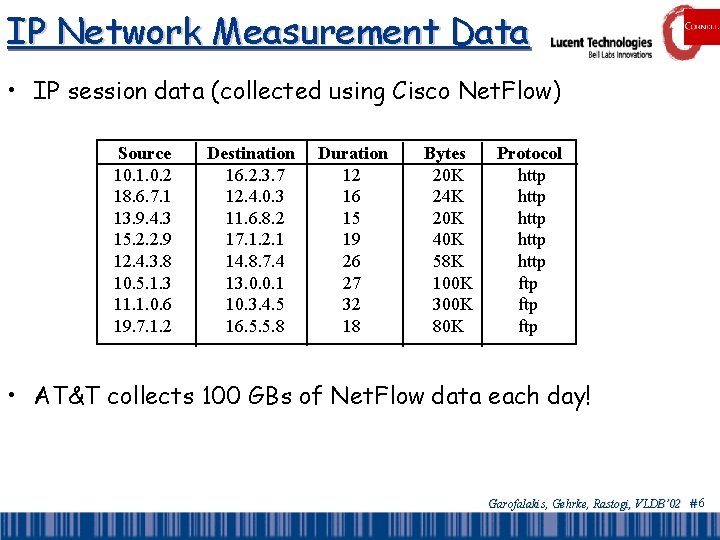
IP Network Measurement Data • IP session data (collected using Cisco Net. Flow) Source 10. 1. 0. 2 18. 6. 7. 1 13. 9. 4. 3 15. 2. 2. 9 12. 4. 3. 8 10. 5. 1. 3 11. 1. 0. 6 19. 7. 1. 2 Destination 16. 2. 3. 7 12. 4. 0. 3 11. 6. 8. 2 17. 1. 2. 1 14. 8. 7. 4 13. 0. 0. 1 10. 3. 4. 5 16. 5. 5. 8 Duration 12 16 15 19 26 27 32 18 Bytes 20 K 24 K 20 K 40 K 58 K 100 K 300 K 80 K Protocol http http ftp ftp • AT&T collects 100 GBs of Net. Flow data each day! Garofalakis, Gehrke, Rastogi, VLDB’ 02 # 6
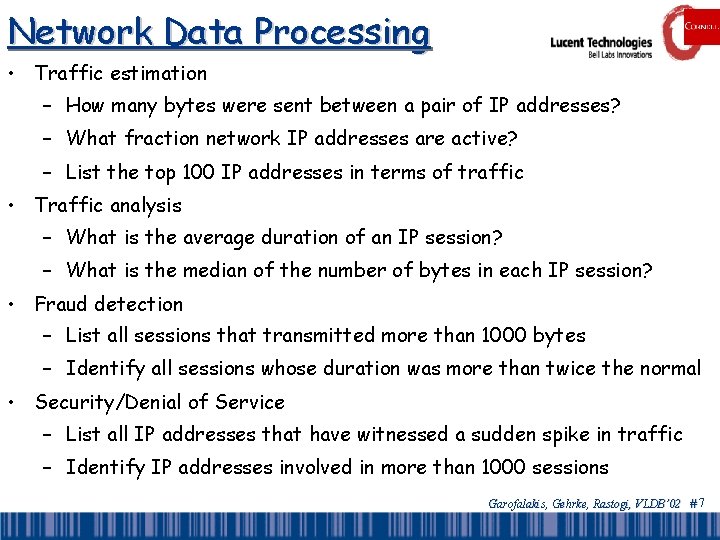
Network Data Processing • Traffic estimation – How many bytes were sent between a pair of IP addresses? – What fraction network IP addresses are active? – List the top 100 IP addresses in terms of traffic • Traffic analysis – What is the average duration of an IP session? – What is the median of the number of bytes in each IP session? • Fraud detection – List all sessions that transmitted more than 1000 bytes – Identify all sessions whose duration was more than twice the normal • Security/Denial of Service – List all IP addresses that have witnessed a sudden spike in traffic – Identify IP addresses involved in more than 1000 sessions Garofalakis, Gehrke, Rastogi, VLDB’ 02 # 7
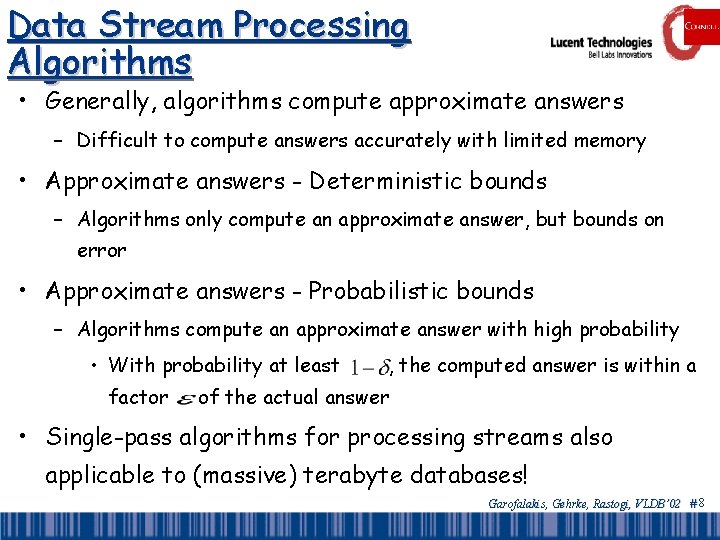
Data Stream Processing Algorithms • Generally, algorithms compute approximate answers – Difficult to compute answers accurately with limited memory • Approximate answers - Deterministic bounds – Algorithms only compute an approximate answer, but bounds on error • Approximate answers - Probabilistic bounds – Algorithms compute an approximate answer with high probability • With probability at least factor , the computed answer is within a of the actual answer • Single-pass algorithms for processing streams also applicable to (massive) terabyte databases! Garofalakis, Gehrke, Rastogi, VLDB’ 02 # 8
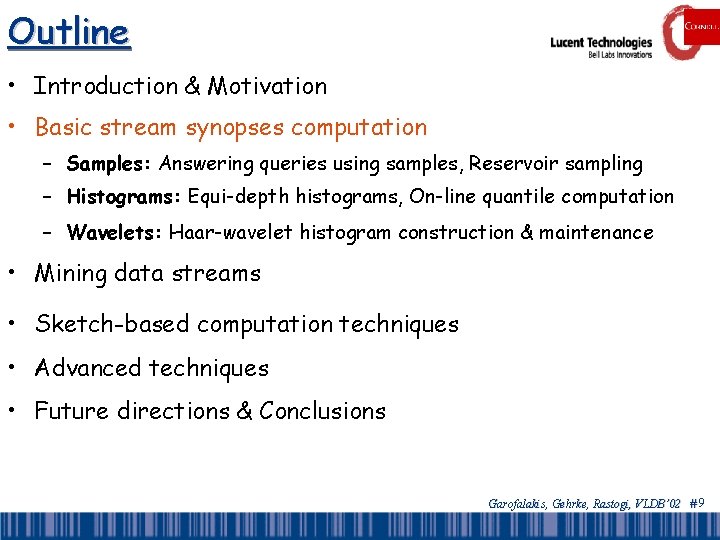
Outline • Introduction & Motivation • Basic stream synopses computation – Samples: Answering queries using samples, Reservoir sampling – Histograms: Equi-depth histograms, On-line quantile computation – Wavelets: Haar-wavelet histogram construction & maintenance • Mining data streams • Sketch-based computation techniques • Advanced techniques • Future directions & Conclusions Garofalakis, Gehrke, Rastogi, VLDB’ 02 # 9
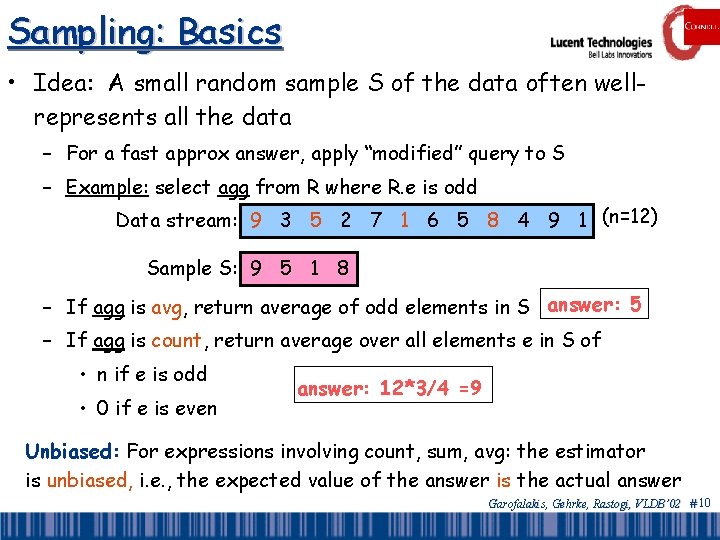
Sampling: Basics • Idea: A small random sample S of the data often wellrepresents all the data – For a fast approx answer, apply “modified” query to S – Example: select agg from R where R. e is odd Data stream: 9 3 5 2 7 1 6 5 8 4 9 1 (n=12) Sample S: 9 5 1 8 – If agg is avg, return average of odd elements in S answer: 5 – If agg is count, return average over all elements e in S of • n if e is odd • 0 if e is even answer: 12*3/4 =9 Unbiased: For expressions involving count, sum, avg: the estimator is unbiased, i. e. , the expected value of the answer is the actual answer Garofalakis, Gehrke, Rastogi, VLDB’ 02 # 10
Probabilistic Guarantees • Example: Actual answer is within 5 ± 1 with prob 0. 9 • Use Tail Inequalities to give probabilistic bounds on returned answer – Markov Inequality – Chebyshev’s Inequality – Hoeffding’s Inequality – Chernoff Bound Garofalakis, Gehrke, Rastogi, VLDB’ 02 # 11
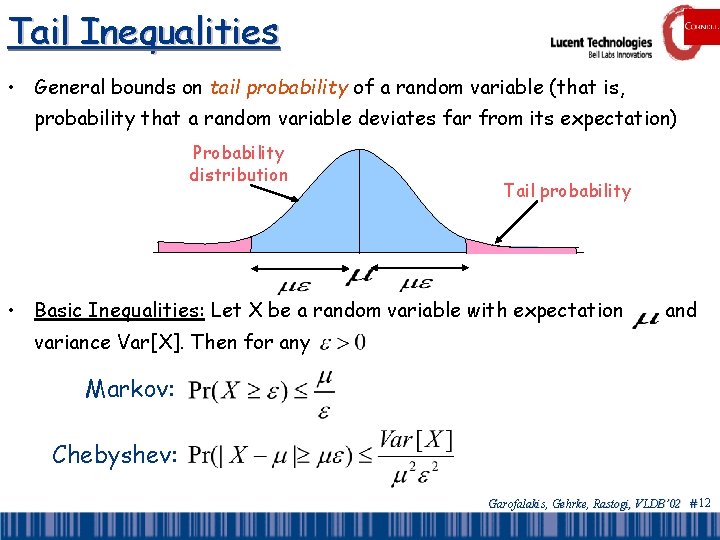
Tail Inequalities • General bounds on tail probability of a random variable (that is, probability that a random variable deviates far from its expectation) Probability distribution Tail probability • Basic Inequalities: Let X be a random variable with expectation and variance Var[X]. Then for any Markov: Chebyshev: Garofalakis, Gehrke, Rastogi, VLDB’ 02 # 12
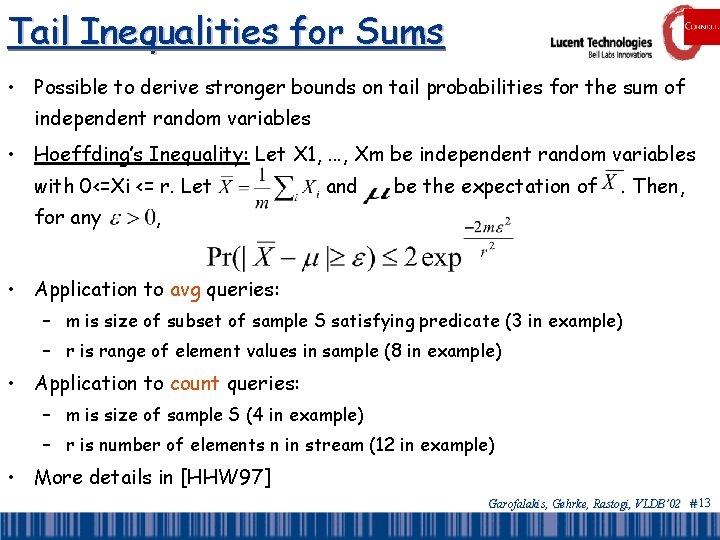
Tail Inequalities for Sums • Possible to derive stronger bounds on tail probabilities for the sum of independent random variables • Hoeffding’s Inequality: Let X 1, . . . , Xm be independent random variables with 0<=Xi <= r. Let for any and be the expectation of . Then, , • Application to avg queries: – m is size of subset of sample S satisfying predicate (3 in example) – r is range of element values in sample (8 in example) • Application to count queries: – m is size of sample S (4 in example) – r is number of elements n in stream (12 in example) • More details in [HHW 97] Garofalakis, Gehrke, Rastogi, VLDB’ 02 # 13
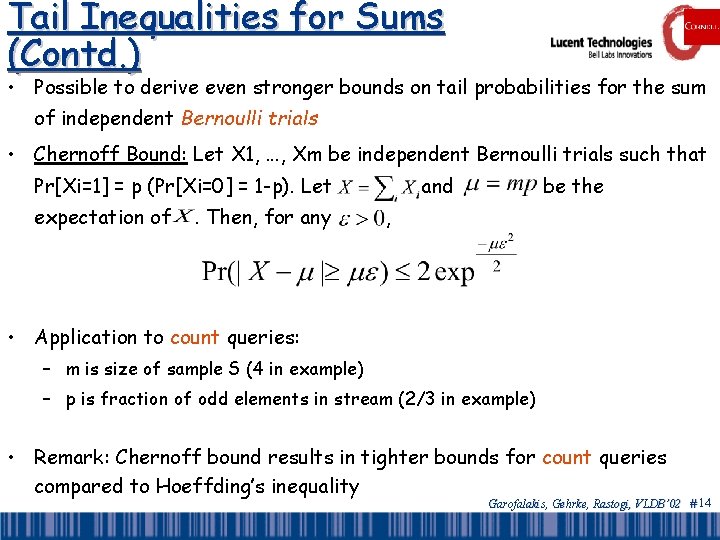
Tail Inequalities for Sums (Contd. ) • Possible to derive even stronger bounds on tail probabilities for the sum of independent Bernoulli trials • Chernoff Bound: Let X 1, . . . , Xm be independent Bernoulli trials such that Pr[Xi=1] = p (Pr[Xi=0] = 1 -p). Let expectation of . Then, for any and be the , • Application to count queries: – m is size of sample S (4 in example) – p is fraction of odd elements in stream (2/3 in example) • Remark: Chernoff bound results in tighter bounds for count queries compared to Hoeffding’s inequality Garofalakis, Gehrke, Rastogi, VLDB’ 02 # 14
Computing Stream Sample • Reservoir Sampling [Vit 85]: Maintains a sample S of a fixed-size M – Add each new element to S with probability M/n, where n is the current number of stream elements – If add an element, evict a random element from S – Instead of flipping a coin for each element, determine the number of elements to skip before the next to be added to S • Concise sampling [GM 98]: Duplicates in sample S stored as <value, count> pairs (thus, potentially boosting actual sample size) – Add each new element to S with probability 1/T (simply increment count if element already in S) – If sample size exceeds M • Select new threshold T’ > T • Evict each element (decrement count) from S with probability 1 T/T’ – Add subsequent elements to S with probability 1/T’ Garofalakis, Gehrke, Rastogi, VLDB’ 02 # 15
Counting Samples [GM 98] • Effective for answering hot list queries (k most frequent values) – Sample S is a set of <value, count> pairs – For each new stream element • If element value in S, increment its count • Otherwise, add to S with probability 1/T – If size of sample S exceeds M, select new threshold T’ > T • For each value (with count C) in S, decrement count in repeated tries until C tries or a try in which count is not decremented – First try, decrement count with probability 1 - T/T’ – Subsequent tries, decrement count with probability 1 -1/T’ – Subject each subsequent stream element to higher threshold T’ • Estimate of frequency for value in S: count in S + 0. 418*T Garofalakis, Gehrke, Rastogi, VLDB’ 02 # 16
Histograms • Histograms approximate the frequency distribution of element values in a stream • A histogram (typically) consists of – A partitioning of element domain values into buckets – A count per bucket B (of the number of elements in B) • Long history of use for selectivity estimation within a query optimizer [Koo 80], [PSC 84], etc. • [PIH 96] [Poo 97] introduced a taxonomy, algorithms, etc. Garofalakis, Gehrke, Rastogi, VLDB’ 02 # 17
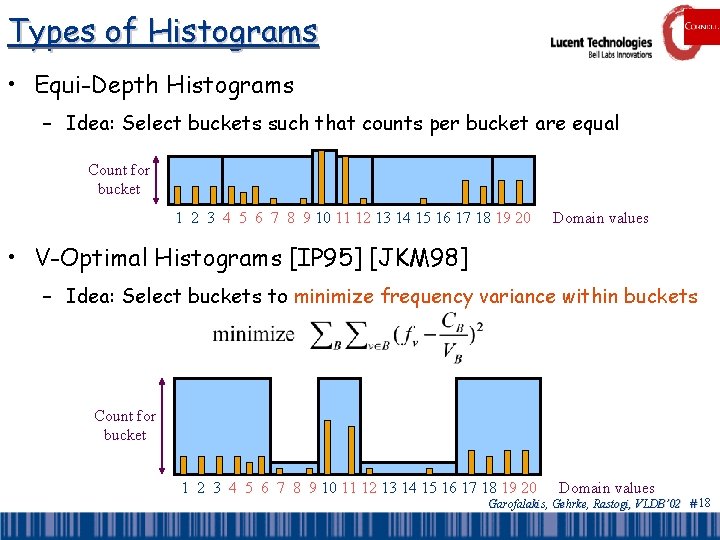
Types of Histograms • Equi-Depth Histograms – Idea: Select buckets such that counts per bucket are equal Count for bucket 1 2 3 4 5 6 7 8 9 10 11 12 13 14 15 16 17 18 19 20 Domain values • V-Optimal Histograms [IP 95] [JKM 98] – Idea: Select buckets to minimize frequency variance within buckets Count for bucket 1 2 3 4 5 6 7 8 9 10 11 12 13 14 15 16 17 18 19 20 Domain values Garofalakis, Gehrke, Rastogi, VLDB’ 02 # 18
Answering Queries using Histograms [IP 99] • (Implicitly) map the histogram back to an approximate relation, & apply the query to the approximate relation • Example: select count(*) from R where 4 <= R. e <= 15 1 2 3 4 5 6 7 8 9 10 11 12 13 14 15 16 17 18 19 20 Count spread evenly among bucket values 4 R. e 15 answer: 3. 5 * • For equi-depth histograms, maximum error: Garofalakis, Gehrke, Rastogi, VLDB’ 02 # 19
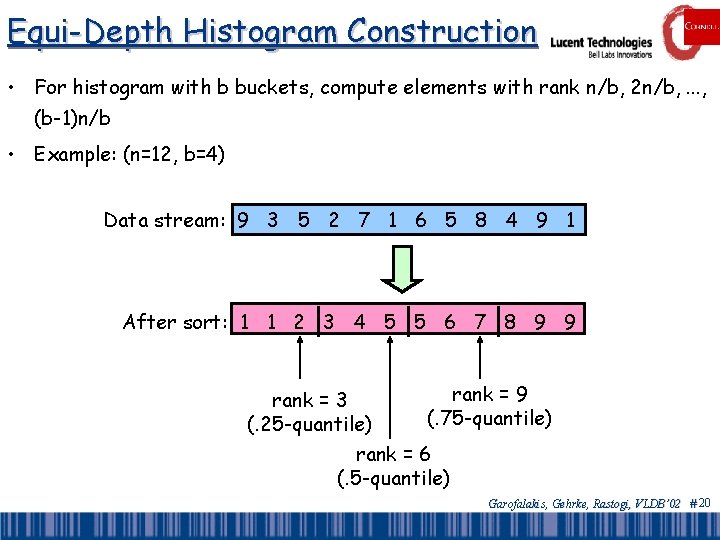
Equi-Depth Histogram Construction • For histogram with b buckets, compute elements with rank n/b, 2 n/b, . . . , (b-1)n/b • Example: (n=12, b=4) Data stream: 9 3 5 2 7 1 6 5 8 4 9 1 After sort: 1 1 2 3 4 5 5 6 7 8 9 9 rank = 3 (. 25 -quantile) rank = 9 (. 75 -quantile) rank = 6 (. 5 -quantile) Garofalakis, Gehrke, Rastogi, VLDB’ 02 # 20
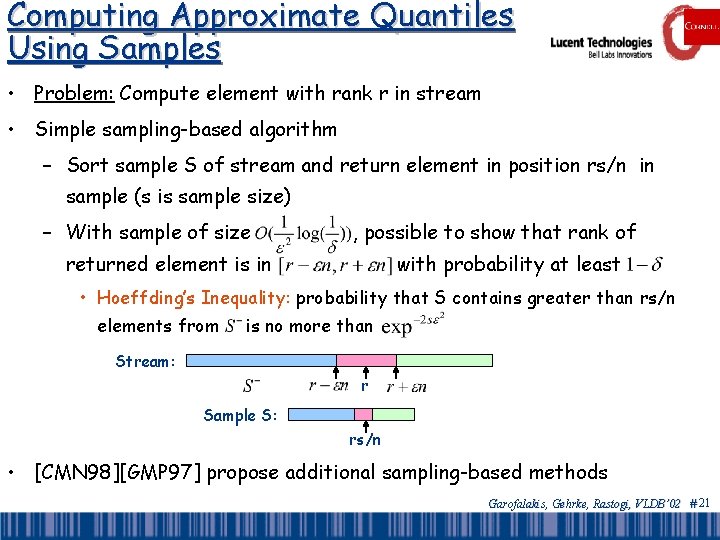
Computing Approximate Quantiles Using Samples • Problem: Compute element with rank r in stream • Simple sampling-based algorithm – Sort sample S of stream and return element in position rs/n in sample (s is sample size) – With sample of size , possible to show that rank of returned element is in with probability at least • Hoeffding’s Inequality: probability that S contains greater than rs/n elements from is no more than Stream: r Sample S: rs/n • [CMN 98][GMP 97] propose additional sampling-based methods Garofalakis, Gehrke, Rastogi, VLDB’ 02 # 21
Algorithms for Computing Approximate Quantiles • [MRL 98], [MRL 99], [GK 01] propose sophisticated algorithms for computing stream element with rank in – Space complexity proportional to instead of • [MRL 98], [MRL 99] – Probabilistic algorithm with space complexity – Combined with sampling, space complexity becomes • [GK 01] – Deterministic algorithm with space complexity Garofalakis, Gehrke, Rastogi, VLDB’ 02 # 22
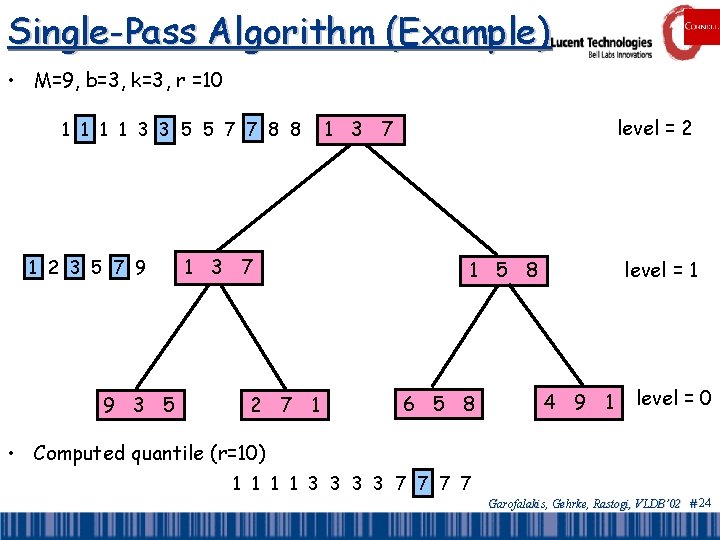
Single-Pass Quantile Computation Algorithm [MRL 98] • Split memory M into b buffers of size k (M = bk) • For each successive set of k elements in stream – If free buffer B exists • insert k elements into B, set level of B to 0 – Else • merge two buffers B and B’ at same level l • output result of merge into B’, set level of B’ to l+1 • insert k elements into B, set level of B to 0 • Output element in position r after making final buffer and sorting them copies of each element in • Merge operation (input buffers B and B’ at level l) – Make copies of each element in B and B’ – Sort copies – Output elements in positions in sorted sequence, j=0, . . . , k-1 Garofalakis, Gehrke, Rastogi, VLDB’ 02 # 23
Single-Pass Algorithm (Example) • M=9, b=3, k=3, r =10 1 1 3 3 5 5 7 7 8 8 1 2 3 5 7 9 9 3 5 1 3 7 2 7 1 level = 2 1 3 7 1 5 8 6 5 8 level = 1 4 9 1 level = 0 • Computed quantile (r=10) 1 1 3 3 7 7 Garofalakis, Gehrke, Rastogi, VLDB’ 02 # 24
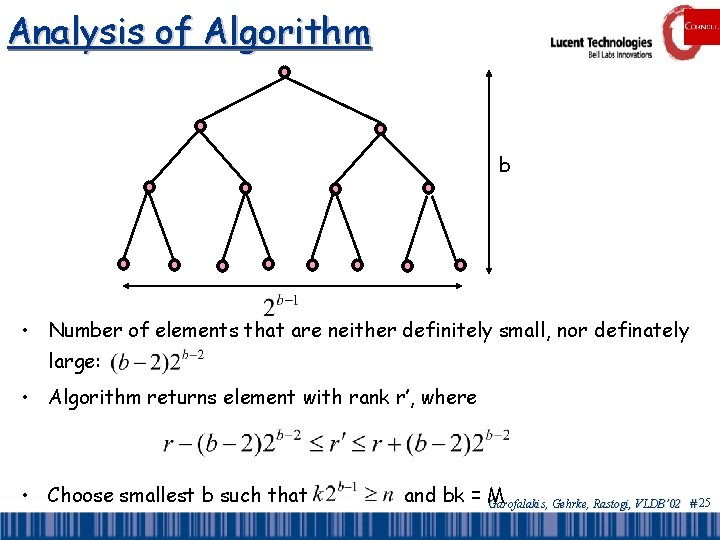
Analysis of Algorithm b • Number of elements that are neither definitely small, nor definately large: • Algorithm returns element with rank r’, where • Choose smallest b such that and bk = M Garofalakis, Gehrke, Rastogi, VLDB’ 02 # 25
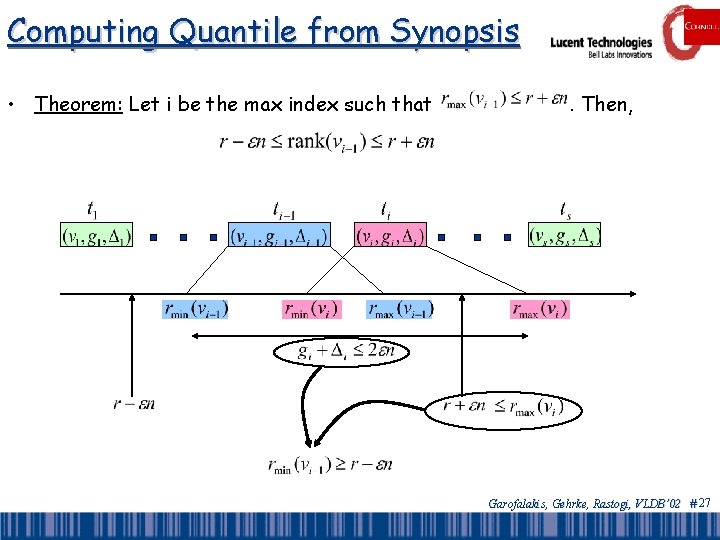
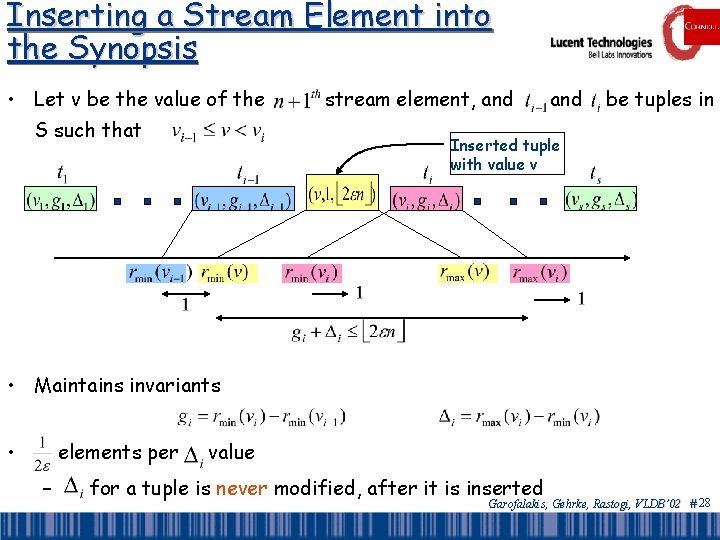
Computing Approximate Quantiles [GK 01] • Synopsis structure S: sequence of tuples Sorted sequence • • : min/max rank of : number of stream elements covered by • Invariants: Garofalakis, Gehrke, Rastogi, VLDB’ 02 # 26
Computing Quantile from Synopsis • Theorem: Let i be the max index such that . Then, Garofalakis, Gehrke, Rastogi, VLDB’ 02 # 27
Inserting a Stream Element into the Synopsis • Let v be the value of the S such that stream element, and be tuples in Inserted tuple with value v • Maintains invariants • elements per – value for a tuple is never modified, after it is inserted Garofalakis, Gehrke, Rastogi, VLDB’ 02 # 28
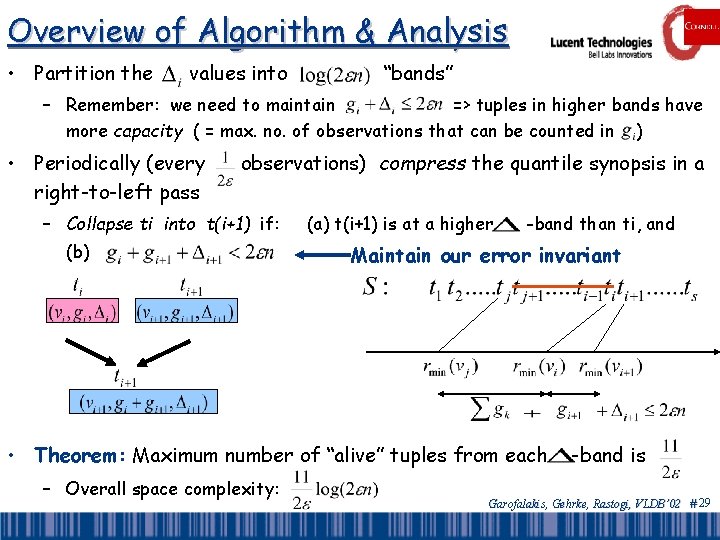
Overview of Algorithm & Analysis • Partition the values into “bands” – Remember: we need to maintain => tuples in higher bands have more capacity ( = max. no. of observations that can be counted in ) • Periodically (every right-to-left pass observations) compress the quantile synopsis in a – Collapse ti into t(i+1) if: (b) (a) t(i+1) is at a higher -band than ti, and Maintain our error invariant • Theorem: Maximum number of “alive” tuples from each – Overall space complexity: -band is Garofalakis, Gehrke, Rastogi, VLDB’ 02 # 29
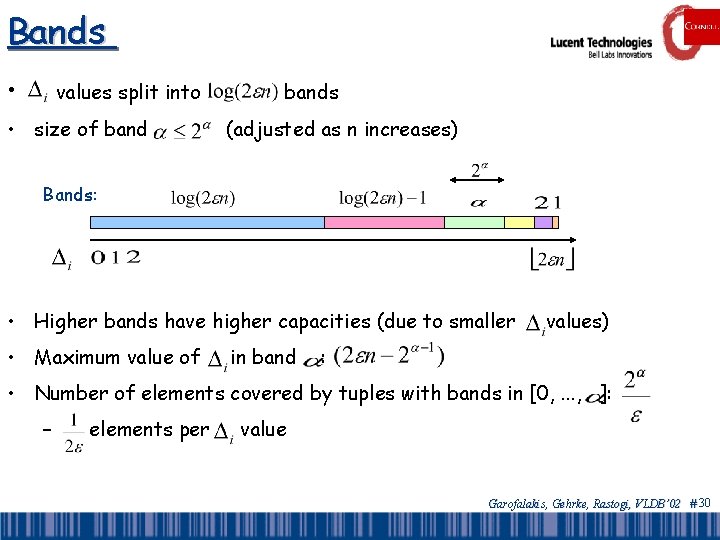
Bands • values split into • size of bands (adjusted as n increases) Bands: • Higher bands have higher capacities (due to smaller • Maximum value of in band values) : • Number of elements covered by tuples with bands in [0, . . . , ]: – elements per value Garofalakis, Gehrke, Rastogi, VLDB’ 02 # 30
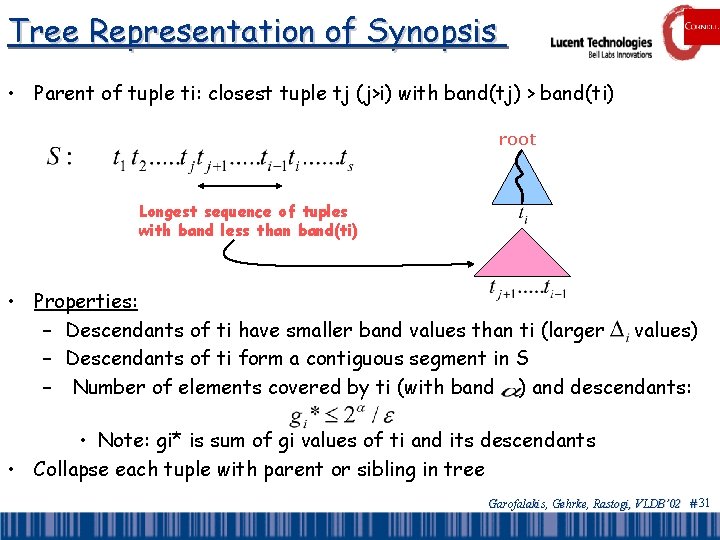
Tree Representation of Synopsis • Parent of tuple ti: closest tuple tj (j>i) with band(tj) > band(ti) root Longest sequence of tuples with band less than band(ti) • Properties: – Descendants of ti have smaller band values than ti (larger values) – Descendants of ti form a contiguous segment in S – Number of elements covered by ti (with band ) and descendants: • Note: gi* is sum of gi values of ti and its descendants • Collapse each tuple with parent or sibling in tree Garofalakis, Gehrke, Rastogi, VLDB’ 02 # 31
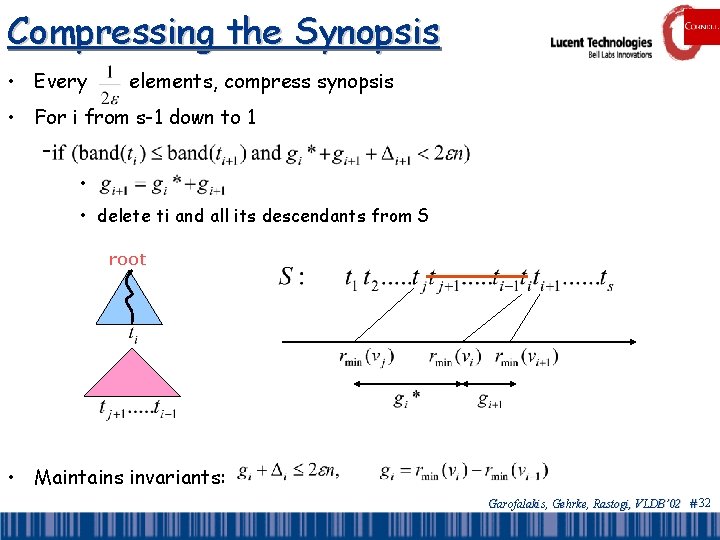
Compressing the Synopsis • Every elements, compress synopsis • For i from s-1 down to 1 – • • delete ti and all its descendants from S root • Maintains invariants: Garofalakis, Gehrke, Rastogi, VLDB’ 02 # 32
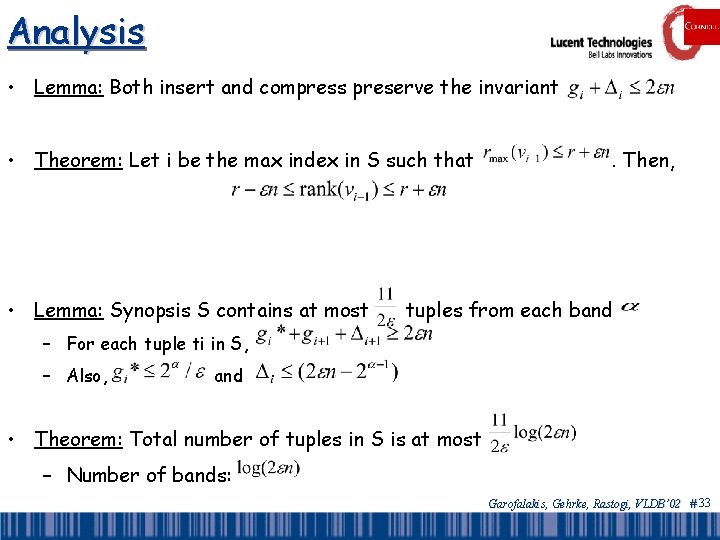
Analysis • Lemma: Both insert and compress preserve the invariant • Theorem: Let i be the max index in S such that • Lemma: Synopsis S contains at most . Then, tuples from each band – For each tuple ti in S, – Also, and • Theorem: Total number of tuples in S is at most – Number of bands: Garofalakis, Gehrke, Rastogi, VLDB’ 02 # 33
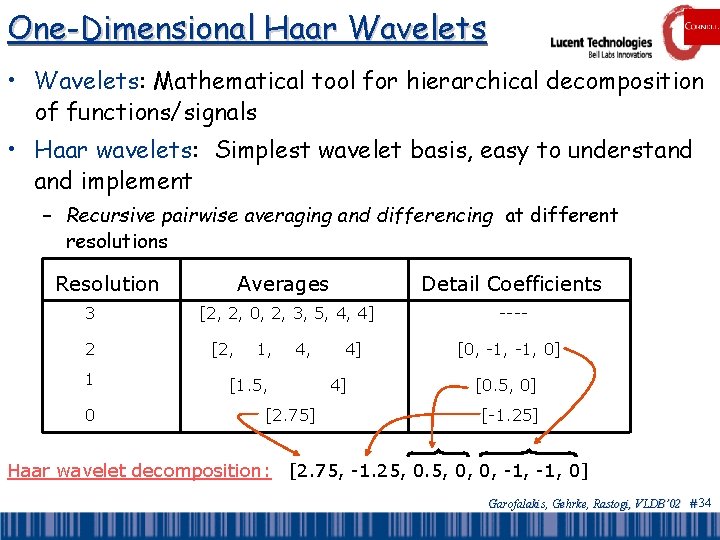
One-Dimensional Haar Wavelets • Wavelets: Mathematical tool for hierarchical decomposition of functions/signals • Haar wavelets: Simplest wavelet basis, easy to understand implement – Recursive pairwise averaging and differencing at different resolutions Resolution 3 2 1 0 Averages Detail Coefficients [2, 2, 0, 2, 3, 5, 4, 4] ---- [2, 1, 4, [1. 5, 4] [2. 75] Haar wavelet decomposition: 4] [0, -1, 0] [0. 5, 0] [-1. 25] [2. 75, -1. 25, 0, 0, -1, 0] Garofalakis, Gehrke, Rastogi, VLDB’ 02 # 34
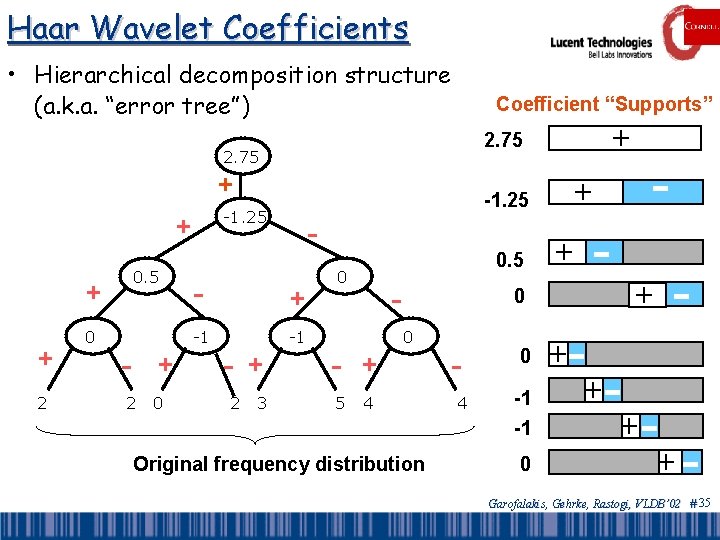
Haar Wavelet Coefficients • Hierarchical decomposition structure (a. k. a. “error tree”) Coefficient “Supports” 2. 75 + 0. 5 + + 2 0 - - + -1 -1 - + 2 3 0. 5 0 0 - + 5 - + + 0 - 4 - 0 4 -1 -1 Original frequency distribution 0 - + -1. 25 + + 2. 75 + - + - Garofalakis, Gehrke, Rastogi, VLDB’ 02 # 35
Wavelet-based Histograms [MVW 98] • Problem: Range-query selectivity estimation • Key idea: Use a compact subset of Haar/linear wavelet coefficients for approximating frequency distribution • Steps – Compute cumulative frequency distribution C – Compute Haar (or linear) wavelet transform of C – Coefficient thresholding : only m<<n coefficients can be kept • Take largest coefficients in absolute normalized value – Haar basis: divide coefficients at resolution j by – Optimal in terms of the overall Mean Squared (L 2) Error • Greedy heuristic methods – Retain coefficients leading to large error reduction – Throw away coefficients that give small increase in error Garofalakis, Gehrke, Rastogi, VLDB’ 02 # 36
Using Wavelet-based Histograms • Selectivity estimation: count(a<= R. e<= b) = C’[b] - C’[a-1] – C’ is the (approximate) “reconstructed” cumulative distribution – Time: O(min{m, log. N}), where m = size of wavelet synopsis (number of coefficients), N= size of domain • At most log. N+1 coefficients are needed to reconstruct any C’ value C’[a] • Empirical results over synthetic data – Improvements over random sampling and histograms Garofalakis, Gehrke, Rastogi, VLDB’ 02 # 37
Dynamic Maintenance of Waveletbased Histograms [MVW 00] • Build Haar-wavelet synopses on the original frequency distribution – Similar accuracy with CDF, makes maintenance simpler • Key issues with dynamic wavelet maintenance – Change in single distribution value can affect the values of many coefficients (path to the root of the decomposition tree) Change propagates up to the root coefficient – As distribution changes, “most significant” (e. g. , largest) coefficients can also change! • Important coefficients can become unimportant, and vice-versa Garofalakis, Gehrke, Rastogi, VLDB’ 02 # 38
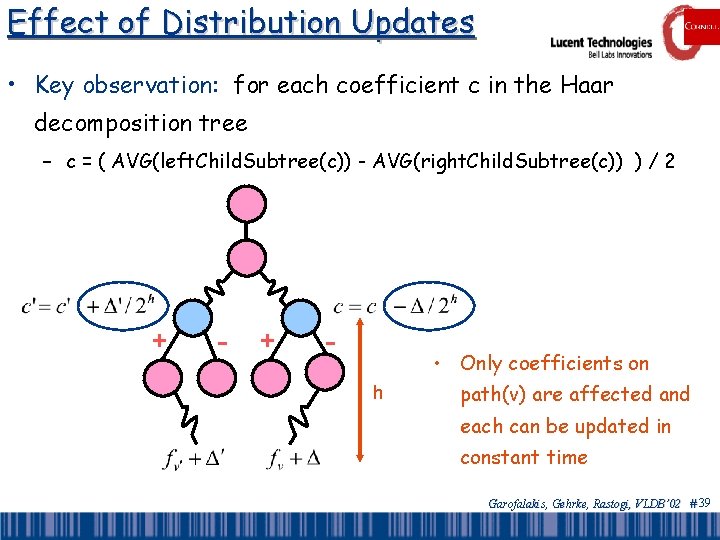
Effect of Distribution Updates • Key observation: for each coefficient c in the Haar decomposition tree – c = ( AVG(left. Child. Subtree(c)) - AVG(right. Child. Subtree(c)) ) / 2 + - • Only coefficients on h path(v) are affected and each can be updated in constant time Garofalakis, Gehrke, Rastogi, VLDB’ 02 # 39
Maintenance Algorithm [MWV 00] Simplified Version • Histogram H: Top m wavelet coefficients • For each new stream element (with value v) – For each coefficient c on path(v) and with “height” h • If c is in H, update c (by adding or substracting ) – For each coefficient c on path(v) and not in H • Insert c into H with probability proportional to (Probabilistic Counting [FM 85]) – Initial value of c: min(H), the minimum coefficient in H • If H contains more than m coefficients – Delete minimum coefficient in H Garofalakis, Gehrke, Rastogi, VLDB’ 02 # 40
Outline • Introduction & motivation – Stream computation model, Applications • Basic stream synopses computation – Samples, Equi-depth histograms, Wavelets • Mining data streams – Decision trees, clustering • Sketch-based computation techniques – Self-joins, Joins, Wavelets, V-optimal histograms • Advanced techniques – Sliding windows, Distinct values, Hot lists • Future directions & Conclusions Garofalakis, Gehrke, Rastogi, VLDB’ 02 # 41
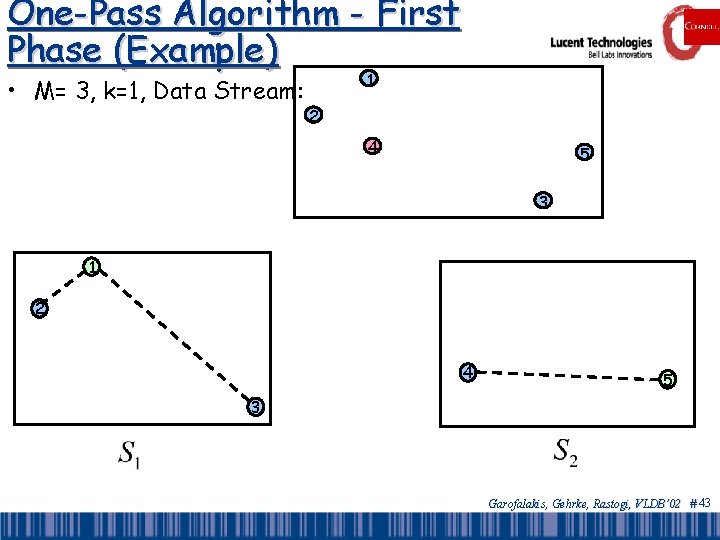
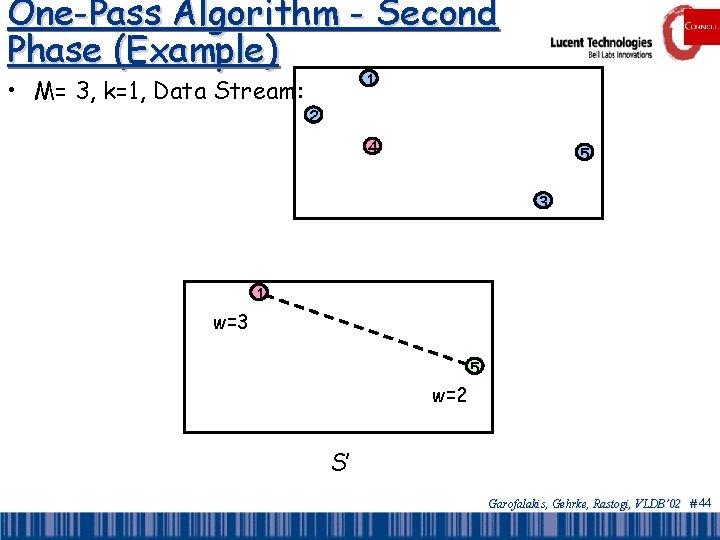
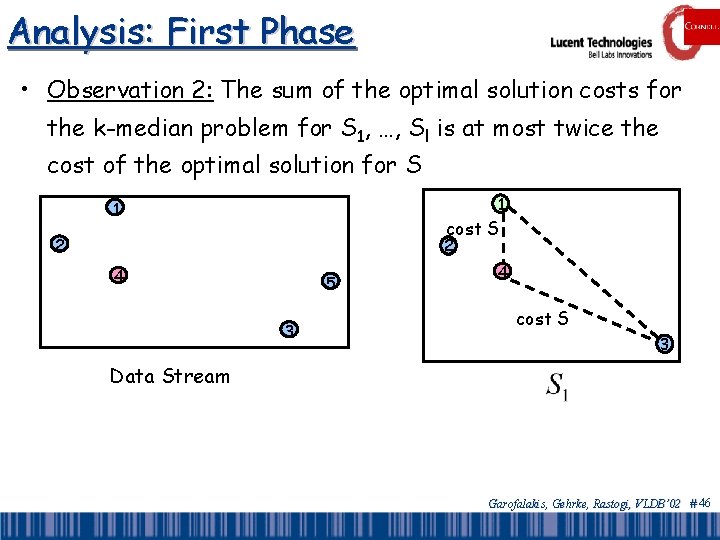
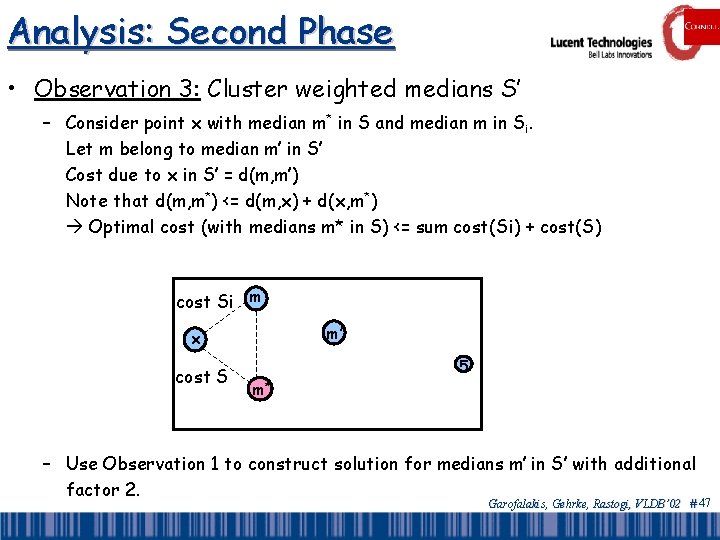
Clustering Data Streams [GMMO 01] K-median problem definition: • Data stream with points from metric space • Find k centers in the stream such that the sum of distances from data points to their closest center is minimized. Previous work: Constant-factor approximation algorithms Two-step algorithm: STEP 1: For each set of M records, Si, find O(k) centers in S 1, …, Sl – Local clustering: Assign each point in Sito its closest center STEP 2: Let S’ be centers for S 1, …, Sl with each center weighted by number of points assigned to it. Cluster S’ to find k centers Algorithm forms a building block for more sophisticated algorithms (see paper). Garofalakis, Gehrke, Rastogi, VLDB’ 02 # 42
One-Pass Algorithm - First Phase (Example) • M= 3, k=1, Data Stream: 1 2 4 5 3 Garofalakis, Gehrke, Rastogi, VLDB’ 02 # 43
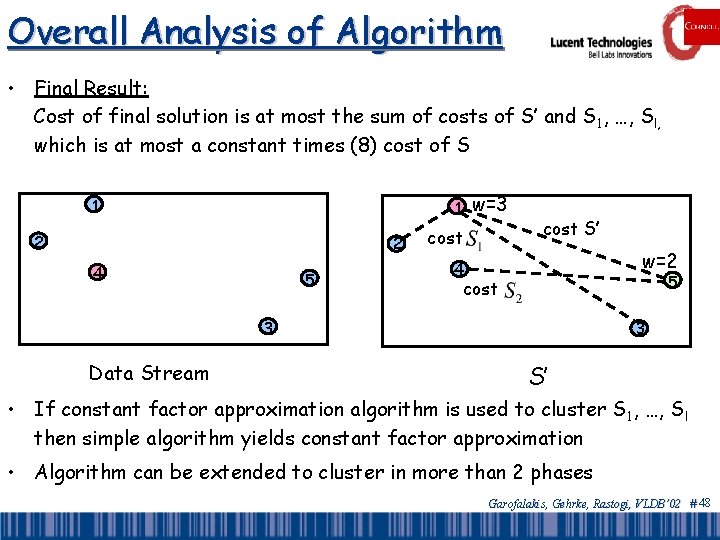
One-Pass Algorithm - Second Phase (Example) • M= 3, k=1, Data Stream: 1 2 4 5 3 1 w=3 5 w=2 S’ Garofalakis, Gehrke, Rastogi, VLDB’ 02 # 44
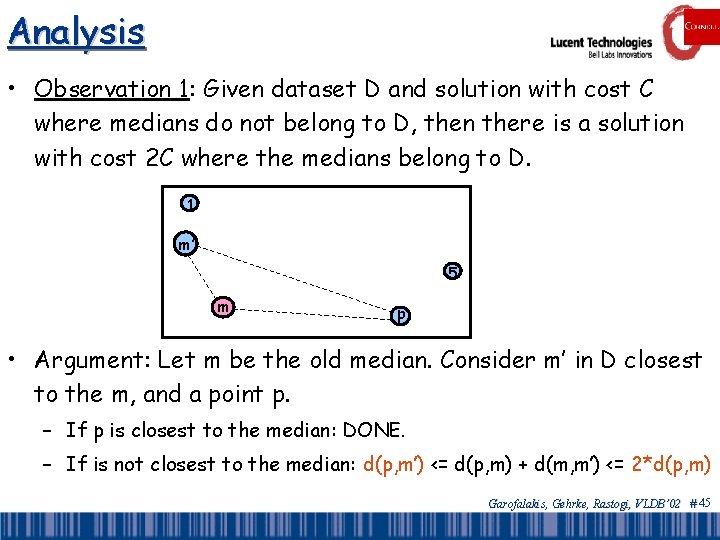
Analysis • Observation 1: Given dataset D and solution with cost C where medians do not belong to D, then there is a solution with cost 2 C where the medians belong to D. 1 m’ 5 m p • Argument: Let m be the old median. Consider m’ in D closest to the m, and a point p. – If p is closest to the median: DONE. – If is not closest to the median: d(p, m’) <= d(p, m) + d(m, m’) <= 2*d(p, m) Garofalakis, Gehrke, Rastogi, VLDB’ 02 # 45
Analysis: First Phase • Observation 2: The sum of the optimal solution costs for the k-median problem for S 1, …, Sl is at most twice the cost of the optimal solution for S 1 1 cost S 2 2 4 5 3 4 cost S 3 Data Stream Garofalakis, Gehrke, Rastogi, VLDB’ 02 # 46
Analysis: Second Phase • Observation 3: Cluster weighted medians S’ – Consider point x with median m* in S and median m in Si. Let m belong to median m’ in S’ Cost due to x in S’ = d(m, m’) Note that d(m, m*) <= d(m, x) + d(x, m*) Optimal cost (with medians m* in S) <= sum cost(Si) + cost(S) cost Si m m’ x cost S 5 m* – Use Observation 1 to construct solution for medians m’ in S’ with additional factor 2. Garofalakis, Gehrke, Rastogi, VLDB’ 02 # 47
Overall Analysis of Algorithm • Final Result: Cost of final solution is at most the sum of costs of S’ and S 1, …, Sl, which is at most a constant times (8) cost of S 1 w=3 1 2 2 4 5 cost S’ w=2 4 5 cost 3 Data Stream 3 S’ • If constant factor approximation algorithm is used to cluster S 1, …, Sl then simple algorithm yields constant factor approximation • Algorithm can be extended to cluster in more than 2 phases Garofalakis, Gehrke, Rastogi, VLDB’ 02 # 48
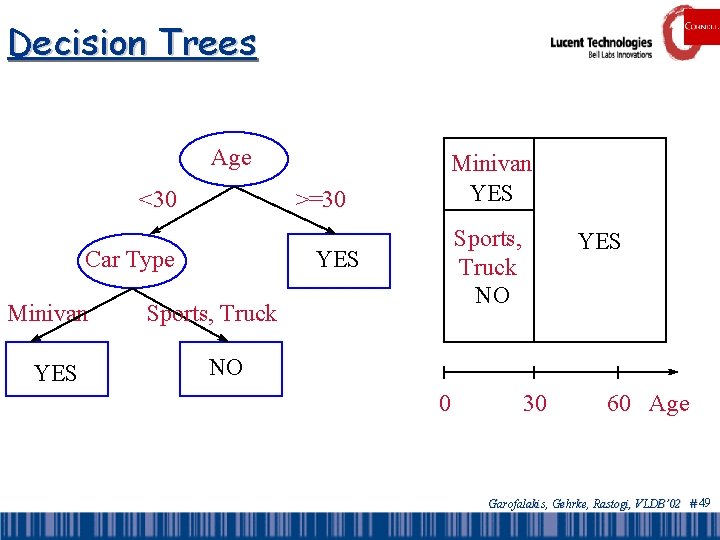
Decision Trees Age <30 >=30 YES Sports, Truck NO YES Car Type Minivan YES Sports, Truck YES NO 0 30 60 Age Garofalakis, Gehrke, Rastogi, VLDB’ 02 # 49
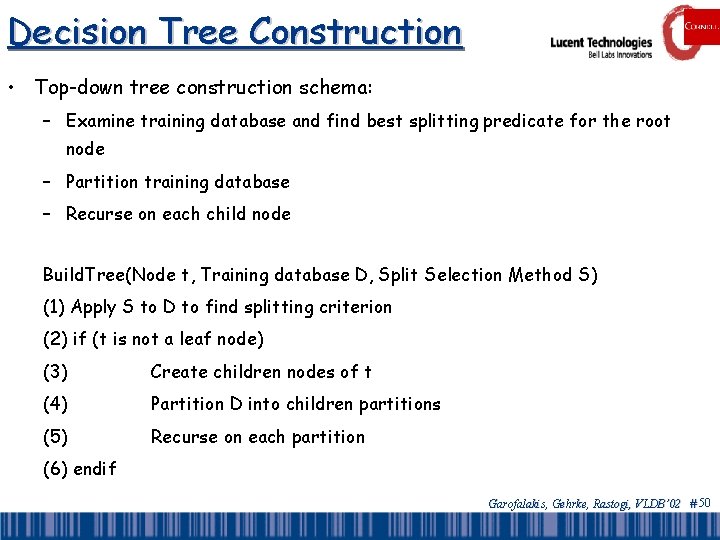
Decision Tree Construction • Top-down tree construction schema: – Examine training database and find best splitting predicate for the root node – Partition training database – Recurse on each child node Build. Tree(Node t, Training database D, Split Selection Method S) (1) Apply S to D to find splitting criterion (2) if (t is not a leaf node) (3) Create children nodes of t (4) Partition D into children partitions (5) Recurse on each partition (6) endif Garofalakis, Gehrke, Rastogi, VLDB’ 02 # 50
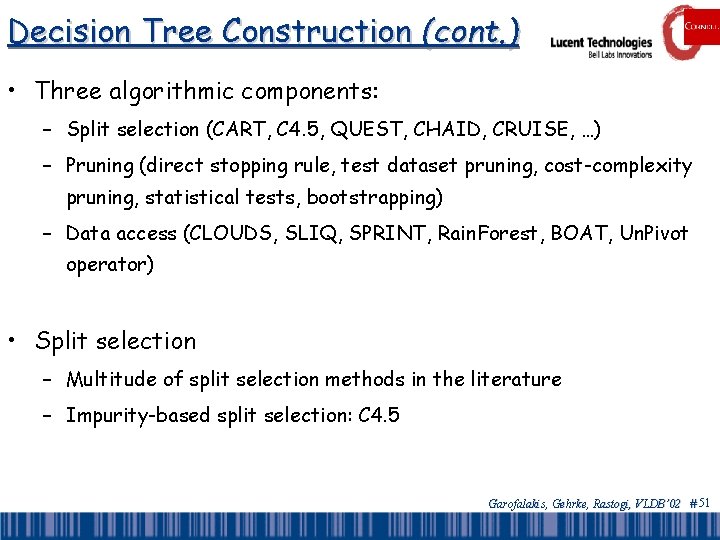
Decision Tree Construction (cont. ) • Three algorithmic components: – Split selection (CART, C 4. 5, QUEST, CHAID, CRUISE, …) – Pruning (direct stopping rule, test dataset pruning, cost-complexity pruning, statistical tests, bootstrapping) – Data access (CLOUDS, SLIQ, SPRINT, Rain. Forest, BOAT, Un. Pivot operator) • Split selection – Multitude of split selection methods in the literature – Impurity-based split selection: C 4. 5 Garofalakis, Gehrke, Rastogi, VLDB’ 02 # 51
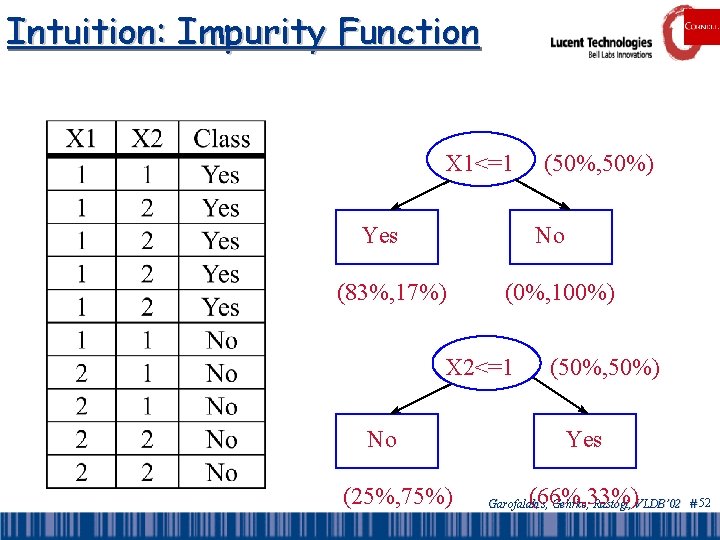
Intuition: Impurity Function X 1<=1 Yes (50%, 50%) No (83%, 17%) (0%, 100%) X 2<=1 No (25%, 75%) (50%, 50%) Yes (66%, 33%) Garofalakis, Gehrke, Rastogi, VLDB’ 02 # 52
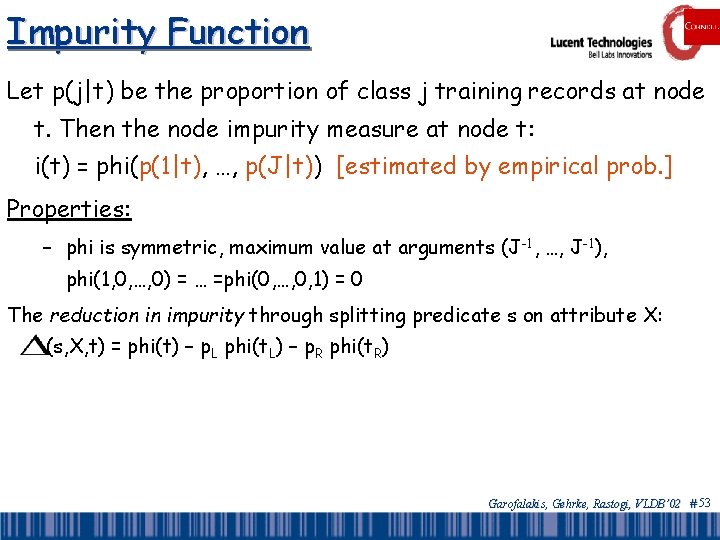
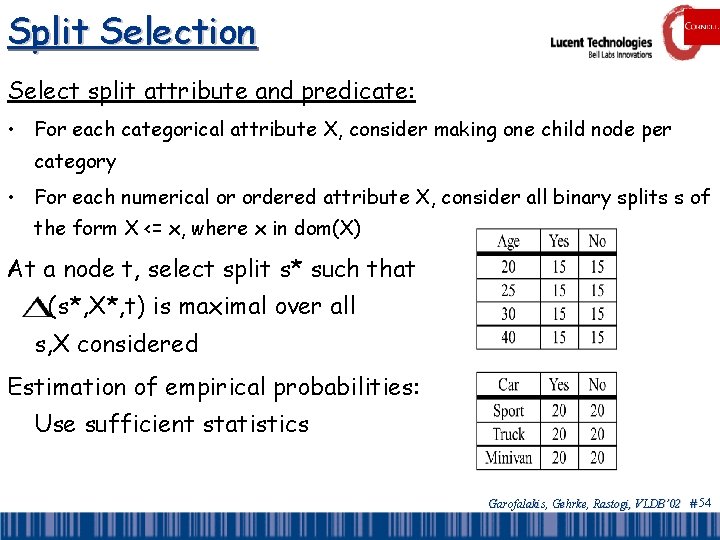
Impurity Function Let p(j|t) be the proportion of class j training records at node t. Then the node impurity measure at node t: i(t) = phi(p(1|t), …, p(J|t)) [estimated by empirical prob. ] Properties: – phi is symmetric, maximum value at arguments (J-1, …, J-1), phi(1, 0, …, 0) = … =phi(0, …, 0, 1) = 0 The reduction in impurity through splitting predicate s on attribute X: (s, X, t) = phi(t) – p. L phi(t. L) – p. R phi(t. R) Garofalakis, Gehrke, Rastogi, VLDB’ 02 # 53
Split Selection Select split attribute and predicate: • For each categorical attribute X, consider making one child node per category • For each numerical or ordered attribute X, consider all binary splits s of the form X <= x, where x in dom(X) At a node t, select split s* such that (s*, X*, t) is maximal over all s, X considered Estimation of empirical probabilities: Use sufficient statistics Garofalakis, Gehrke, Rastogi, VLDB’ 02 # 54
VFDT/CVFDT [DH 00, DH 01] • VFDT: – Constructs model from data stream instead of static database – Assumes the data arrives iid – With high probability, constructs the identical model that a traditional (greedy) method would learn • CVFDT: Extension to time changing data Garofalakis, Gehrke, Rastogi, VLDB’ 02 # 55
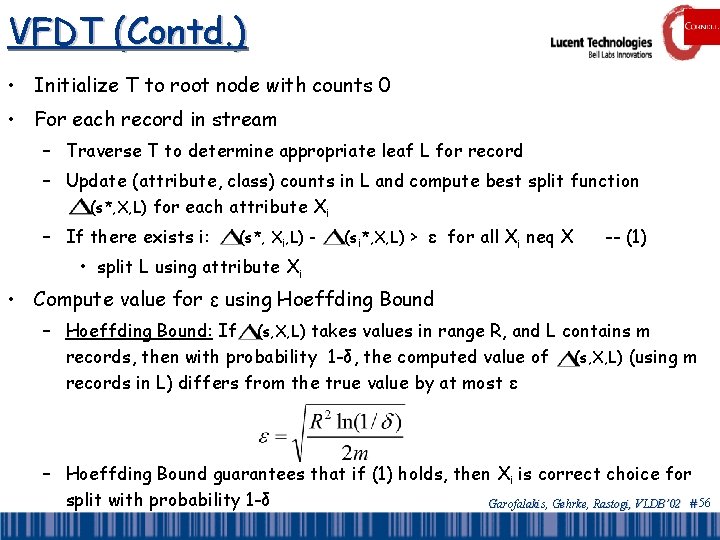
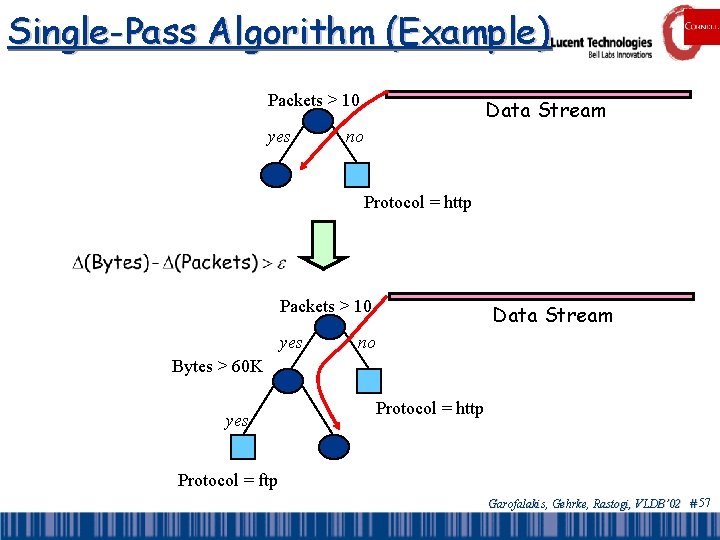
VFDT (Contd. ) • Initialize T to root node with counts 0 • For each record in stream – Traverse T to determine appropriate leaf L for record – Update (attribute, class) counts in L and compute best split function (s*, X, L) for each attribute Xi – If there exists i: (s*, Xi, L) - (si*, X, L) > ε for all Xi neq X -- (1) • split L using attribute Xi • Compute value for ε using Hoeffding Bound – Hoeffding Bound: If (s, X, L) takes values in range R, and L contains m records, then with probability 1 -δ, the computed value of (s, X, L) (using m records in L) differs from the true value by at most ε – Hoeffding Bound guarantees that if (1) holds, then Xi is correct choice for split with probability 1 -δ Garofalakis, Gehrke, Rastogi, VLDB’ 02 # 56
Single-Pass Algorithm (Example) Packets > 10 yes Data Stream no Protocol = http Packets > 10 yes Data Stream no Bytes > 60 K yes Protocol = http Protocol = ftp Garofalakis, Gehrke, Rastogi, VLDB’ 02 # 57
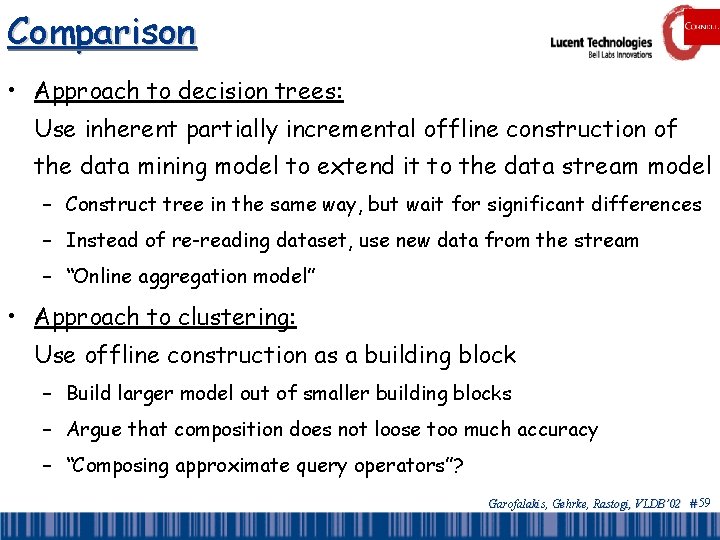
Comparison • Approach to decision trees: Use inherent partially incremental offline construction of the data mining model to extend it to the data stream model – Construct tree in the same way, but wait for significant differences – Instead of re-reading dataset, use new data from the stream – “Online aggregation model” • Approach to clustering: Use offline construction as a building block – Build larger model out of smaller building blocks – Argue that composition does not loose too much accuracy – “Composing approximate query operators”? Garofalakis, Gehrke, Rastogi, VLDB’ 02 # 59
Outline • Introduction & motivation – Stream computation model, Applications • Basic stream synopses computation – Samples, Equi-depth histograms, Wavelets • Mining data streams – Decision trees, clustering, association rules • Sketch-based computation techniques – Self-joins, Joins, Wavelets, V-optimal histograms • Advanced techniques – Distinct values, Sliding windows, Hot lists • Future directions & Conclusions Garofalakis, Gehrke, Rastogi, VLDB’ 02 # 60
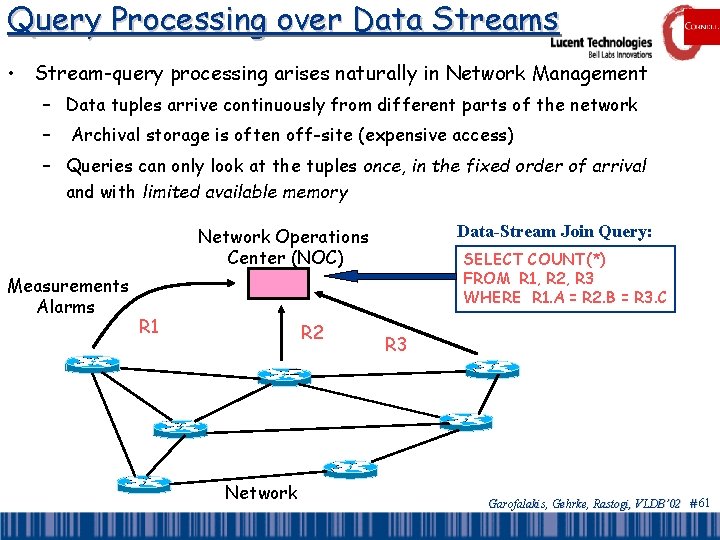
Query Processing over Data Streams • Stream-query processing arises naturally in Network Management – Data tuples arrive continuously from different parts of the network – Archival storage is often off-site (expensive access) – Queries can only look at the tuples once, in the fixed order of arrival and with limited available memory Data-Stream Join Query: Network Operations Center (NOC) Measurements Alarms R 1 R 2 Network SELECT COUNT(*) FROM R 1, R 2, R 3 WHERE R 1. A = R 2. B = R 3. C R 3 Garofalakis, Gehrke, Rastogi, VLDB’ 02 # 61
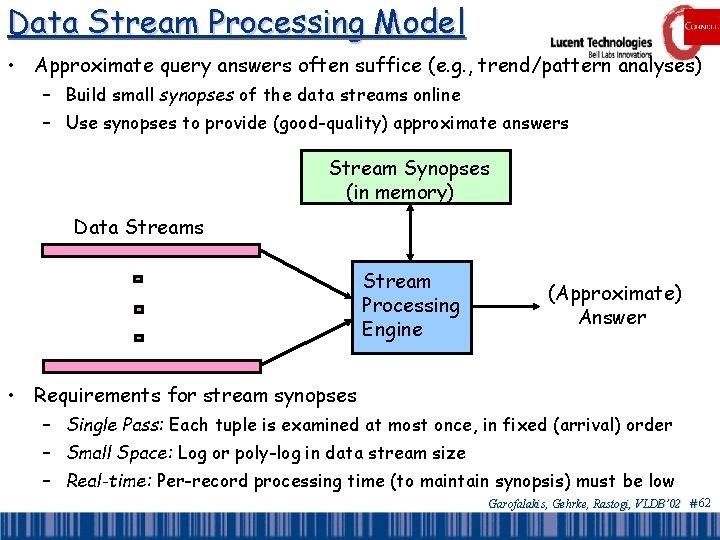
Data Stream Processing Model • Approximate query answers often suffice (e. g. , trend/pattern analyses) – Build small synopses of the data streams online – Use synopses to provide (good-quality) approximate answers Stream Synopses (in memory) Data Streams Stream Processing Engine (Approximate) Answer • Requirements for stream synopses – Single Pass: Each tuple is examined at most once, in fixed (arrival) order – Small Space: Log or poly-log in data stream size – Real-time: Per-record processing time (to maintain synopsis) must be low Garofalakis, Gehrke, Rastogi, VLDB’ 02 # 62
Stream Data Synopses • Conventional data summaries fall short – Quantiles and 1 -d histograms: Cannot capture attribute correlations – Samples (e. g. , using Reservoir Sampling) perform poorly for joins – Multi-d histograms/wavelets: Construction requires multiple passes over the data • Different approach: Randomized sketch synopses – Only logarithmic space – Probabilistic guarantees on the quality of the approximate answer • Overview – Basic technique – Extension to relational query processing over streams – Extracting wavelets and histograms from sketches – Extensions (stable distributions, distinct values, quantiles) Garofalakis, Gehrke, Rastogi, VLDB’ 02 # 63
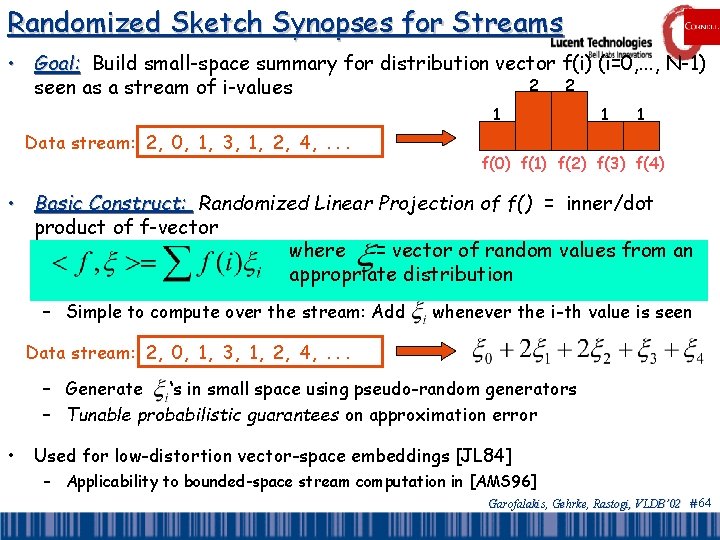
Randomized Sketch Synopses for Streams • Goal: Build small-space summary for distribution vector f(i) (i=0, . . . , N-1) 2 2 seen as a stream of i-values 1 Data stream: 2, 0, 1, 3, 1, 2, 4, . . . 1 1 f(0) f(1) f(2) f(3) f(4) • Basic Construct: Randomized Linear Projection of f() = inner/dot product of f-vector where = vector of random values from an appropriate distribution – Simple to compute over the stream: Add whenever the i-th value is seen Data stream: 2, 0, 1, 3, 1, 2, 4, . . . – Generate ‘s in small space using pseudo-random generators – Tunable probabilistic guarantees on approximation error • Used for low-distortion vector-space embeddings [JL 84] – Applicability to bounded-space stream computation in [AMS 96] Garofalakis, Gehrke, Rastogi, VLDB’ 02 # 64
Sketches for 2 nd Moment Estimation over Streams [AMS 96] • Problem: Tuples of relation R are streaming in -- compute the 2 nd frequency moment of attribute R. A, i. e. , , where f(i) = frequency( i-th value of R. A) • COUNT( R A R ) (size of the self-join on R. A) • Exact solution: too expensive, requires O(N) space!! – How do we do it in small (O(log. N)) space? ? Garofalakis, Gehrke, Rastogi, VLDB’ 02 # 65
Sketches for 2 nd Moment Estimation over Streams [AMS 96] (cont. ) • Key Intuition: Use randomized linear projections of f() to define a random variable X such that – X is easily computed over the stream (in small space) – E[X] = F 2 (unbiased estimate) – Var[X] is small Probabilistic Error Guarantees • Technique – Define a family of 4 -wise independent {-1, +1} random variables • P[ =1] = P[ • Any 4 -tuple =-1] = 1/2 is mutually independent • Generate values on the fly : pseudo-random generator using only O(log. N) space (for seeding)! Garofalakis, Gehrke, Rastogi, VLDB’ 02 # 66
Sketches for 2 nd Moment Estimation over Streams [AMS 96] (cont. ) • Technique (cont. ) – Compute the random variable Z = • Simple linear projection: just add value is observed in the R. A stream to Z whenever the i-th – Define X = • Using 4 -wise independence, show that – E[X] = and Var[X] • By Chebyshev: Garofalakis, Gehrke, Rastogi, VLDB’ 02 # 67
Sketches for 2 nd Moment Estimation over Streams [AMS 96] (cont. ) • Boosting Accuracy and Confidence – Build several independent, identically distributed (iid) copies of X – Use averaging and median-selection operations – Y = average of • By Chebyshev: iid copies of X (=> Var[Y] = Var[X]/s 1 ) – W = median of iid copies of Y “failure” , Prob < 1/8 F 2 (1 -epsilon) Each Y = Binomial trial F 2 (1+epsilon) “success” Prob[ # failures in s 2 trials (by Chernoff bounds) s 2/2 = (1+3) s 2/8] Garofalakis, Gehrke, Rastogi, VLDB’ 02 # 68
Sketches for 2 nd Moment Estimation over Streams [AMS 96] (cont. ) • Total space = O(s 1*s 2*log. N) – Remember: O(log. N) space for “seeding” the construction of each X • Main Theorem – Construct approximation to F 2 within a relative error of with probability using only space • [AMS 96] also gives results for other moments and space-complexity lower bounds (communication complexity) – Results for F 2 approximation are space-optimal (up to a constant factor) Garofalakis, Gehrke, Rastogi, VLDB’ 02 # 69
Sketches for Stream Joins and Multi. Joins [AGM 99, DGG 02] COUNT = SELECT COUNT(*)/SUM(E) FROM R 1, R 2, R 3 WHERE R 1. A = R 2. B, R 2. C = R 3. D ( fk() denotes frequencies in Rk ) 4 -wise independent {-1, +1} families (generated independently) R 1 R 2 A B Update: • Define X = R 3 C D R 2 -tuple with (B, C) = (i, j) -- E[X] = COUNT (unbiased), O(log. N+log. M) space Garofalakis, Gehrke, Rastogi, VLDB’ 02 # 70
Sketches for Stream Joins and Multi. Joins [AGM 99, DGG 02] (cont. ) SELECT COUNT(*) FROM R 1, R 2, R 3 WHERE R 1. A = R 2. B, R 2. C = R 3. D • Var[X] = O( • Define X = , E[X] = COUNT • Unfortunately, Var[X] increases with the number of joins!! self-join sizes) = O( ) • By Chebyshev: Space needed to guarantee high (constant) relative error probability for X is – Strong guarantees in limited space only for joins that are “large” (wrt self-join sizes)! • Proposed solution: Sketch Partitioning [DGG 02] Garofalakis, Gehrke, Rastogi, VLDB’ 02 # 71
Overview of Sketch Partitioning [DGG 02] • Key Intuition: Exploit coarse statistics on the data stream to intelligently partition the join-attribute space and the sketching problem in a way that provably tightens our error guarantees – Coarse historical statistics on the stream or collected over an initial pass – Build independent sketches for each partition ( Estimate = sketches, Variance = partition variances) 10 partition 10 2 self-join(R 1. A)*self-join(R 2. B) = 205*205 = 42 K 1 10 10 dom(R 1. A) self-join(R 1. A)*self-join(R 2. B) + self-join(R 1. A)*self-join(R 2. B) = 200*5 +200*5 = 2 K 2 1 dom(R 2. B) Garofalakis, Gehrke, Rastogi, VLDB’ 02 # 72
Overview of Sketch Partitioning [DGG 02] (cont. ) M SELECT COUNT(*) FROM R 1, R 2, R 3 WHERE R 1. A = R 2. B, R 2. C = R 3. D X 3 dom(R 2. C) X 1 X 4 Independent Families X 2 N • Maintenance: Incoming tuples are mapped to the appropriate partition(s) and the corresponding sketch(es) are updated dom(R 2. B) – • Space = O(k(log. N+log. M)) (k=4= no. of partitions) Final estimate X = X 1+X 2+X 3+X 4 -- Unbiased, Var[X] = Var[Xi] • Improved error guarantees – Var[X] is smaller (by intelligent domain partitioning) – “Variance-aware” boosting • More space for iid sketch copies to regions of high expected variance (self-join product) Garofalakis, Gehrke, Rastogi, VLDB’ 02 # 73
Overview of Sketch Partitioning [DGG 02] (cont. ) • Space allocation among partitions: Easy to solve optimally once the domain partitioning is fixed • Optimal domain partitioning: Given a K, find a K-partitioning that minimizes • Can solve optimally for single-join queries (using Dynamic Programming) • NP-hard for queries with 2 joins! • Proposed an efficient DP heuristic (optimal if join attributes in each relation are independent) • More details in the paper. . . Garofalakis, Gehrke, Rastogi, VLDB’ 02 # 74
Stream Wavelet Approximation using Sketches [GKM 01] • Single-join approximation with sketches [AGM 99] – Construct approximation to |R 1 R 2| = relative error of with probability , where = |R 1 • Observation: |R 1 R 2| = within a using space R 2| / Sqrt( self-join sizes) = inner product!! – General result for inner-product approximation using sketches • Other inner products of interest: Haar wavelet coefficients! – Haar wavelet decomposition = inner products of signal/distribution with specialized (wavelet basis) vectors Garofalakis, Gehrke, Rastogi, VLDB’ 02 # 75
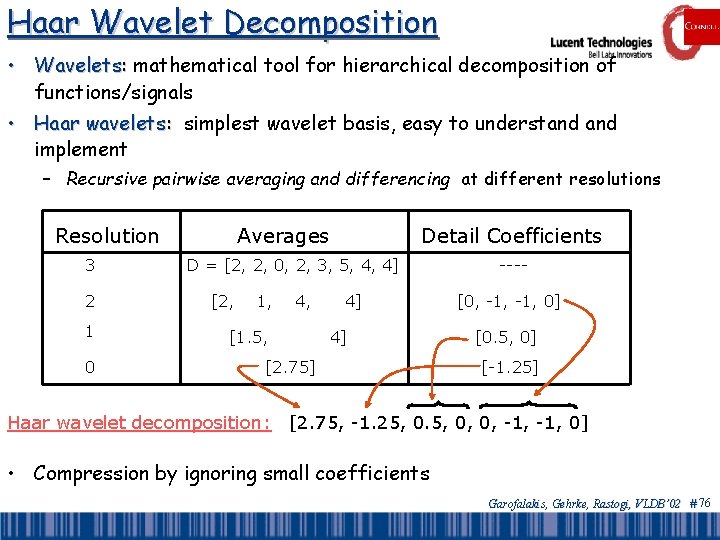
Haar Wavelet Decomposition • Wavelets: mathematical tool for hierarchical decomposition of functions/signals • Haar wavelets: simplest wavelet basis, easy to understand implement – Recursive pairwise averaging and differencing at different resolutions Resolution 3 2 1 0 Averages Detail Coefficients D = [2, 2, 0, 2, 3, 5, 4, 4] [2, 1, 4, [1. 5, 4] 4] [2. 75] Haar wavelet decomposition: ---[0, -1, 0] [0. 5, 0] [-1. 25] [2. 75, -1. 25, 0, 0, -1, 0] • Compression by ignoring small coefficients Garofalakis, Gehrke, Rastogi, VLDB’ 02 # 76
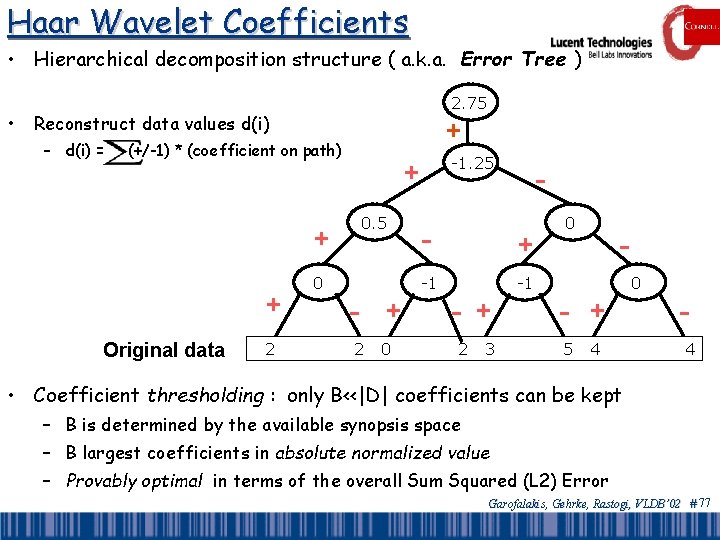
Haar Wavelet Coefficients • Hierarchical decomposition structure ( a. k. a. Error Tree ) • 2. 75 Reconstruct data values d(i) – d(i) = + (+/-1) * (coefficient on path) 0. 5 + + Original data 2 -1. 25 + 0 - + 2 0 - - + -1 -1 - + 2 3 0 0 - + 5 4 4 • Coefficient thresholding : only B<<|D| coefficients can be kept – B is determined by the available synopsis space – B largest coefficients in absolute normalized value – Provably optimal in terms of the overall Sum Squared (L 2) Error Garofalakis, Gehrke, Rastogi, VLDB’ 02 # 77
Stream Wavelet Approximation using Sketches [GKM 01] (cont. ) • Each (normalized) coefficient ci in the Haar decomposition tree – ci = NORMi * ( AVG(left. Child. Subtree(ci)) - AVG(right. Child. Subtree(ci)) ) / 2 Overall average c 0 = <f, w 0> = <f , (1/N, . . . , 1/N)> 1/N w 0 = + - 0 N-1 ci = <f, wi> wi = 0 N-1 f() • Use sketches of f() and wavelet-basis vectors to extract “large” coefficients • Key: “Small-B Property” = Most of f()’s “energy” = concentrated in a small number B of large Haar coefficients is Garofalakis, Gehrke, Rastogi, VLDB’ 02 # 78
Stream Wavelet Approximation using Sketches [GKM 01]: The Method • Input: “Stream of tuples” rendering of a distribution f() that has a BHaar coefficient representation with energy • Build sufficient sketches on f() to accurately (within Haar coefficients ci = <f, wi> such that |ci| – By the single-join result (with – ) estimate all ) the space needed is comes from “union bound” (need all coefficients with probability ) • Keep largest B estimated coefficients with absolute value • Theorem: The resulting approximate representation of (at most) B Haar coefficients has energy with probability • First provable guarantees for Haar wavelet computation over data streams Garofalakis, Gehrke, Rastogi, VLDB’ 02 # 79
Multi-d Histograms over Streams using Sketches [TGI 02] • Multi-dimensional histograms: Approximate joint data distribution over multiple attributes Distribution D Histogram H B B v 1 v 5 v 2 A v 4 v 3 • “Break” multi-d space into hyper-rectangles (buckets) & use a single frequency parameter (e. g. , average frequency) for each A – Piecewise constant approximation – Useful for query estimation/optimization, approximate answers, etc. • Want a histogram H that minimizes L 2 error in approximation, i. e. , for a given number of buckets (V-Optimal) – Build over a stream of data tuples? ? Garofalakis, Gehrke, Rastogi, VLDB’ 02 # 80
Multi-d Histograms over Streams using Sketches [TGI 02] (cont. ) • View distribution and histograms over as -dimensional vectors {0, . . . , N-1}x. . . x{0, . . . , N-1} • Use sketching to reduce vector dimensionality from N^k to (small) d D (N^k entries) * *D= d entries (sketches of D) • Johnson-Lindenstrauss Lemma[JL 84]: Using d= guarantees that L 2 distances with any b-bucket histogram H are approximately preserved with high probability; that is, is within a relative error of from for any b-bucket H Garofalakis, Gehrke, Rastogi, VLDB’ 02 # 81
Multi-d Histograms over Streams using Sketches [TGI 02] (cont. ) • Algorithm – Maintain sketch of the distribution D on-line – Use the sketch to find histogram H such that • Start with H = is minimized and choose buckets one-by-one greedily • At each step, select the bucket that minimizes • Resulting histogram H: Provably near-optimal wrt minimizing (with high probability) – Key: L 2 distances are approximately preserved (by [JL 84]) • Various heuristics to improve running time – Restrict possible bucket hyper-rectangles – Look for “good enough” buckets Garofalakis, Gehrke, Rastogi, VLDB’ 02 # 82
Extensions: Sketching with Stable Distributions [Ind 00] • Idea: Sketch the incoming stream of values rendering the distribution f() using random vectors from “special” distributions • p-stable distribution • If X 1, . . . , Xn are iid with distribution • Then, , a 1, . . . , an are any real numbers has the same distribution as , where X has distribution • Known to exist for any p (0, 2] – p=1: Cauchy distribution – p=2: Gaussian (Normal) distribution • For p-stable : Know the exact distribution of • Basically, sample from where X = p-stable random var. • Stronger than reasoning with just expectation and variance! • NOTE: the Lp norm of f() Garofalakis, Gehrke, Rastogi, VLDB’ 02 # 83
Extensions: Sketching with Stable Distributions [Ind 00] (cont. ) • Use independent sketches with p-stable approximate the Lp norm of the f()-stream ( ) within probability – Use the samples of – Works for any p (0, 2] ‘s to with to estimate (extends [AMS 96], where p=2) – Describe pseudo-random generator for the p-stable ‘s • [CDI 02] uses the same basic technique to estimate the Hamming (L 0) norm over a stream – Hamming norm = number of distinct values in the stream • Hard estimation problem! – Key observation: Lp norm with p->0 gives good approximation to Hamming • Use p-stable sketches with very small p (e. g. , 0. 02) Garofalakis, Gehrke, Rastogi, VLDB’ 02 # 84
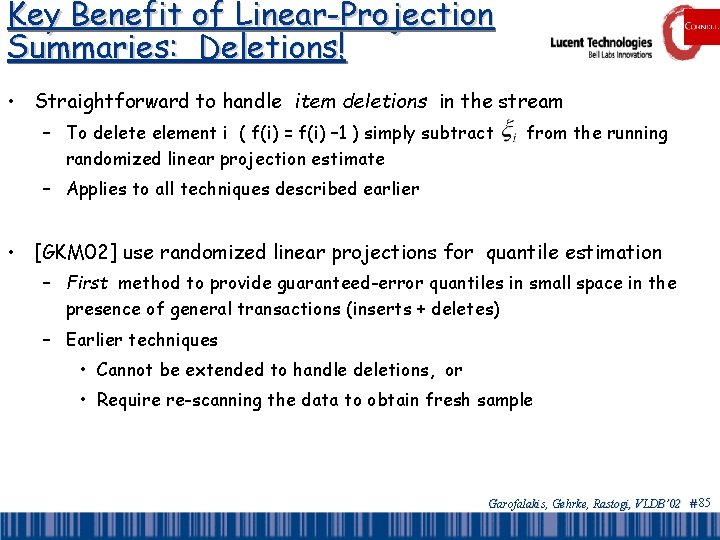
Key Benefit of Linear-Projection Summaries: Deletions! • Straightforward to handle item deletions in the stream – To delete element i ( f(i) = f(i) – 1 ) simply subtract randomized linear projection estimate from the running – Applies to all techniques described earlier • [GKM 02] use randomized linear projections for quantile estimation – First method to provide guaranteed-error quantiles in small space in the presence of general transactions (inserts + deletes) – Earlier techniques • Cannot be extended to handle deletions, or • Require re-scanning the data to obtain fresh sample Garofalakis, Gehrke, Rastogi, VLDB’ 02 # 85
Random-Subset-Sums (RSSs) for Quantile Estimation [GKM 02] • Key Idea: Maintain frequency sums for random subsets of intervals at multiple resolutions f(U) = N = total element count Points at different levels correspond to dyadic intervals: [k 2^i, (k+1)2^i) 0 Random-Subset-Sum (RSS) Synopsis • For each level j U-1 1 + log|U| levels – Pick a random subset S of points (intervals): each point is chosen w/ prob. ½ – Maintain the sum of all frequencies in S’s intervals: f(S) = – Repeat to boost accuracy & confidence f(I) Garofalakis, Gehrke, Rastogi, VLDB’ 02 # 86
Random-Subset-Sums (RSSs) for Quantile Estimation [GKM 02] (cont. ) • Each RSS is a randomized linear projection of the frequency vector f() – = 1 if i belongs in the union of intervals in S; 0 otherwise • Maintenance: Insert/Delete element i – Find dyadic intervals containing i ( check high-order bits of binary(i) ) – Update (+1/-1) all RSSs whose subsets contain these intervals • Making it work in small space & time – Cannot explicitly maintain the random subsets S ( O(|U|) space! ) – Instead, use a O(log|U|) size seed and a pseudo-random function to determine each random subset S • pairwise independence amongst the members of S is sufficient • Membership can be tested in only O(log|U|) time Garofalakis, Gehrke, Rastogi, VLDB’ 02 # 87
Random-Subset-Sums (RSSs) for Quantile Estimation [GKM 02] (cont. ) Estimating f(I), I = interval • For a dyadic interval I: Go to the appropriate level, and use the RSSs to compute the conditional expectation – Only use the maintained RSSs whose subset contains S (about half the RSSs at that level) – Note that: – Use this expression to obtain an estimate for f(I) • For an arbitrary interval I: Write I as the disjoint union of at most O(log|U|) dyadic intervals – Add up the estimates for all dyadic-interval components – Variance of the estimate increases by O(log|U|) • Use averaging and median-selection over iid copies (as in [AMS 96]) to boost accuracy and confidence Garofalakis, Gehrke, Rastogi, VLDB’ 02 # 88
Random-Subset-Sums (RSSs) for Quantile Estimation [GKM 02] (cont. ) Estimating approximate quantiles • Want a value v such that: – Use f(I) estimates in a binary search over the domain [0…U-1] • Theorem: The RSS method computes an -approximate quantile over a stream of insertions/deletions with probability using space of • First technique to deal with general transaction streams • RSS synopses are composable – Can be computed independently over different parts of the stream (e. g. , in a distributed setting) – RSSs for the entire stream can be composed by simple summation – Another benefit of linear projections!! Garofalakis, Gehrke, Rastogi, VLDB’ 02 # 89
More work on Sketches. . . • Low-distortion vector-space embeddings (JL Lemma) [Ind 01] and applications – E. g. , approximate nearest neighbors [IM 98] • Discovering patterns and periodicities in time-series databases [IKM 00, CIK 02] • Maintaining top-k item frequencies over a stream [CCF 02] • Data cleaning [DJM 02] • Other sketching references – Histogram/wavelet extraction [GGI 02, GIM 02] – Stream norm computation [FKS 99] Garofalakis, Gehrke, Rastogi, VLDB’ 02 # 90
Outline • Introduction & motivation – Stream computation model, Applications • Basic stream synopses computation – Samples, Equi-depth histograms, Wavelets • Mining data streams – Decision trees, clustering • Sketch-based computation techniques – Self-joins, Joins, Wavelets, V-optimal histograms • Advanced techniques – Distinct values, Sliding windows • Future directions & Conclusions Garofalakis, Gehrke, Rastogi, VLDB’ 02 # 91
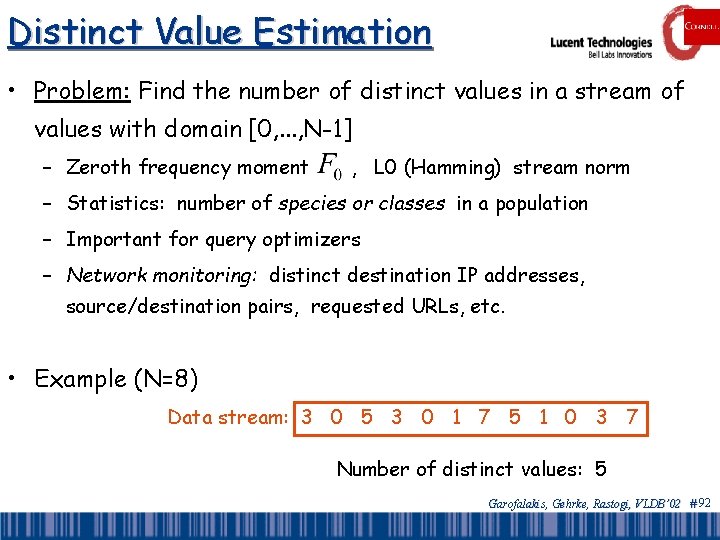
Distinct Value Estimation • Problem: Find the number of distinct values in a stream of values with domain [0, . . . , N-1] – Zeroth frequency moment , L 0 (Hamming) stream norm – Statistics: number of species or classes in a population – Important for query optimizers – Network monitoring: distinct destination IP addresses, source/destination pairs, requested URLs, etc. • Example (N=8) Data stream: 3 0 5 3 0 1 7 5 1 0 3 7 Number of distinct values: 5 Garofalakis, Gehrke, Rastogi, VLDB’ 02 # 92
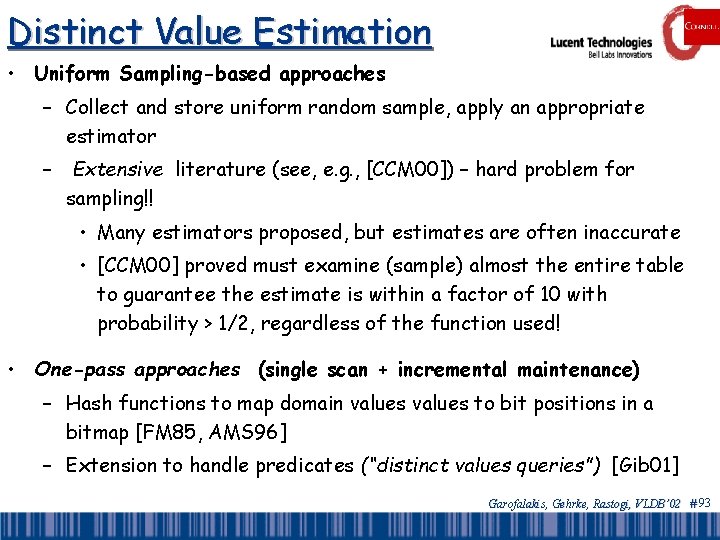
Distinct Value Estimation • Uniform Sampling-based approaches – Collect and store uniform random sample, apply an appropriate estimator – Extensive literature (see, e. g. , [CCM 00]) – hard problem for sampling!! • Many estimators proposed, but estimates are often inaccurate • [CCM 00] proved must examine (sample) almost the entire table to guarantee the estimate is within a factor of 10 with probability > 1/2, regardless of the function used! • One-pass approaches (single scan + incremental maintenance) – Hash functions to map domain values to bit positions in a bitmap [FM 85, AMS 96] – Extension to handle predicates (“distinct values queries”) [Gib 01] Garofalakis, Gehrke, Rastogi, VLDB’ 02 # 93
Distinct Value Estimation Using Hashing [FM 85] • Assume a hash function h(x) that maps incoming values x in [0, …, N-1] uniformly across [0, …, 2^L-1], where L = O(log. N) • Let r(y) denote the position of the least-significant 1 bit in the binary representation of y – A value x is mapped to r(h(x)) • We maintain a BITMAP array of L bits, initialized to 0 – For each incoming value x, set BITMAP[ r(h(x)) ] = 1 BITMAP x=5 h(x) = 101100 r(h(x)) = 2 5 4 0 0 3 0 2 1 0 0 Garofalakis, Gehrke, Rastogi, VLDB’ 02 # 94
Distinct Value Estimation Using Hashing [FM 85] (cont. ) • By uniformity through h(x): Prob[ BITMAP[k]=1 ] = Prob[ ]= – Assuming d distinct values: expect d/2 to map to BITMAP[0] , d/4 to map to BITMAP[1], . . . BITMAP L-1 0 0 0 position >> log(d) 0 1 0 1 1 fringe of 0/1 s around log(d) 1 1 1 position << log(d) • Let R = position of rightmost zero in BITMAP – Use as indicator of log(d) • [FM 85] prove that E[R] = , where – Estimate d = – Averaging over several iid instances (different hash functions) to reduce estimator variance Garofalakis, Gehrke, Rastogi, VLDB’ 02 # 95
Distinct Value Estimation • [FM 85] assume “ideal” hash functions h(x) (N-wise independence) – [AMS 96] prove a similar result using simple linear hash functions (only pairwise independence) • h(x) = [0, …, 2^L-1] , where a, b are random binary vectors in • [CDI 02] Hamming norm estimation using p-stable sketching with p->0 – Based on randomized linear projections can readily handle deletions – Also, composable: Hamming norm estimation over multiple streams • E. g. , number of positions where two streams differ Garofalakis, Gehrke, Rastogi, VLDB’ 02 # 96
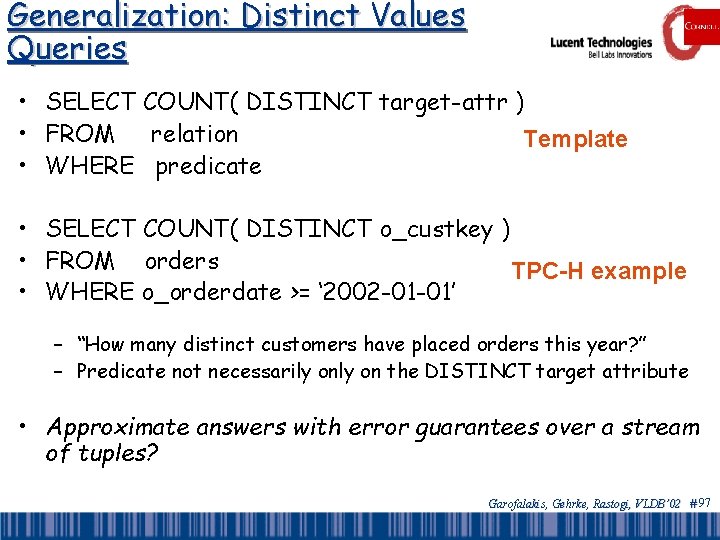
Generalization: Distinct Values Queries • SELECT COUNT( DISTINCT target-attr ) • FROM relation Template • WHERE predicate • SELECT COUNT( DISTINCT o_custkey ) • FROM orders TPC-H example • WHERE o_orderdate >= ‘ 2002 -01 -01’ – “How many distinct customers have placed orders this year? ” – Predicate not necessarily on the DISTINCT target attribute • Approximate answers with error guarantees over a stream of tuples? Garofalakis, Gehrke, Rastogi, VLDB’ 02 # 97
Distinct Sampling [Gib 01] Key Ideas • Use FM-like technique to collect a specially-tailored sample over the distinct values in the stream – Uniform random sample of the distinct values – Very different from traditional URS: each distinct value is chosen uniformly regardless of its frequency – DISTINCT query answers: simply scale up sample answer by sampling rate • To handle additional predicates – Reservoir sampling of tuples for each distinct value in the sample – Use reservoir sample to evaluate predicates Garofalakis, Gehrke, Rastogi, VLDB’ 02 # 98
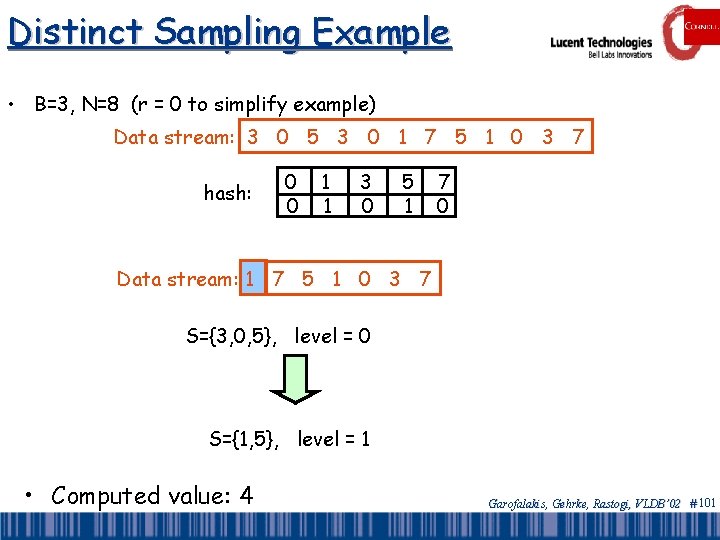
Building a Distinct Sample [Gib 01] • Use FM-like hash function h() for each streaming value x – Prob[ h(x) = k ] = • Key Invariant: “All values with h(x) >= level (and only these) are in the distinct sample” Distinct. Sampling( B , r ) // B = space bound, r = tuple-reservoir size for each distinct value level = 0; S = for each new tuple t do let x = value of DISTINCT target attribute in t if h(x) >= level then // x belongs in the distinct sample use t to update the reservoir sample of tuples for x if |S| >= B then // out of space evict from S all tuples with h(target-attribute-value) = level set level = level + 1 Garofalakis, Gehrke, Rastogi, VLDB’ 02 # 99
Using the Distinct Sample [Gib 01] • If level = l for our sample, then we have selected all distinct values x such that h(x) >= l – Prob[ h(x) >= l ] = – By h()’s randomizing properties, we have uniformly sampled a of the distinct values in our stream Our sampling rate! fraction • Query Answering: Run distinct-values query on the distinct sample and scale the result up by • Distinct-value estimation: Guarantee relative error with probability 1 - using O(log(1/ )/ ^2) space – For q% selectivity predicates the space goes up inversely with q • Experimental results: 0 -10% error vs. 50 -250% error for previous best approaches, using 0. 2% to 10% synopses Garofalakis, Gehrke, Rastogi, VLDB’ 02 # 100
Distinct Sampling Example • B=3, N=8 (r = 0 to simplify example) Data stream: 3 0 5 3 0 1 7 5 1 0 3 7 hash: 0 0 1 1 3 0 5 1 7 0 Data stream: 1 7 5 1 0 3 7 S={3, 0, 5}, level = 0 S={1, 5}, level = 1 • Computed value: 4 Garofalakis, Gehrke, Rastogi, VLDB’ 02 # 101
Sliding Window Model • Model – At every time t, a data record arrives – The record “expires” at time t+N (N is the window length) • When is it useful? – Make decisions based on “recently observed” data – Stock data – Sensor networks Garofalakis, Gehrke, Rastogi, VLDB’ 02 # 102
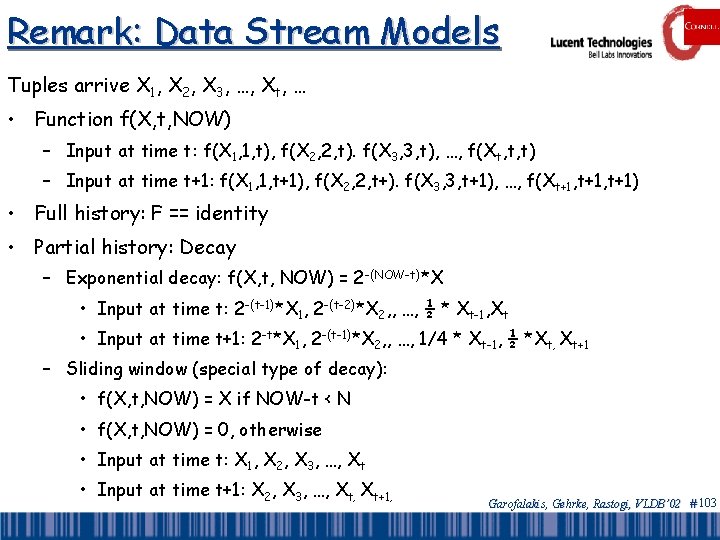
Remark: Data Stream Models Tuples arrive X 1, X 2, X 3, …, Xt, … • Function f(X, t, NOW) – Input at time t: f(X 1, 1, t), f(X 2, 2, t). f(X 3, 3, t), …, f(Xt, t, t) – Input at time t+1: f(X 1, 1, t+1), f(X 2, 2, t+). f(X 3, 3, t+1), …, f(Xt+1, t+1) • Full history: F == identity • Partial history: Decay – Exponential decay: f(X, t, NOW) = 2 -(NOW-t)*X • Input at time t: 2 -(t-1)*X 1, 2 -(t-2)*X 2, , …, ½ * Xt-1, Xt • Input at time t+1: 2 -t*X 1, 2 -(t-1)*X 2, , …, 1/4 * Xt-1, ½ *Xt, Xt+1 – Sliding window (special type of decay): • f(X, t, NOW) = X if NOW-t < N • f(X, t, NOW) = 0, otherwise • Input at time t: X 1, X 2, X 3, …, Xt • Input at time t+1: X 2, X 3, …, Xt+1, Garofalakis, Gehrke, Rastogi, VLDB’ 02 # 103
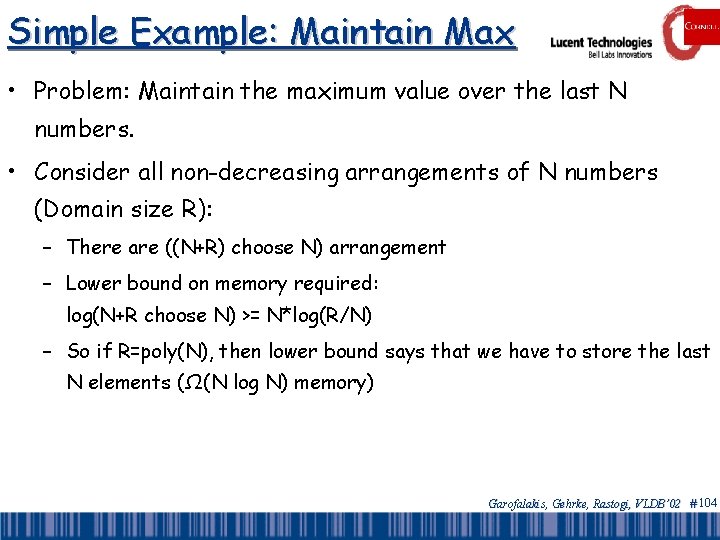
Simple Example: Maintain Max • Problem: Maintain the maximum value over the last N numbers. • Consider all non-decreasing arrangements of N numbers (Domain size R): – There are ((N+R) choose N) arrangement – Lower bound on memory required: log(N+R choose N) >= N*log(R/N) – So if R=poly(N), then lower bound says that we have to store the last N elements (Ω(N log N) memory) Garofalakis, Gehrke, Rastogi, VLDB’ 02 # 104
Statistics Over Sliding Windows • Bitstream: Count the number of ones [DGIM 02] – Exact solution: Θ(N) bits – Algorithm Basic. Counting: • 1 + ε approximation (relative error!) • Space: O(1/ε (log 2 N)) bits • Time: O(log N) worst case, O(1) amortized per record – Lower Bound: • Space: Ω(1/ε (log 2 N)) bits Garofalakis, Gehrke, Rastogi, VLDB’ 02 # 105
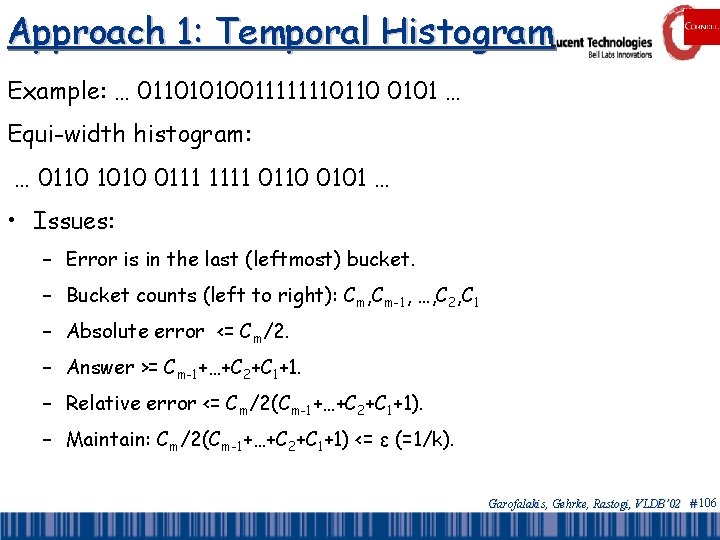
Approach 1: Temporal Histogram Example: … 01101010011111110110 0101 … Equi-width histogram: … 0110 1010 0111 1111 0110 0101 … • Issues: – Error is in the last (leftmost) bucket. – Bucket counts (left to right): Cm, Cm-1, …, C 2, C 1 – Absolute error <= Cm/2. – Answer >= Cm-1+…+C 2+C 1+1. – Relative error <= Cm/2(Cm-1+…+C 2+C 1+1). – Maintain: Cm/2(Cm-1+…+C 2+C 1+1) <= ε (=1/k). Garofalakis, Gehrke, Rastogi, VLDB’ 02 # 106
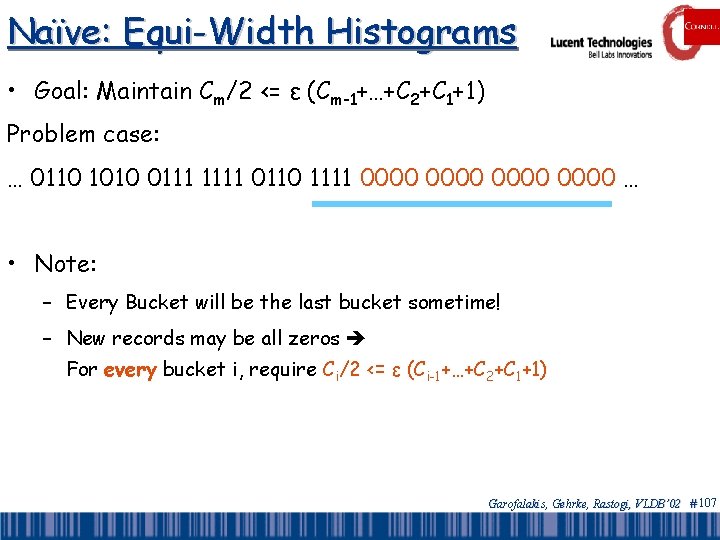
Naïve: Equi-Width Histograms • Goal: Maintain Cm/2 <= ε (Cm-1+…+C 2+C 1+1) Problem case: … 0110 1010 0111 1111 0110 1111 0000 … • Note: – Every Bucket will be the last bucket sometime! – New records may be all zeros For every bucket i, require Ci/2 <= ε (Ci-1+…+C 2+C 1+1) Garofalakis, Gehrke, Rastogi, VLDB’ 02 # 107
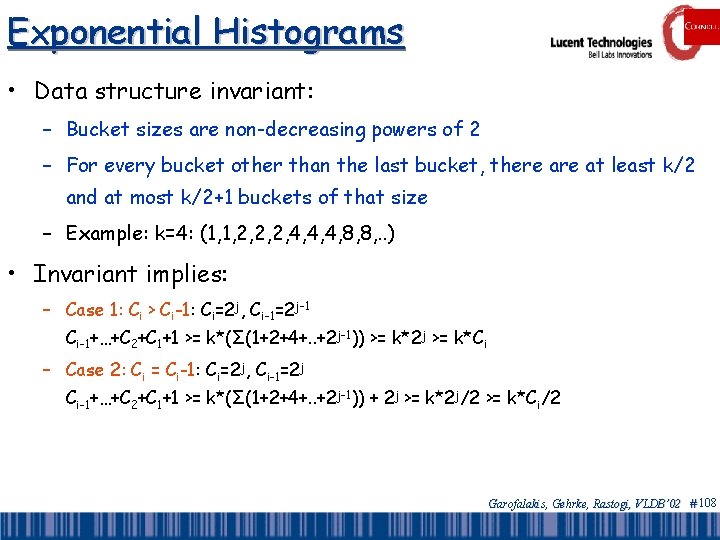
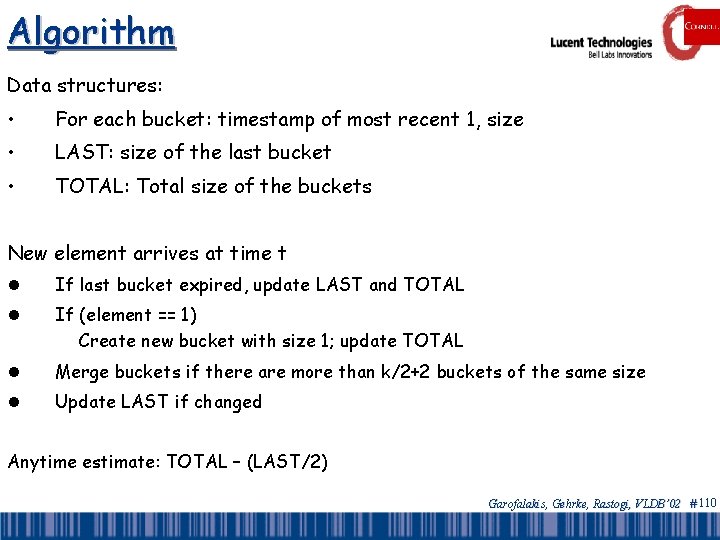
Exponential Histograms • Data structure invariant: – Bucket sizes are non-decreasing powers of 2 – For every bucket other than the last bucket, there at least k/2 and at most k/2+1 buckets of that size – Example: k=4: (1, 1, 2, 2, 2, 4, 4, 4, 8, 8, . . ) • Invariant implies: – Case 1: Ci > Ci-1: Ci=2 j, Ci-1=2 j-1 Ci-1+…+C 2+C 1+1 >= k*(Σ(1+2+4+. . +2 j-1)) >= k*2 j >= k*Ci – Case 2: Ci = Ci-1: Ci=2 j, Ci-1=2 j Ci-1+…+C 2+C 1+1 >= k*(Σ(1+2+4+. . +2 j-1)) + 2 j >= k*2 j/2 >= k*Ci/2 Garofalakis, Gehrke, Rastogi, VLDB’ 02 # 108
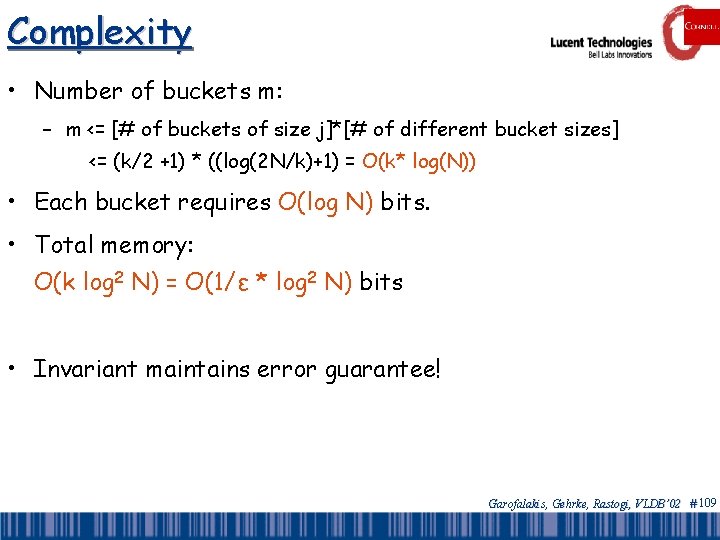
Complexity • Number of buckets m: – m <= [# of buckets of size j]*[# of different bucket sizes] <= (k/2 +1) * ((log(2 N/k)+1) = O(k* log(N)) • Each bucket requires O(log N) bits. • Total memory: O(k log 2 N) = O(1/ε * log 2 N) bits • Invariant maintains error guarantee! Garofalakis, Gehrke, Rastogi, VLDB’ 02 # 109
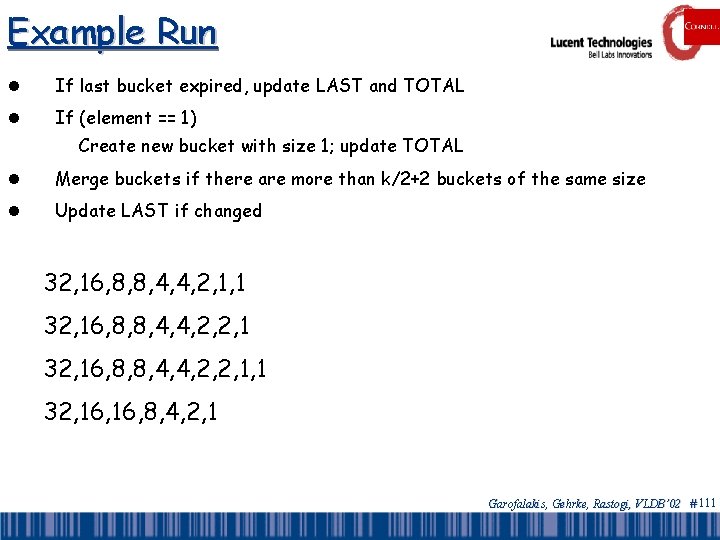
Algorithm Data structures: • For each bucket: timestamp of most recent 1, size • LAST: size of the last bucket • TOTAL: Total size of the buckets New element arrives at time t l If last bucket expired, update LAST and TOTAL l If (element == 1) Create new bucket with size 1; update TOTAL l Merge buckets if there are more than k/2+2 buckets of the same size l Update LAST if changed Anytime estimate: TOTAL – (LAST/2) Garofalakis, Gehrke, Rastogi, VLDB’ 02 # 110
Example Run l If last bucket expired, update LAST and TOTAL l If (element == 1) Create new bucket with size 1; update TOTAL l Merge buckets if there are more than k/2+2 buckets of the same size l Update LAST if changed 32, 16, 8, 8, 4, 4, 2, 1, 1 32, 16, 8, 8, 4, 4, 2, 2, 1, 1 32, 16, 8, 4, 2, 1 Garofalakis, Gehrke, Rastogi, VLDB’ 02 # 111
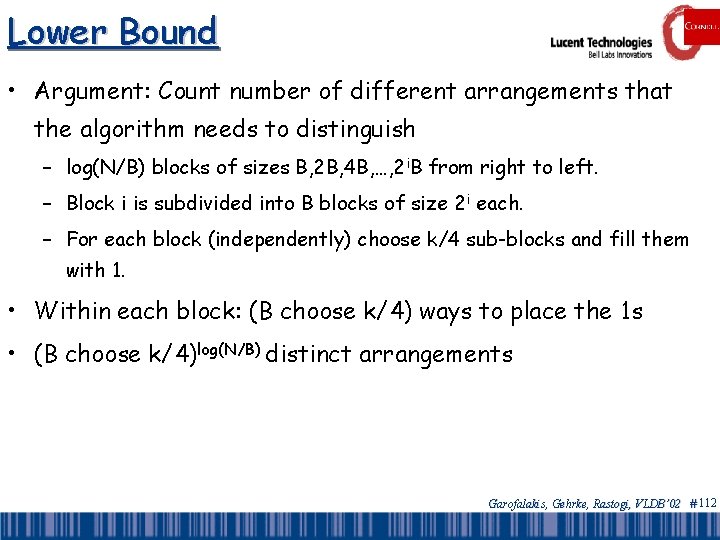
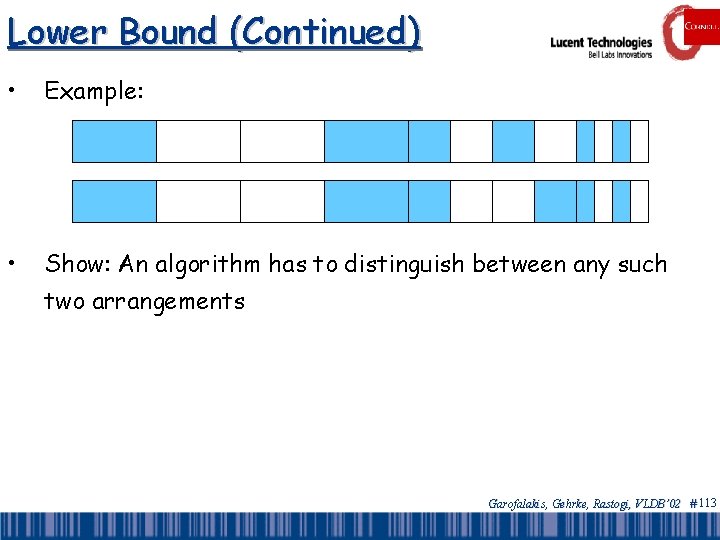
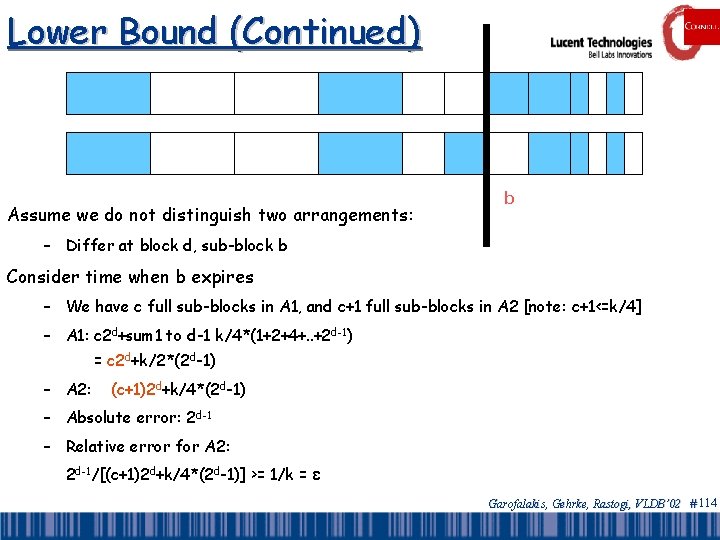
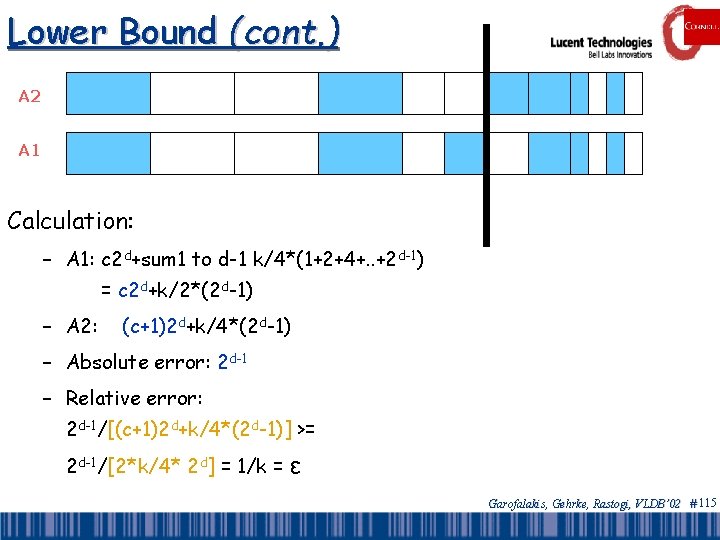
Lower Bound • Argument: Count number of different arrangements that the algorithm needs to distinguish – log(N/B) blocks of sizes B, 2 B, 4 B, …, 2 i. B from right to left. – Block i is subdivided into B blocks of size 2 i each. – For each block (independently) choose k/4 sub-blocks and fill them with 1. • Within each block: (B choose k/4) ways to place the 1 s • (B choose k/4)log(N/B) distinct arrangements Garofalakis, Gehrke, Rastogi, VLDB’ 02 # 112
Lower Bound (Continued) • Example: • Show: An algorithm has to distinguish between any such two arrangements Garofalakis, Gehrke, Rastogi, VLDB’ 02 # 113
Lower Bound (Continued) Assume we do not distinguish two arrangements: b – Differ at block d, sub-block b Consider time when b expires – We have c full sub-blocks in A 1, and c+1 full sub-blocks in A 2 [note: c+1<=k/4] – A 1: c 2 d+sum 1 to d-1 k/4*(1+2+4+. . +2 d-1) = c 2 d+k/2*(2 d-1) – A 2: (c+1)2 d+k/4*(2 d-1) – Absolute error: 2 d-1 – Relative error for A 2: 2 d-1/[(c+1)2 d+k/4*(2 d-1)] >= 1/k = ε Garofalakis, Gehrke, Rastogi, VLDB’ 02 # 114
Lower Bound (cont. ) A 2 A 1 Calculation: – A 1: c 2 d+sum 1 to d-1 k/4*(1+2+4+. . +2 d-1) = c 2 d+k/2*(2 d-1) – A 2: (c+1)2 d+k/4*(2 d-1) – Absolute error: 2 d-1 – Relative error: 2 d-1/[(c+1)2 d+k/4*(2 d-1)] >= 2 d-1/[2*k/4* 2 d] = 1/k = ε Garofalakis, Gehrke, Rastogi, VLDB’ 02 # 115
More Sliding Window Results • Maintain the sum of last N positive integers in range {0, …, R}. • • Results: – 1 + ε approximation. – 1/ε(log N) (log N + log R) bits. – O( log R/log N) amortized, (log N + log R) worst case. Lower Bound: – 1/ε(log. N)(log N + log R) bits. • Variance • Clusters Garofalakis, Gehrke, Rastogi, VLDB’ 02 # 116
Outline • Introduction & motivation – Stream computation model, Applications • Basic stream synopses computation – Samples, Equi-depth histograms, Wavelets • Mining data streams – Decision trees, clustering • Sketch-based computation techniques – Self-joins, Joins, Wavelets, V-optimal histograms • Advanced techniques – Distinct values, Sliding windows • Future directions & Conclusions Garofalakis, Gehrke, Rastogi, VLDB’ 02 # 117
Future Research Directions Three favorite problems; generic laundry list follows: • Appropriate “stream algebra” (operators + composition rules) – • Lower bounds & tradeoffs for data-streaming problems – • Progress: Aurora, Telegraph, STREAM E. g. , no. of passes vs. space requirements (“p passes f(N, p) space”) Making sketches ready for prime-time – Approximating set-valued query results – Multiple standing queries – Beyond relational tuples and numeric attributes – Most appropriate sketching technique for incorporation in DBMSs? Garofalakis, Gehrke, Rastogi, VLDB’ 02 # 118
Data Streaming - Future Research Laundry List • Stream processing system architectures • Memory management for stream processing • Integration of stream processing and databases • Stream indexing, searching, and similarity matching • Exploiting prior knowledge for stream computation • User-interface issues – Exposing approximation model to the user • Content-based routing, filtering, and correlation of XML data streams • Novel stream processing applications – Sensor networks, financial analysis, etc. Garofalakis, Gehrke, Rastogi, VLDB’ 02 # 119
Conclusions • Querying and finding patterns in massive streams is a real problem with many “real-world” applications • Fundamentally rethink data-management issues under stringent constraints – Single-pass algorithms with limited memory resources • A lot of progress in the last few years – Algorithms, system models & architectures • Aurora (Brandeis/Brown/MIT) • Niagara (Wisconsin) • STREAM (Stanford) • Telegraph (Berkeley) • Commercial acceptance still lagging, but will most probably grow in coming years – Specialized systems (e. g. , fraud detection), but still far from “DSMSs” • Great Promise: Still lots of interesting research to be done!! Garofalakis, Gehrke, Rastogi, VLDB’ 02 # 120
Thank you! • Updated slides & references available from http: //www. bell-labs. com/~{minos, rastogi} http: //www. cs. cornell. edu/johannes/ Garofalakis, Gehrke, Rastogi, VLDB’ 02 # 121
References (1) • [AGM 99] N. Alon, P. B. Gibbons, Y. Matias, M. Szegedy. Tracking Join and Self-Join Sizes in Limited Storage. ACM PODS, 1999. • [AMS 96] N. Alon, Y. Matias, M. Szegedy. The space complexity of approximating the frequency moments. ACM STOC, 1996. • [CIK 02] G. Cormode, P. Indyk, N. Koudas, S. Muthukrishnan. Fast mining of tabular data via approximate distance computations. IEEE ICDE, 2002. • [CMN 98] S. Chaudhuri, R. Motwani, and V. Narasayya. “Random Sampling for Histogram Construction: How much is enough? ”. ACM SIGMOD 1998. • [CDI 02] G. Cormode, M. Datar, P. Indyk, S. Muthukrishnan. Comparing Data Streams Using Hamming Norms. VLDB, 2002. • [DGG 02] A. Dobra, M. Garofalakis, J. Gehrke, R. Rastogi. Processing Complex Aggregate Queries over Data Streams. ACM SIGMOD, 2002. • [DJM 02] T. Dasu, T. Johnson, S. Muthukrishnan, V. Shkapenyuk. Mining database structure or how to build a data quality browser. ACM SIGMOD, 2002. • [DH 00] P. Domingos and G. Hulten. Mining high-speed data streams. ACM SIGKDD, 2000. • [EKSWX 98] M. Ester, H. -P. Kriegel, J. Sander, M. Wimmer, and X. Xu. Incremental Clustering for Mining in a Data Warehousing Environment. VLDB 1998. • [FKS 99] J. Feigenbaum, S. Kannan, M. Strauss, M. Viswanathan. An approximate L 1 -difference algorithm for massive data streams. IEEE FOCS, 1999. • [FM 85] P. Flajolet, G. N. Martin. “Probabilistic Counting Algorithms for Data Base Applications”. JCSS 31(2), 1985. Garofalakis, Gehrke, Rastogi, VLDB’ 02 # 122
References (2) • [Gib 01] P. Gibbons. Distinct sampling for highly-accurate answers to distinct values queries and event reports, VLDB 2001. • [GGI 02] A. C. Gilbert, S. Guha, P. Indyk, Y. Kotidis, S. Muthukrishnan, M. Strauss. Fast, small-space algorithms for approximate histogram maintenance. ACM STOC, 2002. • [GGRL 99] J. Gehrke, V. Ganti, R. Ramakrishnan, and W. -Y. Loh: BOAT-Optimistic Decision Tree Construction. SIGMOD 1999. • [GK 01] M. Greenwald and S. Khanna. “Space-Efficient Online Computation of Quantile Summaries”. ACM SIGMOD 2001. • [GKM 01] A. C. Gilbert, Y. Kotidis, S. Muthukrishnan, M. Strauss. Surfing Wavelets on Streams: One Pass Summaries for Approximate Aggregate Queries. VLDB 2001. • [GKM 02] A. C. Gilbert, Y. Kotidis, S. Muthukrishnan, M. Strauss. “How to Summarize the Universe: Dynamic Maintenance of Quantiles”. VLDB 2002. • [GKS 01 b] S. Guha, N. Koudas, and K. Shim. “Data Streams and Histograms”. ACM STOC 2001. • [GM 98] P. B. Gibbons and Y. Matias. “New Sampling-Based Summary Statistics for Improving Approximate Query Answers”. ACM SIGMOD 1998. – Proposes the “concise sample” and “counting sample” techniques for improving the accuracy of sampling-based estimation for a given amount of space for the sample synopsis. • [GMP 97] P. B. Gibbons, Y. Matias, and V. Poosala. “Fast Incremental Maintenance of Approximate • [GT 01] P. B. Gibbons, S. Tirthapura. “Estimating Simple Functions on the Union of Data Streams”. ACM SPAA, 2001. Histograms”. VLDB 1997. Garofalakis, Gehrke, Rastogi, VLDB’ 02 # 123
References (3) • [HHW 97] J. M. Hellerstein, P. J. Haas, and H. J. Wang. “Online Aggregation”. ACM SIGMOD 1997. • [HSD 01] Mining Time-Changing Data Streams. G. Hulten, L. Spencer, and P. Domingos. ACM SIGKD 2001. • [IKM 00] P. Indyk, N. Koudas, S. Muthukrishnan. Identifying representative trends in massive time series data sets using sketches. VLDB, 2000. • [Ind 00] P. Indyk. Stable Distributions, Pseudorandom Generators, Embeddings, and Data Stream Computation. IEEE FOCS, 2000. • [IP 95] Y. Ioannidis and V. Poosala. “Balancing Histogram Optimality and Practicality for Query Result Size Estimation”. ACM SIGMOD 1995. • [IP 99] Y. E. Ioannidis and V. Poosala. “Histogram-Based Approximation of Set-Valued Query Answers”. VLDB 1999. • [JKM 98] H. V. Jagadish, N. Koudas, S. Muthukrishnan, V. Poosala, K. Sevcik, and T. Suel. “Optimal Histograms with Quality Guarantees”. VLDB 1998. • [JL 84] W. B. Johnson, J. Lindenstrauss. Extensions of Lipshitz Mapping into Hilbert space. Contemporary Mathematics, 26, 1984. • [Koo 80] R. P. Kooi. “The Optimization of Queries in Relational Databases”. Ph. D thesis, Case Western Reserve University, 1980. • [MRL 98] G. S. Manku, S. Rajagopalan, and B. G. Lindsay. “Approximate Medians and other Quantiles in One Pass and with Limited Memory”. ACM SIGMOD 1998. • [MRL 99] G. S. Manku, S. Rajagopalan, B. G. Lindsay. Random Sampling Techniques for Space Efficient Online Computation of Order Statistics of Large Datasets. ACM SIGMOD, 1999. Garofalakis, Gehrke, Rastogi, VLDB’ 02 # 124
References (4) • [MVW 98] Y. Matias, J. S. Vitter, and M. Wang. “Wavelet-based Histograms for Selectivity Estimation”. ACM SIGMOD 1998. • [MVW 00] Y. Matias, J. S. Vitter, and M. Wang. “Dynamic Maintenance of Wavelet-based Histograms”. VLDB 2000. • [PIH 96] V. Poosala, Y. Ioannidis, P. Haas, and E. Shekita. “Improved Histograms for Selectivity Estimation of Range Predicates”. ACM SIGMOD 1996. • [PJO 99] F. Provost, D. Jenson, and T. Oates. Efficient Progressive Sampling. KDD 1999. • [Poo 97] V. Poosala. “Histogram-Based Estimation Techniques in Database Systems”. Ph. D Thesis, Univ. of Wisconsin, 1997. • [PSC 84] G. Piatetsky-Shapiro and C. Connell. “Accurate Estimation of the Number of Tuples Satisfying a Condition”. ACM SIGMOD 1984. • [SDS 96] E. J. Stollnitz, T. D. De. Rose, and D. H. Salesin. “Wavelets for Computer Graphics”. Morgan. Kauffman Publishers Inc. , 1996. • [T 96] H. Toivonen. Sampling Large Databases for Association Rules. VLDB 1996. • [TGI 02] N. Thaper, S. Guha, P. Indyk, N. Koudas. Dynamic Multidimensional Histograms. ACM SIGMOD, 2002. • [U 89] P. E. Utgoff. Incremental Induction of Decision Trees. Machine Learning, 4, 1989. • [U 94] P. E. Utgoff: An Improved Algorithm for Incremental Induction of Decision Trees. ICML 1994. • [Vit 85] J. S. Vitter. “Random Sampling with a Reservoir”. ACM TOMS, 1985. This is only a partial list of references on Data Streaming. Further important references can be found, e. g. , in the proceedings of KDD, SIGMOD, PODS, VLDB, ICDE, STOC, FOCS, and other conferences or journals, as well as in the reference lists given in the above papers. Garofalakis, Gehrke, Rastogi, VLDB’ 02 # 125