
Query Processing in Mobile P 2 P Databases
Query Processing in Mobile P 2 P Databases IGERT Seminar Presentation Bo Xu joint work with Ouri Wolfson
Talk outline n n n Introduction System Model The MARKET Algorithm Evaluation Extension to CTS Conclusion and Future Work 20 September 2021 IGERT seminar 2
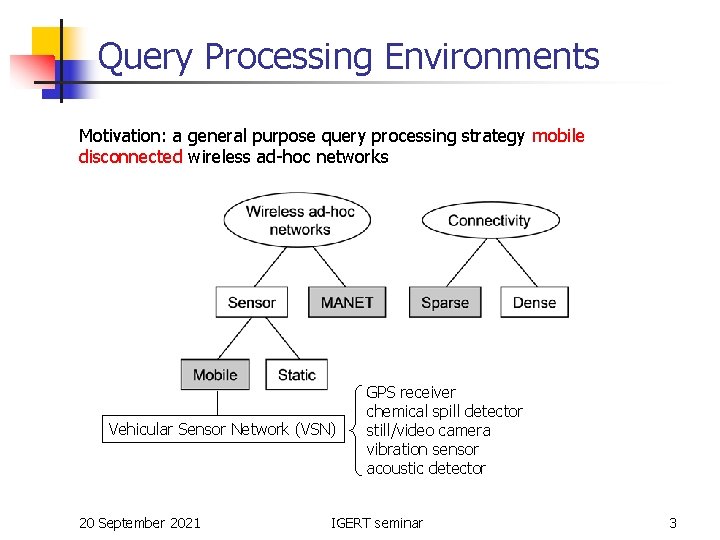
Query Processing Environments Motivation: a general purpose query processing strategy mobile disconnected wireless ad-hoc networks Vehicular Sensor Network (VSN) 20 September 2021 GPS receiver chemical spill detector still/video camera vibration sensor acoustic detector IGERT seminar 3
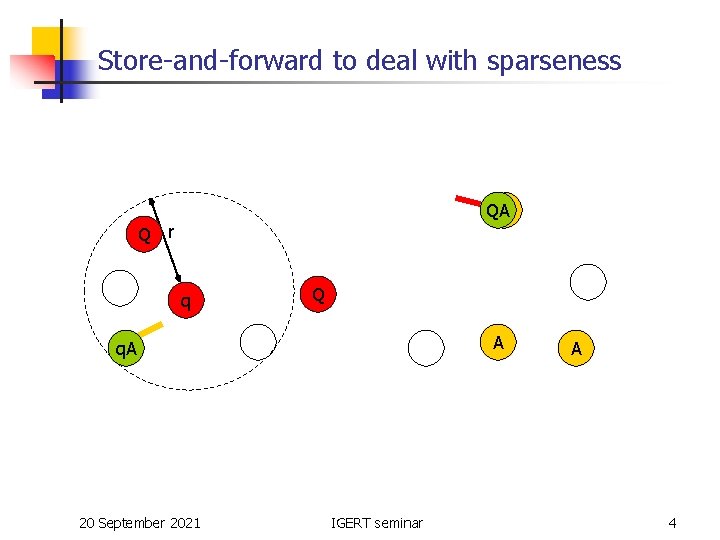
Store-and-forward to deal with sparseness Q QA A r q Q A q. A 20 September 2021 IGERT seminar A 4
Issues with Store-and-forward n How to manage limited memory, power, and bandwidth? n Which reports to save/transmit? 20 September 2021 IGERT seminar 5
Difficulty of Store-and-forward Case: Each mobile node is interested in every data-item Assume that the trajectories of all nodes is known a priori at a central server. If memory, energy, and bandwidth are bounded at mobile nodes, then the problem of determining whether a set of data-items can be disseminated to all the mobile nodes is NP-complete. Mobile P 2 P: Trajectories unknown a priori; Heuristics needed 20 September 2021 IGERT seminar 6
Talk outline n n n Introduction System Model The MARKET Algorithm Evaluation Extension to CTS Conclusion and Future Work 20 September 2021 IGERT seminar 7
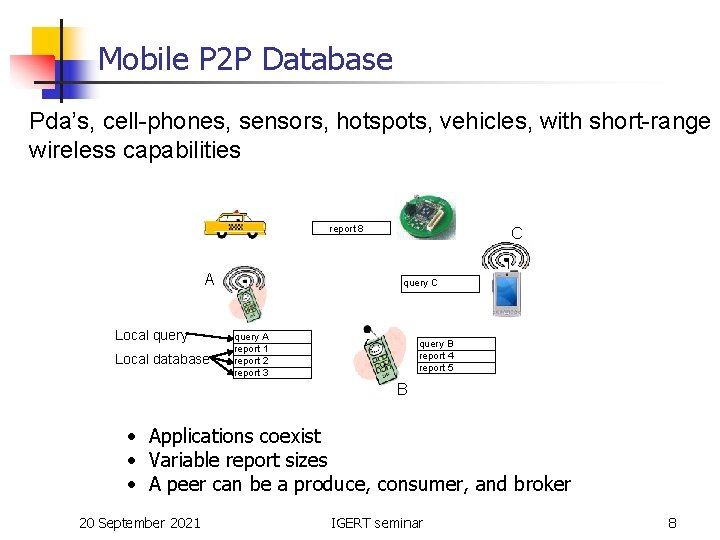
Mobile P 2 P Database Pda’s, cell-phones, sensors, hotspots, vehicles, with short-range wireless capabilities report 8 A Local query Local database C query A report 1 report 2 report 3 query B report 4 report 5 B • Applications coexist • Variable report sizes • A peer can be a produce, consumer, and broker 20 September 2021 IGERT seminar 8
Queries n n A query Q maps each report R to a match degree: Examples: n n n Top parking slots given my current location match(R, Q)=e- t- d Profile with expertise “children-periodontics” Similarity between two images 20 September 2021 IGERT seminar 9
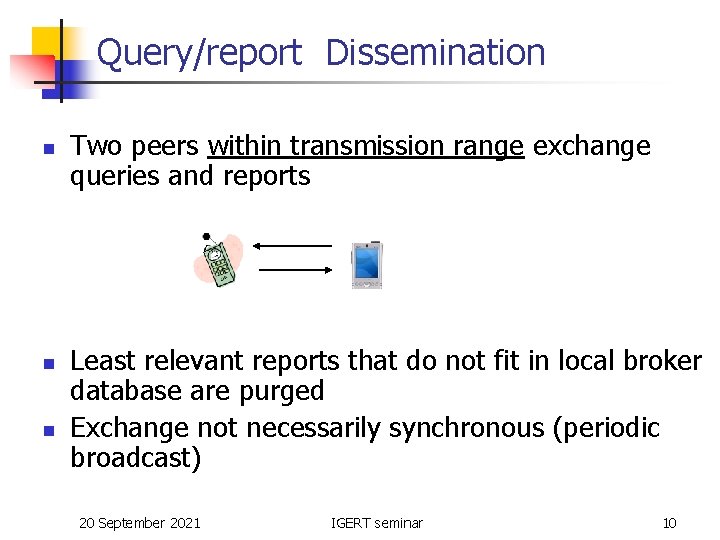
Query/report Dissemination n Two peers within transmission range exchange queries and reports Least relevant reports that do not fit in local broker database are purged Exchange not necessarily synchronous (periodic broadcast) 20 September 2021 IGERT seminar 10
Talk outline n n n Introduction System Model The MARKET Algorithm Evaluation Extension to CTS Conclusion and Future Work 20 September 2021 IGERT seminar 11
Ranking Factors Rank of a report R is determined by n Demand: What fraction of peers are querying R n n Supply: What fraction of peers already have R n n Probability that a peer is interested in R Probability that a peer has R Size of R 20 September 2021 IGERT seminar 12
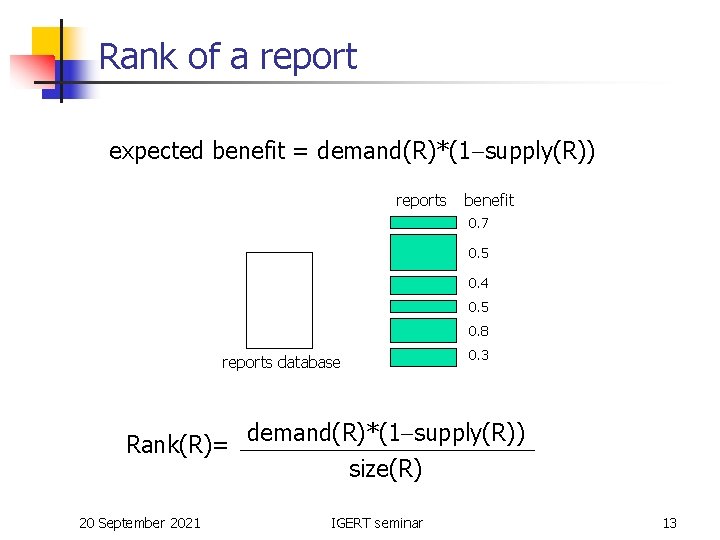
Rank of a report expected benefit = demand(R)*(1 supply(R)) reports benefit 0. 7 0. 5 0. 4 0. 5 0. 8 reports database 0. 3 Rank(R)= demand(R)*(1 supply(R)) size(R) 20 September 2021 IGERT seminar 13
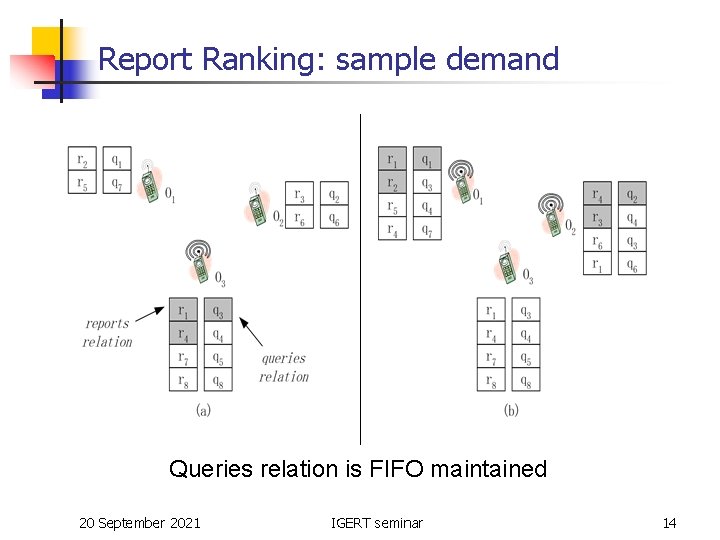
Report Ranking: sample demand Queries relation is FIFO maintained 20 September 2021 IGERT seminar 14
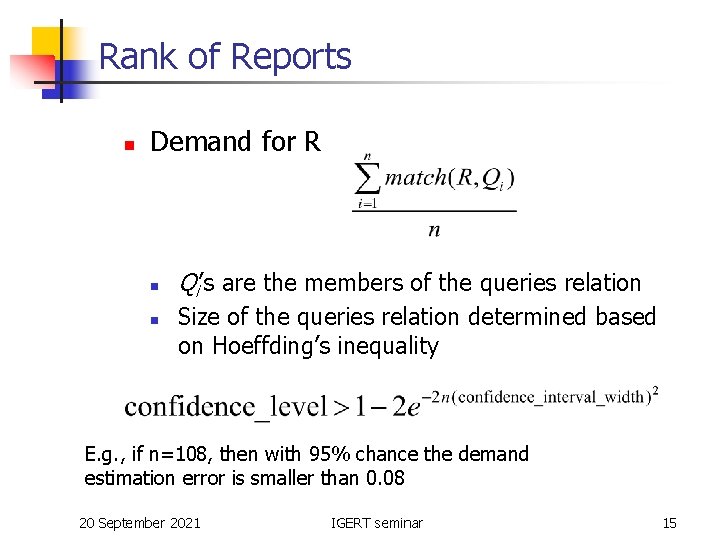
Rank of Reports n Demand for R n n Qi’s are the members of the queries relation Size of the queries relation determined based on Hoeffding’s inequality E. g. , if n=108, then with 95% chance the demand estimation error is smaller than 0. 08 20 September 2021 IGERT seminar 15
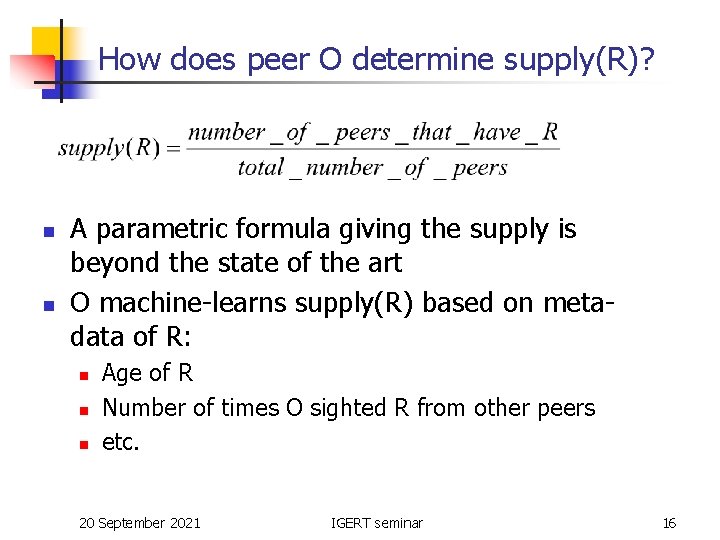
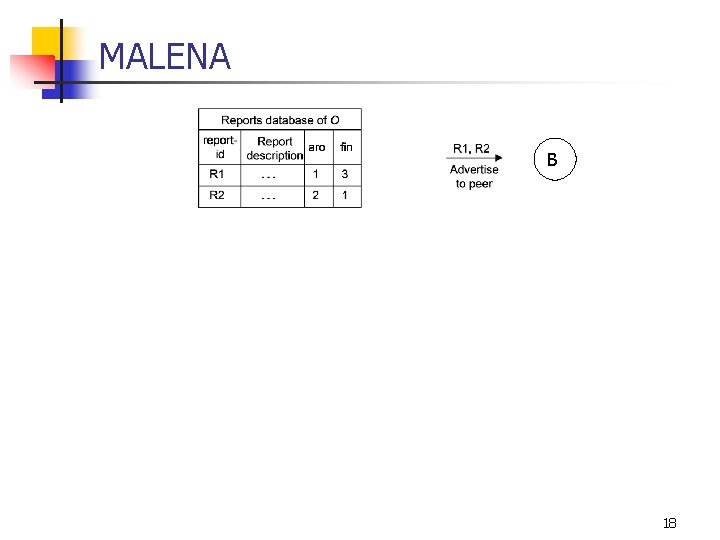
How does peer O determine supply(R)? n n A parametric formula giving the supply is beyond the state of the art O machine-learns supply(R) based on metadata of R: n n n Age of R Number of times O sighted R from other peers etc. 20 September 2021 IGERT seminar 16
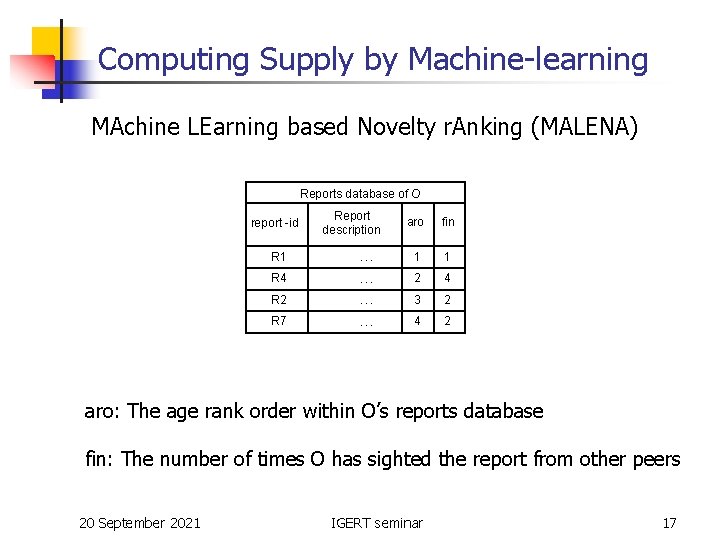
Computing Supply by Machine-learning MAchine LEarning based Novelty r. Anking (MALENA) Reports database of O report -id R 1 R 4 R 2 R 7 Report description … … aro fin 1 1 2 4 3 2 4 2 aro: The age rank order within O’s reports database fin: The number of times O has sighted the report from other peers 20 September 2021 IGERT seminar 17
MALENA B Examples created negative positive 20 September 2021 IGERT seminar Request R 2 B 18
MALENA Implementation Considerations n Minimize overhead n n n No need to actually store examples Model incrementally built Bayesian learning a simple but effective method 20 September 2021 IGERT seminar 19
Talk outline n n n Introduction System Model The MARKET Algorithm Evaluation Extension to CTS Conclusion and Future Work 20 September 2021 IGERT seminar 20
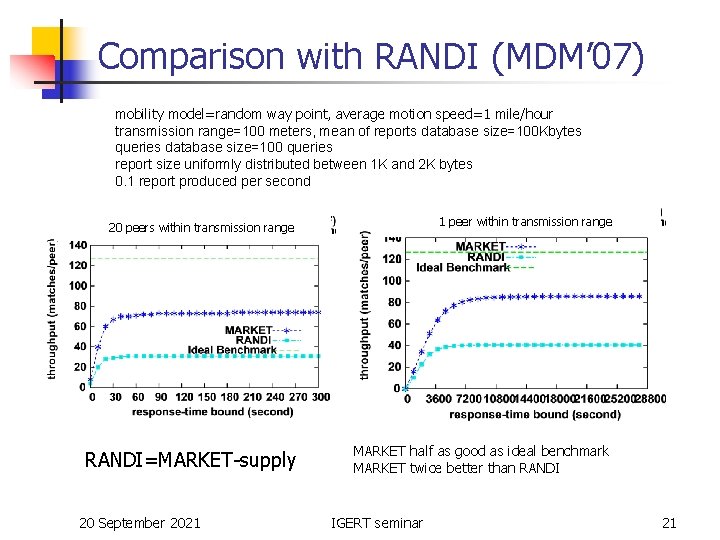
Comparison with RANDI (MDM’ 07) mobility model=random way point, average motion speed=1 mile/hour transmission range=100 meters, mean of reports database size=100 Kbytes queries database size=100 queries report size uniformly distributed between 1 K and 2 K bytes 0. 1 report produced per second 20 peers within transmission range 1 peer within transmission range RANDI=MARKET-supply MARKET half as good as ideal benchmark MARKET twice better than RANDI 20 September 2021 IGERT seminar 21
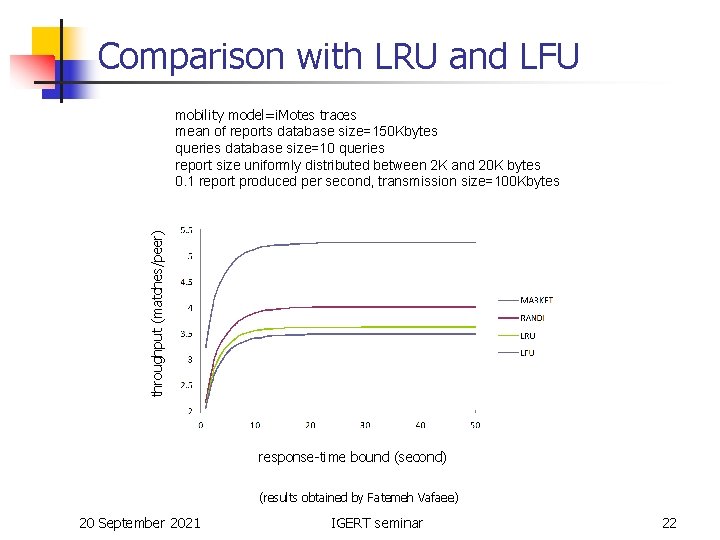
Comparison with LRU and LFU throughput (matches/peer) mobility model=i. Motes traces mean of reports database size=150 Kbytes queries database size=10 queries report size uniformly distributed between 2 K and 20 K bytes 0. 1 report produced per second, transmission size=100 Kbytes response-time bound (second) (results obtained by Fatemeh Vafaee) 20 September 2021 IGERT seminar 22
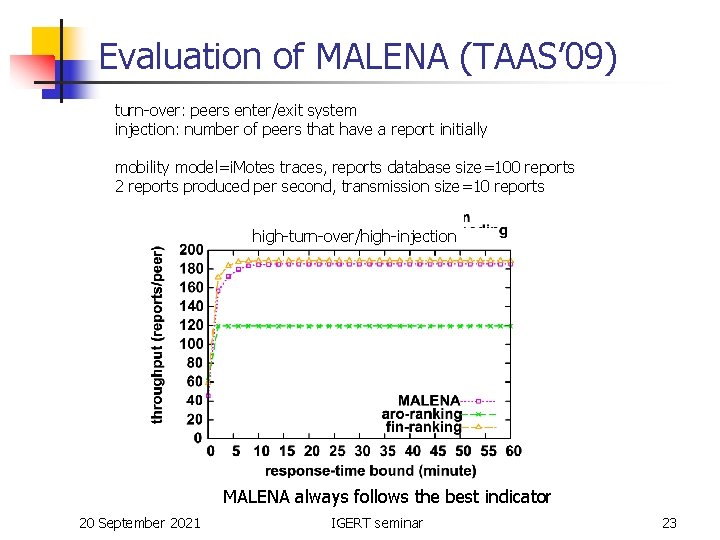
Evaluation of MALENA (TAAS’ 09) turn-over: peers enter/exit system injection: number of peers that have a report initially mobility model=i. Motes traces, reports database size=100 reports 2 reports produced per second, transmission size=10 reports low-turn-over/low-injection high-turn-over/high-injection MALENA always follows the best indicator 20 September 2021 IGERT seminar 23
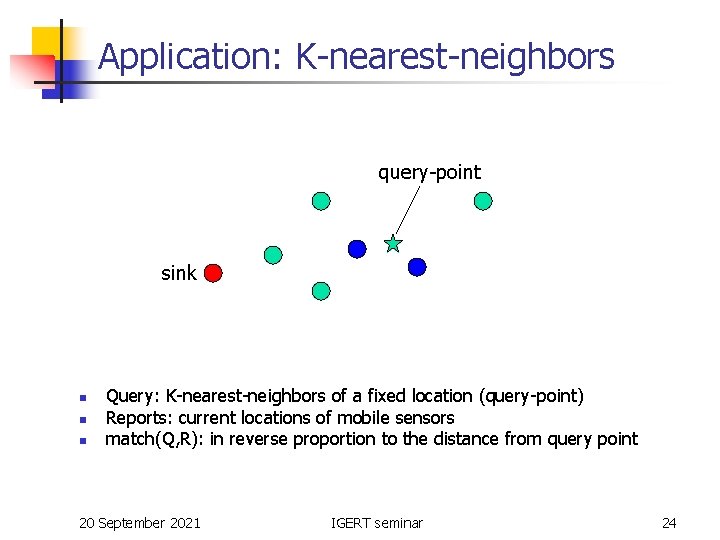
Application: K-nearest-neighbors query-point sink n n n Query: K-nearest-neighbors of a fixed location (query-point) Reports: current locations of mobile sensors match(Q, R): in reverse proportion to the distance from query point 20 September 2021 IGERT seminar 24
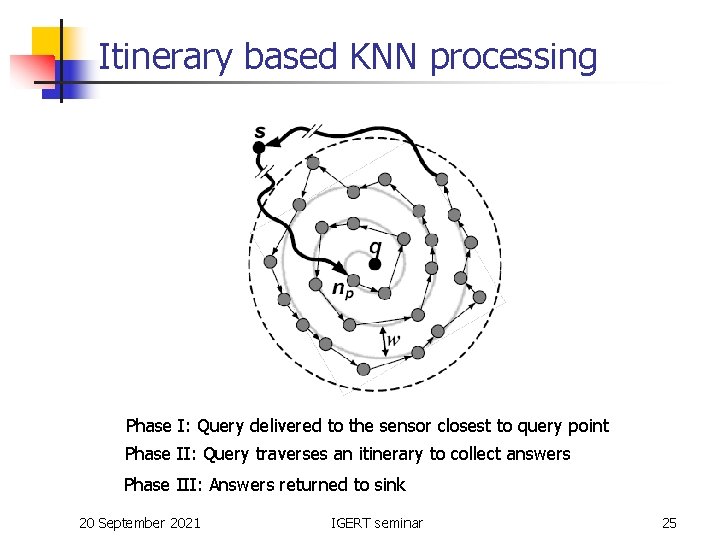
Itinerary based KNN processing Phase I: Query delivered to the sensor closest to query point Phase II: Query traverses an itinerary to collect answers Phase III: Answers returned to sink 20 September 2021 IGERT seminar 25
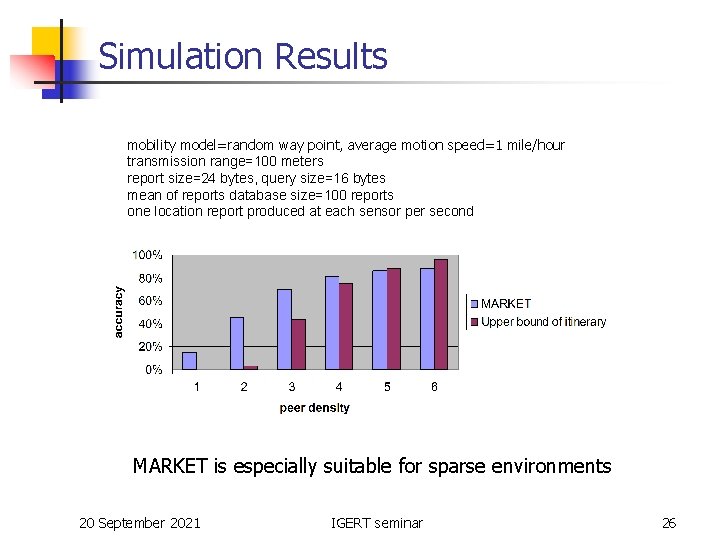
Simulation Results mobility model=random way point, average motion speed=1 mile/hour transmission range=100 meters report size=24 bytes, query size=16 bytes mean of reports database size=100 reports one location report produced at each sensor per second MARKET is especially suitable for sparse environments 20 September 2021 IGERT seminar 26
Talk outline n n n Introduction System Model The MARKET Algorithm Evaluation Extension to CTS Conclusion and Future Work 20 September 2021 IGERT seminar 27
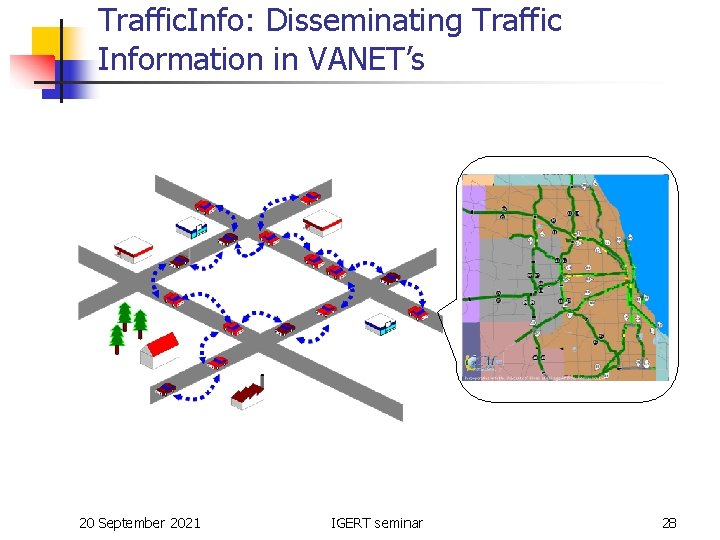
Traffic. Info: Disseminating Traffic Information in VANET’s 20 September 2021 IGERT seminar 28
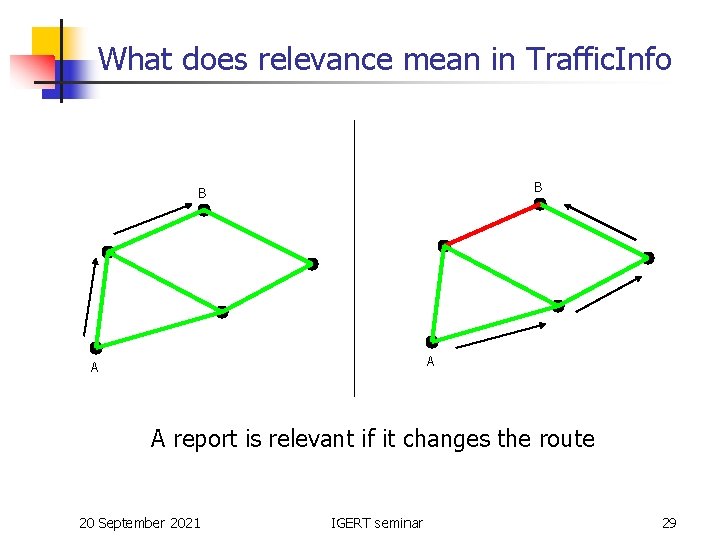
What does relevance mean in Traffic. Info B B A A A report is relevant if it changes the route 20 September 2021 IGERT seminar 29
Which factors indicate relevance of report? n n Distance to the reported road segment Type of road segment Speed variance … 20 September 2021 IGERT seminar 30
Conceptual Learning Procedure n n An example is created for a received report The example is labeled positive if the report changes route and negative otherwise Individual vs. group How to deal with aggregation? 20 September 2021 IGERT seminar 31
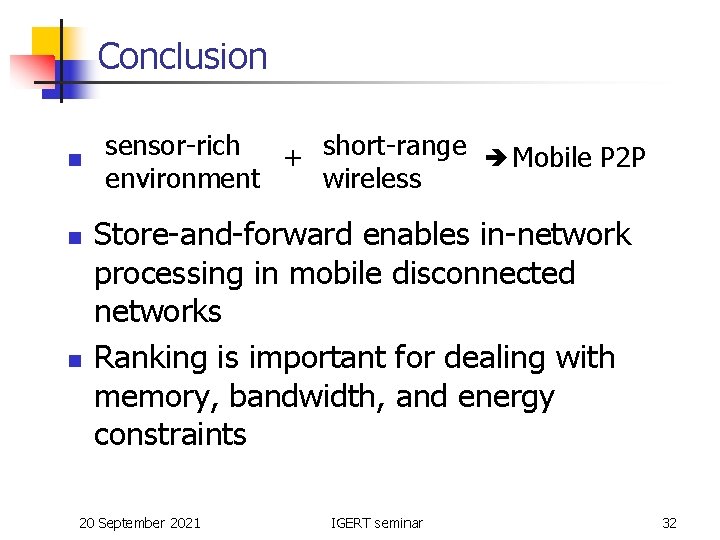
Conclusion n sensor-rich + short-range Query processing environment wireless Mobile P 2 P Store-and-forward enables in-network processing in mobile disconnected networks Ranking is important for dealing with memory, bandwidth, and energy constraints 20 September 2021 IGERT seminar 32
Future Work n Multimedia reports n n n Utilization of metadata Integration of stateless and stateful approaches Starvation/fairness 20 September 2021 IGERT seminar 33
Thanks! Questions? 20 September 2021 IGERT seminar 34
802. 11 Basics n n 3 modes: transmitting, receiving, listening (order of power consumption) When listening: if detecting a message destined to host receive-mode Time divided into slots, 20 microsecs each Transmission: n n n Listen for 1 time slot If channel free start broadcast (observe collision possible) Broadcast may last for many time slots 20 September 2021 IGERT seminar 35
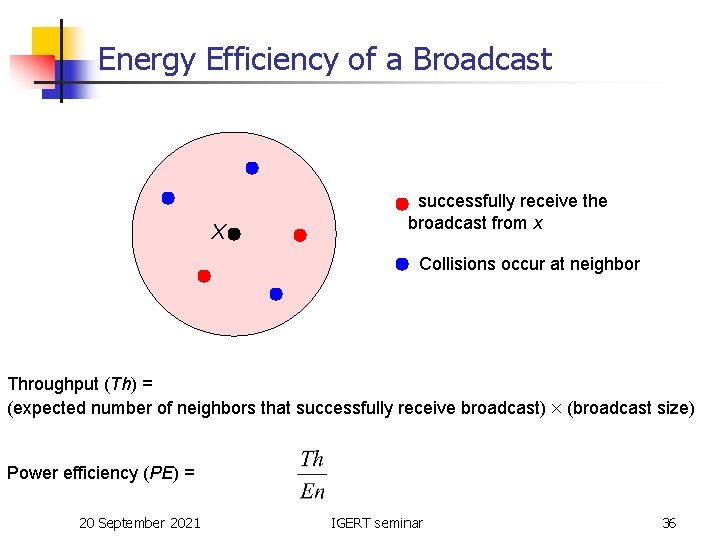
Energy Efficiency of a Broadcast X successfully receive the broadcast from x Collisions occur at neighbor Throughput (Th) = (expected number of neighbors that successfully receive broadcast) (broadcast size) Power efficiency (PE) = 20 September 2021 IGERT seminar 36
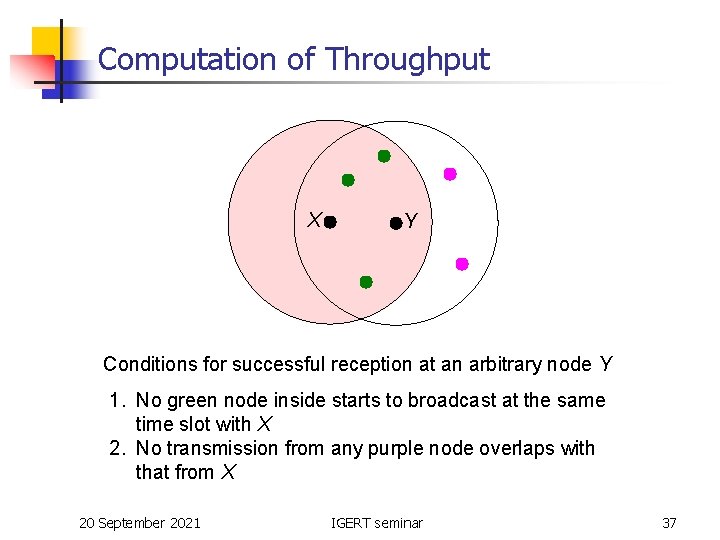
Computation of Throughput X Y Conditions for successful reception at an arbitrary node Y 1. No green node inside starts to broadcast at the same time slot with X 2. No transmission from any purple node overlaps with that from X 20 September 2021 IGERT seminar 37
Energy Constraints Energy consumed by a 802. 11 network interface for transmitting a message of size M bytes En=f M+g For 802. 11 broadcast, g=266 10 -6 Joule, f=5. 27 10 -6 Joule/byte n 20 September 2021 IGERT seminar 38
Experimental MP 2 P Projects (Pedestrians) n n n 7 DS – Columbia University (web pages) i. Clouds – Darmstadt Univ. (incentives) Mo. GATU – UMBC (specialized query processing, e. g. , collaborative joins) People. Net – NUS, IIS-Bangalore (Mobile commerce, information type location baazar) Mo. B – Wisconsin, Cambridge (incentives, information resources e. g. bandwidth) Mobi-Dik – Univ. of Illinois, Chicago (brokering, physical resources, bandwidth/memory/power management) 20 September 2021 IGERT seminar 39
Vehicular Projects n Inter-vehicle Communication and Intelligent Transportation: n n n Car. TALK 2000 is a European project VICS (The Vehicle Information and Control System) is a government -sponsored system in Japan with an 11 -year track record Fleet. Net, an inter-vehicle communications system, is being developed by a consortium of private companies and universities in Germany IVI (Intelligent Vehicle Initiative) and VII (Vehicle Infrastructure Integration), the US DOT MP 2 P provides data management capabilities on top of these communication systems Grassroots, Traffic. View, SOTIS, V 3 – P 2 P dissemination of traffic info to reduce travel times 20 September 2021 IGERT seminar 40
RANk-based DIssemination (RANDI) n n n Ranking of reports Bandwidth/energy aware Exchange enhances n n n Consumer functionality Broker functionality Consumer: Answer local query (pull) Broker: Transmit reports most likely requested by future-encountered peers (push) Transmission trigger: n n Encounter New reports 20 September 2021 IGERT seminar 41
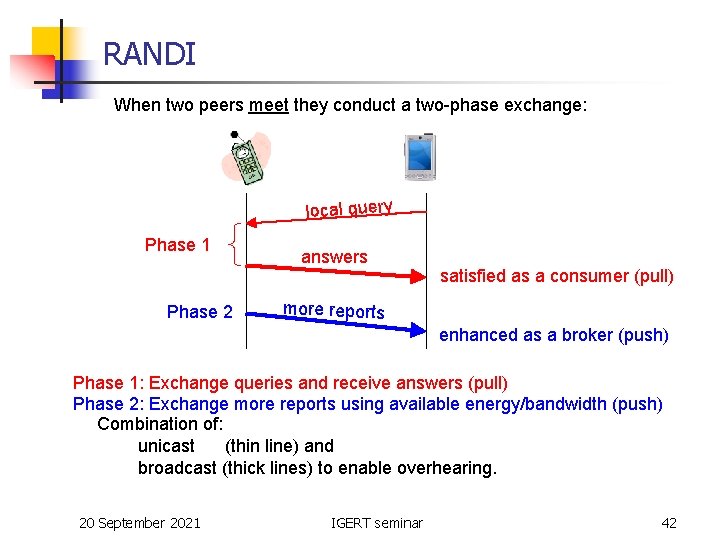
RANDI When two peers meet they conduct a two-phase exchange: local query Phase 1 Phase 2 answers satisfied as a consumer (pull) more reports enhanced as a broker (push) Phase 1: Exchange queries and receive answers (pull) Phase 2: Exchange more reports using available energy/bandwidth (push) Combination of: unicast (thin line) and broadcast (thick lines) to enable overhearing. 20 September 2021 IGERT seminar 42
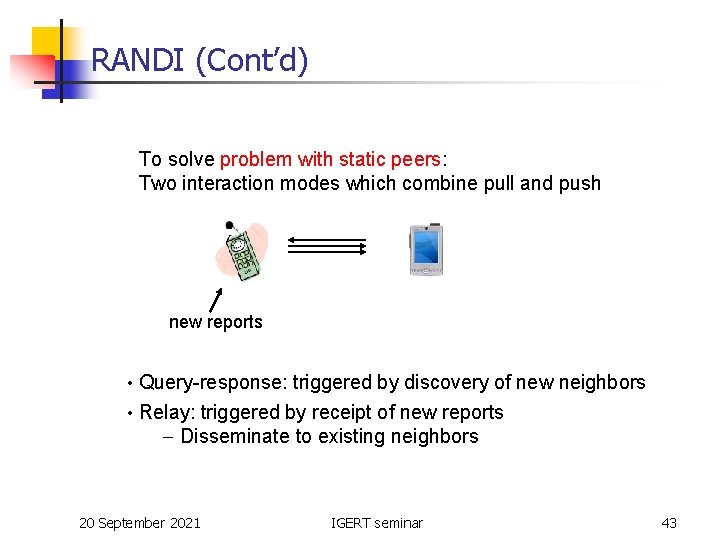
RANDI (Cont’d) To solve problem with static peers: Two interaction modes which combine pull and push new reports • Query-response: triggered by discovery of new neighbors • Relay: triggered by receipt of new reports Disseminate to existing neighbors 20 September 2021 IGERT seminar 43
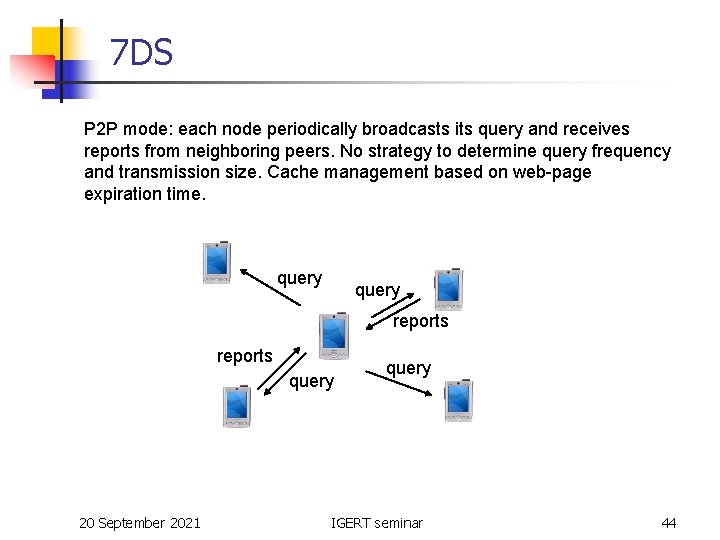
7 DS P 2 P mode: each node periodically broadcasts its query and receives reports from neighboring peers. No strategy to determine query frequency and transmission size. Cache management based on web-page expiration time. query reports query 20 September 2021 query IGERT seminar 44
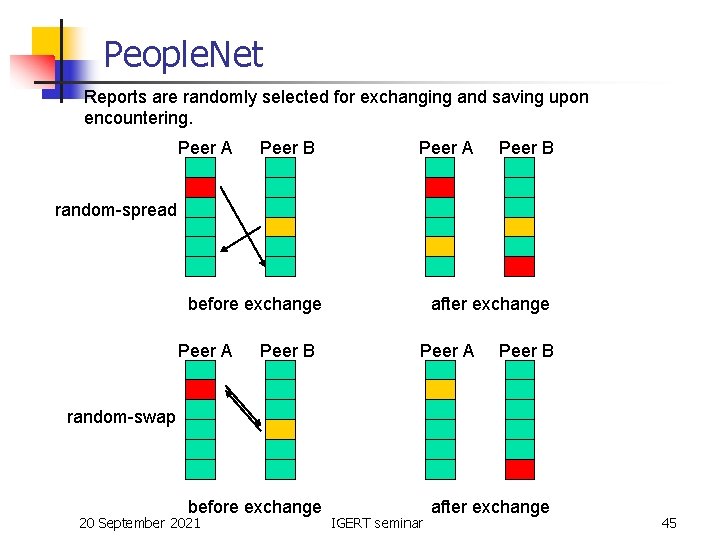
People. Net Reports are randomly selected for exchanging and saving upon encountering. Peer A Peer B random-spread before exchange Peer A Peer B after exchange Peer A Peer B random-swap before exchange 20 September 2021 IGERT seminar after exchange 45
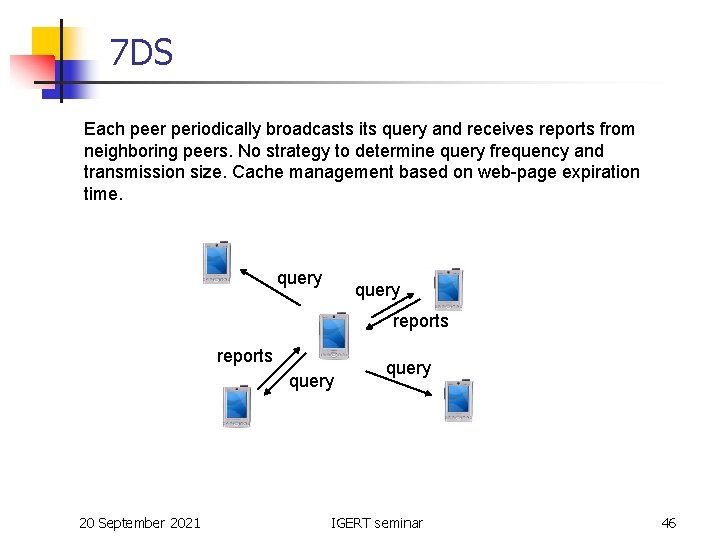
7 DS Each peer periodically broadcasts its query and receives reports from neighboring peers. No strategy to determine query frequency and transmission size. Cache management based on web-page expiration time. query reports query 20 September 2021 query IGERT seminar 46
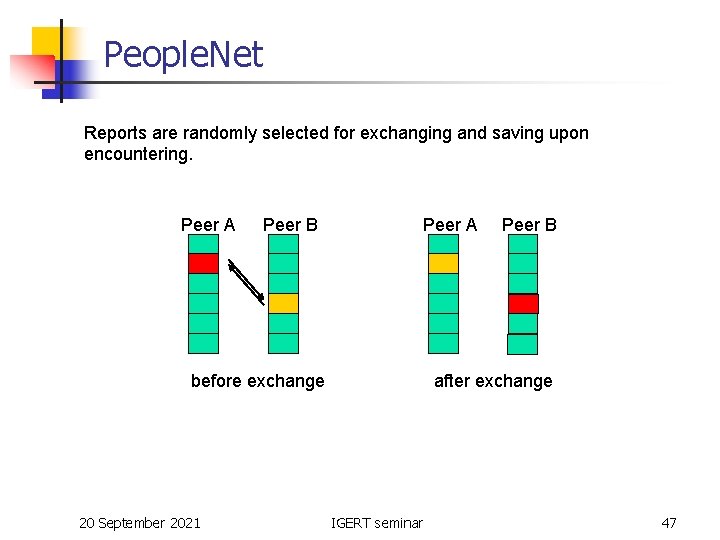
People. Net Reports are randomly selected for exchanging and saving upon encountering. Peer A Peer B Peer A before exchange 20 September 2021 Peer B after exchange IGERT seminar 47
Mobile Local Search: Applications n transportation n n social networking (wearable website) n n n Search for victims in a rubble asset management and tracking n n Sale on an item of interest at mall Music-file exchange emergency response n n Personal profile of interest at a convention Singles matchmaking Floating BBS mobile electronic commerce n n Announce sudden stop, malfunctioning brake light, patch of ice Floating car data Dissemination of multi-media traffic information (picture, video, voice) Search close-by taxi customer, parking slot, ride-share Sensors on containers exchange security information => remote checkpoints tourist and location-based-services n Closest ATM 20 September 2021 IGERT seminar 48
Applications – Common features n n Mobile/stationary peers Resources of interest n n n in a limited geographic area Short time duration Can be solved by fixed servers, but n n Unlikely solution Proposed mp 2 p paradigm can enhance fixed solution (reliability, performance, coverage) 20 September 2021 IGERT seminar 49
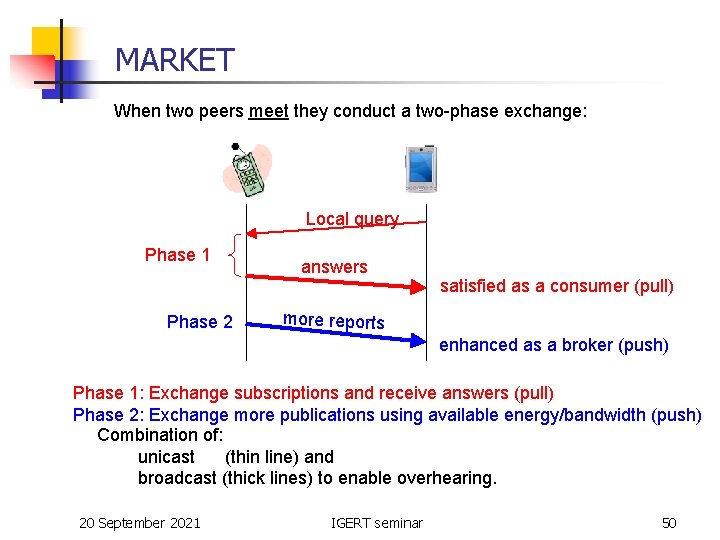
MARKET When two peers meet they conduct a two-phase exchange: Local query Phase 1 Phase 2 answers satisfied as a consumer (pull) more reports enhanced as a broker (push) Phase 1: Exchange subscriptions and receive answers (pull) Phase 2: Exchange more publications using available energy/bandwidth (push) Combination of: unicast (thin line) and broadcast (thick lines) to enable overhearing. 20 September 2021 IGERT seminar 50
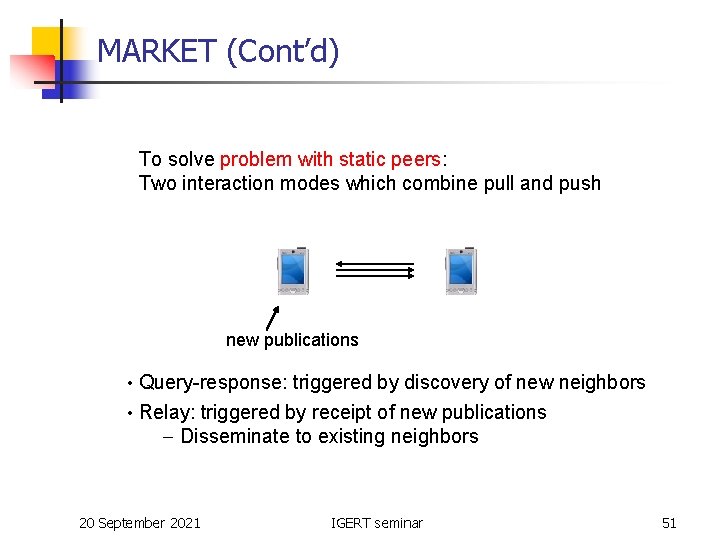
MARKET (Cont’d) To solve problem with static peers: Two interaction modes which combine pull and push new publications • Query-response: triggered by discovery of new neighbors • Relay: triggered by receipt of new publications Disseminate to existing neighbors 20 September 2021 IGERT seminar 51
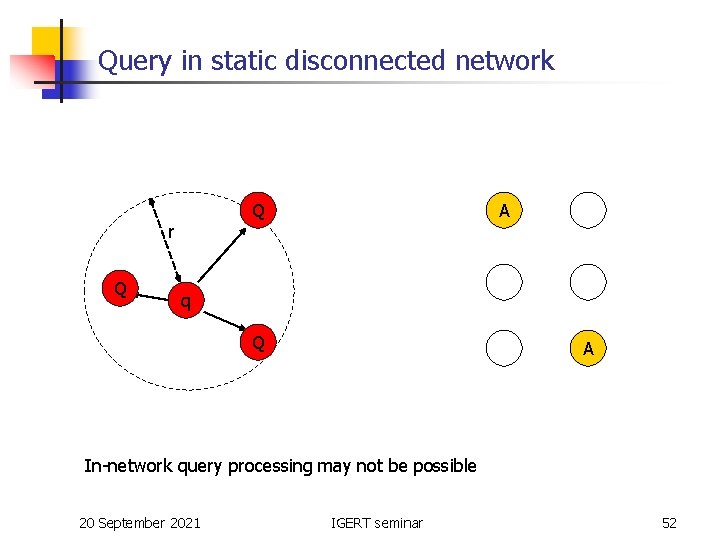
Query in static disconnected network Q r Q A q Q A In-network query processing may not be possible 20 September 2021 IGERT seminar 52
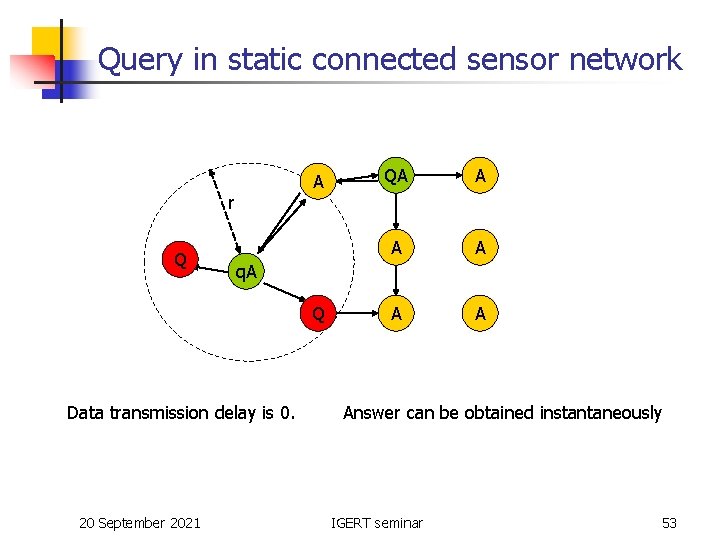
Query in static connected sensor network r Q Q A A q Q Data transmission delay is 0. 20 September 2021 QA A Answer can be obtained instantaneously IGERT seminar 53
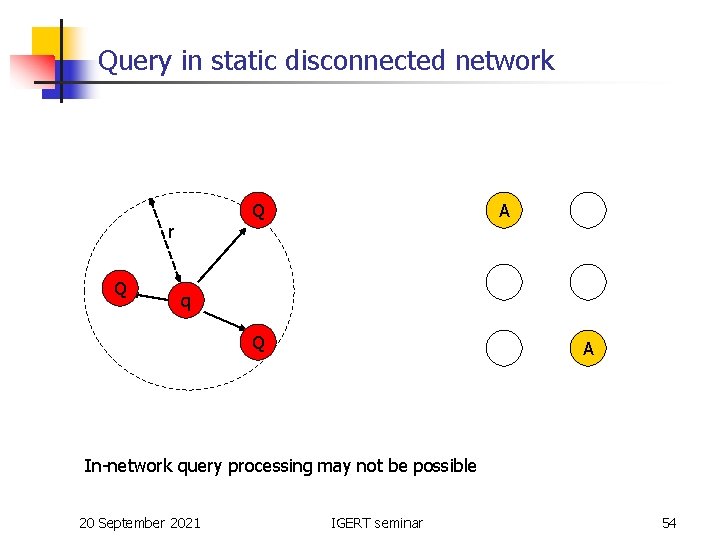
Query in static disconnected network Q r Q A q Q A In-network query processing may not be possible 20 September 2021 IGERT seminar 54
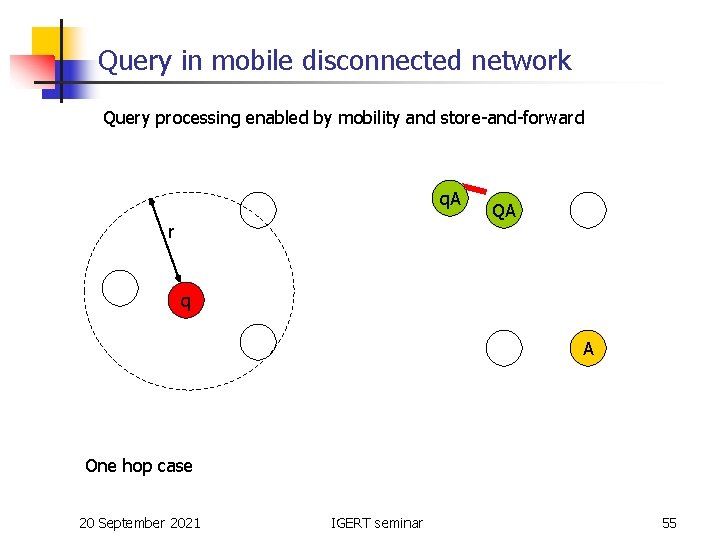
Query in mobile disconnected network Query processing enabled by mobility and store-and-forward q. A r QA A q A One hop case 20 September 2021 IGERT seminar 55
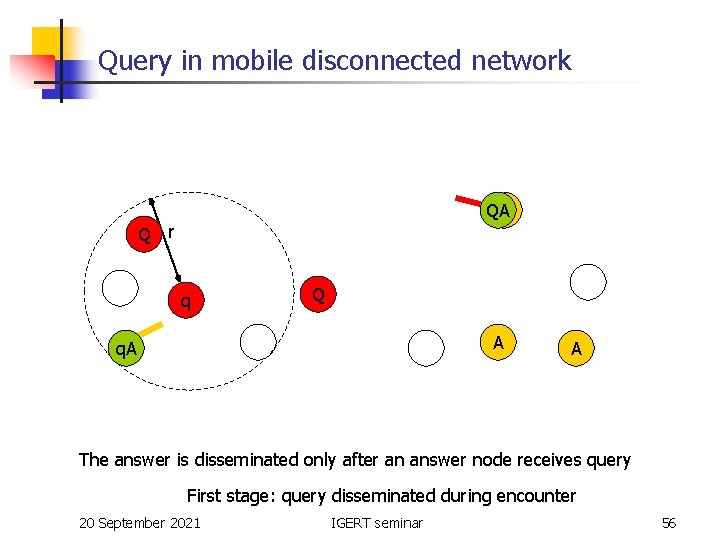
Query in mobile disconnected network Q QA A r q Q A q. A A The answer is in disseminated only after anitanswer node receives query Query Multil-hop can be case network processed, but is delayed Query processing doesn’t control motion. First alogrithm stage: query disseminated during encounter 20 September 2021 IGERT seminar 56
- Slides: 56