
Query Execution in Databases An Introduction Zack Ives
Query Execution in Databases: An Introduction Zack Ives CSE 544 Spring 2000 1
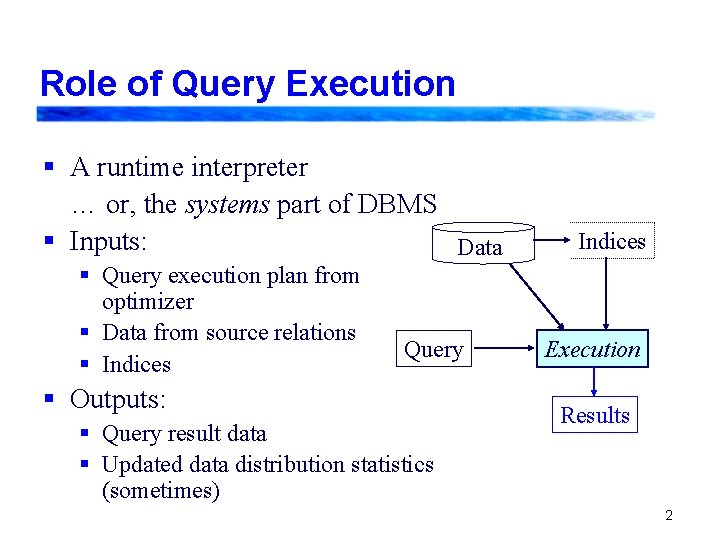
Role of Query Execution § A runtime interpreter … or, the systems part of DBMS § Inputs: Data § Query execution plan from optimizer § Data from source relations § Indices Query § Outputs: § Query result data § Updated data distribution statistics (sometimes) Indices Execution Results 2
Outline § § § § Overview Basic principles Primitive relational operators Aggregation and other advanced operators Querying XML Trends in Execution Wrap-up: execution issues 3
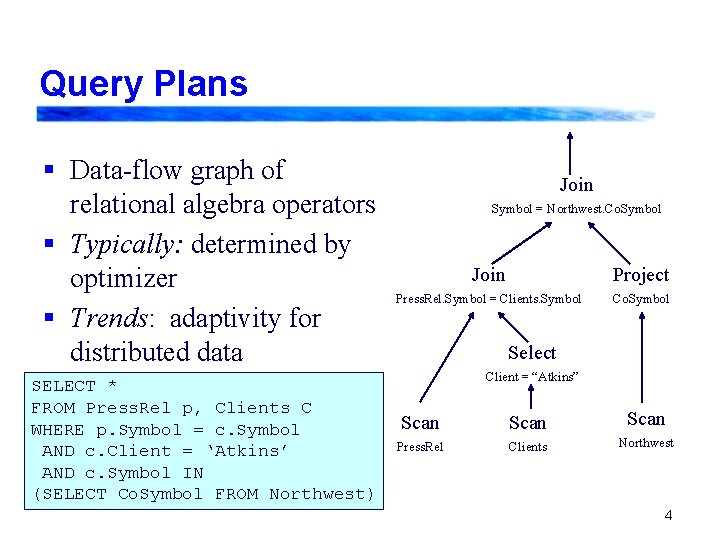
Query Plans § Data-flow graph of relational algebra operators § Typically: determined by optimizer § Trends: adaptivity for distributed data SELECT * FROM Press. Rel p, Clients C WHERE p. Symbol = c. Symbol AND c. Client = ‘Atkins’ AND c. Symbol IN (SELECT Co. Symbol FROM Northwest) Join Symbol = Northwest. Co. Symbol Join Project Press. Rel. Symbol = Clients. Symbol Co. Symbol Select Client = “Atkins” Scan Press. Rel Clients Northwest 4
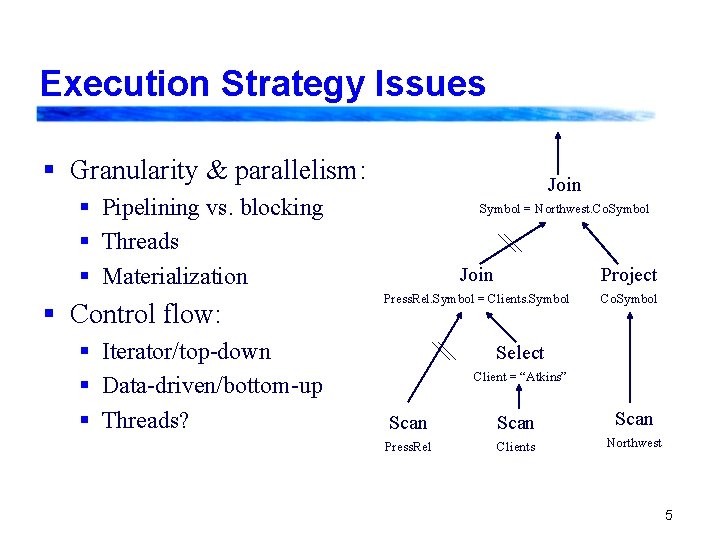
Execution Strategy Issues § Granularity & parallelism: Join § Pipelining vs. blocking § Threads § Materialization § Control flow: § Iterator/top-down § Data-driven/bottom-up § Threads? Symbol = Northwest. Co. Symbol Join Project Press. Rel. Symbol = Clients. Symbol Co. Symbol Select Client = “Atkins” Scan Press. Rel Clients Northwest 5
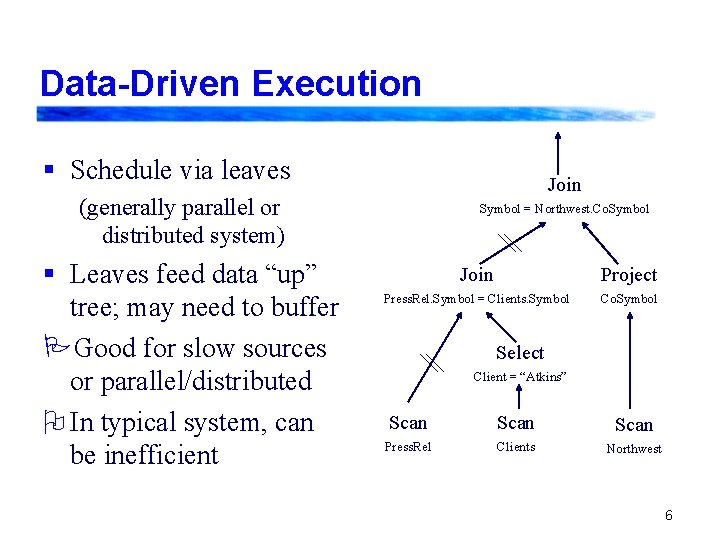
Data-Driven Execution § Schedule via leaves Join (generally parallel or distributed system) § Leaves feed data “up” tree; may need to buffer PGood for slow sources or parallel/distributed O In typical system, can be inefficient Symbol = Northwest. Co. Symbol Join Project Press. Rel. Symbol = Clients. Symbol Co. Symbol Select Client = “Atkins” Scan Press. Rel Clients Northwest 6
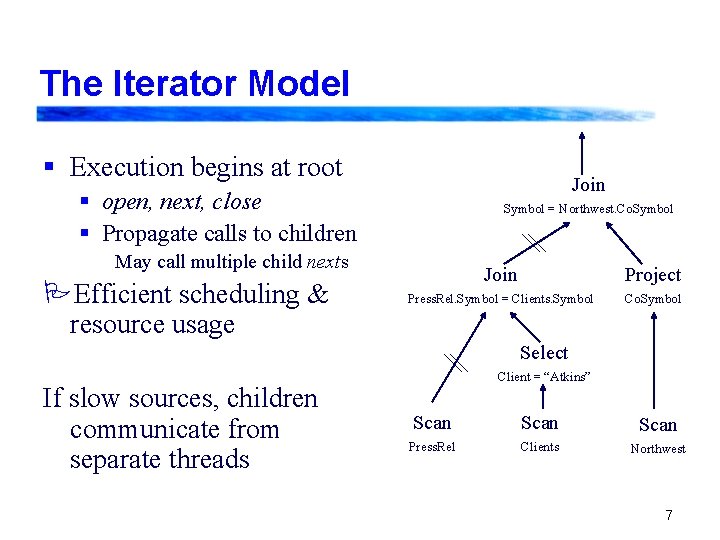
The Iterator Model § Execution begins at root Join § open, next, close § Propagate calls to children Symbol = Northwest. Co. Symbol May call multiple child nexts PEfficient scheduling & resource usage Join Project Press. Rel. Symbol = Clients. Symbol Co. Symbol Select If slow sources, children communicate from separate threads Client = “Atkins” Scan Press. Rel Clients Northwest 7
Execution Has a Cost § Different execution plans produce same results at different cost – optimizer estimates these § It must search for low-cost query execution plan § Statistics: Cardinalities Histograms (estimate selectivities) § I/O vs. computation costs § Pipelining vs. blocking operators § Time-to-first-tuple vs. completion time 8
Basic Principles § Many DB operations require reading tuples, tuple vs. previous tuples, or tuples vs. tuples in another table § Techniques generally used: § Iteration: for/while loop comparing with all tuples on disk § Buffered I/O: buffer manager with page replacement § Index: if comparison of attribute that’s indexed, look up matches in index & return those § Sort: iteration against presorted data (interesting orders) § Hash: build hash table of the tuple list, probe the hash table * Must be able to support larger-than-memory data 9
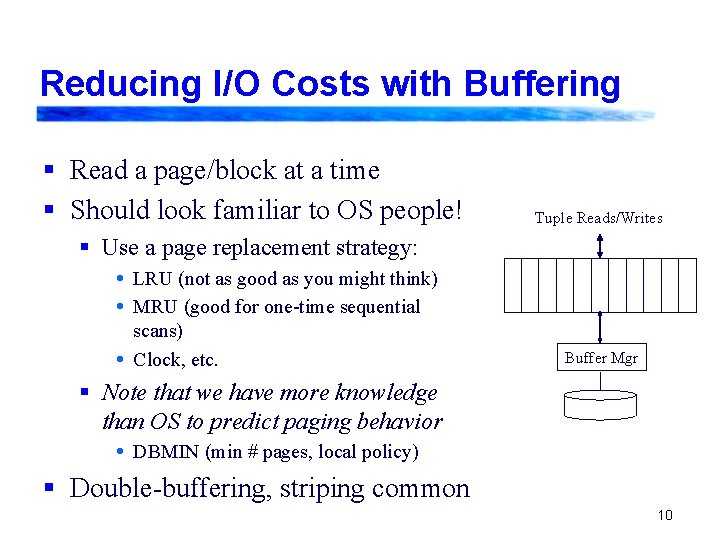
Reducing I/O Costs with Buffering § Read a page/block at a time § Should look familiar to OS people! Tuple Reads/Writes § Use a page replacement strategy: LRU (not as good as you might think) MRU (good for one-time sequential scans) Clock, etc. Buffer Mgr § Note that we have more knowledge than OS to predict paging behavior DBMIN (min # pages, local policy) § Double-buffering, striping common 10
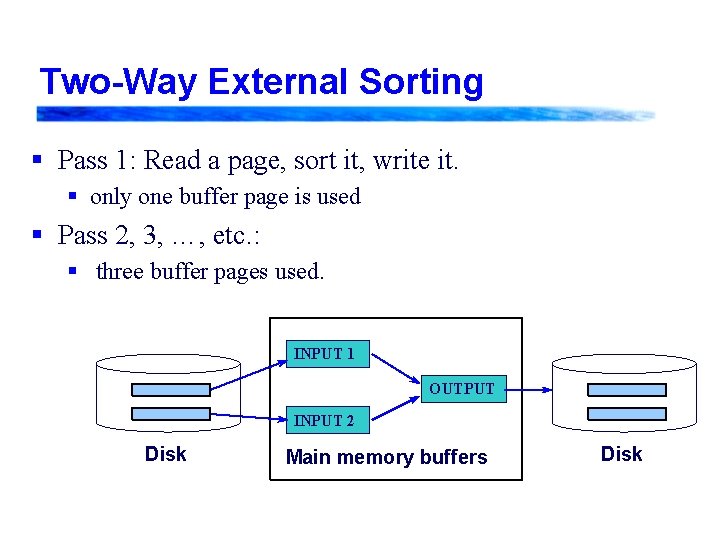
Two-Way External Sorting § Pass 1: Read a page, sort it, write it. § only one buffer page is used § Pass 2, 3, …, etc. : § three buffer pages used. INPUT 1 OUTPUT INPUT 2 Disk Main memory buffers Disk
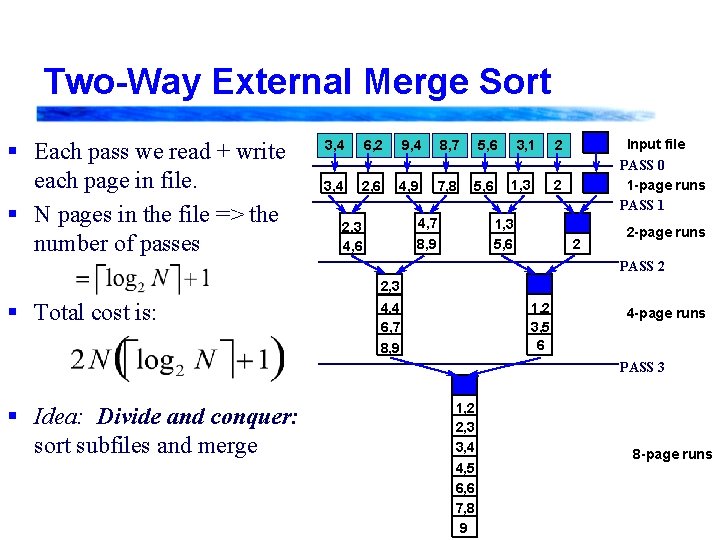
Two-Way External Merge Sort § Each pass we read + write each page in file. § N pages in the file => the number of passes 3, 4 6, 2 9, 4 8, 7 5, 6 3, 4 2, 6 4, 9 7, 8 5, 6 4, 7 8, 9 2, 3 4, 6 3, 1 1, 3 Input file PASS 0 1 -page runs PASS 1 2 2 1, 3 5, 6 2 2 -page runs PASS 2 2, 3 § Total cost is: 4, 4 6, 7 8, 9 1, 2 3, 5 6 4 -page runs PASS 3 § Idea: Divide and conquer: sort subfiles and merge 1, 2 2, 3 3, 4 4, 5 6, 6 7, 8 9 8 -page runs
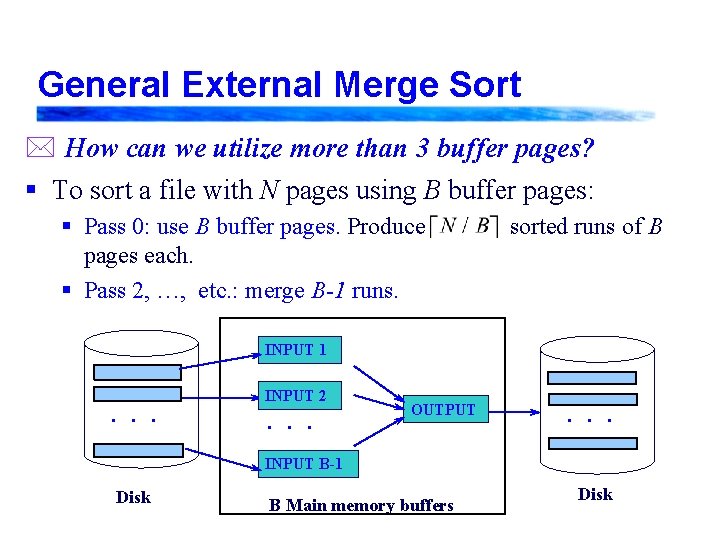
General External Merge Sort * How can we utilize more than 3 buffer pages? § To sort a file with N pages using B buffer pages: § Pass 0: use B buffer pages. Produce pages each. § Pass 2, …, etc. : merge B-1 runs. sorted runs of B INPUT 1 . . . INPUT 2 . . . OUTPUT . . . INPUT B-1 Disk B Main memory buffers Disk
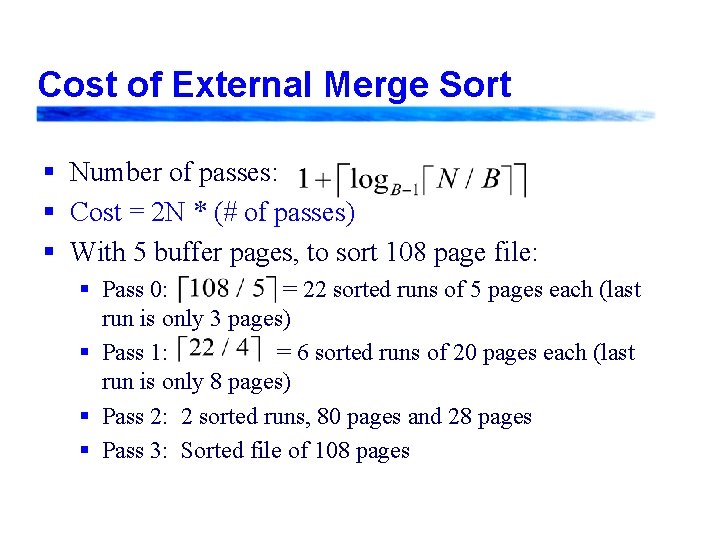
Cost of External Merge Sort § Number of passes: § Cost = 2 N * (# of passes) § With 5 buffer pages, to sort 108 page file: § Pass 0: = 22 sorted runs of 5 pages each (last run is only 3 pages) § Pass 1: = 6 sorted runs of 20 pages each (last run is only 8 pages) § Pass 2: 2 sorted runs, 80 pages and 28 pages § Pass 3: Sorted file of 108 pages
Hashing § A familiar idea: § Requires “good” hash function (may depend on data) § Distribute across buckets § Often multiple items with same key § Types of hash tables: § Static § Extendible (requires directory to buckets; can split) § Linear (two levels, rotate through + split; bad with skew) 15
Basic Operators § Select § Project § Join § Various implementations § Handling of larger-than-memory sources § Semi-join 16
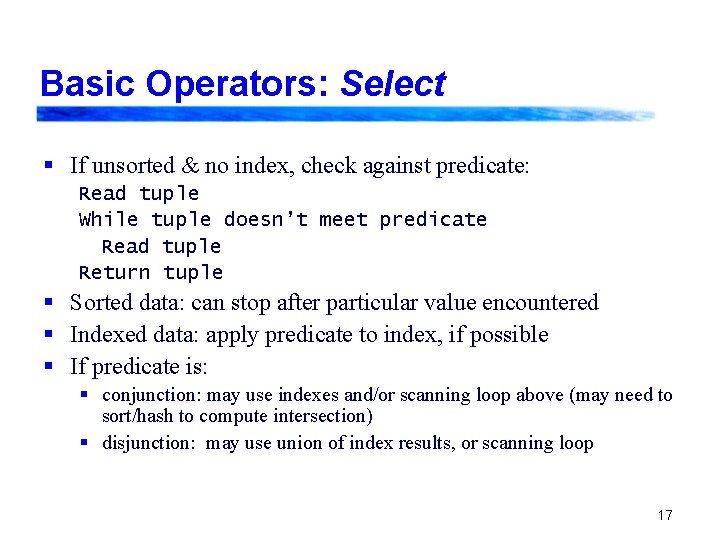
Basic Operators: Select § If unsorted & no index, check against predicate: Read tuple While tuple doesn’t meet predicate Read tuple Return tuple § Sorted data: can stop after particular value encountered § Indexed data: apply predicate to index, if possible § If predicate is: § conjunction: may use indexes and/or scanning loop above (may need to sort/hash to compute intersection) § disjunction: may use union of index results, or scanning loop 17
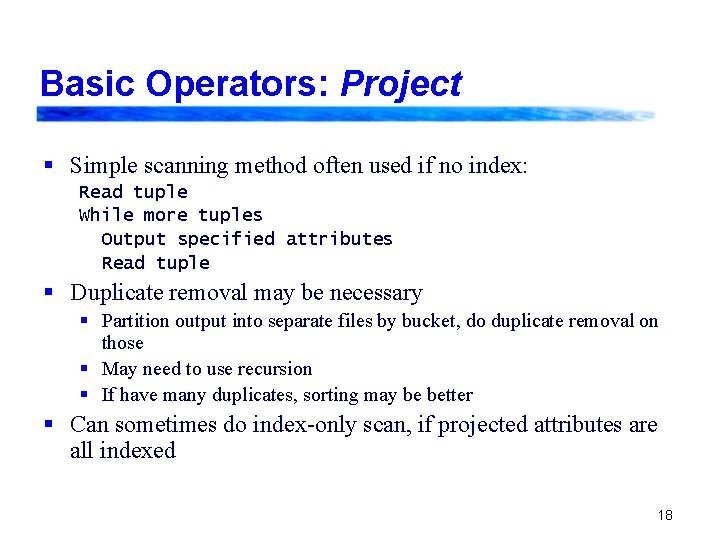
Basic Operators: Project § Simple scanning method often used if no index: Read tuple While more tuples Output specified attributes Read tuple § Duplicate removal may be necessary § Partition output into separate files by bucket, do duplicate removal on those § May need to use recursion § If have many duplicates, sorting may be better § Can sometimes do index-only scan, if projected attributes are all indexed 18
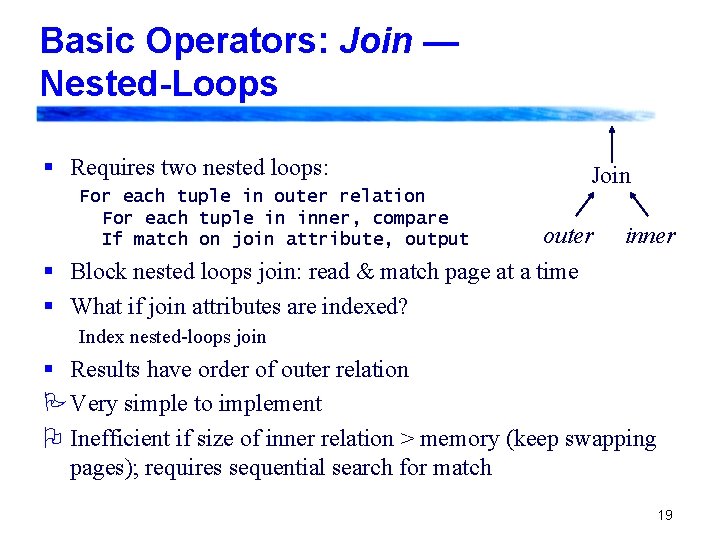
Basic Operators: Join — Nested-Loops § Requires two nested loops: For each tuple in outer relation For each tuple in inner, compare If match on join attribute, output Join outer inner § Block nested loops join: read & match page at a time § What if join attributes are indexed? Index nested-loops join § Results have order of outer relation PVery simple to implement O Inefficient if size of inner relation > memory (keep swapping pages); requires sequential search for match 19
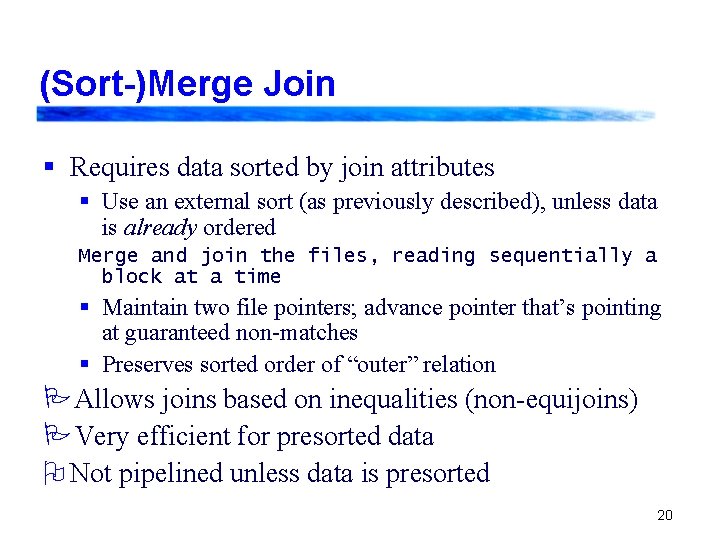
(Sort-)Merge Join § Requires data sorted by join attributes § Use an external sort (as previously described), unless data is already ordered Merge and join the files, reading sequentially a block at a time § Maintain two file pointers; advance pointer that’s pointing at guaranteed non-matches § Preserves sorted order of “outer” relation PAllows joins based on inequalities (non-equijoins) PVery efficient for presorted data O Not pipelined unless data is presorted 20
Hash-Based Joins § Allows partial pipelining of operations with equality comparisons (e. g. equijoin, union) § Sort-based operations block, but allow range and inequality comparisons § Hash joins usually done with static number of hash buckets § Generally have fairly long chains at each bucket § Require a mechanism for handling large datasets 21
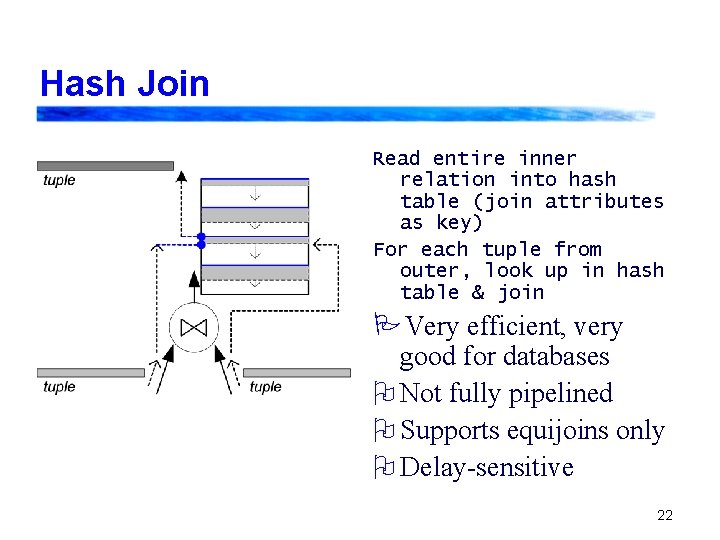
Hash Join Read entire inner relation into hash table (join attributes as key) For each tuple from outer, look up in hash table & join PVery efficient, very good for databases O Not fully pipelined O Supports equijoins only O Delay-sensitive 22
Running out of Memory § Two possible strategies: § Overflow prevention (prevent from happening) § Overflow resolution (handle overflow when it occurs) § GRACE hash overflow resolution: split into groups of buckets, run recursively: Write each bucket to separate file Finish reading inner, swapping tuples to appropriate files Read outer, swapping tuples to overflow files matching those from inner Recursively GRACE hash join matching outer & inner overflow files 23
Hybrid Hash Join Overflow § A “lazy” version of the GRACE hash: When memory overflows, swap a subset of the tables Continue reading inner relation and building table (sending tuples to buckets on disk as necessary) Read outer, joining with buckets in memory or swapping to disk as appropriate Join the corresponding overflow files, using recursion 24
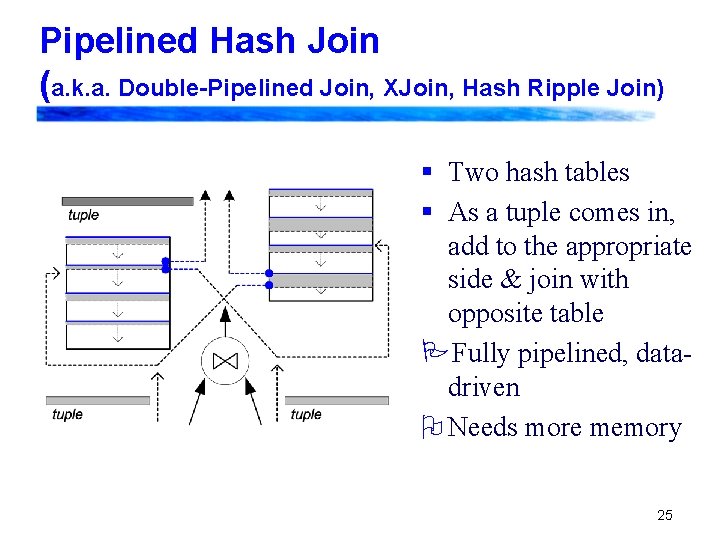
Pipelined Hash Join (a. k. a. Double-Pipelined Join, XJoin, Hash Ripple Join) § Two hash tables § As a tuple comes in, add to the appropriate side & join with opposite table PFully pipelined, datadriven O Needs more memory 25
Overflow Resolution in the DPJoin § Based on the ideas of hybrid hash overflow § Requires a bunch of ugly bookkeeping! Need to mark tuples depending on state of opposite bucket - this lets us know whether they need to be joined later § Three proposed strategies: § Tukwila’s “left flush” – “get rid” of one of the hash tables § Tukwila’s “symmetric” – get rid of one of the hash buckets (both tables) § XJoin’s method – get rid of biggest bucket; during delays, start joining what was overflowed 26
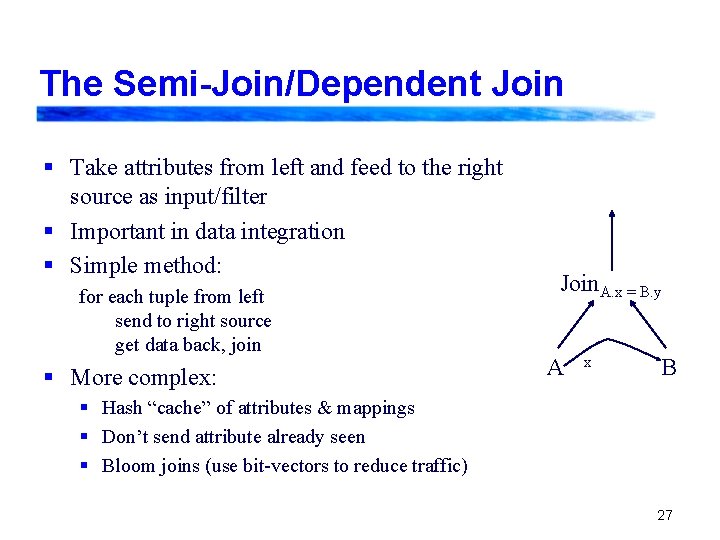
The Semi-Join/Dependent Join § Take attributes from left and feed to the right source as input/filter § Important in data integration § Simple method: for each tuple from left send to right source get data back, join § More complex: Join. A. x = B. y A x B § Hash “cache” of attributes & mappings § Don’t send attribute already seen § Bloom joins (use bit-vectors to reduce traffic) 27
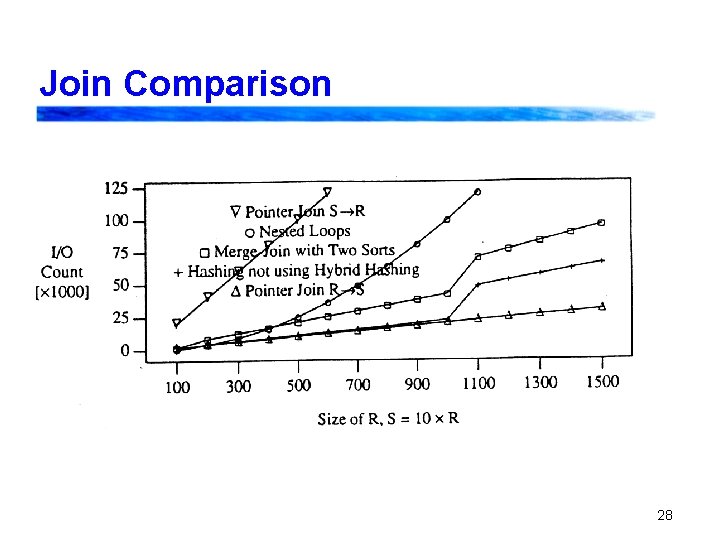
Join Comparison 28
Aggregation + Duplicate Removal § Duplicate removal equivalent to agg function that returns first of duplicate tuples § Min, Max, Avg, Sum, Count over GROUP BY § Iterative approach: while key attribute(s) same: Read tuples from child Update value based on field(s) of interest § Some systems can do this via indices § Merge approach § Hash approach § Same techniques usable for difference, union 29
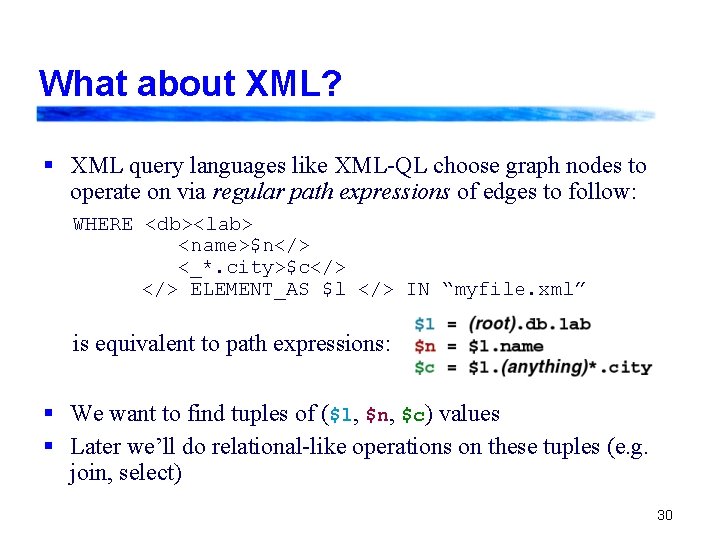
What about XML? § XML query languages like XML-QL choose graph nodes to operate on via regular path expressions of edges to follow: WHERE <db><lab> <name>$n</> <_*. city>$c</> ELEMENT_AS $l </> IN “myfile. xml” is equivalent to path expressions: § We want to find tuples of ($l, $n, $c) values § Later we’ll do relational-like operations on these tuples (e. g. join, select) 30
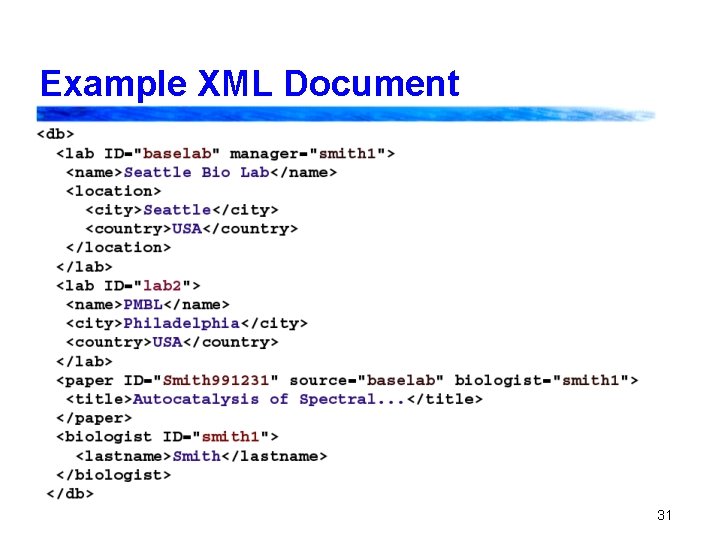
Example XML Document 31
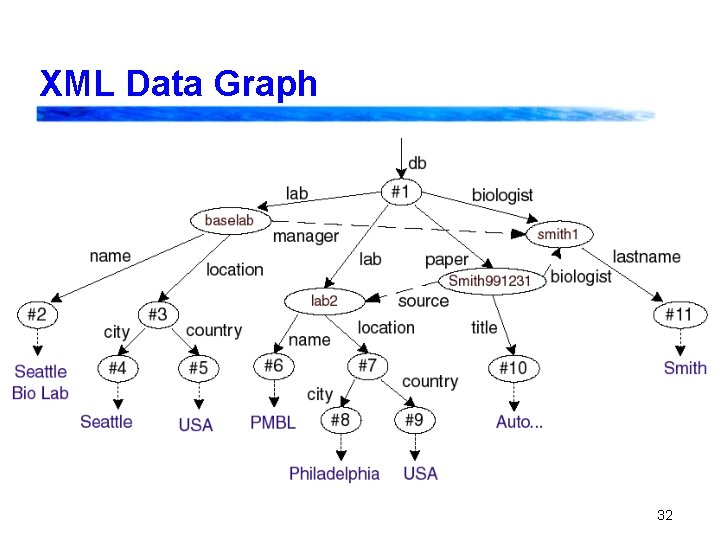
XML Data Graph 32
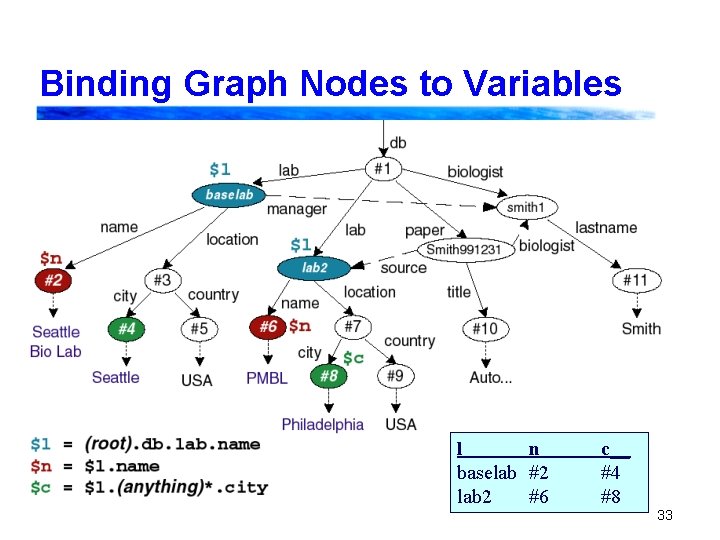
Binding Graph Nodes to Variables l n baselab #2 lab 2 #6 c__ #4 #8 33
XML Operators § New operators: § XML construction: Create element (add tags around data) Add attribute(s) to element (similar to join) Nest element under other element (similar to join) § Path expression evaluation X-scan 34
X-Scan: “Scan” for Streaming XML § We often re-read XML from net on every query Data integration, data exchange, reading from Web § Previous systems: § Store XML on disk, then index & query § Cannot amortize storage costs § X-scan works on streaming XML data § § Read & parse Track nodes by ID Index XML graph structure Evaluate path expressions to select nodes 35
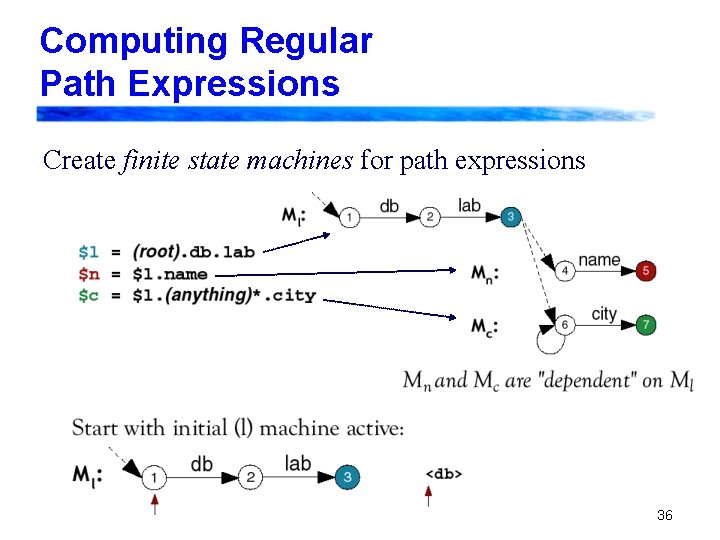
Computing Regular Path Expressions Create finite state machines for path expressions 36
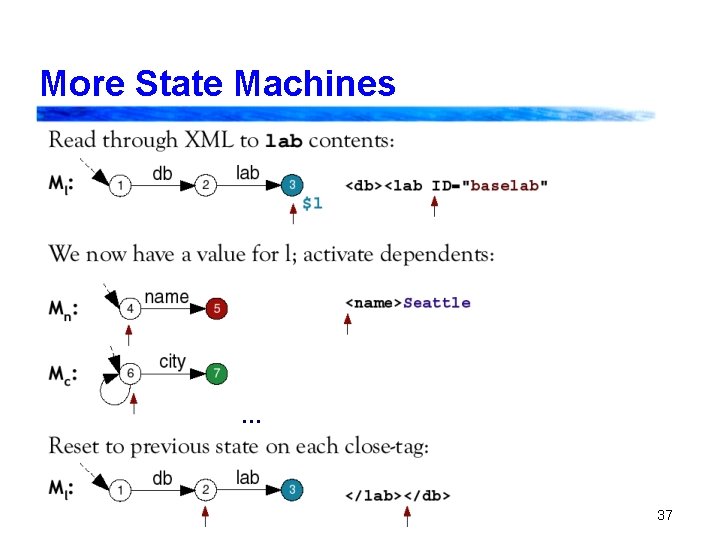
More State Machines … 37
X-Scan works on Graphs § The state machines work on trees – what about IDREFs? § Need to save the document so we can revisit nodes § Keep track of every ID § Build an “index” of the XML document’s structure; add real edges for every subelement and IDREF § When IDREF encountered, see if ID is known If so, dereference and follow it Otherwise, parse and index until we get to it, then process the newly indexed data 38
Recent Work in Execution § XML query processors for data integration § Tukwila, Niagara (Wisconsin), Lore, MIX § “Adaptive” query processing – smarter execution § Handling of exceptions (Tukwila) § Rescheduling of operations while delays occur (XJoin, query scrambling, Bouganim’s multi-fragment execution) § Prioritization of tuples (WHIRL) § Rate-directed tuple flow (Eddies) § Partial results (Niagara) § “Continuous” queries (CQ, Niagra. CQ) 39
Where’s Execution Headed? § Adaptive scheduling of operations – not purely iterator or data-driven § Robust – as in distributed systems, exploit replicas, handle failures § Able to show and update partial/tentative results – operators not “fully” blocking any more § More interactive and responsive – many non-batchoriented applications § More complex data models – handle XML efficiently 40
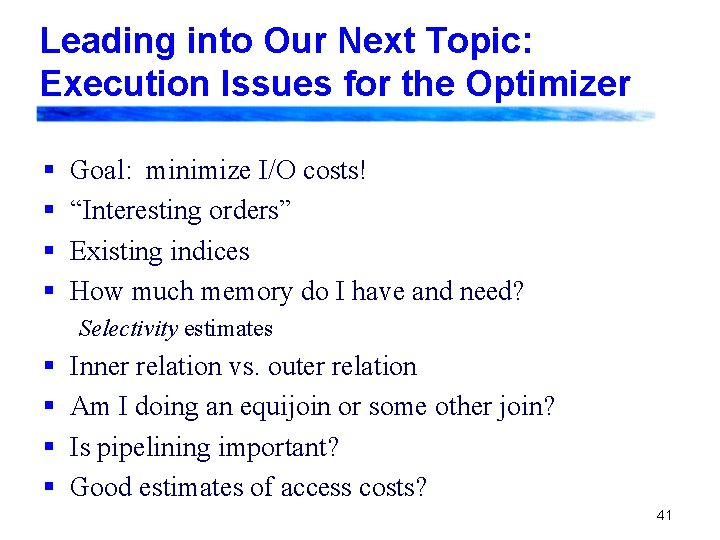
Leading into Our Next Topic: Execution Issues for the Optimizer § § Goal: minimize I/O costs! “Interesting orders” Existing indices How much memory do I have and need? Selectivity estimates § § Inner relation vs. outer relation Am I doing an equijoin or some other join? Is pipelining important? Good estimates of access costs? 41
- Slides: 41