
Quench Detection R Denz and J Steckert Acknowledgements
- Slides: 25
Quench Detection R. Denz and J. Steckert Acknowledgements: S. Pemberton, F. Rodriguez-Mateos, M. Zerlauth logo area HL-LHC Instrumentation Review, September 1, 2020
Outline § § § HL-LHC quench detection systems (QDS) HL-LHC quench detection schemes & algorithms HL-LHC required instrumentation HL-LHC instrumentation failures HL-LHC instrumentation cables Summary logo area 2
Quench Detection and Related Hardware § HL-LHC quench detection systems (QDS) § Superconducting magnets and bus-bars, HTS hybrid current leads, superconducting cable links § Serve as well as data acquisition system and interface to QPS supervision § Protection device supervision units (PDSU) § Distribute QDS trigger signals to protection devices ! ion tcoupling loss a t § Quench heater discharge power supplies (HDS), n se e r p induced quench (CLIQ ) his ft o e § Provide interlocking and re-trigger capability in case of spurious op c s e h devices (HDS, CLIQ) t triggers of protection n i ith w t Nosignals from protection devices for post mortem event § Acquire analysis logo area 3
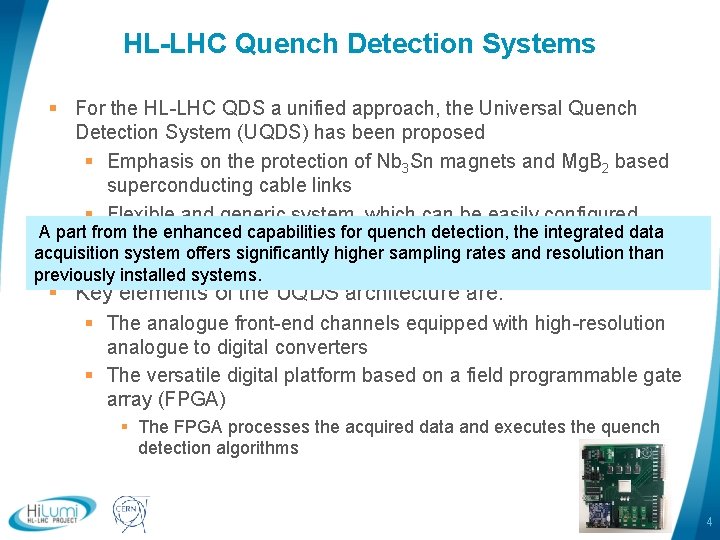
HL-LHC Quench Detection Systems § For the HL-LHC QDS a unified approach, the Universal Quench Detection System (UQDS) has been proposed § Emphasis on the protection of Nb 3 Sn magnets and Mg. B 2 based superconducting cable links § Flexible and generic system, which can be easily configured A part from the enhanced for quench detection, the integrated data according to thecapabilities requirements of a superconducting element or acquisition system offers significantly higher sampling rates and resolution than circuit previously installed systems. § Key elements of the UQDS architecture are: § The analogue front-end channels equipped with high-resolution analogue to digital converters § The versatile digital platform based on a field programmable gate array (FPGA) § The FPGA processes the acquired data and executes the quench detection algorithms logo area 4
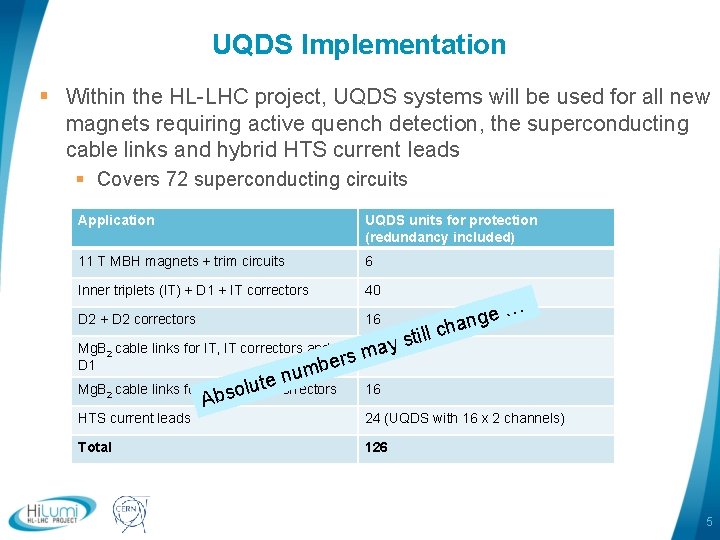
UQDS Implementation § Within the HL-LHC project, UQDS systems will be used for all new magnets requiring active quench detection, the superconducting cable links and hybrid HTS current leads § Covers 72 superconducting circuits Application UQDS units for protection (redundancy included) 11 T MBH magnets + trim circuits 6 Inner triplets (IT) + D 1 + IT correctors 40 D 2 + D 2 correctors 16 Mg. B 2 cable links for IT, IT correctors and 24 ay m s r D 1 mbe nu e… g n a l ch stil te Mg. B 2 cable links for D 2 and solu. D 2 correctors 16 HTS current leads 24 (UQDS with 16 x 2 channels) Total Ab 126 logo area 5
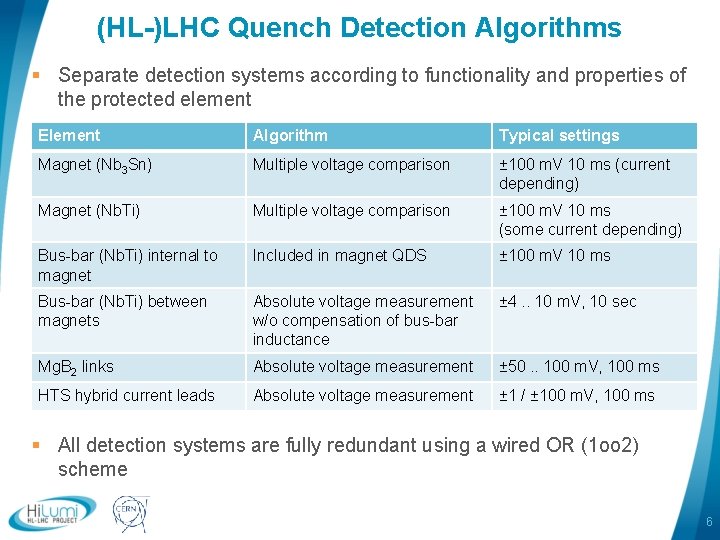
(HL-)LHC Quench Detection Algorithms § Separate detection systems according to functionality and properties of the protected element Element Algorithm Typical settings Magnet (Nb 3 Sn) Multiple voltage comparison ± 100 m. V 10 ms (current depending) Magnet (Nb. Ti) Multiple voltage comparison ± 100 m. V 10 ms (some current depending) Bus-bar (Nb. Ti) internal to magnet Included in magnet QDS ± 100 m. V 10 ms Bus-bar (Nb. Ti) between magnets Absolute voltage measurement w/o compensation of bus-bar inductance ± 4. . 10 m. V, 10 sec Mg. B 2 links Absolute voltage measurement ± 50. . 100 m. V, 100 ms HTS hybrid current leads Absolute voltage measurement ± 1 / ± 100 m. V, 100 ms § All detection systems are fully redundant using a wired OR (1 oo 2) scheme logo area 6
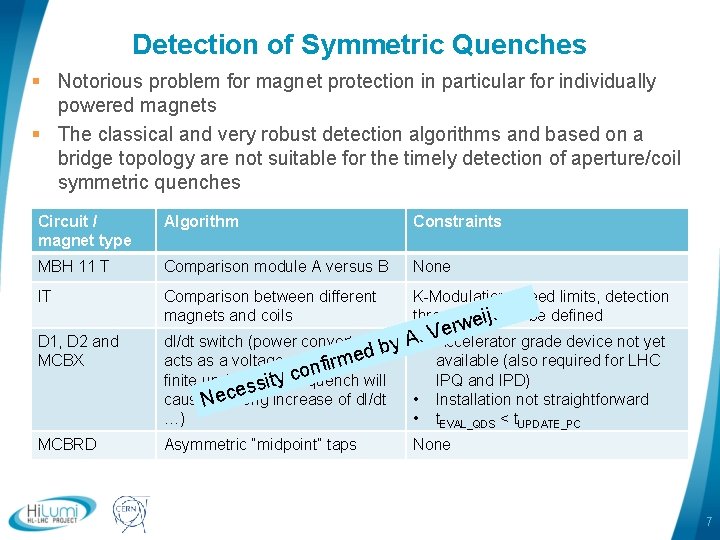
Detection of Symmetric Quenches § Notorious problem for magnet protection in particular for individually powered magnets § The classical and very robust detection algorithms and based on a bridge topology are not suitable for the timely detection of aperture/coil symmetric quenches Circuit / magnet type Algorithm Constraints MBH 11 T Comparison module A versus B None IT Comparison between different magnets and coils K-Modulation speed limits, detection thresholdestill ij. to be defined D 1, D 2 and MCBX MCBRD logo area erw V. y A • Accelerator grade device not yet d. I/dt switch (power converter b ed acts as a voltage source with m r i f n coquench y finite update rate will t i s s e c cause. Naestrong increase of d. I/dt …) • • Asymmetric “midpoint” taps None available (also required for LHC IPQ and IPD) Installation not straightforward t. EVAL_QDS < t. UPDATE_PC 7
HL-LHC Circuit Instrumentation § Circuit instrumentation is crucial for the proper functioning and performance of the quench detection system § Base-line for the definition of the quench detection logic § All voltage taps used for quench detection must be redundant § Circuit current is measured by redundant dedicated current sensors § Protection of Nb 3 Sn magnets requires current dependent detection settings § Instrumentation cables connect to patch boxes installed in the QDS racks § Patch box contains a special “ELQA port” avoiding the disconnection of instrumentation cables during ELQA tests logo area 8
HL-LHC QDS Instrumentation Baseline § Instrumentation must provide all information required for quench detection and diagnostic purposes § Requirements from beam physics e. g. implementation of feed back algorithms must be taken into account § Every pole of a magnet is instrumented § QDS system measures the voltage over each pole of a magnet using an isolated channel § Internal magnet bus-bars are covered by overlapping voltage taps for the poles § Bus-Bars between magnets and magnets to superconducting cable links are covered by dedicated, isolated channels logo area 9
HL-LHC QDS Instrumentation for Monitoring § QDS systems acquire as well the signals from the nonredundant instrumentation voltage taps for monitoring § Those channels can be configured (input voltage range, resolution, sampling rate …) with respect to the user (e. g. MP 3) requirements § QDS analog input channels offer a maximum sensitive input voltage range of ± 20 V § Fully sufficient for all quench detection purposes § In case an extended input voltage range is regarded as useful for analysis purposes additional channels for monitoring could be added § The use of voltage dividers for quench detection channels is not recommended (possible risk of “blind detector”) § LHC main circuits are equipped with earth voltage feelers § Might be useful to equip the HL-LHC triplet circuits as well logo area 10
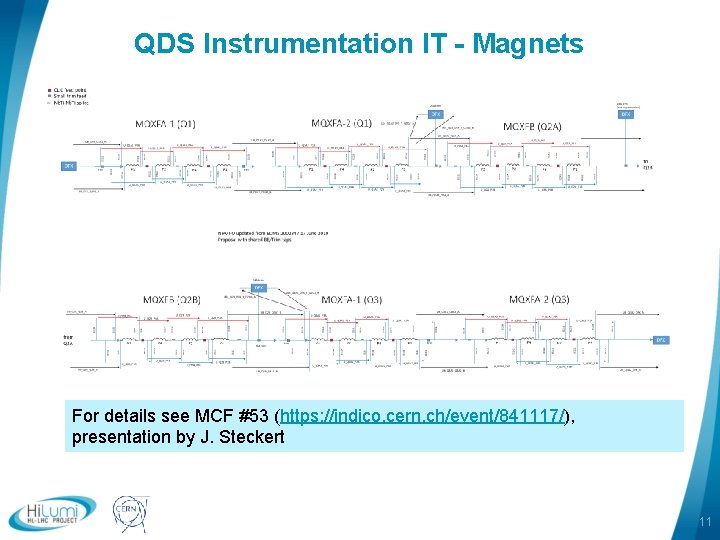
QDS Instrumentation IT - Magnets For details see MCF #53 (https: //indico. cern. ch/event/841117/), presentation by J. Steckert logo area 11
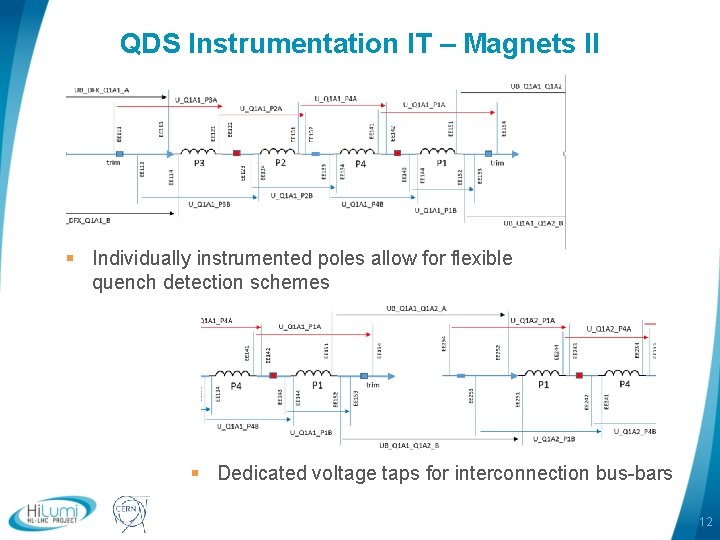
QDS Instrumentation IT – Magnets II § Individually instrumented poles allow for flexible quench detection schemes § Dedicated voltage taps for interconnection bus-bars logo area 12
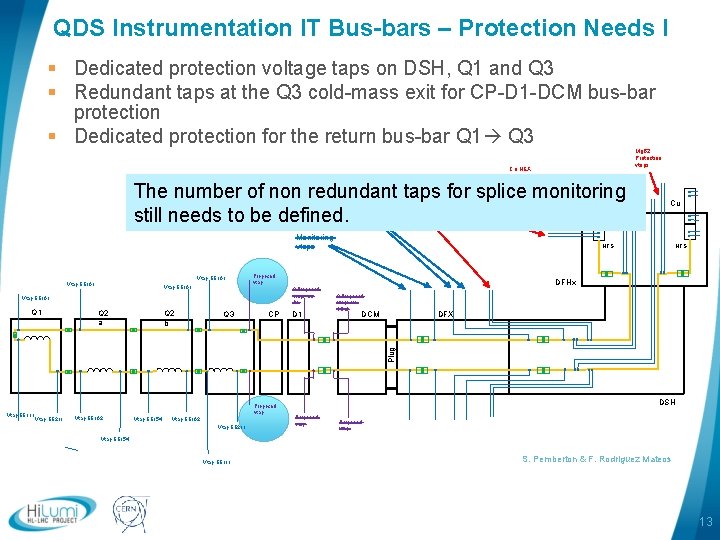
QDS Instrumentation IT Bus-bars – Protection Needs I § Dedicated protection voltage taps on DSH, Q 1 and Q 3 § Redundant taps at the Q 3 cold-mass exit for CP-D 1 -DCM bus-bar protection § Dedicated protection for the return bus-bar Q 1 Q 3 Mg. B 2 Protection vtaps Cu HEX Protection vtaps The number of non redundant taps for splice monitoring still needs to be defined. Nb-Ti/Mg. B 2 Monitoring vtaps Nb-Ti/Nb-Ti Monitoring vtaps Vtap EE 161 Q 2 a CP HTS DFHx 2 Proposed vtaps via D 1 Q 3 Cu D 1 2 Proposed vtaps via DCM DFX Plug Q 2 b Cu HTS Protection vtaps HTS Proposed vtap Vtap EE 161 Q 1 Protection vtaps Vtap EE 111 Proposed vtap Vtap EE 211 Vtap EE 162 Vtap EE 154 Vtap EE 162 Vtap EE 211 DSH Proposed vtap Vtap EE 154 Vtap EE 111 logo area S. Pemberton & F. Rodriguez Mateos 13
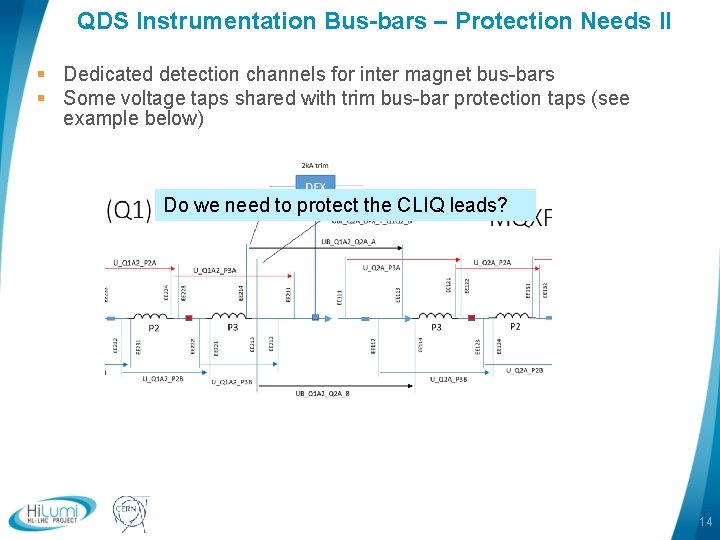
QDS Instrumentation Bus-bars – Protection Needs II § Dedicated detection channels for inter magnet bus-bars § Some voltage taps shared with trim bus-bar protection taps (see example below) Do we need to protect the CLIQ leads? logo area 14
QDS Instrumentation Bus-bars – General Considerations § The number of voltage taps required by QDS to assure protection of all superconducting is rather limited i. e. it is sufficient to cover both ends of the protected bus-bar elementfor (see slides). • The general scheme presented theprevious IT § The bus-bar resistance can be < 1 other nΩ precision bus-bar protection is measured also valid with for the using special powering cycles (pyramids) sufficient to identify bus-bar connections: a bad splice • CP DFX § Monitoring are. DFX nevertheless recommended to allow the • taps D 1 precise location of. Matching a possible. Section fault also • D 2 Linktaking into account that the access the cold mass might become • to MBRD Matching Section Linkdifficult during HLLHC operation. § If there are concerns about the quality or long-term evolution of bus-bar splices, monitoring taps should be foreseen. logo area 15
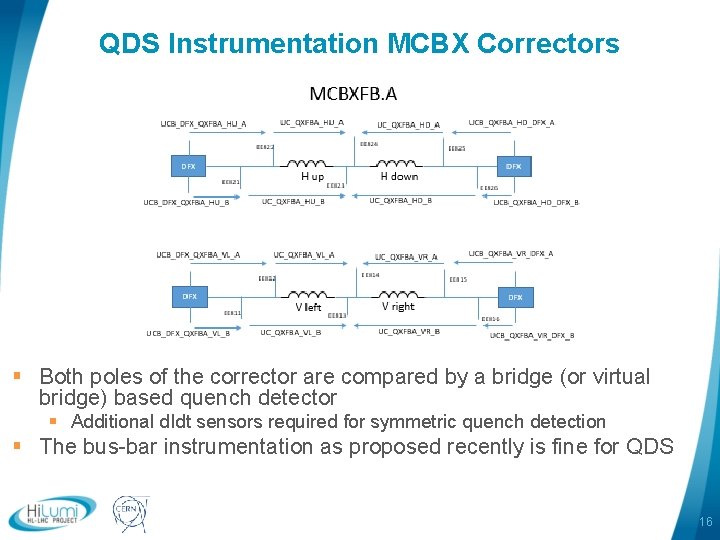
QDS Instrumentation MCBX Correctors § Both poles of the corrector are compared by a bridge (or virtual bridge) based quench detector § Additional d. Idt sensors required for symmetric quench detection § The bus-bar instrumentation as proposed recently is fine for QDS logo area 16
QDS Instrumentation IT Corrector package § Only the 200 A MQSXF circuit requires dedicated quench detection systems and energy extraction § In this case QDS will also take care of the 2 x 2 resistive current leads (similar approach as for the 11 T trim circuit) § Do we need to monitor/interlock the current balance in the leads (as for the 11 T trim circuit)? § The proposed instrumentation looks fine § Assuming that also this magnet may suffer from a symmetric quench one may consider additional d. Idt sensors logo area 17
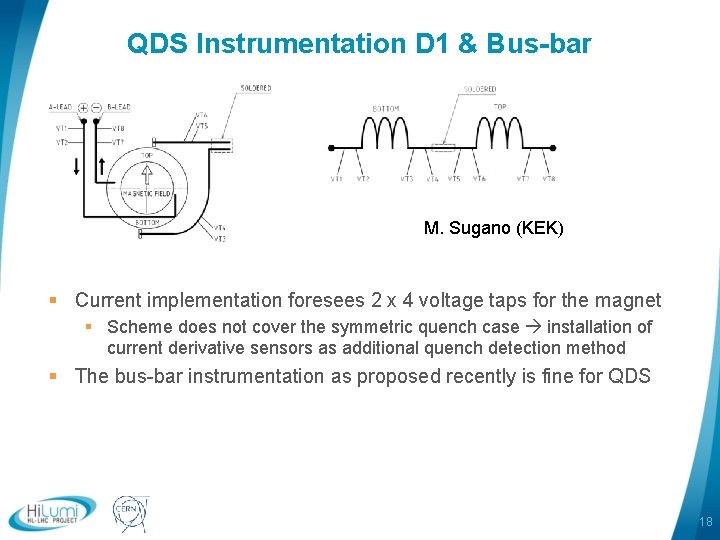
QDS Instrumentation D 1 & Bus-bar M. Sugano (KEK) § Current implementation foresees 2 x 4 voltage taps for the magnet § Scheme does not cover the symmetric quench case installation of current derivative sensors as additional quench detection method § The bus-bar instrumentation as proposed recently is fine for QDS logo area 18
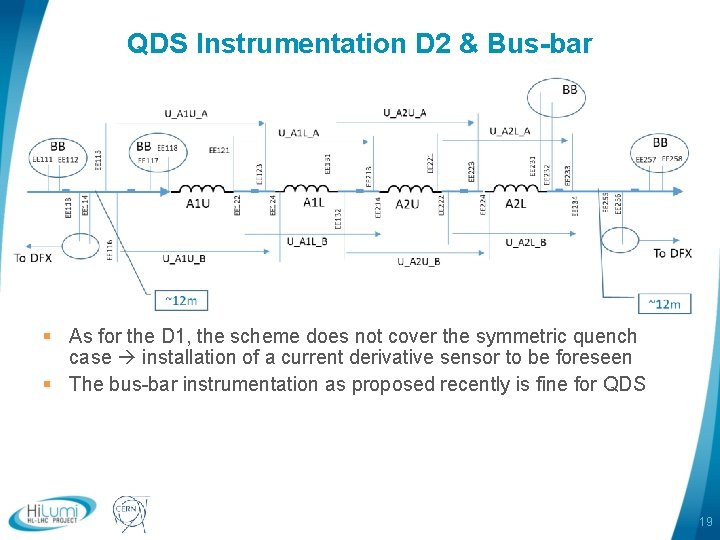
QDS Instrumentation D 2 & Bus-bar § As for the D 1, the scheme does not cover the symmetric quench case installation of a current derivative sensor to be foreseen § The bus-bar instrumentation as proposed recently is fine for QDS logo area 19
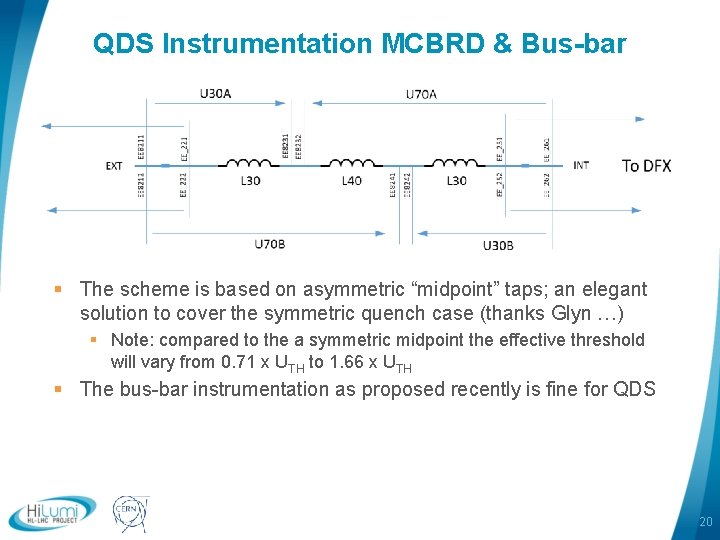
QDS Instrumentation MCBRD & Bus-bar § The scheme is based on asymmetric “midpoint” taps; an elegant solution to cover the symmetric quench case (thanks Glyn …) § Note: compared to the a symmetric midpoint the effective threshold will vary from 0. 71 x UTH to 1. 66 x UTH § The bus-bar instrumentation as proposed recently is fine for QDS logo area 20
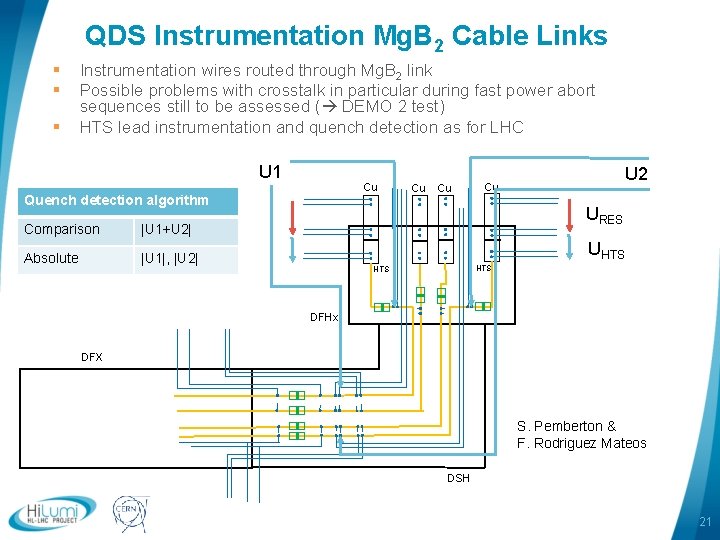
QDS Instrumentation Mg. B 2 Cable Links § § § Instrumentation wires routed through Mg. B 2 link Possible problems with crosstalk in particular during fast power abort sequences still to be assessed ( DEMO 2 test) HTS lead instrumentation and quench detection as for LHC U 1 Cu Quench detection algorithm Comparison |U 1+U 2| Absolute |U 1|, |U 2| Cu Cu U 2 Cu URES UHTS HTS DFHx DFX S. Pemberton & F. Rodriguez Mateos DSH logo area 21
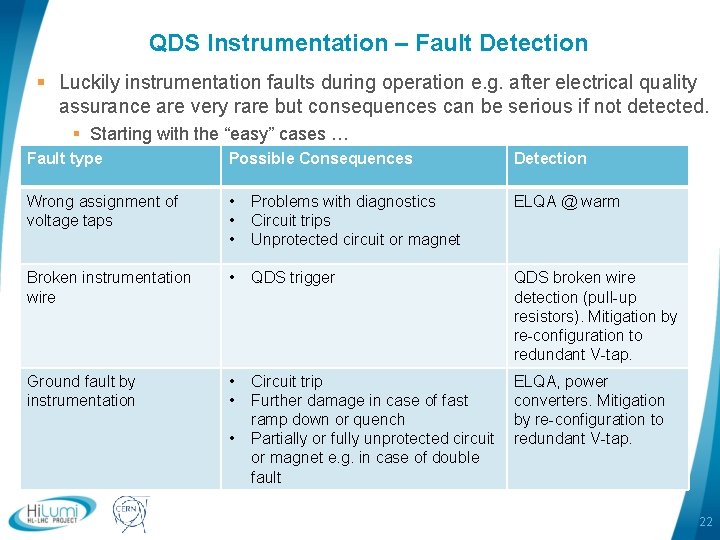
QDS Instrumentation – Fault Detection § Luckily instrumentation faults during operation e. g. after electrical quality assurance are very rare but consequences can be serious if not detected. § Starting with the “easy” cases … Fault type Possible Consequences Detection Wrong assignment of voltage taps • • • Problems with diagnostics Circuit trips Unprotected circuit or magnet ELQA @ warm Broken instrumentation wire • QDS trigger QDS broken wire detection (pull-up resistors). Mitigation by re-configuration to redundant V-tap. Ground fault by instrumentation • • Circuit trip Further damage in case of fast ramp down or quench Partially or fully unprotected circuit or magnet e. g. in case of double fault ELQA, power converters. Mitigation by re-configuration to redundant V-tap. • logo area 22
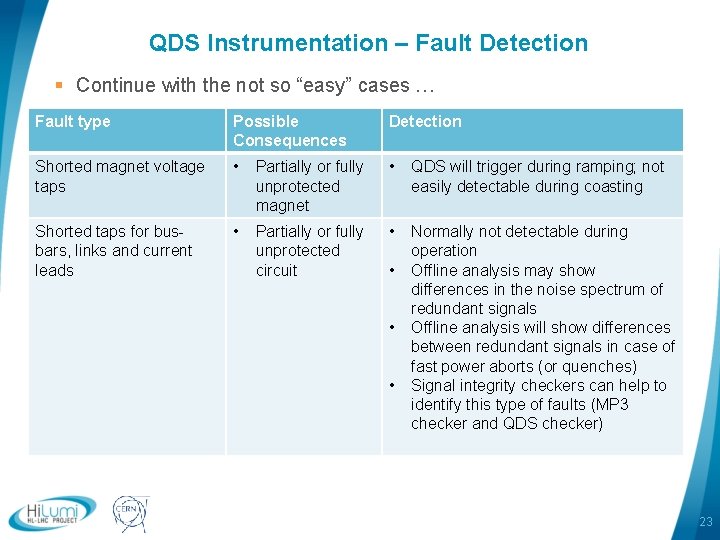
QDS Instrumentation – Fault Detection § Continue with the not so “easy” cases … Fault type Possible Consequences Detection Shorted magnet voltage taps • Partially or fully unprotected magnet • QDS will trigger during ramping; not easily detectable during coasting Shorted taps for busbars, links and current leads • Partially or fully unprotected circuit • Normally not detectable during operation Offline analysis may show differences in the noise spectrum of redundant signals Offline analysis will show differences between redundant signals in case of fast power aborts (or quenches) Signal integrity checkers can help to identify this type of faults (MP 3 checker and QDS checker) • • • logo area 23
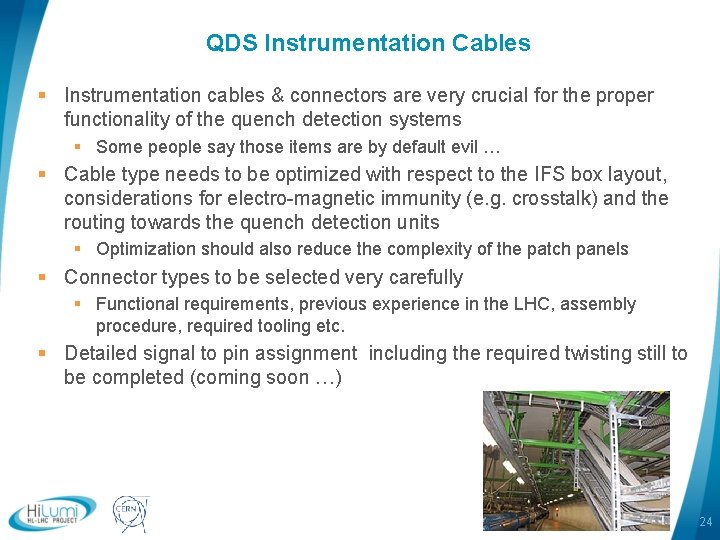
QDS Instrumentation Cables § Instrumentation cables & connectors are very crucial for the proper functionality of the quench detection systems § Some people say those items are by default evil … § Cable type needs to be optimized with respect to the IFS box layout, considerations for electro-magnetic immunity (e. g. crosstalk) and the routing towards the quench detection units § Optimization should also reduce the complexity of the patch panels § Connector types to be selected very carefully § Functional requirements, previous experience in the LHC, assembly procedure, required tooling etc. § Detailed signal to pin assignment including the required twisting still to be completed (coming soon …) logo area 24
Summary & Next Steps § HL-LHC circuit instrumentation is to a very large extent defined and expected to be finalized soon § HL-LHC circuit instrumentation is crucial for the proper functioning and performance of the quench detection system § Partially validated on the SM 18 magnet test benches with HL-LHC quench detection systems § Next steps are: § The final definition of the instrumentation cables and connectors, the pin assignment of the instrumentation cables, the definition of the patch panels … § Completion of the development of accelerator grade d. Idt switches required for symmetric quench detection logo area 25