
Queer Art Beyond Identity Politics About myself Tilen
Queer Art – Beyond Identity Politics

About myself Tilen Kolar University of Leeds 2 nd Year BA Economics and Geography Laidlaw Scholar Slovenia gy 18 tk@leeds. ac. uk +38631822440 Instagram: tilen_
Activity 1 Imagine you are a group of artists. Leeds City Council has commissioned you to design and situate a monument dedicated to the queer community. Using modelling clay and maps, try to design and situ such a monument.
Capitalism and LGBT+ Identity Politics Human Capital Theory Promise of the authentic self at the point of consumption Inequalities within the LGBT+ community Dominance of middle-class white gay men Gentrification of LGBT+ spaces – is it unqueer?
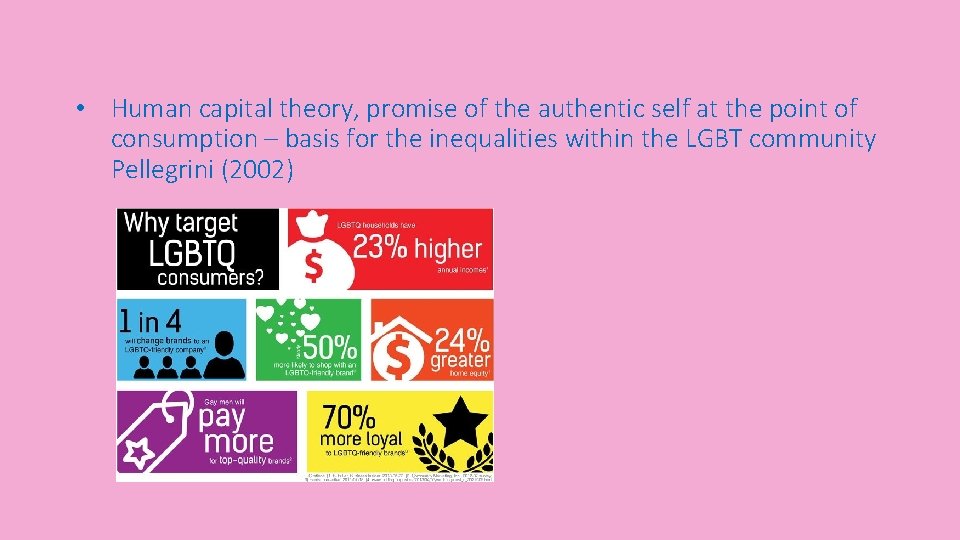
• Human capital theory, promise of the authentic self at the point of consumption – basis for the inequalities within the LGBT community Pellegrini (2002)


Gentrification of LGBT+ spaces and the dominance of white middle-class gay men (Mitchell, 2000)
In the US, in 2012, more than 70% of victims of violence against sexual and gender minorities were people of colour. (Giovanniello, 2013) Johnston (2017) observed that especially black queer and black trans find it uncomfortable to participate in Pride Parades
Participatory Queer Art as a Solution? Public art – spaces of agony (Mouffe, 2007) Positive effects on the LGBT+ community observed by Orangias et al (2018) Vital materiality? (Bennett, 2010)

My Research
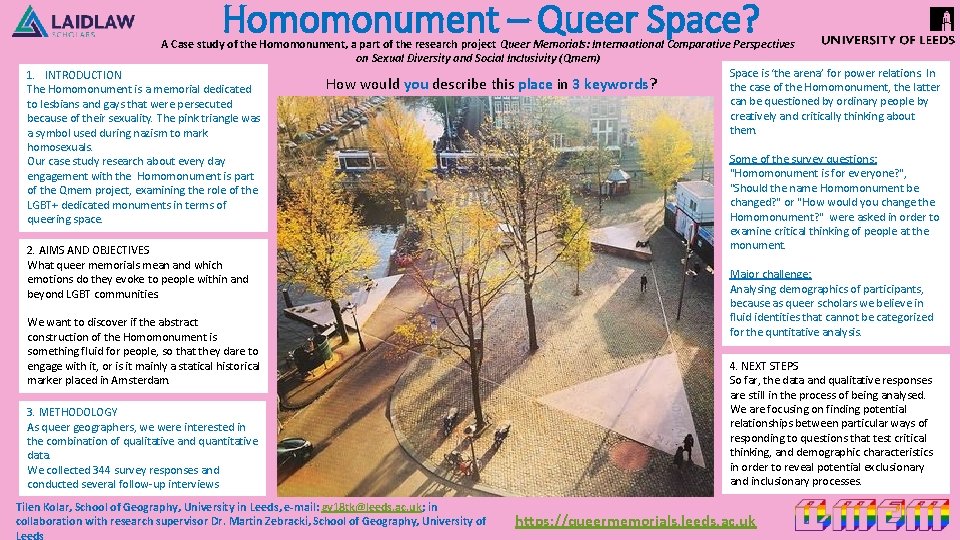
Homomonument – Queer Space? A Case study of the Homomonument, a part of the research project Queer Memorials: Internaational Comparative Perspectives on Sexual Diversity and Social Inclusivity (Qmem) Space is ‘the arena’ for power relations. In 1. INTRODUCTION How would you describe this place in 3 keywords? the case of the Homomonument, the latter The Homomonument is a memorial dedicated can be questioned by ordinary people by to lesbians and gays that were persecuted creatively and critically thinking about because of their sexuality. The pink triangle was them. a symbol used during nazism to mark homosexuals. Some of the survey questions: Our case study research about every day "Homomonument is for everyone? ", engagement with the Homomonument is part "Should the name Homomonument be of the Qmem project, examining the role of the changed? " or "How would you change the LGBT+ dedicated monuments in terms of Homomonument? " were asked in order to queering space. examine critical thinking of people at the monument. 2. AIMS AND OBJECTIVES What queer memorials mean and which emotions do they evoke to people within and beyond LGBT communities. We want to discover if the abstract construction of the Homomonument is something fluid for people, so that they dare to engage with it, or is it mainly a statical historical marker placed in Amsterdam. 3. METHODOLOGY As queer geographers, we were interested in the combination of qualitative and quantitative data. We collected 344 survey responses and conducted several follow-up interviews Tilen Kolar, School of Geography, University in Leeds, e-mail: gy 18 tk@leeds. ac. uk; in collaboration with research supervisor Dr. Martin Zebracki, School of Geography, University of Leeds Major challenge: Analysing demographics of participants, because as queer scholars we believe in fluid identities that cannot be categorized for the quntitative analysis. 4. NEXT STEPS So far, the data and qualitative responses are still in the process of being analysed. We are focusing on finding potential relationships between particular ways of responding to questions that test critical thinking, and demographic characteristics in order to reveal potential exclusionary and inclusionary processes. https: //queermemorials. leeds. ac. uk

https: //vimeo. com/347626414
Reference list • Pellegrini, A. 2002. Consuming Lifestyle: Commodity Capitalism and Transformations in Gay Identity. In: Cruz-Malave, A. , Manalansan, M. eds. Queer Globalizations: Citizenship and the Afterlife of Colonialism. New York: New York University Press, pp. 134 -149. • Mitchell, D. 2000. Sex and Sexuality: The cultural politics and political geography of liberation. In: Mitchell, D, Cultural Geography: A Critical Introduction. pp. 171 -198. Oxford: Blackwell • Bennett, J. 2010. Vibrant Matter: a political ecology of things. Durham: Duke University Press.
- Slides: 13