
Queen Killer Queen from the album Sheer Heart
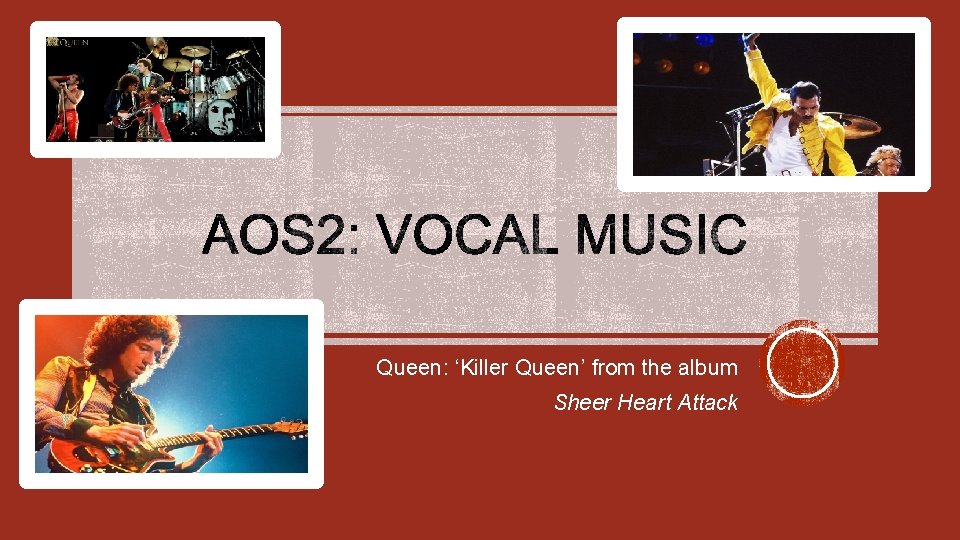
Queen: ‘Killer Queen’ from the album Sheer Heart Attack
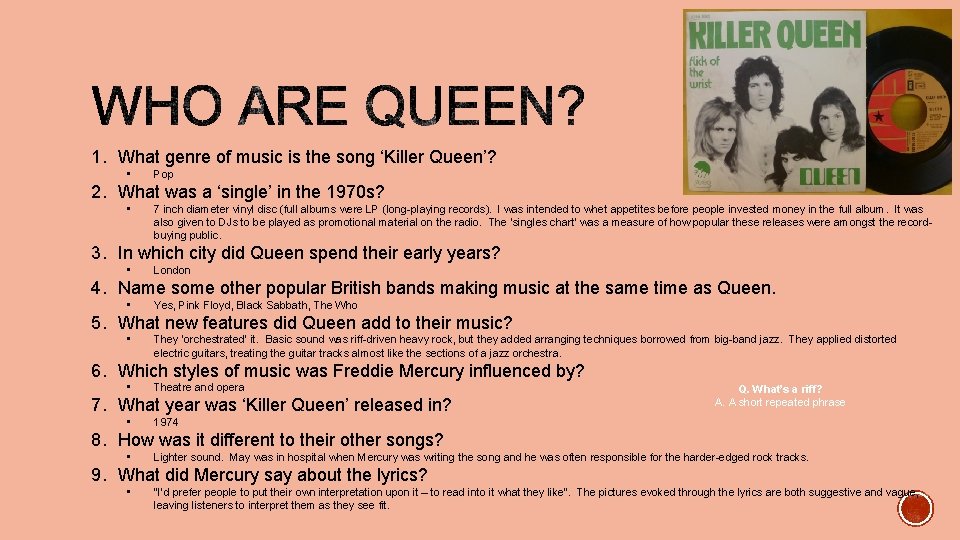
1. What genre of music is the song ‘Killer Queen’? • Pop 2. What was a ‘single’ in the 1970 s? • 7 inch diameter vinyl disc (full albums were LP (long-playing records). I was intended to whet appetites before people invested money in the full album. It was also given to DJs to be played as promotional material on the radio. The ‘singles chart’ was a measure of how popular these releases were amongst the recordbuying public. 3. In which city did Queen spend their early years? • London 4. Name some other popular British bands making music at the same time as Queen. • Yes, Pink Floyd, Black Sabbath, The Who 5. What new features did Queen add to their music? • They ‘orchestrated’ it. Basic sound was riff-driven heavy rock, but they added arranging techniques borrowed from big-band jazz. They applied distorted electric guitars, treating the guitar tracks almost like the sections of a jazz orchestra. 6. Which styles of music was Freddie Mercury influenced by? • Theatre and opera 7. What year was ‘Killer Queen’ released in? • Q. What’s a riff? A. A short repeated phrase 1974 8. How was it different to their other songs? • Lighter sound. May was in hospital when Mercury was writing the song and he was often responsible for the harder-edged rock tracks. 9. What did Mercury say about the lyrics? • “I’d prefer people to put their own interpretation upon it – to read into it what they like”. The pictures evoked through the lyrics are both suggestive and vague, leaving listeners to interpret them as they see fit.
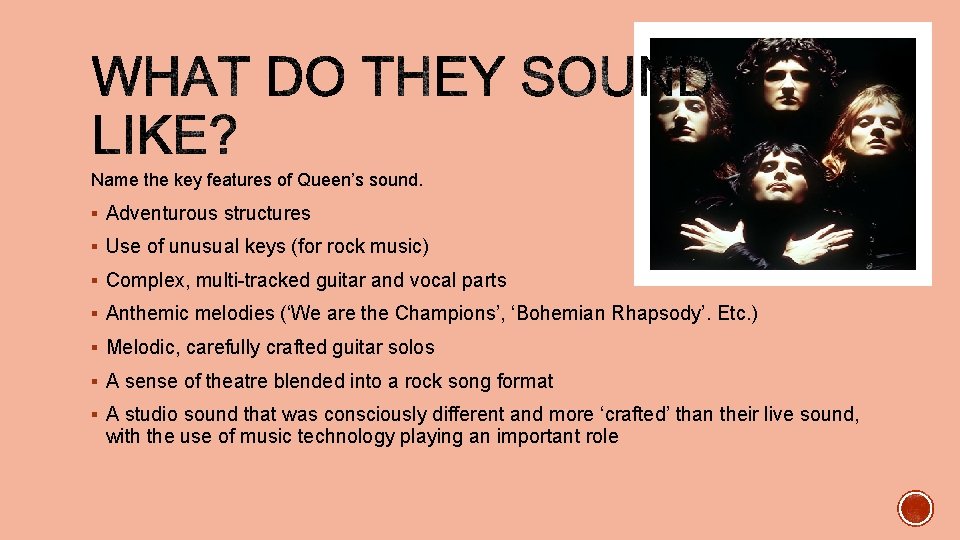
Name the key features of Queen’s sound. § Adventurous structures § Use of unusual keys (for rock music) § Complex, multi-tracked guitar and vocal parts § Anthemic melodies (‘We are the Champions’, ‘Bohemian Rhapsody’. Etc. ) § Melodic, carefully crafted guitar solos § A sense of theatre blended into a rock song format § A studio sound that was consciously different and more ‘crafted’ than their live sound, with the use of music technology playing an important role
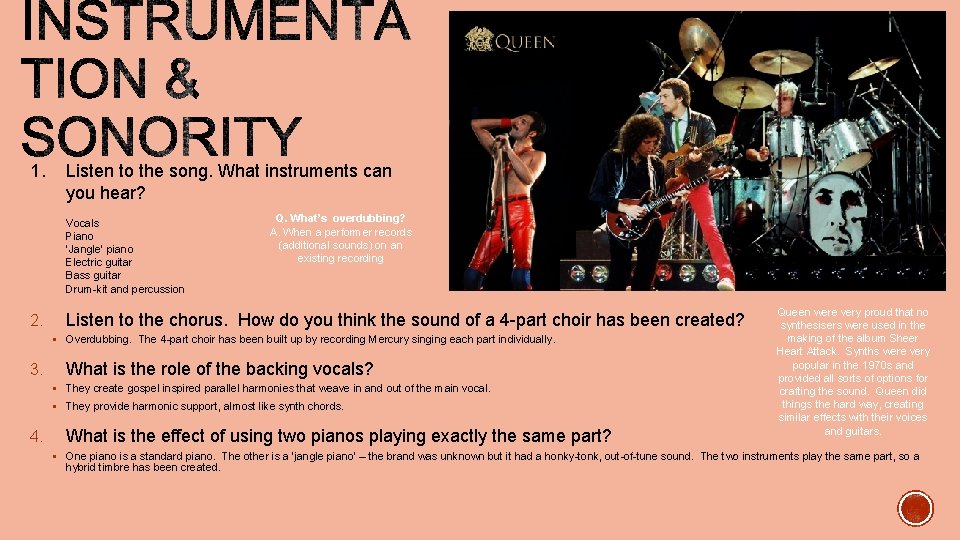
1. Listen to the song. What instruments can you hear? Vocals Piano ‘Jangle’ piano Electric guitar Bass guitar Drum-kit and percussion Q. What’s overdubbing? A. When a performer records (additional sounds) on an existing recording Listen to the chorus. How do you think the sound of a 4 -part choir has been created? 2. § Overdubbing. The 4 -part choir has been built up by recording Mercury singing each part individually. What is the role of the backing vocals? 3. § They create gospel inspired parallel harmonies that weave in and out of the main vocal. § They provide harmonic support, almost like synth chords. What is the effect of using two pianos playing exactly the same part? 4. § Queen were very proud that no synthesisers were used in the making of the album Sheer Heart Attack. Synths were very popular in the 1970 s and provided all sorts of options for crafting the sound. Queen did things the hard way, creating similar effects with their voices and guitars. One piano is a standard piano. The other is a ‘jangle piano’ – the brand was unknown but it had a honky-tonk, out-of-tune sound. The two instruments play the same part, so a hybrid timbre has been created.
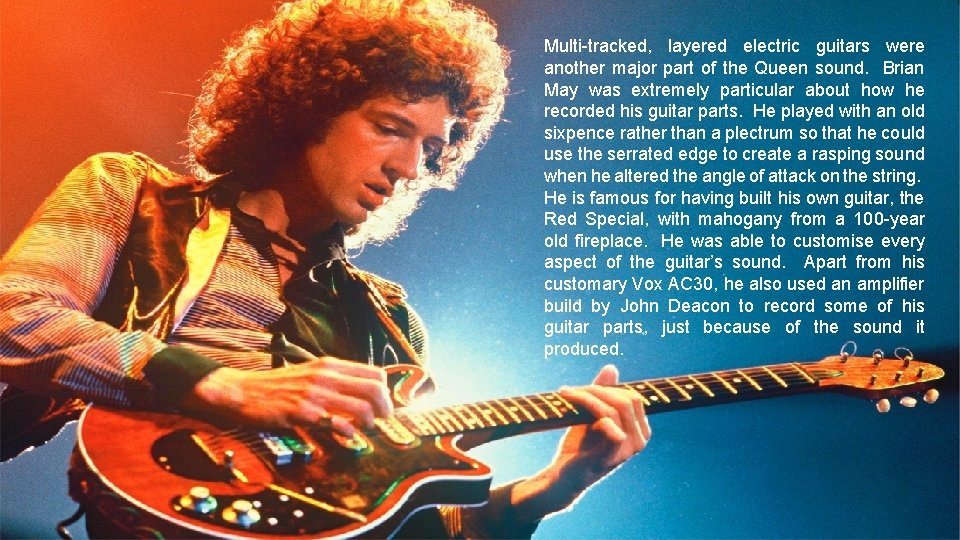
Multi-tracked, layered electric guitars were another major part of the Queen sound. Brian May was extremely particular about how he recorded his guitar parts. He played with an old sixpence rather than a plectrum so that he could use the serrated edge to create a rasping sound when he altered the angle of attack on the string. He is famous for having built his own guitar, the Red Special, with mahogany from a 100 -year old fireplace. He was able to customise every aspect of the guitar’s sound. Apart from his customary Vox AC 30, he also used an amplifier build by John Deacon to record some of his guitar parts, just because of the sound it produced.
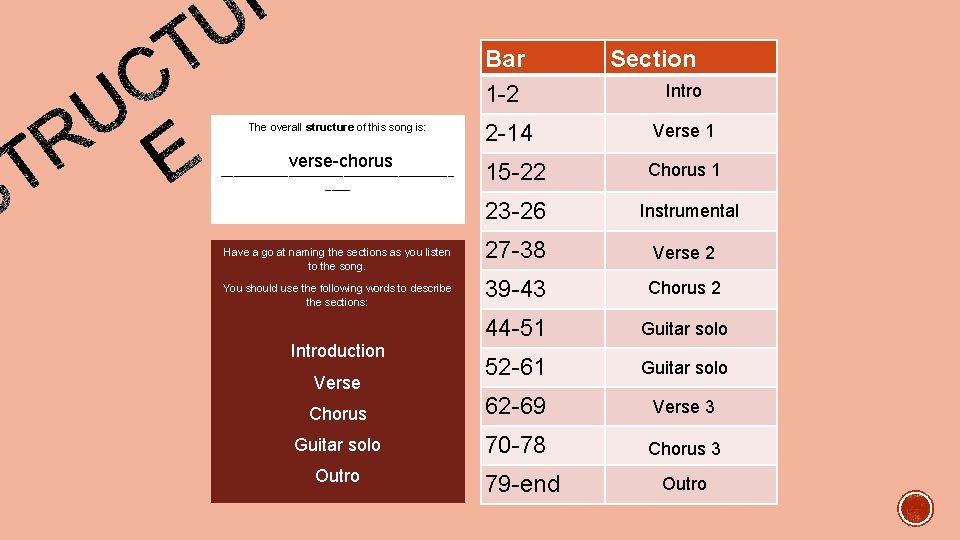
The overall structure of this song is: verse-chorus ___________________ Have a go at naming the sections as you listen to the song. You should use the following words to describe the sections: Introduction Verse Chorus Guitar solo Outro Bar 1 -2 Section 2 -14 15 -22 23 -26 27 -38 39 -43 44 -51 52 -61 62 -69 70 -78 79 -end Intro Verse 1 Chorus 1 Instrumental Verse 2 Chorus 2 Guitar solo Verse 3 Chorus 3 Outro
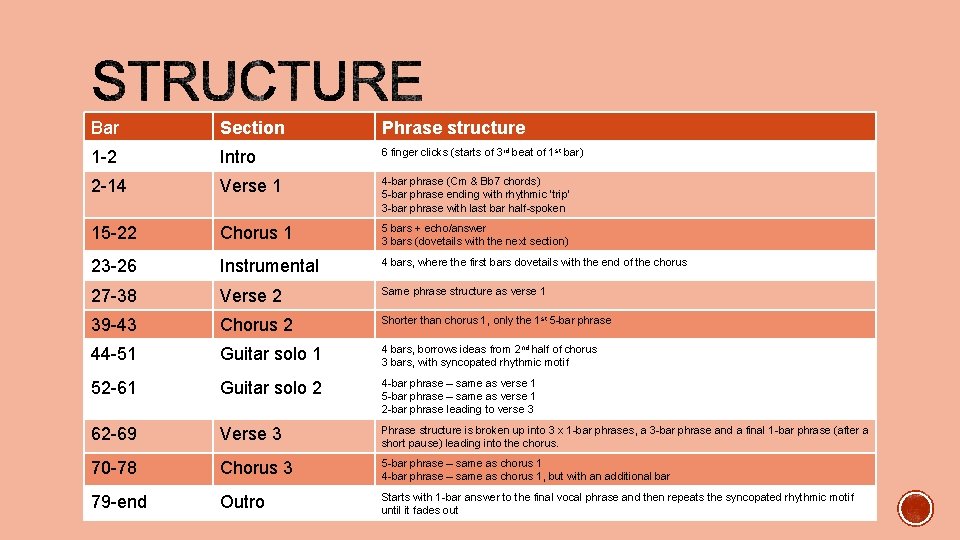
Bar Section Phrase structure 1 -2 Intro 6 finger clicks (starts of 3 rd beat of 1 st bar) 2 -14 Verse 1 4 -bar phrase (Cm & Bb 7 chords) 5 -bar phrase ending with rhythmic ‘trip’ 3 -bar phrase with last bar half-spoken 15 -22 Chorus 1 5 bars + echo/answer 3 bars (dovetails with the next section) 23 -26 Instrumental 4 bars, where the first bars dovetails with the end of the chorus 27 -38 Verse 2 Same phrase structure as verse 1 39 -43 Chorus 2 Shorter than chorus 1, only the 1 st 5 -bar phrase 44 -51 Guitar solo 1 4 bars, borrows ideas from 2 nd half of chorus 3 bars, with syncopated rhythmic motif 52 -61 Guitar solo 2 4 -bar phrase – same as verse 1 5 -bar phrase – same as verse 1 2 -bar phrase leading to verse 3 62 -69 Verse 3 Phrase structure is broken up into 3 x 1 -bar phrases, a 3 -bar phrase and a final 1 -bar phrase (after a short pause) leading into the chorus. 70 -78 Chorus 3 5 -bar phrase – same as chorus 1 4 -bar phrase – same as chorus 1, but with an additional bar 79 -end Outro Starts with 1 -bar answer to the final vocal phrase and then repeats the syncopated rhythmic motif until it fades out
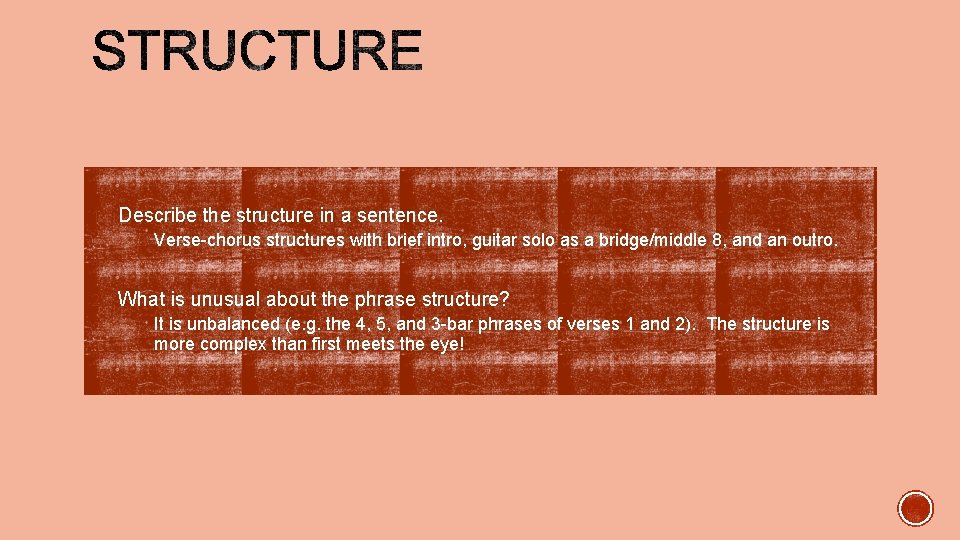
1. Describe the structure in a sentence. • Verse-chorus structures with brief intro, guitar solo as a bridge/middle 8, and an outro. 2. What is unusual about the phrase structure? • It is unbalanced (e. g. the 4, 5, and 3 -bar phrases of verses 1 and 2). The structure is more complex than first meets the eye!
Listen to the guitar parts in bars 70 -73 and 55 -61. What effect has been used here? 1. § Overdubbing three parts to create a harmonised melodic line. Bars 70 -73 sound like a saxophone section in a big band. What is the role of the bass guitar part? 2. § Harmonic support § The Fender bass has a warm, round sound. The amp has been customised. What is the role of the drum-kit? 3. § § § Keeps time with one hit per beat alternating between the bass and snare drums. Adds colour with cymbal and snare rolls (e. g. beginning of verse 2) Emphasises important rhythmic motifs (bars 47 -50) Just hi-hat at points (bars 51 -52) Dynamic contrast created by altering use of hi-hat between verse and chorus. Tasteful fills and use of cymbals.
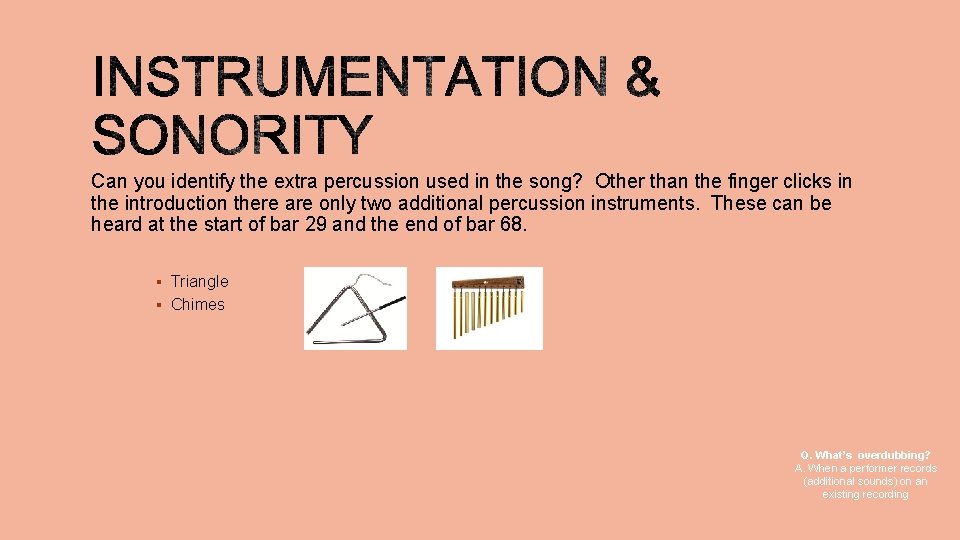
Can you identify the extra percussion used in the song? Other than the finger clicks in the introduction there are only two additional percussion instruments. These can be heard at the start of bar 29 and the end of bar 68. § Triangle § Chimes Q. What’s overdubbing? A. When a performer records (additional sounds) on an existing recording
1. What is the time signature? § 12/8 § Compound quadruple 2. What is the tempo marking? § 112 crotchet beats per minute (moderate tempo) 3. Syncopation is an important rhythmic feature of this piece. There are two important syncopated motifs. Can you find them? § Bar 47 -50 (LH piano) § also heard end of bar 23, end of bar 25 § Bar 6 (vocal line) “Just like Marie Antoinette” § Developed on “built a remedy” with an anacrusis on ‘a’ and slight change to 2 nd beat § Bar 44 -46 (guitar solo), also uses string bends, slides, vibrato and staccato
1. Is the vocal line mostly melismatic or syllabic? § Syllabic 2. Describe the melodic shape of the first phrase of verse 1. § Starts lower in pitch and ascends (over the 4 bars) 3. Name the musical device used on the words “recommended at the price” (bar 20) and “(in)satiable an appetite” (bar 21) § Descending sequence 4. Describe the pitch range of the guitar in the solo. § Uses very high tessitura (see the ledger lines and 8 va symbol on the score) 5. Sometimes the vocal line has an ‘x’ printed as the note-head. What does this mean? § The words are almost spoken, rather than sung, at an undefined pitch.
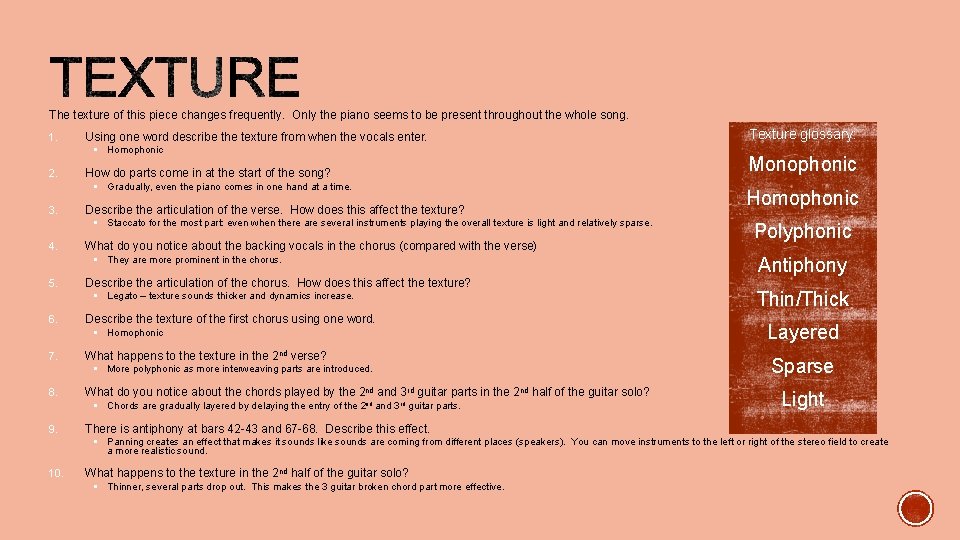
The texture of this piece changes frequently. Only the piano seems to be present throughout the whole song. 1. Using one word describe the texture from when the vocals enter. § 2. How do parts come in at the start of the song? § 3. Chords are gradually layered by delaying the entry of the 2 nd and 3 rd guitar parts. Monophonic Homophonic Polyphonic Antiphony Thin/Thick Layered Sparse Light There is antiphony at bars 42 -43 and 67 -68. Describe this effect. § 10. More polyphonic as more interweaving parts are introduced. What do you notice about the chords played by the 2 nd and 3 rd guitar parts in the 2 nd half of the guitar solo? § 9. Homophonic What happens to the texture in the 2 nd verse? § 8. Legato – texture sounds thicker and dynamics increase. Describe the texture of the first chorus using one word. § 7. They are more prominent in the chorus. Describe the articulation of the chorus. How does this affect the texture? § 6. Staccato for the most part: even when there are several instruments playing the overall texture is light and relatively sparse. What do you notice about the backing vocals in the chorus (compared with the verse) § 5. Gradually, even the piano comes in one hand at a time. Describe the articulation of the verse. How does this affect the texture? § 4. Homophonic Texture glossary: Panning creates an effect that makes it sounds like sounds are coming from different places (speakers). You can move instruments to the left or right of the stereo field to create a more realistic sound. What happens to the texture in the 2 nd half of the guitar solo? § Thinner, several parts drop out. This makes the 3 guitar broken chord part more effective.
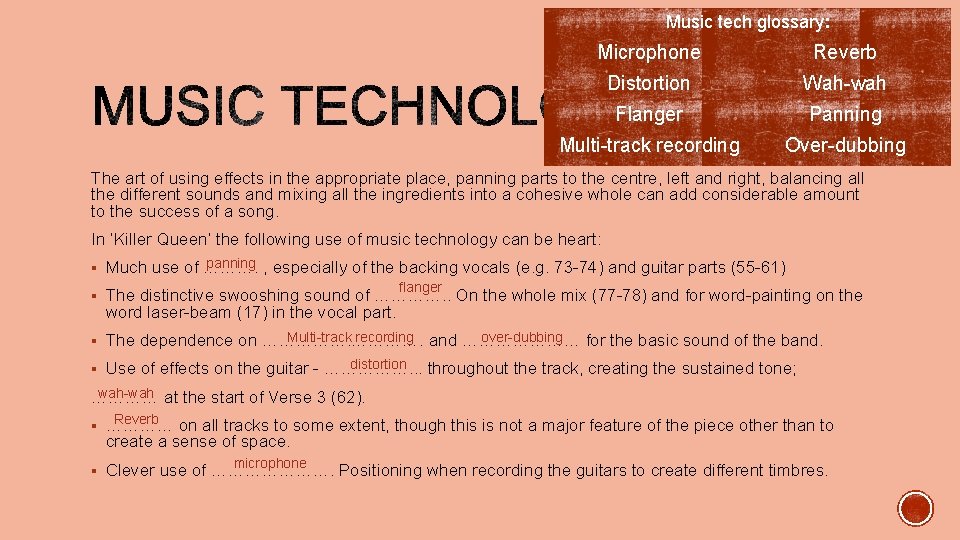
Music tech glossary: Microphone Reverb Distortion Wah-wah Flanger Panning Multi-track recording Over-dubbing The art of using effects in the appropriate place, panning parts to the centre, left and right, balancing all the different sounds and mixing all the ingredients into a cohesive whole can add considerable amount to the success of a song. In ‘Killer Queen’ the following use of music technology can be heart: panning § Much use of ………. , especially of the backing vocals (e. g. 73 -74) and guitar parts (55 -61) flanger § The distinctive swooshing sound of …………. . On the whole mix (77 -78) and for word-painting on the word laser-beam (17) in the vocal part. over-dubbing Multi-track recording § The dependence on ……………. and ………………… for the basic sound of the band. distortion § Use of effects on the guitar - ……………. . . throughout the track, creating the sustained tone; wah-wah ………… at the start of Verse 3 (62). Reverb § ………… on all tracks to some extent, though this is not a major feature of the piece other than to create a sense of space. microphone § Clever use of …………………. Positioning when recording the guitars to create different timbres.
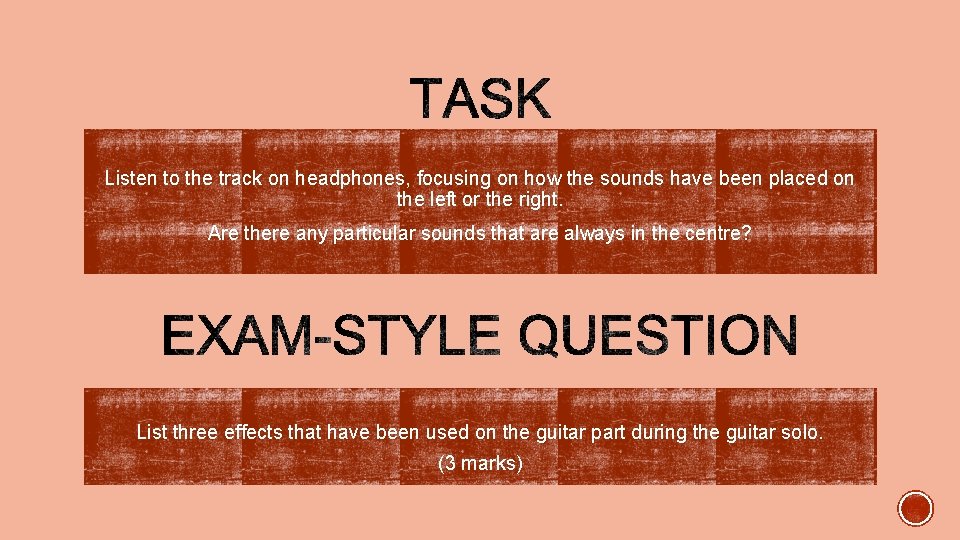
Listen to the track on headphones, focusing on how the sounds have been placed on the left or the right. Are there any particular sounds that are always in the centre? List three effects that have been used on the guitar part during the guitar solo. (3 marks)
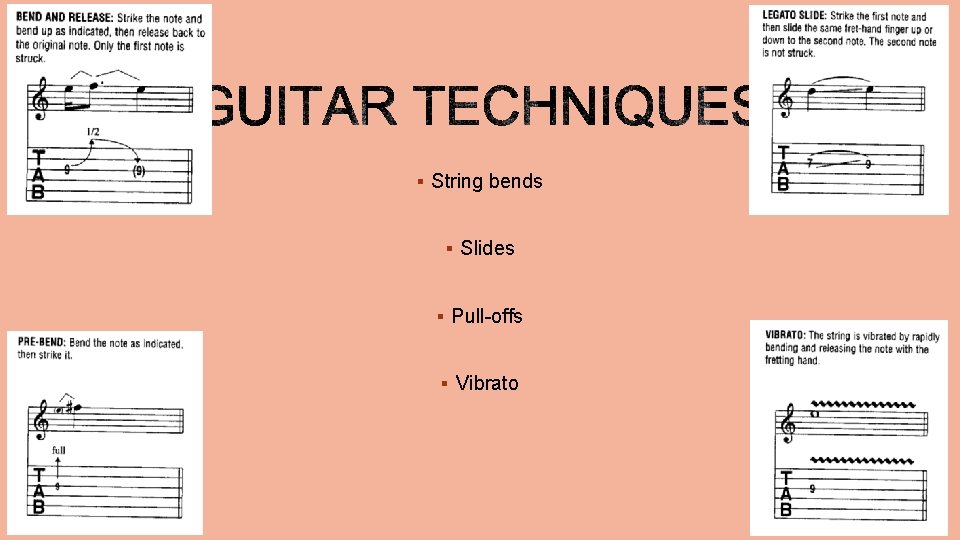
§ String bends § Slides § Pull-offs § Vibrato
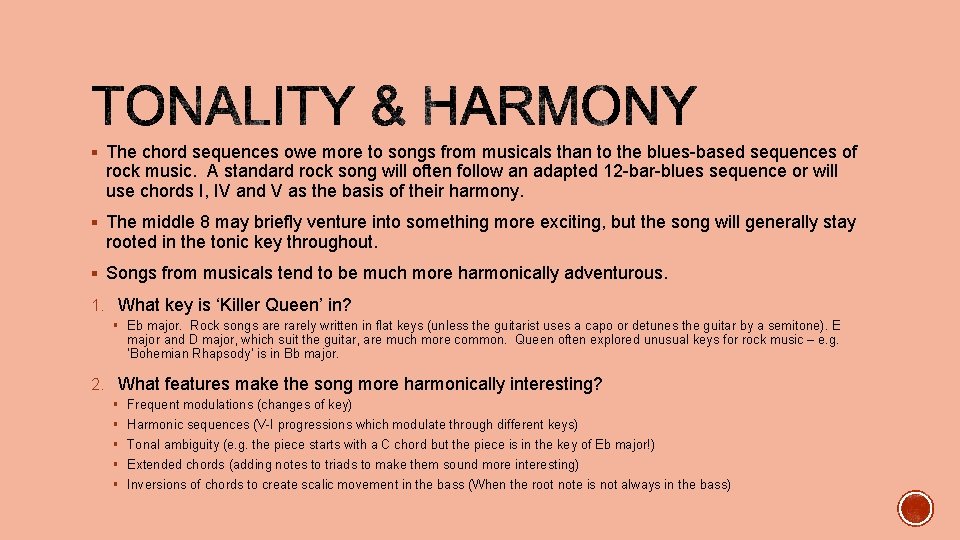
§ The chord sequences owe more to songs from musicals than to the blues-based sequences of rock music. A standard rock song will often follow an adapted 12 -bar-blues sequence or will use chords I, IV and V as the basis of their harmony. § The middle 8 may briefly venture into something more exciting, but the song will generally stay rooted in the tonic key throughout. § Songs from musicals tend to be much more harmonically adventurous. 1. What key is ‘Killer Queen’ in? § Eb major. Rock songs are rarely written in flat keys (unless the guitarist uses a capo or detunes the guitar by a semitone). E major and D major, which suit the guitar, are much more common. Queen often explored unusual keys for rock music – e. g. ‘Bohemian Rhapsody’ is in Bb major. 2. What features make the song more harmonically interesting? § Frequent modulations (changes of key) § Harmonic sequences (V-I progressions which modulate through different keys) § Tonal ambiguity (e. g. the piece starts with a C chord but the piece is in the key of Eb major!) § Extended chords (adding notes to triads to make them sound more interesting) § Inversions of chords to create scalic movement in the bass (When the root note is not always in the bass)
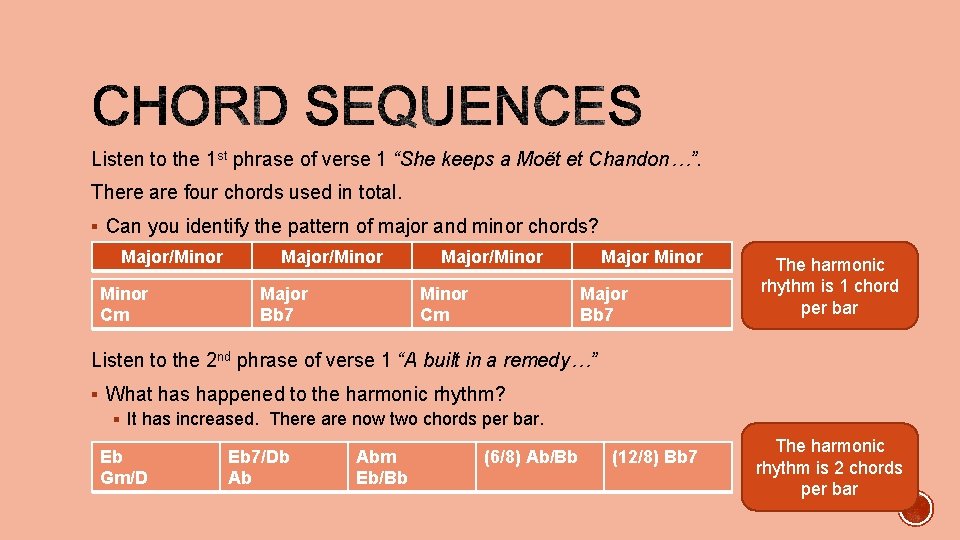
Listen to the 1 st phrase of verse 1 “She keeps a Moët et Chandon…”. There are four chords used in total. § Can you identify the pattern of major and minor chords? Major/Minor Cm Major/Minor Major Bb 7 Major/Minor Cm Major Minor Major Bb 7 The harmonic rhythm is 1 chord per bar Listen to the 2 nd phrase of verse 1 “A built in a remedy…” § What has happened to the harmonic rhythm? § It has increased. There are now two chords per bar. Eb Gm/D Eb 7/Db Ab Abm Eb/Bb (6/8) Ab/Bb (12/8) Bb 7 The harmonic rhythm is 2 chords per bar
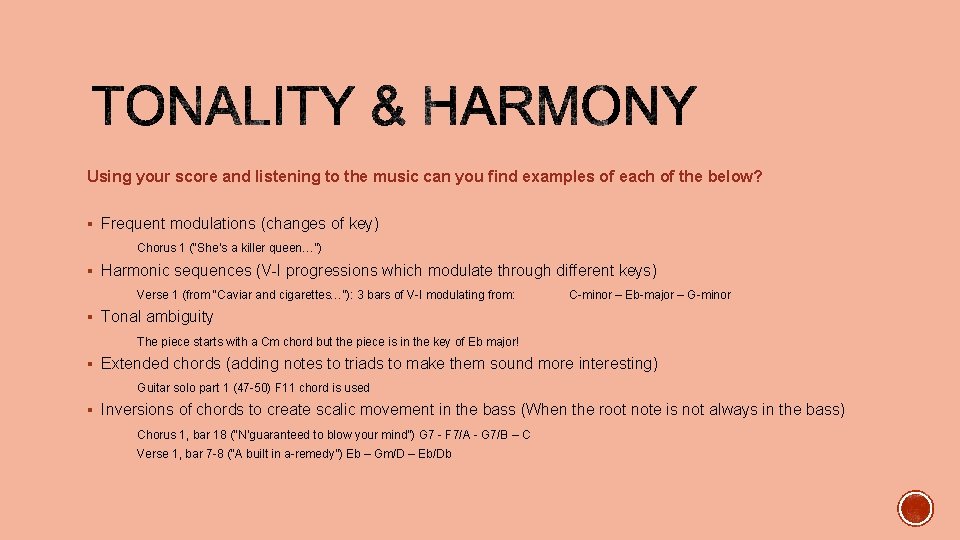
Using your score and listening to the music can you find examples of each of the below? § Frequent modulations (changes of key) Chorus 1 (“She’s a killer queen…”) § Harmonic sequences (V-I progressions which modulate through different keys) Verse 1 (from “Caviar and cigarettes…”): 3 bars of V-I modulating from: C-minor – Eb-major – G-minor § Tonal ambiguity The piece starts with a Cm chord but the piece is in the key of Eb major! § Extended chords (adding notes to triads to make them sound more interesting) Guitar solo part 1 (47 -50) F 11 chord is used § Inversions of chords to create scalic movement in the bass (When the root note is not always in the bass) Chorus 1, bar 18 (“N’guaranteed to blow your mind”) G 7 - F 7/A - G 7/B – C Verse 1, bar 7 -8 (“A built in a-remedy”) Eb – Gm/D – Eb/Db
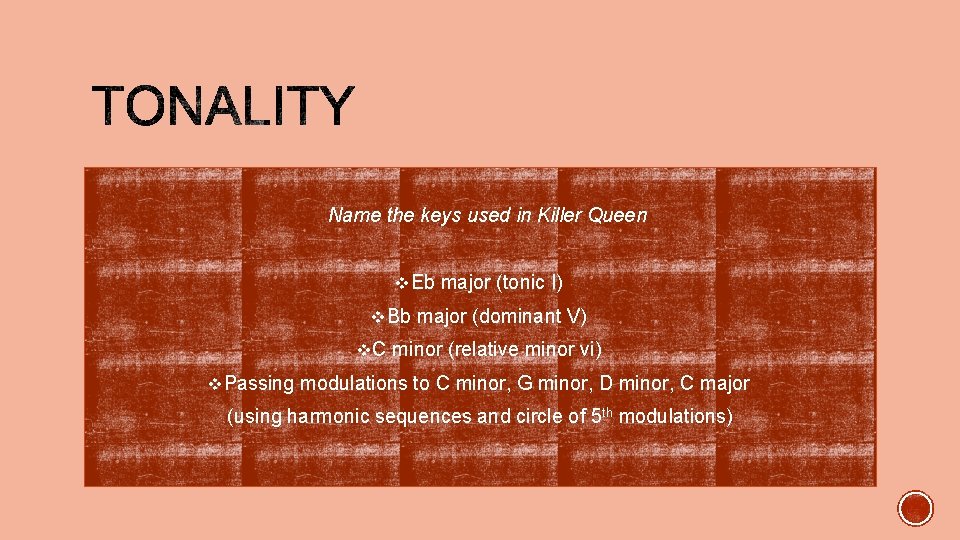
§ Name the keys used in Killer Queen v. Eb major (tonic I) v. Bb major (dominant V) v. C minor (relative minor vi) v. Passing modulations to C minor, G minor, D minor, C major (using harmonic sequences and circle of 5 th modulations)
Name the harmonic devices used in Killer Queen v. Harmonic sequences (e. g. 12 -13) v. Circle of fifths modulations (e. g. 20 -21) v. Pedal notes (e. g. 23 -24, 27 -30) v. Extended chords (e. g. 23 -24)
1. Listen for the difference in harmonic rhythm from the 1 st 4 -bars of the verse onwards. What effect does this have? What effect does it have when the chords start changing on every beat (e. g. bar 18)? 2. Listen to the circle of 5 ths sequence in bars 20 -21. Do you think you would recognise this sequence if you heard it in an unfamiliar piece of music? 3. Do you think the ending is effective when the song returns to Eb-major at the end? What words would you use to describe the key change here?
§ Create a table with two headings: ‘heavy rock’ and ‘songs from musicals’. List the elements of ‘Killer Queen’ under the appropriate heading. § Write out the overall structure of ‘Killer Queen’ using fewer than 30 words. § Where is a ‘circle of fifths’ chord sequence used in ‘Killer Queen’? § Describe how the use of music technology has enhanced this song. § What are the key elements of ‘Killer Queen’ that reflect Mercury’s love of theatrical?
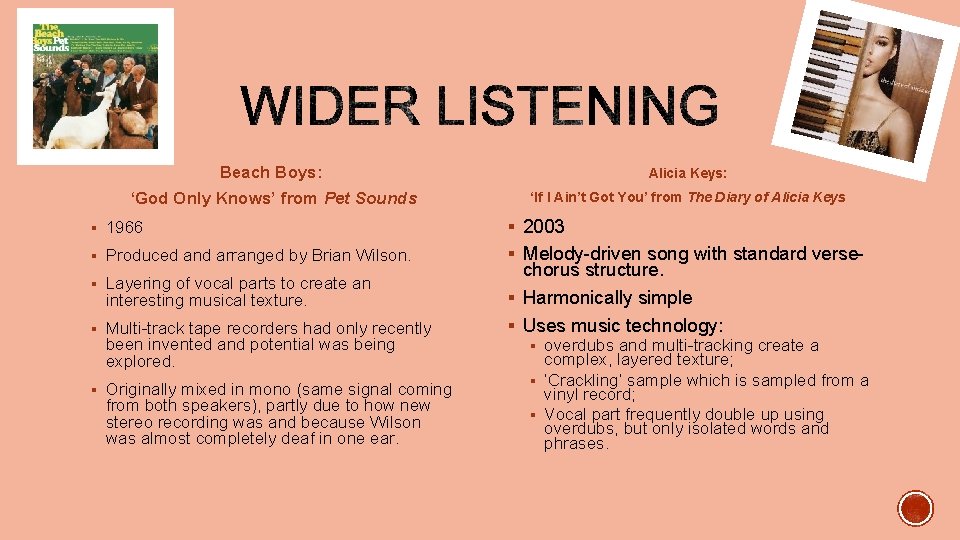
Beach Boys: Alicia Keys: ‘God Only Knows’ from Pet Sounds ‘If I Ain’t Got You’ from The Diary of Alicia Keys § 1966 § 2003 § Produced and arranged by Brian Wilson. § Melody-driven song with standard verse- § Layering of vocal parts to create an interesting musical texture. § Multi-track tape recorders had only recently been invented and potential was being explored. § Originally mixed in mono (same signal coming from both speakers), partly due to how new stereo recording was and because Wilson was almost completely deaf in one ear. chorus structure. § Harmonically simple § Uses music technology: § overdubs and multi-tracking create a complex, layered texture; § ‘Crackling’ sample which is sampled from a vinyl record; § Vocal part frequently double up using overdubs, but only isolated words and phrases.
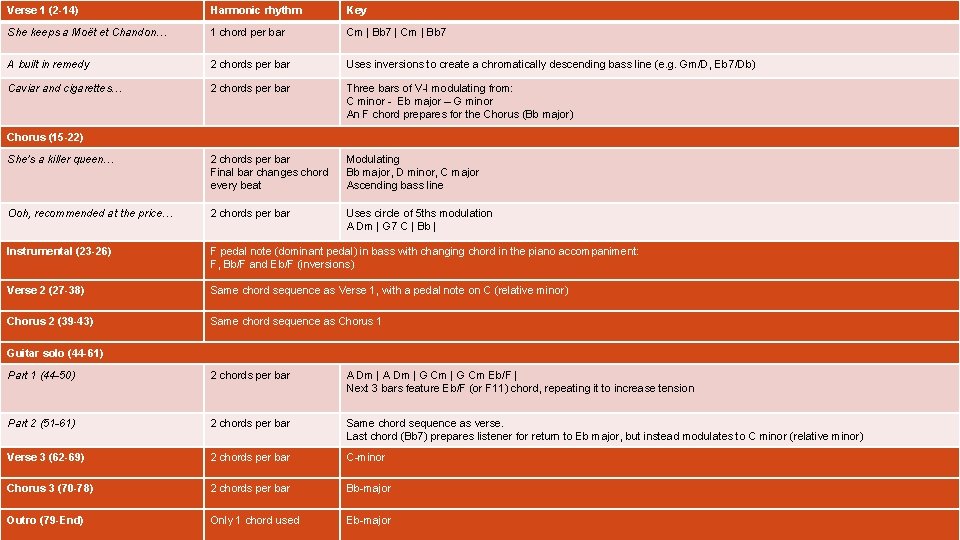
Verse 1 (2 -14) Harmonic rhythm Key She keeps a Moët et Chandon… 1 chord per bar Cm | Bb 7 | Cm | Bb 7 A built in remedy 2 chords per bar Uses inversions to create a chromatically descending bass line (e. g. Gm/D, Eb 7/Db) Caviar and cigarettes… 2 chords per bar Three bars of V-I modulating from: C minor - Eb major – G minor An F chord prepares for the Chorus (Bb major) She’s a killer queen… 2 chords per bar Final bar changes chord every beat Modulating Bb major, D minor, C major Ascending bass line Ooh, recommended at the price… 2 chords per bar Uses circle of 5 ths modulation A Dm | G 7 C | Bb | Instrumental (23 -26) F pedal note (dominant pedal) in bass with changing chord in the piano accompaniment: F, Bb/F and Eb/F (inversions) Verse 2 (27 -38) Same chord sequence as Verse 1, with a pedal note on C (relative minor) Chorus 2 (39 -43) Same chord sequence as Chorus 1 Chorus (15 -22) Guitar solo (44 -61) Part 1 (44 -50) 2 chords per bar A Dm | G Cm Eb/F | Next 3 bars feature Eb/F (or F 11) chord, repeating it to increase tension Part 2 (51 -61) 2 chords per bar Same chord sequence as verse. Last chord (Bb 7) prepares listener for return to Eb major, but instead modulates to C minor (relative minor) Verse 3 (62 -69) 2 chords per bar C-minor Chorus 3 (70 -78) 2 chords per bar Bb-major Outro (79 -End) Only 1 chord used Eb-major
- Slides: 25