
QuasiRandom Number Sequences from a Long Period TLP
Quasi-Random Number Sequences from a Long Period TLP Generator with Remarks on Application to Cryptography By Herbert S. Bright and Richard L. Enison Presented by Saunders Roesser
The Problem • Generation of successful random number sequences that pass all statistical testing criteria. • Generation in an Application domain.
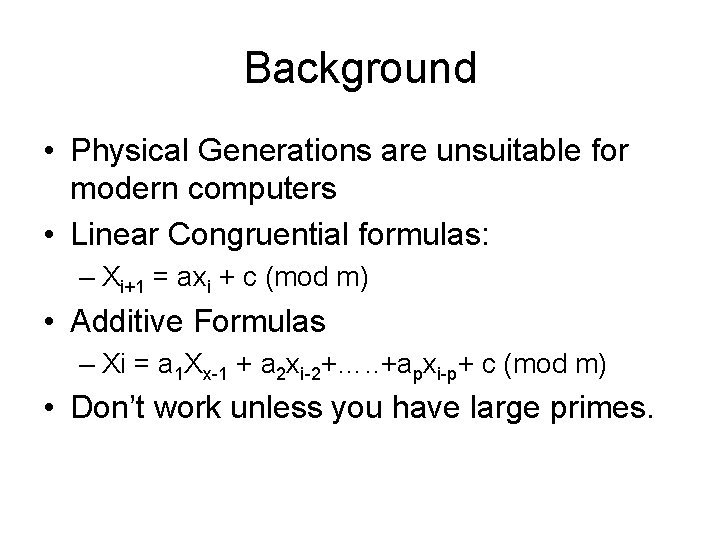
Background • Physical Generations are unsuitable for modern computers • Linear Congruential formulas: – Xi+1 = axi + c (mod m) • Additive Formulas – Xi = a 1 Xx-1 + a 2 xi-2+…. . +apxi-p+ c (mod m) • Don’t work unless you have large primes.
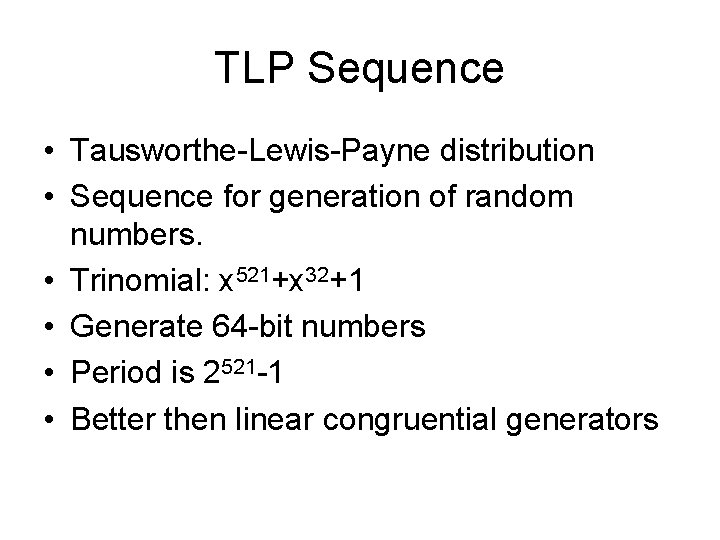
TLP Sequence • Tausworthe-Lewis-Payne distribution • Sequence for generation of random numbers. • Trinomial: x 521+x 32+1 • Generate 64 -bit numbers • Period is 2521 -1 • Better then linear congruential generators
Statistical Testing Criteria • Equidistribution/Frequency Test – The number of time a given number falls into a given interval • Serial Test – The number of times a sequence appears in a certain number of numbers • Gap Test – The distribution of gaps in the sequence of various lengths.
More Tests • Runs Test – Plots the distribution of maximal ascending runs of various lengths • Coupon Collector’s Test – Choose a small interger, divide the number into intervals then plot the distribution runs of various lengths required to have all intervals represented
More Tests • Permutation Test – Order relations between the members of the sequence in groups of k. • Serial Correlation Test – Computer the correlation coefficient between consecutive members of the sequence. • Others. .
Results • At the time, all present generators failed the battery of tests. • Hope came from recursive function theory. • TLP Generator showed good results in string tests • Passed equidistributivity tests, along with other tests.
Other Physical Random Number Generators • • • Dice Ionizing radiation Gas discharge tubes Leaky capacitors Physical noise generators
- Slides: 9