
Quasiincompressibility of growth of magnetic field in supersonic
Quasi-incompressibility of growth of magnetic field in supersonic turbulence Itzhak Fouxon and Michael Mond Ben-Gurion University of the Negev Axel Brandenburg's 60 th Birthday Symposium 4 April 2019 Tuusula, Finland
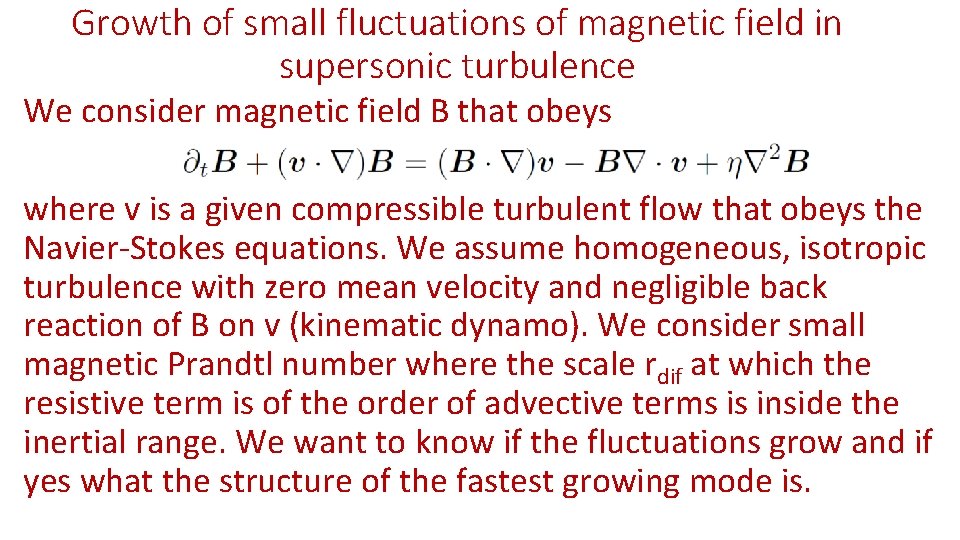
Growth of small fluctuations of magnetic field in supersonic turbulence We consider magnetic field B that obeys where v is a given compressible turbulent flow that obeys the Navier-Stokes equations. We assume homogeneous, isotropic turbulence with zero mean velocity and negligible back reaction of B on v (kinematic dynamo). We consider small magnetic Prandtl number where the scale rdif at which the resistive term is of the order of advective terms is inside the inertial range. We want to know if the fluctuations grow and if yes what the structure of the fastest growing mode is.
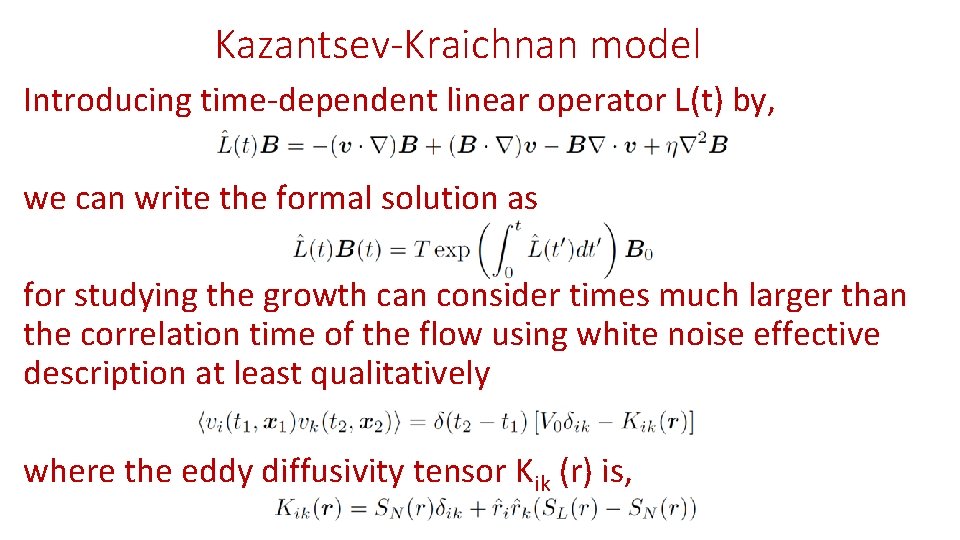
Kazantsev-Kraichnan model Introducing time-dependent linear operator L(t) by, we can write the formal solution as for studying the growth can consider times much larger than the correlation time of the flow using white noise effective description at least qualitatively where the eddy diffusivity tensor Kik (r) is,
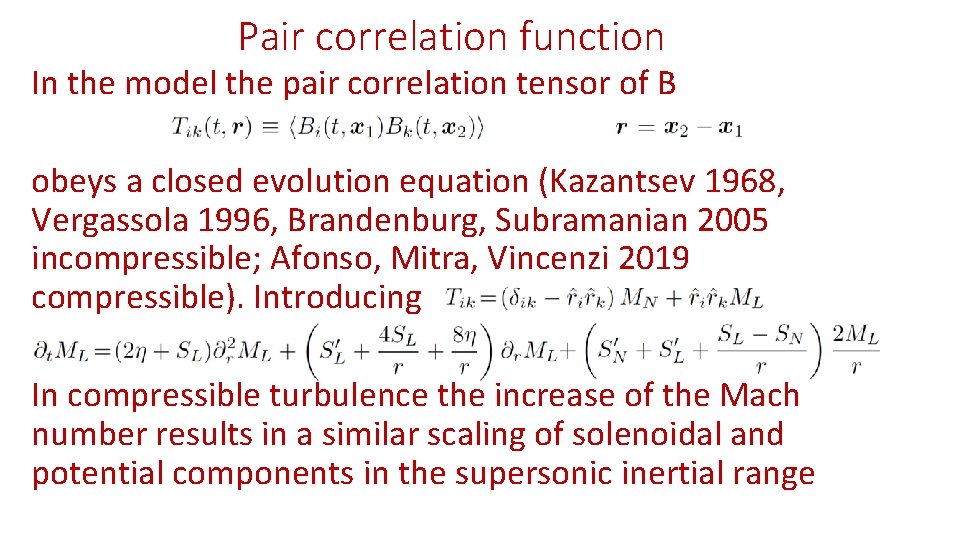
Pair correlation function In the model the pair correlation tensor of B obeys a closed evolution equation (Kazantsev 1968, Vergassola 1996, Brandenburg, Subramanian 2005 incompressible; Afonso, Mitra, Vincenzi 2019 compressible). Introducing In compressible turbulence the increase of the Mach number results in a similar scaling of solenoidal and potential components in the supersonic inertial range
Usage of the model for physical conclusions The input of the model is the structure of the eddy diffusivity tensor which is phenomenological. The inertial range is divided by the sonic scale rs at which the velocity of turbulent eddies is of order of the speed of sound (local Mach number is one). In supersonic inertial range above rs solenoidal and potential components scale similarly at high Mach numbers (4 -6, depending on the forcing), e. g. Kritsuk et. al 2007. Thus we assume that SL and SN scale with the same exponent ζ at r>rs. In contrast, at r<rs the flow is incompressible!
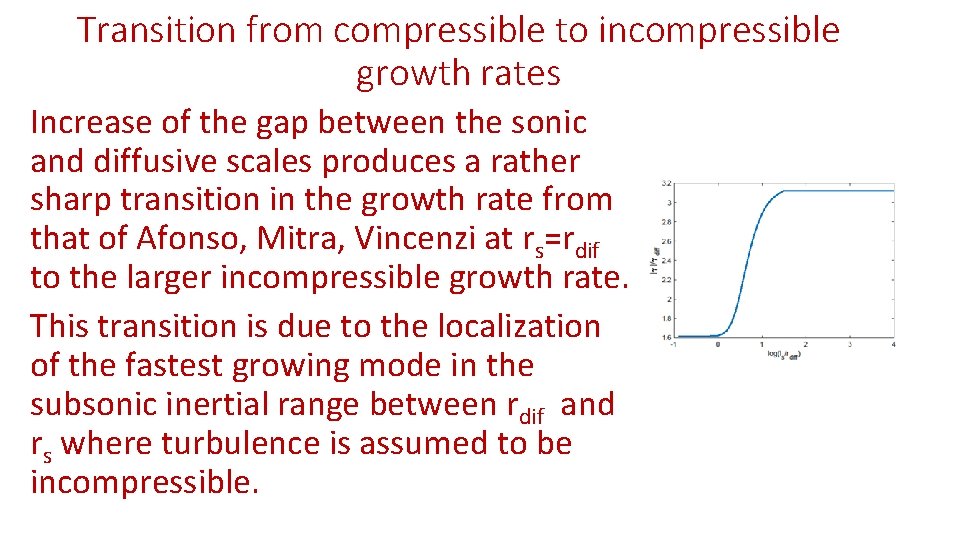
Transition from compressible to incompressible growth rates Increase of the gap between the sonic and diffusive scales produces a rather sharp transition in the growth rate from that of Afonso, Mitra, Vincenzi at rs=rdif to the larger incompressible growth rate. This transition is due to the localization of the fastest growing mode in the subsonic inertial range between rdif and rs where turbulence is assumed to be incompressible.
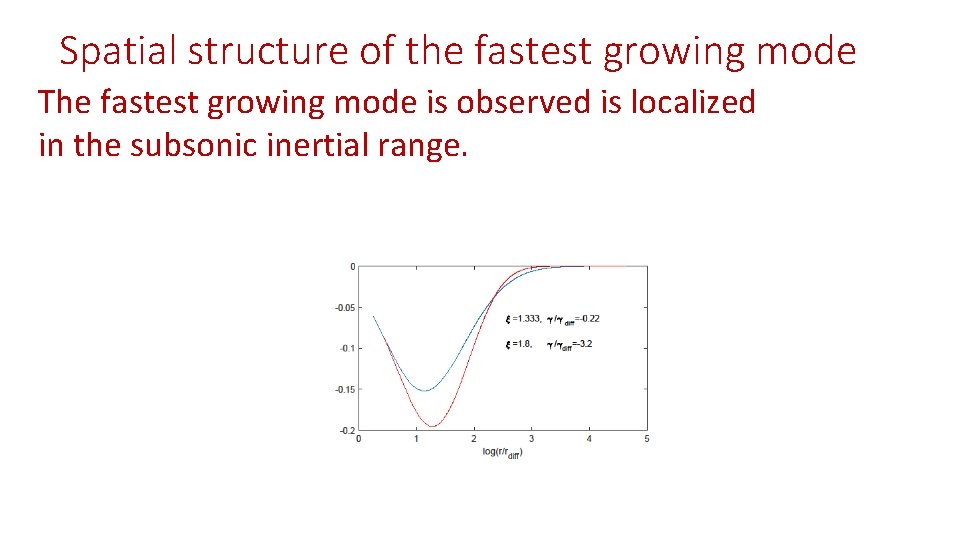
Spatial structure of the fastest growing mode The fastest growing mode is observed is localized in the subsonic inertial range.
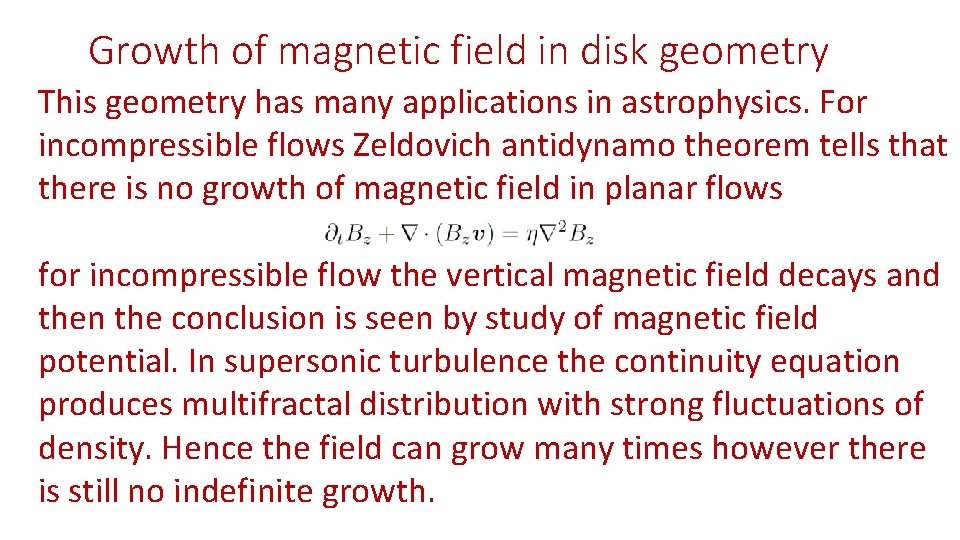
Growth of magnetic field in disk geometry This geometry has many applications in astrophysics. For incompressible flows Zeldovich antidynamo theorem tells that there is no growth of magnetic field in planar flows for incompressible flow the vertical magnetic field decays and then the conclusion is seen by study of magnetic field potential. In supersonic turbulence the continuity equation produces multifractal distribution with strong fluctuations of density. Hence the field can grow many times however there is still no indefinite growth.
Conclusions • rate of growth of magnetic field in compressible turbulence with possibly large Mach number coincides with that in incompressible flow that is assumed, conventionally, to hold between the resistive (diffusive) scale and the sonic scale. The fastest growing mode is localized in that subsonic inertial range. The slower growth in the supersonic inertial range is given by the study of Afonso, Mitra and Vincenzi (Proc. Roy. Soc. A 2019). This is a robust structure that must be observable in astrophysics. • in disk geometry Zeldovich anti-dynamo theorem must be refined. The amplitude of the field does not grow indefinitely however it can get multiplied many times becoming multifractal in the supersonic inertial range
- Slides: 9