
Quasifree electron scattering from highly charged ions Theo


- Slides: 62
Quasi-free electron scattering from highly charged ions Theo J. M. Zouros University of Crete – Heraklion GREECE KSU August 27, 2003 1
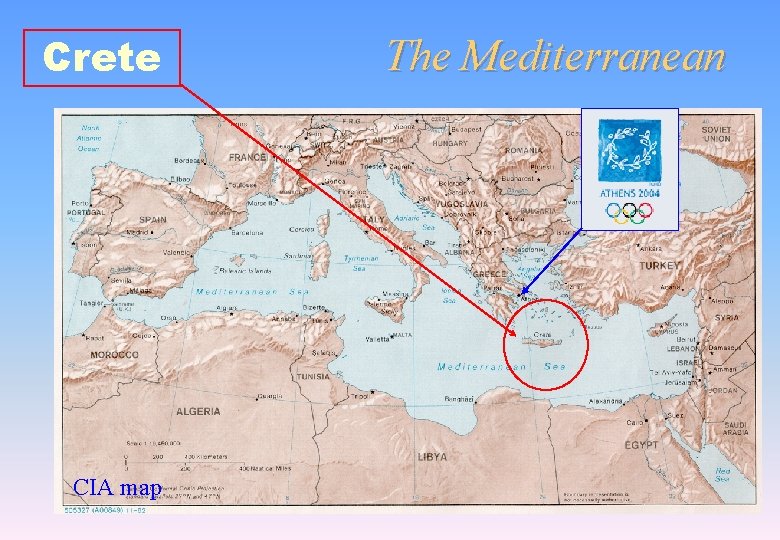
Crete CIA map The Mediterranean
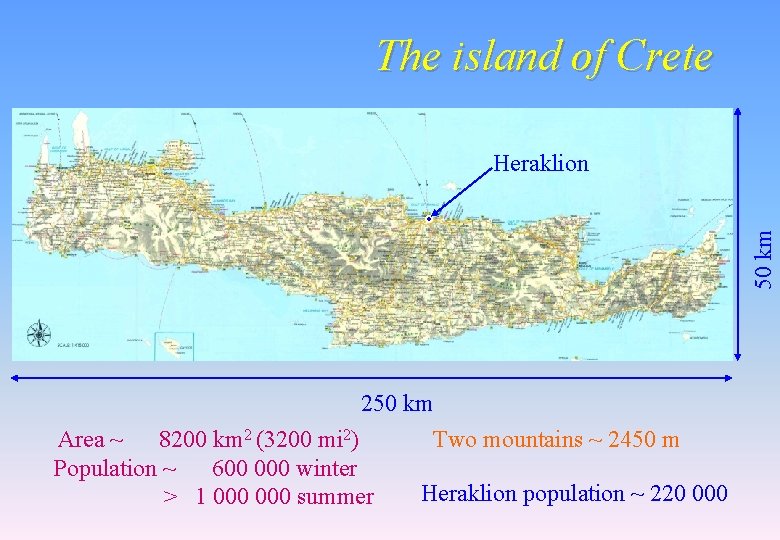
The island of Crete 50 km Heraklion 250 km Area ~ 8200 km 2 (3200 mi 2) Population ~ 600 000 winter > 1 000 summer Two mountains ~ 2450 m Heraklion population ~ 220 000
Heraklion Crete
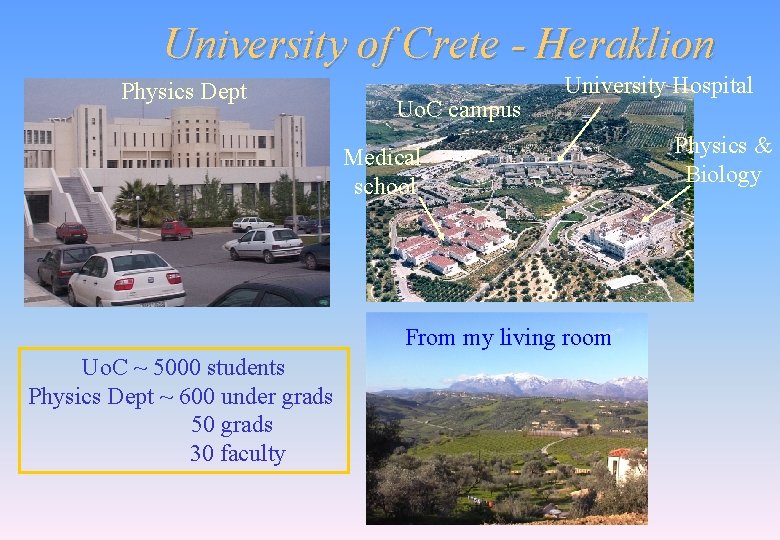
University of Crete - Heraklion Physics Dept Uo. C campus University Hospital Medical school From my living room Uo. C ~ 5000 students Physics Dept ~ 600 under grads 50 grads 30 faculty Physics & Biology
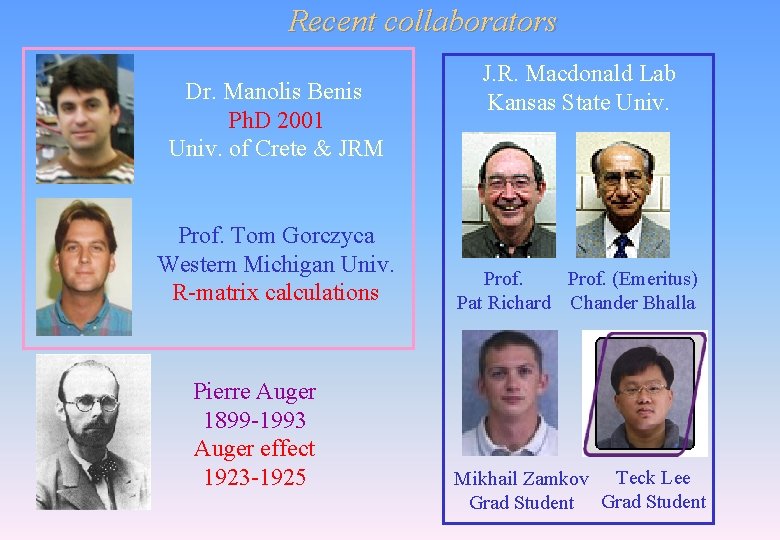
Recent collaborators Dr. Manolis Benis Ph. D 2001 Univ. of Crete & JRM Prof. Tom Gorczyca Western Michigan Univ. R-matrix calculations Pierre Auger 1899 -1993 Auger effect 1923 -1925 J. R. Macdonald Lab Kansas State Univ. Prof. (Emeritus) Pat Richard Chander Bhalla Mikhail Zamkov Teck Lee Grad Student
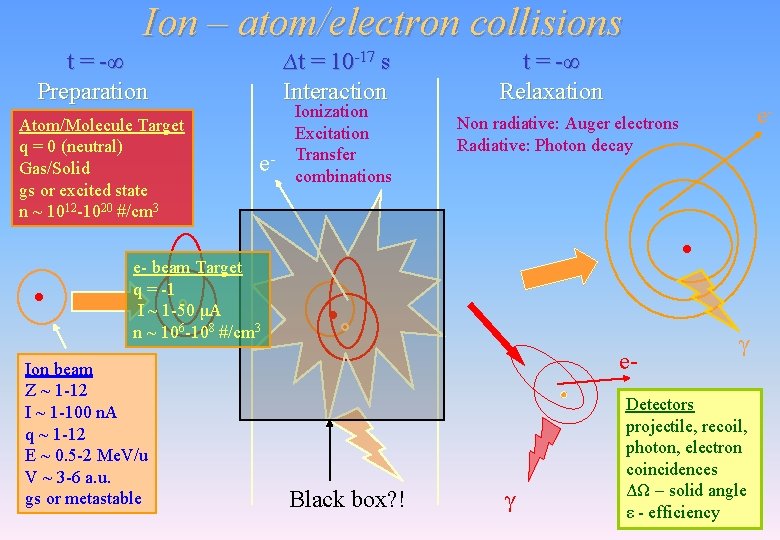
Ion – atom/electron collisions t = -∞ Preparation Atom/Molecule Target q = 0 (neutral) Gas/Solid gs or excited state n ~ 1012 -1020 #/cm 3 ∆t = 10 -17 s Interaction e- Ionization Excitation Transfer combinations t = -∞ Relaxation Non radiative: Auger electrons Radiative: Photon decay e- beam Target q = -1 I ~ 1 -50 μA n ~ 106 -108 #/cm 3 Ion beam Z ~ 1 -12 I ~ 1 -100 n. A q ~ 1 -12 E ~ 0. 5 -2 Me. V/u V ~ 3 -6 a. u. gs or metastable e- Black box? ! e- γ γ Detectors projectile, recoil, photon, electron coincidences ΔΩ – solid angle ε - efficiency
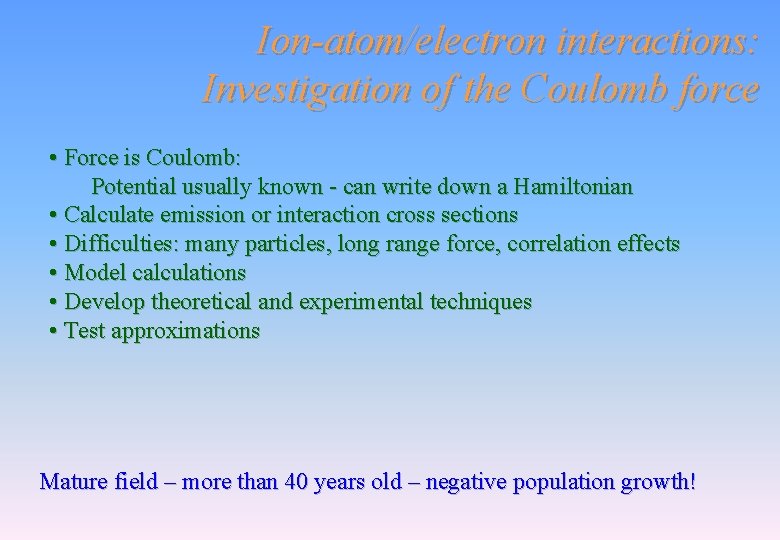
Ion-atom/electron interactions: Investigation of the Coulomb force • Force is Coulomb: Potential usually known - can write down a Hamiltonian • Calculate emission or interaction cross sections • Difficulties: many particles, long range force, correlation effects • Model calculations • Develop theoretical and experimental techniques • Test approximations Mature field – more than 40 years old – negative population growth!
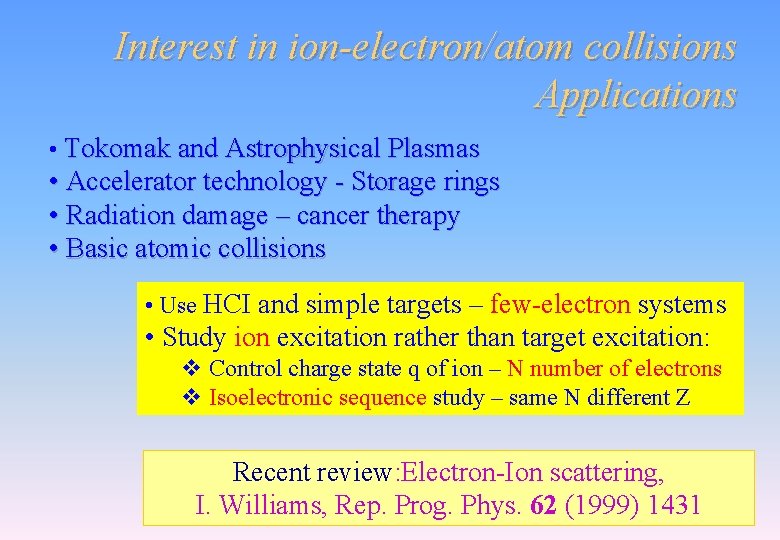
Interest in ion-electron/atom collisions Applications • Tokomak and Astrophysical Plasmas • Accelerator technology - Storage rings • Radiation damage – cancer therapy • Basic atomic collisions • Use HCI and simple targets – few-electron systems • Study ion excitation rather than target excitation: v Control charge state q of ion – N number of electrons v Isoelectronic sequence study – same N different Z Recent review: Electron-Ion scattering, I. Williams, Rep. Prog. Phys. 62 (1999) 1431
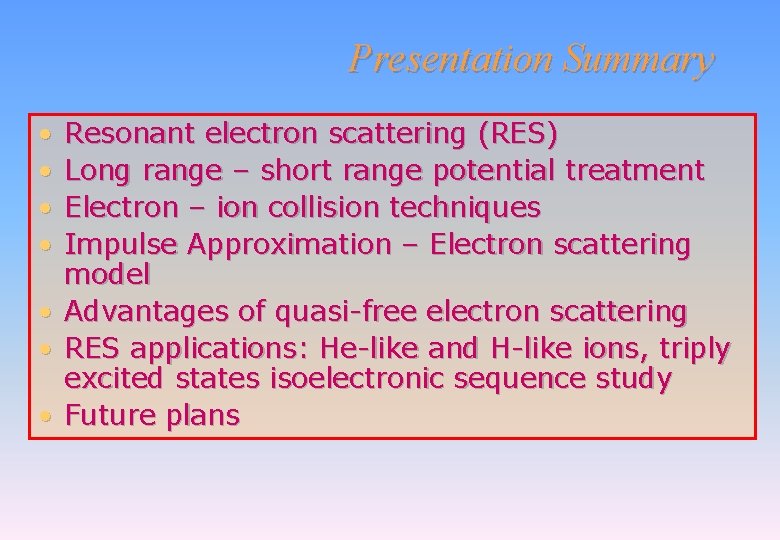
Presentation Summary • • Resonant electron scattering (RES) Long range – short range potential treatment Electron – ion collision techniques Impulse Approximation – Electron scattering model • Advantages of quasi-free electron scattering • RES applications: He-like and H-like ions, triply excited states isoelectronic sequence study • Future plans
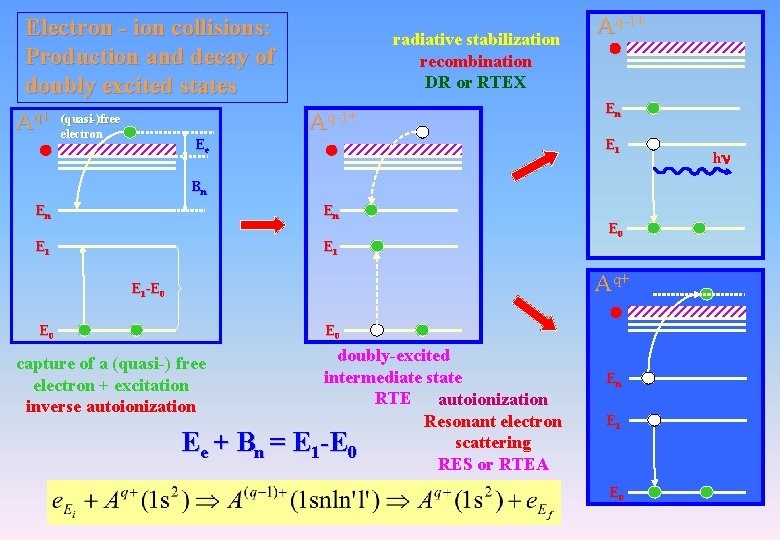
Electron - ion collisions: Production and decay of doubly excited states Aq+ (quasi-)free electron Ee radiative stabilization recombination DR or RTEX Aq-1+ En E 1 Bn En En E 1 E 0 Aq+ E 1 -E 0 capture of a (quasi-) free electron + excitation inverse autoionization Ee + B n = doubly-excited intermediate state RTE autoionization Resonant electron scattering E 1 -E 0 RES or RTEA En E 1 E 0 h
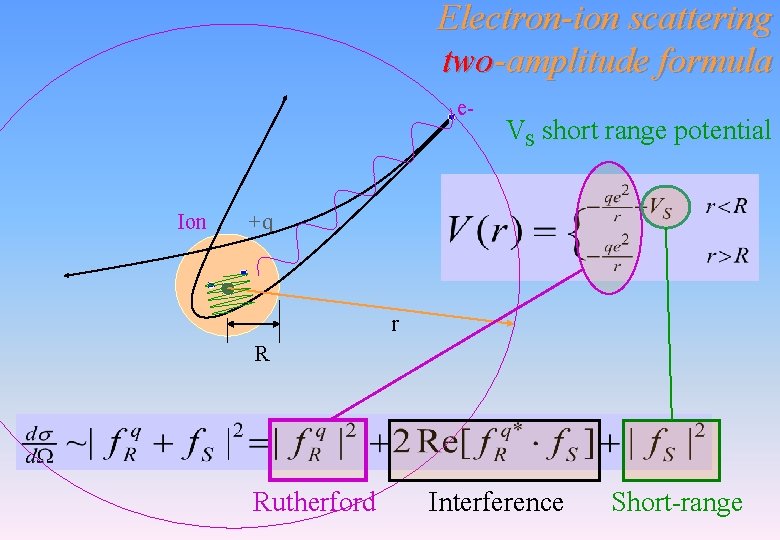
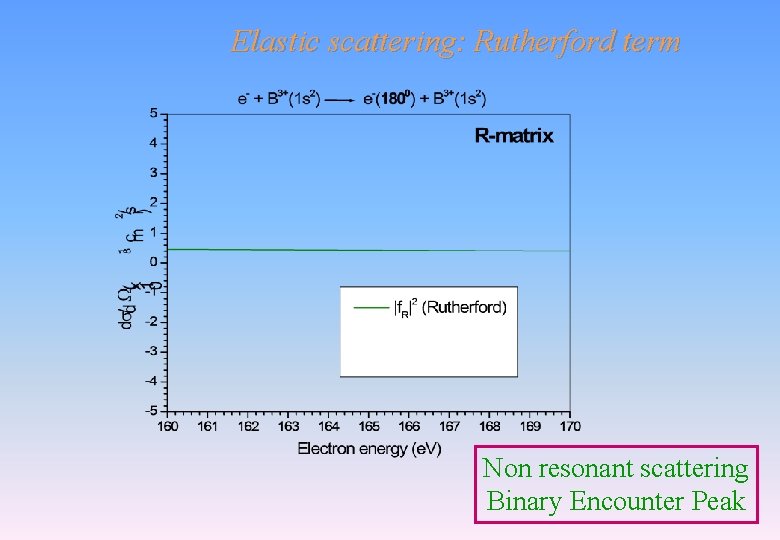
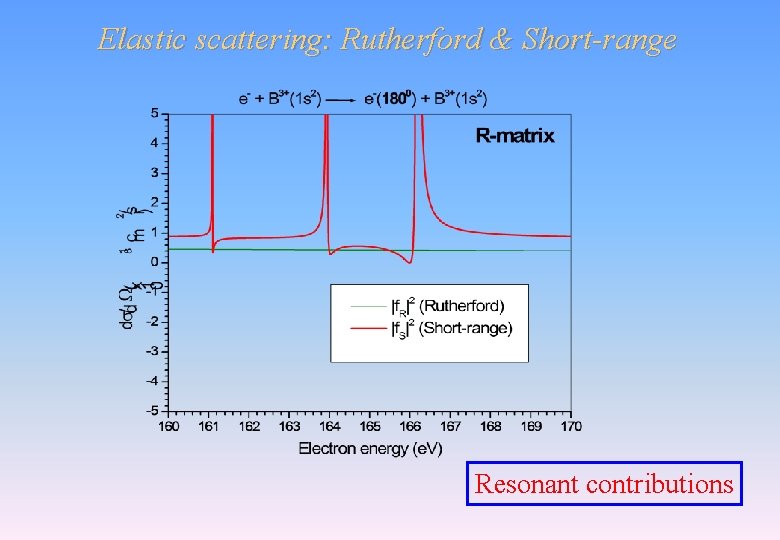
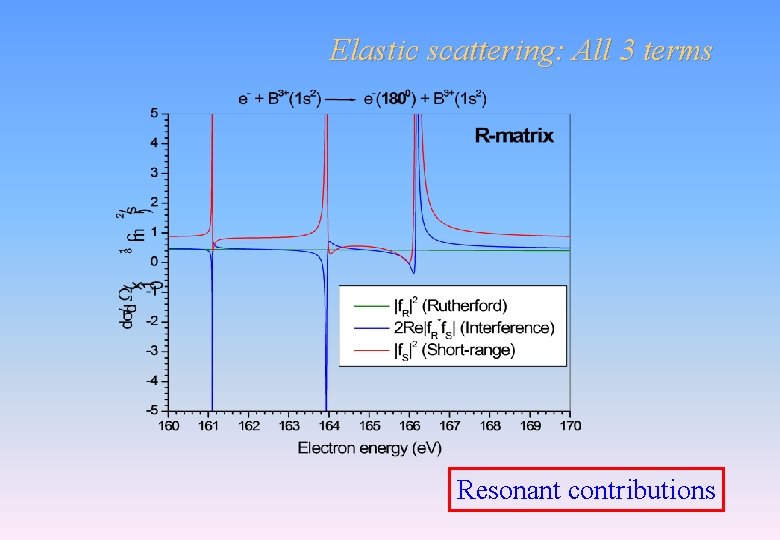
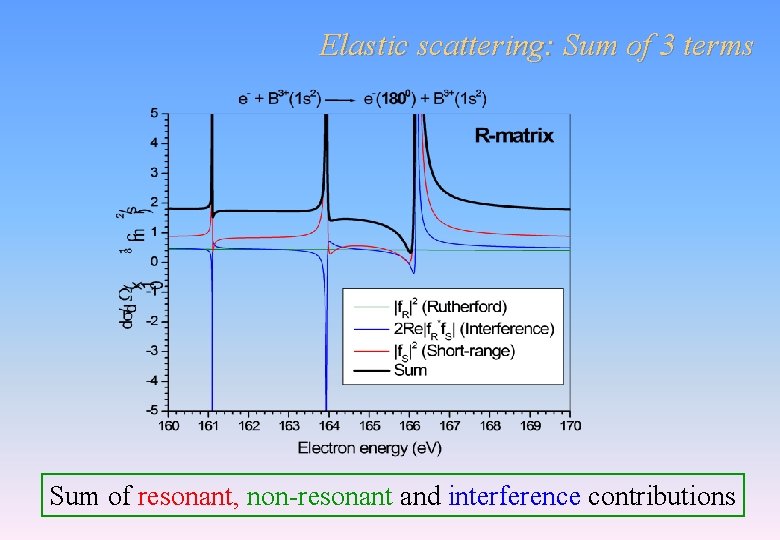
Electron-ion scattering two-amplitude formula e- Ion VS short range potential +q r R Rutherford Interference Short-range
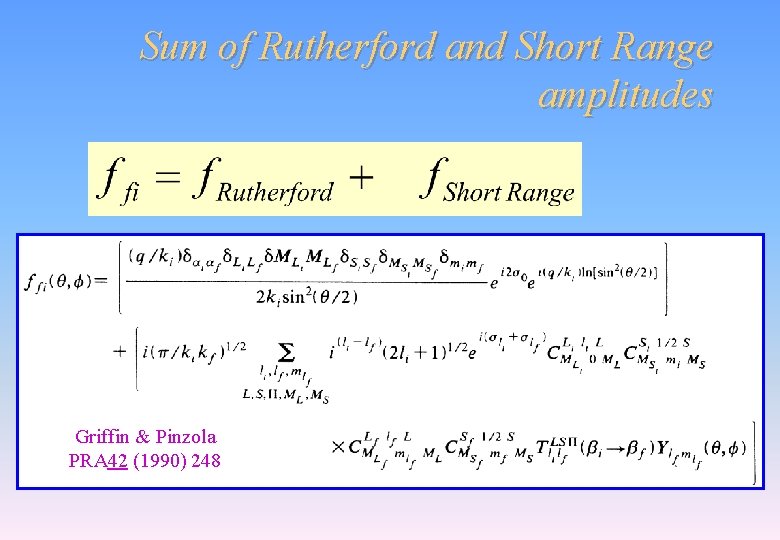
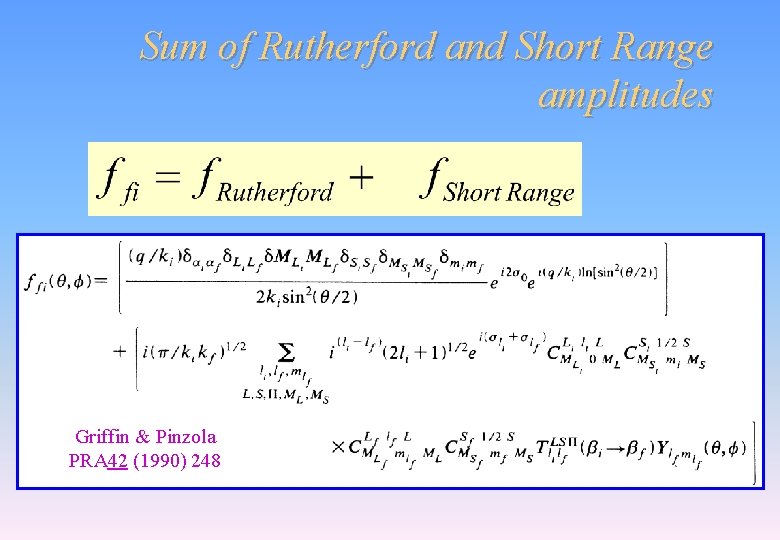
Sum of Rutherford and Short Range amplitudes Griffin & Pinzola PRA 42 (1990) 248
Elastic scattering: Rutherford term Non resonant scattering Binary Encounter Peak
Elastic scattering: Rutherford & Short-range Resonant contributions
Elastic scattering: All 3 terms Resonant contributions
Elastic scattering: Sum of 3 terms Sum of resonant, non-resonant and interference contributions
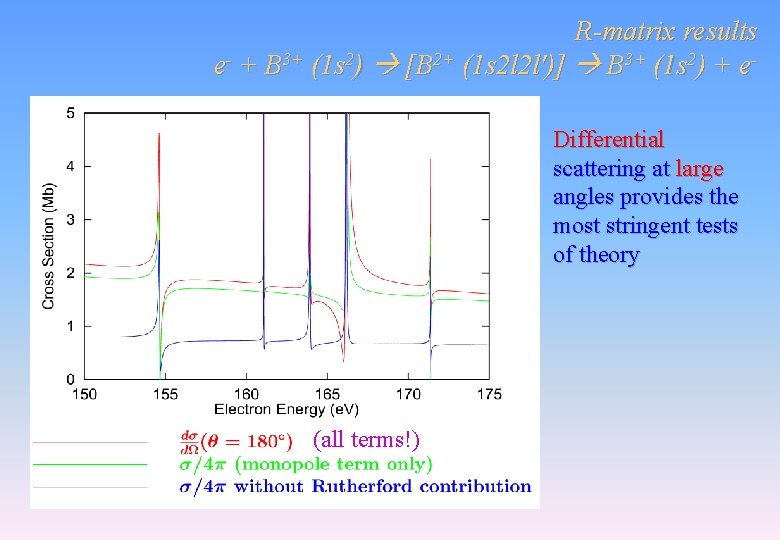
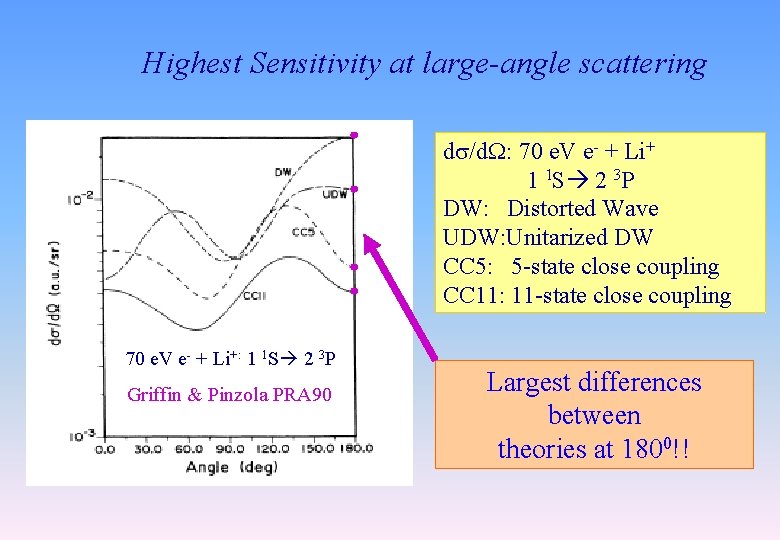
R-matrix results e- + B 3+ (1 s 2) [B 2+ (1 s 2 l 2 l')] B 3+ (1 s 2) + e. Differential scattering at large angles provides the most stringent tests of theory (all terms!)
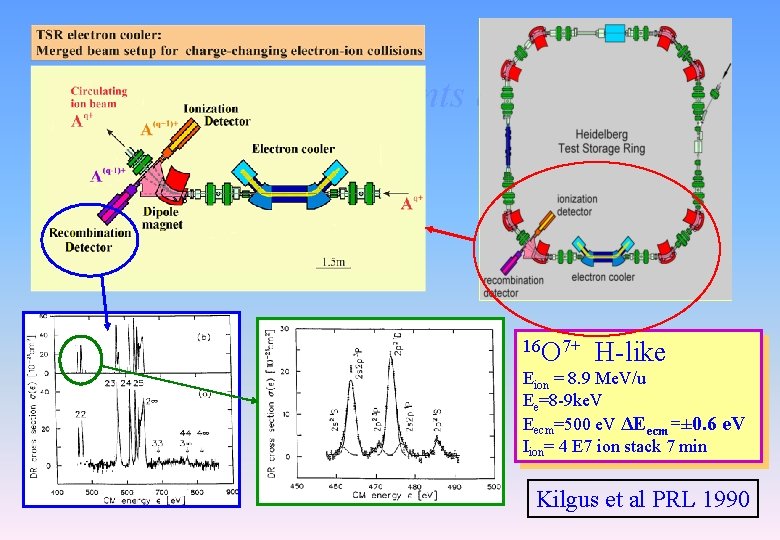
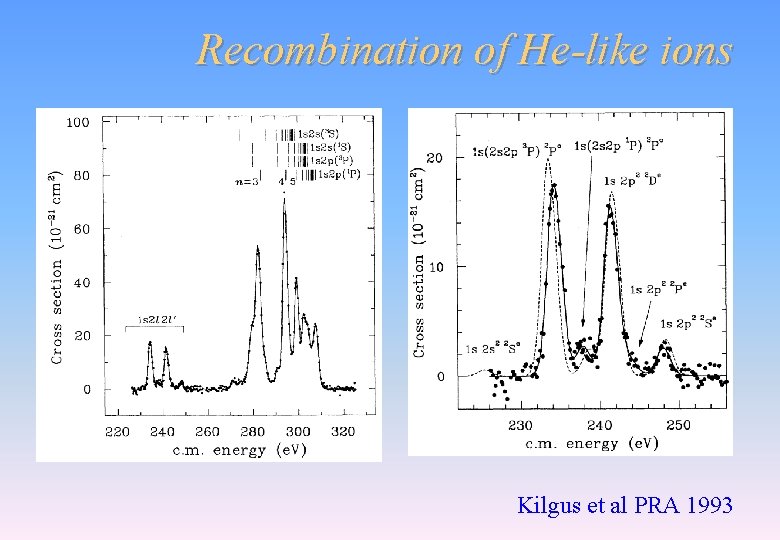
Merged beam experiments at storage ring 16 O 7+ H-like Eion = 8. 9 Me. V/u Ee=8 -9 ke. V Eecm=500 e. V ΔEecm=± 0. 6 e. V Iion= 4 E 7 ion stack 7 min Kilgus et al PRL 1990
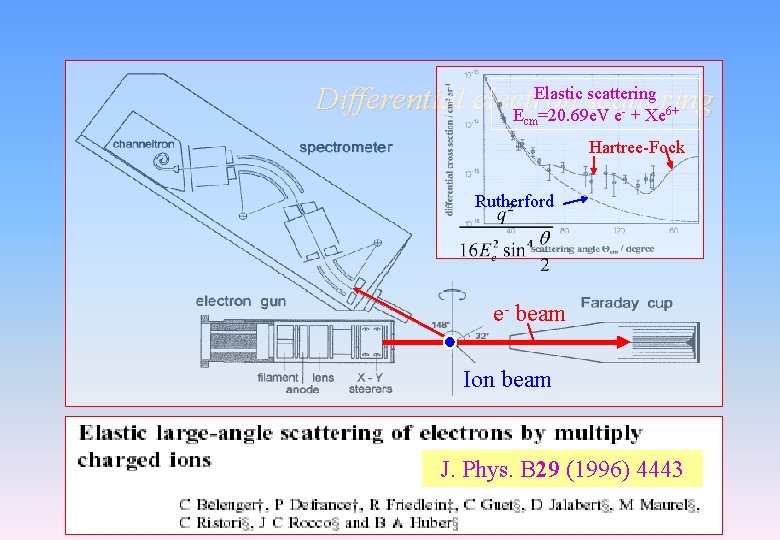
Elastic scattering Differential electron scattering E =20. 69 e. V e + Xe cm - 6+ Hartree-Fock Rutherford e- beam Ion beam J. Phys. B 29 (1996) 4443
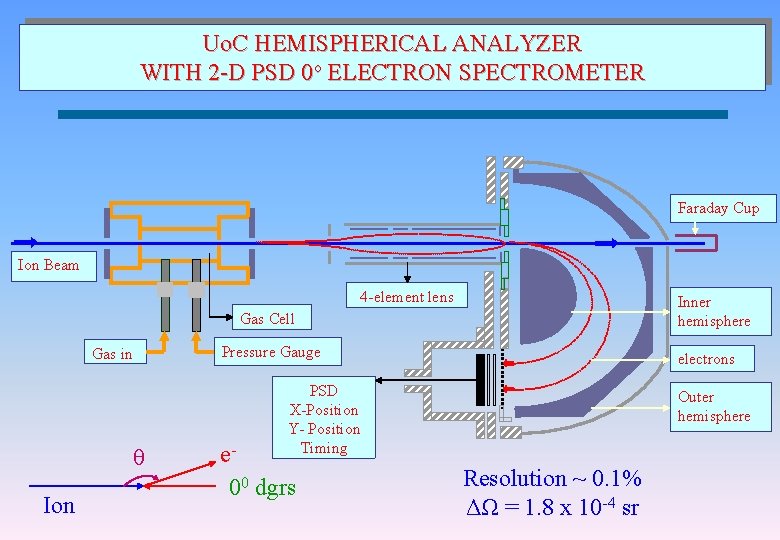
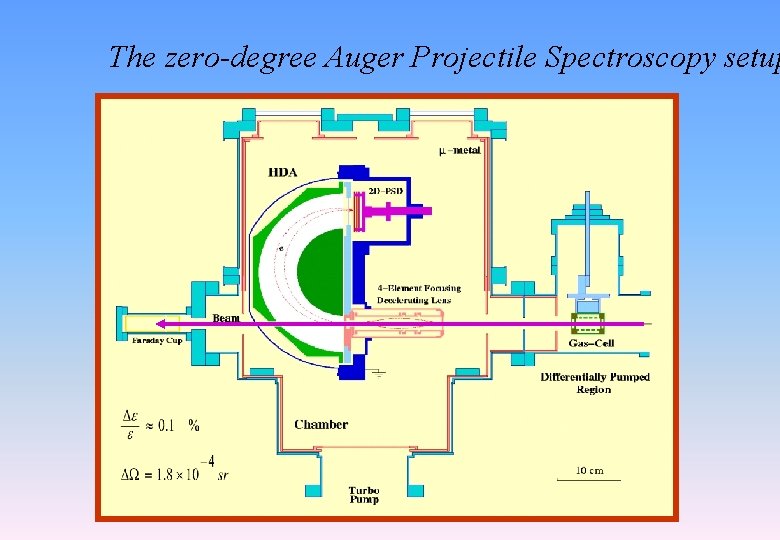
Uo. C HEMISPHERICAL ANALYZER WITH 2 -D PSD 0 o ELECTRON SPECTROMETER Faraday Cup Ion Beam 4 -element lens Inner hemisphere Gas Cell Pressure Gauge Gas in θ Ion electrons PSD X-Position Y- Position Timing e 00 dgrs Outer hemisphere Resolution ~ 0. 1% ΔΩ = 1. 8 x 10 -4 sr
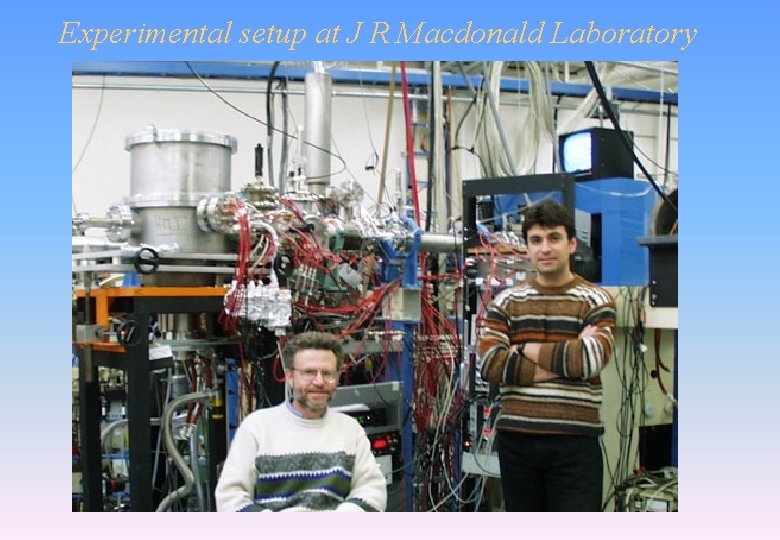
Experimental setup at J R Macdonald Laboratory
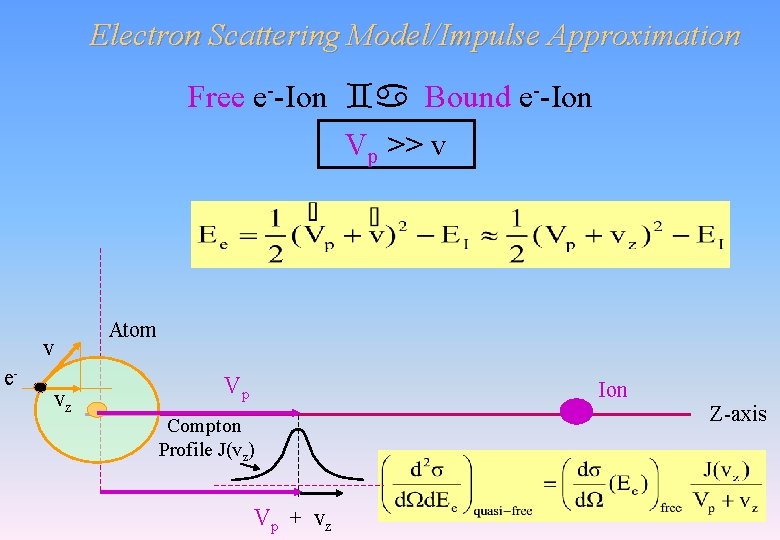
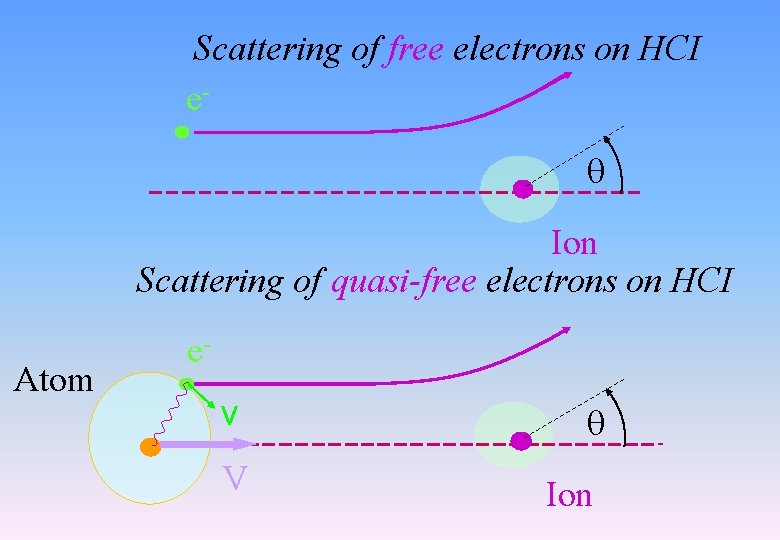
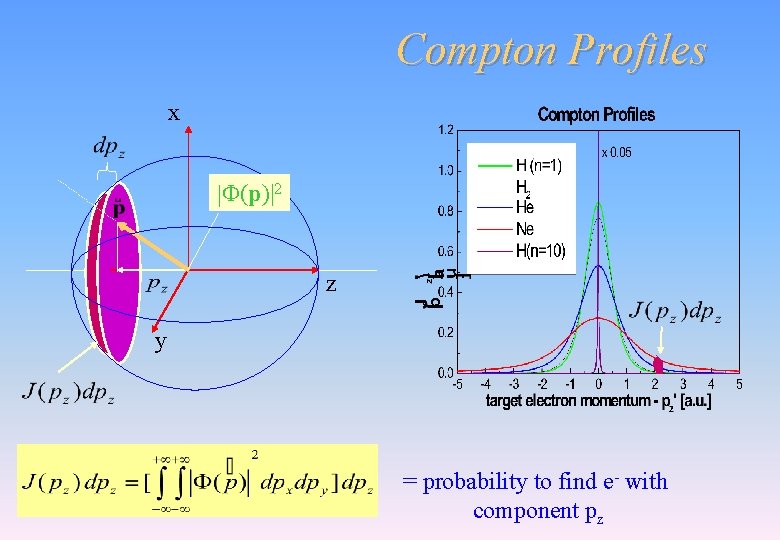
Electron Scattering Model/Impulse Approximation Free e--Ion Bound e--Ion Vp >> v Atom v e- vz Vp Ion Compton Profile J(vz) Vp + vz Z-axis
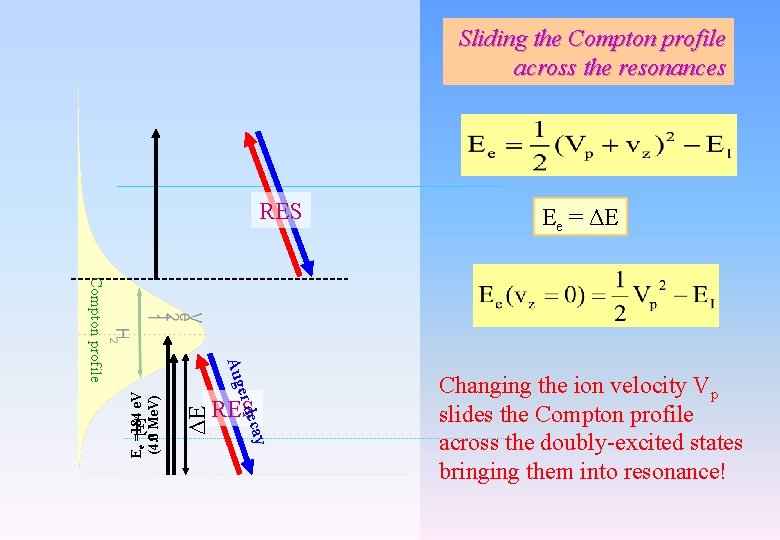
Sliding the Compton profile across the resonances RES y ΔΕ deca Ee =184 e. V (4. 0 Me. V) er Aug Compton profile Ee RES Εe = ΔΕ Changing the ion velocity Vp slides the Compton profile across the doubly-excited states bringing them into resonance!
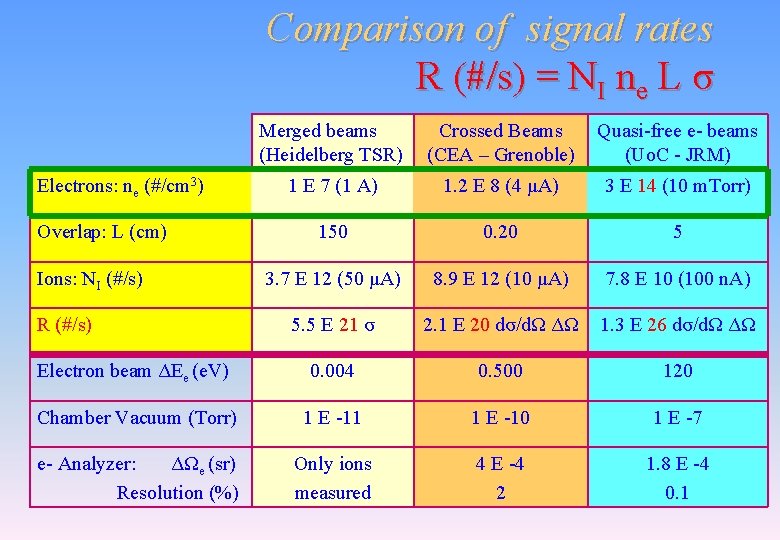
Comparison of signal rates R (#/s) = NI ne L σ Merged beams (Heidelberg TSR) Crossed Beams (CEA – Grenoble) Quasi-free e- beams (Uo. C - JRM) 1 E 7 (1 A) 1. 2 Ε 8 (4 μΑ) 3 Ε 14 (10 m. Torr) 150 0. 20 5 3. 7 E 12 (50 μA) 8. 9 E 12 (10 μA) 7. 8 E 10 (100 n. A) 5. 5 E 21 σ 2. 1 E 20 dσ/dΩ ΔΩ 1. 3 E 26 dσ/dΩ ΔΩ Electron beam ΔΕe (e. V) 0. 004 0. 500 120 Chamber Vacuum (Torr) 1 E -11 1 E -10 1 E -7 e- Analyzer: ΔΩe (sr) Resolution (%) Only ions measured 4 E -4 2 1. 8 E -4 0. 1 Electrons: ne (#/cm 3) Overlap: L (cm) Ions: NI (#/s) R (#/s)
What’s the use of a quasi-free electron? 1. >106 higher luminosity compared to 2. crossed electron-ion beam experiments! 2. Measure scattering at 1800 (very sensitive)! 3. Include also resonances 4. (e- energy dependence – d 2 /d. Ed )! 4. No UHV 5. Spectrum in 30 minutes! Sounds great but is it really electron-ion scattering? ? ?
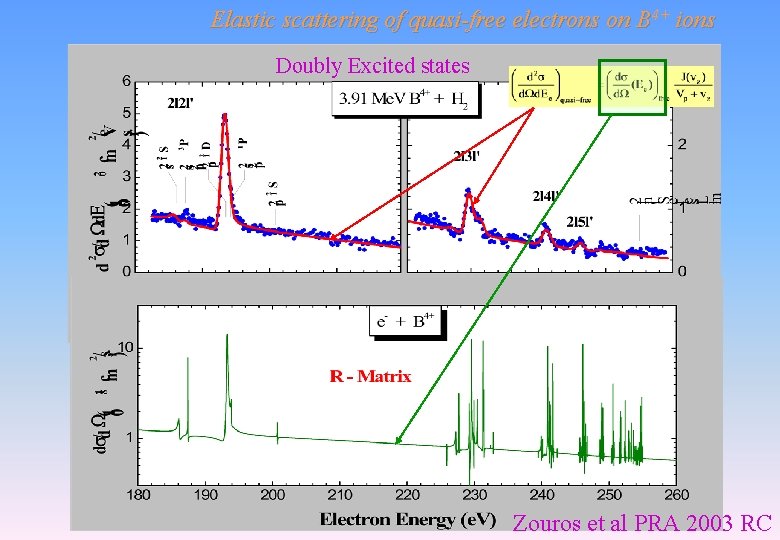
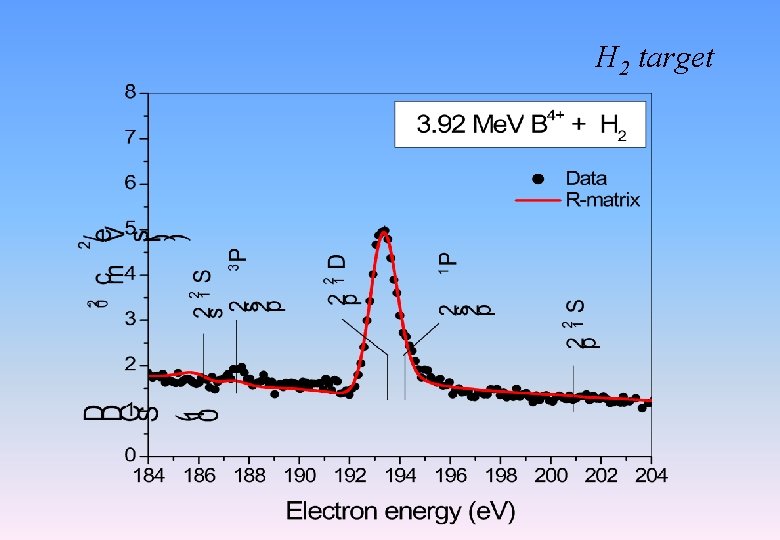
Elastic scattering of quasi-free electrons on B 4+ ions Doubly Excited states Elastic scattering of quasi-free electrons on B 4+ ions Zouros et al PRA 2003 RC
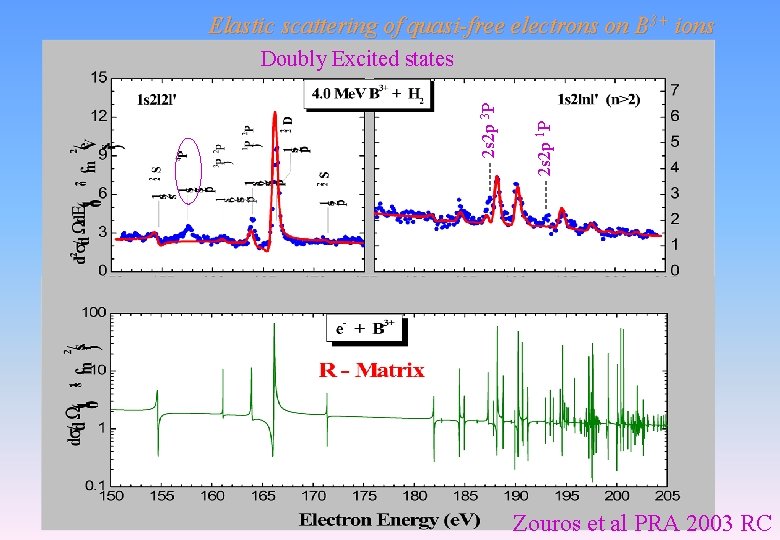
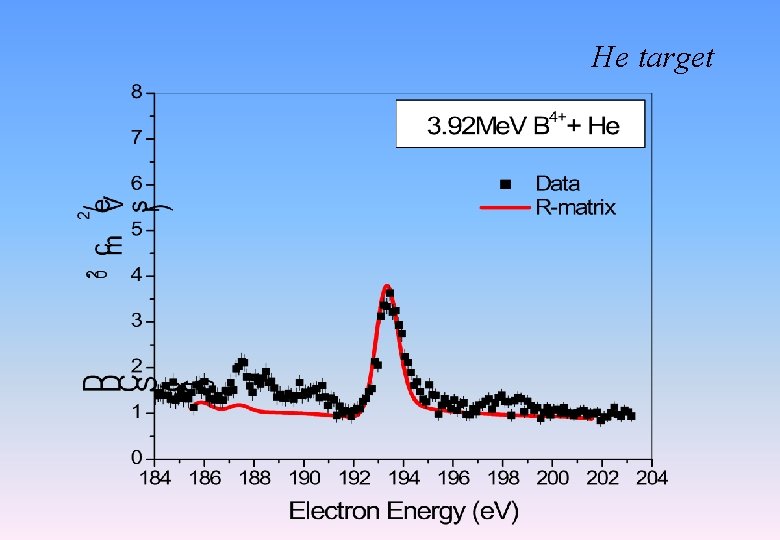
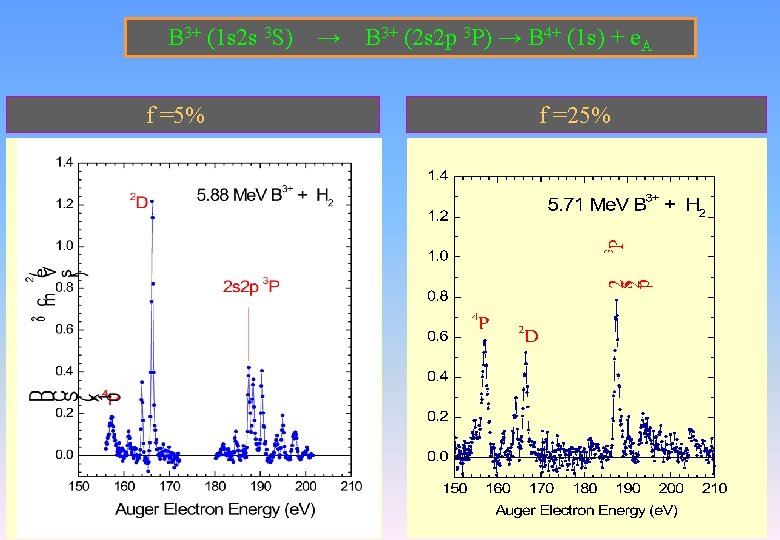
Elastic scattering of quasi-free electrons on B 3+ ions ----- 2 s 2 p 1 P ----- 2 s 2 p 3 P Doubly Excited states Zouros et al PRA 2003 RC
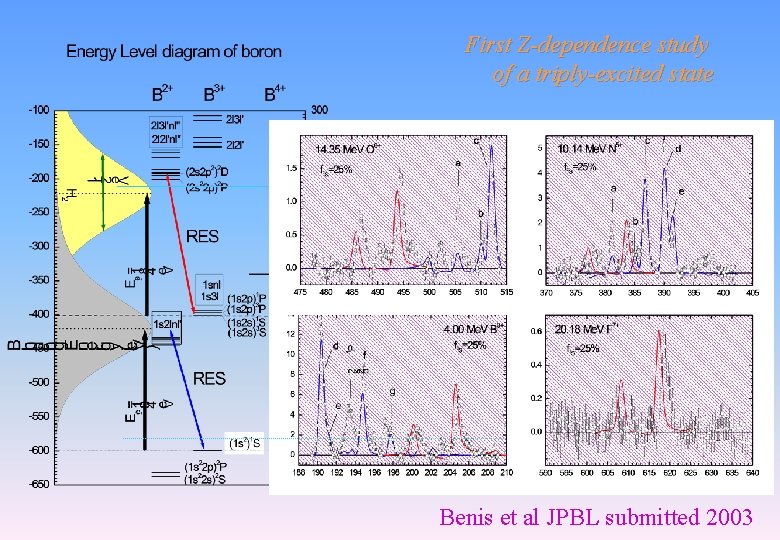
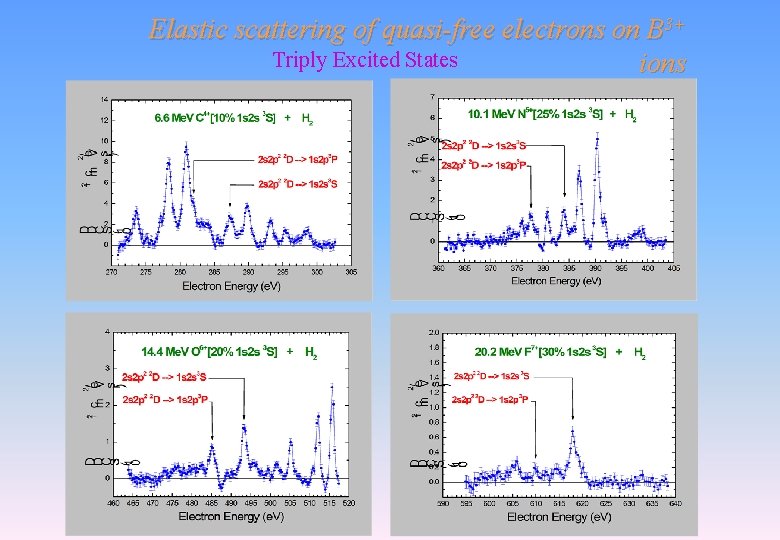
First Z-dependence study of a triply-excited state Benis et al JPBL submitted 2003
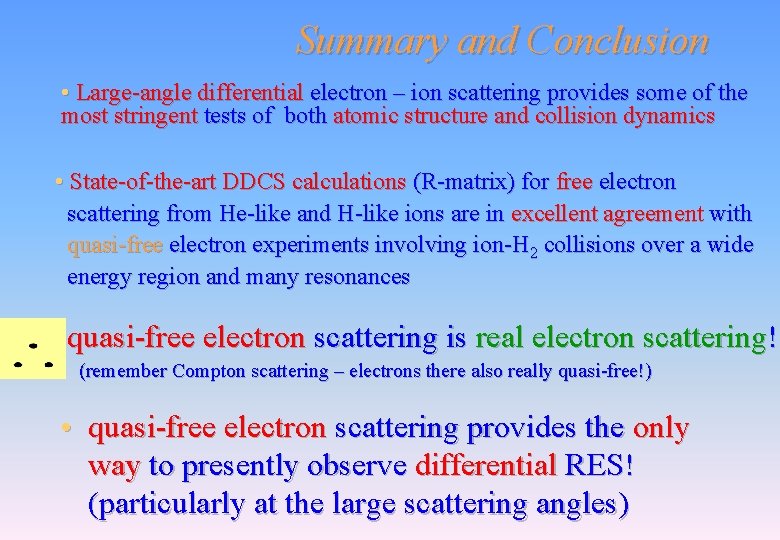
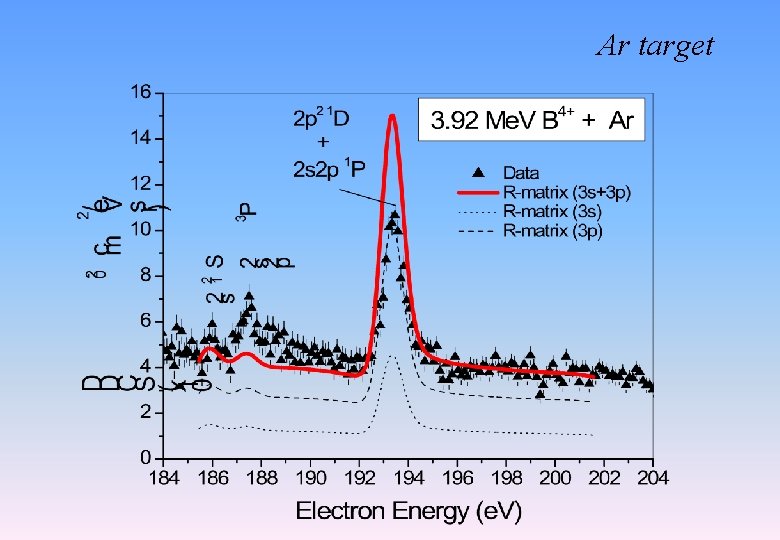
Summary and Conclusion • Large-angle differential electron – ion scattering provides some of the most stringent tests of both atomic structure and collision dynamics • State-of-the-art DDCS calculations (R-matrix) for free electron scattering from He-like and H-like ions are in excellent agreement with quasi-free electron experiments involving ion-H 2 collisions over a wide energy region and many resonances quasi-free electron scattering is real electron scattering! (remember Compton scattering – electrons there also really quasi-free!) • quasi-free electron scattering provides the only way to presently observe differential RES! (particularly at the large scattering angles)
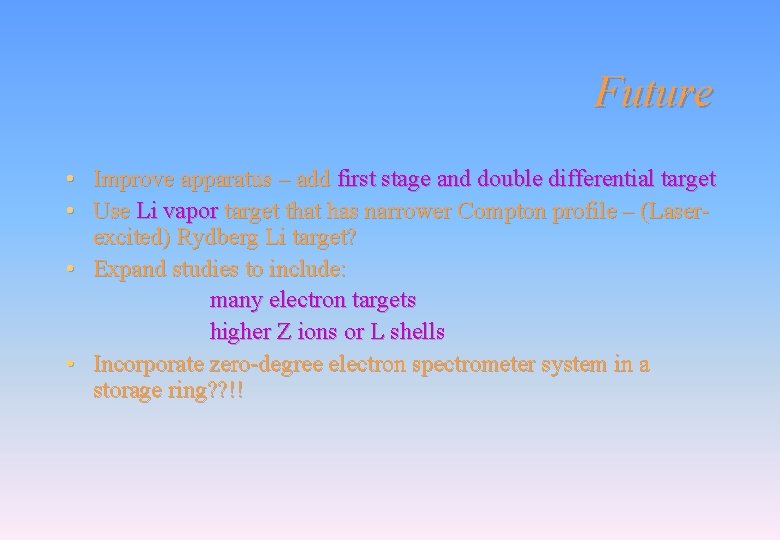
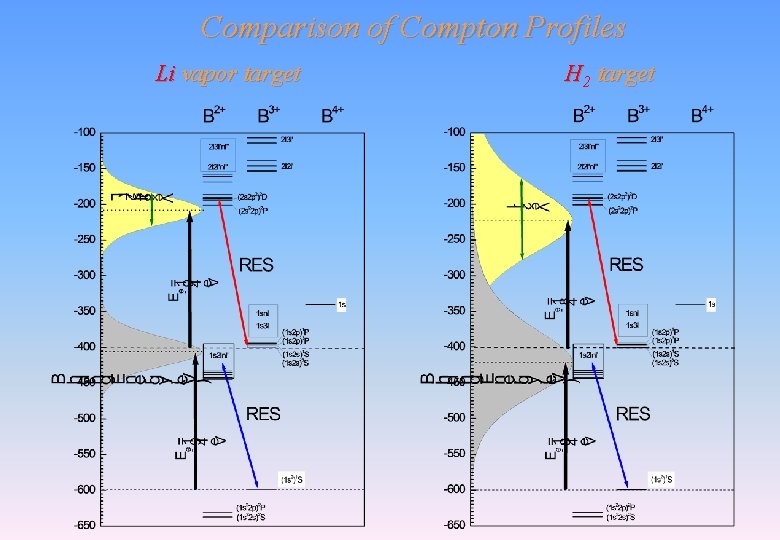
Future • Improve apparatus – add first stage and double differential target • Use Li vapor target that has narrower Compton profile – (Laserexcited) Rydberg Li target? • Expand studies to include: many electron targets higher Z ions or L shells • Incorporate zero-degree electron spectrometer system in a storage ring? ? !!
Comparison of Compton Profiles Li vapor target H 2 target
H 2 target
He target
Ar target
The End Many thanks to all my colleagues and friends for making my sabbatical such a fun and exciting experience!
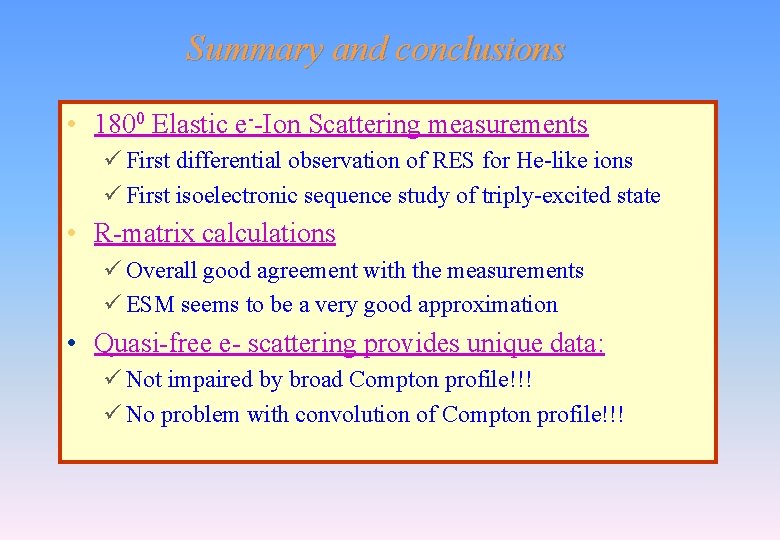
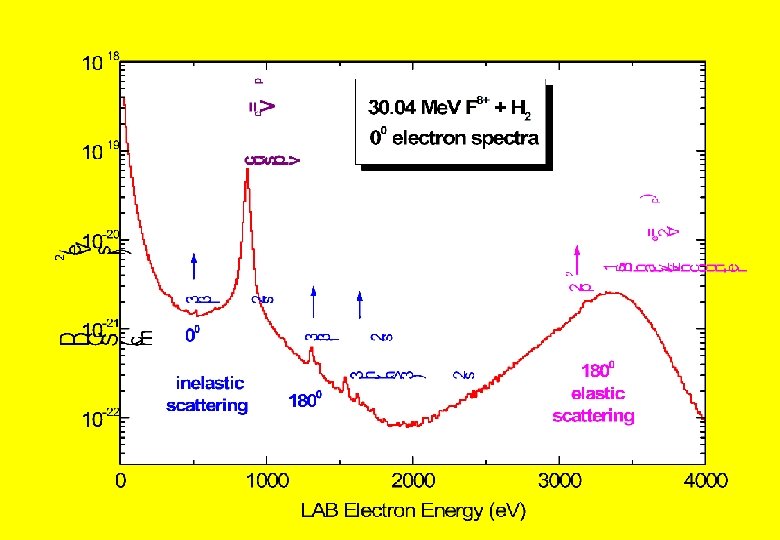
Summary and conclusions • 1800 Elastic e--Ion Scattering measurements ü First differential observation of RES for He-like ions ü First isoelectronic sequence study of triply-excited state • R-matrix calculations ü Overall good agreement with the measurements ü ESM seems to be a very good approximation • Quasi-free e- scattering provides unique data: ü Not impaired by broad Compton profile!!! ü No problem with convolution of Compton profile!!!
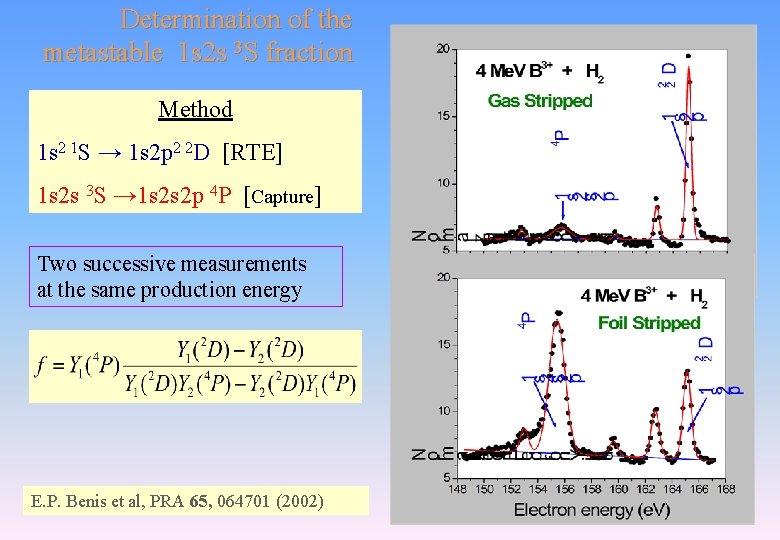
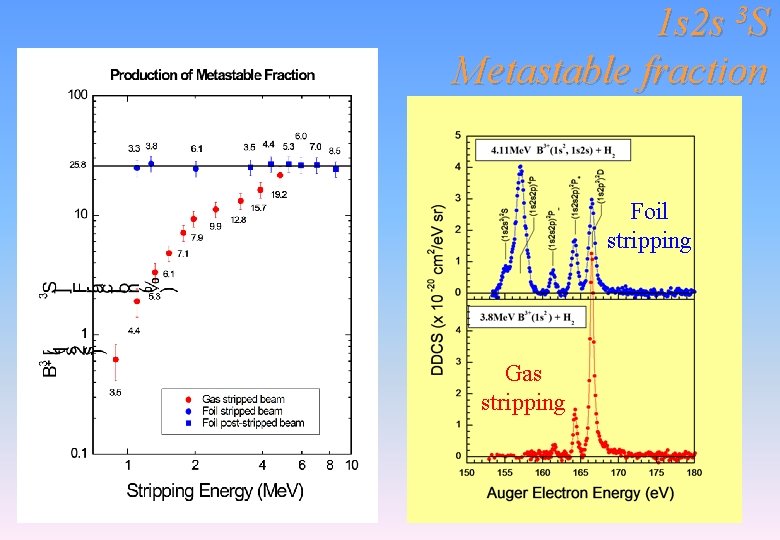
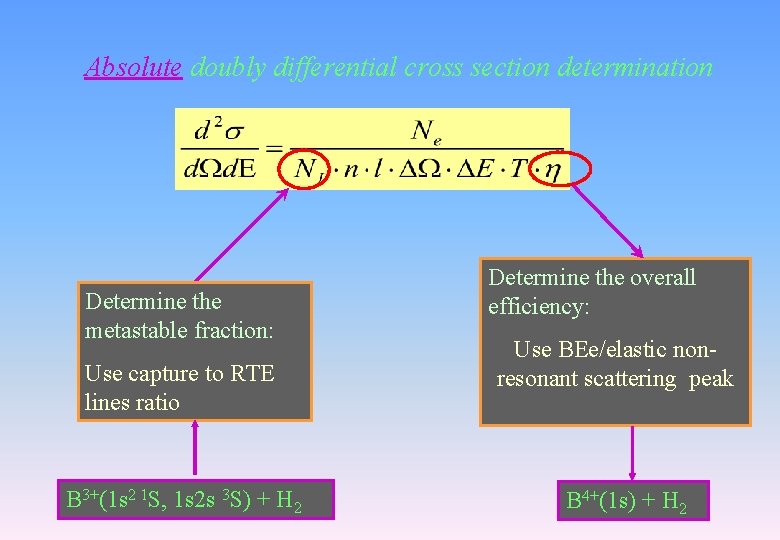
Determination of the metastable 1 s 2 s 3 S fraction Method 1 s 2 1 S → 1 s 2 p 2 2 D [RTE] 1 s 2 s 3 S → 1 s 2 s 2 p 4 P [Capture] Two successive measurements at the same production energy E. P. Benis et al, PRA 65, 064701 (2002)
1 s 2 s 3 S Metastable fraction Foil stripping Gas stripping
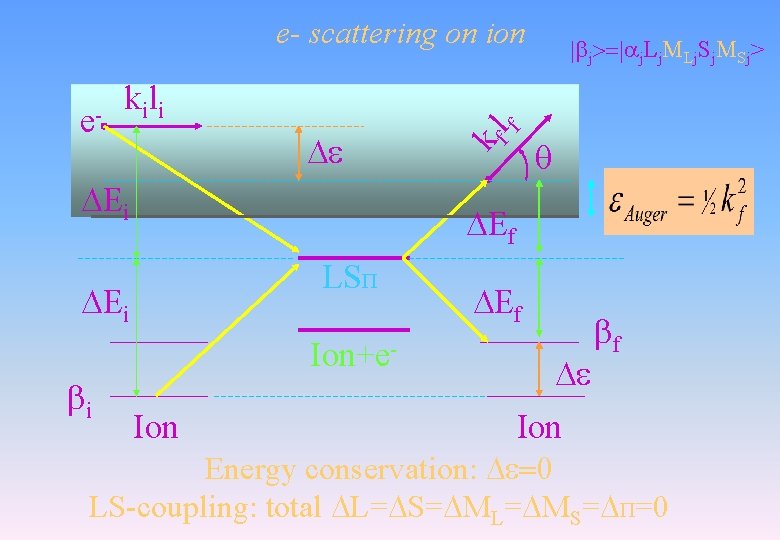
e- scattering on ion kili DEi f DEf LSP DEi Ion+ebi f De kl e- |bj>=|aj. Lj. MLj. Sj. MSj> Ion DEf De bf Ion Energy conservation: De=0 LS-coupling: total DL=DS=DML=DMS=DP=0
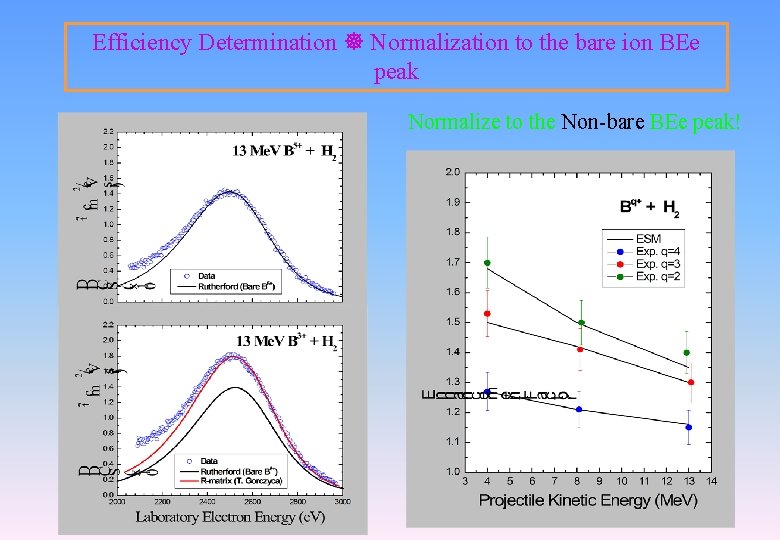
Absolute doubly differential cross section determination Determine the metastable fraction: Use capture to RTE lines ratio B 3+(1 s 2 1 S, 1 s 2 s 3 S) + H 2 Determine the overall efficiency: Use BEe/elastic nonresonant scattering peak B 4+(1 s) + H 2
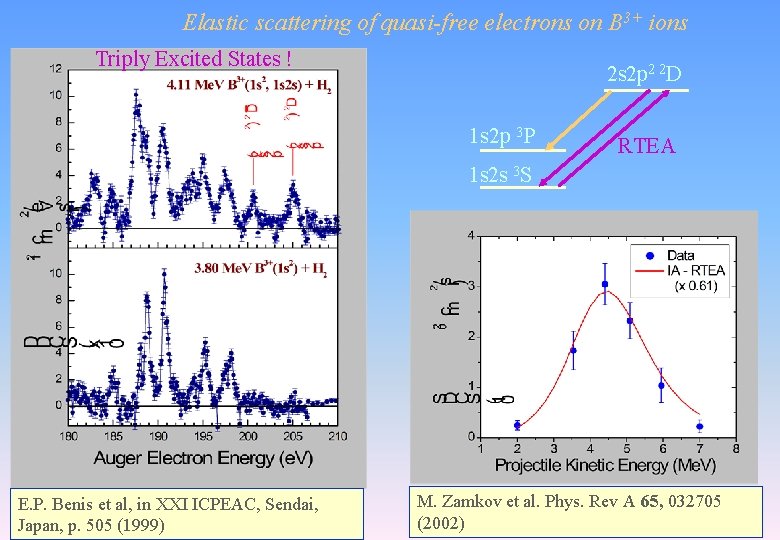
Elastic scattering of quasi-free electrons on B 3+ ions Triply Excited States ! 2 s 2 p 2 2 D 1 s 2 p 3 P RTEA 1 s 2 s 3 S E. P. Benis et al, in XXI ICPEAC, Sendai, Japan, p. 505 (1999) M. Zamkov et al. Phys. Rev A 65, 032705 (2002)
Elastic scattering of quasi-free electrons on B 3+ Triply Excited States ions
B 3+ (1 s 2 s 3 S) f =5% → B 3+ (2 s 2 p 3 P) → B 4+ (1 s) + e. A f =25%
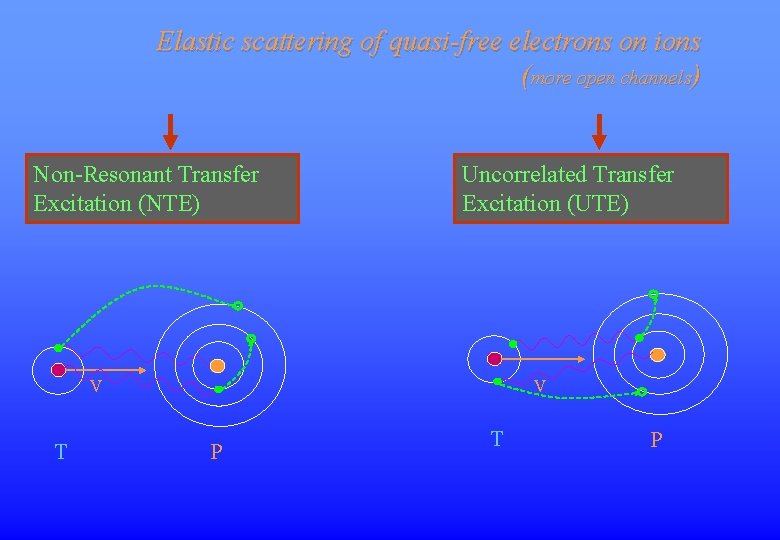
Elastic scattering of quasi-free electrons on ions (more open channels) Non-Resonant Transfer Excitation (NTE) Uncorrelated Transfer Excitation (UTE) V V T P
Scattering of free electrons on HCI e Ion Scattering of quasi-free electrons on HCI Atom ev V Ion
Compton Profiles x |F(p)|2 z y = probability to find e- with component pz
Highest Sensitivity at large-angle scattering d /d : 70 e. V e- + Li+ 1 1 S 2 3 P DW: Distorted Wave UDW: Unitarized DW CC 5: 5 -state close coupling CC 11: 11 -state close coupling 70 e. V e- + Li+: 1 1 S 2 3 P Griffin & Pinzola PRA 90 Largest differences between theories at 1800!!
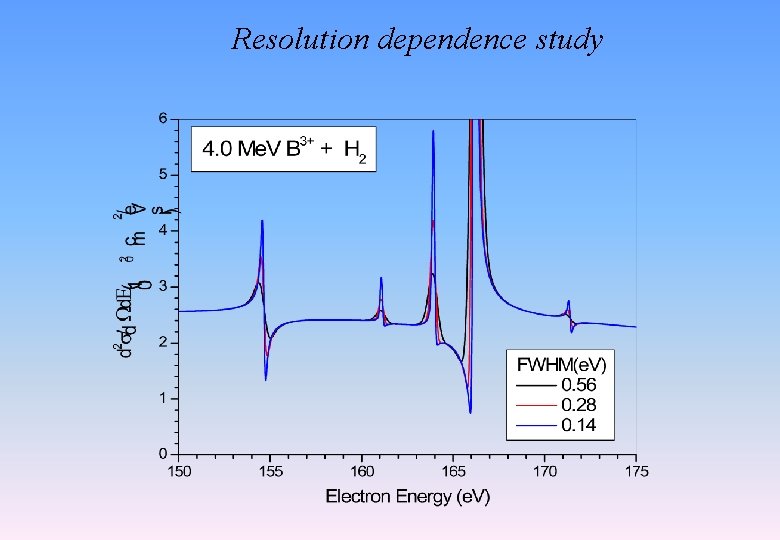
Resolution dependence study
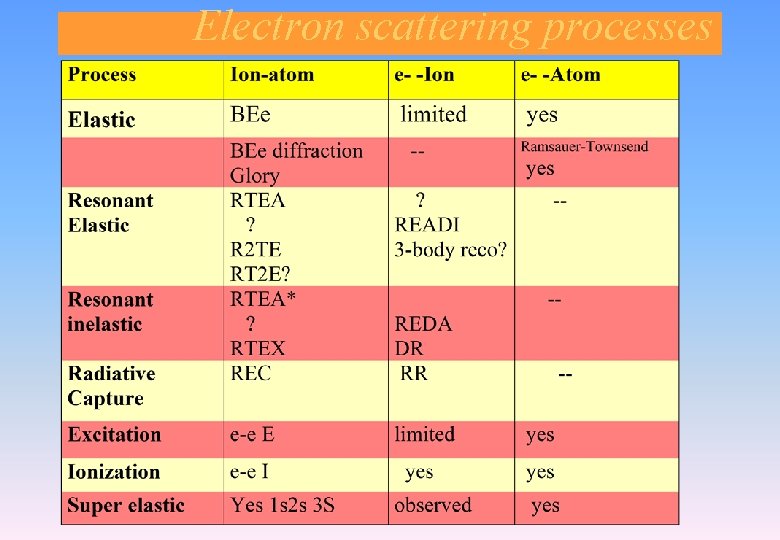
Electron scattering processes
Summary The impulse approximation provides: • simplification of ion-atom collisions by separating target-electron interactions from target-nucleus interactions. • unifying view-point for treating electron scattering in ion-atom, e-ion and Compton.
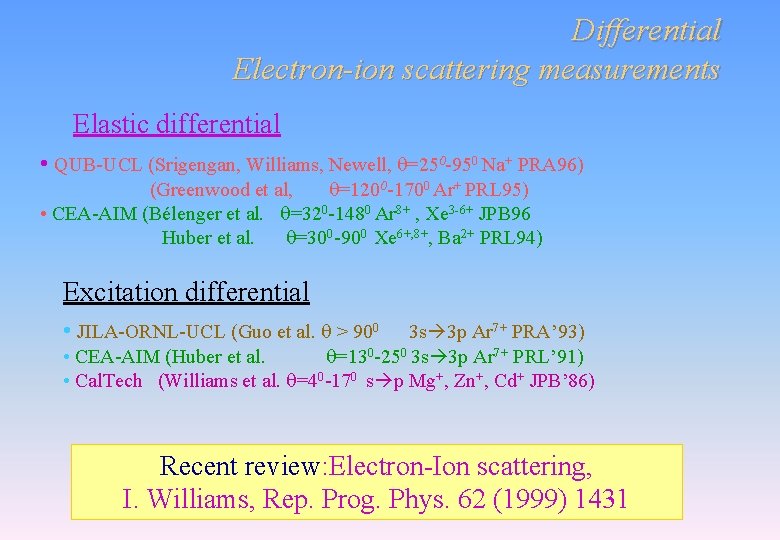
Differential Electron-ion scattering measurements Elastic differential • QUB-UCL (Srigengan, Williams, Newell, =250 -950 Na+ PRA 96) (Greenwood et al, =1200 -1700 Ar+ PRL 95) • CEA-AIM (Bélenger et al. =320 -1480 Ar 8+ , Xe 3 -6+ JPB 96 Huber et al. =300 -900 Xe 6+, 8+, Ba 2+ PRL 94) Excitation differential • JILA-ORNL-UCL (Guo et al. > 900 3 s 3 p Ar 7+ PRA’ 93) • CEA-AIM (Huber et al. =130 -250 3 s 3 p Ar 7+ PRL’ 91) • Cal. Tech (Williams et al. =40 -170 s p Mg+, Zn+, Cd+ JPB’ 86) Recent review: Electron-Ion scattering, I. Williams, Rep. Prog. Phys. 62 (1999) 1431
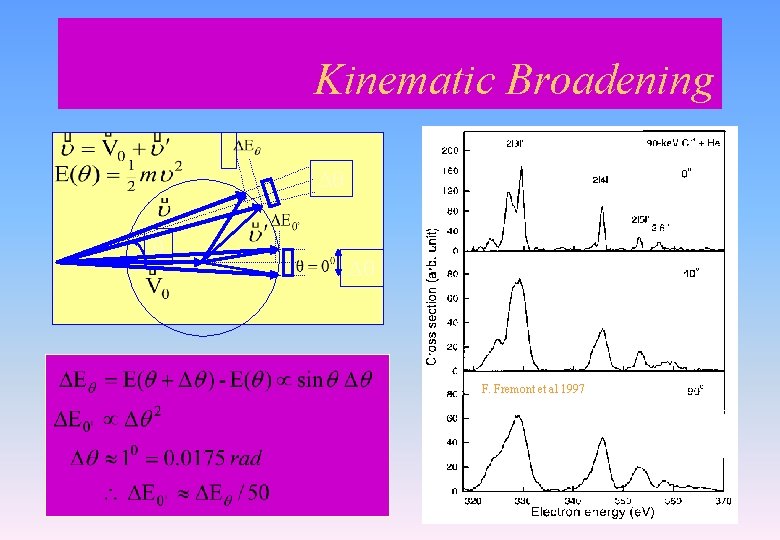
Kinematic Broadening D D F. Fremont et al 1997
The zero-degree Auger Projectile Spectroscopy setup
Sum of Rutherford and Short Range amplitudes Griffin & Pinzola PRA 42 (1990) 248
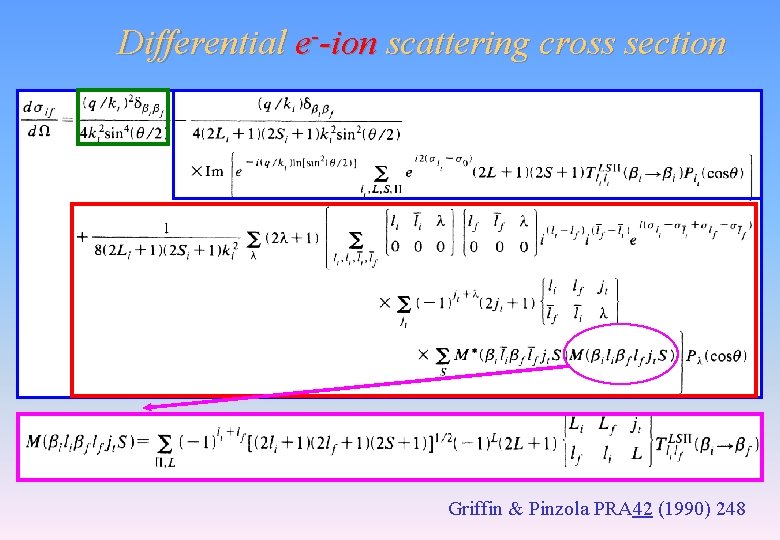
Differential e--ion scattering cross section Griffin & Pinzola PRA 42 (1990) 248
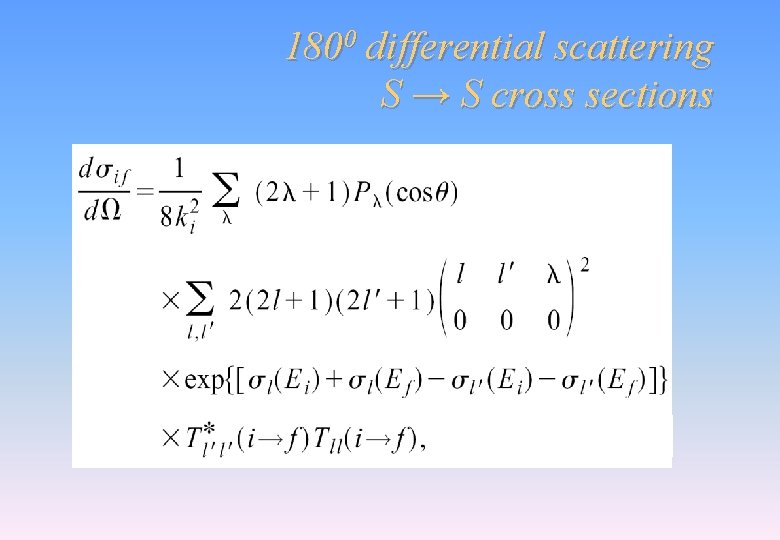
1800 differential scattering S → S cross sections
Efficiency Determination Normalization to the bare ion BEe peak Normalize to the Non-bare BEe peak!
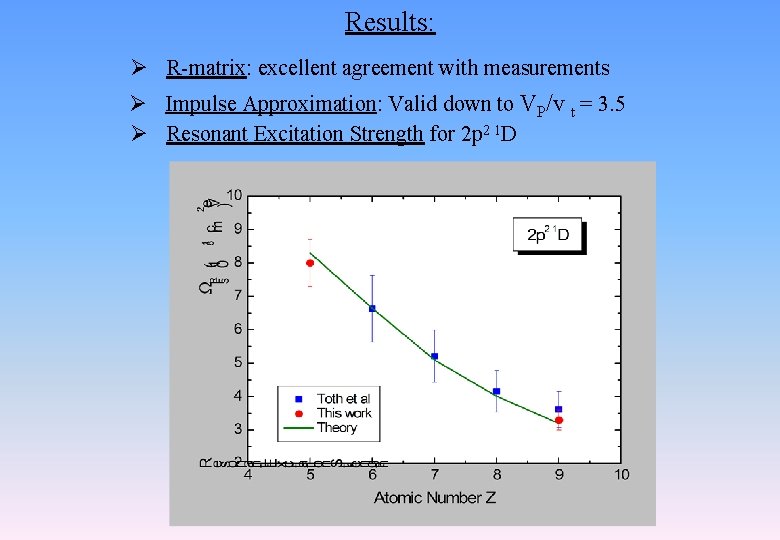
Results: Ø R-matrix: excellent agreement with measurements Ø Impulse Approximation: Valid down to VP/v t = 3. 5 Ø Resonant Excitation Strength for 2 p 2 1 D
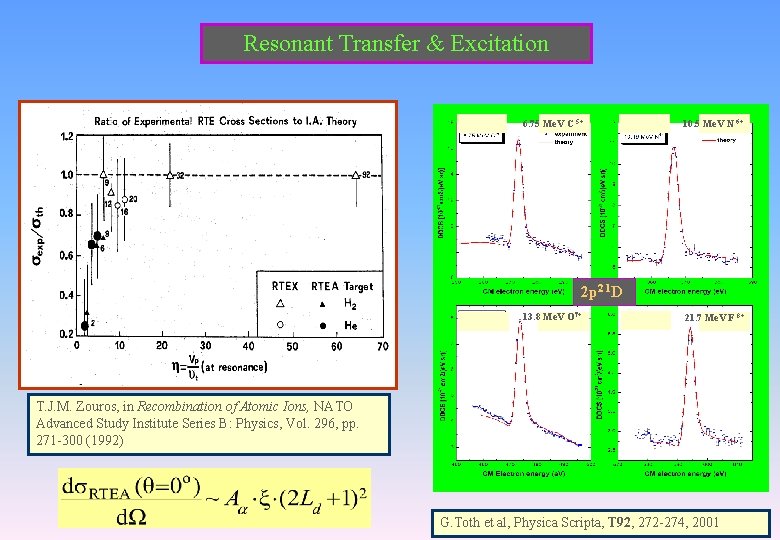
Resonant Transfer & Excitation 6. 75 Me. V C 5+ 10. 5 Me. V N 6+ 2 p 2 1 D 13. 8 Me. V O 7+ 21. 7 Me. V F 8+ T. J. M. Zouros, in Recombination of Atomic Ions, NATO Advanced Study Institute Series B: Physics, Vol. 296, pp. 271 -300 (1992) G. Toth et al, Physica Scripta, T 92, 272 -274, 2001
Recombination of He-like ions Kilgus et al PRA 1993