
Quasi Images ppt from Physics Department Princeton U
- Slides: 23
Quasi Images. ppt from Physics Department, Princeton U By Daniel Schechtman
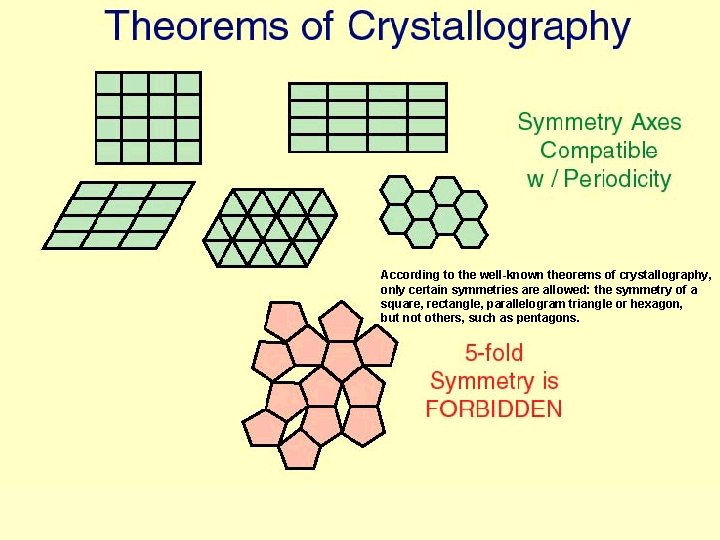
According to the well-known theorems of crystallography, only certain symmetries are allowed: the symmetry of a square, rectangle, parallelogram triangle or hexagon, but not others, such as pentagons.
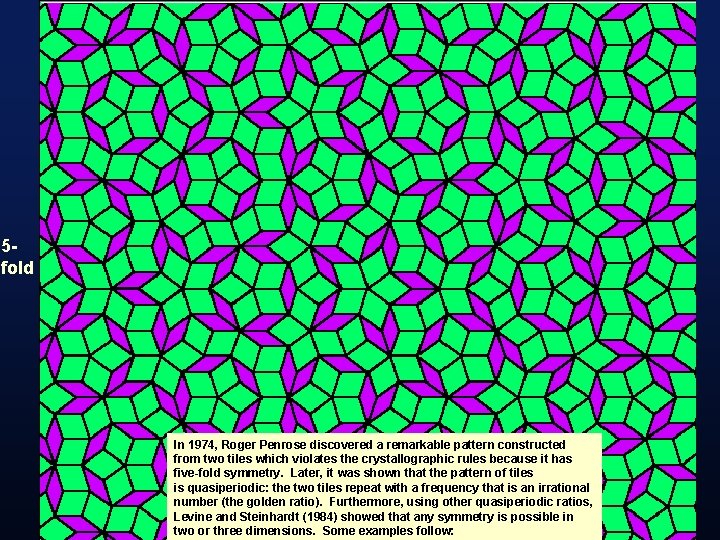
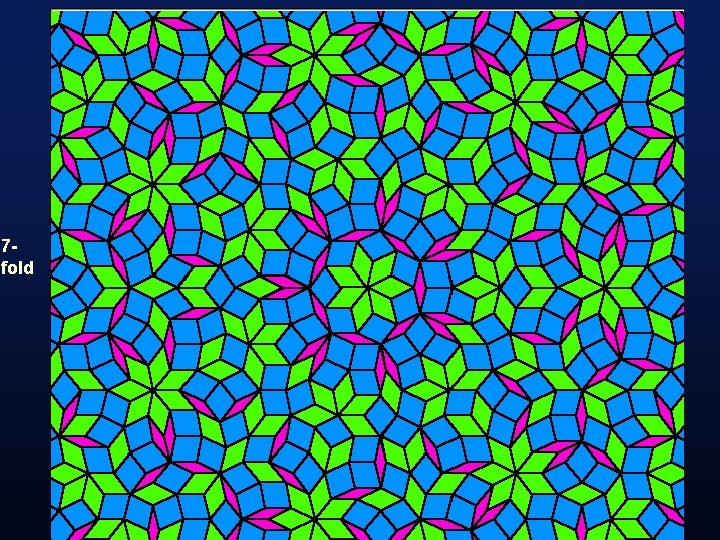
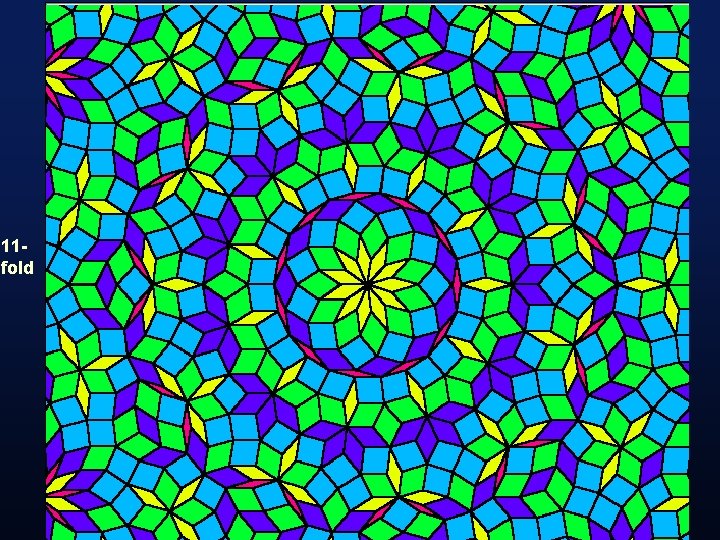
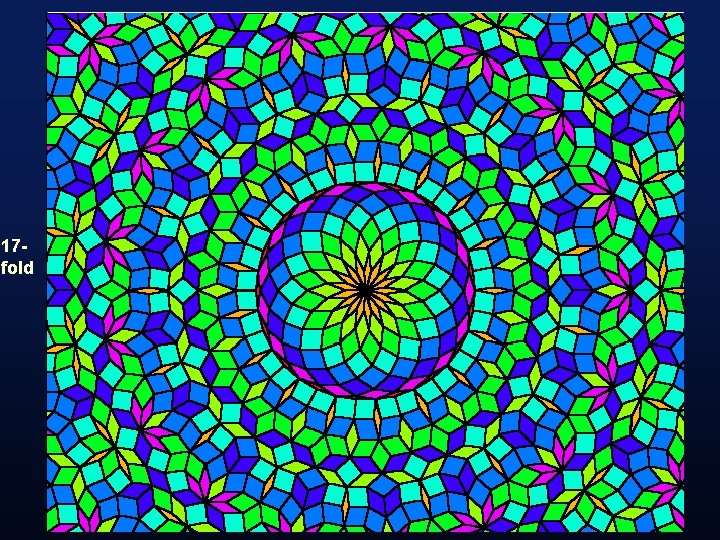
5 fold In 1974, Roger Penrose discovered a remarkable pattern constructed from two tiles which violates the crystallographic rules because it has five-fold symmetry. Later, it was shown that the pattern of tiles is quasiperiodic: the two tiles repeat with a frequency that is an irrational number (the golden ratio). Furthermore, using other quasiperiodic ratios, Levine and Steinhardt (1984) showed that any symmetry is possible in two or three dimensions. Some examples follow:
7 fold
11 fold
17 fold
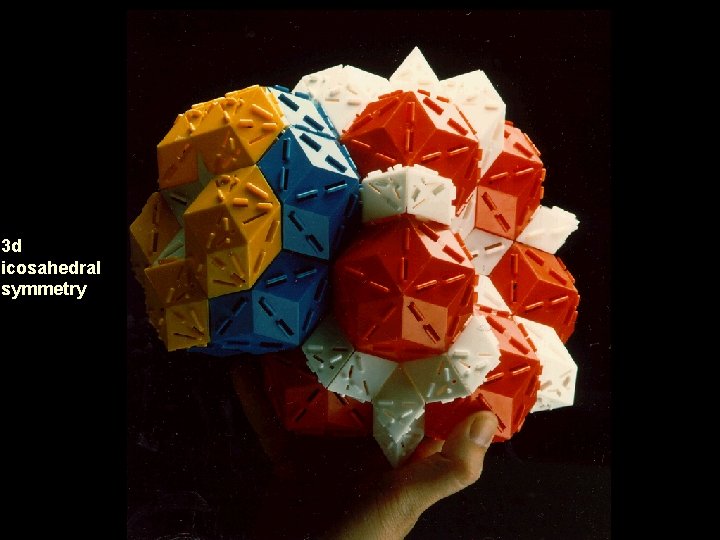
3 d icosahedral symmetry
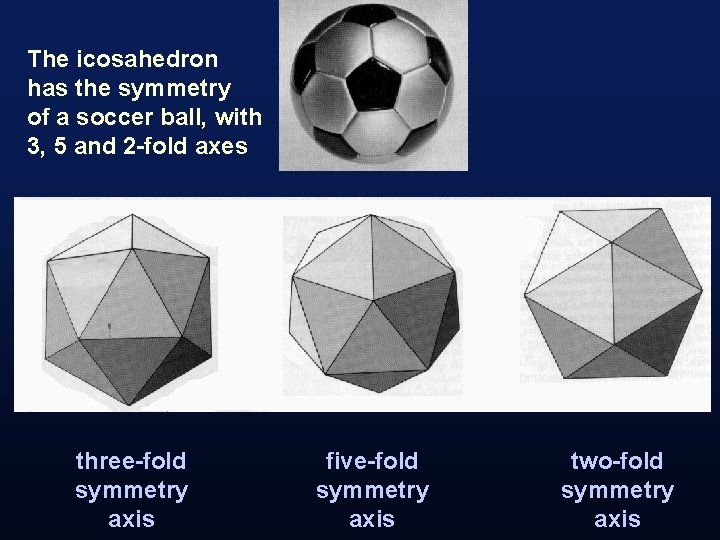
The icosahedron has the symmetry of a soccer ball, with 3, 5 and 2 -fold axes three-fold symmetry axis five-fold symmetry axis two-fold symmetry axis
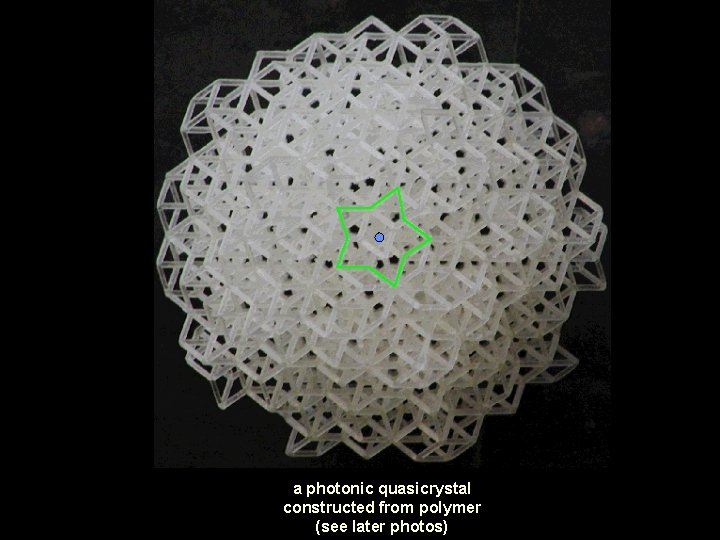
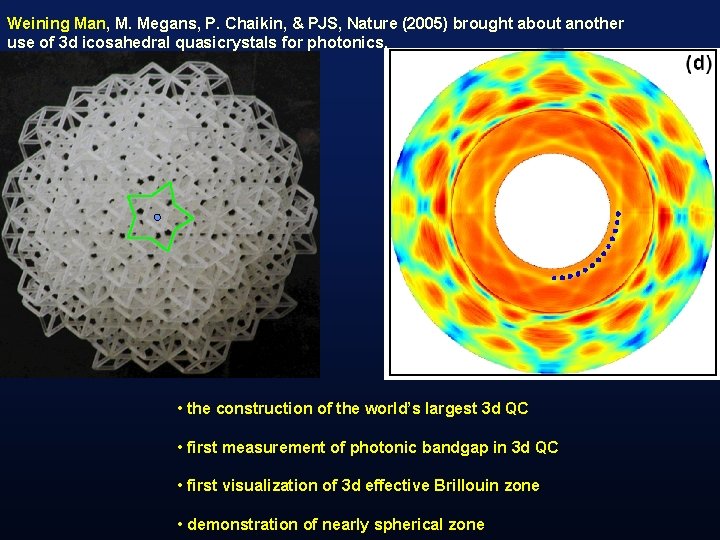
a photonic quasicrystal constructed from polymer (see later photos)
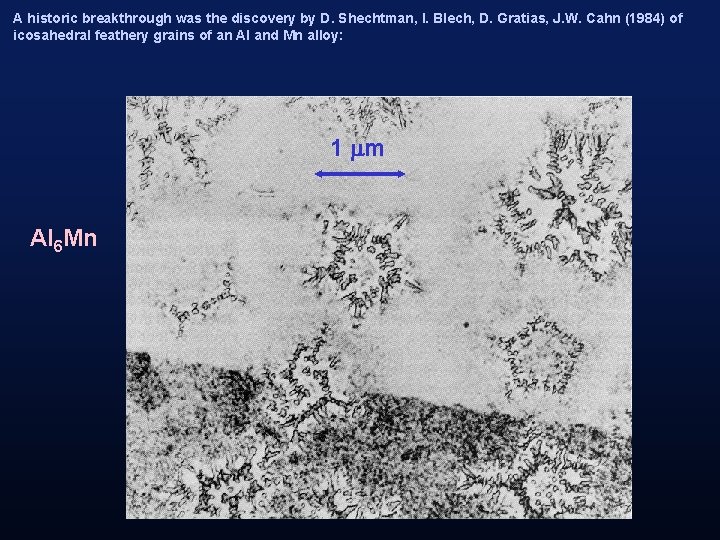
A historic breakthrough was the discovery by D. Shechtman, I. Blech, D. Gratias, J. W. Cahn (1984) of icosahedral feathery grains of an Al and Mn alloy: 1 mm Al 6 Mn
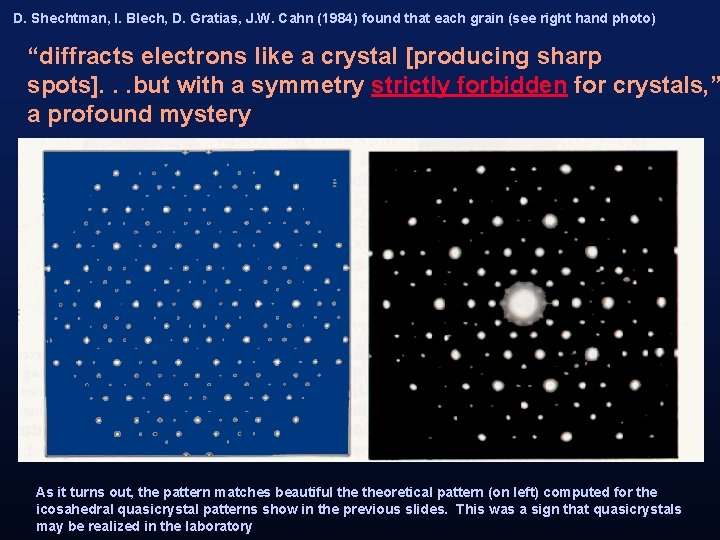
D. Shechtman, I. Blech, D. Gratias, J. W. Cahn (1984) found that each grain (see right hand photo) “diffracts electrons like a crystal [producing sharp spots]. . . but with a symmetry strictly forbidden for crystals, ” a profound mystery As it turns out, the pattern matches beautiful theoretical pattern (on left) computed for the icosahedral quasicrystal patterns show in the previous slides. This was a sign that quasicrystals may be realized in the laboratory
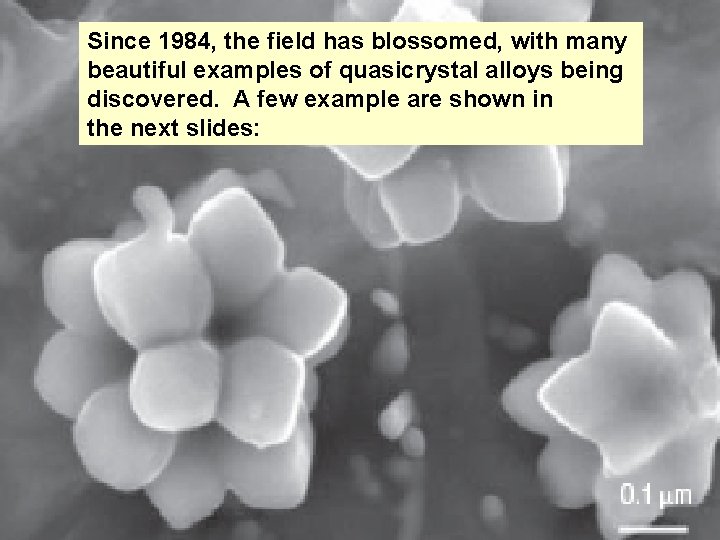
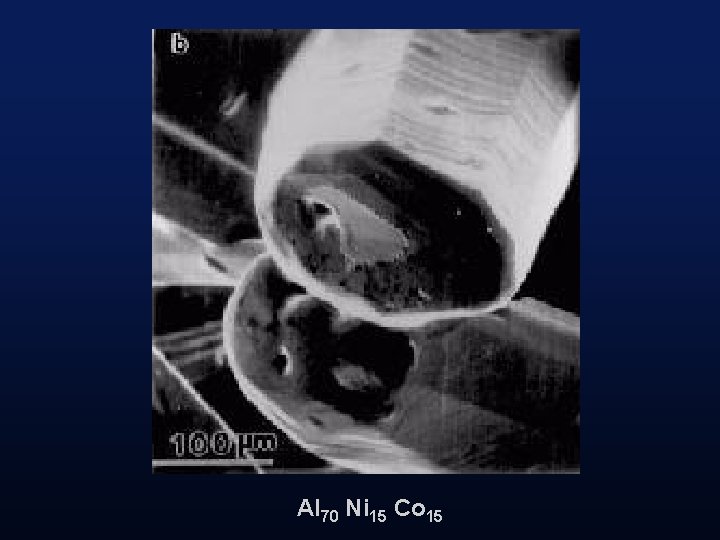
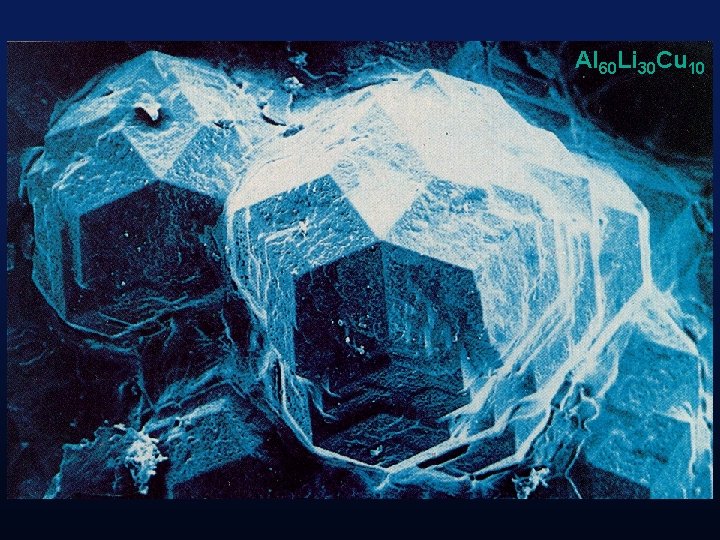
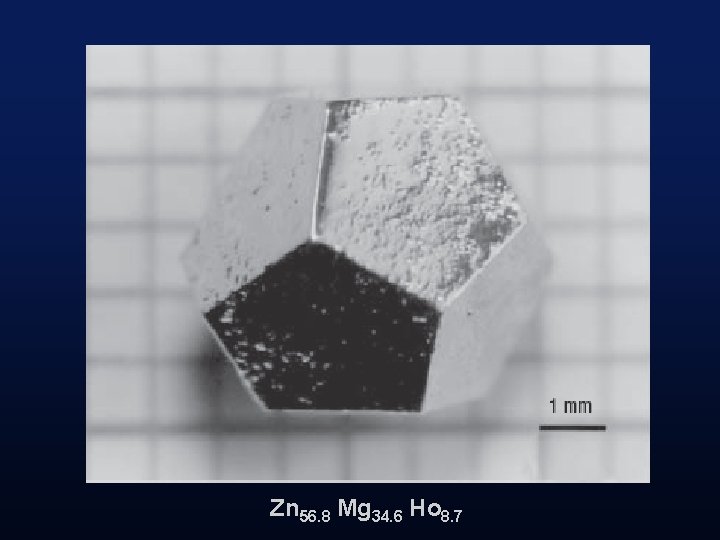
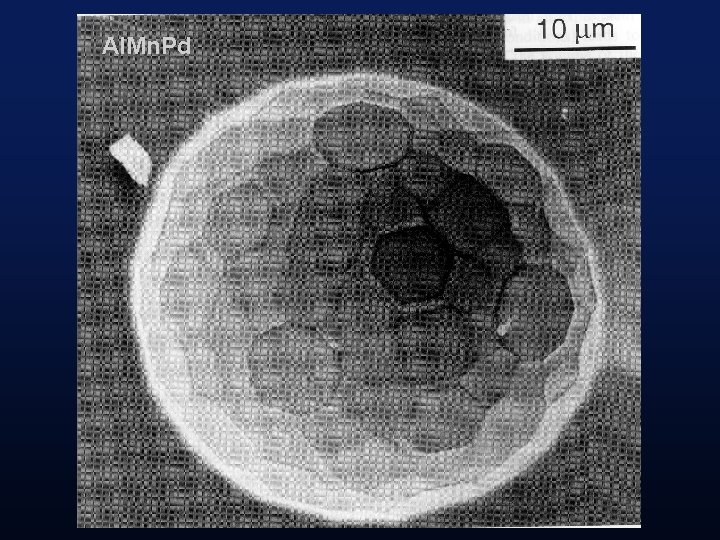
Since 1984, the field has blossomed, with many beautiful examples of quasicrystal alloys being discovered. A few example are shown in the next slides:
Al 70 Ni 15 Co 15
Al 60 Li 30 Cu 10
Zn 56. 8 Mg 34. 6 Ho 8. 7
Al. Mn. Pd
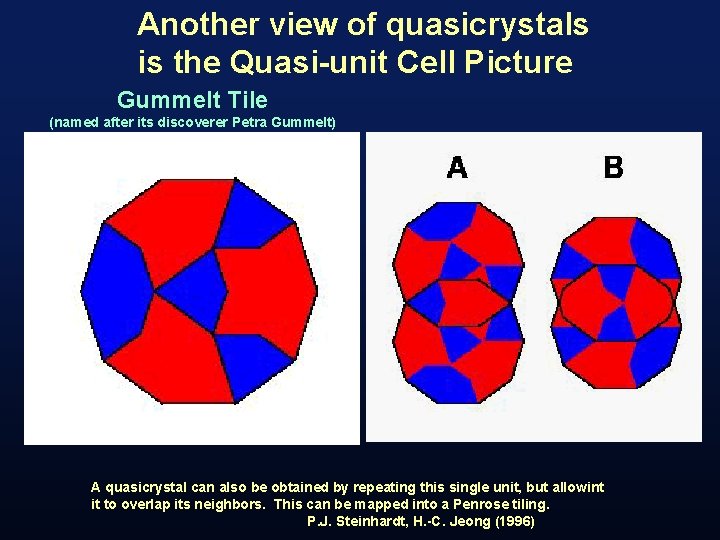
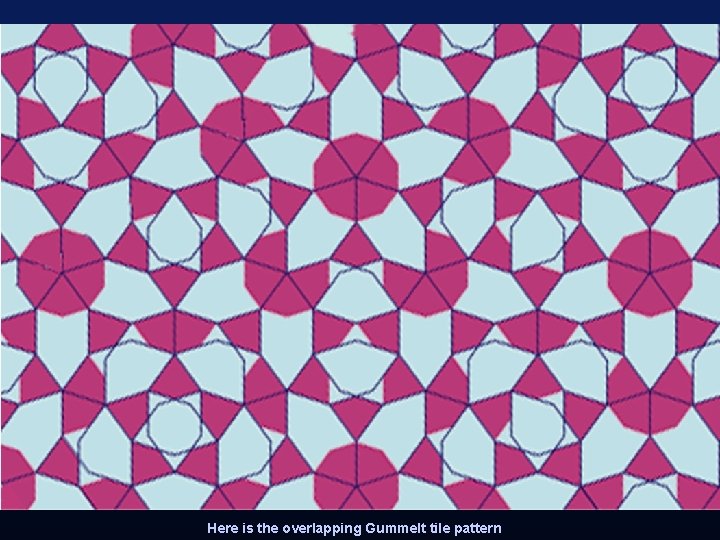
Another view of quasicrystals is the Quasi-unit Cell Picture Gummelt Tile (named after its discoverer Petra Gummelt) A quasicrystal can also be obtained by repeating this single unit, but allowint it to overlap its neighbors. This can be mapped into a Penrose tiling. P. J. Steinhardt, H. -C. Jeong (1996)
Here is the overlapping Gummelt tile pattern
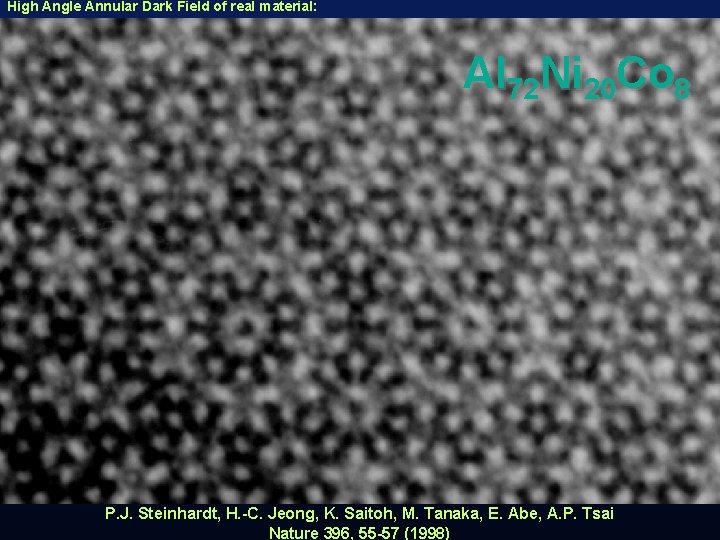
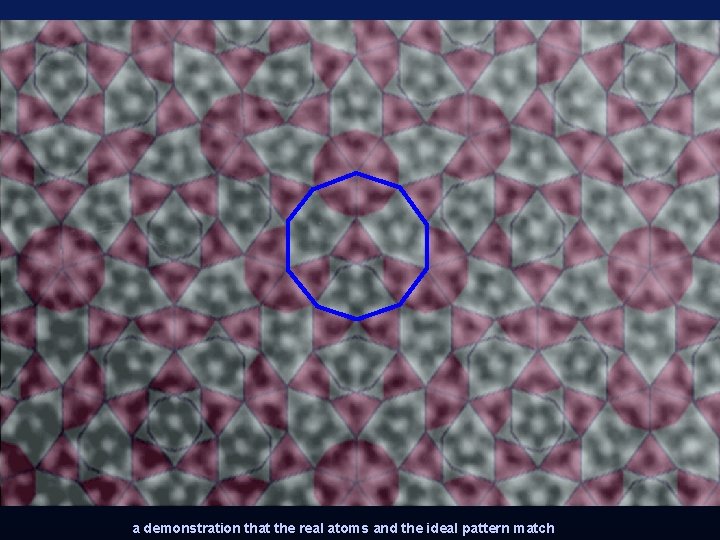
High Angle Annular Dark Field of real material: Al 72 Ni 20 Co 8 P. J. Steinhardt, H. -C. Jeong, K. Saitoh, M. Tanaka, E. Abe, A. P. Tsai Nature 396, 55 -57 (1998)
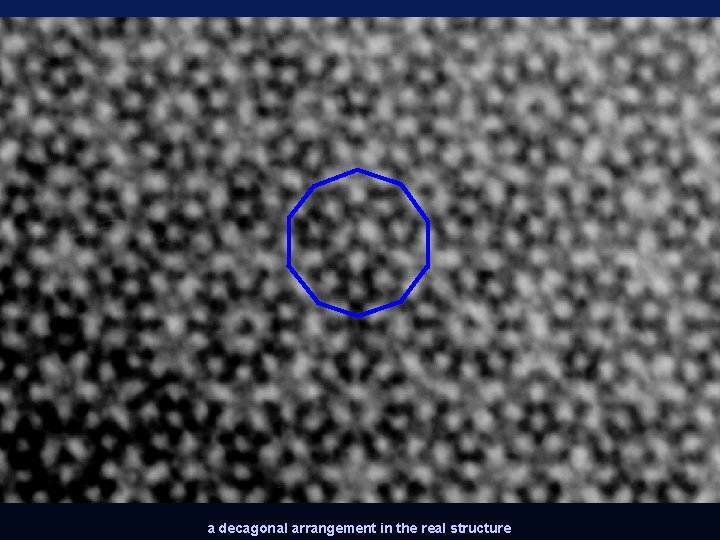
a decagonal arrangement in the real structure
a demonstration that the real atoms and the ideal pattern match
Weining Man, M. Megans, P. Chaikin, & PJS, Nature (2005) brought about another use of 3 d icosahedral quasicrystals for photonics. • the construction of the world’s largest 3 d QC • first measurement of photonic bandgap in 3 d QC • first visualization of 3 d effective Brillouin zone • demonstration of nearly spherical zone
In Lu & Steinhardt (2007), this tiling on the Darb-i-Imam shrine in Isfahan is shown which is nearly perfectly quasicrystalline. Although it can be mapped into a Penrose tiling with only a few point-like defects, it appears more likely that the designers used a subdivision rule that, if continued, would lead to a different five-fold quasicrystalline pattern.