
Quarterly Updates Evidence Based Practice for Public Health
Quarterly Updates Evidence Based Practice for Public Health Nurses Session I Public Health Nursing Section Evidence Based Practice Committee July 30, 2008
What is Evidence Based Practice? l Conscientious use of current best evidence in making decisions about client care l It is a problem solving approach that integrates ¡Search for and critical appraisal of the most relevant evidence to answer a burning clinical question ¡One's own clinical expertise ¡Patient preferences and values Melnyk & Fineout-Overholt, 2005
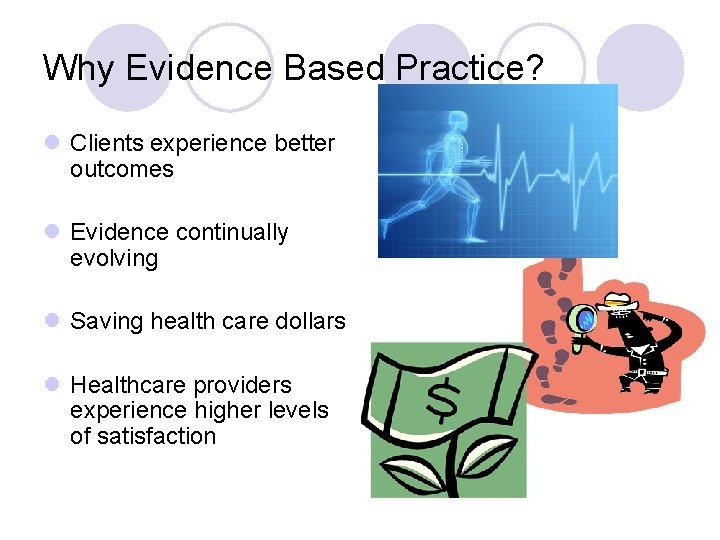
Why Evidence Based Practice? l Clients experience better outcomes l Evidence continually evolving l Saving health care dollars l Healthcare providers experience higher levels of satisfaction

Why Evidence Based Practice for Public Health Nursing? l EBP is inherently tied to quality l Major way of achieving: ¡ the core public health functions ¡ the essential public health services
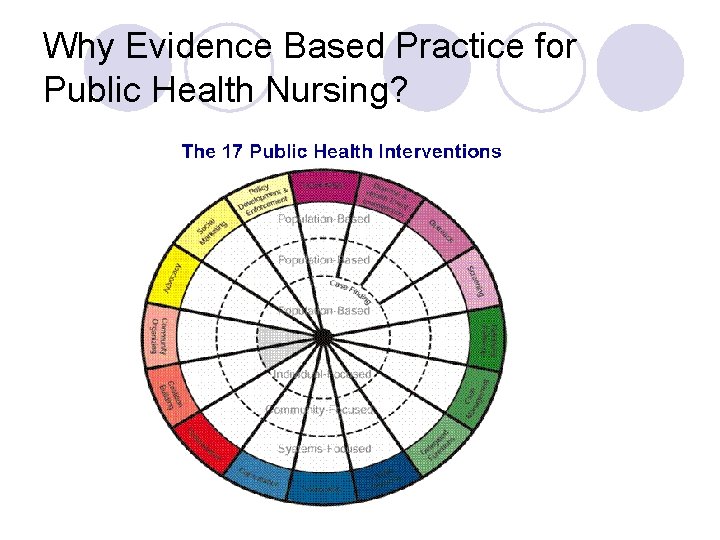
Why Evidence Based Practice for Public Health Nursing?
How Evidence Based Practice Different From…. . ? l Research Utilization l Clinical Practice Guideline l Best Practice
Steps of Evidence Based Practice l Ask the burning clinical question l Search for best evidence l Critically appraise the evidence l Integrate the evidence l Evaluate practice decision or change Melnyk & Fineout-Overholt, 2005
Asking the Burning Question Using PICO l Patient population of interest l Intervention of interest l Comparison of interest l Outcome of interest
Suggested Template for Asking a PICO Question l Prevention ¡For _______does the use of _______reduce the future risk of _____compared with _____? ¡For example: For clients 50 years and older (P), does the use of an influenza vaccine (I) reduce the future risk of pneumonia (O) compared with clients who have not received the vaccine (C)?
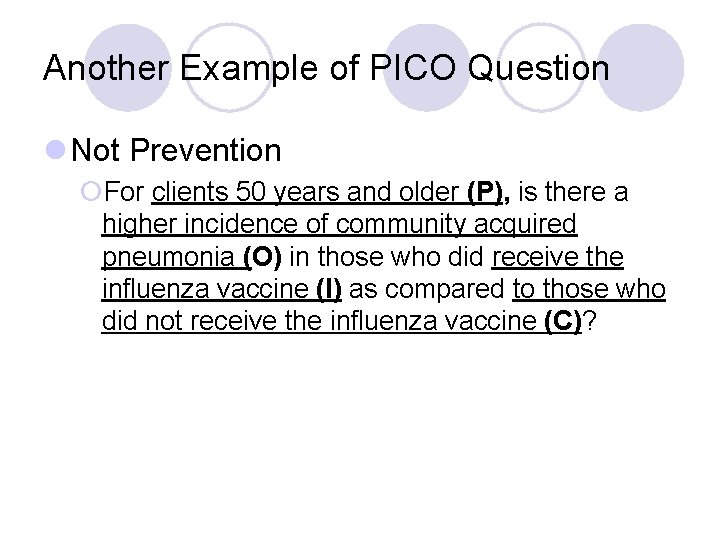
Another Example of PICO Question l Not Prevention ¡For clients 50 years and older (P), is there a higher incidence of community acquired pneumonia (O) in those who did receive the influenza vaccine (I) as compared to those who did not receive the influenza vaccine (C)?
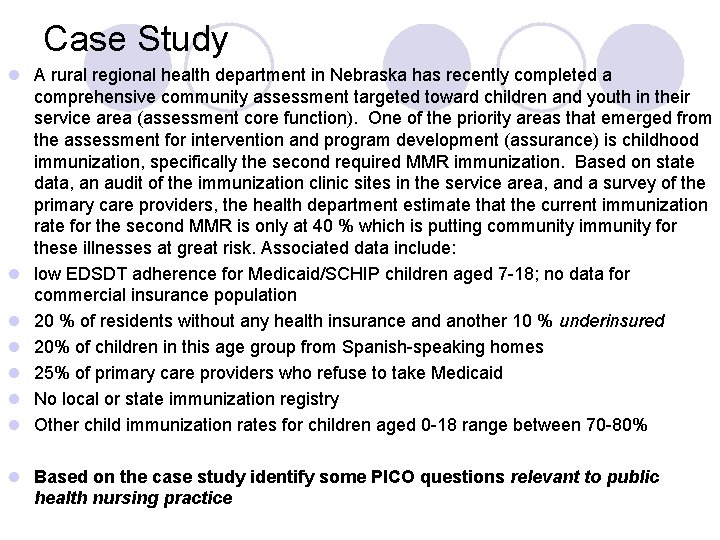
Case Study l A rural regional health department in Nebraska has recently completed a comprehensive community assessment targeted toward children and youth in their service area (assessment core function). One of the priority areas that emerged from the assessment for intervention and program development (assurance) is childhood immunization, specifically the second required MMR immunization. Based on state data, an audit of the immunization clinic sites in the service area, and a survey of the primary care providers, the health department estimate that the current immunization rate for the second MMR is only at 40 % which is putting community immunity for these illnesses at great risk. Associated data include: l low EDSDT adherence for Medicaid/SCHIP children aged 7 -18; no data for commercial insurance population l 20 % of residents without any health insurance and another 10 % underinsured l 20% of children in this age group from Spanish-speaking homes l 25% of primary care providers who refuse to take Medicaid l No local or state immunization registry l Other child immunization rates for children aged 0 -18 range between 70 -80% l Based on the case study identify some PICO questions relevant to public health nursing practice
- Slides: 11