
Quarter Three Reading Informational Text Grade 3 Teacher












- Slides: 36
Quarter Three Reading Informational Text Grade 3 Teacher Directions Common Formative Assessment
Quarter Three Informational Text Common Formative Assessments Team Members and Writers Deborah Alvarado Heather Giard Sandra Maines Martha Rodriguez Nicole Chronister Christine Goldmann Marie Maxwell Kelly Rooke Tammy Cole Jamie Goldstein Heather Mc. Cullum Jill Russo Lindsay Crowell Melissa Hancock Gina Mc. Lain Brent Saxton Deborah Delplanche Jamie Incrovato Shawna Munson Leslie Sell Diane Dow Ginger Jay Gustavo Olvera Erin Shepherd Liana Duran Jenn Johnson Teresa Portinga Wendy Sunday Carrie Ellis Ko Kagawa Judy Ramer Niki Thoen Sheri Fisher Kimberly Laws Erin Reamer Mandy Wedel Lindsay Garcia Berta Lule Sara Retzlaff Stephanie Gerig Alfonso Lule Jennifer Robbins Thank you to all of those who reviewed and edited and a special appreciation to Vicki and her amazing editing skills. Rev. Control: 01/01/2014 HSD – OSP and Susan Richmond Daniels 2
Important Information A. This booklet is divided into two parts… 1. Teacher Resources a. Page 1 – 16 2. Student Assessment b. Page’s 17 – 36 This booklet is intended for assessing reading informational standards RI 4, 8 and 9 at the end of the third quarter as well as Research Targets 2, 3 and 4 as applicable. Do NOT allow students to read the passages before the assessment. Students who do not read independently should be given the assessment as a listening comprehension test. Do NOT read the passage to the students until it is time for the assessment. Printing Instructions… Be sure you have printed a teacher’s Edition! Please print the teacher’s directions (pages 1 – 16). Read the directions before giving the assessment. Print pages 17 – 36 for each student. This would print each student page as an 8 ½ X 11 page… or login to the Print Shop and order pre-assessments and/or CFAs. NEW CCSS Lexile Band (range) Grade Band Current Lexile Band CCSS Lexile Band* K– 1 N/A 2– 3 450 L– 725 L 420 L– 820 L 4– 5 645 L– 845 L 740 L– 1010 L 6– 8 860 L– 1010 L 925 L– 1185 L 9 -10 960 L– 1115 L 1050 L– 1335 L 11–CCR 1070 L– 1220 L 1185 L– 1385 L Rev. Control: 01/01/2014 HSD – OSP and Susan Richmond 3
Types of Readers Independent Readers: Students read selections independently without reading assistance. Non-Independent Readers: (Please indicate on record sheet if student is Not an Independent Reader) Read the selection and questions aloud to the student in English or Spanish. Students complete the selected response answers by shading in the bubble. Kindergarten teachers should follow the kindergarten teacher directions as “Listening Comprehension. ” Read the selected response answers to the student. Students complete the constructed response answers by writing a response for each question. Read the constructed response answers to the student. You may write the answer the student says unless he/she is able to do so. Selected and Constructed Response Questions Note: The constructed response questions do NOT assess writing proficiency and should not be scored as such. Constructed Response - Quarters 1 and 2 Students answer 2 Short Response Constructed Response Questions about the passages. Selected Response - Quarters 1 - 4 Students answer 10 Selected Response Questions about the passages. Constructed Response - Quarters 3 and 4 Students answer 2 Research Constructed Response Questions about the passages. Scoring Options Class Check-Lists (Reading Learning Progressions form) Write and Revise There is a learning progression “Class Check-List” for each standard assessed. This is to be used by the teacher for recording or monitoring progress if desired (optional). Write and Revise are added to the pre-assessments and CFAs in quarters 2, 3 and 4. They are not “officially” scored on any form, but will be scored on SBAC. DOK Guide Path to DOK - 2 Path to DOK - 1 Grade 3 Sample Path to DOK 2 Informational Text Learning Progressions End Goal DOK 1 - Ka DOK 1 - Kc Locate specific text features (i. e. , key words, sidebars, hyperlinks) from a text read and discussed in class. Define (understand use) Standard Academic Language: key words, sidebars, hyperlinks, relevant, efficiently, topic and text features/tools. DOK 1 - Cf Answers questions about the purpose of different text features and search tools. DOK 2 - Ch DOK 2 - Cl DOK 2 - APn Standard Concept Development Understands that search or text features (tools) can provide information about a text or topic. Locate information using key words, sidebars or hyperlinks (and other search tools/text features) relevant to a topic. Obtain and Interpret information using key words, sidebars or hyperlinks relevant to a topic. RI 3. 5 Use text features and search tools (e. g. , key words, sidebars, hyperlinks) to locate information relevant to a given topic efficiently. Student Name Class Summary Assessment Sheet This is a spreadsheet to record each quarter’s pre-assessment and CFA. Selected Responses (SRs) are given a score of “ 0” or “ 1. ” Constructed Response (CRs) in quarters 1 and 2 are given a score on a rubric continuum of “ 0 – 3, ” and in quarters 3 and 4 a research score on a rubric continuum of “ 0 -2. " Student Self-Scoring Students have a self-scoring sheet to color happy faces green if their answers are correct or red if they are not. Student Reflection The last page in the student assessment book is a reflection page. Students can reflect about each question they missed and why. Teacher prompts may help students reflect (such as: What was the question asking, can you rephrase it? ). Scoring forms are available at: http: //sresource. homestead. com/index. html Rev. Control: 01/01/2014 HSD – OSP and Susan Richmond 4
Write and Revise The Common Core standards are integrative in nature. Student proficiency develops and is assessed on a continuum. The HSD Common Formative Assessment (CFA) for quarter three includes three write and revise assessed categories to prepare our students for this transition in conjunction with our primary focus of Reading Informational Text. Quarter 3 1. Students “Read to Write” integrating basic writing and language revision skills. Write and Revise Assessed Categories for Quarter Three a. Writing: Write and Revise (revision of short text) b. Language: Language and Vocabulary Use (accurate use of words and phrases) c. Language: Edit and Clarify (accurate use of grammar, mechanics and syntax) Rev. Control: 01/01/2014 HSD – OSP and Susan Richmond 5
Important Please Read Before Starting Assessment Quarter Three Preparing for Performance Tasks The quarter three CFAs prepares students for performance tasks. There are many combinations of claims, targets and standards that can be used within a performance task. 1 Performance tasks have two parts (Part 1 and Part 2). In quarter three students will complete the tasks highlighted below. Performance Tasks Have Two Parts The underlined sections are those scored on SBAC. Part 1 • • • Part 2 Read two paired passages. Take notes while reading (note-taking). Answer SR and CR research questions about sources • Plan your essay (brainstorming pre-writing). • • Write, Revise and Edit W. 5 Writing a Full Composition or Speech IMPORTANT – NEW Please make copies of the note-taking form for each student in your class if you choose to use it. 1. Note-Taking: Students take notes as they read passages to gather information about their sources. Students are allowed to use their notes to later write a full composition (essay). Note-taking strategies should be taught as structured lessons throughout the school year in grades K – 6. A note-taking form is provided for your students to use for this assessment or you may use whatever formats you’ve had past success with. Please have students practice using the note-taking page in this document before the actual assessment if you choose to use it. 2. Research: In Part 1 of a performance task students answer constructed response questions written to measure a student’s ability to use research skills. These CR questions are scored using the SBAC Research Rubrics rather than the short response rubric used in quarters 1 and 2. The SBAC Research Rubrics assesses research skills students need in order to complete a performance task. 3. Planning: In Part 2 of a performance task students plan their essay. They are allowed to use their notes. This is the brainstorming or pre-writing activity. Students can plan their writing using a graphic organizer. Note: During the actual SBAC assessment (grades 3 – 6) you may not be allowed to give students a pre-made note taking form or graphic organizer. Students may have to develop their own as they read. Student Directions: Your students have directions in their student assessment booklet. They are a shortened version of what the directions will actually look like on the SBAC assessment. Please remind them to read the directions. 1 Performance tasks (PT) measure complex assessment targets and demonstrate students' ability to think and reason. Performance tasks produce fully developed writing or speeches. PTs connect to real life applications (such as writing an essay or a speech or producing a specific product). http: //www. smarterbalanced. org/sample-items-and-performance-tasks/. Rev. Control: 01/01/2014 HSD – OSP and Susan Richmond 6
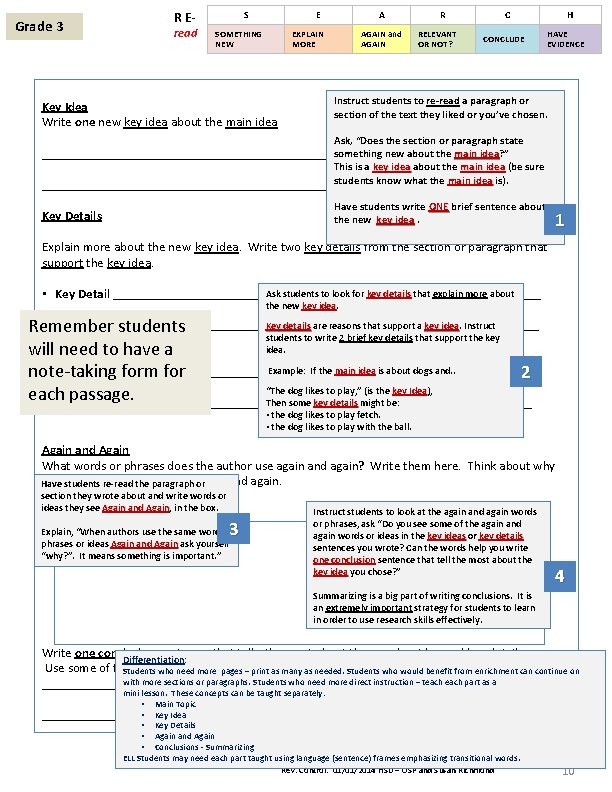
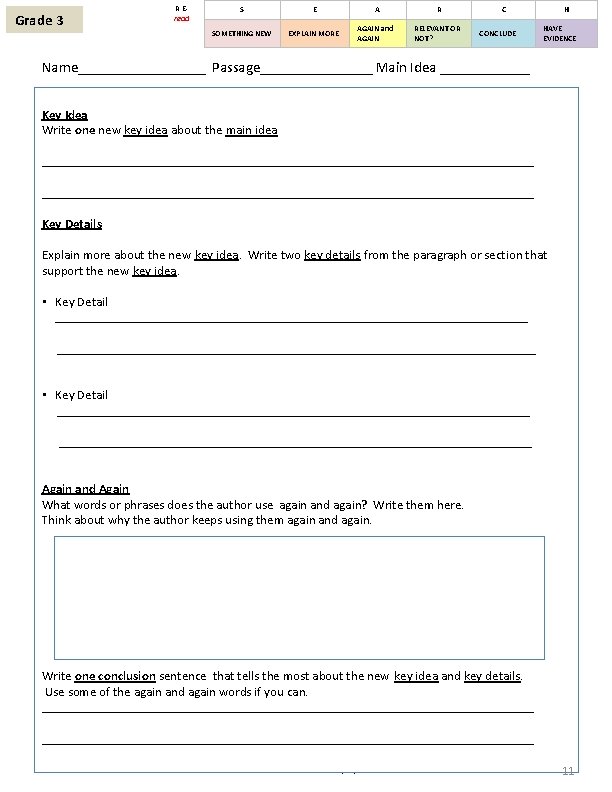
Teachers. . Note-Taking Feel free to use the note-taking forms if you wish or use what you’ve been using in your classrooms and have had success with. If you use the provided note-taking form, your students need to have had practice with the form before the assessment. Each student will need a note-taking form for each passage. The form is located in the teacher’s instructional section. All underlined words on the note-taking form are grade-level standard specific academic language. Important information about note-taking: During a Performance Task, students who take notes as they re-read a passage for specific details that promote research skills (main idea/topic, key details, conclusion) will later be able to find answers to questions more efficiently. Reading the questions first and then the looking in the text for the answer is a good practice, however not all answers to higher level or inferred questions have explicit answers within a text. 1. Read the text through to get the “gist” without the distraction of finding answers or note-taking. 2. Re-read the text. Take notes using a note-taking form. 3. Read answer the questions. Students may find some answers to highlight if they are not inferred or explicit although many research questions are of a higher level. Rev. Control: 01/01/2014 HSD – OSP and Susan Richmond
Planning to Write a Full Composition Informational Full-Composition Performance Task Prompt Compare and contrast the characteristics of dolphins and porpoises. Use important points and key details from both passages to support your answer. OPTIONAL! (By 4 th quarter students will be asked to write a full composition. For now, you can do a whole group guided practice, modeled demonstration or skip the experience all together) Teachers. . Your students are preparing to write a full composition. Part 1 of a performance task is part of that preparation (read paired passages, take notes and answer SR and CR questions). During Part 2 of a performance task students are allowed to look at their notes and SR and CR questions to gather information to plan a full informational writing piece using the performance task prompt (above). If you would like your students to have the experience of “planning” a full informational composition after completing Part 1 (this assessment) here a few ideas: 1. Find a graphic organizer you’ve used before to plan a writing piece. 2. Give explicit-direct instruction of the grade-level process allowing students to use their paired passages, notes and SR and CR responses. 3. Be sure students know the criteria before they begin (what you are expecting them to do). 4. Share exemplary models of completed graphic organizers. Review the criteria. Rev. Control: 01/01/2014 HSD – OSP and Susan Richmond
Research Note-Taking In the Classroom The note-taking forms are scaffolded in grades K – 6 following the recommended SBAC research targets and embedded standards. http: //www. smarterbalanced. org/wordpress/wp-content/uploads/2011/12/ELA-Literacy-Content-Specifications. pdf Research Informational Text Standards: (RI. 3: Standard 3 is included as resource in the development of research and writing as it supports connecting information between and within texts). RI. 9: Final Task Goal: Students are able to compare and contrast – find similarities and differences within or between texts for a specific purpose. The note-taking forms in this assessment support the above goal and the following assessed research targets: ü Research Target 2 Locate, Select, Interpret and Integrate Information ü Research Target 3 Gather/ Distinguish Relevance of Information ü Research Target 4 Cite evidence to support opinions or ideas Writing Research Standards: Writing Standard 7: Shows and builds knowledge about a topic Writing Standard 8: Analyzes information for a purpose Writing Standard 9: Supporting with evidence and reason Rev. Control: 01/01/2014 HSD – OSP and Susan Richmond
Grade 3 R E- read S E SOMETHING NEW A EXPLAIN MORE Key Idea Write one new key idea about the main idea AGAIN and AGAIN R RELEVANT OR NOT? C CONCLUDE H HAVE EVIDENCE Instruct students to re-read a paragraph or section of the text they liked or you’ve chosen. Ask, “Does the section or paragraph state something new about the main idea? ” ______________________________________ idea This is a key idea about the main idea (be sure students know what the main idea is). ______________________________________ Have students write ONE brief sentence about the new key idea. Key Details 1 Explain more about the new key idea. Write two key details from the section or paragraph that support the key idea. Ask students to look for key details that explain more about • Key Detail _________________________________ the new key idea Key details are reasons that support a key idea. _____________________________________ idea Instruct Remember students to write 2 brief key details that support the key idea. will need to have a Example: If the main idea is about dogs and. . • Key Detail _________________________________ note-taking form for 2 “The dog likes to play, ” (is the key Idea), Idea each_____________________________________ passage. Then some key details might be: • the dog likes to play fetch. • the dog likes to play with the ball. Again and Again What words or phrases does the author use again and again? Write them here. Think about why the author them again and again. Have students keeps re-read using the paragraph or section they wrote about and write words or ideas they see Again and Again, Again in the box. 3 Explain, “When authors use the same words, phrases or ideas Again and Again ask yourself “why? ”. It means something is important. ” Instruct students to look at the again and again words or phrases, ask “Do you see some of the again and again words or ideas in the key ideas or key details sentences you wrote? Can the words help you write one conclusion sentence that tell the most about the key idea you chose? ” 4 Summarizing is a big part of writing conclusions. It is an extremely important strategy for students to learn in order to use research skills effectively. Write one conclusion sentence that tells the most about the new key idea and key details. Differentiation: Use some of the againwho and again if you can. as needed. Students who would benefit from enrichment can continue on Students need more words pages – print as many with more sections or paragraphs. Students who need more direct instruction – teach part as a ______________________________________ mini lesson. These concepts can be taught separately: • Main Topic • Key Idea _______________________________________ • Key Details • Again and Again • Conclusions - Summarizing ELL Students may need each part taught using language (sentence) frames emphasizing transitional words. Rev. Control: 01/01/2014 HSD – OSP and Susan Richmond 10
Grade 3 R Eread S E SOMETHING NEW EXPLAIN MORE A AGAIN and AGAIN R RELEVANT OR NOT? C CONCLUDE H HAVE EVIDENCE Name_________ Passage________ Main Idea ______ Key Idea Write one new key idea about the main idea ____________________________________________________________________________ Key Details Explain more about the new key idea. Write two key details from the paragraph or section that support the new key idea. • Key Detail __________________________________________________________________________ • Key Detail _________________________________________________________________________ Again and Again What words or phrases does the author use again and again? Write them here. Think about why the author keeps using them again and again. Write one conclusion sentence that tells the most about the new key idea and key details. Use some of the again and again words if you can. ____________________________________________________________________________ Rev. Control: 01/01/2014 HSD – OSP and Susan Richmond 11
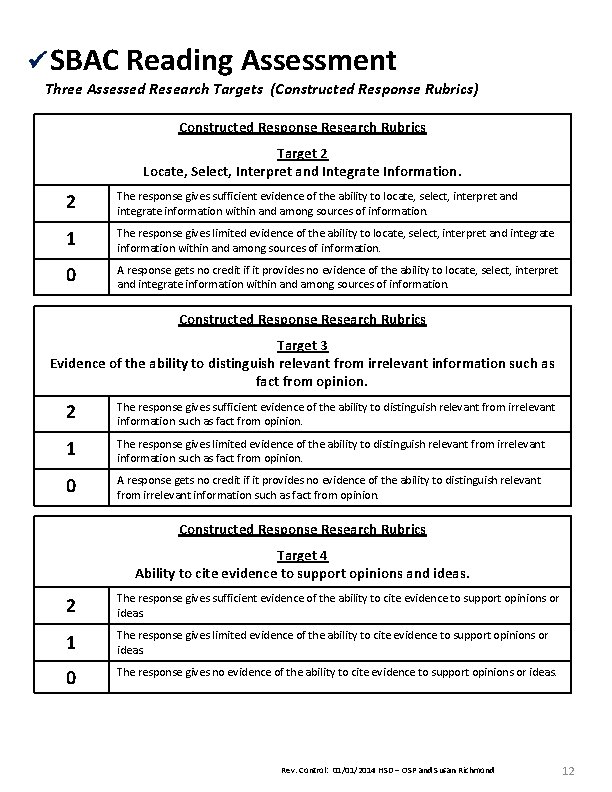
SBAC Reading Assessment Three Assessed Research Targets (Constructed Response Rubrics) Constructed Response Research Rubrics Target 2 Locate, Select, Interpret and Integrate Information. 2 The response gives sufficient evidence of the ability to locate, select, interpret and integrate information within and among sources of information. 1 The response gives limited evidence of the ability to locate, select, interpret and integrate information within and among sources of information. 0 A response gets no credit if it provides no evidence of the ability to locate, select, interpret and integrate information within and among sources of information. Constructed Response Research Rubrics Target 3 Evidence of the ability to distinguish relevant from irrelevant information such as fact from opinion. 2 The response gives sufficient evidence of the ability to distinguish relevant from irrelevant information such as fact from opinion. 1 The response gives limited evidence of the ability to distinguish relevant from irrelevant information such as fact from opinion. 0 A response gets no credit if it provides no evidence of the ability to distinguish relevant from irrelevant information such as fact from opinion. Constructed Response Research Rubrics Target 4 Ability to cite evidence to support opinions and ideas. 2 The response gives sufficient evidence of the ability to cite evidence to support opinions or ideas. 1 The response gives limited evidence of the ability to cite evidence to support opinions or ideas. 0 The response gives no evidence of the ability to cite evidence to support opinions or ideas. Rev. Control: 01/01/2014 HSD – OSP and Susan Richmond 12
Quarter 3 CFA Research Constructed Response Answer Key Constructed Response RI. 3. 4 Research Target #2 6. Based on the passage Is it a Porpoise or a Dolphin? , explain what a mammal is. What key details from the passage Dolphins and Porpoises supports your answer? Constructed Response Research Rubrics Target 2 Locate, Select, Interpret and Integrate Information Teacher /Rubric “Language Response” The response: gives sufficient evidence of the ability to locate and select information about the prompt. Students must locate and then select the information that supports what a mammal is from the passage Is it a Porpoise or a Dolphin? . Students should locate and select the following facts: (1) mammals are warm-blooded, (2) mammals are born alive, and (3) mammals have lungs and breathe air. Students may include any example found in the text (dogs, cats, horses, etc…. ) The response: gives sufficient evidence of the ability to interpret and integrate information about the prompt. Students must interpret and integrate how the passage Dolphins and Porpoises supports or confirms the definition of what a mammal is from the previous passage. Evidence that supports the definition of what a mammal is in the passage could include (1) dolphins and porpoises belong to a species that breathes air and must surface for air, (2) and pods protect baby dolphins which are born alive. Student writing should consistently reflect the prompt and not have extraneous information. Student “Language” Response Example Student locates and selects 3 facts defining what a mammal is found in the passage Is it a Porpoise or a Dolphin? , and 2 facts integrating what a mammal is from the passage Dolphins and Porpoises. 2 1 0 The passage Is it a Porpoise or a Dolphin? explains that dolphins and porpoises are mammals. A mammal is an animal that is warm blooded, which means their body temperature always stays the same. Mammals also give birth to live young. Mammals have lungs and breathe air. Dolphins and porpoises come to the surface of the ocean to breathe air through their blowhole. In the passage Dolphins and Porpoises, it also says dolphins and porpoises must breathe air and come to the surface to breathe and their babies are born alive. Student locates and selects 2 facts defining what a mammal is found in the passage Is it a Porpoise or a Dolphin? , and 1 fact integrating (supporting) what a mammal is from the passage Dolphins and Porpoises. The first story said that mammals are warm blooded animals. Dolphins and porpoises are mammals. They breathe air and are warm blooded. The other story also said they need air. The student does not answer the prompt. Dolphins are very friendly and nice. Toward RI. 3. 4 and Research Target 2 Locate, Select, Interpret and Integrate Information. RI. 3. 4 Determine the meaning of general academic and domain-specific words and phrases in a text relevant to a grade 3 topic or subject area. Rev. Control: 01/01/2014 HSD – OSP and Susan Richmond 13
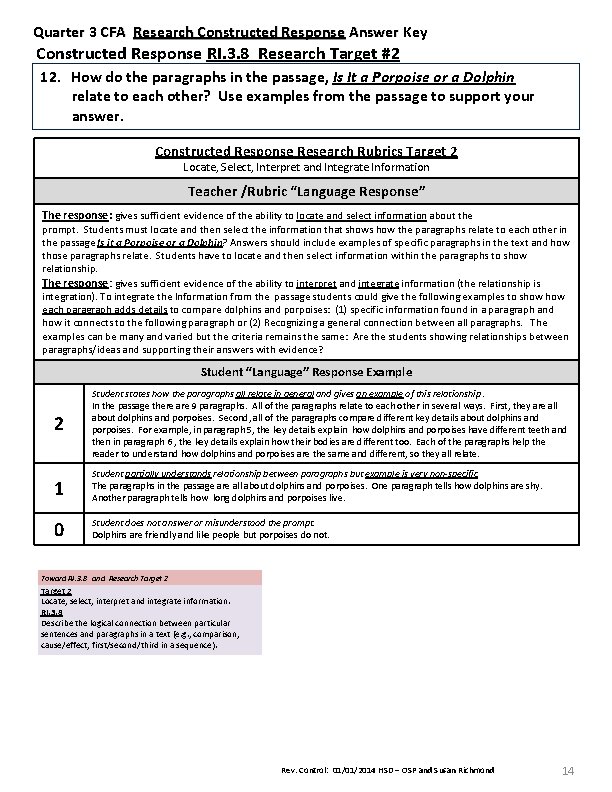
Quarter 3 CFA Research Constructed Response Answer Key Constructed Response RI. 3. 8 Research Target #2 12. How do the paragraphs in the passage, Is It a Porpoise or a Dolphin relate to each other? Use examples from the passage to support your answer. Constructed Response Research Rubrics Target 2 Locate, Select, Interpret and Integrate Information Teacher /Rubric “Language Response” The response: gives sufficient evidence of the ability to locate and select information about the prompt. Students must locate and then select the information that shows how the paragraphs relate to each other in the passage Is it a Porpoise or a Dolphin? Answers should include examples of specific paragraphs in the text and how those paragraphs relate. Students have to locate and then select information within the paragraphs to show relationship. The response: gives sufficient evidence of the ability to interpret and integrate information (the relationship is integration). To integrate the Information from the passage students could give the following examples to show each paragraph adds details to compare dolphins and porpoises: (1) specific information found in a paragraph and how it connects to the following paragraph or (2) Recognizing a general connection between all paragraphs. The examples can be many and varied but the criteria remains the same: Are the students showing relationships between paragraphs/ideas and supporting their answers with evidence? Student “Language” Response Example 2 Student states how the paragraphs all relate in general and gives an example of this relationship. In the passage there are 9 paragraphs. All of the paragraphs relate to each other in several ways. First, they are all about dolphins and porpoises. Second, all of the paragraphs compare different key details about dolphins and porpoises. For example, in paragraph 5, the key details explain how dolphins and porpoises have different teeth and then in paragraph 6 , the key details explain how their bodies are different too. Each of the paragraphs help the reader to understand how dolphins and porpoises are the same and different, so they all relate. 1 Student partially understands relationship between paragraphs but example is very non-specific. The paragraphs in the passage are all about dolphins and porpoises. One paragraph tells how dolphins are shy. Another paragraph tells how long dolphins and porpoises live. 0 Student does not answer or misunderstood the prompt. Dolphins are friendly and like people but porpoises do not. Toward RI. 3. 8 and Research Target 2 Locate, select, interpret and integrate information. RI. 3. 8 Describe the logical connection between particular sentences and paragraphs in a text (e. g. , comparison, cause/effect, first/second/third in a sequence). Rev. Control: 01/01/2014 HSD – OSP and Susan Richmond 14
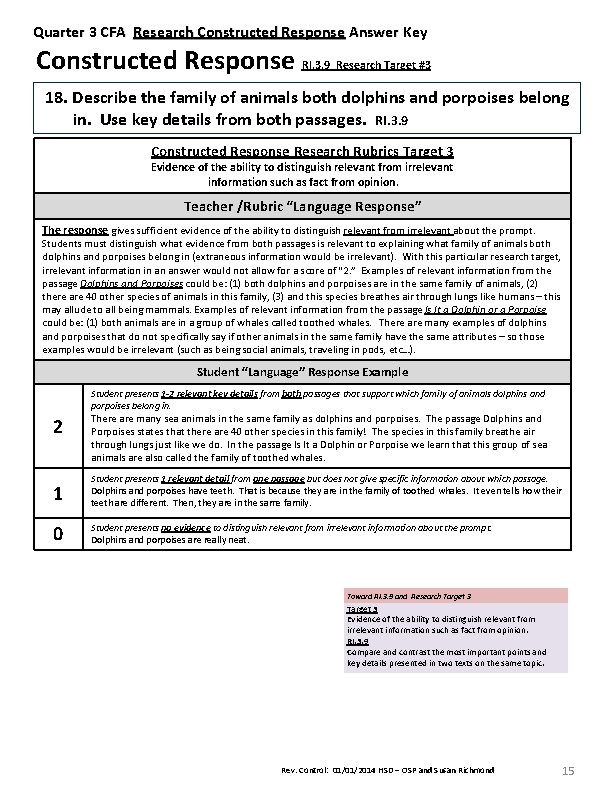
Quarter 3 CFA Research Constructed Response Answer Key Constructed Response RI. 3. 9 Research Target #3 18. Describe the family of animals both dolphins and porpoises belong in. Use key details from both passages. RI. 3. 9 Constructed Response Research Rubrics Target 3 Evidence of the ability to distinguish relevant from irrelevant information such as fact from opinion. Teacher /Rubric “Language Response” The response gives sufficient evidence of the ability to distinguish relevant from irrelevant about the prompt. Students must distinguish what evidence from both passages is relevant to explaining what family of animals both dolphins and porpoises belong in (extraneous information would be irrelevant). With this particular research target, irrelevant information in an answer would not allow for a score of “ 2. ” Examples of relevant information from the passage Dolphins and Porpoises could be: (1) both dolphins and porpoises are in the same family of animals, (2) there are 40 other species of animals in this family, (3) and this species breathes air through lungs like humans – this may allude to all being mammals. Examples of relevant information from the passage Is It a Dolphin or a Porpoise could be: (1) both animals are in a group of whales called toothed whales. There are many examples of dolphins and porpoises that do not specifically say if other animals in the same family have the same attributes – so those examples would be irrelevant (such as being social animals, traveling in pods, etc…). Student “Language” Response Example Student presents 1 -2 relevant key details from both passages that support which family of animals dolphins and porpoises belong in. 2 There are many sea animals in the same family as dolphins and porpoises. The passage Dolphins and Porpoises states that there are 40 other species in this family! The species in this family breathe air through lungs just like we do. In the passage Is It a Dolphin or Porpoise we learn that this group of sea animals are also called the family of toothed whales. 1 Student presents 1 relevant detail from one passage but does not give specific information about which passage. Dolphins and porpoises have teeth. That is because they are in the family of toothed whales. It even tells how their teeth are different. Then, they are in the same family. 0 Student presents no evidence to distinguish relevant from irrelevant information about the prompt. Dolphins and porpoises are really neat. Toward RI. 3. 9 and Research Target 3 Evidence of the ability to distinguish relevant from irrelevant information such as fact from opinion. RI. 3. 9 Compare and contrast the most important points and key details presented in two texts on the same topic. Rev. Control: 01/01/2014 HSD – OSP and Susan Richmond 15
Quarter 3 CFA Selected Response Answer Key Question 1 What is the meaning of the word blunt based on how it is used in the passage Dolphins and Porpoises? RI. 3. 4 C Question 2 According to the passage Dolphins and Porpoises what does the word pod mean? RI. 3. 4 B Question 3 What does the word protected mean in the passage Dolphins and Porpoises? RI. 3. 4 D Question 4 What is the meaning of the word echolocation in the passage Is it a Porpoise or a Dolphin? RI. 3. 4 A Question 5 Which word or phrase has about the same meaning as the word avoid as used in the passage Is it a Porpoise or a Dolphin? RI. 3. 4 B Question 6 Constructed Response RI. 3. 4 Question 7 In the passage Dolphins and Porpoises, what reason best explains why dolphins and porpoises have been placed on a list for protective species? RI. 3. 8 B Question 8 Why does the author of the article Dolphins and Porpoises add a paragraph about bottlenose dolphins? RI. 3. 8 D Question 9 Why does the author of Is it a Porpoise or a Dolphin? , begin paragraph 2 with the statement, “Many people think dolphins and porpoises are fish, but this is simply not true. ”? RI. 3. 8 C Question 10 According to the passage Is it a Porpoise or a Dolphin? why do dolphins and porpoises use echolocation? RI. 3. 8 D Question 11 How do dolphins and porpoises act differently around humans? RI. 3. 8 C Question 12 Constructed Response RI. 3. 8 Question 13 Which statement best explains how porpoise and dolphin teeth are different? RI. 3. 9 C Question 14 How do both authors present the key details in both passages? RI. 3. 9 B Question 15 What important point are both authors presenting in the two passages about dolphins and porpoises? RI. 3. 9 D Question 16 What key details about dolphins and porpoises are the same in both passages? RI. 3. 9 A Question 17 What can you infer about the largest species of dolphin compared to a smaller species of dolphin? RI. 3. 9 B Question 18 Constructed Response RI. 3. 9 Write and Revise Question 19 Which sentence does not support the main idea of the paragraph? (Write and Revise W. 2 -L. 3. 4 a) C Question 20 Which number sequence shows how the sentences in the paragraph should be organized? ? (Write and Revise W. 2 -L. 3. 4 a) A Question 21 Which word means about the same as pressure? (Write and Revise L. 33 a) C Question 22 Which phrase would replace the words “really do some damage” with more specific language? (L. 3. 5 c) D Question 23 Which example below shows the correct way to write the sentence? (L. 3. 2 c) A Question 24 Which example below shows the correct way to write the sentence? (L. 3. 2 d) C Rev. Control: 01/01/2014 HSD – OSP and Susan Richmond 16
Quarter Three Reading Informational Text Grade 3 Common Formative Assessment Reading Informational Text Student Assessment Name________
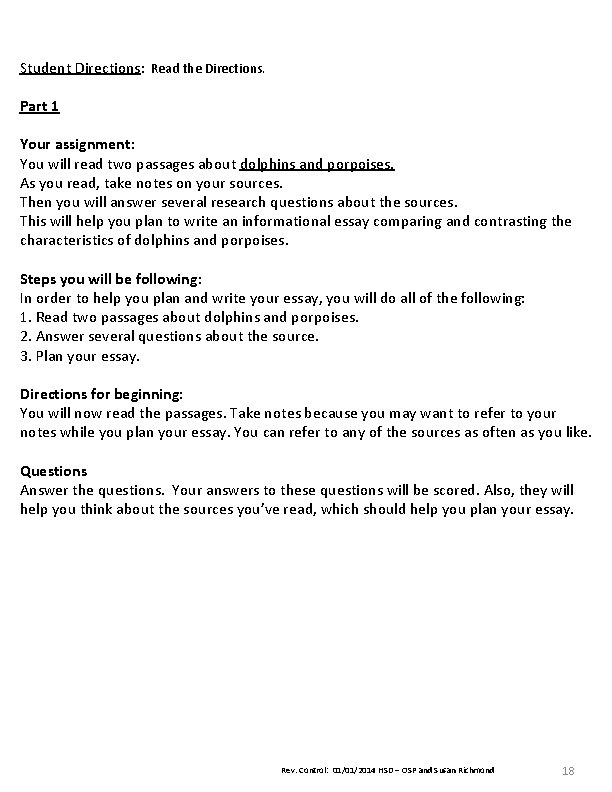
Student Directions: Read the Directions. Part 1 Your assignment: You will read two passages about dolphins and porpoises. As you read, take notes on your sources. Then you will answer several research questions about the sources. This will help you plan to write an informational essay comparing and contrasting the characteristics of dolphins and porpoises. Steps you will be following: In order to help you plan and write your essay, you will do all of the following: 1. Read two passages about dolphins and porpoises. 2. Answer several questions about the source. 3. Plan your essay. Directions for beginning: You will now read the passages. Take notes because you may want to refer to your notes while you plan your essay. You can refer to any of the sources as often as you like. Questions Answer the questions. Your answers to these questions will be scored. Also, they will help you think about the sources you’ve read, which should help you plan your essay. Rev. Control: 01/01/2014 HSD – OSP and Susan Richmond 18
Grade Equivalence 3. 5 Lexile 730 Dolphins and Porpoises 1 Do you know the difference between a porpoise and a dolphin? Both can be found in oceans all over the world, and both are in the same family of animals, which includes 40 other species. This species breathes air through lungs like humans do. They must come to the surface of the water for air. Dolphins and porpoises may look similar, but they are very different types of creatures. 2 Porpoises are smaller than dolphins and are rounder in shape. They have rounded heads and short noses. Porpoises do not grow longer than 6 feet in length and weigh less than 300 pounds. The teeth of porpoises are blunt and do not have sharp points like the teeth of dolphins. Porpoises travel in small groups of 2 to 4. 3 Dolphins are much larger and have a more elongated shape than porpoises. Dolphins grow between 6 feet and 26 feet in length and weigh between 70 and 1500 pounds. They have sharp teeth and long noses. Dolphins travel in sizeable groups, called pods, with 2 to more than 100 members. The pods of both dolphins and porpoises protect the babies when they are born. Baby dolphins and porpoises are born alive and can swim just a few minutes after they are born. 4 Most commonly seen off the coast of North Carolina is the bottlenose dolphin. This smaller dolphin generally swims close to the shore in groups of 2 to 12. The bottlenose dolphin is light colored on the belly and dark colored on the back. This special coloring is called an adaptation and this helps keep the dolphin safe from other animals. 5 Dolphins and porpoises are sometimes hunted or accidentally caught by fishermen. Because the numbers of dolphins and porpoises have declined, these animals are protected and have been placed on a list of protected species. This means that people are asked to pay special attention to keeping dolphins and porpoises safe from harm. Rev. Control: 01/01/2014 HSD – OSP and Susan Richmond 19
Grade Equivalence 3. 9 Lexile 800 Is it a Porpoise or a Dolphin? By Guy Belleranti 1 Porpoises and dolphins are fascinating and beautiful sea creatures. They are in the group of whales called toothed whales. 2 Many people think dolphins and porpoises are fish, but this is simply not true. They are mammals, just like dogs, cats, horses, cows, deer, and humans. Like all mammals, dolphins and porpoises are warm-blooded, which means their body temperature always stays the same. While most other animals are born from eggs, mammals are born alive. Also, mammals have lungs and breathe air. Dolphins and porpoises need to come up to the surface of the water to breathe through the blowhole in the top of their heads. penguins, walruses, and whales. 3 Most porpoises and dolphins eat fish, squid, and crustaceans. However, the largest species of dolphin, the orca, also hunts seals, 4 Both porpoises and dolphins use echolocation. This means they send out sounds and then listen for the echoes bouncing back. Echolocation helps them find food and escape predators. 5 Both porpoises and dolphins are toothed whales. However, porpoise teeth are shaped differently than dolphin teeth. Dolphins have sharp, cone-shaped teeth, but porpoise teeth are spade-shaped and flatter. Rev. Control: 01/01/2014 HSD – OSP and Susan Richmond 20
Is it a Porpoise or a Dolphin? 6 Their bodies are shaped differently, too. Porpoises are shorter with more rounded beaks and bodies. The dorsal fins on their backs are also shorter and less pointed. Dolphins, on the other hand, have longer, more pointed beaks. Their dorsal fins are taller and more pointed too. 7 Porpoises are usually under seven feet (two meters) long. Many dolphins are over ten feet (three meters). Orcas can grow over twenty feet long. 8 The life span of a dolphin is usually much longer than the life span of a porpoise. Dolphins can live 50 or more years. Porpoises seldom live longer than 15 years. 9 Dolphins are very social animals. They live in large groups called pods, with up to a dozen individuals. Dolphins enjoy interacting with humans. Sometimes they swim beside boats and make whistling and chirping sounds as they talk. Porpoises are much more shy than dolphins, and they tend to avoid human interaction. They usually live in smaller pods of 2 to 4 individuals. Their sounds can’t be heard by our ears. Rev. Control: 01/01/2014 HSD – OSP and Susan Richmond 21
Name _______ 1. What is the meaning of the word blunt based on how it is used in the passage Dolphins and Porpoises? A. similar but different B. travel C. does not have sharp edges D. dolphin’s teeth Standard RI. 3. 4 Determine the meaning of general academic and domain-specific words and phrases in a text relevant to a grade 3 topic or subject area. 2. According to the passage Dolphins and Porpoises what does the word pod mean? A. differences B. sizeable group C. rounder in shape D. pay special attention Standard RI. 3. 4 Determine the meaning of general academic and domain-specific words and phrases in a text relevant to a grade 3 topic or subject area. Rev. Control: 01/01/2014 HSD – OSP and Susan Richmond 22
3. What does the word protected mean in the passage Dolphins and Porpoises? A. types of creatures B. elongated shape C. special coloring D. safe from harm Standard RI. 3. 4 Determine the meaning of general academic and domain-specific words and phrases in a text relevant to a grade 3 topic or subject area. 4. What is the meaning of the word echolocation in the passage Is it a Porpoise or a Dolphin? A. sending out and listening for sounds to help locate objects B. coming to the surface for air because mammals need air to breathe C. escaping from predators D. making whistling and chirping sounds to talk to each other Standard RI. 3. 4 Determine the meaning of general academic and domain-specific words and phrases in a text relevant to a grade 3 topic or subject area. Rev. Control: 01/01/2014 HSD – OSP and Susan Richmond 23
5. Which word or phrase has about the same meaning as the word avoid as used in the passage Is it a Porpoise or a Dolphin? A. keep out B. keep away from C. interact with D. near Standard RI. 3. 4 Determine the meaning of general academic and domain-specific words and phrases in a text relevant to a grade 3 topic or subject area. 6. Based on the passage it a Porpoise or a Dolphin? , explain what a mammal is. What key details from the passage Dolphins and Porpoises supports your answer? RI. 3. 4, Research Target 2 Rev. Control: 01/01/2014 HSD – OSP and Susan Richmond 24
7. In the passage Dolphins and Porpoises, what reason best explains why dolphins and porpoises have been placed on a list for protective species? A. They have been hunted. B. Their numbers have declined. C. Sometimes they are caught by fisherman. D. People are asked to pay special attention to them. Standard RI. 3. 8 Describe the logical connection between particular sentences and paragraphs in a text (e. g. , comparison, cause/effect, first/second/third in a sequence). 8. Why does the author of the article Dolphins and Porpoises add a paragraph about bottlenose dolphins? A. They are the largest dolphin. B. They are light colored. C. They swim close to shore. D. They are commonly seen. Standard RI. 3. 8 Describe the logical connection between particular sentences and paragraphs in a text (e. g. , comparison, cause/effect, first/second/third in a sequence). Rev. Control: 01/01/2014 HSD – OSP and Susan Richmond 25
9. Why does the author of Is it a Porpoise or a Dolphin? begin paragraph 2 with the statement, “Many people think dolphins and porpoises are fish, but this is simply not true. ”? A. The paragraph begins with this statement to explain what type of fish dolphins and porpoises eat. B. The paragraph begins with this statement to explain how people and dolphins eat fish. C. The paragraph begins with this statement to explain why dolphins and porpoises are not fish. D. The paragraph begins with this statement to explain what type of fish are in the ocean. Standard RI. 3. 8 Describe the logical connection between particular sentences and paragraphs in a text (e. g. , comparison, cause/effect, first/second/third in a sequence). 10. According to the passage Is it a Porpoise or a Dolphin? why do dolphins and porpoises use echolocation? A. They are mammals. B. Their bodies are shaped differently. C. They enjoy interacting with humans. D. It helps them find food and escape predators. Standard RI. 3. 8 Describe the logical connection between particular sentences and paragraphs in a text (e. g. , comparison, cause/effect, first/second/third in a sequence). Rev. Control: 01/01/2014 HSD – OSP and Susan Richmond
11. How do dolphins and porpoises act differently around humans? A. Dolphins and porpoises do not enjoying interacting with humans. B. Dolphins and porpoises enjoy interacting with humans. C. Dolphins enjoy interacting with humans and porpoises do not. D. Porpoises enjoy interacting with humans and dolphins do not. Standard RI. 3. 8 Describe the logical connection between particular sentences and paragraphs in a text (e. g. , comparison, cause/effect, first/second/third in a sequence). 12. How do the paragraphs in the passage, Is It a Porpoise or a Dolphin relate to each other? Use examples from the passage to explain. RI. 3. 8, Research Target 2 Rev. Control: 01/01/2014 HSD – OSP and Susan Richmond 27
13. Which statement best explains how porpoise and dolphin teeth are different? A. Dolphins hunt seals, penguins, walruses and whales which require sharp teeth. B. Both dolphins and porpoises are toothed whales. C. Dolphins have sharp cone-shaped teeth, but porpoises’ teeth are spade-shaped and flatter. D. Dolphins and porpoises eat fish, squid and crustaceans. Standard RI. 3. 9 Compare and contrast the most important points and key details presented in two texts on the same topic. 14. How do both authors present the key details in both passages? A. Dolphins and porpoises have many things in common in both passages. B. Dolphins and porpoises are compared using key details. C. There are many key details about dolphins and porpoises. D. Both passages have key details about dolphins and porpoises being protected species. Standard RI. 3. 9 Compare and contrast the most important points and key details presented in two texts on the same topic. Rev. Control: 01/01/2014 HSD – OSP and Susan Richmond
15. What important point are both authors presenting in the two passages about dolphins and porpoises? A. Dolphins and porpoises can be found all over the world. B. Porpoises travel in smaller groups, however dolphins live in larger groups C. Dolphins and porpoises are often hunted. D. The differences between dolphins and porpoises. Standard RI. 3. 9 Compare and contrast the most important points and key details presented in two texts on the same topic. 16. What key details about dolphins and porpoises are the same in both passages? A. the shape of their bodies, length and weight B. descriptions of their dorsal fins C. the differences in their teeth D. their life span and what they eat Standard RI. 3. 9 Compare and contrast the most important points and key details presented in two texts on the same topic. Rev. Control: 01/01/2014 HSD – OSP and Susan Richmond
17. What can you infer about the largest species of dolphins compared to the bottlenose dolphins? A. The largest species of dolphin hunts seals, penguins, walruses and whales. B. The largest dolphin species hunts animals found in the deep sea while a smaller species hunts and swims close to the shore. C. Smaller species of dolphins live near the shore of North Carolina. D. The largest dolphin species is very dangerous while the smaller species is not. Standard RI. 3. 9 Compare and contrast the most important points and key details presented in two texts on the same topic. 18. Describe the family of animals both dolphins and porpoises belong in. Use key details from both passages. Rev. Control: 01/01/2014 HSD – OSP and Susan Richmond
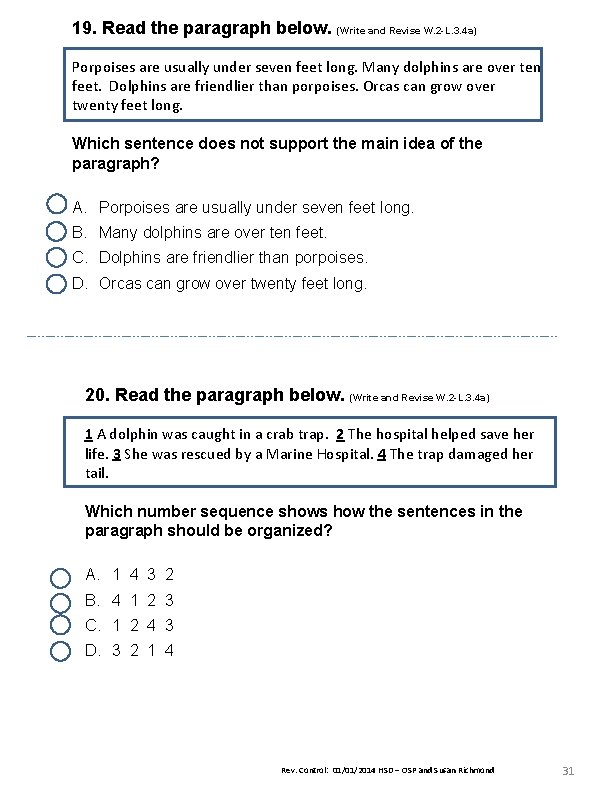
19. Read the paragraph below. (Write and Revise W. 2 -L. 3. 4 a) Porpoises are usually under seven feet long. Many dolphins are over ten feet. Dolphins are friendlier than porpoises. Orcas can grow over twenty feet long. Which sentence does not support the main idea of the paragraph? A. Porpoises are usually under seven feet long. B. Many dolphins are over ten feet. C. Dolphins are friendlier than porpoises. D. Orcas can grow over twenty feet long. 20. Read the paragraph below. (Write and Revise W. 2 -L. 3. 4 a) 1 A dolphin was caught in a crab trap. 2 The hospital helped save her life. 3 She was rescued by a Marine Hospital. 4 The trap damaged her tail. Which number sequence shows how the sentences in the paragraph should be organized? A. 1 4 3 2 B. 4 1 2 3 C. 1 2 4 3 D. 3 2 1 4 Rev. Control: 01/01/2014 HSD – OSP and Susan Richmond 31
21. Read the sentence. (Write and Revise L. 3. 3. a) Dolphins do not feel pressure under water because they do not breathe air under water. Which word means about the same as pressure? A. gas B. deep C. force D. strong 22. Read the sentence. (Write and Revise L. 3. 5 c) Crab traps can really do some damage to sea animals that get tangled in nets and ropes. Which phrase would replace the phrase “really do some damage” with more specific language? A. remain a food source B. be confusing C. be like a wall D. cause great injury Rev. Control: 01/01/2014 HSD – OSP and Susan Richmond 32
23. Read the sentence below. (Write and Revise L. 3. 2 c) The dolphin is not afraid of me said Tom. Which example below shows the correct way to write the sentence? A. “The dolphin is not afraid of me, ” said Tom. B. The dolphin is not afraid of me, said Tom. C. The dolphin is not afraid of me, “ said Tom. ” D. The dolphin, is not afraid of me, “ said Tom. ” 24. Read the sentence below. (Write and Revise L. 3. 2 d) The dolphins pod at the aquarium had 15 dolphins in it. Which example below shows the correct way to write the sentence? A. The dolphin’s pod at the aquarium had 15 dolphin’s in it. B. The dolphins pod at the aquarium had 15 dolphins’ in it. C. The dolphins’ pod at the aquarium had 15 dolphins in it. D. The dolphins’ pod at the aquarium had 15 dolphins’ in it. Rev. Control: 01/01/2014 HSD – OSP and Susan Richmond 33
STOP Close your books and wait for instructions! Rev. Control: 01/01/2014 HSD – OSP and Susan Richmond 34
Student Self-Check How Did You Do? Directions: Check the box for each answer as Correct or Not Correct 1 0 1 0 Question 1 What is the meaning of the word blunt based on how it is used in the passage Dolphins and Porpoises? RI. 3. 4 Question 2 According to the passage Dolphins and Porpoises what does the word pod mean? RI. 3. 4 Question 3 What does the word protected mean in the passage Dolphins and Porpoises? RI. 3. 4 Question 4 What is the meaning of the word echolocation in the passage Is it a Porpoise or a Dolphin? RI. 3. 4 Question 5 Which word or phrase has about the same meaning as the word avoid as used in the passage Is it a Porpoise or a Dolphin? RI. 3. 4 Question 6 Constructed Response Circle Final Score (3. 4) 3 2 Question 7 In the passage Dolphins and Porpoises, what reason best explains why dolphinsand porpoises have been placed on a list for protective species? RI. 3. 8 Question 8 Why does the author of the article Dolphins and Porpoises add a paragraph about bottlenose dolphins? RI. 3. 8 Question 9 Why does the author of Is it a Porpoise or a Dolphin? begin paragraph 2 with the statement, “Many people think dolphins and porpoises are fish, but this is simply not true. ” RI. 3. 8 Question 10 According to the passage Is it a Porpoise or a Dolphin? why do dolphins and porpoises use echolocation? RI. 3. 8 Question 11 How do dolphins and porpoises act differently around humans? RI. 3. 8 Question 12: Constructed Response Circle Final Score (3. 8) 3 2 Question 13 Which statement best explains how porpoise and dolphin teeth are different? RI. 3. 9 Question 14 How do both authors present the key details in both passages? RI. 3. 9 Question 15 What important point are both authors presenting in the two passages about dolphins and porpoises? RI. 3. 9 Question 16 What key details about dolphins and porpoises are the same in both passages? RI. 3. 9 Question 17 What can you infer about the largest species of dolphin compared to a smaller species of dolphin? RI. 3. 9 Question 18: Constructed Response Circle Final Score (3. 9) 3 2 Rev. Control: 01/01/2014 HSD – OSP and Susan Richmond 35
1 2 3 4 5 6 7 8 9 10 11 12 Rev. Control: 01/01/2014 HSD – OSP and Susan Richmond 36