
Quarter Three Reading Informational Text Grade 1 Teacher
- Slides: 36
Quarter Three Reading Informational Text Grade 1 Teacher Directions Common Formative Assessment
Quarter Three Informational Text Common Formative Assessments Team Members and Writers Deborah Alvarado Heather Giard Sandra Maines Martha Rodriguez Nicole Chronister Christine Goldmann Marie Maxwell Kelly Rooke Tammy Cole Jamie Goldstein Heather Mc. Cullum Jill Russo Lindsay Crowell Melissa Hancock Gina Mc. Lain Brent Saxton Deborah Delplanche Jamie Incrovato Shawna Munson Leslie Sell Diane Dow Ginger Jay Gustavo Olvera Erin Shepherd Liana Duran Jenn Johnson Teresa Portinga Wendy Sunday Carrie Ellis Ko Kagawa Judy Ramer Niki Thoen Sheri Fisher Kimberly Laws Erin Reamer Mandy Wedel Lindsay Garcia Berta Lule Sara Retzlaff Stephanie Gerig Alfonso Lule Jennifer Robbins Thank you to all of those who reviewed and edited and a special appreciation to Vicki Daniels and her amazing editing skills. Rev. Control: 02 -24 -14 HSD – OSP and © Susan Richmond 2
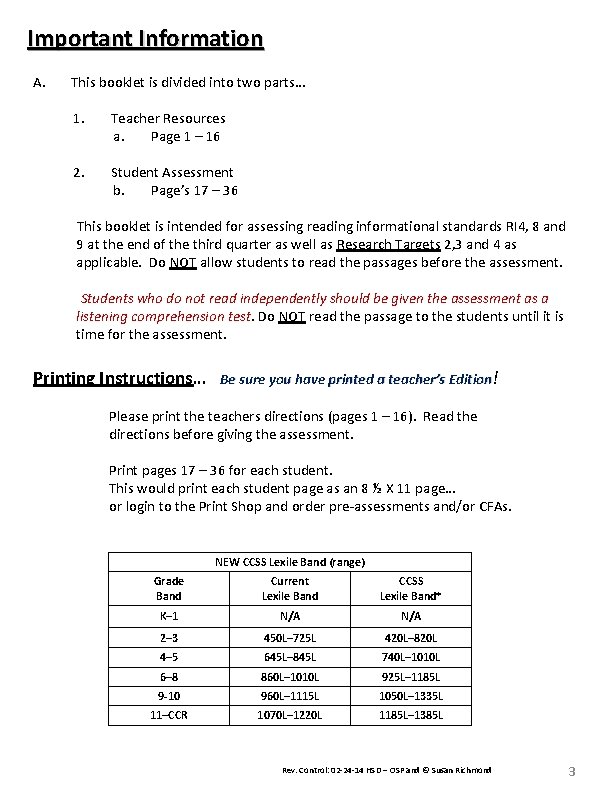
Important Information A. This booklet is divided into two parts… 1. Teacher Resources a. Page 1 – 16 2. Student Assessment b. Page’s 17 – 36 This booklet is intended for assessing reading informational standards RI 4, 8 and 9 at the end of the third quarter as well as Research Targets 2, 3 and 4 as applicable. Do NOT allow students to read the passages before the assessment. Students who do not read independently should be given the assessment as a listening comprehension test. Do NOT read the passage to the students until it is time for the assessment. Printing Instructions… Be sure you have printed a teacher’s Edition! Please print the teachers directions (pages 1 – 16). Read the directions before giving the assessment. Print pages 17 – 36 for each student. This would print each student page as an 8 ½ X 11 page… or login to the Print Shop and order pre-assessments and/or CFAs. NEW CCSS Lexile Band (range) Grade Band Current Lexile Band CCSS Lexile Band* K– 1 N/A 2– 3 450 L– 725 L 420 L– 820 L 4– 5 645 L– 845 L 740 L– 1010 L 6– 8 860 L– 1010 L 925 L– 1185 L 9 -10 960 L– 1115 L 1050 L– 1335 L 11–CCR 1070 L– 1220 L 1185 L– 1385 L Rev. Control: 02 -24 -14 HSD – OSP and © Susan Richmond 3
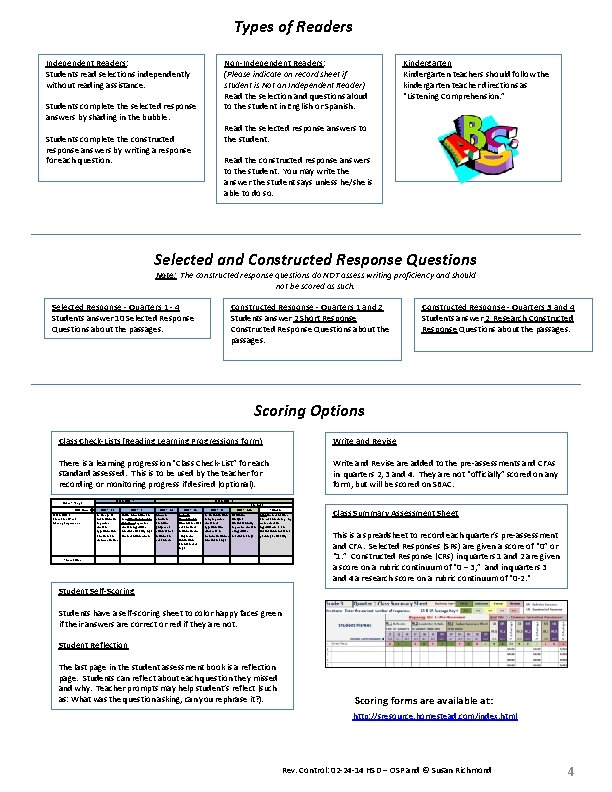
Types of Readers Independent Readers: Students read selections independently without reading assistance. Non-Independent Readers: (Please indicate on record sheet if student is Not an Independent Reader) Read the selection and questions aloud to the student in English or Spanish. Students complete the selected response answers by shading in the bubble. Kindergarten teachers should follow the kindergarten teacher directions as “Listening Comprehension. ” Read the selected response answers to the student. Students complete the constructed response answers by writing a response for each question. Read the constructed response answers to the student. You may write the answer the student says unless he/she is able to do so. Selected and Constructed Response Questions Note: The constructed response questions do NOT assess writing proficiency and should not be scored as such. Constructed Response - Quarters 1 and 2 Students answer 2 Short Response Constructed Response Questions about the passages. Selected Response - Quarters 1 - 4 Students answer 10 Selected Response Questions about the passages. Constructed Response - Quarters 3 and 4 Students answer 2 Research Constructed Response Questions about the passages. Scoring Options Class Check-Lists (Reading Learning Progressions form) Write and Revise There is a learning progression “Class Check-List” for each standard assessed. This is to be used by the teacher for recording or monitoring progress if desired (optional). Write and Revise are added to the pre-assessments and CFAs in quarters 2, 3 and 4. They are not “officially” scored on any form, but will be scored on SBAC. DOK Guide Path to DOK - 2 Path to DOK - 1 Grade 3 Sample Path to DOK 2 Informational Text Learning Progressions End Goal DOK 1 - Ka DOK 1 - Kc Locate specific text features (i. e. , key words, sidebars, hyperlinks) from a text read and discussed in class. Define (understand use) Standard Academic Language: key words, sidebars, hyperlinks, relevant, efficiently, topic and text features/tools. DOK 1 - Cf Answers questions about the purpose of different text features and search tools. DOK 2 - Ch DOK 2 - Cl DOK 2 - APn Standard Concept Development Understands that search or text features (tools) can provide information about a text or topic. Locate information using key words, sidebars or hyperlinks (and other search tools/text features) relevant to a topic. Obtain and Interpret information using key words, sidebars or hyperlinks relevant to a topic. RI 3. 5 Use text features and search tools (e. g. , key words, sidebars, hyperlinks) to locate information relevant to a given topic efficiently. Student Name Class Summary Assessment Sheet This is a spreadsheet to record each quarter’s pre-assessment and CFA. Selected Responses (SRs) are given a score of “ 0” or “ 1. ” Constructed Response (CRs) in quarters 1 and 2 are given a score on a rubric continuum of “ 0 – 3, ” and in quarters 3 and 4 a research score on a rubric continuum of “ 0 -2. " Student Self-Scoring Students have a self-scoring sheet to color happy faces green if their answers are correct or red if they are not. Student Reflection The last page in the student assessment book is a reflection page. Students can reflect about each question they missed and why. Teacher prompts may help student’s reflect (such as: What was the question asking, can you rephrase it? ). Scoring forms are available at: http: //sresource. homestead. com/index. html Rev. Control: 02 -24 -14 HSD – OSP and © Susan Richmond 4
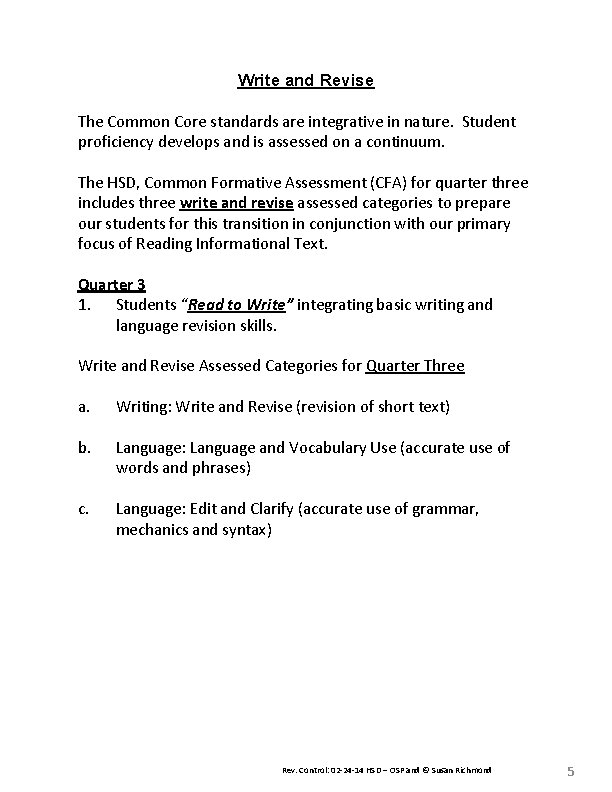
Write and Revise The Common Core standards are integrative in nature. Student proficiency develops and is assessed on a continuum. The HSD, Common Formative Assessment (CFA) for quarter three includes three write and revise assessed categories to prepare our students for this transition in conjunction with our primary focus of Reading Informational Text. Quarter 3 1. Students “Read to Write” integrating basic writing and language revision skills. Write and Revise Assessed Categories for Quarter Three a. Writing: Write and Revise (revision of short text) b. Language: Language and Vocabulary Use (accurate use of words and phrases) c. Language: Edit and Clarify (accurate use of grammar, mechanics and syntax) Rev. Control: 02 -24 -14 HSD – OSP and © Susan Richmond 5
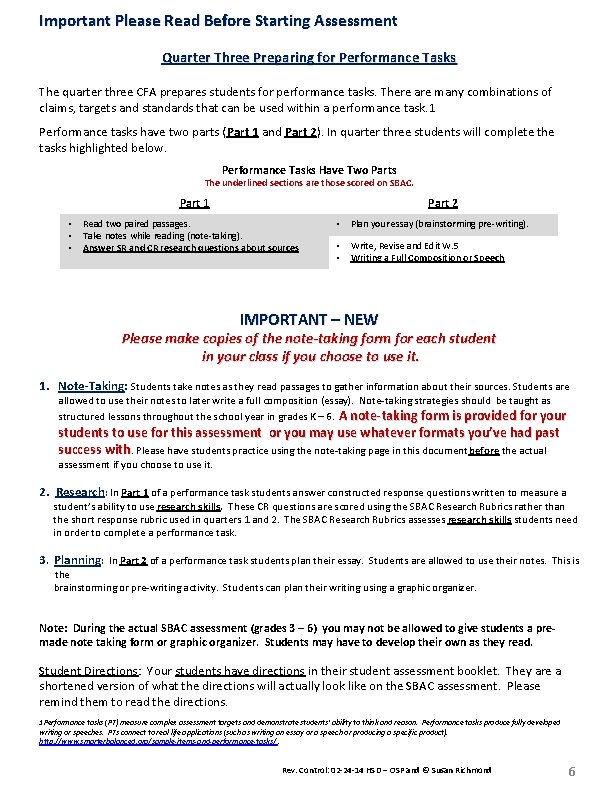
Important Please Read Before Starting Assessment Quarter Three Preparing for Performance Tasks The quarter three CFA prepares students for performance tasks. There are many combinations of claims, targets and standards that can be used within a performance task. 1 Performance tasks have two parts (Part 1 and Part 2). In quarter three students will complete the tasks highlighted below. Performance Tasks Have Two Parts The underlined sections are those scored on SBAC. Part 1 • • • Part 2 Read two paired passages. Take notes while reading (note-taking). Answer SR and CR research questions about sources • Plan your essay (brainstorming pre-writing). • • Write, Revise and Edit W. 5 Writing a Full Composition or Speech IMPORTANT – NEW Please make copies of the note-taking form for each student in your class if you choose to use it. 1. Note-Taking: Students take notes as they read passages to gather information about their sources. Students are allowed to use their notes to later write a full composition (essay). Note-taking strategies should be taught as structured lessons throughout the school year in grades K – 6. A note-taking form is provided for your students to use for this assessment or you may use whatever formats you’ve had past success with. Please have students practice using the note-taking page in this document before the actual assessment if you choose to use it. 2. Research: In Part 1 of a performance task students answer constructed response questions written to measure a student’s ability to use research skills. These CR questions are scored using the SBAC Research Rubrics rather than the short response rubric used in quarters 1 and 2. The SBAC Research Rubrics assesses research skills students need in order to complete a performance task. 3. Planning: In Part 2 of a performance task students plan their essay. Students are allowed to use their notes. This is the brainstorming or pre-writing activity. Students can plan their writing using a graphic organizer. Note: During the actual SBAC assessment (grades 3 – 6) you may not be allowed to give students a premade note taking form or graphic organizer. Students may have to develop their own as they read. Student Directions: Your students have directions in their student assessment booklet. They are a shortened version of what the directions will actually look like on the SBAC assessment. Please remind them to read the directions. 1 Performance tasks (PT) measure complex assessment targets and demonstrate students' ability to think and reason. Performance tasks produce fully developed writing or speeches. PTs connect to real life applications (such as writing an essay or a speech or producing a specific product). http: //www. smarterbalanced. org/sample-items-and-performance-tasks/. Rev. Control: 02 -24 -14 HSD – OSP and © Susan Richmond 6
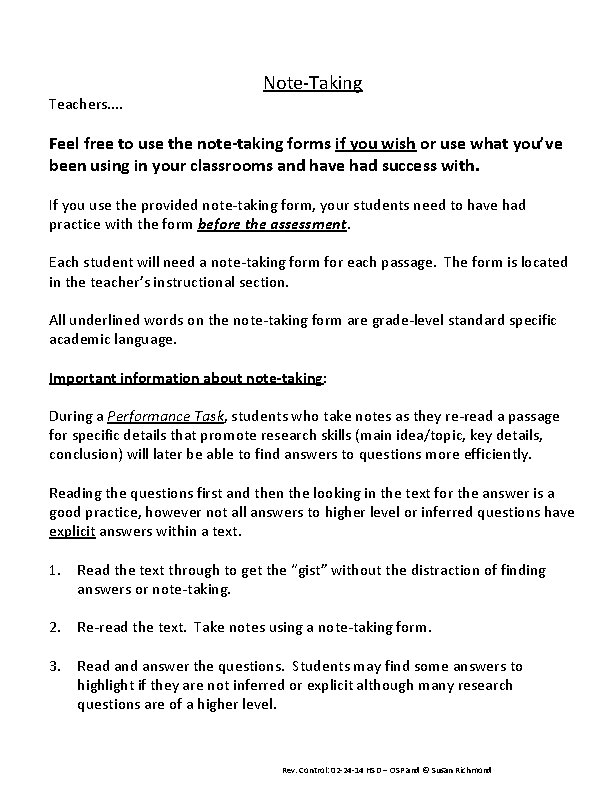
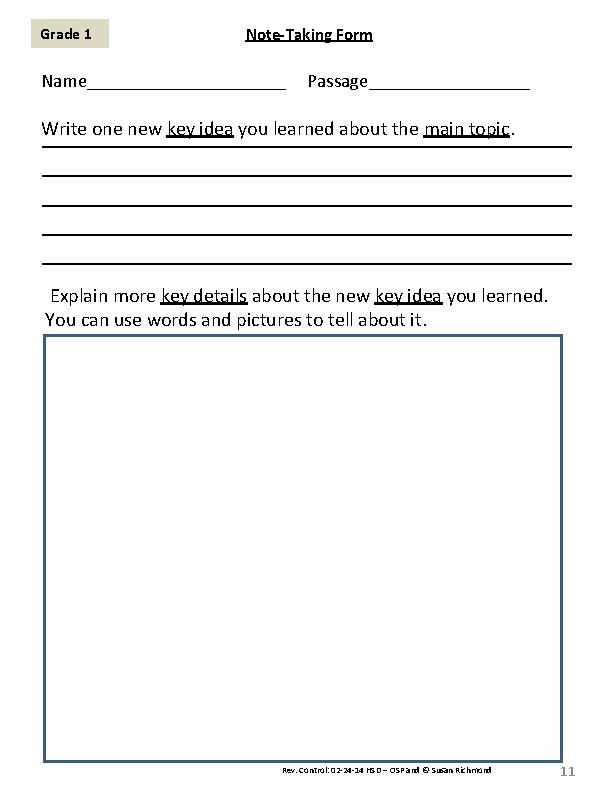
Teachers. . Note-Taking Feel free to use the note-taking forms if you wish or use what you’ve been using in your classrooms and have had success with. If you use the provided note-taking form, your students need to have had practice with the form before the assessment. Each student will need a note-taking form for each passage. The form is located in the teacher’s instructional section. All underlined words on the note-taking form are grade-level standard specific academic language. Important information about note-taking: During a Performance Task, students who take notes as they re-read a passage for specific details that promote research skills (main idea/topic, key details, conclusion) will later be able to find answers to questions more efficiently. Reading the questions first and then the looking in the text for the answer is a good practice, however not all answers to higher level or inferred questions have explicit answers within a text. 1. Read the text through to get the “gist” without the distraction of finding answers or note-taking. 2. Re-read the text. Take notes using a note-taking form. 3. Read answer the questions. Students may find some answers to highlight if they are not inferred or explicit although many research questions are of a higher level. Rev. Control: 02 -24 -14 HSD – OSP and © Susan Richmond
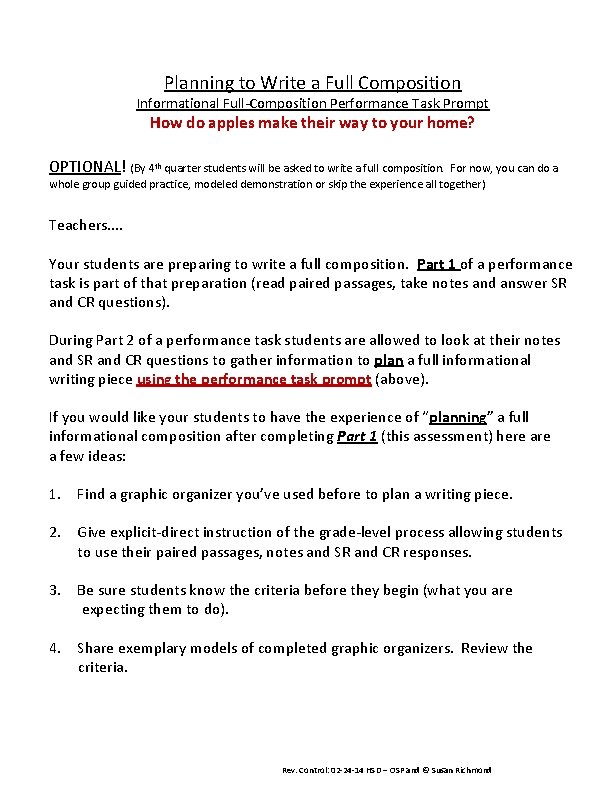
Planning to Write a Full Composition Informational Full-Composition Performance Task Prompt How do apples make their way to your home? OPTIONAL! (By 4 th quarter students will be asked to write a full composition. For now, you can do a whole group guided practice, modeled demonstration or skip the experience all together) Teachers. . Your students are preparing to write a full composition. Part 1 of a performance task is part of that preparation (read paired passages, take notes and answer SR and CR questions). During Part 2 of a performance task students are allowed to look at their notes and SR and CR questions to gather information to plan a full informational writing piece using the performance task prompt (above). If you would like your students to have the experience of “planning” a full informational composition after completing Part 1 (this assessment) here a few ideas: 1. Find a graphic organizer you’ve used before to plan a writing piece. 2. Give explicit-direct instruction of the grade-level process allowing students to use their paired passages, notes and SR and CR responses. 3. Be sure students know the criteria before they begin (what you are expecting them to do). 4. Share exemplary models of completed graphic organizers. Review the criteria. Rev. Control: 02 -24 -14 HSD – OSP and © Susan Richmond
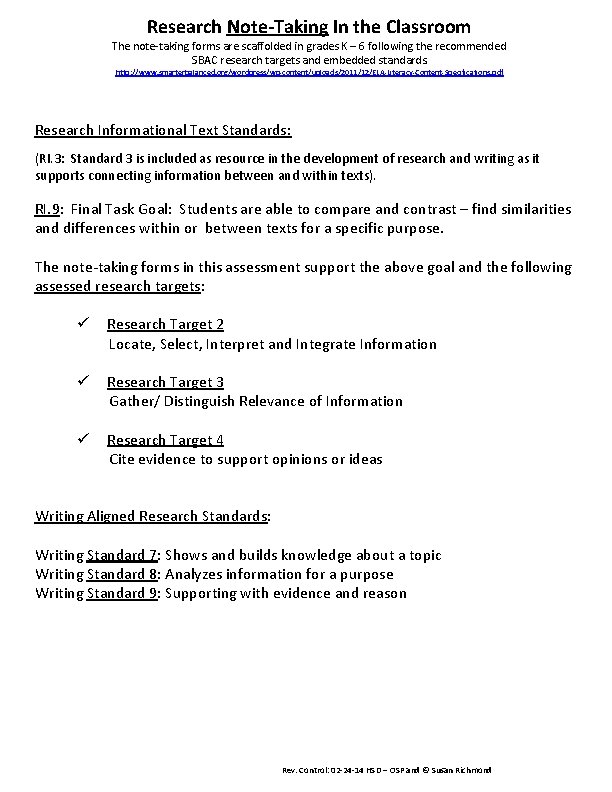
Research Note-Taking In the Classroom The note-taking forms are scaffolded in grades K – 6 following the recommended SBAC research targets and embedded standards. http: //www. smarterbalanced. org/wordpress/wp-content/uploads/2011/12/ELA-Literacy-Content-Specifications. pdf Research Informational Text Standards: (RI. 3: Standard 3 is included as resource in the development of research and writing as it supports connecting information between and within texts). RI. 9: Final Task Goal: Students are able to compare and contrast – find similarities and differences within or between texts for a specific purpose. The note-taking forms in this assessment support the above goal and the following assessed research targets: ü Research Target 2 Locate, Select, Interpret and Integrate Information ü Research Target 3 Gather/ Distinguish Relevance of Information ü Research Target 4 Cite evidence to support opinions or ideas Writing Aligned Research Standards: Writing Standard 7: Shows and builds knowledge about a topic Writing Standard 8: Analyzes information for a purpose Writing Standard 9: Supporting with evidence and reason Rev. Control: 02 -24 -14 HSD – OSP and © Susan Richmond
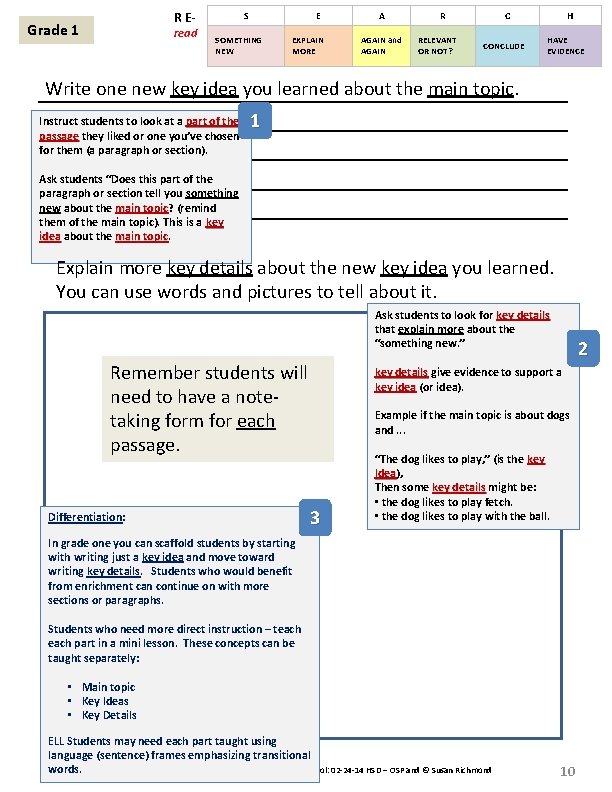
R E- Grade 1 read S SOMETHING NEW E EXPLAIN MORE A AGAIN and AGAIN R RELEVANT OR NOT? C CONCLUDE H HAVE EVIDENCE Write one new key idea you learned about the main topic. . Instruct students to look at a part of the 1 passage they liked or one you’ve chosen. for them (a paragraph or section). Ask students “Does this part of the paragraph or section tell you something new about the main topic? topic (remind them of the main topic). This is a key idea about the main topic Explain more key details about the new key idea you learned. You can use words and pictures to tell about it. Ask students to look for key details that explain more about the “something new. ” Remember students will need to have a notetaking form for each passage. Differentiation: 2 key details give evidence to support a key idea (or idea). Example if the main topic is about dogs and. . . 3 “The dog likes to play, ” (is the key Idea), Idea Then some key details might be: • the dog likes to play fetch. • the dog likes to play with the ball. In grade one you can scaffold students by starting with writing just a key idea and move toward writing key details. Students who would benefit from enrichment can continue on with more sections or paragraphs. Students who need more direct instruction – teach part in a mini lesson. These concepts can be taught separately: • Main topic • Key Ideas • Key Details ELL Students may need each part taught using language (sentence) frames emphasizing transitional Rev. Control: 02 -24 -14 HSD – OSP and © Susan Richmond words. 10
Grade 1 Note-Taking Form Name___________ Passage_________ Write one new key idea you learned about the main topic. Explain more key details about the new key idea you learned. You can use words and pictures to tell about it. Rev. Control: 02 -24 -14 HSD – OSP and © Susan Richmond 11
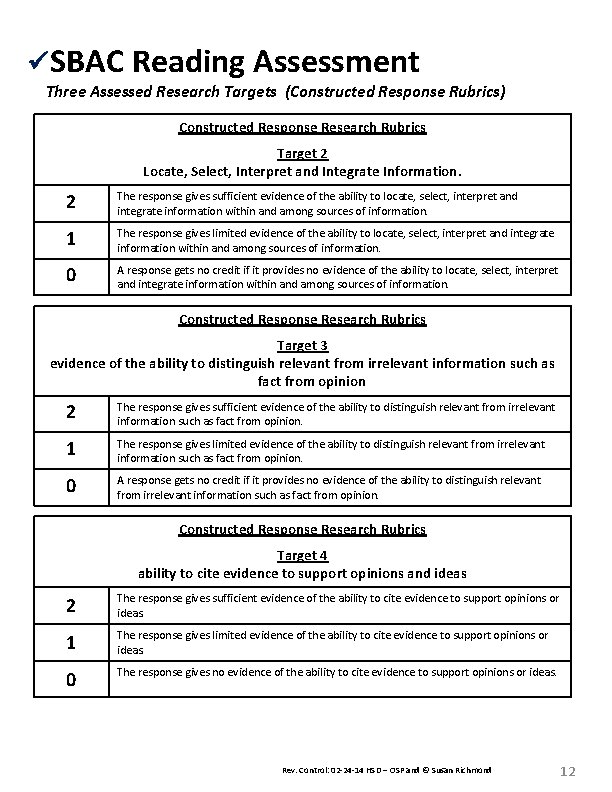
SBAC Reading Assessment Three Assessed Research Targets (Constructed Response Rubrics) Constructed Response Research Rubrics Target 2 Locate, Select, Interpret and Integrate Information. 2 The response gives sufficient evidence of the ability to locate, select, interpret and integrate information within and among sources of information. 1 The response gives limited evidence of the ability to locate, select, interpret and integrate information within and among sources of information. 0 A response gets no credit if it provides no evidence of the ability to locate, select, interpret and integrate information within and among sources of information. Constructed Response Research Rubrics Target 3 evidence of the ability to distinguish relevant from irrelevant information such as fact from opinion 2 The response gives sufficient evidence of the ability to distinguish relevant from irrelevant information such as fact from opinion. 1 The response gives limited evidence of the ability to distinguish relevant from irrelevant information such as fact from opinion. 0 A response gets no credit if it provides no evidence of the ability to distinguish relevant from irrelevant information such as fact from opinion. Constructed Response Research Rubrics Target 4 ability to cite evidence to support opinions and ideas 2 The response gives sufficient evidence of the ability to cite evidence to support opinions or ideas. 1 The response gives limited evidence of the ability to cite evidence to support opinions or ideas. 0 The response gives no evidence of the ability to cite evidence to support opinions or ideas. Rev. Control: 02 -24 -14 HSD – OSP and © Susan Richmond 12
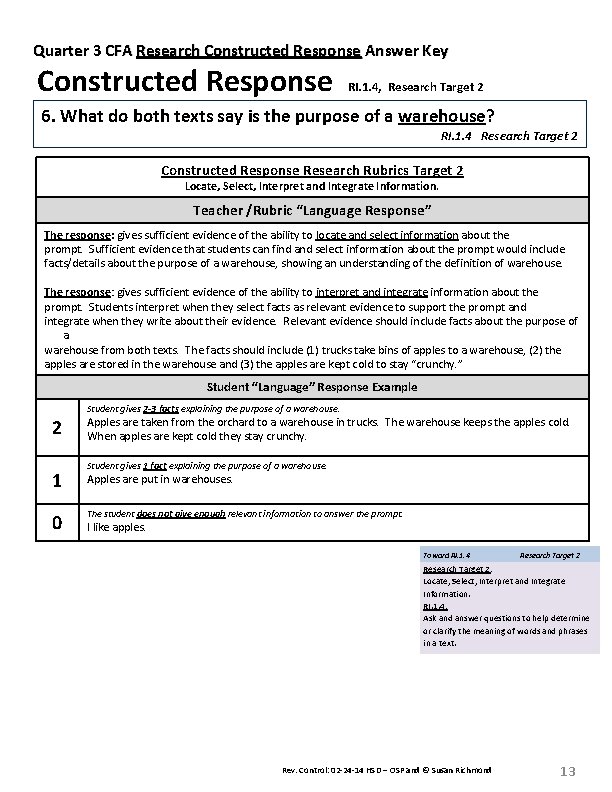
Quarter 3 CFA Research Constructed Response Answer Key Constructed Response RI. 1. 4, Research Target 2 6. What do both texts say is the purpose of a warehouse? RI. 1. 4 Research Target 2 Constructed Response Research Rubrics Target 2 Locate, Select, Interpret and Integrate Information. Teacher /Rubric “Language Response” The response: gives sufficient evidence of the ability to locate and select information about the prompt. Sufficient evidence that students can find and select information about the prompt would include facts/details about the purpose of a warehouse, showing an understanding of the definition of warehouse. The response: gives sufficient evidence of the ability to interpret and integrate information about the prompt. Students interpret when they select facts as relevant evidence to support the prompt and integrate when they write about their evidence. Relevant evidence should include facts about the purpose of a warehouse from both texts. The facts should include (1) trucks take bins of apples to a warehouse, (2) the apples are stored in the warehouse and (3) the apples are kept cold to stay “crunchy. ” Student “Language” Response Example Student gives 2 -3 facts explaining the purpose of a warehouse. 2 1 0 Apples are taken from the orchard to a warehouse in trucks. The warehouse keeps the apples cold. When apples are kept cold they stay crunchy. Student gives 1 fact explaining the purpose of a warehouse. Apples are put in warehouses. The student does not give enough relevant information to answer the prompt. I like apples. Toward RI. 1. 4 Research Target 2: Locate, Select, Interpret and Integrate Information. RI. 1. 4: Ask and answer questions to help determine or clarify the meaning of words and phrases in a text. Rev. Control: 02 -24 -14 HSD – OSP and © Susan Richmond 13
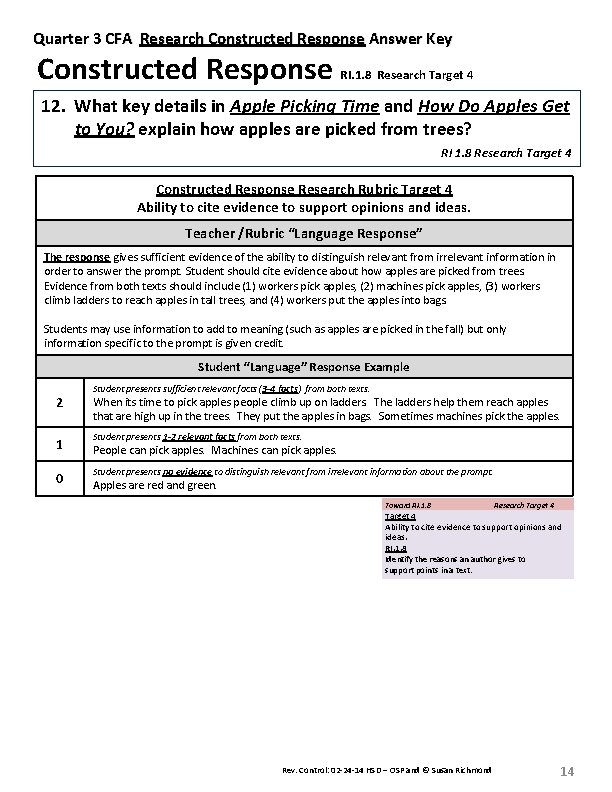
Quarter 3 CFA Research Constructed Response Answer Key Constructed Response RI. 1. 8 Research Target 4 12. What key details in Apple Picking Time and How Do Apples Get to You? explain how apples are picked from trees? RI 1. 8 Research Target 4 Constructed Response Research Rubric Target 4 Ability to cite evidence to support opinions and ideas. Teacher /Rubric “Language Response” The response gives sufficient evidence of the ability to distinguish relevant from irrelevant information in order to answer the prompt. Student should cite evidence about how apples are picked from trees. Evidence from both texts should include (1) workers pick apples, (2) machines pick apples, (3) workers climb ladders to reach apples in tall trees, and (4) workers put the apples into bags. Students may use information to add to meaning (such as apples are picked in the fall) but only information specific to the prompt is given credit. Student “Language” Response Example 2 Student presents sufficient relevant facts (3 -4 facts) from both texts. When its time to pick apples people climb up on ladders. The ladders help them reach apples that are high up in the trees. They put the apples in bags. Sometimes machines pick the apples. 1 Student presents 1 -2 relevant facts from both texts. 0 Student presents no evidence to distinguish relevant from irrelevant information about the prompt. People can pick apples. Machines can pick apples. Apples are red and green. Toward RI. 1. 8 Research Target 4 Ability to cite evidence to support opinions and ideas. RI. 1. 8 Identify the reasons an author gives to support points in a text. Rev. Control: 02 -24 -14 HSD – OSP and © Susan Richmond 14
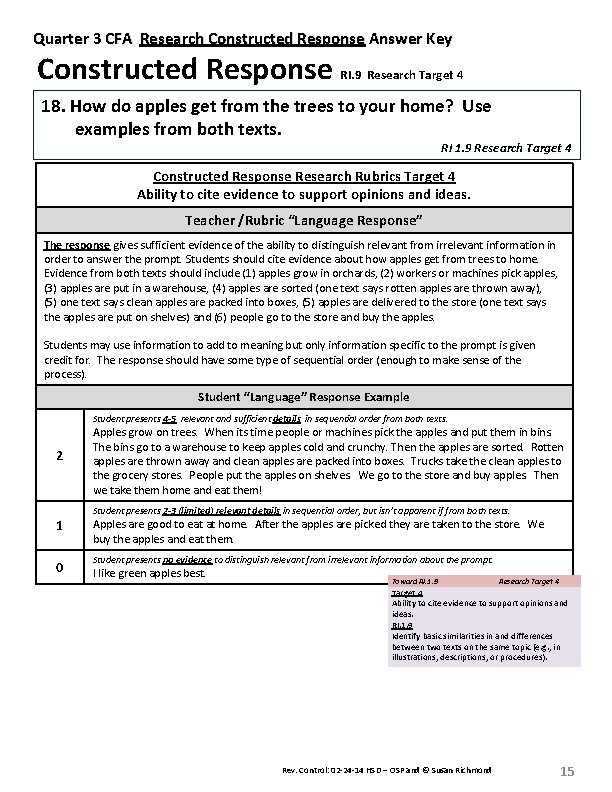
Quarter 3 CFA Research Constructed Response Answer Key Constructed Response RI. 9 Research Target 4 18. How do apples get from the trees to your home? Use examples from both texts. RI 1. 9 Research Target 4 Constructed Response Research Rubrics Target 4 Ability to cite evidence to support opinions and ideas. Teacher /Rubric “Language Response” The response gives sufficient evidence of the ability to distinguish relevant from irrelevant information in order to answer the prompt. Students should cite evidence about how apples get from trees to home. Evidence from both texts should include (1) apples grow in orchards, (2) workers or machines pick apples, (3) apples are put in a warehouse, (4) apples are sorted (one text says rotten apples are thrown away), (5) one text says clean apples are packed into boxes, (5) apples are delivered to the store (one text says the apples are put on shelves) and (6) people go to the store and buy the apples. Students may use information to add to meaning but only information specific to the prompt is given credit for. The response should have some type of sequential order (enough to make sense of the process). Student “Language” Response Example Student presents 4 -5 relevant and sufficient details in sequential order from both texts. 2 1 0 Apples grow on trees. When its time people or machines pick the apples and put them in bins. The bins go to a warehouse to keep apples cold and crunchy. Then the apples are sorted. Rotten apples are thrown away and clean apples are packed into boxes. Trucks take the clean apples to the grocery stores. People put the apples on shelves. We go to the store and buy apples. Then we take them home and eat them! Student presents 2 -3 (limited) relevant details in sequential order, but isn’t apparent if from both texts. Apples are good to eat at home. After the apples are picked they are taken to the store. We buy the apples and eat them. Student presents no evidence to distinguish relevant from irrelevant information about the prompt. I like green apples best. Toward RI. 1. 9 Research Target 4 Ability to cite evidence to support opinions and ideas. RI. 1. 9 Identify basic similarities in and differences between two texts on the same topic (e. g. , in illustrations, descriptions, or procedures). Rev. Control: 02 -24 -14 HSD – OSP and © Susan Richmond 15
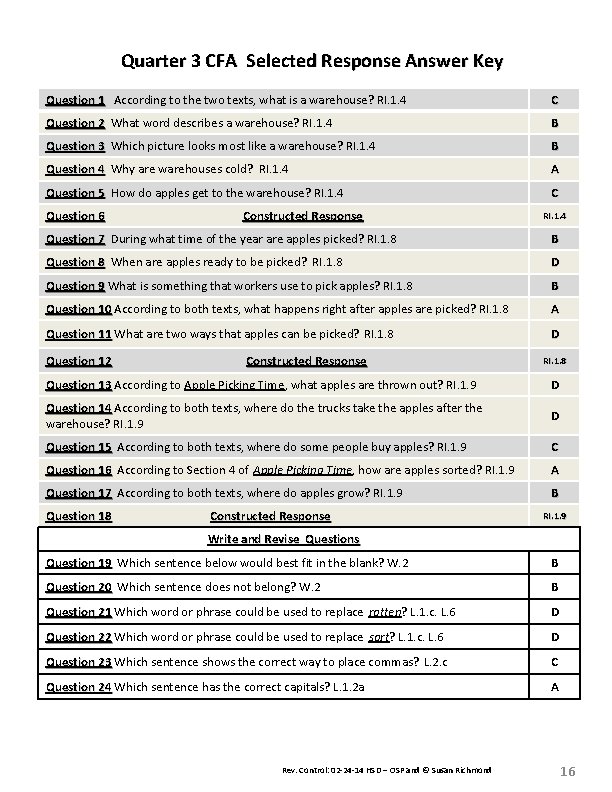
Quarter 3 CFA Selected Response Answer Key Question 1 According to the two texts, what is a warehouse? RI. 1. 4 C Question 2 What word describes a warehouse? RI. 1. 4 B Question 3 Which picture looks most like a warehouse? RI. 1. 4 B Question 4 Why are warehouses cold? RI. 1. 4 A Question 5 How do apples get to the warehouse? RI. 1. 4 C Question 6 Constructed Response RI. 1. 4 Question 7 During what time of the year are apples picked? RI. 1. 8 B Question 8 When are apples ready to be picked? RI. 1. 8 D Question 9 What is something that workers use to pick apples? RI. 1. 8 B Question 10 According to both texts, what happens right after apples are picked? RI. 1. 8 A Question 11 What are two ways that apples can be picked? RI. 1. 8 D Question 12 Constructed Response RI. 1. 8 Question 13 According to Apple Picking Time, what apples are thrown out? RI. 1. 9 D Question 14 According to both texts, where do the trucks take the apples after the warehouse? RI. 1. 9 D Question 15 According to both texts, where do some people buy apples? RI. 1. 9 C Question 16 According to Section 4 of Apple Picking Time, how are apples sorted? RI. 1. 9 A Question 17 According to both texts, where do apples grow? RI. 1. 9 B Question 18 Constructed Response RI. 1. 9 Write and Revise Questions Question 19 Which sentence below would best fit in the blank? W. 2 B Question 20 Which sentence does not belong? W. 2 B Question 21 Which word or phrase could be used to replace rotten? L. 1. c. L. 6 D Question 22 Which word or phrase could be used to replace sort? L. 1. c. L. 6 D Question 23 Which sentence shows the correct way to place commas? L. 2. c C Question 24 Which sentence has the correct capitals? L. 1. 2 a A Rev. Control: 02 -24 -14 HSD – OSP and © Susan Richmond 16
Quarter Three Reading Informational Text Grade 1 Common Formative Assessment Reading Informational Text Name________
Student Directions: Part 1 Your assignment: You will read two texts about apples. 1. Read both texts. 2. Take notes about the texts. 3. Answer the questions. Rev. Control: 02 -24 -14 HSD – OSP and © Susan Richmond 18
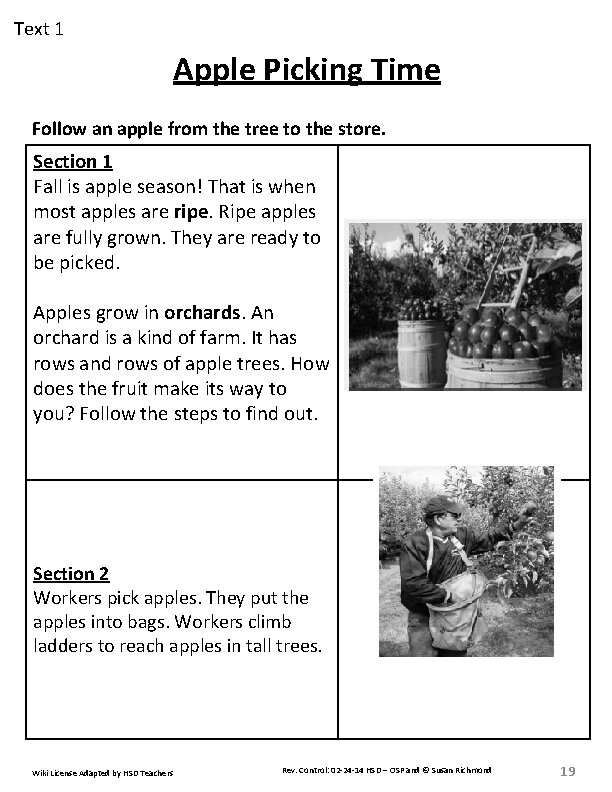
Text 1 Apple Picking Time Follow an apple from the tree to the store. Section 1 Fall is apple season! That is when most apples are ripe. Ripe apples are fully grown. They are ready to be picked. Apples grow in orchards. An orchard is a kind of farm. It has rows and rows of apple trees. How does the fruit make its way to you? Follow the steps to find out. Section 2 Workers pick apples. They put the apples into bags. Workers climb ladders to reach apples in tall trees. Wiki License Adapted by HSD Teachers Rev. Control: 02 -24 -14 HSD – OSP and © Susan Richmond 19
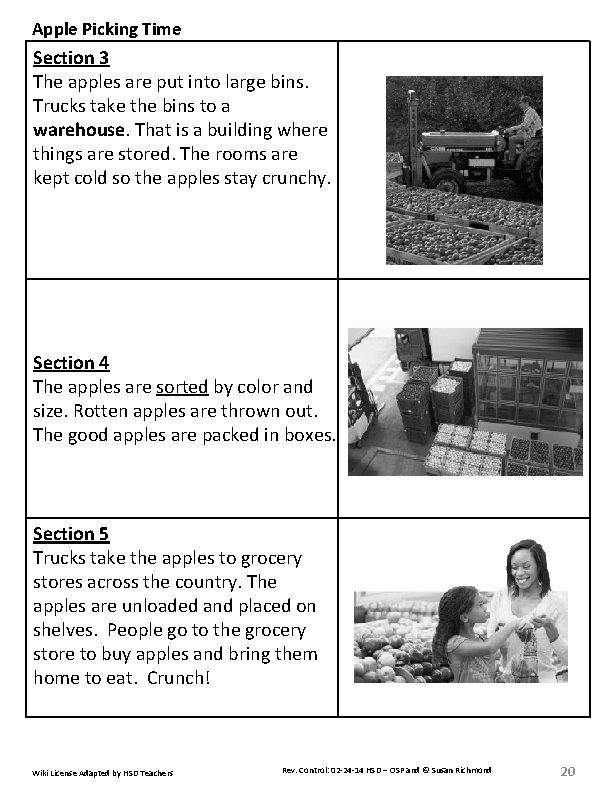
Apple Picking Time Section 3 The apples are put into large bins. Trucks take the bins to a warehouse. That is a building where things are stored. The rooms are kept cold so the apples stay crunchy. Section 4 The apples are sorted by color and size. Rotten apples are thrown out. The good apples are packed in boxes. Section 5 Trucks take the apples to grocery stores across the country. The apples are unloaded and placed on shelves. People go to the grocery store to buy apples and bring them home to eat. Crunch! Wiki License Adapted by HSD Teachers Rev. Control: 02 -24 -14 HSD – OSP and © Susan Richmond 20
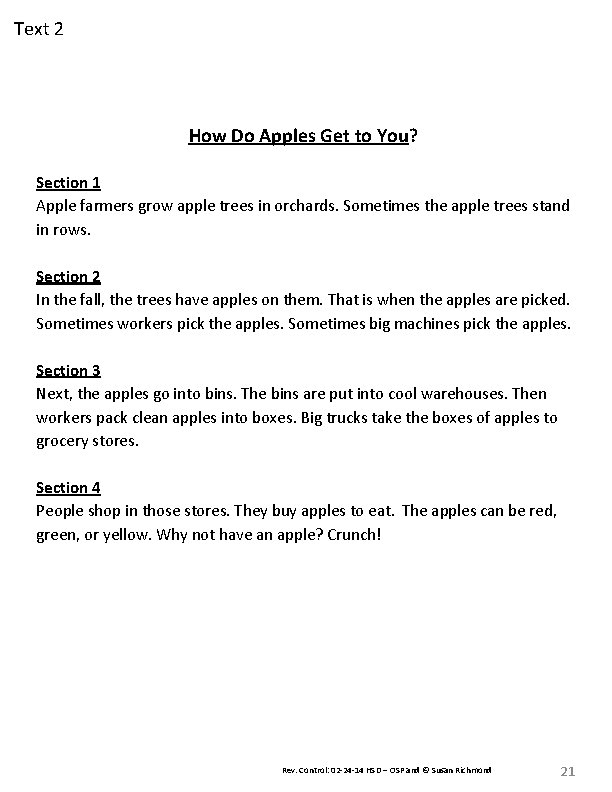
Text 2 How Do Apples Get to You? Section 1 Apple farmers grow apple trees in orchards. Sometimes the apple trees stand in rows. Section 2 In the fall, the trees have apples on them. That is when the apples are picked. Sometimes workers pick the apples. Sometimes big machines pick the apples. Section 3 Next, the apples go into bins. The bins are put into cool warehouses. Then workers pack clean apples into boxes. Big trucks take the boxes of apples to grocery stores. Section 4 People shop in those stores. They buy apples to eat. The apples can be red, green, or yellow. Why not have an apple? Crunch! Rev. Control: 02 -24 -14 HSD – OSP and © Susan Richmond 21
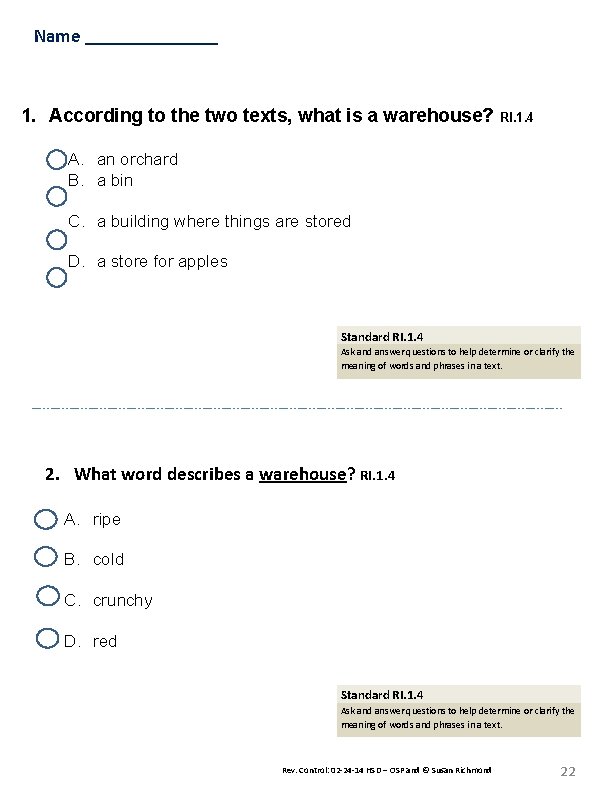
Name _______ 1. According to the two texts, what is a warehouse? RI. 1. 4 A. an orchard B. a bin C. a building where things are stored D. a store for apples Standard RI. 1. 4 Ask and answer questions to help determine or clarify the meaning of words and phrases in a text. 2. What word describes a warehouse? RI. 1. 4 A. ripe B. cold C. crunchy D. red Standard RI. 1. 4 Ask and answer questions to help determine or clarify the meaning of words and phrases in a text. Rev. Control: 02 -24 -14 HSD – OSP and © Susan Richmond 22
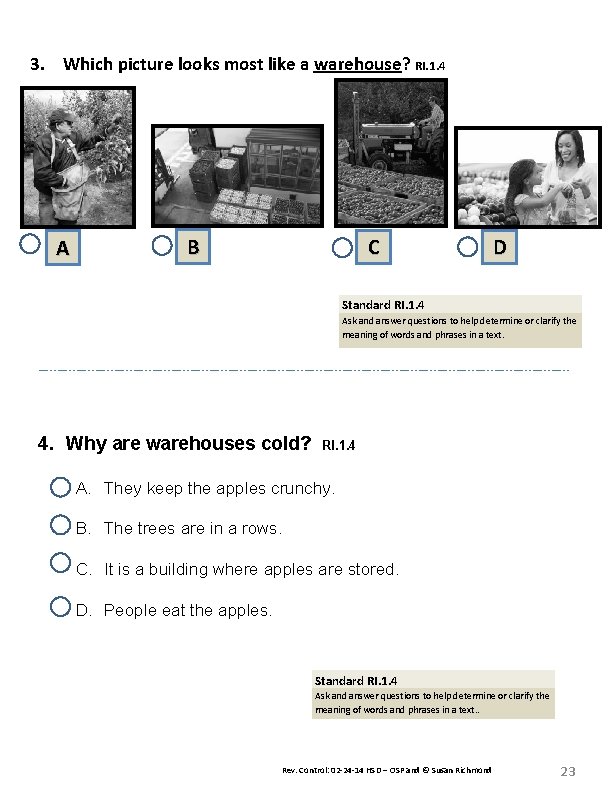
3. Which picture looks most like a warehouse? RI. 1. 4 A B C D Standard RI. 1. 4 Ask and answer questions to help determine or clarify the meaning of words and phrases in a text. 4. Why are warehouses cold? RI. 1. 4 A. They keep the apples crunchy. B. The trees are in a rows. C. It is a building where apples are stored. D. People eat the apples. Standard RI. 1. 4 Ask and answer questions to help determine or clarify the meaning of words and phrases in a text. . Rev. Control: 02 -24 -14 HSD – OSP and © Susan Richmond 23
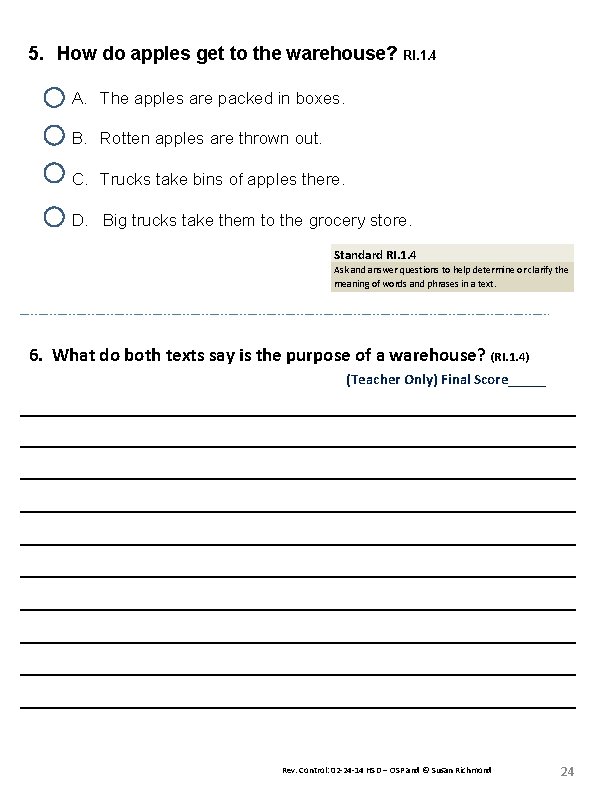
5. How do apples get to the warehouse? RI. 1. 4 A. The apples are packed in boxes. B. Rotten apples are thrown out. C. Trucks take bins of apples there. D. Big trucks take them to the grocery store. Standard RI. 1. 4 Ask and answer questions to help determine or clarify the meaning of words and phrases in a text. 6. What do both texts say is the purpose of a warehouse? (RI. 1. 4) (Teacher Only) Final Score_____ Rev. Control: 02 -24 -14 HSD – OSP and © Susan Richmond 24
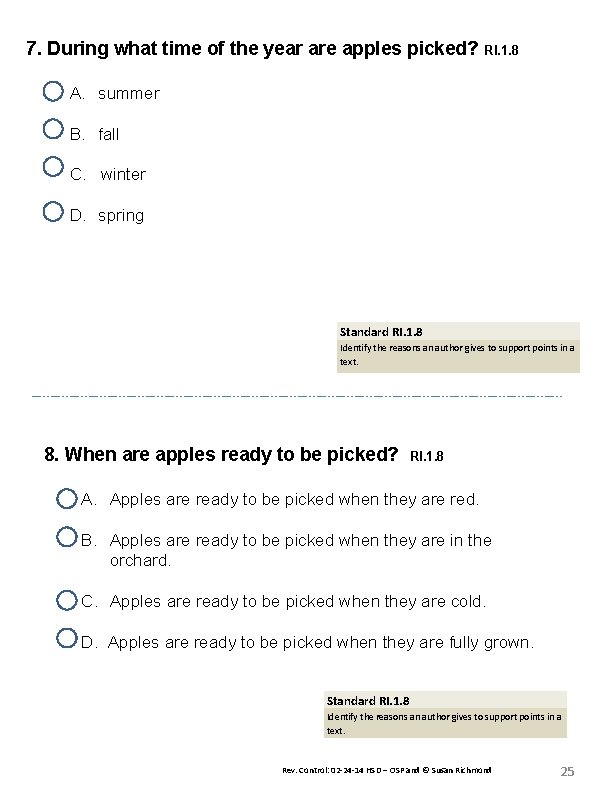
7. During what time of the year are apples picked? RI. 1. 8 A. summer B. fall C. winter D. spring Standard RI. 1. 8 Identify the reasons an author gives to support points in a text. 8. When are apples ready to be picked? RI. 1. 8 A. Apples are ready to be picked when they are red. B. Apples are ready to be picked when they are in the orchard. C. Apples are ready to be picked when they are cold. D. Apples are ready to be picked when they are fully grown. Standard RI. 1. 8 Identify the reasons an author gives to support points in a text. Rev. Control: 02 -24 -14 HSD – OSP and © Susan Richmond 25
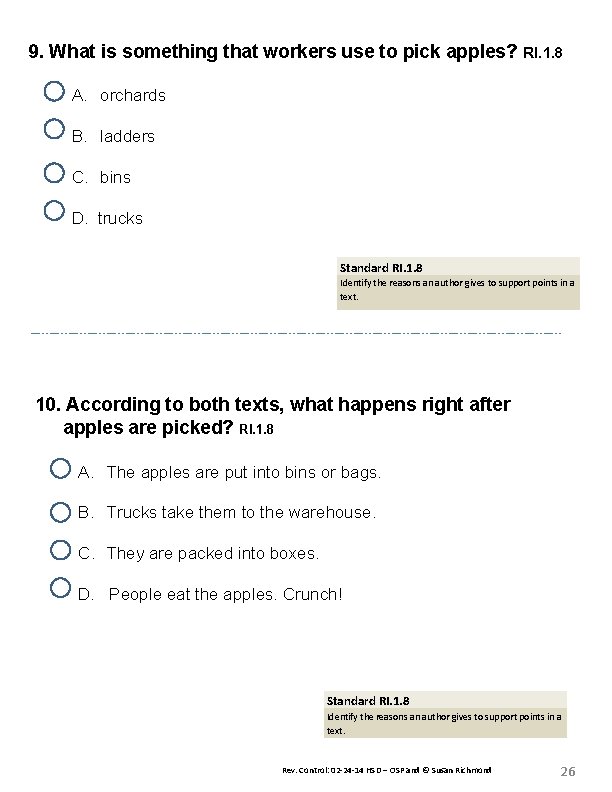
9. What is something that workers use to pick apples? RI. 1. 8 A. orchards B. ladders C. bins D. trucks Standard RI. 1. 8 Identify the reasons an author gives to support points in a text. 10. According to both texts, what happens right after apples are picked? RI. 1. 8 A. The apples are put into bins or bags. B. Trucks take them to the warehouse. C. They are packed into boxes. D. People eat the apples. Crunch! Standard RI. 1. 8 Identify the reasons an author gives to support points in a text. Rev. Control: 02 -24 -14 HSD – OSP and © Susan Richmond 26
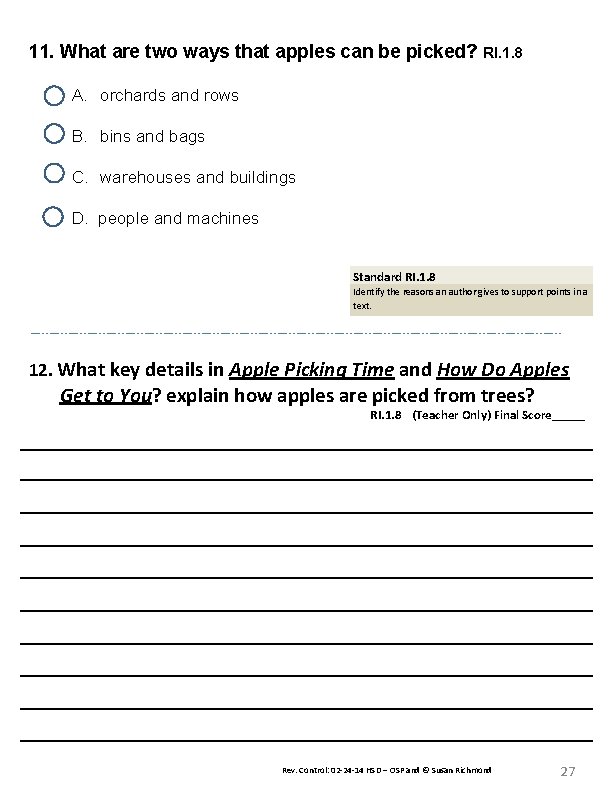
11. What are two ways that apples can be picked? RI. 1. 8 A. orchards and rows B. bins and bags C. warehouses and buildings D. people and machines Standard RI. 1. 8 Identify the reasons an author gives to support points in a text. 12. What key details in Apple Picking Time and How Do Apples Get to You? explain how apples are picked from trees? RI. 1. 8 (Teacher Only) Final Score_____ Rev. Control: 02 -24 -14 HSD – OSP and © Susan Richmond 27
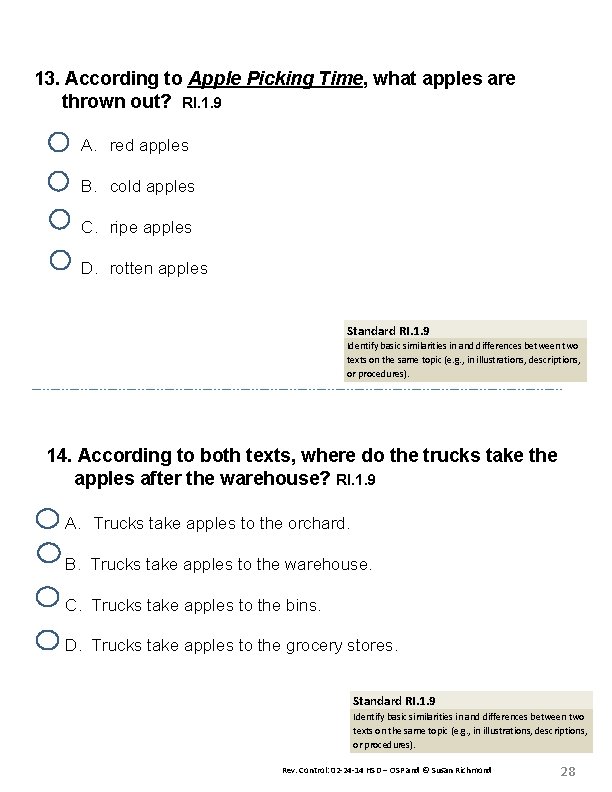
13. According to Apple Picking Time, what apples are thrown out? RI. 1. 9 A. red apples B. cold apples C. ripe apples D. rotten apples Standard RI. 1. 9 Identify basic similarities in and differences between two texts on the same topic (e. g. , in illustrations, descriptions, or procedures). 14. According to both texts, where do the trucks take the apples after the warehouse? RI. 1. 9 A. Trucks take apples to the orchard. B. Trucks take apples to the warehouse. C. Trucks take apples to the bins. D. Trucks take apples to the grocery stores. Standard RI. 1. 9 Identify basic similarities in and differences between two texts on the same topic (e. g. , in illustrations, descriptions, or procedures). Rev. Control: 02 -24 -14 HSD – OSP and © Susan Richmond 28
15. According to both texts, where do some people buy apples? RI. 1. 9 A. orchards B. warehouses C. grocery stores D. home Standard RI. 1. 9 Identify basic similarities in and differences between two texts on the same topic (e. g. , in illustrations, descriptions, or procedures). 16. According to Section 4 of Apple Picking Time, how are apples sorted? RI. 1. 9 A. color and size B. size and shape C. clean or dirty D. red, yellow or green Standard RI. 1. 9 Identify basic similarities in and differences between two texts on the same topic (e. g. , in illustrations, descriptions, or procedures). Rev. Control: 02 -24 -14 HSD – OSP and © Susan Richmond 29
17. According to both texts, where do apples grow? RI. 1. 9 A. warehouses B. orchards C. grocery stores D. at home Standard RI. 1. 9 Identify basic similarities in and differences between two texts on the same topic (e. g. , in illustrations, descriptions, or procedures). 18. How do apples get from the trees to your home? Use examples from both texts. (RI. 1. 9) (Teacher Only) Final Score_____ Rev. Control: 02 -24 -14 HSD – OSP and © Susan Richmond 30
19. Read the sentences below. (Write and Revise W. 2) People shop in those stores. They buy apples to eat. The apples can be red, green, or yellow. Why not have an apple? Crunch! ______________________. Which sentence below would best fit in the blank? A. You can pick apples. B. You might really like it. C. Apples grow on trees. D. The apples are in a warehouse. 20. Read the sentences below: (Write and Revise W. 2) Apples grow in orchards. You can buy the apples at a store. Then the apples are picked. The apples are stored in a warehouse to stay cold. Which sentence does not belong? A. Apples grow in orchards. B. You can buy the apples at a store. C. Then the apples are picked. D. The apples are stored in a warehouse to stay cold. Rev. Control: 02 -24 -14 HSD – OSP and © Susan Richmond 31
21. If you see a rotten apple, do not eat it. (Write and Revise L. 1. c. L. 6) Which word or phrase could be used to replace rotten? A. very good B. red C. sweet D. not good 22. After you sort the apples, put the good ones in a box. (Write and Revise L. 1. c, L. 6) Which word or phrase could be used to replace sort? A. mix up B. eat C. Find the apples D. pick the best Rev. Control: 02 -24 -14 HSD – OSP and © Susan Richmond 32
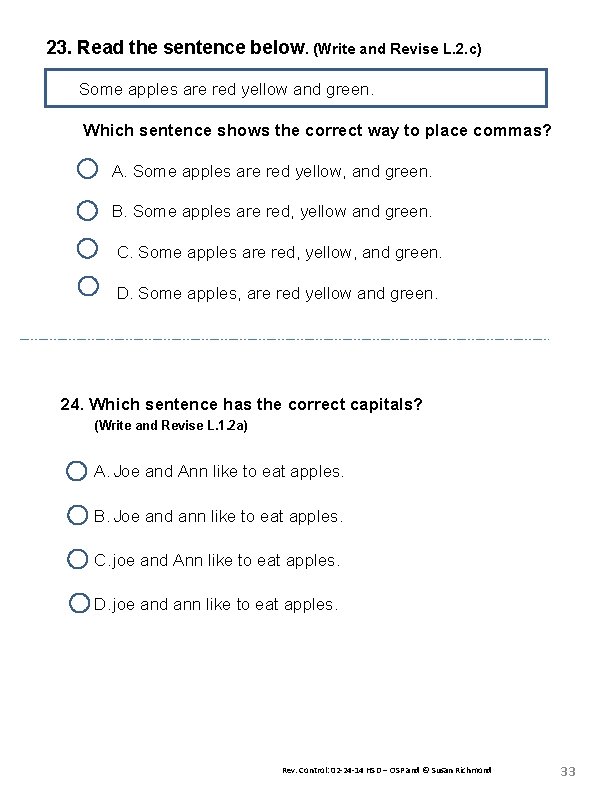
23. Read the sentence below. (Write and Revise L. 2. c) Some apples are red yellow and green. Which sentence shows the correct way to place commas? A. Some apples are red yellow, and green. B. Some apples are red, yellow and green. C. Some apples are red, yellow, and green. D. Some apples, are red yellow and green. 24. Which sentence has the correct capitals? (Write and Revise L. 1. 2 a) A. Joe and Ann like to eat apples. B. Joe and ann like to eat apples. C. joe and Ann like to eat apples. D. joe and ann like to eat apples. Rev. Control: 02 -24 -14 HSD – OSP and © Susan Richmond 33
STOP Close your books and wait for instructions! Rev. Control: 02 -24 -14 HSD – OSP and © Susan Richmond 34
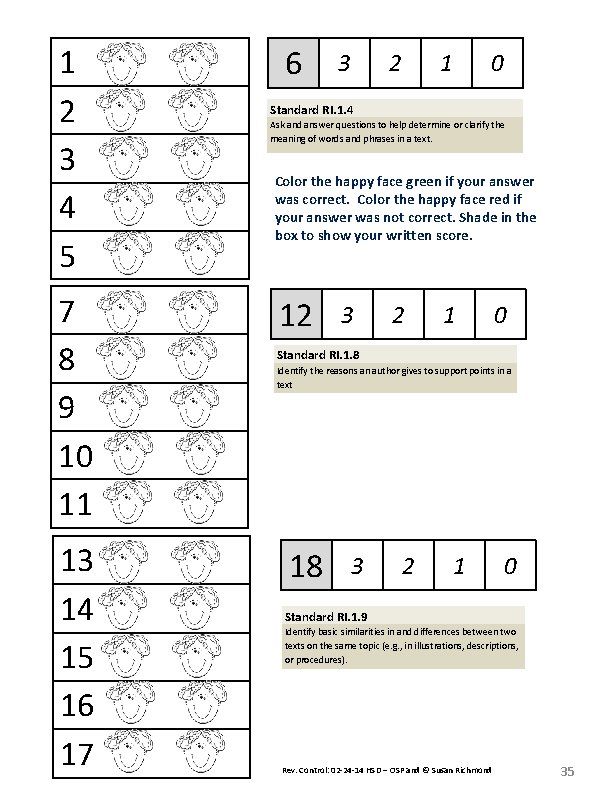
1 2 3 4 5 7 8 9 10 11 13 14 15 16 17 6 3 2 1 0 Standard RI. 1. 4 Ask and answer questions to help determine or clarify the meaning of words and phrases in a text. Color the happy face green if your answer was correct. Color the happy face red if your answer was not correct. Shade in the box to show your written score. 12 3 2 1 0 Standard RI. 1. 8 Identify the reasons an author gives to support points in a text 18 3 2 1 0 Standard RI. 1. 9 Identify basic similarities in and differences between two texts on the same topic (e. g. , in illustrations, descriptions, or procedures). Rev. Control: 02 -24 -14 HSD – OSP and © Susan Richmond 35
Question no. ___ Question no. ___ Rev. Control: 02 -24 -14 HSD – OSP and © Susan Richmond 36