
Quarter One Reading Informational Text Grade 2 Teacher

- Slides: 25
Quarter One Reading Informational Text Grade 2 Teacher Directions Common Formative Assessment
Rev. Control: 10/10/2013 HSD – OSP and © Susan Richmond 2
Important Information A. This booklet is divided into two parts… 1. Teacher’s Resources and Answer Keys a. Pages 1 – 9 2. Student Assessment (can be printed in a small booklet form) b. Pages 10– 25 B. This material is intended for assessing reading informational standards RI - 1, 2 and 3 at the end of quarter 1. Do NOT allow students to read the passages before the assessment. C. Student scores can be recorded on the (1) Learning Progressions Checklist (in the last box) or student scores can also be recorded on the (2) Class Assessment Summary Sheet (enter the total number of correct selected responses for each standard). Each constructed response receives a score from 0 – 3. Printing Instructions… Decide on the primary way to use this booklet, then choose one of the following ways to print this material. You can print the entire 25 pages – then divide it into two sections (teacher and student). This would be a regular 8 ½ X 11 sheet for students per page. OR… Send to the HSD Print Shop: Print Shop instructions for Small Student Booklet Format. Print pages 10 – 25 in booklet format. • Set print driver properties to - - Original size 8 ½ x 11 • Paper size = 11 x 17 • Print type = Small Student Booklet Rev. Control: 10/10/2013 HSD – OSP and © Susan Richmond 3
Directions for Common Formative Assessment Independent Readers: • Students read selections independently without reading assistance. • Students complete the selected response answers by shading in the bubble. • Students complete the constructed response answers by writing a response for each question. Non-Readers or Far Below Grade Level: (Please indicate on record sheet if student is Not an Independent Reader) • Read the selection and questions aloud to the student in English or Spanish. • Read the selected response answers to the student. • Read the constructed response answers to the student. You may write the answer the student says unless he/she is able to do so. Note: The constructed response questions do NOT assess writing proficiency and should not be scored as such. The constructed responses are evidence of reading comprehension. Remind students to S TOP on the stop page. Do not allow them to go on to the “happy face” page until you have scored their answers. When scoring. . . . (Assessment Class Summary Sheet) • When students have finished the entire assessment enter the total number of correct selected responses for each standard (0 – 5) on the Assessment Class Summary Sheet. • Each constructed response receives a score from 0 – 3 as indicated by the constructed response rubric. • DO NOT write recommendations for the student as to why a score was incorrect in their test booklet. It is important for students to reflect on their own answers (after the tests have been scored) on the reflection sheet (last page of student booklet). • Return the scored test booklets to the students. Students record their responses as correct or incorrect on page 24. • The last page in the student booklet is a reflection page (page 25). This last page activity is invaluable for understanding how to differentiate student instructional needs. • Present ONE specific question for students to reflect on concerning incorrect answers. They can do this on their own, with a peer or with a teacher. Example reflections questions might include: • What did you not understand about the question? • Underline words you did not understand. • Rewrite the question to what you think it is asking Rev. Control: 10/10/2013 HSD – OSP and © Susan Richmond 4
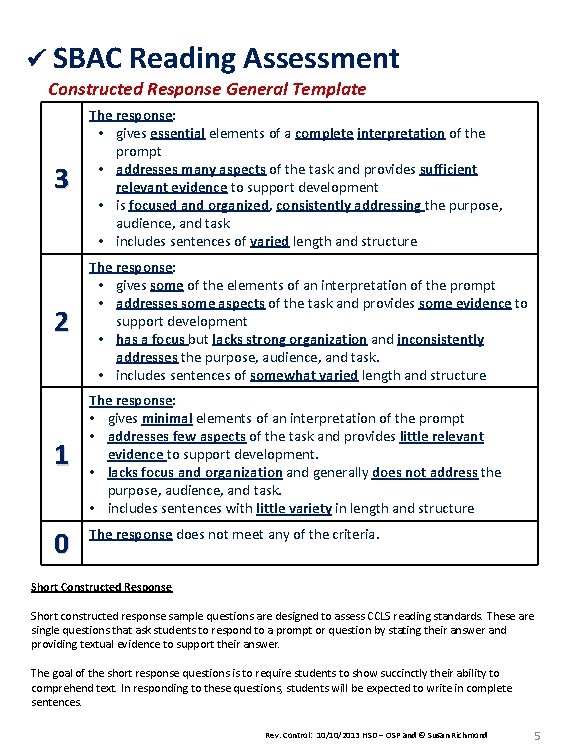
SBAC Reading Assessment Constructed Response General Template 3 The response: • gives essential elements of a complete interpretation of the prompt • addresses many aspects of the task and provides sufficient relevant evidence to support development • is focused and organized, consistently addressing the purpose, audience, and task • includes sentences of varied length and structure 2 The response: • gives some of the elements of an interpretation of the prompt • addresses some aspects of the task and provides some evidence to support development • has a focus but lacks strong organization and inconsistently addresses the purpose, audience, and task. • includes sentences of somewhat varied length and structure 1 The response: • gives minimal elements of an interpretation of the prompt • addresses few aspects of the task and provides little relevant evidence to support development. • lacks focus and organization and generally does not address the purpose, audience, and task. • includes sentences with little variety in length and structure 0 The response does not meet any of the criteria. Short Constructed Response Short constructed response sample questions are designed to assess CCLS reading standards. These are single questions that ask students to respond to a prompt or question by stating their answer and providing textual evidence to support their answer. The goal of the short response questions is to require students to show succinctly their ability to comprehend text. In responding to these questions, students will be expected to write in complete sentences. Rev. Control: 10/10/2013 HSD – OSP and © Susan Richmond 5
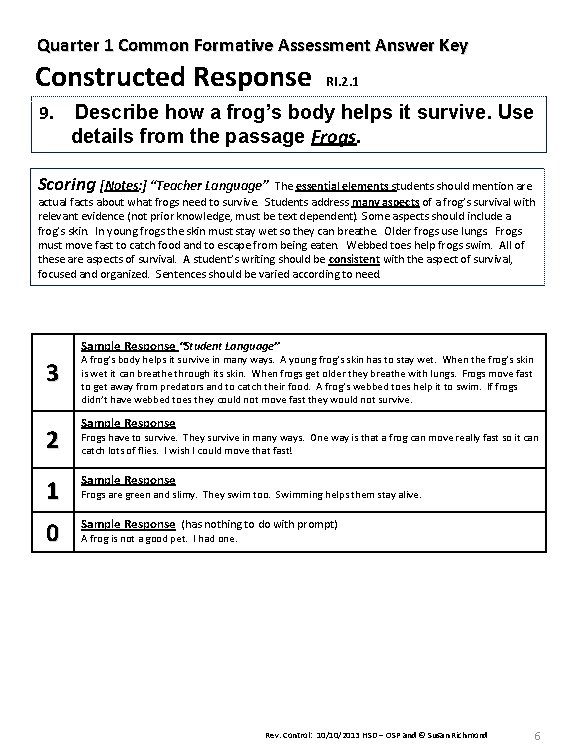
Quarter 1 Common Formative Assessment Answer Key Constructed Response 9. RI. 2. 1 Describe how a frog’s body helps it survive. Use details from the passage Frogs. Scoring [Notes: ] “Teacher Language” The essential elements students should mention are actual facts about what frogs need to survive. Students address many aspects of a frog’s survival with relevant evidence (not prior knowledge, must be text dependent). Some aspects should include a frog’s skin. In young frogs the skin must stay wet so they can breathe. Older frogs use lungs. Frogs must move fast to catch food and to escape from being eaten. Webbed toes help frogs swim. All of these are aspects of survival. A student’s writing should be consistent with the aspect of survival, focused and organized. Sentences should be varied according to need. Sample Response “Student Language” 3 2 A frog’s body helps it survive in many ways. A young frog’s skin has to stay wet. When the frog’s skin is wet it can breathe through its skin. When frogs get older they breathe with lungs. Frogs move fast to get away from predators and to catch their food. A frog’s webbed toes help it to swim. If frogs didn’t have webbed toes they could not move fast they would not survive. Sample Response Frogs have to survive. They survive in many ways. One way is that a frog can move really fast so it can catch lots of flies. I wish I could move that fast! 1 Sample Response 0 Sample Response (has nothing to do with prompt) Frogs are green and slimy. They swim too. Swimming helps them stay alive. A frog is not a good pet. I had one. Rev. Control: 10/10/2013 HSD – OSP and © Susan Richmond 6
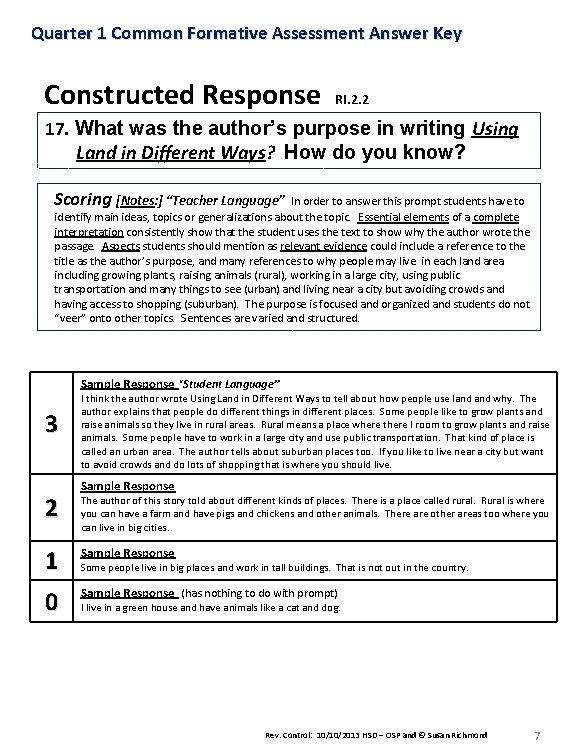
Quarter 1 Common Formative Assessment Answer Key Constructed Response RI. 2. 2 17. What was the author’s purpose in writing Using Land in Different Ways? How do you know? Scoring [Notes: ] “Teacher Language” In order to answer this prompt students have to identify main ideas, topics or generalizations about the topic. Essential elements of a complete interpretation consistently show that the student uses the text to show why the author wrote the passage. Aspects students should mention as relevant evidence could include a reference to the title as the author’s purpose, and many references to why people may live in each land area including growing plants, raising animals (rural), working in a large city, using public transportation and many things to see (urban) and living near a city but avoiding crowds and having access to shopping (suburban). The purpose is focused and organized and students do not “veer” onto other topics. Sentences are varied and structured. Sample Response "Student Language” 3 2 I think the author wrote Using Land in Different Ways to tell about how people use land why. The author explains that people do different things in different places. Some people like to grow plants and raise animals so they live in rural areas. Rural means a place where there I room to grow plants and raise animals. Some people have to work in a large city and use public transportation. That kind of place is called an urban area. The author tells about suburban places too. If you like to live near a city but want to avoid crowds and do lots of shopping that is where you should live. Sample Response The author of this story told about different kinds of places. There is a place called rural. Rural is where you can have a farm and have pigs and chickens and other animals. There are other areas too where you can live in big cities. 1 Sample Response 0 Sample Response (has nothing to do with prompt) Some people live in big places and work in tall buildings. That is not out in the country. I live in a green house and have animals like a cat and dog. Rev. Control: 10/10/2013 HSD – OSP and © Susan Richmond 7
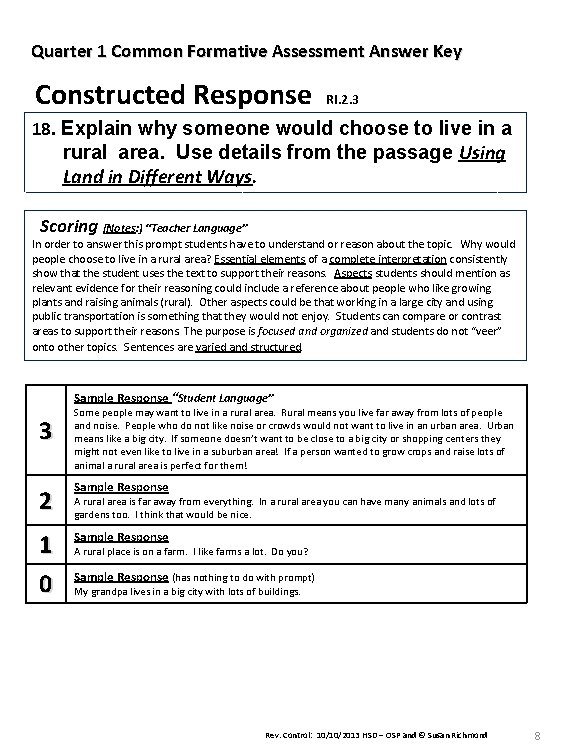
Quarter 1 Common Formative Assessment Answer Key Constructed Response RI. 2. 3 18. Explain why someone would choose to live in a rural area. Use details from the passage Using Land in Different Ways. Scoring [Notes: ] “Teacher Language” In order to answer this prompt students have to understand or reason about the topic. Why would people choose to live in a rural area? Essential elements of a complete interpretation consistently show that the student uses the text to support their reasons. Aspects students should mention as relevant evidence for their reasoning could include a reference about people who like growing plants and raising animals (rural). Other aspects could be that working in a large city and using public transportation is something that they would not enjoy. Students can compare or contrast areas to support their reasons. The purpose is focused and organized and students do not “veer” onto other topics. Sentences are varied and structured. Sample Response “Student Language” 3 Some people may want to live in a rural area. Rural means you live far away from lots of people and noise. People who do not like noise or crowds would not want to live in an urban area. Urban means like a big city. If someone doesn’t want to be close to a big city or shopping centers they might not even like to live in a suburban area! If a person wanted to grow crops and raise lots of animal a rural area is perfect for them! 2 Sample Response 1 0 Sample Response A rural area is far away from everything. In a rural area you can have many animals and lots of gardens too. I think that would be nice. A rural place is on a farm. I like farms a lot. Do you? Sample Response (has nothing to do with prompt) My grandpa lives in a big city with lots of buildings. Rev. Control: 10/10/2013 HSD – OSP and © Susan Richmond 8
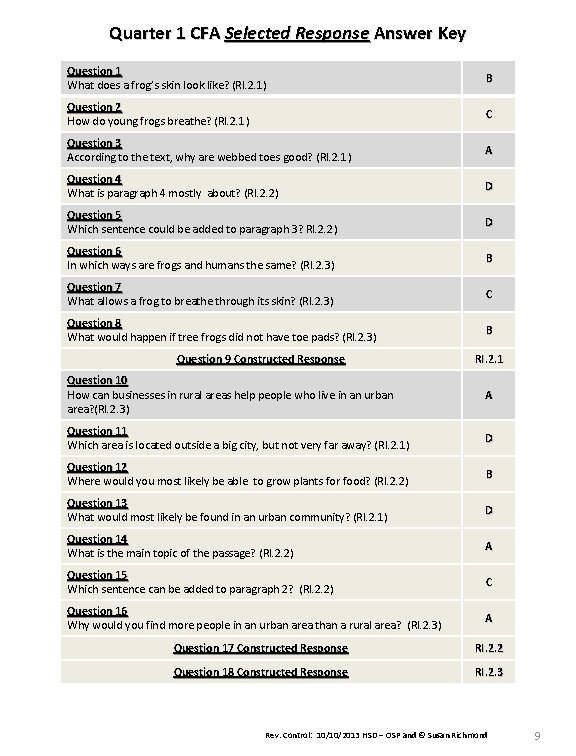
Quarter 1 CFA Selected Response Answer Key Question 1 What does a frog’s skin look like? (RI. 2. 1) B Question 2 How do young frogs breathe? (RI. 2. 1) C Question 3 According to the text, why are webbed toes good? (RI. 2. 1) A Question 4 What is paragraph 4 mostly about? (RI. 2. 2) D Question 5 Which sentence could be added to paragraph 3? RI. 2. 2) D Question 6 In which ways are frogs and humans the same? (RI. 2. 3) B Question 7 What allows a frog to breathe through its skin? (RI. 2. 3) C Question 8 What would happen if tree frogs did not have toe pads? (RI. 2. 3) B Question 9 Constructed Response RI. 2. 1 Question 10 How can businesses in rural areas help people who live in an urban area? (RI. 2. 3) A Question 11 Which area is located outside a big city, but not very far away? (RI. 2. 1) D Question 12 Where would you most likely be able to grow plants for food? (RI. 2. 2) B Question 13 What would most likely be found in an urban community? (RI. 2. 1) D Question 14 What is the main topic of the passage? (RI. 2. 2) A Question 15 Which sentence can be added to paragraph 2? (RI. 2. 2) C Question 16 Why would you find more people in an urban area than a rural area? (RI. 2. 3) A Question 17 Constructed Response RI. 2. 2 Question 18 Constructed Response RI. 2. 3 Rev. Control: 10/10/2013 HSD – OSP and © Susan Richmond 9
Quarter One Reading Informational Text Grade 2 Common Formative Assessment Name_________
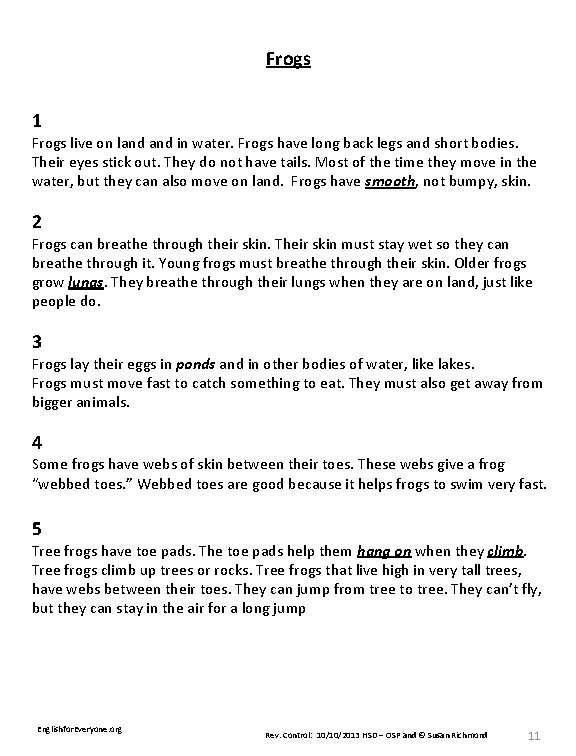
Frogs 1 Frogs live on land in water. Frogs have long back legs and short bodies. Their eyes stick out. They do not have tails. Most of the time they move in the water, but they can also move on land. Frogs have smooth, not bumpy, skin. 2 Frogs can breathe through their skin. Their skin must stay wet so they can breathe through it. Young frogs must breathe through their skin. Older frogs grow lungs. They breathe through their lungs when they are on land, just like people do. 3 Frogs lay their eggs in ponds and in other bodies of water, like lakes. Frogs must move fast to catch something to eat. They must also get away from bigger animals. 4 Some frogs have webs of skin between their toes. These webs give a frog “webbed toes. ” Webbed toes are good because it helps frogs to swim very fast. 5 Tree frogs have toe pads. The toe pads help them hang on when they climb. Tree frogs climb up trees or rocks. Tree frogs that live high in very tall trees, have webs between their toes. They can jump from tree to tree. They can’t fly, but they can stay in the air for a long jump Englishfor. Everyone. org Rev. Control: 10/10/2013 HSD – OSP and © Susan Richmond 11
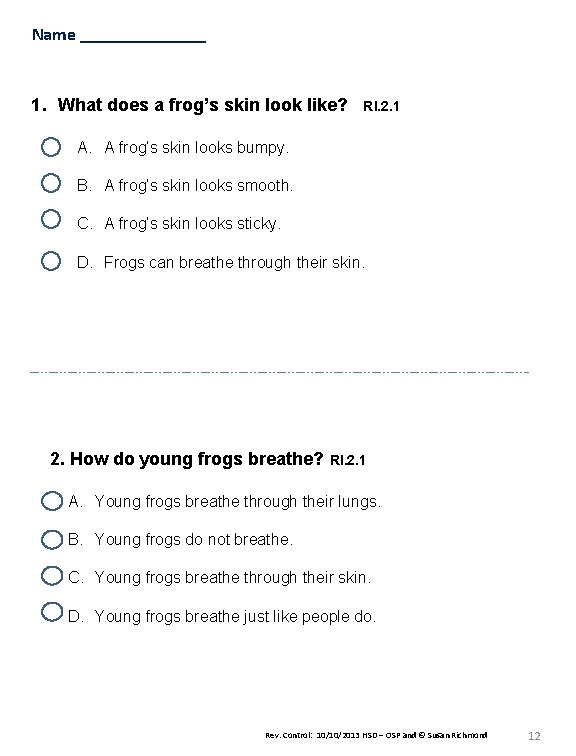
Name _______ 1. What does a frog’s skin look like? RI. 2. 1 A. A frog’s skin looks bumpy. B. A frog’s skin looks smooth. C. A frog’s skin looks sticky. D. Frogs can breathe through their skin. 2. How do young frogs breathe? RI. 2. 1 A. Young frogs breathe through their lungs. B. Young frogs do not breathe. C. Young frogs breathe through their skin. D. Young frogs breathe just like people do. Rev. Control: 10/10/2013 HSD – OSP and © Susan Richmond 12
3. According to the text, why are webbed toes good? RI. 2. 1 A. Webbed toes help frogs to swim very fast. B. Webbed toes help frogs hang on when they climb. C. Webbed toes are good for all frogs. D. Webbed toes help frogs to swim very slowly. 4. What is paragraph 4 mostly about? RI. 2. 2 A. Frog’s skin helps them breathe. B. Tree frogs can jump from tree to tree. C. Frogs breathe using lungs. D. Webbed toes help frogs survive. Rev. Control: 10/10/2013 HSD – OSP and © Susan Richmond 13
5. Which sentence could be added to paragraph 3? RI. 2. 2 A. Frogs lay their eggs in ponds. B. Lizards are also very fast. C. Frogs eat many harmful insects each year. D. Some frogs can jump 20 times their body length. 6. In which ways are frogs and humans the same? RI. 2. 3 A. They both have webs between their toes. B. They can both breathe through their lungs. C. They both breathe through their skin. D. They both need their skin to stay wet. Rev. Control: 10/10/2013 HSD – OSP and © Susan Richmond 14
7. What allows a frog to breathe through its skin? RI. 2. 3 A. A smooth skin. B. Being underwater. C. A wet skin. D. Frogs do not have tails. 8. What would happen if tree frogs did not have toe pads? RI. 2. 3 A. Tree frogs could not move in the water. B. Tree frogs would not be able to hang on when they climb. C. Tree frogs could not jump. D. Tree frogs could not breathe through their skin. Rev. Control: 10/10/2013 HSD – OSP and © Susan Richmond 15
9. Describe how a frog’s body helps it survive. Use details from the passage Frogs. RI. 2. 1 Rev. Control: 10/10/2013 HSD – OSP and © Susan Richmond 16
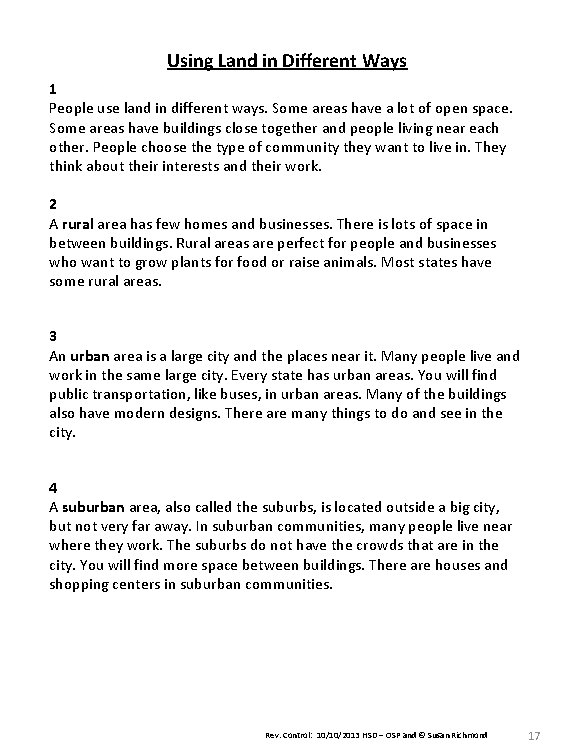
Using Land in Different Ways 1 People use land in different ways. Some areas have a lot of open space. Some areas have buildings close together and people living near each other. People choose the type of community they want to live in. They think about their interests and their work. 2 A rural area has few homes and businesses. There is lots of space in between buildings. Rural areas are perfect for people and businesses who want to grow plants for food or raise animals. Most states have some rural areas. 3 An urban area is a large city and the places near it. Many people live and work in the same large city. Every state has urban areas. You will find public transportation, like buses, in urban areas. Many of the buildings also have modern designs. There are many things to do and see in the city. 4 A suburban area, also called the suburbs, is located outside a big city, but not very far away. In suburban communities, many people live near where they work. The suburbs do not have the crowds that are in the city. You will find more space between buildings. There are houses and shopping centers in suburban communities. Rev. Control: 10/10/2013 HSD – OSP and © Susan Richmond 17
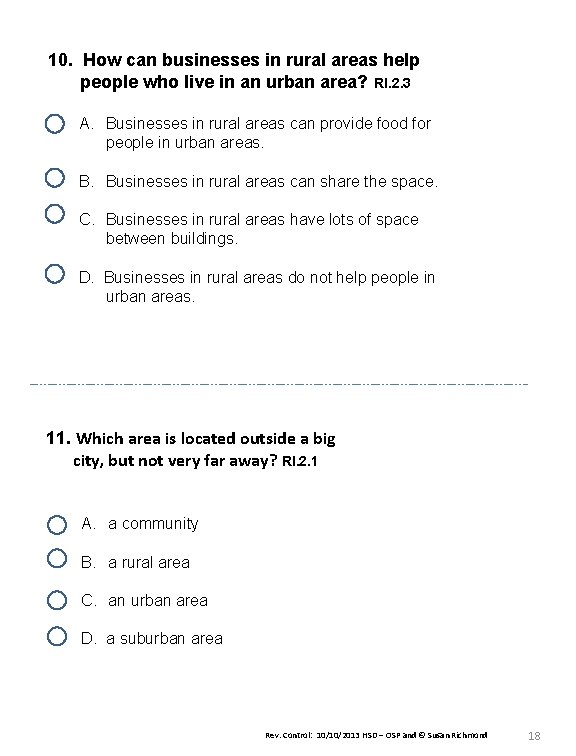
10. How can businesses in rural areas help people who live in an urban area? RI. 2. 3 A. Businesses in rural areas can provide food for people in urban areas. B. Businesses in rural areas can share the space. C. Businesses in rural areas have lots of space between buildings. D. Businesses in rural areas do not help people in urban areas. 11. Which area is located outside a big city, but not very far away? RI. 2. 1 A. a community B. a rural area C. an urban area D. a suburban area Rev. Control: 10/10/2013 HSD – OSP and © Susan Richmond 18
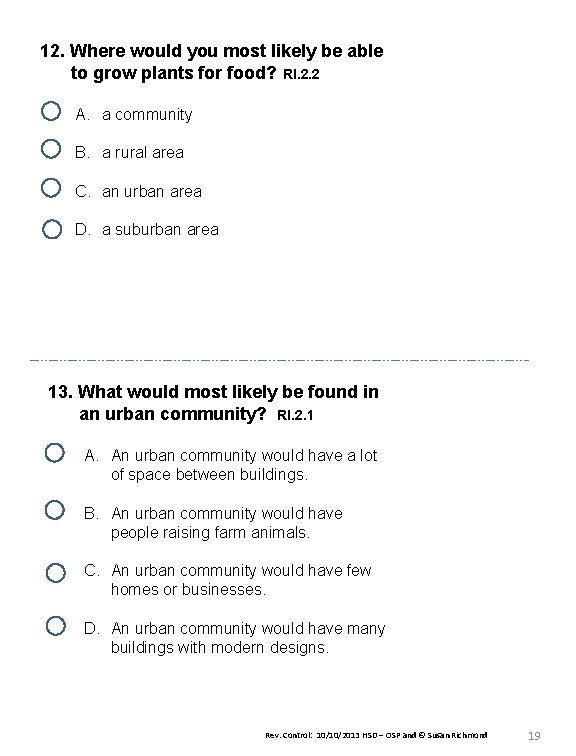
12. Where would you most likely be able to grow plants for food? RI. 2. 2 A. a community B. a rural area C. an urban area D. a suburban area 13. What would most likely be found in an urban community? RI. 2. 1 A. An urban community would have a lot of space between buildings. B. An urban community would have people raising farm animals. C. An urban community would have few homes or businesses. D. An urban community would have many buildings with modern designs. Rev. Control: 10/10/2013 HSD – OSP and © Susan Richmond 19
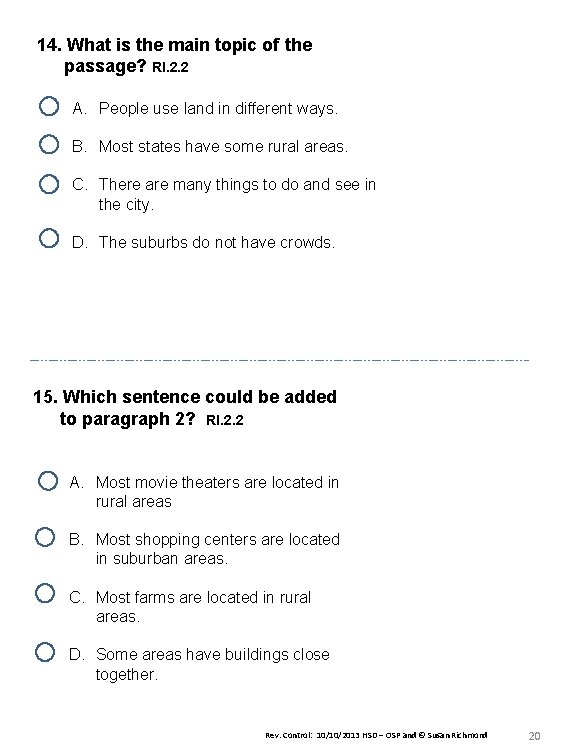
14. What is the main topic of the passage? RI. 2. 2 A. People use land in different ways. B. Most states have some rural areas. C. There are many things to do and see in the city. D. The suburbs do not have crowds. 15. Which sentence could be added to paragraph 2? RI. 2. 2 A. Most movie theaters are located in rural areas B. Most shopping centers are located in suburban areas. C. Most farms are located in rural areas. D. Some areas have buildings close together. Rev. Control: 10/10/2013 HSD – OSP and © Susan Richmond 20
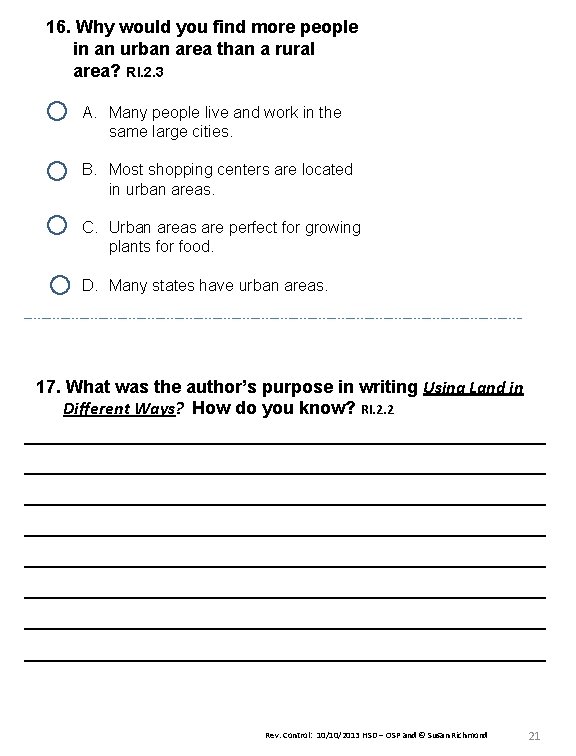
16. Why would you find more people in an urban area than a rural area? RI. 2. 3 A. Many people live and work in the same large cities. B. Most shopping centers are located in urban areas. C. Urban areas are perfect for growing plants for food. D. Many states have urban areas. 17. What was the author’s purpose in writing Using Land in Different Ways? How do you know? RI. 2. 2 Rev. Control: 10/10/2013 HSD – OSP and © Susan Richmond 21
18. Explain why someone would choose to live in a rural area. Use details from the passage Using Land in Different Ways. RI. 2. 3 Rev. Control: 10/10/2013 HSD – OSP and © Susan Richmond 22
STOP Close your books and wait for instructions! Rev. Control: 10/10/2013 HSD – OSP and © Susan Richmond 23
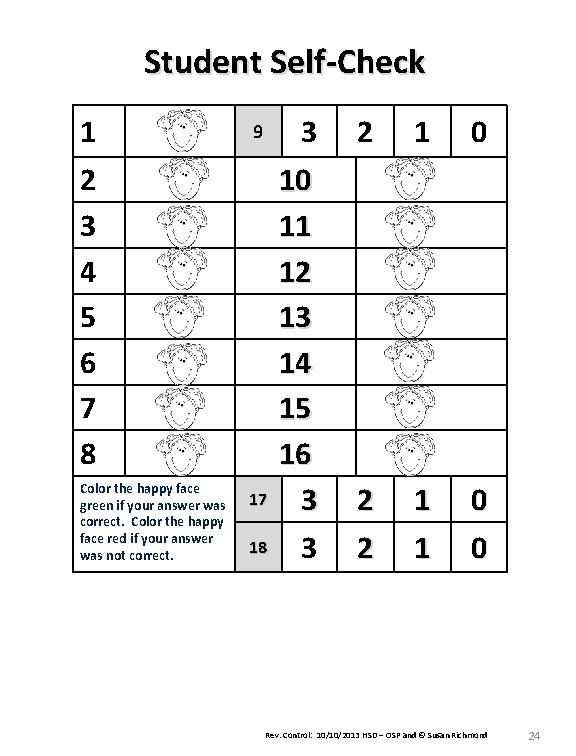
Student Self-Check 1 9 2 3 4 5 6 7 8 Color the happy face green if your answer was correct. Color the happy face red if your answer was not correct. 17 18 3 2 1 0 10 11 12 13 14 15 16 3 3 2 2 1 1 0 0 Rev. Control: 10/10/2013 HSD – OSP and © Susan Richmond 24
1 2 3 4 5 6 7 8 9 10 11 12 Rev. Control: 10/10/2013 HSD – OSP and © Susan Richmond 25