
Quarter Four Reading Informational Text Grade 6 Teacher
- Slides: 44
Quarter Four Reading Informational Text Grade 6 Teacher Directions Common Formative Assessment
Quarter Four Informational Text Common Formative Assessments Team Members and Writers This assessment was developed working backwards by identifying the deep understanding of the two passages in order to write a performance task prompt. Key Ideas were identified to support constructed responses and key details align with the selected response questions. All questions support students’ background knowledge in order to answer the performance task prompt. Haley Christensen Melissa Hancock Sandy Maines Kelly Rooke Tammy Cole Jamie Incrovato Gina Mc. Lain Jill Russo Lindsay Crowell Ginger Jay Shawna Munson Leslie Sell Deborah Delplanche Jenn Johnson Christina Orozco Erin Shepherd Lindsay Garcia Dovina Israel Teresa Portinga Erin Van. Dyle Heather Giard Ko Kagawa Judy Ramer Christy Walters Brooke Godfrey Kimberly Laws Erin Reamer Melanie Winters Christine Goldmann Alfonso Lule Sara Retzlaff Alia Zagyva Jamie Goldstein Berta Lule Jennifer Robbins Thank you to all of those who reviewed and edited and a special appreciation to Vicki Daniels and her amazing editing skills. Rev. Control: 05/25/14 HSD – OSP and © Susan Richmond 2
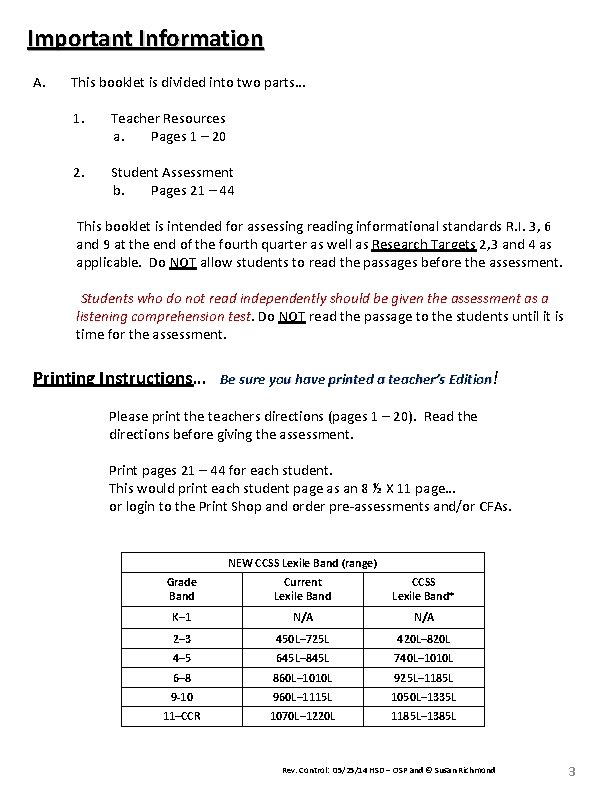
Important Information A. This booklet is divided into two parts… 1. Teacher Resources a. Pages 1 – 20 2. Student Assessment b. Pages 21 – 44 This booklet is intended for assessing reading informational standards R. I. 3, 6 and 9 at the end of the fourth quarter as well as Research Targets 2, 3 and 4 as applicable. Do NOT allow students to read the passages before the assessment. Students who do not read independently should be given the assessment as a listening comprehension test. Do NOT read the passage to the students until it is time for the assessment. Printing Instructions… Be sure you have printed a teacher’s Edition! Please print the teachers directions (pages 1 – 20). Read the directions before giving the assessment. Print pages 21 – 44 for each student. This would print each student page as an 8 ½ X 11 page… or login to the Print Shop and order pre-assessments and/or CFAs. NEW CCSS Lexile Band (range) Grade Band Current Lexile Band CCSS Lexile Band* K– 1 N/A 2– 3 450 L– 725 L 420 L– 820 L 4– 5 645 L– 845 L 740 L– 1010 L 6– 8 860 L– 1010 L 925 L– 1185 L 9 -10 960 L– 1115 L 1050 L– 1335 L 11–CCR 1070 L– 1220 L 1185 L– 1385 L Rev. Control: 05/25/14 HSD – OSP and © Susan Richmond 3
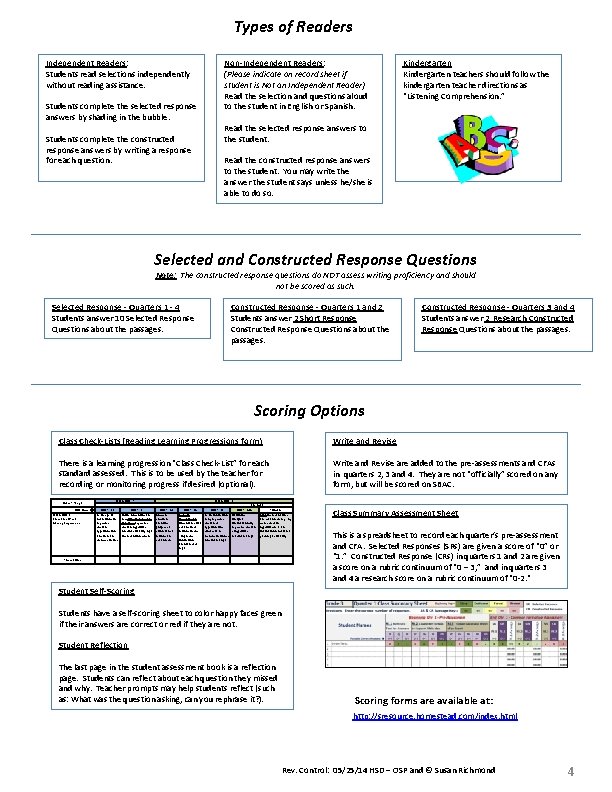
Types of Readers Independent Readers: Students read selections independently without reading assistance. Non-Independent Readers: (Please indicate on record sheet if student is Not an Independent Reader) Read the selection and questions aloud to the student in English or Spanish. Students complete the selected response answers by shading in the bubble. Kindergarten teachers should follow the kindergarten teacher directions as “Listening Comprehension. ” Read the selected response answers to the student. Students complete the constructed response answers by writing a response for each question. Read the constructed response answers to the student. You may write the answer the student says unless he/she is able to do so. Selected and Constructed Response Questions Note: The constructed response questions do NOT assess writing proficiency and should not be scored as such. Constructed Response - Quarters 1 and 2 Students answer 2 Short Response Constructed Response Questions about the passages. Selected Response - Quarters 1 - 4 Students answer 10 Selected Response Questions about the passages. Constructed Response - Quarters 3 and 4 Students answer 2 Research Constructed Response Questions about the passages. Scoring Options Class Check-Lists (Reading Learning Progressions form) Write and Revise There is a learning progression “Class Check-List” for each standard assessed. This is to be used by the teacher for recording or monitoring progress if desired (optional). Write and Revise are added to the pre-assessments and CFAs in quarters 2, 3 and 4. They are not “officially” scored on any form, but will be scored on SBAC. DOK Guide Path to DOK - 2 Path to DOK - 1 Grade 3 Sample Path to DOK 2 Informational Text Learning Progressions End Goal DOK 1 - Ka DOK 1 - Kc Locate specific text features (i. e. , key words, sidebars, hyperlinks) from a text read and discussed in class. Define (understand use) Standard Academic Language: key words, sidebars, hyperlinks, relevant, efficiently, topic and text features/tools. DOK 1 - Cf Answers questions about the purpose of different text features and search tools. DOK 2 - Ch DOK 2 - Cl DOK 2 - APn Standard Concept Development Understands that search or text features (tools) can provide information about a text or topic. Locate information using key words, sidebars or hyperlinks (and other search tools/text features) relevant to a topic. Obtain and Interpret information using key words, sidebars or hyperlinks relevant to a topic. RI 3. 5 Use text features and search tools (e. g. , key words, sidebars, hyperlinks) to locate information relevant to a given topic efficiently. Student Name Class Summary Assessment Sheet This is a spreadsheet to record each quarter’s pre-assessment and CFA. Selected Responses (SRs) are given a score of “ 0” or “ 1. ” Constructed Response (CRs) in quarters 1 and 2 are given a score on a rubric continuum of “ 0 – 3, ” and in quarters 3 and 4 a research score on a rubric continuum of “ 0 -2. " Student Self-Scoring Students have a self-scoring sheet to color happy faces green if their answers are correct or red if they are not. Student Reflection The last page in the student assessment book is a reflection page. Students can reflect about each question they missed and why. Teacher prompts may help students reflect (such as: What was the question asking, can you rephrase it? ). Scoring forms are available at: http: //sresource. homestead. com/index. html Rev. Control: 05/25/14 HSD – OSP and © Susan Richmond 4
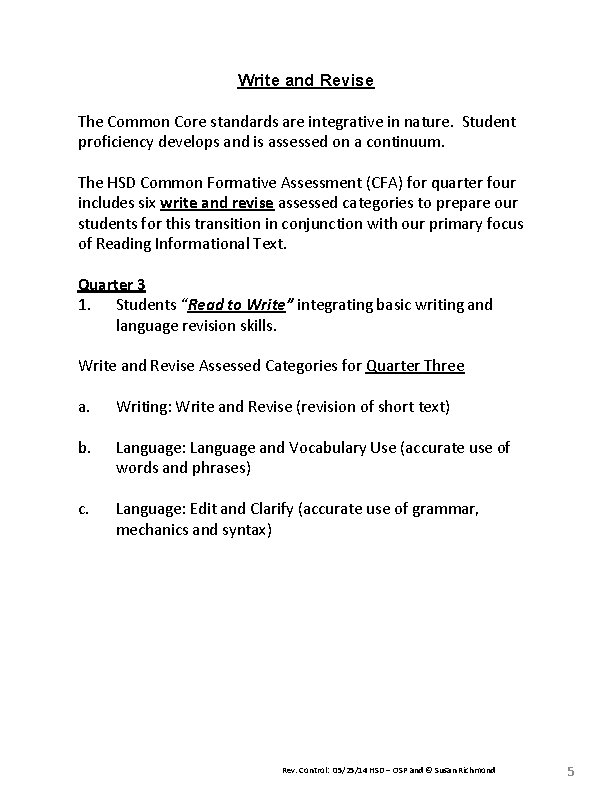
Write and Revise The Common Core standards are integrative in nature. Student proficiency develops and is assessed on a continuum. The HSD Common Formative Assessment (CFA) for quarter four includes six write and revise assessed categories to prepare our students for this transition in conjunction with our primary focus of Reading Informational Text. Quarter 3 1. Students “Read to Write” integrating basic writing and language revision skills. Write and Revise Assessed Categories for Quarter Three a. Writing: Write and Revise (revision of short text) b. Language: Language and Vocabulary Use (accurate use of words and phrases) c. Language: Edit and Clarify (accurate use of grammar, mechanics and syntax) Rev. Control: 05/25/14 HSD – OSP and © Susan Richmond 5
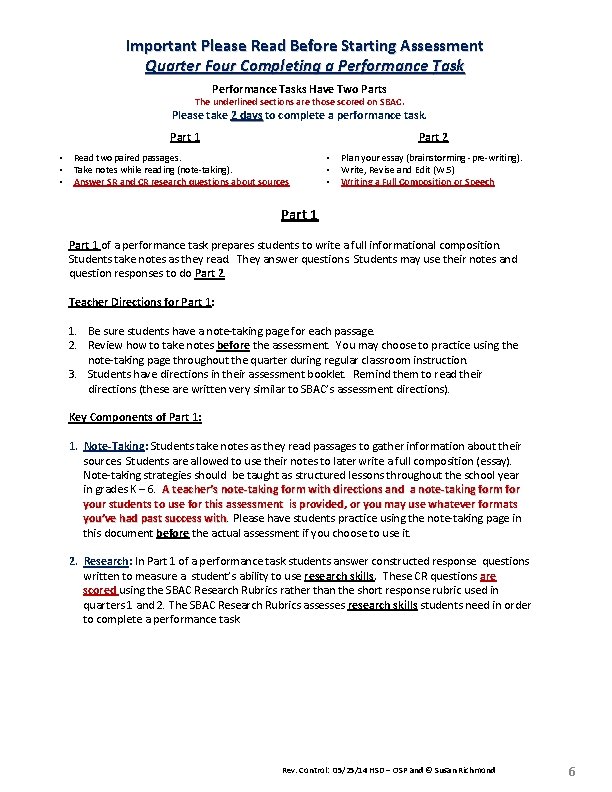
Important Please Read Before Starting Assessment Quarter Four Completing a Performance Tasks Have Two Parts The underlined sections are those scored on SBAC. Please take 2 days to complete a performance task. Part 1 • • • Part 2 Read two paired passages. Take notes while reading (note-taking). Answer SR and CR research questions about sources • • • Plan your essay (brainstorming -pre-writing). Write, Revise and Edit (W. 5) Writing a Full Composition or Speech Part 1 of a performance task prepares students to write a full informational composition. Students take notes as they read. They answer questions. Students may use their notes and question responses to do Part 2. Teacher Directions for Part 1: 1. Be sure students have a note-taking page for each passage. 2. Review how to take notes before the assessment. You may choose to practice using the note-taking page throughout the quarter during regular classroom instruction. 3. Students have directions in their assessment booklet. Remind them to read their directions (these are written very similar to SBAC’s assessment directions). Key Components of Part 1: 1. Note-Taking: Students take notes as they read passages to gather information about their sources. Students are allowed to use their notes to later write a full composition (essay). Note-taking strategies should be taught as structured lessons throughout the school year in grades K – 6. A teacher’s note-taking form with directions and a note-taking form for your students to use for this assessment is provided, or you may use whatever formats you’ve had past success with Please have students practice using the note-taking page in this document before the actual assessment if you choose to use it. 2. Research: In Part 1 of a performance task students answer constructed response questions written to measure a student’s ability to use research skills. These CR questions are scored using the SBAC Research Rubrics rather than the short response rubric used in quarters 1 and 2. The SBAC Research Rubrics assesses research skills students need in order to complete a performance task. Rev. Control: 05/25/14 HSD – OSP and © Susan Richmond 6
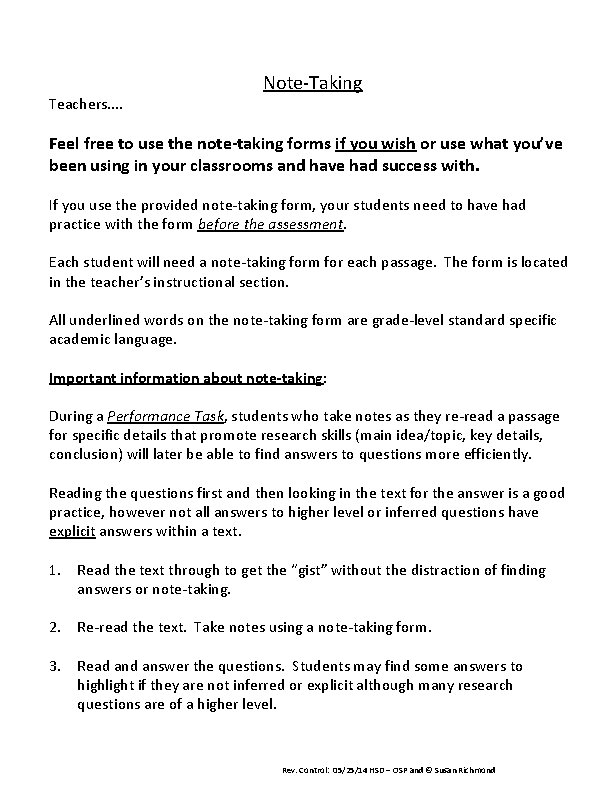
Teachers. . Note-Taking Feel free to use the note-taking forms if you wish or use what you’ve been using in your classrooms and have had success with. If you use the provided note-taking form, your students need to have had practice with the form before the assessment. Each student will need a note-taking form for each passage. The form is located in the teacher’s instructional section. All underlined words on the note-taking form are grade-level standard specific academic language. Important information about note-taking: During a Performance Task, students who take notes as they re-read a passage for specific details that promote research skills (main idea/topic, key details, conclusion) will later be able to find answers to questions more efficiently. Reading the questions first and then looking in the text for the answer is a good practice, however not all answers to higher level or inferred questions have explicit answers within a text. 1. Read the text through to get the “gist” without the distraction of finding answers or note-taking. 2. Re-read the text. Take notes using a note-taking form. 3. Read answer the questions. Students may find some answers to highlight if they are not inferred or explicit although many research questions are of a higher level. Rev. Control: 05/25/14 HSD – OSP and © Susan Richmond
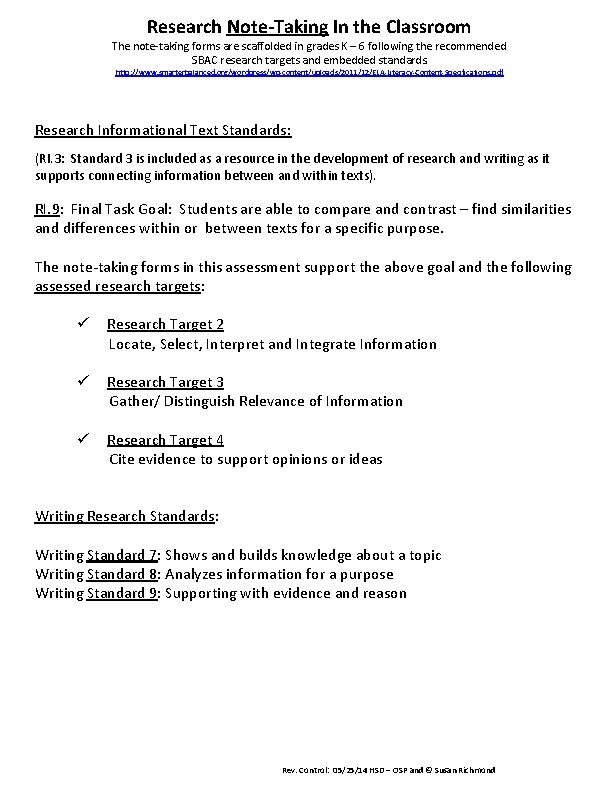
Research Note-Taking In the Classroom The note-taking forms are scaffolded in grades K – 6 following the recommended SBAC research targets and embedded standards. http: //www. smarterbalanced. org/wordpress/wp-content/uploads/2011/12/ELA-Literacy-Content-Specifications. pdf Research Informational Text Standards: (RI. 3: Standard 3 is included as a resource in the development of research and writing as it supports connecting information between and within texts). RI. 9: Final Task Goal: Students are able to compare and contrast – find similarities and differences within or between texts for a specific purpose. The note-taking forms in this assessment support the above goal and the following assessed research targets: ü Research Target 2 Locate, Select, Interpret and Integrate Information ü Research Target 3 Gather/ Distinguish Relevance of Information ü Research Target 4 Cite evidence to support opinions or ideas Writing Research Standards: Writing Standard 7: Shows and builds knowledge about a topic Writing Standard 8: Analyzes information for a purpose Writing Standard 9: Supporting with evidence and reason Rev. Control: 05/25/14 HSD – OSP and © Susan Richmond
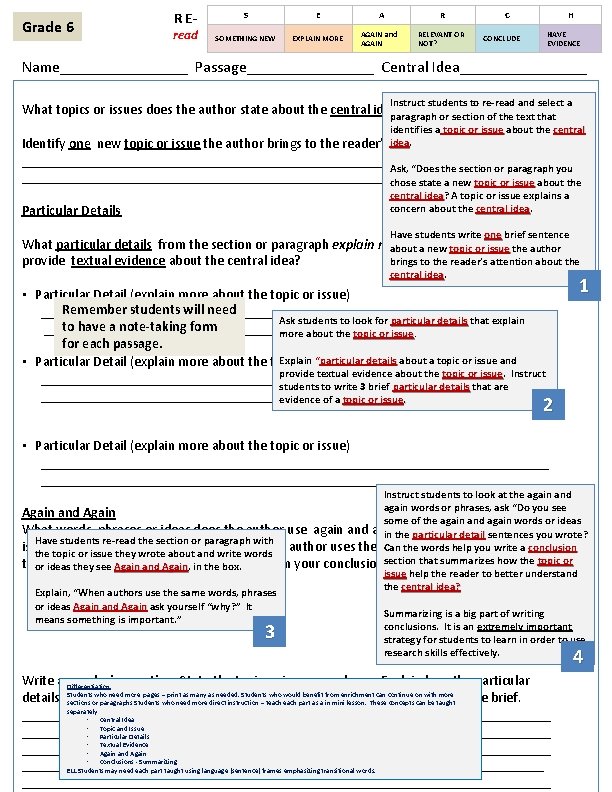
Grade 6 R E- read S E SOMETHING NEW EXPLAIN MORE A R AGAIN and AGAIN RELEVANT OR NOT? C CONCLUDE H HAVE EVIDENCE Name________ Passage________ Central Idea________ Instruct students to re-read and select a What topics or issues does the author state about the central idea? paragraph or section of the text that identifies a topic or issue about the central idea Identify one new topic or issue the author brings to the reader’s idea. attention about the central idea. ______________________________________ Ask, “Does the section or paragraph you _______________________________________ chose state a new topic or issue about the central idea? idea A topic or issue explains a concern about the central idea Particular Details Have students write one brief sentence What particular details from the section or paragraph explain more orthe issue and about a new the topic or issue author brings to the reader’s attention about the provide textual evidence about the central idea? central idea • Particular Detail (explain more about the topic or issue) Remember students will need ____________________________________ Ask students to look for particular details that explain to have a note-taking form ____________________________________ more about the topic or issue for each passage. Explain particular details about a topic or issue and “issue) • Particular Detail (explain more about the topic or “particular provide textual evidence about the topic or issue Instruct _____________________________________ students to write 3 brief particular details that are _____________________________________ evidence of a topic or issue. 1 2 • Particular Detail (explain more about the topic or issue) _________________________________________________________________________ Instruct students to look at the again and again words or phrases, ask “Do you see Again and Again some of the again and again words or ideas What words, phrases or ideas does the author use again and again referring to the topic or in thewhen particular detail sentences you wrote? Have students re-read the section or paragraph with the words help you. You write a conclusion issue? Write them here. Ask yourself why the author uses them. Can again and again. may want the topic or issue they wrote about and write words section that summarizes how the topic or to or use some words, or ideas in your conclusion. ideas theyof seethese Again and Again, in the box. Againphrases issue help the reader to better understand the central idea? Explain, “When authors use the same words, phrases or ideas Again and Again ask yourself “why? ” It Summarizing is a big part of writing means something is important. ” conclusions. It is an extremely important strategy for students to learn in order to use research skills effectively. 3 Write a conclusion section. State the topic or issue you chose. Explain how the particular Differentiation: Students who need more pages – print as many as needed. Students who would benefit from enrichment can continue on with more details about topic orwhoissue support the– teach central idea. summary be brief. sections or the paragraphs Students need more direct instruction each part as a in mini Your lesson. These concepts can beshould taught separately: ______________________________________ • Central Idea • Topic and Issue ______________________________________ • Particular Details • Textual Evidence ______________________________________ • Again and Again • Conclusions - Summarizing ______________________________________ ELL Students may need each part taught using language (sentence) frames. Rev. emphasizing transitional words. Control: 05/25/14 HSD – OSP and © Susan Richmond ______________________________________ 4
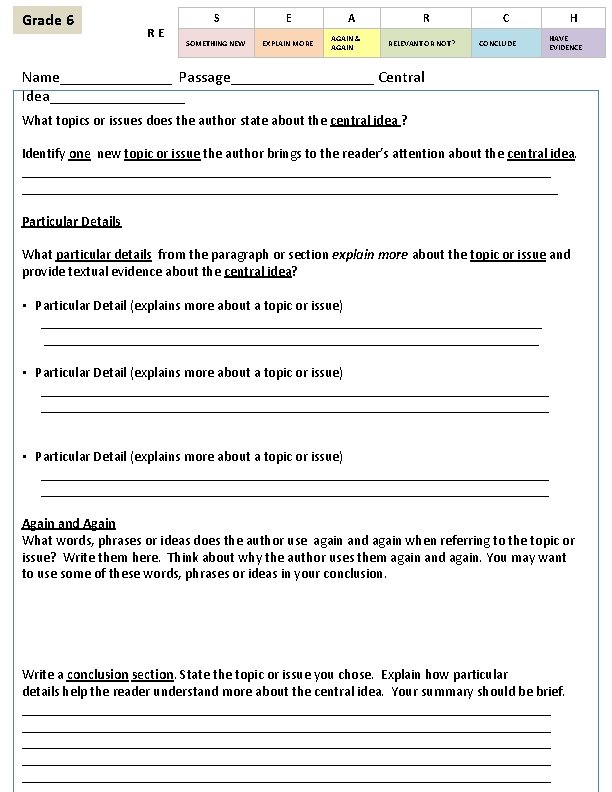
Grade 6 RE S E SOMETHING NEW EXPLAIN MORE A AGAIN & AGAIN R RELEVANT OR NOT? C CONCLUDE H HAVE EVIDENCE Name_______ Passage_________ Central Idea_________ What topics or issues does the author state about the central idea ? Identify one new topic or issue the author brings to the reader’s attention about the central idea. _____________________________________________________________________________ Particular Details What particular details from the paragraph or section explain more about the topic or issue and provide textual evidence about the central idea? • Particular Detail (explains more about a topic or issue) _______________________________________________________________________ • Particular Detail (explains more about a topic or issue) _________________________________________________________________________ Again and Again What words, phrases or ideas does the author use again and again when referring to the topic or issue? Write them here. Think about why the author uses them again and again. You may want to use some of these words, phrases or ideas in your conclusion. Write a conclusion section. State the topic or issue you chose. Explain how particular details help the reader understand more about the central idea. Your summary should be brief. ____________________________________________________________________________ Rev. Control: 05/25/14 HSD – OSP and © Susan Richmond ______________________________________
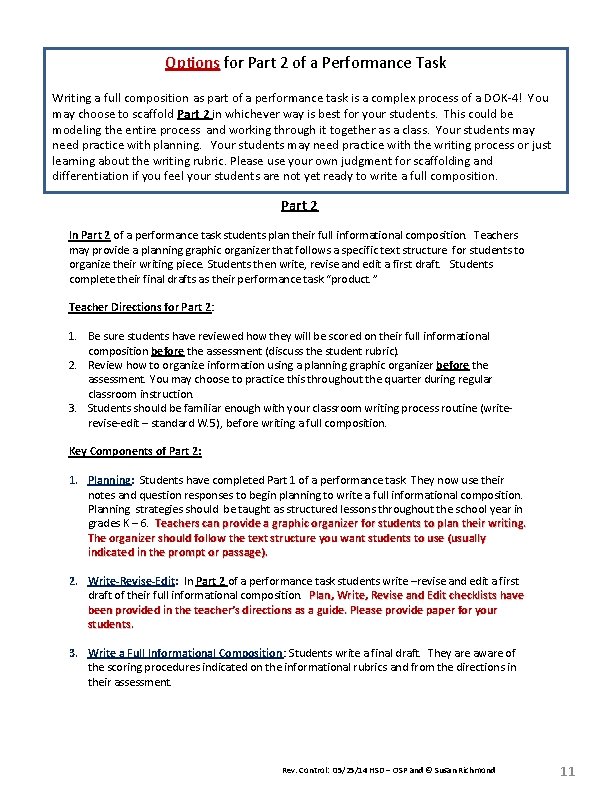
Options for Part 2 of a Performance Task Writing a full composition as part of a performance task is a complex process of a DOK-4! You may choose to scaffold Part 2 in whichever way is best for your students. This could be modeling the entire process and working through it together as a class. Your students may need practice with planning. Your students may need practice with the writing process or just learning about the writing rubric. Please use your own judgment for scaffolding and differentiation if you feel your students are not yet ready to write a full composition. Part 2 In Part 2 of a performance task students plan their full informational composition. Teachers may provide a planning graphic organizer that follows a specific text structure for students to organize their writing piece. Students then write, revise and edit a first draft. Students complete their final drafts as their performance task “product. ” Teacher Directions for Part 2: 1. Be sure students have reviewed how they will be scored on their full informational composition before the assessment (discuss the student rubric). 2. Review how to organize information using a planning graphic organizer before the assessment. You may choose to practice this throughout the quarter during regular classroom instruction. 3. Students should be familiar enough with your classroom writing process routine (writerevise-edit – standard W. 5), before writing a full composition. Key Components of Part 2: 1. Planning: Students have completed Part 1 of a performance task. They now use their notes and question responses to begin planning to write a full informational composition. Planning strategies should be taught as structured lessons throughout the school year in grades K – 6. Teachers can provide a graphic organizer for students to plan their writing. The organizer should follow the text structure you want students to use (usually indicated in the prompt or passage). 2. Write-Revise-Edit: In Part 2 of a performance task students write –revise and edit a first draft of their full informational composition. Plan, Write, Revise and Edit checklists have been provided in the teacher’s directions as a guide. Please provide paper for your students. 3. Write a Full Informational Composition: Students write a final draft. They are aware of the scoring procedures indicated on the informational rubrics and from the directions in their assessment. Rev. Control: 05/25/14 HSD – OSP and © Susan Richmond 11
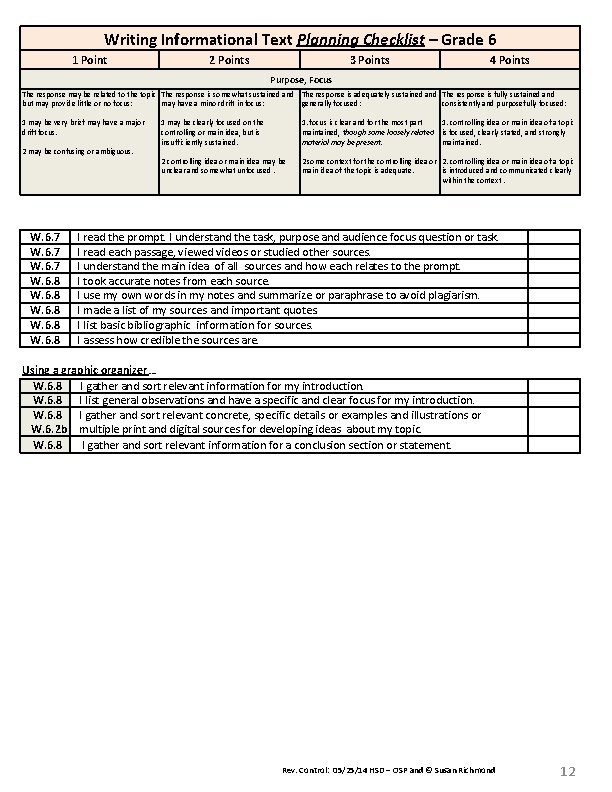
Writing Informational Text Planning Checklist – Grade 6 1 Point 2 Points 3 Points 4 Points Purpose, Focus The response may be related to the topic The response is somewhat sustained and The response is adequately sustained and The response is fully sustained and but may provide little or no focus: may have a minor drift in focus: generally focused: consistently and purposefully focused: 1 may be very brief may have a major drift focus. 2 may be confusing or ambiguous. W. 6. 7 W. 6. 8 1 may be clearly focused on the controlling or main idea, but is insufficiently sustained. 1. focus is clear and for the most part 1. controlling idea or main idea of a topic maintained, though some loosely related is focused, clearly stated, and strongly material may be present. maintained. 2 controlling idea or main idea may be unclear and somewhat unfocused. 2 some context for the controlling idea or 2. controlling idea or main idea of a topic main idea of the topic is adequate. is introduced and communicated clearly within the context. I read the prompt. I understand the task, purpose and audience focus question or task. I read each passage, viewed videos or studied other sources. I understand the main idea of all sources and how each relates to the prompt. I took accurate notes from each source. I use my own words in my notes and summarize or paraphrase to avoid plagiarism. I made a list of my sources and important quotes. I list basic bibliographic information for sources. I assess how credible the sources are. Using a graphic organizer… W. 6. 8 I gather and sort relevant information for my introduction. W. 6. 8 I list general observations and have a specific and clear focus for my introduction. W. 6. 8 I gather and sort relevant concrete, specific details or examples and illustrations or W. 6. 2 b multiple print and digital sources for developing ideas about my topic. W. 6. 8 I gather and sort relevant information for a conclusion section or statement. Rev. Control: 05/25/14 HSD – OSP and © Susan Richmond 12
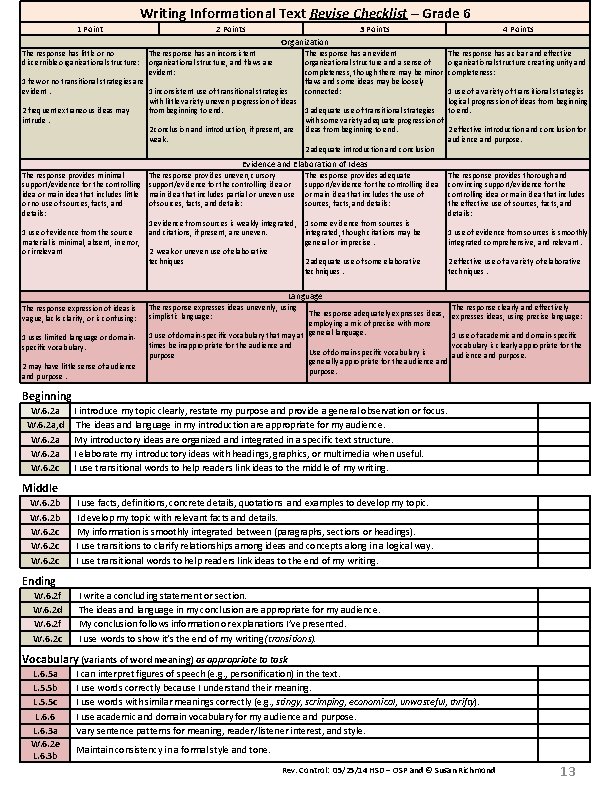
Writing Informational Text Revise Checklist – Grade 6 1 Point 2 Points 3 Points 4 Points The response has an evident organizational structure and a sense of completeness, though there may be minor flaws and some ideas may be loosely connected: The response has a clear and effective organizational structure creating unity and completeness: Organization The response has little or no discernible organizational structure: The response has an inconsistent organizational structure, and flaws are evident: 1 few or no transitional strategies are evident. 1 inconsistent use of transitional strategies with little variety uneven progression of ideas 2 frequent extraneous ideas may from beginning to end. 1 adequate use of transitional strategies intrude. with some variety adequate progression of 2 conclusion and introduction, if present, are ideas from beginning to end. weak. 2 adequate introduction and conclusion 1 use of a variety of transitional strategies logical progression of ideas from beginning to end. 2 effective introduction and conclusion for audience and purpose. Evidence and Elaboration of Ideas The response provides minimal support/evidence for the controlling idea or main idea that includes little or no use of sources, facts, and details: 1 use of evidence from the source material is minimal, absent, in error, or irrelevant The response provides uneven, cursory support/evidence for the controlling idea or main idea that includes partial or uneven use of sources, facts, and details: The response provides adequate support/evidence for the controlling idea or main idea that includes the use of sources, facts, and details: 1 evidence from sources is weakly integrated, 1 some evidence from sources is and citations, if present, are uneven. integrated, though citations may be general or imprecise. 2 weak or uneven use of elaborative techniques 2 adequate use of some elaborative techniques. The response provides thorough and convincing support/evidence for the controlling idea or main idea that includes the effective use of sources, facts, and details: 1 use of evidence from sources is smoothly integrated comprehensive, and relevant. 2 effective use of a variety of elaborative techniques. Language The response expression of ideas is vague, lacks clarity, or is confusing: 1 uses limited language or domainspecific vocabulary. 2 may have little sense of audience and purpose. The response expresses ideas unevenly, using simplistic language: The response clearly and effectively The response adequately expresses ideas, using precise language: employing a mix of precise with more 1 use of domain-specific vocabulary that may at general language. 1 use of academic and domain-specific times be inappropriate for the audience and vocabulary is clearly appropriate for the Use of domain-specific vocabulary is purpose audience and purpose. generally appropriate for the audience and purpose. Beginning W. 6. 2 a, d W. 6. 2 a W. 6. 2 c I introduce my topic clearly, restate my purpose and provide a general observation or focus. The ideas and language in my introduction are appropriate for my audience. My introductory ideas are organized and integrated in a specific text structure. I elaborate my introductory ideas with headings, graphics, or multimedia when useful. I use transitional words to help readers link ideas to the middle of my writing. Middle W. 6. 2 b W. 6. 2 c I use facts, definitions, concrete details, quotations and examples to develop my topic. I develop my topic with relevant facts and details. My information is smoothly integrated between (paragraphs, sections or headings). I use transitions to clarify relationships among ideas and concepts along in a logical way. I use transitional words to help readers link ideas to the end of my writing. Ending W. 6. 2 f W. 6. 2 d W. 6. 2 f W. 6. 2 c I write a concluding statement or section. The ideas and language in my conclusion are appropriate for my audience. My conclusion follows information or explanations I’ve presented. I use words to show it’s the end of my writing (transitions). Vocabulary (variants of word meaning) as appropriate to task L. 6. 5 a L. 5. 5 b L. 5. 5 c L. 6. 6 L. 6. 3 a W. 6. 2 e L. 6. 3 b I can interpret figures of speech (e. g. , personification) in the text. I use words correctly because I understand their meaning. I use words with similar meanings correctly (e. g. , stingy, scrimping, economical, unwasteful, thrifty). I use academic and domain vocabulary for my audience and purpose. Vary sentence patterns for meaning, reader/listener interest, and style. Maintain consistency in a formal style and tone. Rev. Control: 05/25/14 HSD – OSP and © Susan Richmond 13
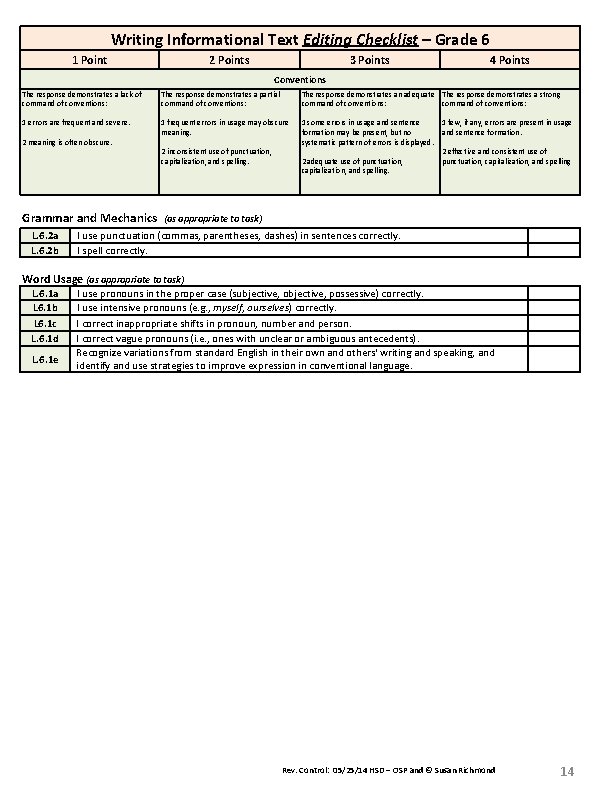
Writing Informational Text Editing Checklist – Grade 6 1 Point 2 Points 3 Points 4 Points Conventions The response demonstrates a lack of command of conventions: The response demonstrates a partial command of conventions: The response demonstrates an adequate The response demonstrates a strong command of conventions: 1 errors are frequent and severe. 1 frequent errors in usage may obscure meaning. 1 some errors in usage and sentence formation may be present, but no systematic pattern of errors is displayed. 2 meaning is often obscure. Grammar and Mechanics L. 6. 2 a L. 6. 2 b 2 inconsistent use of punctuation, capitalization, and spelling. 2 adequate use of punctuation, capitalization, and spelling. 1 few, if any, errors are present in usage and sentence formation. 2 effective and consistent use of punctuation, capitalization, and spelling (as appropriate to task) I use punctuation (commas, parentheses, dashes) in sentences correctly. I spell correctly. Word Usage (as appropriate to task) L. 6. 1 a L 6. 1 b L 6. 1 c L. 6. 1 d L. 6. 1 e I use pronouns in the proper case (subjective, objective, possessive) correctly. I use intensive pronouns (e. g. , myself, ourselves) correctly. I correct inappropriate shifts in pronoun, number and person. I correct vague pronouns (i. e. , ones with unclear or ambiguous antecedents). Recognize variations from standard English in their own and others' writing and speaking, and identify and use strategies to improve expression in conventional language. Rev. Control: 05/25/14 HSD – OSP and © Susan Richmond 14
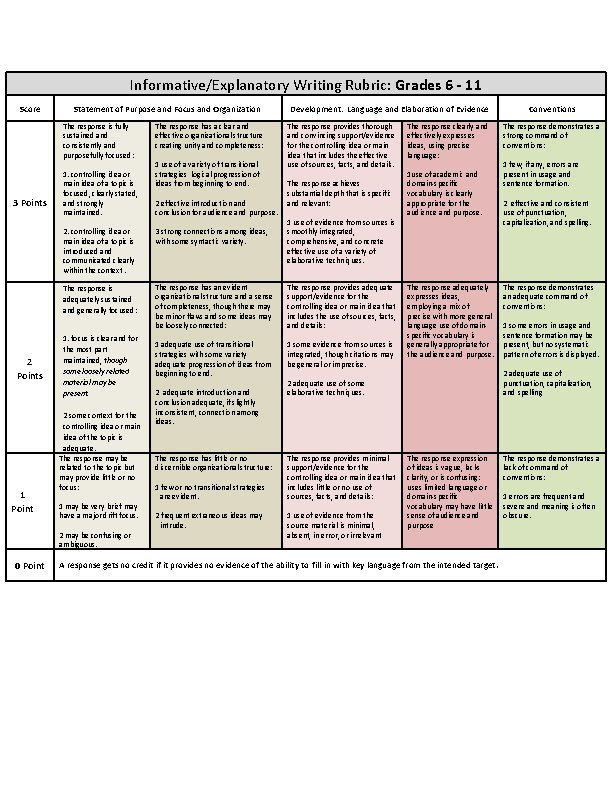
Informative/Explanatory Writing Rubric: Grades 6 - 11 Score Statement of Purpose and Focus and Organization The response is fully sustained and consistently and purposefully focused: 3 Points 2 Points 1 Point 1. controlling idea or main idea of a topic is focused, clearly stated, and strongly maintained. 1 use of a variety of transitional strategies logical progression of ideas from beginning to end. 2 effective introduction and conclusion for audience and purpose. The response provides thorough and convincing support/evidence for the controlling idea or main idea that includes the effective use of sources, facts, and details. The response achieves substantial depth that is specific and relevant: 1 use of evidence from sources is smoothly integrated, comprehensive, and concrete effective use of a variety of elaborative techniques. 2. controlling idea or main idea of a topic is introduced and communicated clearly within the context. 3 strong connections among ideas, with some syntactic variety. The response is adequately sustained and generally focused: The response has an evident organizational structure and a sense of completeness, though there may be minor flaws and some ideas may be loosely connected: The response provides adequate support/evidence for the controlling idea or main idea that includes the use of sources, facts, and details: 1 adequate use of transitional strategies with some variety adequate progression of ideas from beginning to end. 1 some evidence from sources is integrated, though citations may be general or imprecise. 1. focus is clear and for the most part maintained, though some loosely related material may be present. 2 some context for the controlling idea or main idea of the topic is adequate. The response may be related to the topic but may provide little or no focus: 1 may be very brief may have a major drift focus. 2 may be confusing or ambiguous. 0 Point The response has a clear and effective organizational structure creating unity and completeness: Development: Language and Elaboration of Evidence 2 adequate introduction and conclusion adequate, if slightly inconsistent, connection among ideas. The response has little or no discernible organizational structure: 1 few or no transitional strategies are evident. 2 frequent extraneous ideas may intrude. The response clearly and effectively expresses ideas, using precise language: 1 use of academic and domain-specific vocabulary is clearly appropriate for the audience and purpose. The response adequately expresses ideas, employing a mix of precise with more general language use of domainspecific vocabulary is generally appropriate for the audience and purpose. 1 use of evidence from the source material is minimal, absent, in error, or irrelevant The response demonstrates a strong command of conventions: 1 few, if any, errors are present in usage and sentence formation. 2 effective and consistent use of punctuation, capitalization, and spelling. The response demonstrates an adequate command of conventions: 1 some errors in usage and sentence formation may be present, but no systematic pattern of errors is displayed. 2 adequate use of punctuation, capitalization, and spelling 2 adequate use of some elaborative techniques. The response provides minimal support/evidence for the controlling idea or main idea that includes little or no use of sources, facts, and details: Conventions The response expression of ideas is vague, lacks clarity, or is confusing: uses limited language or domain-specific vocabulary may have little sense of audience and purpose A response gets no credit if it provides no evidence of the ability to fill in with key language from the intended target. The response demonstrates a lack of command of conventions: 1 errors are frequent and severe and meaning is often obscure.
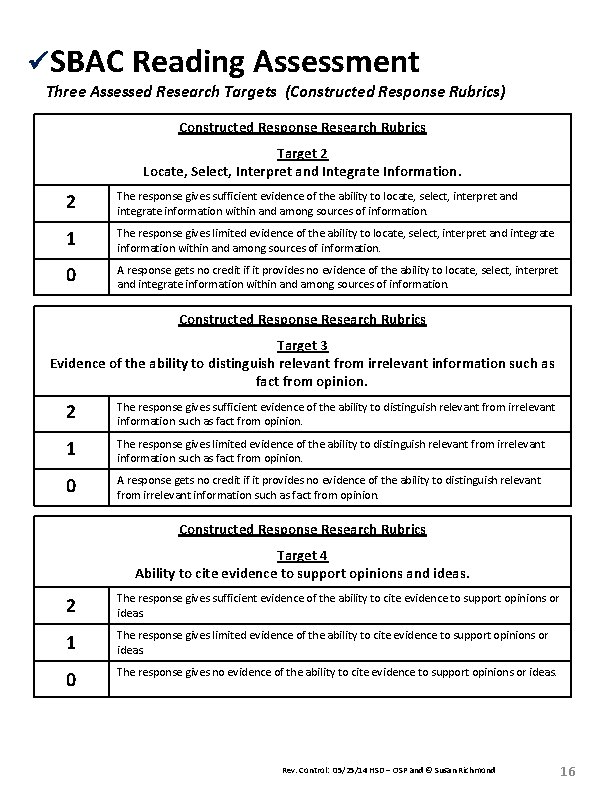
SBAC Reading Assessment Three Assessed Research Targets (Constructed Response Rubrics) Constructed Response Research Rubrics Target 2 Locate, Select, Interpret and Integrate Information. 2 The response gives sufficient evidence of the ability to locate, select, interpret and integrate information within and among sources of information. 1 The response gives limited evidence of the ability to locate, select, interpret and integrate information within and among sources of information. 0 A response gets no credit if it provides no evidence of the ability to locate, select, interpret and integrate information within and among sources of information. Constructed Response Research Rubrics Target 3 Evidence of the ability to distinguish relevant from irrelevant information such as fact from opinion. 2 The response gives sufficient evidence of the ability to distinguish relevant from irrelevant information such as fact from opinion. 1 The response gives limited evidence of the ability to distinguish relevant from irrelevant information such as fact from opinion. 0 A response gets no credit if it provides no evidence of the ability to distinguish relevant from irrelevant information such as fact from opinion. Constructed Response Research Rubrics Target 4 Ability to cite evidence to support opinions and ideas. 2 The response gives sufficient evidence of the ability to cite evidence to support opinions or ideas. 1 The response gives limited evidence of the ability to cite evidence to support opinions or ideas. 0 The response gives no evidence of the ability to cite evidence to support opinions or ideas. Rev. Control: 05/25/14 HSD – OSP and © Susan Richmond 16
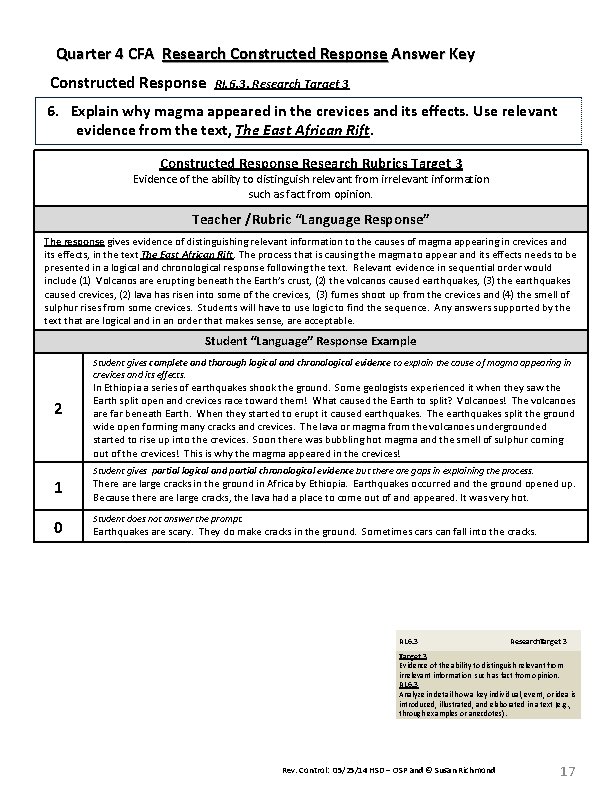
Quarter 4 CFA Research Constructed Response Answer Key Constructed Response RI. 6. 3, Research Target 3 6. Explain why magma appeared in the crevices and its effects. Use relevant evidence from the text, The East African Rift. Constructed Response Research Rubrics Target 3 Evidence of the ability to distinguish relevant from irrelevant information such as fact from opinion. Teacher /Rubric “Language Response” The response gives evidence of distinguishing relevant information to the causes of magma appearing in crevices and its effects, in the text The East African Rift. The process that is causing the magma to appear and its effects needs to be presented in a logical and chronological response following the text. Relevant evidence in sequential order would include (1) Volcanos are erupting beneath the Earth’s crust, (2) the volcanos caused earthquakes, (3) the earthquakes caused crevices, (2) lava has risen into some of the crevices, (3) fumes shoot up from the crevices and (4) the smell of sulphur rises from some crevices. Students will have to use logic to find the sequence. Any answers supported by the text that are logical and in an order that makes sense, are acceptable. Student “Language” Response Example Student gives complete and thorough logical and chronological evidence to explain the cause of magma appearing in crevices and its effects. 2 1 0 In Ethiopia a series of earthquakes shook the ground. Some geologists experienced it when they saw the Earth split open and crevices race toward them! What caused the Earth to split? Volcanoes! The volcanoes are far beneath Earth. When they started to erupt it caused earthquakes. The earthquakes split the ground wide open forming many cracks and crevices. The lava or magma from the volcanoes undergrounded started to rise up into the crevices. Soon there was bubbling hot magma and the smell of sulphur coming out of the crevices! This is why the magma appeared in the crevices! Student gives partial logical and partial chronological evidence but there are gaps in explaining the process. There are large cracks in the ground in Africa by Ethiopia. Earthquakes occurred and the ground opened up. Because there are large cracks, the lava had a place to come out of and appeared. It was very hot. Student does not answer the prompt. Earthquakes are scary. They do make cracks in the ground. Sometimes cars can fall into the cracks. RI. 6. 3 Research. Target 3 Evidence of the ability to distinguish relevant from irrelevant information such as fact from opinion. RI. 6. 3 Analyze in detail how a key individual, event, or idea is introduced, illustrated, and elaborated in a text (e. g. , through examples or anecdotes). Rev. Control: 05/25/14 HSD – OSP and © Susan Richmond 17
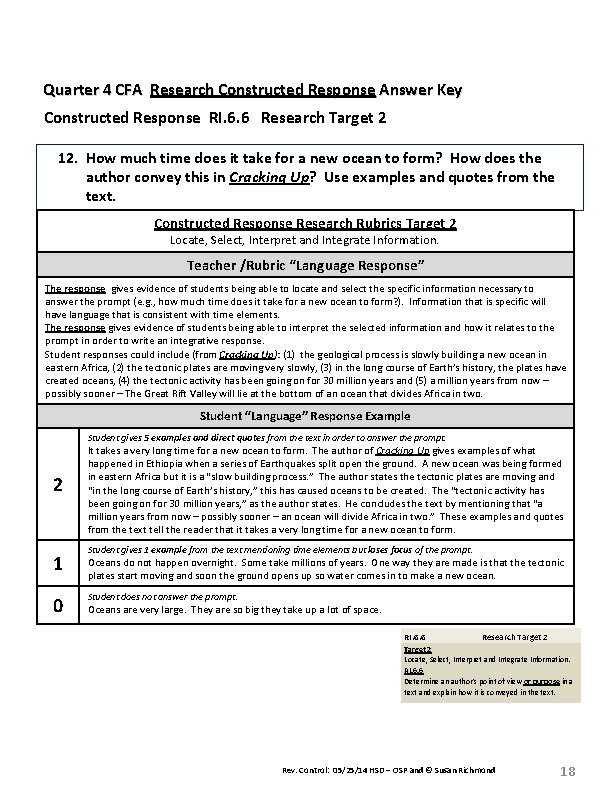
Quarter 4 CFA Research Constructed Response Answer Key Constructed Response RI. 6. 6 Research Target 2 12. How much time does it take for a new ocean to form? How does the author convey this in Cracking Up? Use examples and quotes from the text. Constructed Response Research Rubrics Target 2 Locate, Select, Interpret and Integrate Information. Teacher /Rubric “Language Response” The response gives evidence of students being able to locate and select the specific information necessary to answer the prompt (e. g. , how much time does it take for a new ocean to form? ). Information that is specific will have language that is consistent with time elements. The response gives evidence of students being able to interpret the selected information and how it relates to the prompt in order to write an integrative response. Student responses could include (from Cracking Up): (1) the geological process is slowly building a new ocean in eastern Africa, (2) the tectonic plates are moving very slowly, (3) in the long course of Earth’s history, the plates have created oceans, (4) the tectonic activity has been going on for 30 million years and (5) a million years from now – possibly sooner – The Great Rift Valley will lie at the bottom of an ocean that divides Africa in two. Student “Language” Response Example Student gives 5 examples and direct quotes from the text in order to answer the prompt. 2 1 0 It takes a very long time for a new ocean to form. The author of Cracking Up gives examples of what happened in Ethiopia when a series of Earthquakes split open the ground. A new ocean was being formed in eastern Africa but it is a “slow building process. ” The author states the tectonic plates are moving and “in the long course of Earth’s history, ” this has caused oceans to be created. The “tectonic activity has been going on for 30 million years, ” as the author states. He concludes the text by mentioning that “a million years from now – possibly sooner – an ocean will divide Africa in two. ” These examples and quotes from the text tell the reader that it takes a very long time for a new ocean to form. Student gives 1 example from the text mentioning time elements but loses focus of the prompt. Oceans do not happen overnight. Some take millions of years. One way they are made is that the tectonic plates start moving and soon the ground opens up so water comes in to make a new ocean. Student does not answer the prompt. Oceans are very large. They are so big they take up a lot of space. RI. 6. 6 Research Target 2 Locate, Select, Interpret and Integrate Information. RI. 6. 6 Determine an author's point of view or purpose in a text and explain how it is conveyed in the text. Rev. Control: 05/25/14 HSD – OSP and © Susan Richmond 18
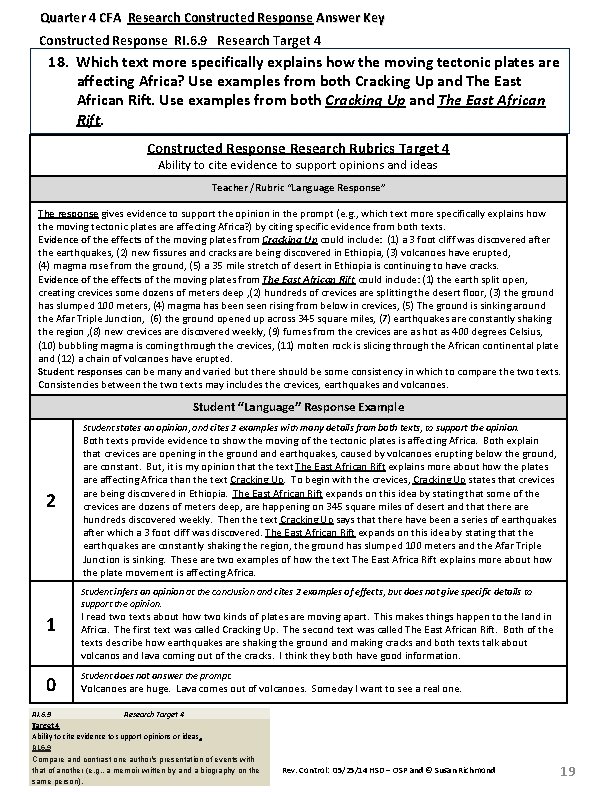
Quarter 4 CFA Research Constructed Response Answer Key Constructed Response RI. 6. 9 Research Target 4 18. Which text more specifically explains how the moving tectonic plates are affecting Africa? Use examples from both Cracking Up and The East African Rift. Constructed Response Research Rubrics Target 4 Ability to cite evidence to support opinions and ideas Teacher /Rubric “Language Response” The response gives evidence to support the opinion in the prompt (e. g. , which text more specifically explains how the moving tectonic plates are affecting Africa? ) by citing specific evidence from both texts. Evidence of the effects of the moving plates from Cracking Up could include: (1) a 3 foot cliff was discovered after the earthquakes, (2) new fissures and cracks are being discovered in Ethiopia, (3) volcanoes have erupted, (4) magma rose from the ground, (5) a 35 mile stretch of desert in Ethiopia is continuing to have cracks. Evidence of the effects of the moving plates from The East African Rift could include: (1) the earth split open, creating crevices some dozens of meters deep , (2) hundreds of crevices are splitting the desert floor, (3) the ground has slumped 100 meters, (4) magma has been seen rising from below in crevices, (5) The ground is sinking around the Afar Triple Junction, (6) the ground opened up across 345 square miles, (7) earthquakes are constantly shaking the region , (8) new crevices are discovered weekly, (9) fumes from the crevices are as hot as 400 degrees Celsius, (10) bubbling magma is coming through the crevices, (11) molten rock is slicing through the African continental plate and (12) a chain of volcanoes have erupted. Student responses can be many and varied but there should be some consistency in which to compare the two texts. Consistencies between the two texts may includes the crevices, earthquakes and volcanoes. Student “Language” Response Example Student states an opinion, and cites 2 examples with many details from both texts, to support the opinion. 2 Both texts provide evidence to show the moving of the tectonic plates is affecting Africa. Both explain that crevices are opening in the ground and earthquakes, caused by volcanoes erupting below the ground, are constant. But, it is my opinion that the text The East African Rift explains more about how the plates are affecting Africa than the text Cracking Up. To begin with the crevices, Cracking Up states that crevices are being discovered in Ethiopia. The East African Rift expands on this idea by stating that some of the crevices are dozens of meters deep, are happening on 345 square miles of desert and that there are hundreds discovered weekly. Then the text Cracking Up says that there have been a series of earthquakes after which a 3 foot cliff was discovered. The East African Rift expands on this idea by stating that the earthquakes are constantly shaking the region, the ground has slumped 100 meters and the Afar Triple Junction is sinking. These are two examples of how the text The East Africa Rift explains more about how the plate movement is affecting Africa. Student infers an opinion at the conclusion and cites 2 examples of effects, but does not give specific details to support the opinion. 1 I read two texts about how two kinds of plates are moving apart. This makes things happen to the land in Africa. The first text was called Cracking Up. The second text was called The East African Rift. Both of the texts describe how earthquakes are shaking the ground and making cracks and both texts talk about volcanos and lava coming out of the cracks. I think they both have good information. 0 Student does not answer the prompt. Volcanoes are huge. Lava comes out of volcanoes. Someday I want to see a real one. RI. 6. 9 Research Target 4 Ability to cite evidence to support opinions or ideas. RI. 6. 9 Compare and contrast one author's presentation of events with that of another (e. g. , a memoir written by and a biography on the same person). Rev. Control: 05/25/14 HSD – OSP and © Susan Richmond 19
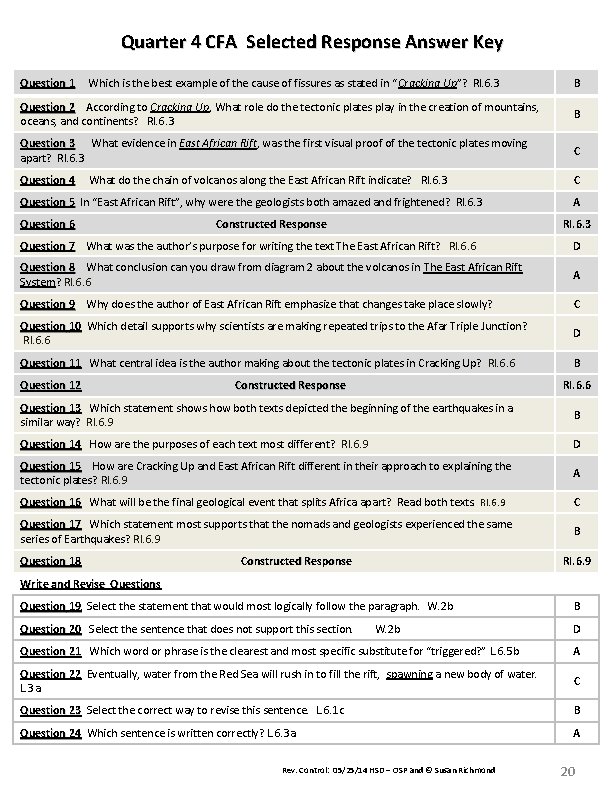
Quarter 4 CFA Selected Response Answer Key Question 1 Which is the best example of the cause of fissures as stated in “Cracking Up”? RI. 6. 3 B Question 2 According to Cracking Up, What role do the tectonic plates play in the creation of mountains, oceans, and continents? RI. 6. 3 B Question 3 What evidence in East African Rift, was the first visual proof of the tectonic plates moving apart? RI. 6. 3 C Question 4 C What do the chain of volcanos along the East African Rift indicate? RI. 6. 3 Question 5 In “East African Rift”, why were the geologists both amazed and frightened? RI. 6. 3 Question 6 Constructed Response A RI. 6. 3 Question 7 What was the author’s purpose for writing the text The East African Rift? RI. 6. 6 D Question 8 What conclusion can you draw from diagram 2 about the volcanos in The East African Rift System? RI. 6. 6 A Question 9 Why does the author of East African Rift emphasize that changes take place slowly? C Question 10 Which detail supports why scientists are making repeated trips to the Afar Triple Junction? RI. 6. 6 D Question 11 What central idea is the author making about the tectonic plates in Cracking Up? RI. 6. 6 B Question 12 Constructed Response RI. 6. 6 Question 13 Which statement shows how both texts depicted the beginning of the earthquakes in a similar way? RI. 6. 9 B Question 14 How are the purposes of each text most different? RI. 6. 9 D Question 15 How are Cracking Up and East African Rift different in their approach to explaining the tectonic plates? RI. 6. 9 A Question 16 What will be the final geological event that splits Africa apart? Read both texts. RI. 6. 9 C Question 17 Which statement most supports that the nomads and geologists experienced the same series of Earthquakes? RI. 6. 9 B Question 18 Constructed Response RI. 6. 9 Write and Revise Questions Question 19. 19 Select the statement that would most logically follow the paragraph. W. 2 b B Question 20 Select the sentence that does not support this section. D W. 2 b Question 21 Which word or phrase is the clearest and most specific substitute for “triggered? ” L. 6. 5 b A Question 22 Eventually, water from the Red Sea will rush in to fill the rift, spawning a new body of water. L. 3 a C Question 23 Select the correct way to revise this sentence. L. 6. 1 c B Question 24 Which sentence is written correctly? L. 6. 3 a A Rev. Control: 05/25/14 HSD – OSP and © Susan Richmond 20
Quarter Three Reading Informational Text Grade 6 Common Formative Assessment Reading Informational Text Name________
Student Directions: Read the Directions. Part 1 Your assignment: You will read two texts about a geological process happening in Africa. As you read, take notes on these sources. Then you will answer several research questions using these two sources. These will help you plan to write an informational report. Steps you will be following: In order to help you plan and write your essay, you will do all of the following: 1. Read two texts. 2. Answer several questions about the sources. 3. Plan your informational report. Directions for beginning: You will now read two articles. Take notes because you may want to refer to your notes while you plan your informational report. You can refer to any of the sources as often as you like. Questions Answer the questions. Your answers to these questions will be scored. Also, they will help you think about the sources you’ve read, which should help you plan your informational report. Part 2 You will: 1. Plan your writing. You may use your notes and answers. You may use a graphic organizer 2. Write – Revise and Edit your first draft (your teacher will give you paper). 3. Your assignment: It is 2005. You are a reporter investigating the effects of the African and Arabian Plates pulling away from each other. Write an informational article on what you see, hear and feel. Who did you interview? Summarize your report with a conclusion of the importance of this geological process. How you will be scored How your report will be scored: The people scoring your report will be assigning scores for: 1. Statement of Purpose/Focus—how well you clearly state and maintain your controlling idea or main idea 2. Organization – how well the ideas progress from the introduction to the conclusion using effective transitions and how well you stay on topic throughout. 3. Elaboration of Evidence – how well you provide evidence from sources about your topic and elaborate with specific information. 4. Language and Vocabulary – how well you effectively express ideas using precise language that is appropriate for your audience and purpose. 5. Conventions – how well you follow the rules of usage, punctuation, capitalization, and spelling. Rev. Control: 05/25/14 HSD – OSP and © Susan Richmond 22
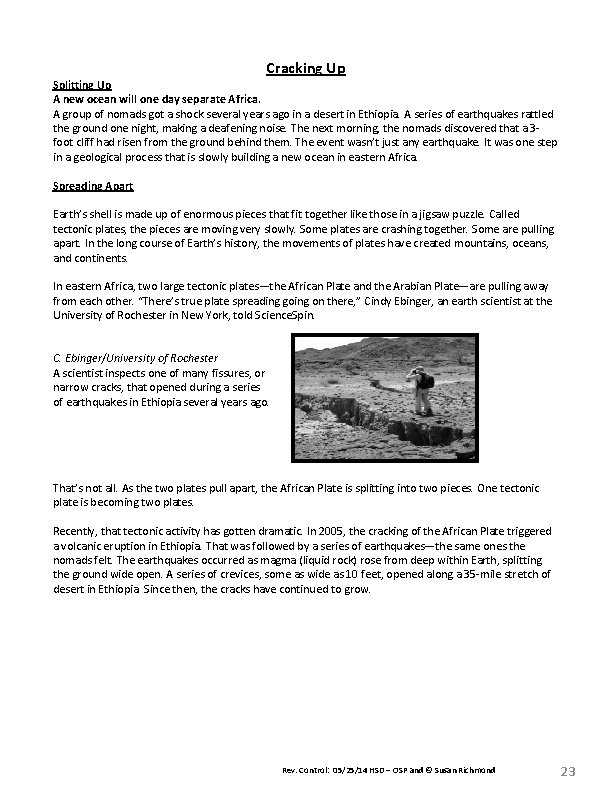
Cracking Up Splitting Up A new ocean will one day separate Africa. A group of nomads got a shock several years ago in a desert in Ethiopia. A series of earthquakes rattled the ground one night, making a deafening noise. The next morning, the nomads discovered that a 3 foot cliff had risen from the ground behind them. The event wasn’t just any earthquake. It was one step in a geological process that is slowly building a new ocean in eastern Africa. Spreading Apart Earth’s shell is made up of enormous pieces that fit together like those in a jigsaw puzzle. Called tectonic plates, the pieces are moving very slowly. Some plates are crashing together. Some are pulling apart. In the long course of Earth’s history, the movements of plates have created mountains, oceans, and continents. In eastern Africa, two large tectonic plates—the African Plate and the Arabian Plate—are pulling away from each other. “There’s true plate spreading going on there, ” Cindy Ebinger, an earth scientist at the University of Rochester in New York, told Science. Spin. C. Ebinger/University of Rochester A scientist inspects one of many fissures, or narrow cracks, that opened during a series of earthquakes in Ethiopia several years ago. That’s not all. As the two plates pull apart, the African Plate is splitting into two pieces. One tectonic plate is becoming two plates. Recently, that tectonic activity has gotten dramatic. In 2005, the cracking of the African Plate triggered a volcanic eruption in Ethiopia. That was followed by a series of earthquakes—the same ones the nomads felt. The earthquakes occurred as magma (liquid rock) rose from deep within Earth, splitting the ground wide open. A series of crevices, some as wide as 10 feet, opened along a 35 -mile stretch of desert in Ethiopia. Since then, the cracks have continued to grow. Rev. Control: 05/25/14 HSD – OSP and © Susan Richmond 23
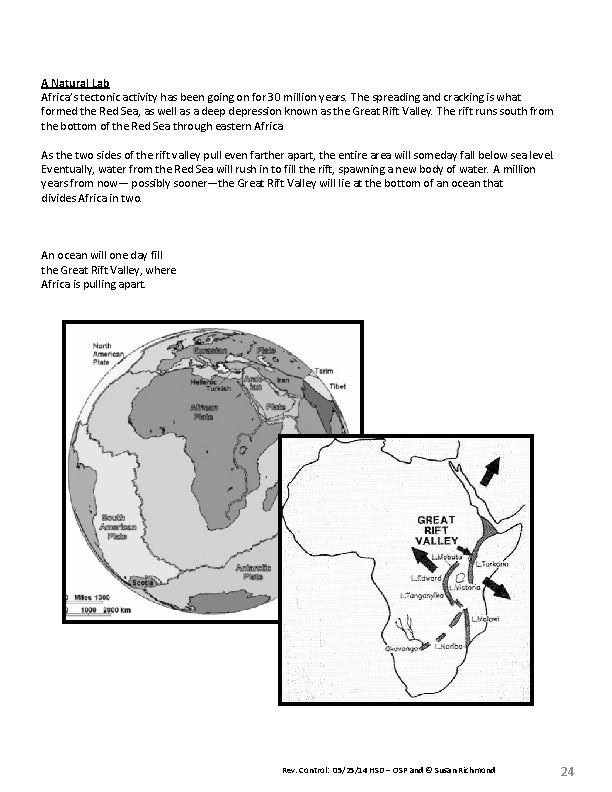
A Natural Lab Africa’s tectonic activity has been going on for 30 million years. The spreading and cracking is what formed the Red Sea, as well as a deep depression known as the Great Rift Valley. The rift runs south from the bottom of the Red Sea through eastern Africa. As the two sides of the rift valley pull even farther apart, the entire area will someday fall below sea level. Eventually, water from the Red Sea will rush in to fill the rift, spawning a new body of water. A million years from now— possibly sooner—the Great Rift Valley will lie at the bottom of an ocean that divides Africa in two. An ocean will one day fill the Great Rift Valley, where Africa is pulling apart. Rev. Control: 05/25/14 HSD – OSP and © Susan Richmond 24
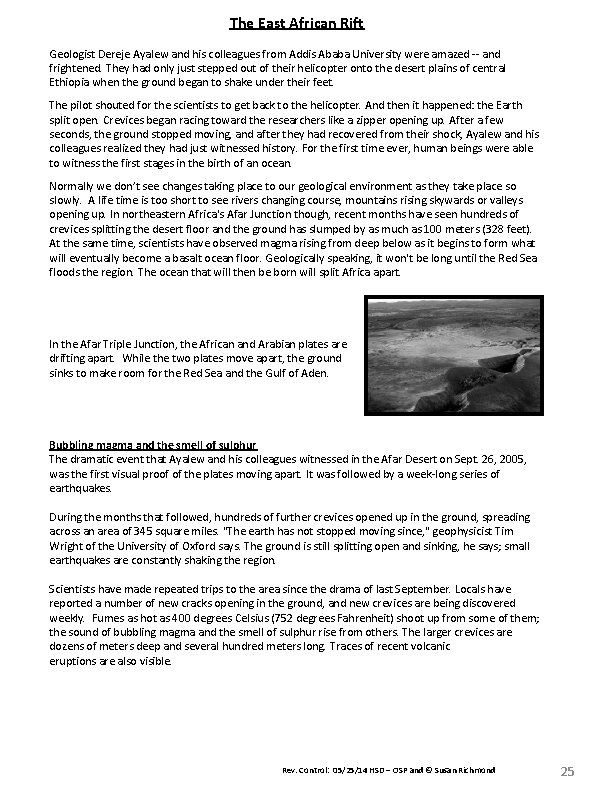
The East African Rift Geologist Dereje Ayalew and his colleagues from Addis Ababa University were amazed -- and frightened. They had only just stepped out of their helicopter onto the desert plains of central Ethiopia when the ground began to shake under their feet. The pilot shouted for the scientists to get back to the helicopter. And then it happened: the Earth split open. Crevices began racing toward the researchers like a zipper opening up. After a few seconds, the ground stopped moving, and after they had recovered from their shock, Ayalew and his colleagues realized they had just witnessed history. For the first time ever, human beings were able to witness the first stages in the birth of an ocean. Normally we don’t see changes taking place to our geological environment as they take place so slowly. A life time is too short to see rivers changing course, mountains rising skywards or valleys opening up. In northeastern Africa's Afar Junction though, recent months have seen hundreds of crevices splitting the desert floor and the ground has slumped by as much as 100 meters (328 feet). At the same time, scientists have observed magma rising from deep below as it begins to form what will eventually become a basalt ocean floor. Geologically speaking, it won't be long until the Red Sea floods the region. The ocean that will then be born will split Africa apart. In the Afar Triple Junction, the African and Arabian plates are drifting apart. While the two plates move apart, the ground sinks to make room for the Red Sea and the Gulf of Aden. Bubbling magma and the smell of sulphur The dramatic event that Ayalew and his colleagues witnessed in the Afar Desert on Sept. 26, 2005, was the first visual proof of the plates moving apart. It was followed by a week-long series of earthquakes. During the months that followed, hundreds of further crevices opened up in the ground, spreading across an area of 345 square miles. "The earth has not stopped moving since, " geophysicist Tim Wright of the University of Oxford says. The ground is still splitting open and sinking, he says; small earthquakes are constantly shaking the region. Scientists have made repeated trips to the area since the drama of last September. Locals have reported a number of new cracks opening in the ground, and new crevices are being discovered weekly. Fumes as hot as 400 degrees Celsius (752 degrees Fahrenheit) shoot up from some of them; the sound of bubbling magma and the smell of sulphur rise from others. The larger crevices are dozens of meters deep and several hundred meters long. Traces of recent volcanic eruptions are also visible. Rev. Control: 05/25/14 HSD – OSP and © Susan Richmond 25
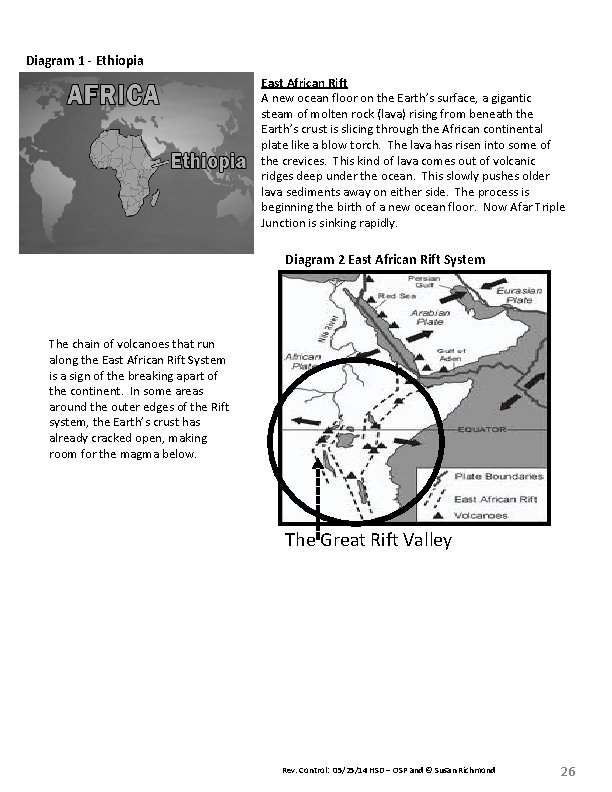
Diagram 1 - Ethiopia East African Rift A new ocean floor on the Earth’s surface, a gigantic steam of molten rock (lava) rising from beneath the Earth’s crust is slicing through the African continental plate like a blow torch. The lava has risen into some of the crevices. This kind of lava comes out of volcanic ridges deep under the ocean. This slowly pushes older lava sediments away on either side. The process is beginning the birth of a new ocean floor. Now Afar Triple Junction is sinking rapidly. Diagram 2 East African Rift System The chain of volcanoes that run along the East African Rift System is a sign of the breaking apart of the continent. In some areas around the outer edges of the Rift system, the Earth’s crust has already cracked open, making room for the magma below. The Great Rift Valley Rev. Control: 05/25/14 HSD – OSP and © Susan Richmond 26
1. Which is the best example of the cause of fissures as stated in “Cracking Up”? A. volcanic eruptions B. earthquakes C. deafening noises D. narrow cracks RI. 6. 3 Analyze in detail how a key individual, event, or idea is introduced, illustrated, and elaborated in a text (e. g. , through examples or anecdotes). 2. According to Cracking Up, What role do the tectonic plates play in the creation of mountains, oceans, and continents? A. Volcanos create earthquakes. B. Tectonic plates crash together and some pull apart slowly. C. The earthquakes occur as magma rises from within Earth. D. Earth’s shell is made up of enormous pieces that fit together. RI. 6. 3 Analyze in detail how a key individual, event, or idea is introduced, illustrated, and elaborated in a text (e. g. , through examples or anecdotes). Rev. Control: 05/25/14 HSD – OSP and © Susan Richmond 27
3. What evidence in The East African Rift, was the first visual proof of the tectonic plates moving apart? A. The smell of sulfur rising from the crevices. B. The sound of bubbling magma. C. The Earth split open and crevices opened up. D. A new ocean formed in Africa. RI. 6. 3 Analyze in detail how a key individual, event, or idea is introduced, illustrated, and elaborated in a text (e. g. , through examples or anecdotes). 4. What do the chain of volcanos along the East African Rift indicate? A. The chain of volcanos indicate that there will be many eruptions and earthquakes. B. The chain of volcanos indicate that many crevices are forming. C. The chain of volcanos indicate that there is lava beneath the Earth’s crust breaking the continental plate. D. The chain of volcanos indicate that new crevices have very hot fumes. RI. 6. 3 Analyze in detail how a key individual, event, or idea is introduced, illustrated, and elaborated in a text (e. g. , through examples or anecdotes). Rev. Control: 05/25/14 HSD – OSP and © Susan Richmond 28
5. In “The East African Rift”, why were the geologists both amazed and frightened? A. The geologists were amazed that the Earth had split opened, but were frightened of the shaking ground. B. The geologists were amazed that they had just witnessed history. C. The geologists were both amazed and frightened when the pilot shouted for them to get back to the helicopter. D. The geologists were afraid of the earthquake tremors but amazed at how strong the ground shook. RI. 6. 3 Analyze in detail how a key individual, event, or idea is introduced, illustrated, and elaborated in a text (e. g. , through examples or anecdotes). 6. Explain why magma appeared in the crevices and its effects. Use examples from The East African Rift. RI. 6. 3 (Teacher Only) Final Score_____ Rev. Control: 05/25/14 HSD – OSP and © Susan Richmond 29
7. What was the author’s main purpose for writing the text The East African Rift? A. The author is describing the land changes occurring in East Africa. B. The author is convincing the reader that East Africa’s geological changes make the area a dangerous place to live. C. The author wanted to explain how a group of nomads got a shock several years ago in a desert in Ethiopia. D. The author is informing the reader about the geological formation taking place in East Africa. RI. 6. 6 Determine an author's point of view or purpose in a text and explain how it is conveyed in the text. 8. What conclusion can you draw from diagram 2 about the volcanos in The East African Rift System? A. The chain of volcanos occur where the continent is breaking apart. B. The volcanos create plate boundaries. C. The volcanos are located where the rift valleys are. D. The volcanos show the pass of Nile river. RI. 6. 6 Determine an author's point of view or purpose in a text and explain how it is conveyed in the text. Rev. Control: 05/25/14 HSD – OSP and © Susan Richmond 30
9. Why does the author of The East African Rift emphasize that changes take place slowly? A. It takes time for new lava to push old lava away. B. The author is explaining that it will be a long time before a new ocean is formed. C. People do not usually get to see changes taking place. D. The African and Arabian plates will take millions of years to totally drift apart. RI. 6. 6 Determine an author's point of view or purpose in a text and explain how it is conveyed in the text. 10. Which detail from The East African Rift, supports why scientists are making repeated trips to the Afar Triple Junction? A. The ground is sinking to make room for the Red Sea and the Gulf of Aden. B. Geologists were frightened. C. “The earth has not stopped moving since, ” said geophysicist Tim Wright. D. Locals have reported a number of new cracks and new crevices are being discovered weekly. RI. 6. 6 Determine an author's point of view or purpose in a text and explain how it is conveyed in the text. Rev. Control: 05/25/14 HSD – OSP and © Susan Richmond 31
11. What central idea is the author making about the tectonic plates in Cracking Up? A. Earthquakes will continue. B. Eventually Africa will be divided in two. C. Tectonic plates in Eastern Africa are pulling away from each other. D. Cracks and fissures are constantly being discovered. RI. 6. 6 Determine an author's point of view or purpose in a text and explain how it is conveyed in the text. 12. How much time does it take for a new ocean to form? How does the author convey this in Cracking Up? Use examples and quotes from the text. RI. 6. 6 (Teacher Only) Final Score_____ Rev. Control: 05/25/14 HSD – OSP and © Susan Richmond 32
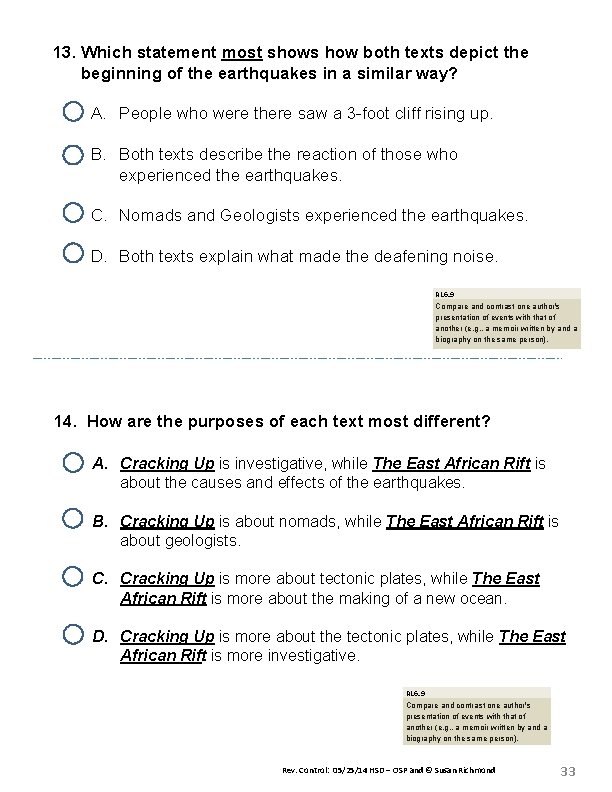
13. Which statement most shows how both texts depict the beginning of the earthquakes in a similar way? A. People who were there saw a 3 -foot cliff rising up. B. Both texts describe the reaction of those who experienced the earthquakes. C. Nomads and Geologists experienced the earthquakes. D. Both texts explain what made the deafening noise. RI. 6. 9 Compare and contrast one author's presentation of events with that of another (e. g. , a memoir written by and a biography on the same person). 14. How are the purposes of each text most different? A. Cracking Up is investigative, while The East African Rift is about the causes and effects of the earthquakes. B. Cracking Up is about nomads, while The East African Rift is about geologists. C. Cracking Up is more about tectonic plates, while The East African Rift is more about the making of a new ocean. D. Cracking Up is more about the tectonic plates, while The East African Rift is more investigative. RI. 6. 9 Compare and contrast one author's presentation of events with that of another (e. g. , a memoir written by and a biography on the same person). Rev. Control: 05/25/14 HSD – OSP and © Susan Richmond 33
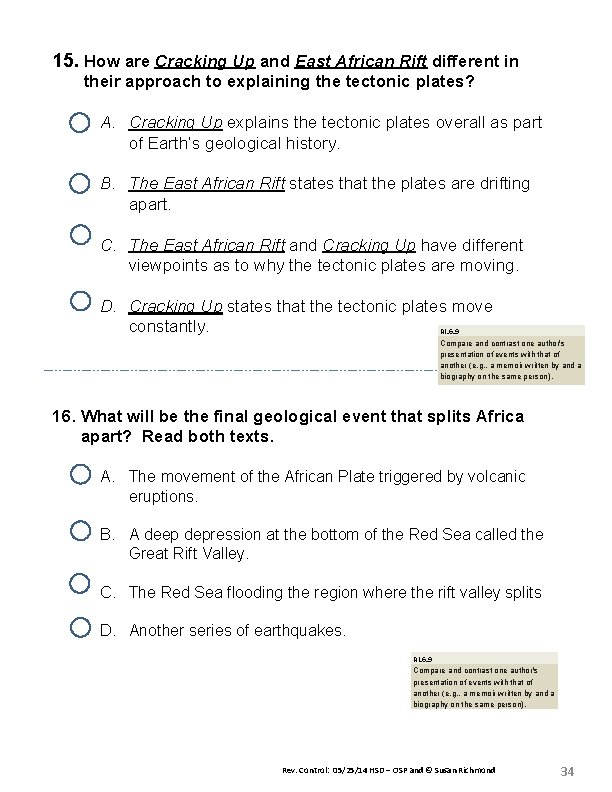
15. How are Cracking Up and East African Rift different in their approach to explaining the tectonic plates? A. Cracking Up explains the tectonic plates overall as part of Earth’s geological history. B. The East African Rift states that the plates are drifting apart. C. The East African Rift and Cracking Up have different viewpoints as to why the tectonic plates are moving. D. Cracking Up states that the tectonic plates move constantly. RI. 6. 9 Compare and contrast one author's presentation of events with that of another (e. g. , a memoir written by and a biography on the same person). 16. What will be the final geological event that splits Africa apart? Read both texts. A. The movement of the African Plate triggered by volcanic eruptions. B. A deep depression at the bottom of the Red Sea called the Great Rift Valley. C. The Red Sea flooding the region where the rift valley splits D. Another series of earthquakes. RI. 6. 9 Compare and contrast one author's presentation of events with that of another (e. g. , a memoir written by and a biography on the same person). Rev. Control: 05/25/14 HSD – OSP and © Susan Richmond 34
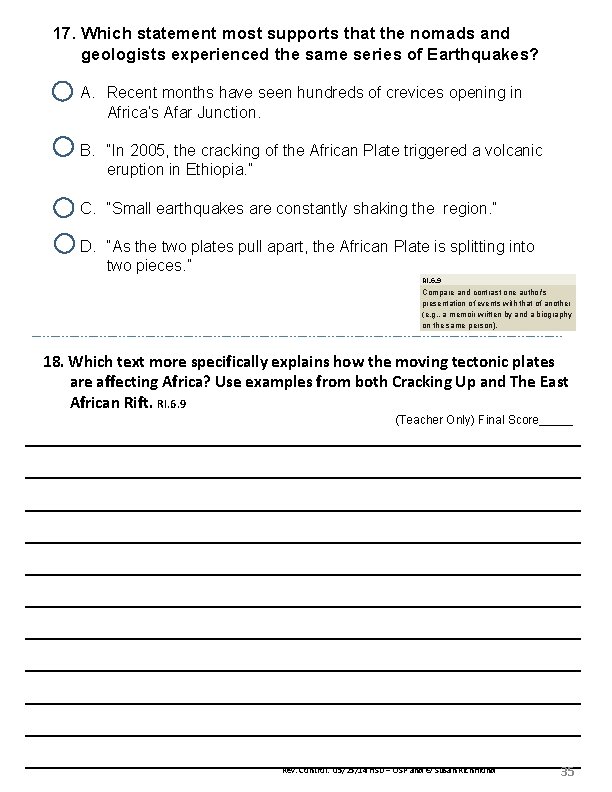
17. Which statement most supports that the nomads and geologists experienced the same series of Earthquakes? A. Recent months have seen hundreds of crevices opening in Africa’s Afar Junction. B. “In 2005, the cracking of the African Plate triggered a volcanic eruption in Ethiopia. ” C. “Small earthquakes are constantly shaking the region. ” D. “As the two plates pull apart, the African Plate is splitting into two pieces. ” RI. 6. 9 Compare and contrast one author's presentation of events with that of another (e. g. , a memoir written by and a biography on the same person). 18. Which text more specifically explains how the moving tectonic plates are affecting Africa? Use examples from both Cracking Up and The East African Rift. RI. 6. 9 (Teacher Only) Final Score_____ Rev. Control: 05/25/14 HSD – OSP and © Susan Richmond 35
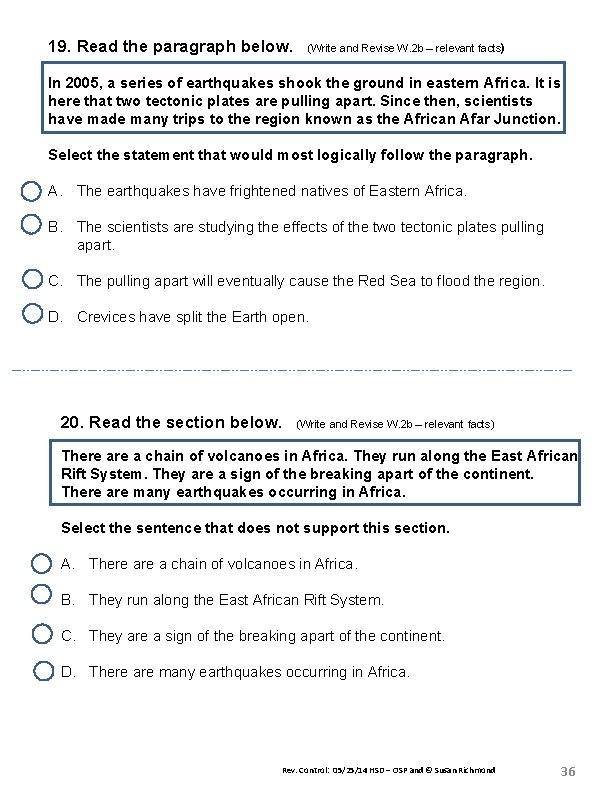
19. Read the paragraph below. (Write and Revise W. 2 b – relevant facts) In 2005, a series of earthquakes shook the ground in eastern Africa. It is here that two tectonic plates are pulling apart. Since then, scientists have made many trips to the region known as the African Afar Junction. Select the statement that would most logically follow the paragraph. A. The earthquakes have frightened natives of Eastern Africa. B. The scientists are studying the effects of the two tectonic plates pulling apart. C. The pulling apart will eventually cause the Red Sea to flood the region. D. Crevices have split the Earth open. 20. Read the section below. (Write and Revise W. 2 b – relevant facts) There a chain of volcanoes in Africa. They run along the East African Rift System. They are a sign of the breaking apart of the continent. There are many earthquakes occurring in Africa. Select the sentence that does not support this section. A. There a chain of volcanoes in Africa. B. They run along the East African Rift System. C. They are a sign of the breaking apart of the continent. D. There are many earthquakes occurring in Africa. Rev. Control: 05/25/14 HSD – OSP and © Susan Richmond 36
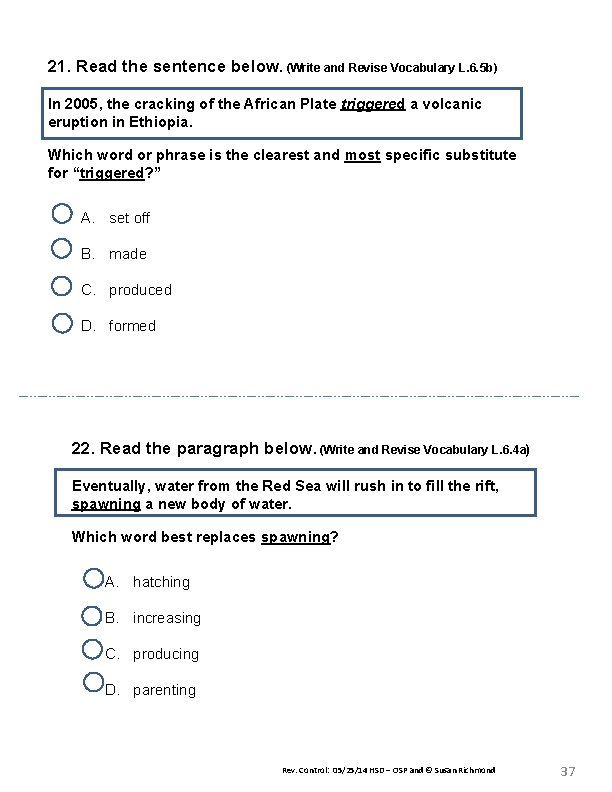
21. Read the sentence below. (Write and Revise Vocabulary L. 6. 5 b) In 2005, the cracking of the African Plate triggered a volcanic eruption in Ethiopia. Which word or phrase is the clearest and most specific substitute for “triggered? ” A. set off B. made C. produced D. formed 22. Read the paragraph below. (Write and Revise Vocabulary L. 6. 4 a) Eventually, water from the Red Sea will rush in to fill the rift, spawning a new body of water. Which word best replaces spawning? A. hatching B. increasing C. producing D. parenting Rev. Control: 05/25/14 HSD – OSP and © Susan Richmond 37
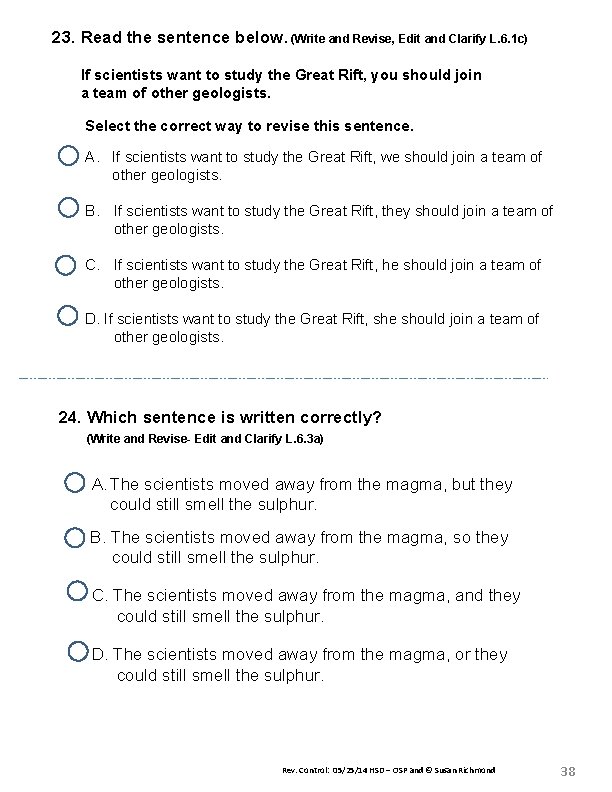
23. Read the sentence below. (Write and Revise, Edit and Clarify L. 6. 1 c) If scientists want to study the Great Rift, you should join a team of other geologists. Select the correct way to revise this sentence. A. If scientists want to study the Great Rift, we should join a team of other geologists. B. If scientists want to study the Great Rift, they should join a team of other geologists. C. If scientists want to study the Great Rift, he should join a team of other geologists. D. If scientists want to study the Great Rift, she should join a team of other geologists. 24. Which sentence is written correctly? (Write and Revise- Edit and Clarify L. 6. 3 a) A. The scientists moved away from the magma, but they could still smell the sulphur. B. The scientists moved away from the magma, so they could still smell the sulphur. C. The scientists moved away from the magma, and they could still smell the sulphur. D. The scientists moved away from the magma, or they could still smell the sulphur. Rev. Control: 05/25/14 HSD – OSP and © Susan Richmond 38
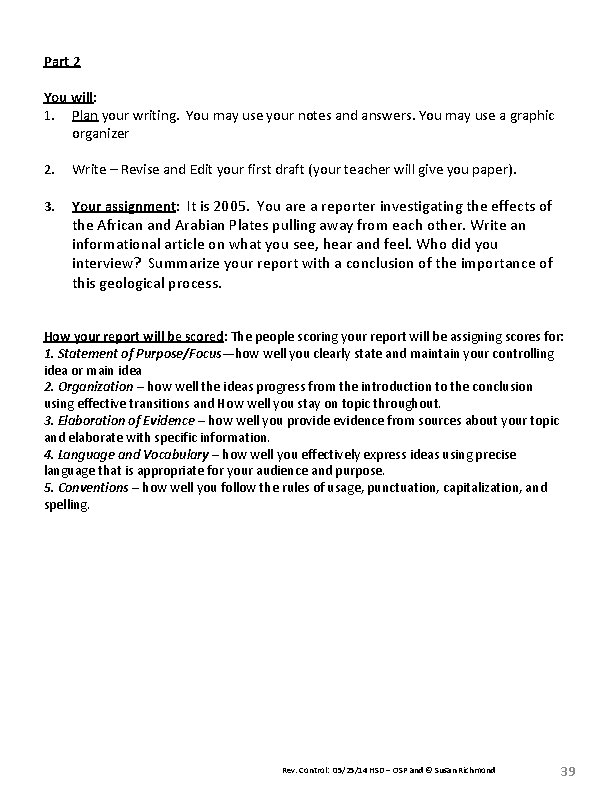
Part 2 You will: 1. Plan your writing. You may use your notes and answers. You may use a graphic organizer 2. Write – Revise and Edit your first draft (your teacher will give you paper). 3. Your assignment: It is 2005. You are a reporter investigating the effects of the African and Arabian Plates pulling away from each other. Write an informational article on what you see, hear and feel. Who did you interview? Summarize your report with a conclusion of the importance of this geological process. How your report will be scored: The people scoring your report will be assigning scores for: 1. Statement of Purpose/Focus—how well you clearly state and maintain your controlling idea or main idea 2. Organization – how well the ideas progress from the introduction to the conclusion using effective transitions and How well you stay on topic throughout. 3. Elaboration of Evidence – how well you provide evidence from sources about your topic and elaborate with specific information. 4. Language and Vocabulary – how well you effectively express ideas using precise language that is appropriate for your audience and purpose. 5. Conventions – how well you follow the rules of usage, punctuation, capitalization, and spelling. Rev. Control: 05/25/14 HSD – OSP and © Susan Richmond 39
Rev. Control: 05/25/14 HSD – OSP and © Susan Richmond 40
Rev. Control: 05/25/14 HSD – OSP and © Susan Richmond 41
STOP Close your books and wait for instructions! Rev. Control: 05/25/14 HSD – OSP and © Susan Richmond 42
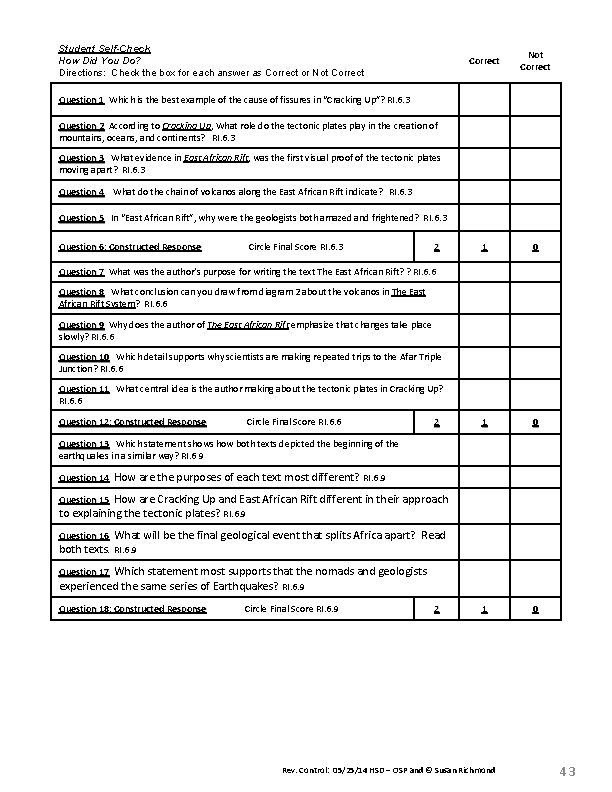
Student Self-Check How Did You Do? Directions: Check the box for each answer as Correct or Not Correct 1 0 1 0 Question 1 Which is the best example of the cause of fissures in “Cracking Up”? RI. 6. 3 Question 2 According to Cracking Up, What role do the tectonic plates play in the creation of mountains, oceans, and continents? RI. 6. 3 Question 3 What evidence in East African Rift, was the first visual proof of the tectonic plates moving apart? RI. 6. 3 Question 4 What do the chain of volcanos along the East African Rift indicate? RI. 6. 3 Question 5 In “East African Rift”, why were the geologists both amazed and frightened? RI. 6. 3 Question 6: Constructed Response Circle Final Score RI. 6. 3 2 Question 7 What was the author’s purpose for writing the text The East African Rift? ? RI. 6. 6 Question 8 What conclusion can you draw from diagram 2 about the volcanos in The East African Rift System? RI. 6. 6 Question 9 Why does the author of The East African Rift emphasize that changes take place slowly? RI. 6. 6 Question 10 Which detail supports why scientists are making repeated trips to the Afar Triple Junction? RI. 6. 6 Question 11 What central idea is the author making about the tectonic plates in Cracking Up? RI. 6. 6 Question 12: Constructed Response Circle Final Score RI. 6. 6 2 Question 13 Which statement shows how both texts depicted the beginning of the earthquakes in a similar way? RI. 6 9 Question 14 How are the purposes of each text most different? RI. 6. 9 How are Cracking Up and East African Rift different in their approach to explaining the tectonic plates? RI. 6. 9 Question 15 Question 16 What will be the final geological event that splits Africa apart? Read both texts. RI. 6. 9 Which statement most supports that the nomads and geologists experienced the same series of Earthquakes? RI. 6. 9 Question 17 Question 18: Constructed Response Circle Final Score RI. 6. 9 2 Rev. Control: 05/25/14 HSD – OSP and © Susan Richmond 43
Question no. ___ Question no. ___ Rev. Control: 05/25/14 HSD – OSP and © Susan Richmond 44