
Quarter Four Reading Informational Text Grade 4 Teacher



- Slides: 45
Quarter Four Reading Informational Text Grade 4 Teacher Directions Common Formative Assessment
Quarter Four Informational Text Common Formative Assessments Team Members and Writers This assessment was developed working backwards by identifying the deep understanding of the two passages in order to write a performance task prompt. Key Ideas were identified to support constructed responses and key details align with the selected response questions. All questions support students’ background knowledge in order to answer the performance task prompt. Haley Christensen Melissa Hancock Sandy Maines Kelly Rooke Tammy Cole Jamie Incrovato Gina Mc. Lain Jill Russo Lindsay Crowell Ginger Jay Shawna Munson Leslie Sell Deborah Delplanche Jenn Johnson Christina Orozco Erin Shepherd Lindsay Garcia Dovina Israel Teresa Portinga Erin Van. Dyle Heather Giard Ko Kagawa Judy Ramer Christy Walters Brooke Godfrey Kimberly Laws Erin Reamer Melanie Winters Christine Goldmann Alfonso Lule Sara Retzlaff Alia Zagyva Jamie Goldstein Berta Lule Jennifer Robbins Thank you to all of those who reviewed and edited and a special appreciation to Vicki Daniels and her amazing editing skills. Rev. Control: 05 -23 -14 HSD – OSP-CFA Team, Susan Richmond 2
Important Information A. This booklet is divided into two parts… 1. Teacher Resources a. Page 1 – 20 2. Student Assessment b. Pages 21 – 45 This booklet is intended for assessing reading informational standards RI 3, 6 and 9 at the end of the fourth quarter as well as Research Targets 2, 3 and 4 as applicable. Do NOT allow students to read the passages before the assessment. Students who do not read independently should be given the assessment as a listening comprehension test. Do NOT read the passage to the students until it is time for the assessment. Printing Instructions… Be sure you have printed a teacher’s Edition! Please print the teacher’s directions (pages 1 – 20). Read the directions before giving the assessment. Print pages 21 – 45 for each student. This would print each student page as an 8 ½ X 11 page… or login to the Print Shop and order pre-assessments and/or CFAs. NEW CCSS Lexile Band (range) Grade Band Current Lexile Band CCSS Lexile Band* K– 1 N/A 2– 3 450 L– 725 L 420 L– 820 L 4– 5 645 L– 845 L 740 L– 1010 L 6– 8 860 L– 1010 L 925 L– 1185 L 9 -10 960 L– 1115 L 1050 L– 1335 L 11–CCR 1070 L– 1220 L 1185 L– 1385 L Rev. Control: 05 -23 -14 HSD – OSP-CFA Team, Susan Richmond 3
Write and Revise The Common Core standards are integrative in nature. Student proficiency develops and is assessed on a continuum. The HSD, CFAs for quarter four includes six write and revise assessed categories to prepare our students for this transition in conjunction with our primary focus of Reading Informational Text. Quarter 3 1. Students “Read to Write” integrating basic writing and language revision skills. Write and Revise Assessed Categories for Quarter Four a. Writing: Write and Revise (revision of short text) b. Language: Language and Vocabulary Use (accurate use of words and phrases) c. Language: Edit and Clarify (accurate use of grammar, mechanics and syntax) Rev. Control: 05 -23 -14 HSD – OSP-CFA Team, Susan Richmond 4
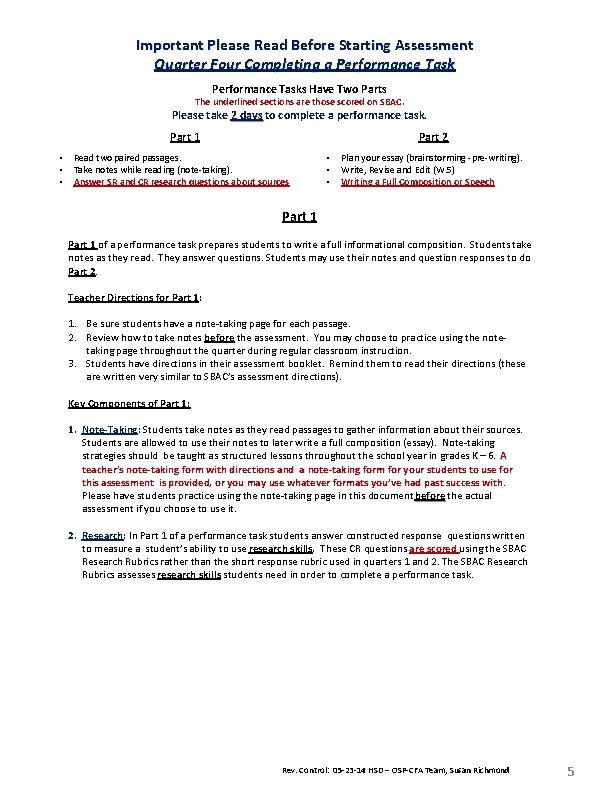
Important Please Read Before Starting Assessment Quarter Four Completing a Performance Tasks Have Two Parts The underlined sections are those scored on SBAC. Please take 2 days to complete a performance task. Part 1 Part 2 • Read two paired passages. • Take notes while reading (note-taking). • Answer SR and CR research questions about sources • Plan your essay (brainstorming -pre-writing). • Write, Revise and Edit (W. 5) • Writing a Full Composition or Speech Part 1 of a performance task prepares students to write a full informational composition. Students take notes as they read. They answer questions. Students may use their notes and question responses to do Part 2. Teacher Directions for Part 1: 1. Be sure students have a note-taking page for each passage. 2. Review how to take notes before the assessment. You may choose to practice using the notetaking page throughout the quarter during regular classroom instruction. 3. Students have directions in their assessment booklet. Remind them to read their directions (these are written very similar to SBAC’s assessment directions). Key Components of Part 1: 1. Note-Taking: Students take notes as they read passages to gather information about their sources. Students are allowed to use their notes to later write a full composition (essay). Note-taking strategies should be taught as structured lessons throughout the school year in grades K – 6. A A teacher’s note-taking form with directions and a note-taking form for your students to use for this assessment is provided, or you may use whatever formats you’ve had past success with Please have students practice using the note-taking page in this document before the actual assessment if you choose to use it. 2. Research: In Part 1 of a performance task students answer constructed response questions written to measure a student’s ability to use research skills. These CR questions are scored using the SBAC Research Rubrics rather than the short response rubric used in quarters 1 and 2. The SBAC Research Rubrics assesses research skills students need in order to complete a performance task. Rev. Control: 05 -23 -14 HSD – OSP-CFA Team, Susan Richmond 5
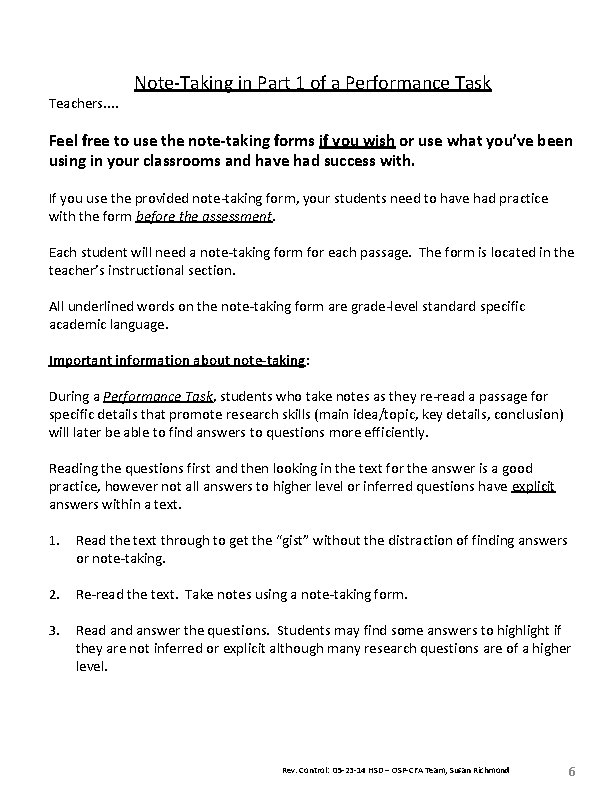
Teachers. . Note-Taking in Part 1 of a Performance Task Feel free to use the note-taking forms if you wish or use what you’ve been using in your classrooms and have had success with. If you use the provided note-taking form, your students need to have had practice with the form before the assessment. Each student will need a note-taking form for each passage. The form is located in the teacher’s instructional section. All underlined words on the note-taking form are grade-level standard specific academic language. Important information about note-taking: During a Performance Task, students who take notes as they re-read a passage for specific details that promote research skills (main idea/topic, key details, conclusion) will later be able to find answers to questions more efficiently. Reading the questions first and then looking in the text for the answer is a good practice, however not all answers to higher level or inferred questions have explicit answers within a text. 1. Read the text through to get the “gist” without the distraction of finding answers or note-taking. 2. Re-read the text. Take notes using a note-taking form. 3. Read answer the questions. Students may find some answers to highlight if they are not inferred or explicit although many research questions are of a higher level. Rev. Control: 05 -23 -14 HSD – OSP-CFA Team, Susan Richmond 6
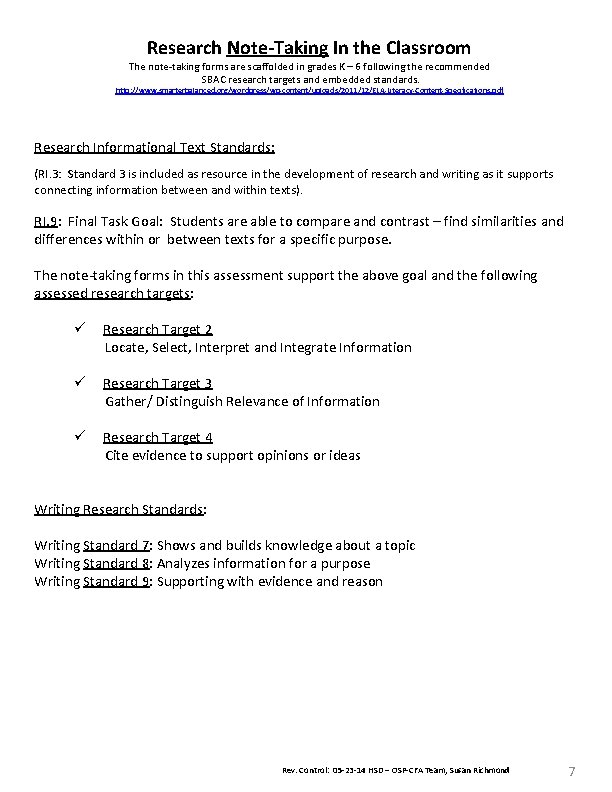
Research Note-Taking In the Classroom The note-taking forms are scaffolded in grades K – 6 following the recommended SBAC research targets and embedded standards. http: //www. smarterbalanced. org/wordpress/wp-content/uploads/2011/12/ELA-Literacy-Content-Specifications. pdf Research Informational Text Standards: (RI. 3: Standard 3 is included as resource in the development of research and writing as it supports connecting information between and within texts). RI. 9: Final Task Goal: Students are able to compare and contrast – find similarities and differences within or between texts for a specific purpose. The note-taking forms in this assessment support the above goal and the following assessed research targets: ü Research Target 2 Locate, Select, Interpret and Integrate Information ü Research Target 3 Gather/ Distinguish Relevance of Information ü Research Target 4 Cite evidence to support opinions or ideas Writing Research Standards: Writing Standard 7: Shows and builds knowledge about a topic Writing Standard 8: Analyzes information for a purpose Writing Standard 9: Supporting with evidence and reason Rev. Control: 05 -23 -14 HSD – OSP-CFA Team, Susan Richmond 7
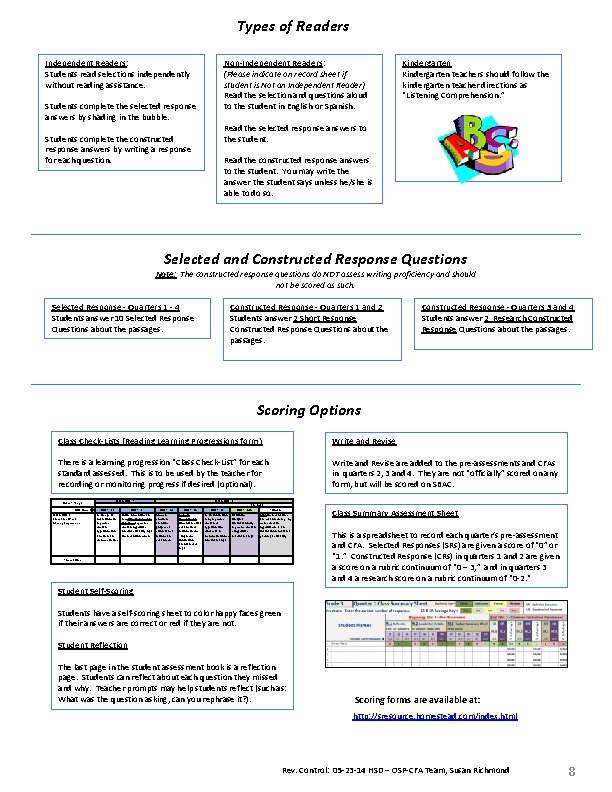
Types of Readers Independent Readers: Students read selections independently without reading assistance. Non-Independent Readers: (Please indicate on record sheet if student is Not an Independent Reader) Read the selection and questions aloud to the student in English or Spanish. Students complete the selected response answers by shading in the bubble. Kindergarten teachers should follow the kindergarten teacher directions as “Listening Comprehension. ” Read the selected response answers to the student. Students complete the constructed response answers by writing a response for each question. Read the constructed response answers to the student. You may write the answer the student says unless he/she is able to do so. Selected and Constructed Response Questions Note: The constructed response questions do NOT assess writing proficiency and should not be scored as such. Constructed Response - Quarters 1 and 2 Students answer 2 Short Response Constructed Response Questions about the passages. Selected Response - Quarters 1 - 4 Students answer 10 Selected Response Questions about the passages. Constructed Response - Quarters 3 and 4 Students answer 2 Research Constructed Response Questions about the passages. Scoring Options Class Check-Lists (Reading Learning Progressions form) Write and Revise There is a learning progression “Class Check-List” for each standard assessed. This is to be used by the teacher for recording or monitoring progress if desired (optional). Write and Revise are added to the pre-assessments and CFAs in quarters 2, 3 and 4. They are not “officially” scored on any form, but will be scored on SBAC. Path to DOK - 2 Path to DOK - 1 End Goal Grade 3 Sample DOK Guide Path to DOK 2 Informational Text Learning Progressions DOK 1 - Ka DOK 1 - Kc Locate specific text features (i. e. , key words, sidebars, hyperlinks) from a text read and discussed in class. Define (understand use) Standard Academic Language: key words, sidebars, hyperlinks, relevant, efficiently, topic and text features/tools. DOK 1 - Cf Answers questions about the purpose of different text features and search tools. DOK 2 - Ch DOK 2 - Cl DOK 2 - APn Standard Concept Development Understands that search or text features (tools) can provide information about a text or topic. Locate information using key words, sidebars or hyperlinks (and other search tools/text features) relevant to a topic. Obtain and Interpret information using key words, sidebars or hyperlinks relevant to a topic. RI 3. 5 Use text features and search tools (e. g. , key words, sidebars, hyperlinks) to locate information relevant to a given topic efficiently. Student Name Class Summary Assessment Sheet This is a spreadsheet to record each quarter’s pre-assessment and CFA. Selected Responses (SRs) are given a score of “ 0” or “ 1. ” Constructed Response (CRs) in quarters 1 and 2 are given a score on a rubric continuum of “ 0 – 3, ” and in quarters 3 and 4 a research score on a rubric continuum of “ 0 -2. " Student Self-Scoring Students have a self-scoring sheet to color happy faces green if their answers are correct or red if they are not. Student Reflection The last page in the student assessment book is a reflection page. Students can reflect about each question they missed and why. Teacher prompts may help students reflect (such as: What was the question asking, can you rephrase it? ). Scoring forms are available at: http: //sresource. homestead. com/index. html Rev. Control: 05 -23 -14 HSD – OSP-CFA Team, Susan Richmond 8
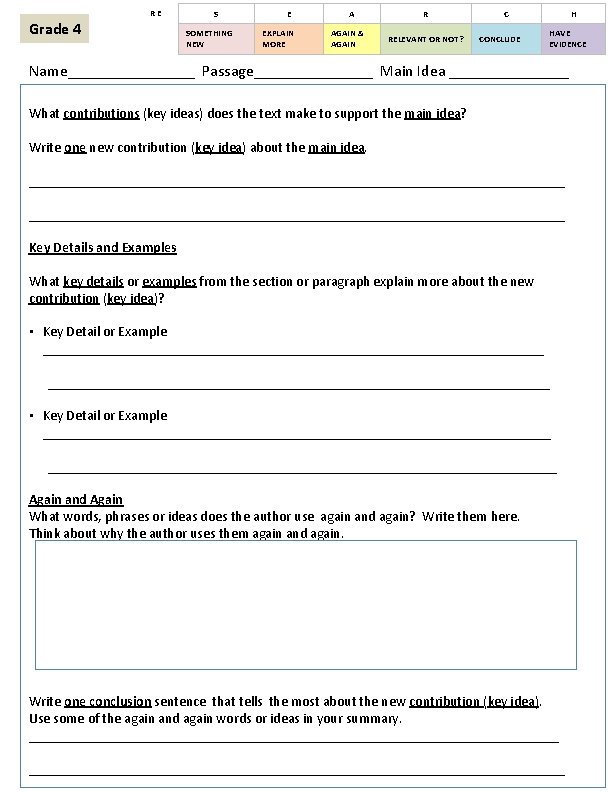
Grade 4 R E- read S E A SOMETHING NEW EXPLAIN MORE R AGAIN and AGAIN RELEVANT OR NOT? C CONCLUDE H HAVE EVIDENCE Name_________ Passage________ Main Idea ________ What contributions (key ideas) does the text make to support the main idea? Instruct students to re-read a paragraph or section of the text that has strong text contributions to support a key idea Write one new contribution (key idea) about the main idea. In fourth grade CCSS refers to key ideas as part of text contributions (a strong _______________________________________ Ask, “Does the section or paragraph you and specific support of a key idea). Use chose have a strong statement about the both terms when discussing key ideas, main idea? ” idea _______________________________________ as students may need the continued reference. This is a contribution within a key idea Key Details and Examples about the main idea (be sure students can identify the main topic). What key details and examples from the section or paragraph explain more about the new contribution 1 Have students write ONE brief sentence (key idea)? about the new contribution (key idea ). Ask students to look for key details and examples that • Key Detail or Example explain more about the new strong contribution (key idea. ) idea ____________________________________ Key details are reasons that support the new contribution ____________________________________ (key idea) Instruct students to write 2 brief key details or Remember students examples that support the key idea. will need to have a Example: if the main topic is about dogs and. . . • Key Detail or Example 2 note-taking form for _____________________________________ “The dog likes to play, ” (is the new contribution (key contribution key Idea), Idea each passage. Then some key details might be: _____________________________________ • The dog likes to play fetch. • The dog likes to play with the ball. Again and Again What words, phrases or ideas does the author use again and again? Write them here. Instruct students to look at the again and again Think about why the author uses them again and again. words or phrases, ask “Do you see some of the again Have students re-read the paragraph or section they wrote about and write words or ideas they see Again and Again, Again in the box. and again words or ideas in the key idea or key detail sentences you wrote? Can the words help you write one conclusion sentence that summarizes the contribution (key idea ) and key details? ” Explain, “When authors use the same words, phrases or ideas Again and Again ask yourself “why? ” It means something is important. ” Summarizing is a big part of writing conclusions. It is an extremely important strategy for students to learn in order to use research skills effectively. 3 4 Differentiation: Students who need more pages – print as many as needed. Students who would benefit from enrichment can continue on with more sections or paragraphs. Students who need more direct instruction – teach part as a mini lesson. These concepts can be taught separately: • Main Topic • Contribution (key idea) • Key Details Examples • Again and Again • Conclusions - Summarizing ELL Students may need each part taught using language (sentence) frames emphasizing transitional words. Write one conclusion sentence that tells the most about the new contribution ( key idea). Use some of the again and again words or ideas in your summary. _____________________________________________________________________________ Rev. Control: 05 -23 -14 HSD – OSP-CFA Team, Susan Richmond
RE Grade 4 S SOMETHING NEW E EXPLAIN MORE A AGAIN & AGAIN R RELEVANT OR NOT? C CONCLUDE H HAVE EVIDENCE Name________ Passage________ Main Idea ________ What contributions (key ideas) does the text make to support the main idea? Write one new contribution (key idea) about the main idea. _____________________________________________________________________________ Key Details and Examples What key details or examples from the section or paragraph explain more about the new contribution (key idea)? • Key Detail or Example _________________________________________________________________________ Again and Again What words, phrases or ideas does the author use again and again? Write them here. Think about why the author uses them again and again. Write one conclusion sentence that tells the most about the new contribution (key idea). Use some of the again and again words or ideas in your summary. ______________________________________ Rev. Control: 05 -23 -14 HSD – OSP-CFA Team, Susan Richmond _______________________________________
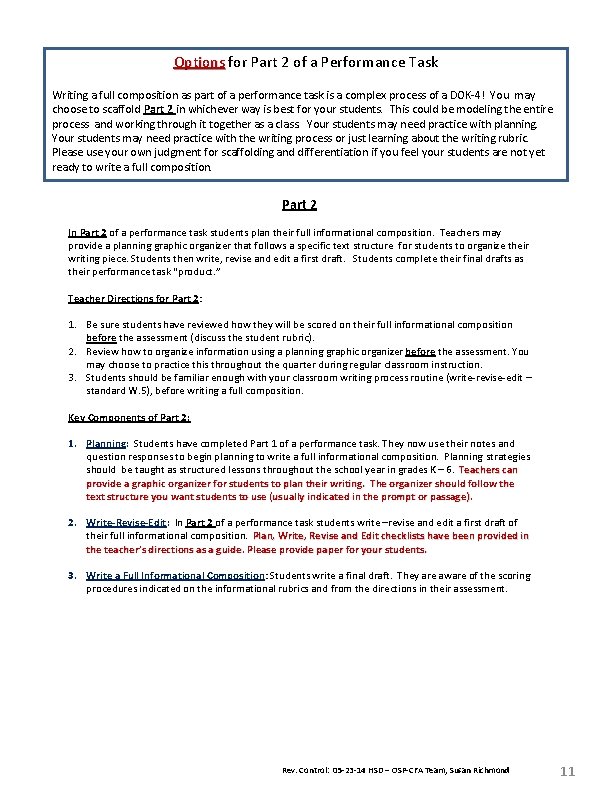
Options for Part 2 of a Performance Task Options Writing a full composition as part of a performance task is a complex process of a DOK-4! You may choose to scaffold Part 2 in whichever way is best for your students. This could be modeling the entire process and working through it together as a class. Your students may need practice with planning. Your students may need practice with the writing process or just learning about the writing rubric. Please use your own judgment for scaffolding and differentiation if you feel your students are not yet ready to write a full composition. Part 2 In Part 2 of a performance task students plan their full informational composition. Teachers may provide a planning graphic organizer that follows a specific text structure for students to organize their writing piece. Students then write, revise and edit a first draft. Students complete their final drafts as their performance task “product. ” Teacher Directions for Part 2: 1. Be sure students have reviewed how they will be scored on their full informational composition before the assessment (discuss the student rubric). 2. Review how to organize information using a planning graphic organizer before the assessment. You may choose to practice this throughout the quarter during regular classroom instruction. 3. Students should be familiar enough with your classroom writing process routine (write-revise-edit – standard W. 5), before writing a full composition. Key Components of Part 2: 1. Planning: Students have completed Part 1 of a performance task. They now use their notes and question responses to begin planning to write a full informational composition. Planning strategies should be taught as structured lessons throughout the school year in grades K – 6. Teachers can provide a graphic organizer for students to plan their writing. The organizer should follow the text structure you want students to use (usually indicated in the prompt or passage). 2. Write-Revise-Edit: In Part 2 of a performance task students write –revise and edit a first draft of their full informational composition. Plan, Write, Revise and Edit checklists have been provided in the teacher’s directions as a guide. Please provide paper for your students. 3. Write a Full Informational Composition: Students write a final draft. They are aware of the scoring procedures indicated on the informational rubrics and from the directions in their assessment. Rev. Control: 05 -23 -14 HSD – OSP-CFA Team, Susan Richmond 11
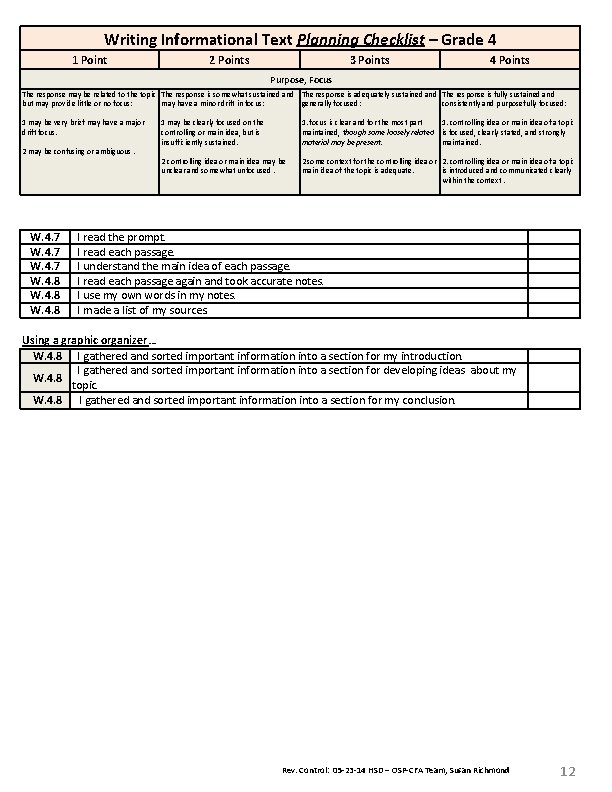
Writing Informational Text Planning Checklist – Grade 4 1 Point 2 Points 3 Points 4 Points Purpose, Focus The response may be related to the topic The response is somewhat sustained and The response is adequately sustained and The response is fully sustained and but may provide little or no focus: may have a minor drift in focus: generally focused: consistently and purposefully focused: 1 may be very brief may have a major drift focus. 2 may be confusing or ambiguous. W. 4. 7 W. 4. 8 1 may be clearly focused on the controlling or main idea, but is insufficiently sustained. 2 controlling idea or main idea may be unclear and somewhat unfocused. 1. focus is clear and for the most part 1. controlling idea or main idea of a topic maintained, though some loosely related is focused, clearly stated, and strongly material may be present. maintained. 2 some context for the controlling idea or 2. controlling idea or main idea of a topic main idea of the topic is adequate. is introduced and communicated clearly within the context. I read the prompt. I read each passage. I understand the main idea of each passage. I read each passage again and took accurate notes. I use my own words in my notes. I made a list of my sources. Using a graphic organizer… W. 4. 8 I gathered and sorted important information into a section for my introduction. I gathered and sorted important information into a section for developing ideas about my W. 4. 8 topic. W. 4. 8 I gathered and sorted important information into a section for my conclusion. Rev. Control: 05 -23 -14 HSD – OSP-CFA Team, Susan Richmond 12
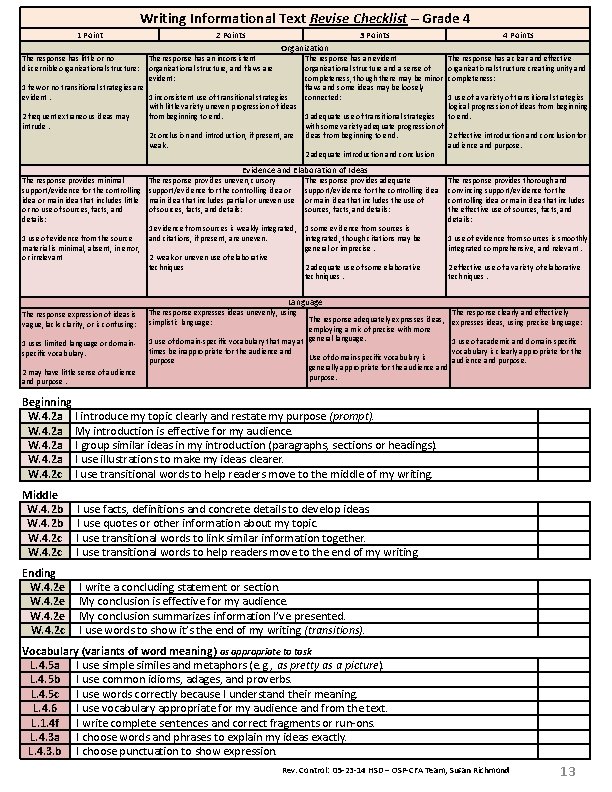
Writing Informational Text Revise Checklist – Grade 4 1 Point 2 Points 3 Points 4 Points The response has an evident organizational structure and a sense of completeness, though there may be minor flaws and some ideas may be loosely connected: The response has a clear and effective organizational structure creating unity and completeness: Organization The response has little or no The response has an inconsistent discernible organizational structure: organizational structure, and flaws are evident: 1 few or no transitional strategies are evident. 1 inconsistent use of transitional strategies with little variety uneven progression of ideas 2 frequent extraneous ideas may from beginning to end. intrude. 2 conclusion and introduction, if present, are weak. 1 use of a variety of transitional strategies logical progression of ideas from beginning to end. 1 adequate use of transitional strategies with some variety adequate progression of ideas from beginning to end. 2 effective introduction and conclusion for audience and purpose. 2 adequate introduction and conclusion Evidence and Elaboration of Ideas The response provides minimal support/evidence for the controlling idea or main idea that includes little or no use of sources, facts, and details: The response provides uneven, cursory support/evidence for the controlling idea or main idea that includes partial or uneven use of sources, facts, and details: 1 evidence from sources is weakly integrated, 1 use of evidence from the source and citations, if present, are uneven. material is minimal, absent, in error, or irrelevant 2 weak or uneven use of elaborative techniques The response provides adequate support/evidence for the controlling idea or main idea that includes the use of sources, facts, and details: 1 some evidence from sources is integrated, though citations may be general or imprecise. 2 adequate use of some elaborative techniques. The response provides thorough and convincing support/evidence for the controlling idea or main idea that includes the effective use of sources, facts, and details: 1 use of evidence from sources is smoothly integrated comprehensive, and relevant. 2 effective use of a variety of elaborative techniques. Language The response expression of ideas is vague, lacks clarity, or is confusing: 1 uses limited language or domainspecific vocabulary. 2 may have little sense of audience and purpose. The response expresses ideas unevenly, using simplistic language: The response clearly and effectively The response adequately expresses ideas, using precise language: employing a mix of precise with more 1 use of domain-specific vocabulary that may at general language. 1 use of academic and domain-specific times be inappropriate for the audience and vocabulary is clearly appropriate for the Use of domain-specific vocabulary is purpose audience and purpose. generally appropriate for the audience and purpose. Beginning W. 4. 2 a I introduce my topic clearly and restate my purpose (prompt). W. 4. 2 a My introduction is effective for my audience. W. 4. 2 a I group similar ideas in my introduction (paragraphs, sections or headings). W. 4. 2 a I use illustrations to make my ideas clearer. W. 4. 2 c I use transitional words to help readers move to the middle of my writing. Middle W. 4. 2 b I use facts, definitions and concrete details to develop ideas. W. 4. 2 b I use quotes or other information about my topic. W. 4. 2 c I use transitional words to link similar information together. W. 4. 2 c I use transitional words to help readers move to the end of my writing. Ending W. 4. 2 e W. 4. 2 c I write a concluding statement or section. My conclusion is effective for my audience. My conclusion summarizes information I’ve presented. I use words to show it’s the end of my writing (transitions). Vocabulary (variants of word meaning) as appropriate to task L. 4. 5 a I use simple similes and metaphors (e. g. , as pretty as a picture). L. 4. 5 b I use common idioms, adages, and proverbs. L. 4. 5 c I use words correctly because I understand their meaning. L. 4. 6 I use vocabulary appropriate for my audience and from the text. L. 1. 4 f I write complete sentences and correct fragments or run-ons. L. 4. 3 a I choose words and phrases to explain my ideas exactly. L. 4. 3. b I choose punctuation to show expression. Rev. Control: 05 -23 -14 HSD – OSP-CFA Team, Susan Richmond 13
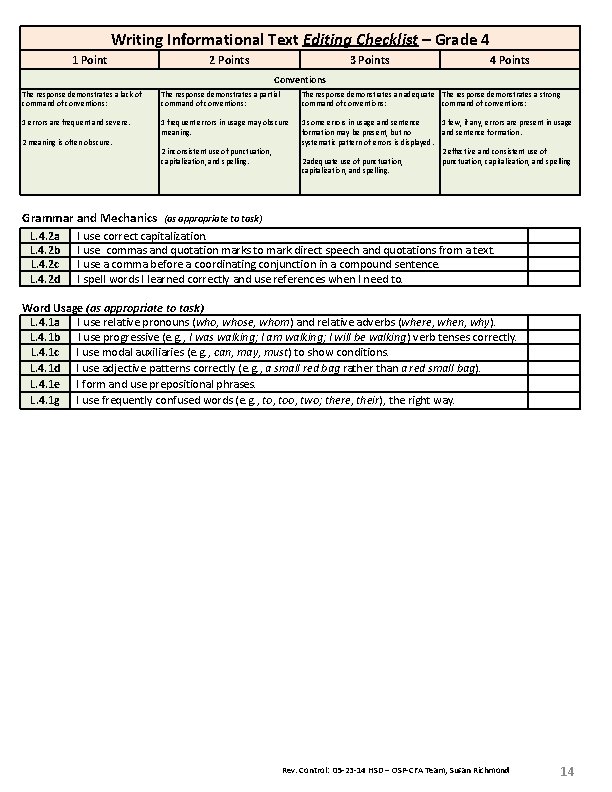
Writing Informational Text Editing Checklist – Grade 4 1 Point 2 Points 3 Points 4 Points Conventions The response demonstrates a lack of command of conventions: The response demonstrates a partial command of conventions: The response demonstrates an adequate The response demonstrates a strong command of conventions: 1 errors are frequent and severe. 1 frequent errors in usage may obscure meaning. 1 some errors in usage and sentence formation may be present, but no systematic pattern of errors is displayed. 2 meaning is often obscure. Grammar and Mechanics L. 4. 2 a L. 4. 2 b L. 4. 2 c L. 4. 2 d 2 inconsistent use of punctuation, capitalization, and spelling. 2 adequate use of punctuation, capitalization, and spelling. 1 few, if any, errors are present in usage and sentence formation. 2 effective and consistent use of punctuation, capitalization, and spelling (as appropriate to task) I use correct capitalization. I use commas and quotation marks to mark direct speech and quotations from a text. I use a comma before a coordinating conjunction in a compound sentence. I spell words I learned correctly and use references when I need to. Word Usage (as appropriate to task) L. 4. 1 a I use relative pronouns (who, whose, whom) and relative adverbs (where, when, why). L. 4. 1 b I use progressive (e. g. , I was walking; I am walking; I will be walking) verb tenses correctly. L. 4. 1 c I use modal auxiliaries (e. g. , can, may, must) to show conditions. L. 4. 1 d I use adjective patterns correctly (e. g. , a small red bag rather than a red small bag). L. 4. 1 e I form and use prepositional phrases. L. 4. 1 g I use frequently confused words (e. g. , too, two; there, their), the right way. Rev. Control: 05 -23 -14 HSD – OSP-CFA Team, Susan Richmond 14
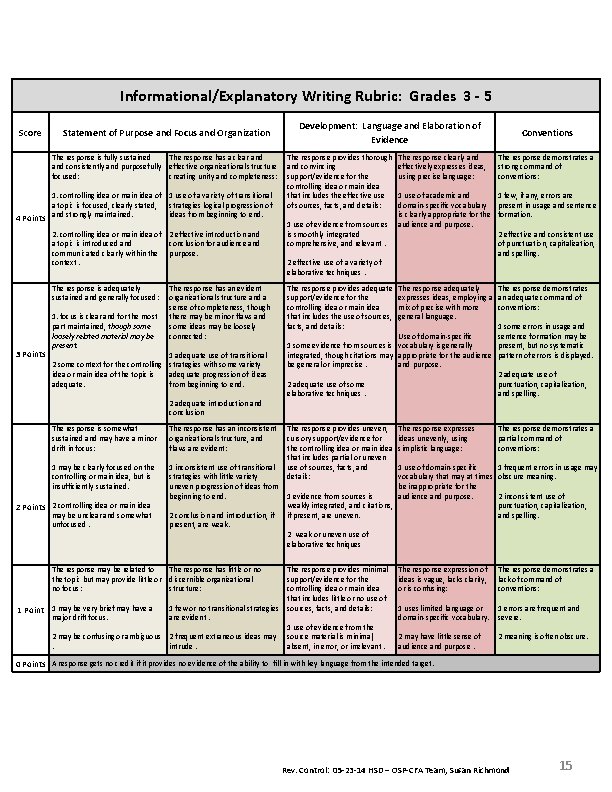
Informational/Explanatory Writing Rubric: Grades 3 - 5 Score Statement of Purpose and Focus and Organization Development: Language and Elaboration of Evidence The response is fully sustained The response has a clear and The response provides thorough The response clearly and consistently and purposefully effective organizational structure and convincing effectively expresses ideas, focused: creating unity and completeness: support/evidence for the using precise language: controlling idea or main idea 1. controlling idea or main idea of 1 use of a variety of transitional that includes the effective use 1 use of academic and a topic is focused, clearly stated, strategies logical progression of of sources, facts, and details: domain-specific vocabulary and strongly maintained. ideas from beginning to end. is clearly appropriate for the 4 Points 1 use of evidence from sources audience and purpose. 2. controlling idea or main idea of 2 effective introduction and is smoothly integrated a topic is introduced and conclusion for audience and comprehensive, and relevant. communicated clearly within the purpose. context. 2 effective use of a variety of elaborative techniques. The response is adequately sustained and generally focused: 3 Points 1. focus is clear and for the most part maintained, though some loosely related material may be present. The response has an evident organizational structure and a sense of completeness, though there may be minor flaws and some ideas may be loosely connected: 1 adequate use of transitional 2 some context for the controlling strategies with some variety idea or main idea of the topic is adequate progression of ideas adequate. from beginning to end. 2 adequate introduction and conclusion The response is somewhat sustained and may have a minor drift in focus: 1 may be clearly focused on the controlling or main idea, but is insufficiently sustained. 2 Points 2 controlling idea or main idea may be unclear and somewhat unfocused. The response has an inconsistent organizational structure, and flaws are evident: 1 Point The response demonstrates a strong command of conventions: 1 few, if any, errors are present in usage and sentence formation. 2 effective and consistent use of punctuation, capitalization, and spelling. The response provides adequate support/evidence for the controlling idea or main idea that includes the use of sources, facts, and details: The response adequately The response demonstrates expresses ideas, employing a an adequate command of mix of precise with more conventions: general language. 1 some errors in usage and Use of domain-specific sentence formation may be 1 some evidence from sources is vocabulary is generally present, but no systematic integrated, though citations may appropriate for the audience pattern of errors is displayed. be general or imprecise. and purpose. 2 adequate use of some punctuation, capitalization, elaborative techniques. and spelling. The response provides uneven, cursory support/evidence for the controlling idea or main idea that includes partial or uneven use of sources, facts, and details: 1 inconsistent use of transitional strategies with little variety uneven progression of ideas from beginning to end. 1 evidence from sources is weakly integrated, and citations, 2 conclusion and introduction, if if present, are uneven. present, are weak. 2 weak or uneven use of elaborative techniques The response may be related to The response has little or no the topic but may provide little or discernible organizational no focus: structure: Conventions The response provides minimal support/evidence for the controlling idea or main idea that includes little or no use of 1 may be very brief may have a 1 few or no transitional strategies sources, facts, and details: major drift focus. are evident. 1 use of evidence from the 2 may be confusing or ambiguous 2 frequent extraneous ideas may source material is minimal, . intrude. absent, in error, or irrelevant. The response expresses ideas unevenly, using simplistic language: The response demonstrates a partial command of conventions: 1 use of domain-specific 1 frequent errors in usage may vocabulary that may at times obscure meaning. be inappropriate for the audience and purpose. 2 inconsistent use of punctuation, capitalization, and spelling. The response expression of ideas is vague, lacks clarity, or is confusing: The response demonstrates a lack of command of conventions: 1 uses limited language or 1 errors are frequent and domain-specific vocabulary. severe. 2 may have little sense of audience and purpose. 2 meaning is often obscure. 0 Points A response gets no credit if it provides no evidence of the ability to fill in with key language from the intended target. Rev. Control: 05 -23 -14 HSD – OSP-CFA Team, Susan Richmond 15
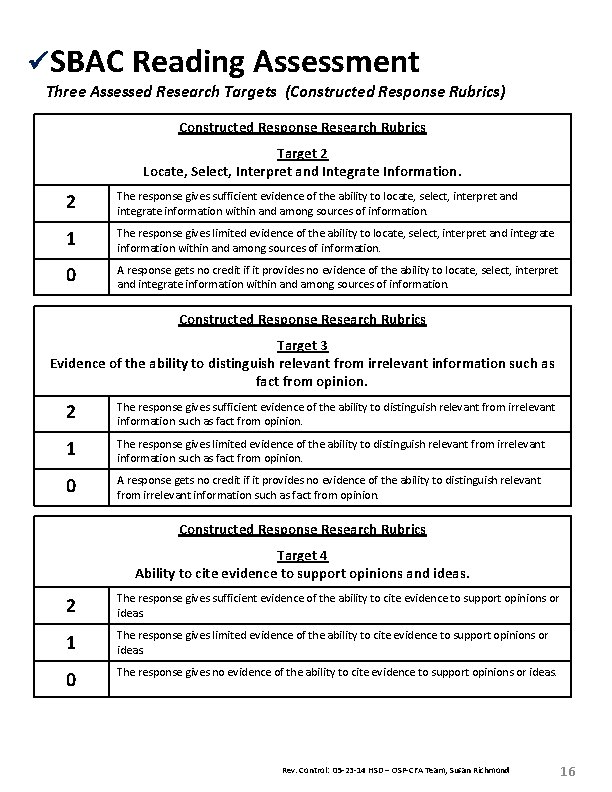
SBAC Reading Assessment Three Assessed Research Targets (Constructed Response Rubrics) Constructed Response Research Rubrics Target 2 Locate, Select, Interpret and Integrate Information. 2 The response gives sufficient evidence of the ability to locate, select, interpret and integrate information within and among sources of information. 1 The response gives limited evidence of the ability to locate, select, interpret and integrate information within and among sources of information. 0 A response gets no credit if it provides no evidence of the ability to locate, select, interpret and integrate information within and among sources of information. Constructed Response Research Rubrics Target 3 Evidence of the ability to distinguish relevant from irrelevant information such as fact from opinion. 2 The response gives sufficient evidence of the ability to distinguish relevant from irrelevant information such as fact from opinion. 1 The response gives limited evidence of the ability to distinguish relevant from irrelevant information such as fact from opinion. 0 A response gets no credit if it provides no evidence of the ability to distinguish relevant from irrelevant information such as fact from opinion. Constructed Response Research Rubrics Target 4 Ability to cite evidence to support opinions and ideas. 2 The response gives sufficient evidence of the ability to cite evidence to support opinions or ideas. 1 The response gives limited evidence of the ability to cite evidence to support opinions or ideas. 0 The response gives no evidence of the ability to cite evidence to support opinions or ideas. Rev. Control: 05 -23 -14 HSD – OSP-CFA Team, Susan Richmond 16
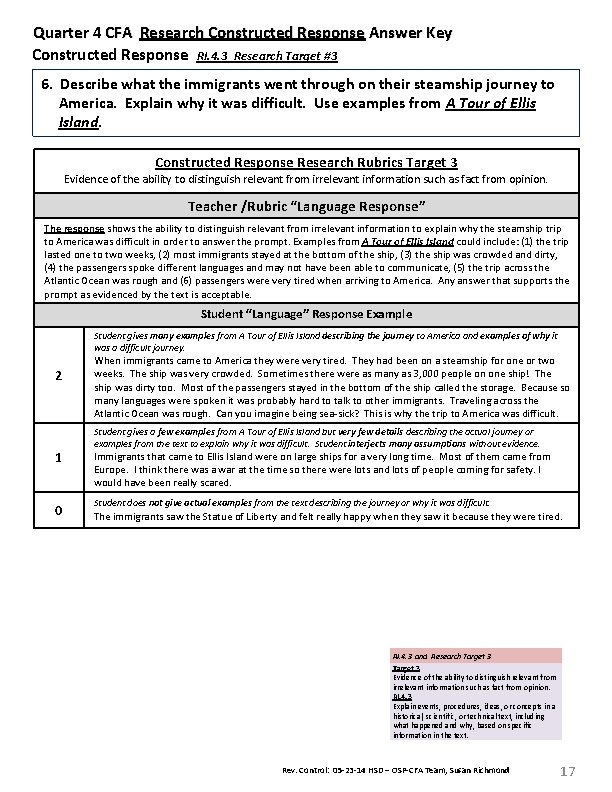
Quarter 4 CFA Research Constructed Response Answer Key Constructed Response RI. 4. 3 Research Target #3 6. Describe what the immigrants went through on their steamship journey to America. Explain why it was difficult. Use examples from A Tour of Ellis Island. Constructed Response Research Rubrics Target 3 Evidence of the ability to distinguish relevant from irrelevant information such as fact from opinion. Teacher /Rubric “Language Response” The response shows the ability to distinguish relevant from irrelevant information to explain why the steamship trip to America was difficult in order to answer the prompt. Examples from A Tour of Ellis Island could include: (1) the trip lasted one to two weeks, (2) most immigrants stayed at the bottom of the ship, (3) the ship was crowded and dirty, (4) the passengers spoke different languages and may not have been able to communicate, (5) the trip across the Atlantic Ocean was rough and (6) passengers were very tired when arriving to America. Any answer that supports the prompt as evidenced by the text is acceptable. Student “Language” Response Example Student gives many examples from A Tour of Ellis Island describing the journey to America and examples of why it was a difficult journey. 2 1 0 When immigrants came to America they were very tired. They had been on a steamship for one or two weeks. The ship was very crowded. Sometimes there were as many as 3, 000 people on one ship! The ship was dirty too. Most of the passengers stayed in the bottom of the ship called the storage. Because so many languages were spoken it was probably hard to talk to other immigrants. Traveling across the Atlantic Ocean was rough. Can you imagine being sea-sick? This is why the trip to America was difficult. Student gives a few examples from A Tour of Ellis Island but very few details describing the actual journey or examples from the text to explain why it was difficult. Student interjects many assumptions without evidence. Immigrants that came to Ellis Island were on large ships for a very long time. Most of them came from Europe. I think there was a war at the time so there were lots and lots of people coming for safety. I would have been really scared. Student does not give actual examples from the text describing the journey or why it was difficult. The immigrants saw the Statue of Liberty and felt really happy when they saw it because they were tired. RI. 4. 3 and Research Target 3 Evidence of the ability to distinguish relevant from irrelevant information such as fact from opinion. RI. 4. 3 Explain events, procedures, ideas, or concepts in a historical, scientific, or technical text, including what happened and why, based on specific information in the text. Rev. Control: 05 -23 -14 HSD – OSP-CFA Team, Susan Richmond 17
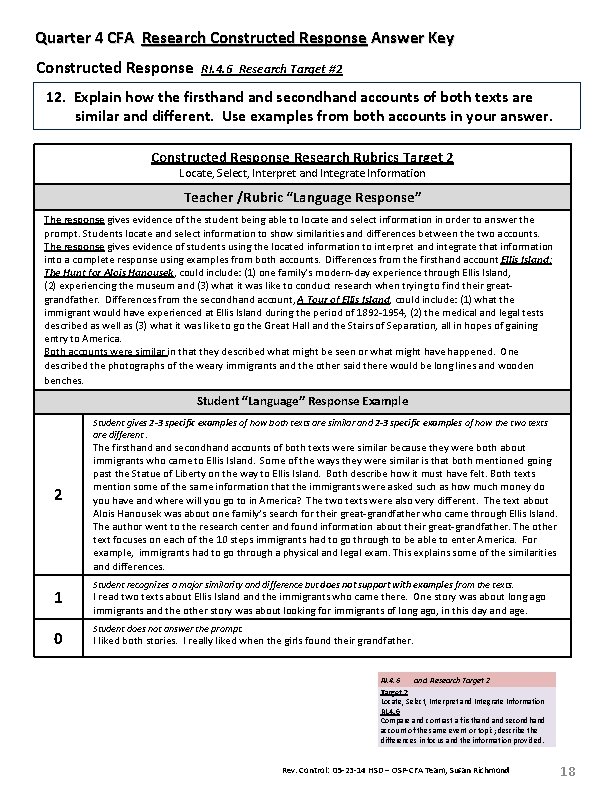
Quarter 4 CFA Research Constructed Response Answer Key Constructed Response RI. 4. 6 Research Target #2 12. Explain how the firsthand secondhand accounts of both texts are similar and different. Use examples from both accounts in your answer. Constructed Response Research Rubrics Target 2 Locate, Select, Interpret and Integrate Information Teacher /Rubric “Language Response” The response gives evidence of the student being able to locate and select information in order to answer the prompt. Students locate and select information to show similarities and differences between the two accounts. The response gives evidence of students using the located information to interpret and integrate that information into a complete response using examples from both accounts. Differences from the firsthand account Ellis Island: The Hunt for Alois Hanousek, could include: (1) one family’s modern-day experience through Ellis Island, (2) experiencing the museum and (3) what it was like to conduct research when trying to find their greatgrandfather. Differences from the secondhand account, A Tour of Ellis Island, could include: (1) what the immigrant would have experienced at Ellis Island during the period of 1892 -1954, (2) the medical and legal tests described as well as (3) what it was like to go the Great Hall and the Stairs of Separation, all in hopes of gaining entry to America. Both accounts were similar in that they described what might be seen or what might have happened. One described the photographs of the weary immigrants and the other said there would be long lines and wooden benches. Student “Language” Response Example Student gives 2 -3 specific examples of how both texts are similar and 2 -3 specific examples of how the two texts are different. 2 1 0 The firsthand secondhand accounts of both texts were similar because they were both about immigrants who came to Ellis Island. Some of the ways they were similar is that both mentioned going past the Statue of Liberty on the way to Ellis Island. Both describe how it must have felt. Both texts mention some of the same information that the immigrants were asked such as how much money do you have and where will you go to in America? The two texts were also very different. The text about Alois Hanousek was about one family’s search for their great-grandfather who came through Ellis Island. The author went to the research center and found information about their great-grandfather. The other text focuses on each of the 10 steps immigrants had to go through to be able to enter America. For example, immigrants had to go through a physical and legal exam. This explains some of the similarities and differences. Student recognizes a major similarity and difference but does not support with examples from the texts. I read two texts about Ellis Island the immigrants who came there. One story was about long ago immigrants and the other story was about looking for immigrants of long ago, in this day and age. Student does not answer the prompt. I liked both stories. I really liked when the girls found their grandfather. RI. 4. 6 and Research Target 2 Locate, Select, Interpret and Integrate Information RI. 4. 6 Compare and contrast a firsthand secondhand account of the same event or topic; describe the differences in focus and the information provided. Rev. Control: 05 -23 -14 HSD – OSP-CFA Team, Susan Richmond 18
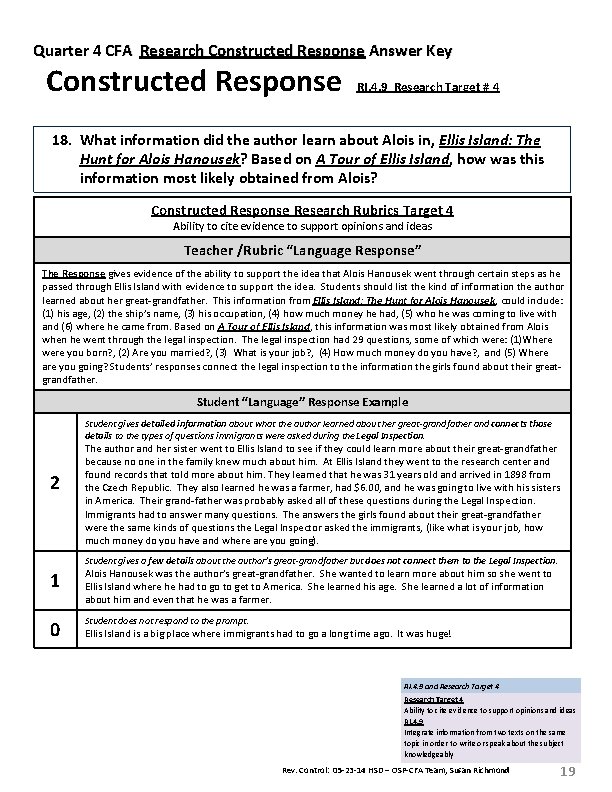
Quarter 4 CFA Research Constructed Response Answer Key Constructed Response RI. 4. 9 Research Target # 4 18. What information did the author learn about Alois in, Ellis Island: The Hunt for Alois Hanousek? Based on A Tour of Ellis Island, how was this information most likely obtained from Alois? Constructed Response Research Rubrics Target 4 Ability to cite evidence to support opinions and ideas Teacher /Rubric “Language Response” The Response gives evidence of the ability to support the idea that Alois Hanousek went through certain steps as he passed through Ellis Island with evidence to support the idea. Students should list the kind of information the author learned about her great-grandfather. This information from Ellis Island: The Hunt for Alois Hanousek, could include: (1) his age, (2) the ship’s name, (3) his occupation, (4) how much money he had, (5) who he was coming to live with and (6) where he came from. Based on A Tour of Ellis Island, this information was most likely obtained from Alois when he went through the legal inspection. The legal inspection had 29 questions, some of which were: (1)Where were you born? , (2) Are you married? , (3) What is your job? , (4) How much money do you have? , and (5) Where are you going? Students’ responses connect the legal inspection to the information the girls found about their greatgrandfather. Student “Language” Response Example Student gives detailed information about what the author learned about her great-grandfather and connects those details to the types of questions immigrants were asked during the Legal Inspection. 2 The author and her sister went to Ellis Island to see if they could learn more about their great-grandfather because no one in the family knew much about him. At Ellis Island they went to the research center and found records that told more about him. They learned that he was 31 years old and arrived in 1898 from the Czech Republic. They also learned he was a farmer, had $6. 00, and he was going to live with his sisters in America. Their grand-father was probably asked all of these questions during the Legal Inspection. Immigrants had to answer many questions. The answers the girls found about their great-grandfather were the same kinds of questions the Legal Inspector asked the immigrants, (like what is your job, how much money do you have and where are you going). Student gives a few details about the author’s great-grandfather but does not connect them to the Legal Inspection. 1 Alois Hanousek was the author’s great-grandfather. She wanted to learn more about him so she went to Ellis Island where he had to go to get to America. She learned his age. She learned a lot of information about him and even that he was a farmer. 0 Student does not respond to the prompt. Ellis Island is a big place where immigrants had to go a long time ago. It was huge! RI. 4. 9 and Research Target 4 Ability to cite evidence to support opinions and ideas RI. 4. 9 Integrate information from two texts on the same topic in order to write or speak about the subject knowledgeably Rev. Control: 05 -23 -14 HSD – OSP-CFA Team, Susan Richmond 19
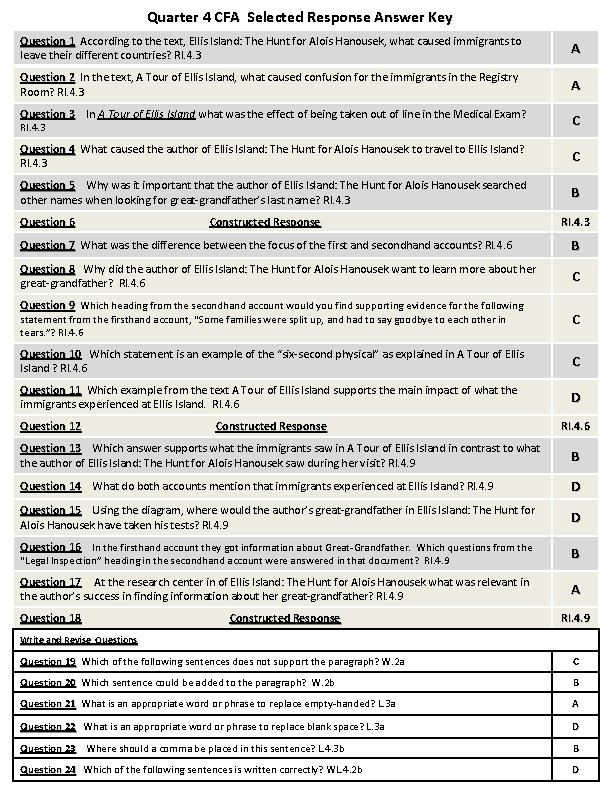
Quarter 4 CFA Selected Response Answer Key Question 1 According to the text, Ellis Island: The Hunt for Alois Hanousek, what caused immigrants to leave their different countries? RI. 4. 3 A Question 2 In the text, A Tour of Ellis Island, what caused confusion for the immigrants in the Registry Room? RI. 4. 3 A Question 3 In A Tour of Ellis Island what was the effect of being taken out of line in the Medical Exam? RI. 4. 3 C Question 4 What caused the author of Ellis Island: The Hunt for Alois Hanousek to travel to Ellis Island? RI. 4. 3 C Question 5 Why was it important that the author of Ellis Island: The Hunt for Alois Hanousek searched other names when looking for great-grandfather’s last name? RI. 4. 3 B Question 6 Constructed Response 6 RI. 4. 3 Question 7 What was the difference between the focus of the first and secondhand accounts? RI. 4. 6 B Question 8 Why did the author of Ellis Island: The Hunt for Alois Hanousek want to learn more about her great-grandfather? RI. 4. 6 C Question 9 Which heading from the secondhand account would you find supporting evidence for the following statement from the firsthand account, “Some families were split up, and had to say goodbye to each other in tears. ”? RI. 4. 6 C Question 10 Which statement is an example of the “six-second physical” as explained in A Tour of Ellis Island ? RI. 4. 6 C Question 11 Which example from the text A Tour of Ellis Island supports the main impact of what the immigrants experienced at Ellis Island. RI. 4. 6 D Question 12 Constructed Response RI. 4. 6 Question 13 Which answer supports what the immigrants saw in A Tour of Ellis Island in contrast to what the author of Ellis Island: The Hunt for Alois Hanousek saw during her visit? RI. 4. 9 B Question 14 What do both accounts mention that immigrants experienced at Ellis Island? RI. 4. 9 D Question 15 Using the diagram, where would the author’s great-grandfather in Ellis Island: The Hunt for Alois Hanousek have taken his tests? RI. 4. 9 D Question 16 In the firsthand account they got information about Great-Grandfather. Which questions from the “Legal Inspection” heading in the secondhand account were answered in that document? RI. 4. 9 B Question 17 At the research center in of Ellis Island: The Hunt for Alois Hanousek what was relevant in the author’s success in finding information about her great-grandfather? RI. 4. 9 A Question 18 Constructed Response RI. 4. 9 Write and Revise Questions Question 19 Which of the following sentences does not support the paragraph? W. 2 a C Question 20 Which sentence could be added to the paragraph? W. 2 b B Question 21 What is an appropriate word or phrase to replace empty-handed? L. 3 a A Question 22 What is an appropriate word or phrase to replace blank space? L. 3 a D Question 23 Where should a comma be placed in this sentence? L. 4. 3 b B Rev. Control: 05 -23 -14 HSD – OSP-CFA Team, Susan Richmond Question 24 Which of the following sentences is written correctly? WL. 4. 2 b 20 D
Quarter Four Reading Informational Text Grade 4 Common Formative Assessment Name_________
Student Directions: Read the Directions. Part 1 Your assignment: You will read two accounts about Ellis Island. As you read, take notes on these sources. Then you will answer several research questions about these two sources. These will help you plan to write an article. In your article you will explain what it was like to go through Ellis Island as an immigrant and why it was a difficult and emotional experience. Use information from both accounts. Steps you will be following: In order to help you plan and write your essay, you will do all of the following: 1. Read two articles about Ellis Island. 2. Answer several questions about the sources. 3. Plan your article. Directions for beginning: You will now read two articles. Take notes because you may want to refer to your notes while you plan your article. You can refer to any of the sources as often as you like. Questions Answer the questions. Your answers to these questions will be scored. Also, they will help you think about the sources you’ve read, which should help you plan your article. Part 2 Your assignment: Write an article about the immigrants who went through Ellis Island. In your article you will explain what it was like to go through Ellis Island as an immigrant and why it was a difficult and emotional experience. Use information from both accounts. You will: 1. Plan your writing. You may use your notes and answers. 2. Write – Revise and Edit your first draft (your teacher will give you paper). 3. Write a final draft for your report. How you will be scored How your report will be scored: The people scoring your writing will be assigning scores for: 1. Statement of Purpose/Focus—how well you clearly state and maintain your controlling idea or main idea. 2. Organization – how well the ideas progress from the introduction to the conclusion using effective transitions and how well you stay on topic throughout. 3. Elaboration of Evidence – how well you provide evidence from sources about your topic and elaborate with specific information. 4. Language and Vocabulary – how well you effectively express ideas using precise language that is appropriate for your audience and purpose. 5. Conventions – how well you follow the rules of usage, punctuation, capitalization, and spelling. Rev. Control: 05 -23 -14 HSD – OSP-CFA Team, Susan Richmond 22
Ellis Island: The Hunt for Alois Hanousek No one in my family knew much about Alois Hanousek, my great-grandfather. We knew that he immigrated to the United States in the 1890 s. We also knew he came from or near a town in the Czech Republic called Kutna Hora. My family once went to Kutna Hora in search of information. We came home empty-handed. So far, we had very little information to go on. Both of my grandparents on that side of the family have passed away. My father, who is an only child, never knew his grandfather. My sister Rebekah and I were determined to fill in the blank space on our family tree. So, we set out to Ellis Island in New York City. Most immigrants arrived there from 1892 to 1954. We hoped they would have the records we needed to learn more about our family history. To get there, we took a ferry from Battery Park on the southern tip of Manhattan. The ferry sailed past the impressive Statue of Liberty. I imagined how my great-grandfather must have felt when he first saw the majestic lady with the golden torch. Minutes later, we arrived at Ellis Island. I walked in the doors and you could feel the history. The museum had photographs of immigrants everywhere. Some looked weary from their long voyage. Others looked excited. Still others looked sad. As we walked around the building, you could see all the things people brought with them. There was colorful clothing from every part of the world. There were also religious items and family treasures, such as musical instruments. I imagined that these things made it easier to be a stranger in a strange, new land. Millions of immigrants were processed at Ellis Island. They were given medical exams and reading tests. They were asked countless personal questions, including: “Who paid for your voyage? ” “How much money do you have in your possession? ” “Do you have more than one wife? ” Not everyone got in. Those who were too unhealthy were sent back. Some families were split up, and had to say goodbye to each other in tears. Rev. Control: 05 -23 -14 HSD – OSP-CFA Team, Susan Richmond 23
Eventually, my sister and I arrived at the research center. We sat down at a computer and began searching the records of ship after ship looking for our great-grandfather. At first, we found nothing. Then, my sister had an idea. She began doing searches on names like Yanousek, Lanousek, and Canousek. That is when I saw it! My great-grandfather’s name. It was written as “Canousek. It had been spelled wrong at Ellis Island. Here is some of the information we got from the document: • Alois was 31 and single when he arrived on April 2 nd, 1898. • He was on a ship named the H. H. Keier. • He was a farmer. • He had $6 on him. • He was coming to live with his sisters. • He was from Cervene Pesky, a town just outside Kutna Hora. My sister and I were thrilled. It looks like we will be making another trip to the Czech Republic! These Czech immigrants are waving from the S. S. President Harding. The ship landed in New York City on May 25, 1935. Rev. Control: 05 -23 -14 HSD – OSP-CFA Team, Susan Richmond 24
Ellis Island Immigration Station A Tour of Ellis Island Welcome to Ellis Island! About 12 million immigrants made their first stop in America at the Ellis Island Immigration Station between 1892 and 1954. Many Americans can trace their family history back to Ellis Island. Follow in the immigrants' footsteps. What was it like to go to America through Ellis Island? On the Boat – 1 Most of the immigrants who came to America through Ellis Island were from Europe. Many immigrants came to escape poverty or war. Many came for religious freedom. They began their journey to America on foot, horseback, or train. Many walked hundreds of miles across Europe to get to a seaport. When they arrived, they boarded a steamship. The trip across the Atlantic Ocean lasted one to two weeks. Rich immigrants stayed in cabins. But most stayed in a large, open space at the bottom of the ship called the steerage. As many as 3, 000 people crowded each ship. They often came from different countries. They spoke different languages, and belonged to different religions. Arriving – 2 The trip across the Atlantic Ocean was rough. The ships were crowded and dirty. So most passengers were very tired when they arrived in the New York Harbor. One of the first things they saw was the Statue of Liberty. It has stood on its own island in the harbor since 1886. People would cheer when they saw the statue. Some would weep with joy as the ship passed by it. Before the immigrants could get off the ships, doctors boarded the ships. They looked for signs of diseases. The doctors would check the health of the immigrants in the cabins first. These lucky few could leave the ship when it docked at New York City. But most immigrants often would wait for hours or days. Then they would board a ferryboat to Ellis Island. Rev. Control: 05 -23 -14 HSD – OSP-CFA Team, Susan Richmond 25
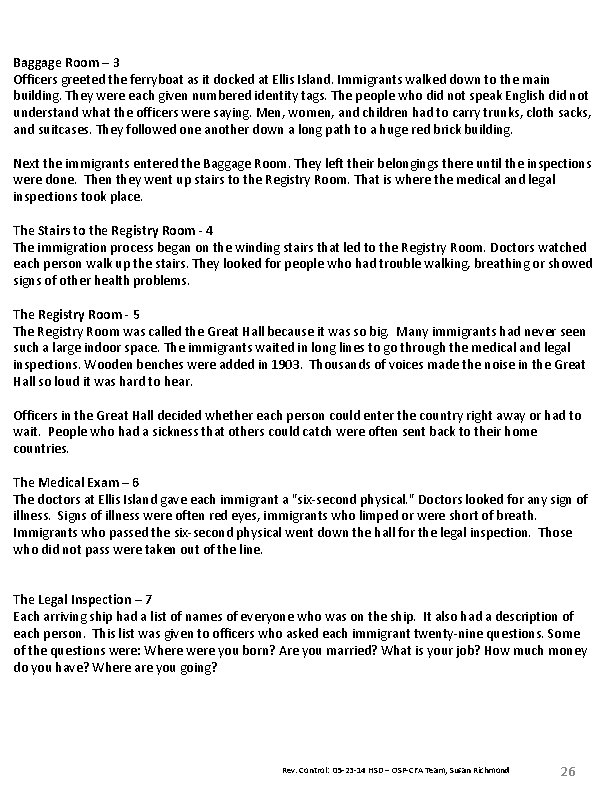
Baggage Room – 3 Officers greeted the ferryboat as it docked at Ellis Island. Immigrants walked down to the main building. They were each given numbered identity tags. The people who did not speak English did not understand what the officers were saying. Men, women, and children had to carry trunks, cloth sacks, and suitcases. They followed one another down a long path to a huge red brick building. Next the immigrants entered the Baggage Room. They left their belongings there until the inspections were done. Then they went up stairs to the Registry Room. That is where the medical and legal inspections took place. The Stairs to the Registry Room - 4 The immigration process began on the winding stairs that led to the Registry Room. Doctors watched each person walk up the stairs. They looked for people who had trouble walking, breathing or showed signs of other health problems. The Registry Room - 5 The Registry Room was called the Great Hall because it was so big. Many immigrants had never seen such a large indoor space. The immigrants waited in long lines to go through the medical and legal inspections. Wooden benches were added in 1903. Thousands of voices made the noise in the Great Hall so loud it was hard to hear. Officers in the Great Hall decided whether each person could enter the country right away or had to wait. People who had a sickness that others could catch were often sent back to their home countries. The Medical Exam – 6 The doctors at Ellis Island gave each immigrant a "six-second physical. " Doctors looked for any sign of illness. Signs of illness were often red eyes, immigrants who limped or were short of breath. Immigrants who passed the six-second physical went down the hall for the legal inspection. Those who did not pass were taken out of the line. The Legal Inspection – 7 Each arriving ship had a list of names of everyone who was on the ship. It also had a description of each person. This list was given to officers who asked each immigrant twenty-nine questions. Some of the questions were: Where were you born? Are you married? What is your job? How much money do you have? Where are you going? Rev. Control: 05 -23 -14 HSD – OSP-CFA Team, Susan Richmond 26
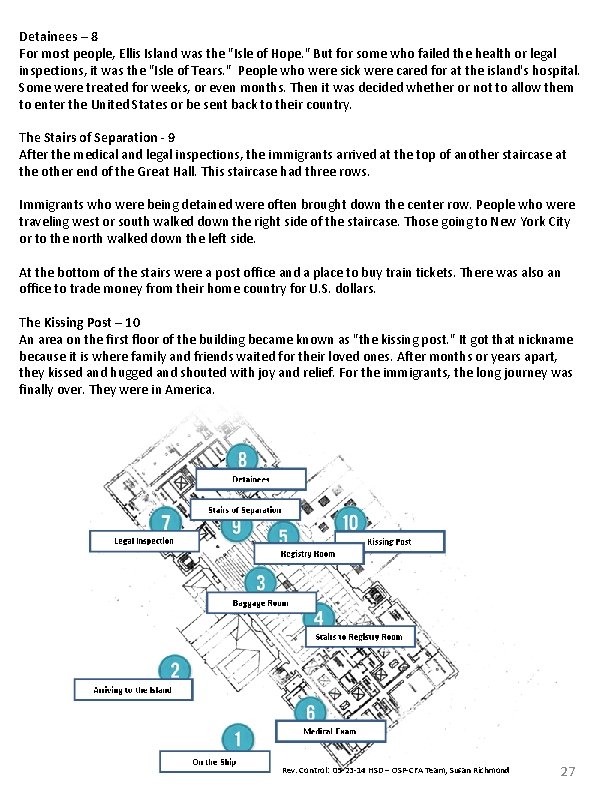
Detainees – 8 For most people, Ellis Island was the "Isle of Hope. " But for some who failed the health or legal inspections, it was the "Isle of Tears. " People who were sick were cared for at the island's hospital. Some were treated for weeks, or even months. Then it was decided whether or not to allow them to enter the United States or be sent back to their country. The Stairs of Separation - 9 After the medical and legal inspections, the immigrants arrived at the top of another staircase at the other end of the Great Hall. This staircase had three rows. Immigrants who were being detained were often brought down the center row. People who were traveling west or south walked down the right side of the staircase. Those going to New York City or to the north walked down the left side. At the bottom of the stairs were a post office and a place to buy train tickets. There was also an office to trade money from their home country for U. S. dollars. The Kissing Post – 10 An area on the first floor of the building became known as "the kissing post. " It got that nickname because it is where family and friends waited for their loved ones. After months or years apart, they kissed and hugged and shouted with joy and relief. For the immigrants, the long journey was finally over. They were in America. Rev. Control: 05 -23 -14 HSD – OSP-CFA Team, Susan Richmond 27
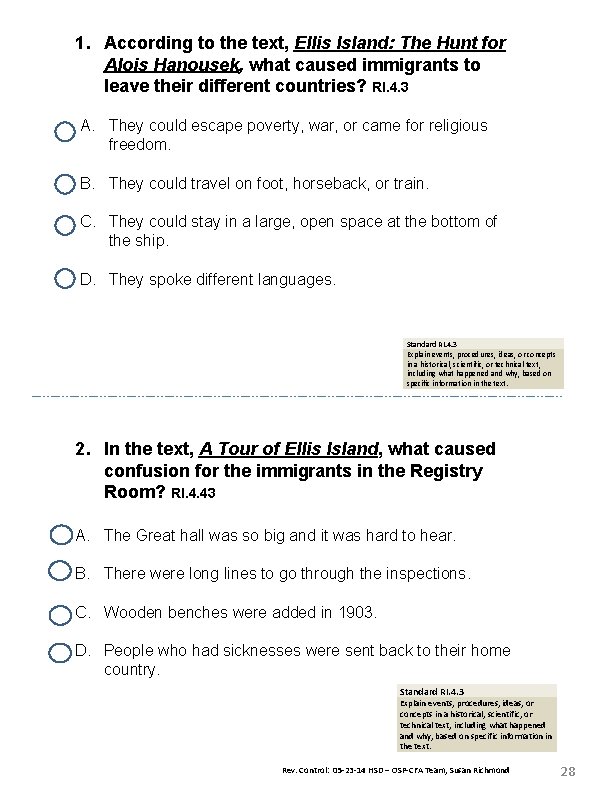
1. According to the text, Ellis Island: The Hunt for Alois Hanousek, what caused immigrants to leave their different countries? RI. 4. 3 A. They could escape poverty, war, or came for religious freedom. B. They could travel on foot, horseback, or train. C. They could stay in a large, open space at the bottom of the ship. D. They spoke different languages. Standard RI. 4. 3 Explain events, procedures, ideas, or concepts in a historical, scientific, or technical text, including what happened and why, based on specific information in the text. 2. In the text, A Tour of Ellis Island, what caused confusion for the immigrants in the Registry Room? RI. 4. 43 A. The Great hall was so big and it was hard to hear. B. There were long lines to go through the inspections. C. Wooden benches were added in 1903. D. People who had sicknesses were sent back to their home country. Standard RI. 4. 3 Explain events, procedures, ideas, or concepts in a historical, scientific, or technical text, including what happened and why, based on specific information in the text. Rev. Control: 05 -23 -14 HSD – OSP-CFA Team, Susan Richmond 28
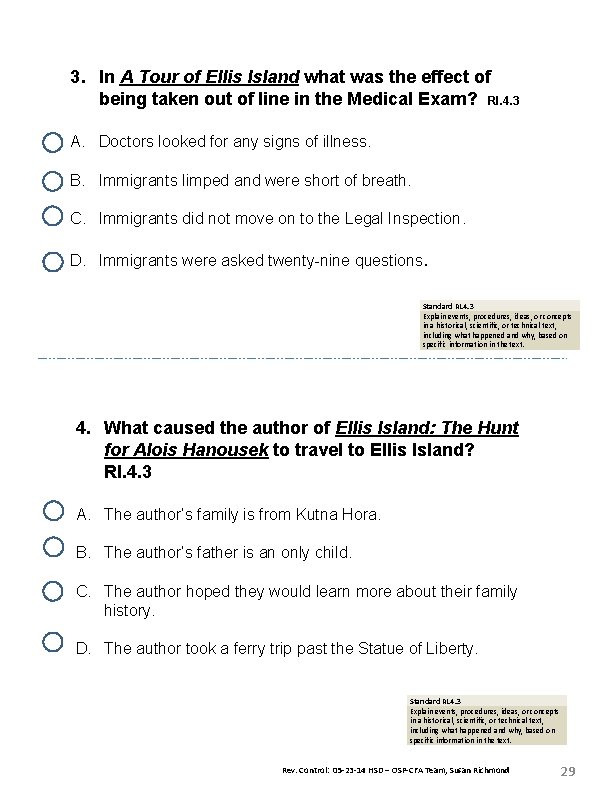
3. In A Tour of Ellis Island what was the effect of being taken out of line in the Medical Exam? RI. 4. 3 A. Doctors looked for any signs of illness. B. Immigrants limped and were short of breath. C. Immigrants did not move on to the Legal Inspection. D. Immigrants were asked twenty-nine questions. Standard RI. 4. 3 Explain events, procedures, ideas, or concepts in a historical, scientific, or technical text, including what happened and why, based on specific information in the text. 4. What caused the author of Ellis Island: The Hunt for Alois Hanousek to travel to Ellis Island? RI. 4. 3 A. The author’s family is from Kutna Hora. B. The author’s father is an only child. C. The author hoped they would learn more about their family history. D. The author took a ferry trip past the Statue of Liberty. Standard RI. 4. 3 Explain events, procedures, ideas, or concepts in a historical, scientific, or technical text, including what happened and why, based on specific information in the text. Rev. Control: 05 -23 -14 HSD – OSP-CFA Team, Susan Richmond 29
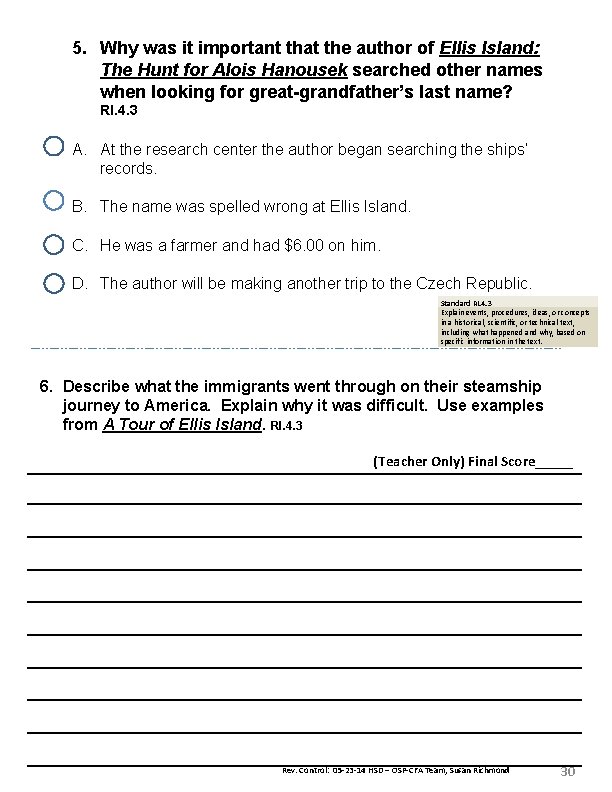
5. Why was it important that the author of Ellis Island: The Hunt for Alois Hanousek searched other names when looking for great-grandfather’s last name? RI. 4. 3 A. At the research center the author began searching the ships’ records. B. The name was spelled wrong at Ellis Island. C. He was a farmer and had $6. 00 on him. D. The author will be making another trip to the Czech Republic. Standard RI. 4. 3 Explain events, procedures, ideas, or concepts in a historical, scientific, or technical text, including what happened and why, based on specific information in the text. 6. Describe what the immigrants went through on their steamship journey to America. Explain why it was difficult. Use examples from A Tour of Ellis Island. RI. 4. 3 (Teacher Only) Final Score_____ Rev. Control: 05 -23 -14 HSD – OSP-CFA Team, Susan Richmond 30
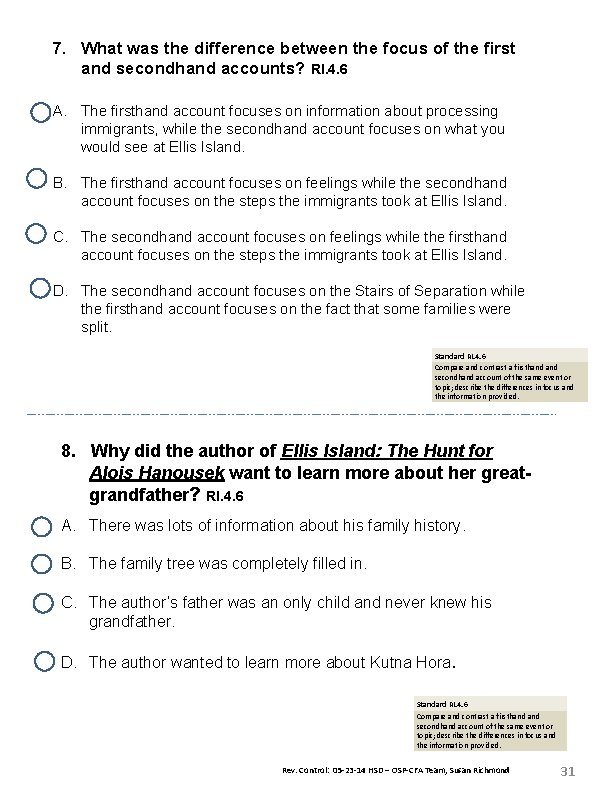
7. What was the difference between the focus of the first and secondhand accounts? RI. 4. 6 A. The firsthand account focuses on information about processing immigrants, while the secondhand account focuses on what you would see at Ellis Island. B. The firsthand account focuses on feelings while the secondhand account focuses on the steps the immigrants took at Ellis Island. C. The secondhand account focuses on feelings while the firsthand account focuses on the steps the immigrants took at Ellis Island. D. The secondhand account focuses on the Stairs of Separation while the firsthand account focuses on the fact that some families were split. Standard RI. 4. 6 Compare and contrast a firsthand secondhand account of the same event or topic; describe the differences in focus and the information provided. 8. Why did the author of Ellis Island: The Hunt for Alois Hanousek want to learn more about her greatgrandfather? RI. 4. 6 A. There was lots of information about his family history. B. The family tree was completely filled in. C. The author’s father was an only child and never knew his grandfather. D. The author wanted to learn more about Kutna Hora. Standard RI. 4. 6 Compare and contrast a firsthand secondhand account of the same event or topic; describe the differences in focus and the information provided. Rev. Control: 05 -23 -14 HSD – OSP-CFA Team, Susan Richmond 31
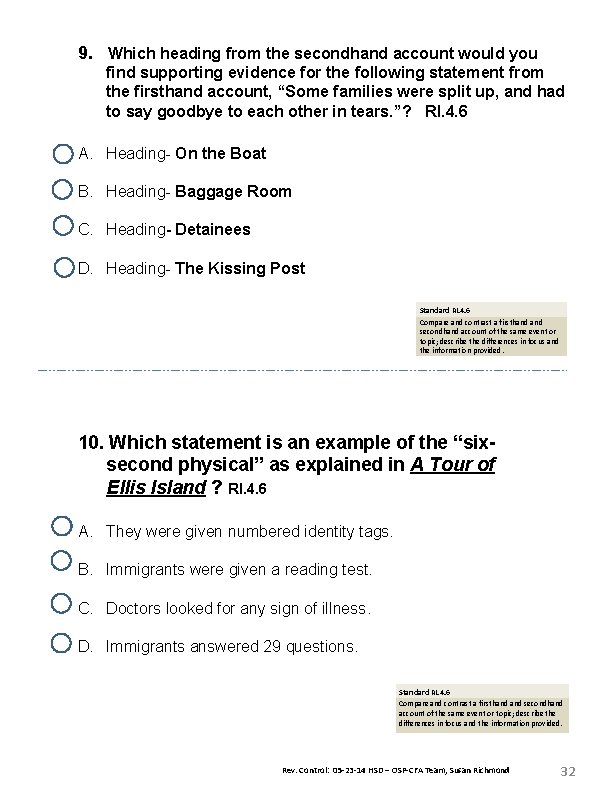
9. Which heading from the secondhand account would you find supporting evidence for the following statement from the firsthand account, “Some families were split up, and had to say goodbye to each other in tears. ”? RI. 4. 6 A. Heading- On the Boat B. Heading- Baggage Room C. Heading- Detainees D. Heading- The Kissing Post Standard RI. 4. 6 Compare and contrast a firsthand secondhand account of the same event or topic; describe the differences in focus and the information provided. 10. Which statement is an example of the “sixsecond physical” as explained in A Tour of Ellis Island ? RI. 4. 6 A. They were given numbered identity tags. B. Immigrants were given a reading test. C. Doctors looked for any sign of illness. D. Immigrants answered 29 questions. Standard RI. 4. 6 Compare and contrast a firsthand secondhand account of the same event or topic; describe the differences in focus and the information provided. Rev. Control: 05 -23 -14 HSD – OSP-CFA Team, Susan Richmond 32
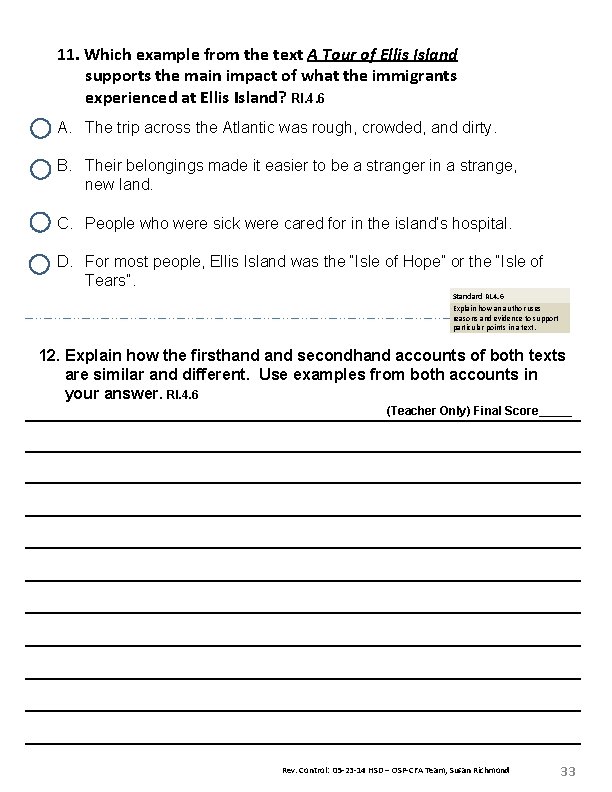
11. Which example from the text A Tour of Ellis Island supports the main impact of what the immigrants experienced at Ellis Island? RI. 4. 6 A. The trip across the Atlantic was rough, crowded, and dirty. B. Their belongings made it easier to be a stranger in a strange, new land. C. People who were sick were cared for in the island’s hospital. D. For most people, Ellis Island was the “Isle of Hope” or the “Isle of Tears”. Standard RI. 4. 6 Explain how an author uses reasons and evidence to support particular points in a text. 12. Explain how the firsthand secondhand accounts of both texts are similar and different. Use examples from both accounts in your answer. RI. 4. 6 (Teacher Only) Final Score_____ Rev. Control: 05 -23 -14 HSD – OSP-CFA Team, Susan Richmond 33
13. Which answer supports what the immigrants saw in A Tour of Ellis Island in contrast to what the author of Ellis Island: The Hunt for Alois Hanousek saw during her visit? RI. 4. 9 A. One saw the Statue of Liberty, while the other saw a majestic lady with a golden torch. B. One saw weary, dirty travelers, while the other saw photographs of immigrants. C. Both saw long lines of people from other countries. D. Both saw the Stairs of Separation with three rows. Standard RI. 4. 9 Integrate information from two texts on the same topic in order to write or speak about the subject knowledgeably. 14. What do both accounts mention that immigrants experienced at Ellis Island? RI. 4. 9 A. They heard people speaking different languages. B. They saw colorful clothing and family treasures. C. The immigrants waited in long lines. D. The immigrants who were sick or unhealthy were sent back to their country. Standard RI. 4. 9 Integrate information from two texts on the same topic in order to write or speak about the subject knowledgeably. Rev. Control: 05 -23 -14 HSD – OSP-CFA Team, Susan Richmond 34
15. Using the diagram, where would the author’s greatgrandfather in Ellis Island: The Hunt for Alois Hanousek have taken his tests? RI. 4. 9 A. Baggage Room and Registry Room B. Arriving on the Island the Detainees C. Kissing Post and Stairs of Separation D. Medical Exam Room and the Legal Inspection Room Standard RI. 4. 9 Integrate information from two texts on the same topic in order to write or speak about the subject knowledgeably. 16. In the firsthand account the author found a document about her Great-Grandfather. Which questions from the “Legal Inspection” heading in the secondhand account were answered in that document? RI. 4. 9 A. Where are you going and are you traveling with anyone? B. How much money do you have and are you married? C. Who paid for your voyage and where are you going? D. Do you have more than one wife and what is her name? Standard RI. 4. 9 Integrate information from two texts on the same topic in order to write or speak about the subject knowledgeably. Rev. Control: 05 -23 -14 HSD – OSP-CFA Team, Susan Richmond 35
17. At the research center in of Ellis Island: The Hunt for Alois Hanousek what was relevant in the author’s success in finding information about her great-grandfather? RI. 4. 9 A. There were ship records and a computer for researching. B. The spelling was correct in the last name. C. Great-Grandfather was coming to live with his sisters. D. There was a snack bar and a souvenir shop Standard RI. 4. 9 Integrate information from two texts on the same topic in order to write or speak about the subject knowledgeably. 18. What information did the author learn about Alois in, Ellis Island: The Hunt for Alois Hanousek? Based on A Tour of Ellis Island, how was this information mostlikely obtained from Alois? RI. 4. 9(Teacher Only) Final Score_____ Rev. Control: 05 -23 -14 HSD – OSP-CFA Team, Susan Richmond 36
19. Read the paragraph below. (Write and Revise W. 2 a) Some immigrants were detained. Some failed the health inspection. Most immigrants were from Europe. Some failed the legal inspection. Which of the following sentences does not support the paragraph? A. Some immigrants were detained. B. Some failed the health inspection. C. Most immigrants were from Europe. D. Some failed the legal inspection. 20. Read the paragraph below: (Write and Revise L. 2 b) Touring the Ellis Island museum is like taking a walk back into history. There are photographs of immigrants from long ago. There are old historical records. _______________ Which sentence could be added to the paragraph? A. More than 12, 000 immigrants came through Ellis Island. B. There are even old family treasures on display. C. The immigrants must have been very tired. D. You can search for your own ancestors at Ellis Island. Rev. Control: 05 -23 -14 HSD – OSP-CFA Team, Susan Richmond 37
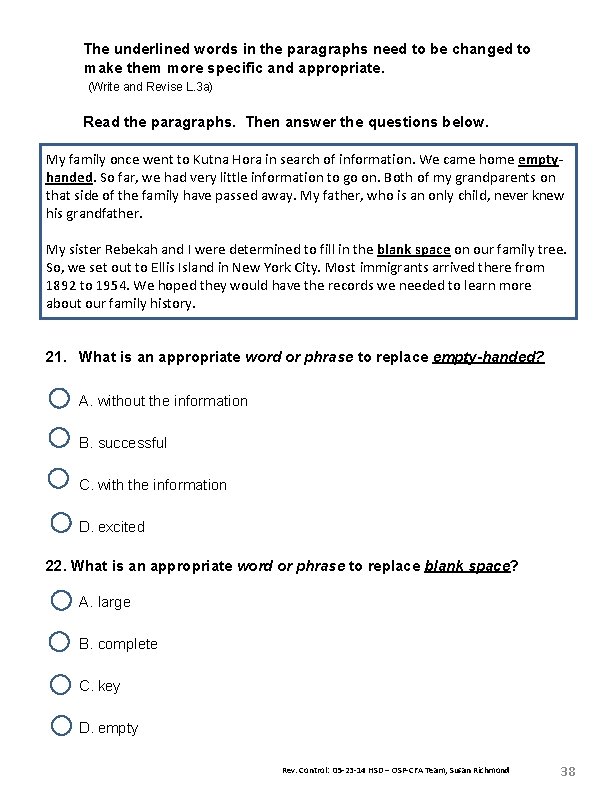
The underlined words in the paragraphs need to be changed to make them more specific and appropriate. (Write and Revise L. 3 a) Read the paragraphs. Then answer the questions below. My family once went to Kutna Hora in search of information. We came home emptyhanded. So far, we had very little information to go on. Both of my grandparents on that side of the family have passed away. My father, who is an only child, never knew his grandfather. My sister Rebekah and I were determined to fill in the blank space on our family tree. So, we set out to Ellis Island in New York City. Most immigrants arrived there from 1892 to 1954. We hoped they would have the records we needed to learn more about our family history. 21. What is an appropriate word or phrase to replace empty-handed? A. without the information B. successful C. with the information D. excited 22. What is an appropriate word or phrase to replace blank space? A. large B. complete C. key D. empty Rev. Control: 05 -23 -14 HSD – OSP-CFA Team, Susan Richmond 38
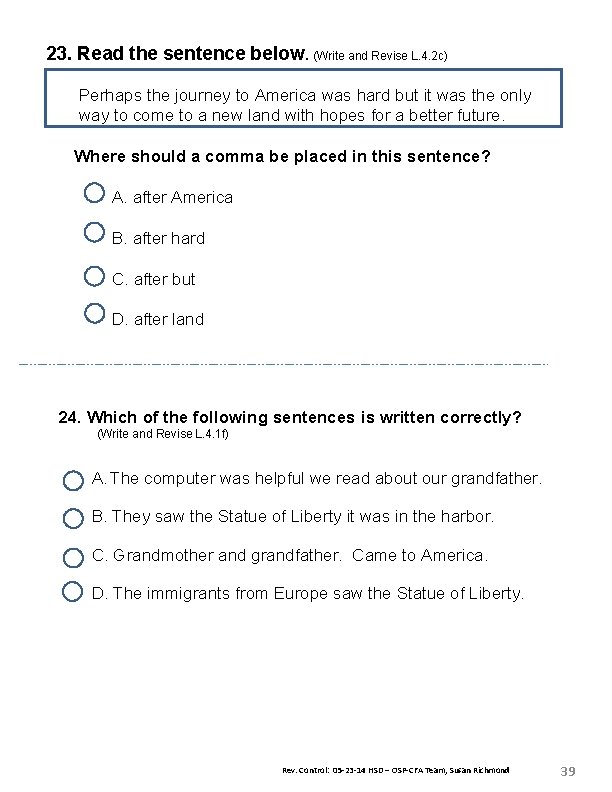
23. Read the sentence below. (Write and Revise L. 4. 2 c) Perhaps the journey to America was hard but it was the only way to come to a new land with hopes for a better future. Where should a comma be placed in this sentence? A. after America B. after hard C. after but D. after land 24. Which of the following sentences is written correctly? (Write and Revise L. 4. 1 f) A. The computer was helpful we read about our grandfather. B. They saw the Statue of Liberty it was in the harbor. C. Grandmother and grandfather. Came to America. D. The immigrants from Europe saw the Statue of Liberty. Rev. Control: 05 -23 -14 HSD – OSP-CFA Team, Susan Richmond 39
Part 2 You will: 1. Plan your writing. You may use your notes and answers. You may use a graphic organizer 2. Write – Revise and Edit your first draft (your teacher will give you paper). 3. Your assignment: Part 2 Write an article about the immigrants who went through Ellis Island. In your article you will explain what it was like to go through Ellis Island as an immigrant and why it was a difficult and emotional experience. Use information from both accounts. How you will be scored How your report will be scored: The people scoring your writing will be assigning scores for: 1. Statement of Purpose/Focus—how well you clearly state and maintain your controlling idea or main idea. 2. Organization – how well the ideas progress from the introduction to the conclusion using effective transitions and how well you stay on topic throughout. 3. Elaboration of Evidence – how well you provide evidence from sources about your topic and elaborate with specific information. 4. Language and Vocabulary – how well you effectively express ideas using precise language that is appropriate for your audience and purpose. 5. Conventions – how well you follow the rules of usage, punctuation, capitalization, and spelling. Rev. Control: 05 -23 -14 HSD – OSP-CFA Team, Susan Richmond 40
Rev. Control: 05 -23 -14 HSD – OSP-CFA Team, Susan Richmond 41
Rev. Control: 05 -23 -14 HSD – OSP-CFA Team, Susan Richmond 42
STOP Close your books and wait for instructions! Rev. Control: 05 -23 -14 HSD – OSP-CFA Team, Susan Richmond 43
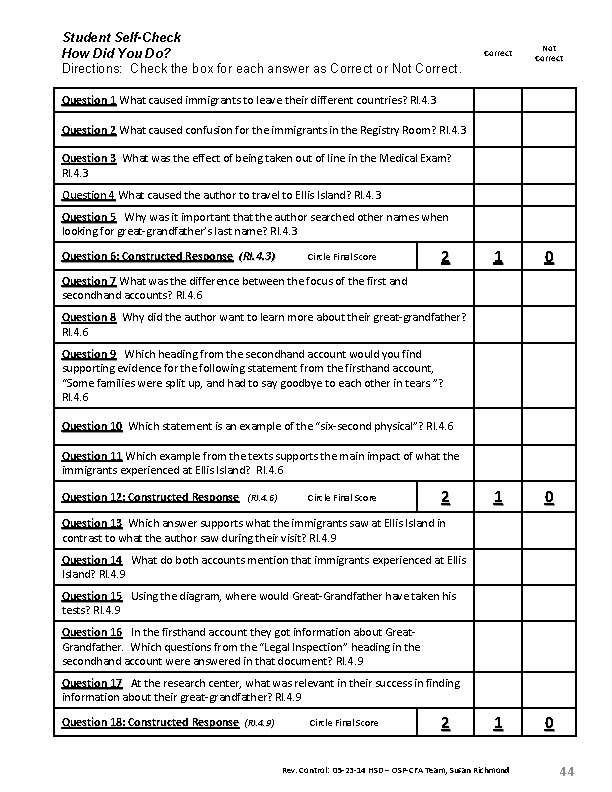
Student Self-Check How Did You Do? Directions: Check the box for each answer as Correct or Not Correct 1 0 1 0 Question 1 What caused immigrants to leave their different countries? RI. 4. 3 Question 2 What caused confusion for the immigrants in the Registry Room? RI. 4. 3 Question 3 What was the effect of being taken out of line in the Medical Exam? RI. 4. 3 Question 4 What caused the author to travel to Ellis Island? RI. 4. 3 Question 5 Why was it important that the author searched other names when looking for great-grandfather’s last name? RI. 4. 3 Question 6: Constructed Response (RI. 4. 3) Circle Final Score 2 Question 7 What was the difference between the focus of the first and secondhand accounts? RI. 4. 6 Question 8 Why did the author want to learn more about their great-grandfather? RI. 4. 6 Question 9 Which heading from the secondhand account would you find supporting evidence for the following statement from the firsthand account, “Some families were split up, and had to say goodbye to each other in tears. ”? RI. 4. 6 Question 10 Which statement is an example of the “six-second physical”? RI. 4. 6 Question 11 Which example from the texts supports the main impact of what the immigrants experienced at Ellis Island? RI. 4. 6 Question 12: Constructed Response (RI. 4. 6) Circle Final Score 2 Question 13 Which answer supports what the immigrants saw at Ellis Island in contrast to what the author saw during their visit? RI. 4. 9 Question 14 What do both accounts mention that immigrants experienced at Ellis Island? RI. 4. 9 Question 15 Using the diagram, where would Great-Grandfather have taken his tests? RI. 4. 9 Question 16 In the firsthand account they got information about Great Grandfather. Which questions from the “Legal Inspection” heading in the secondhand account were answered in that document? RI. 4. 9 Question 17 At the research center, what was relevant in their success in finding information about their great-grandfather? RI. 4. 9 Question 18: Constructed Response (RI. 4. 9) Circle Final Score 2 Rev. Control: 05 -23 -14 HSD – OSP-CFA Team, Susan Richmond 44
Question no. ___ Question no. ___ Rev. Control: 05 -23 -14 HSD – OSP-CFA Team, Susan Richmond 45