
Quarks By Sarah Newton and Samantha Arkin A
Quarks By Sarah Newton and Samantha Arkin
A little background • Murray Gell-Mann and George Zweig discovered that particle are made of 3 base particles • Called elementary particles • Protons and neutrons are made of Quarks • Quarks are classified into 6 Catagories called “flavors”

The 6 “Flavors” of quarks • • • The up quark or u quark is the lightest quark The down quark or d quark is the second -lightest quark The strange quark or s quark is the thirdlightest quark The charm quark or c quark is the third heaviest quark The top quark, also known as the t quark or truth quark is the heaviest of all quarks The bottom quark or b quark, also known as the beauty quark
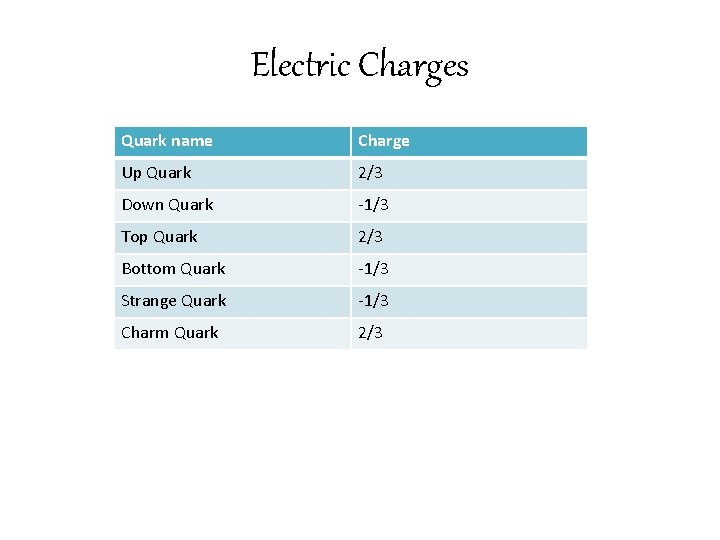
Electric Charges Quark name Charge Up Quark 2/3 Down Quark -1/3 Top Quark 2/3 Bottom Quark -1/3 Strange Quark -1/3 Charm Quark 2/3

Antiquarks • • Top quark/anti-top Bottom quark/anti-bottom Technically there are 12 quarks Between these 12 quarks you can create almost anything
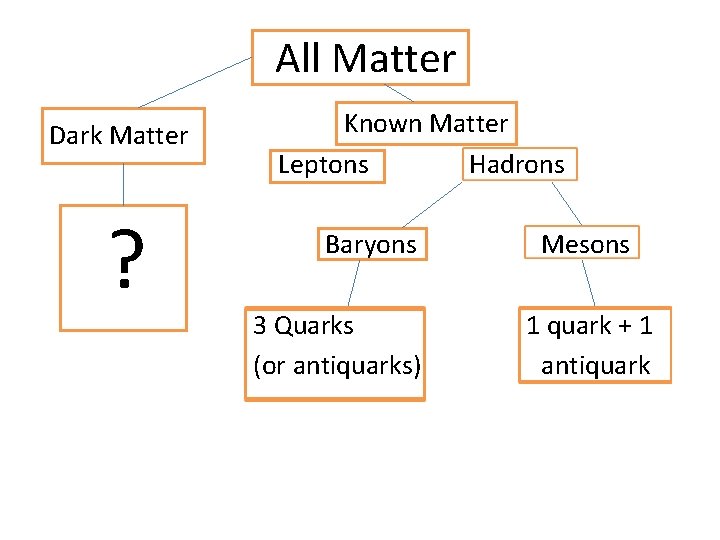
All Matter Dark Matter ? Known Matter Leptons Hadrons Baryons 3 Quarks (or antiquarks) Mesons 1 quark + 1 antiquark
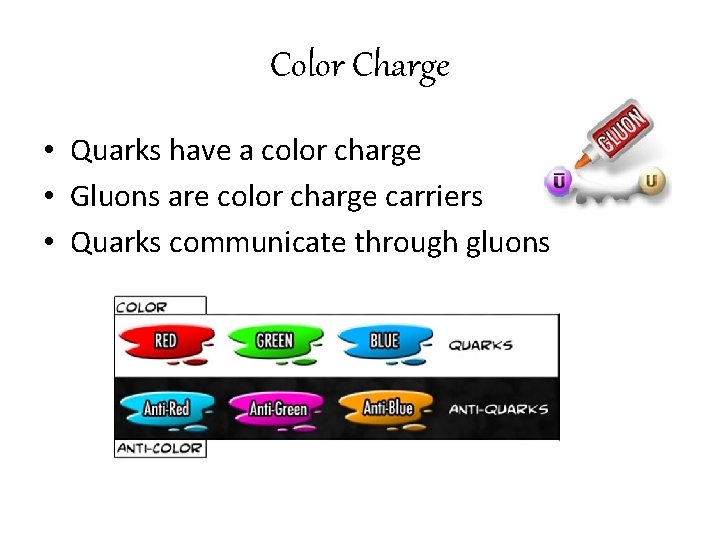
Color Charge • Quarks have a color charge • Gluons are color charge carriers • Quarks communicate through gluons
Spin • Spin: an intrinsic property of elementary particles, and its directions is an important degree of freedom • Can be represented by a vector that is measured in the unit ħ. • Classified as spin -1/2 particles • Example: an up quark with a spin of +1/2 along the z axis is denoted by u
Weak Interactions • Quarks can transform into another flavor but only through weak interaction • Absorbing a W boson can change any up quark into a down quark and vice versa • Beta decay: a neutron “splits” into a proton – Occurs when a down quark decays into an up quark by emitting a W boson
Weak Interactions • Beta decay and Inverse decay are used in medical applications such as PET (positron emission tomography) and neutrino detection • Transformation of flavor happens to every quark but each quark has a preference
Strong Interactions • Quarks posses a color charge – Blue, Green, and Red – Antiblue, Antigreen, and Antired – Every quark carries a color and every antiquark carries an anticolor • System of attraction and repulsion – Different combinations of the three colors are called strong interaction
Mass • Current quark mass – The mass of the quark itself • Constituent quark mass – Current quark mass plus the mass of the gluon field surrounding the quarks • Hadron’s mass is from the gluons that bind the constituent quarks • Gluons are inherently massless, but have energy
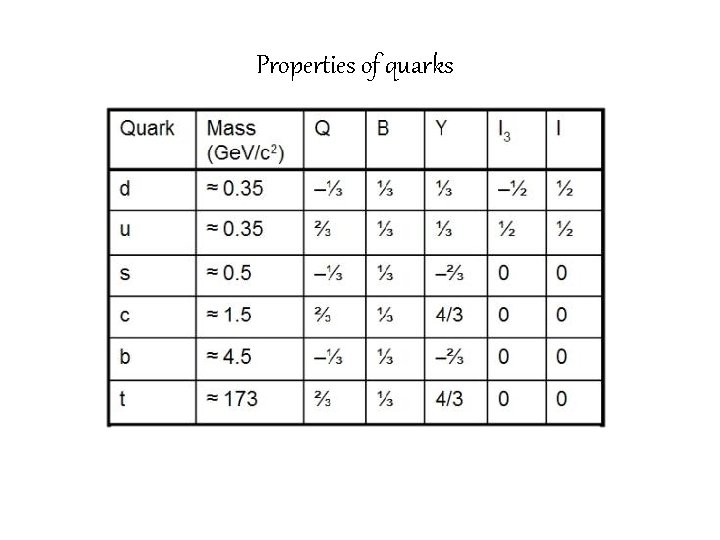
Properties of quarks
Interacting Quarks • When a gluon is transferred to a quark a color changes in both • Gluons are able to emit and absorb other gluons – Causes asympotic freedom • Quarks coming closer to each other, while the chromodynamics binding force between them weakens • As distance increases the binding force strengths
Sea Quarks • Hadrons that contribute to their quantum numbers contain virtual quark-antiquarks called Sea Quarks • Form when a gluon of the hadron’s color field splits • Much less stable than their valence counterparts • Can hadronize into baryonic or mesonic particles
The END http: //youtu. be/x. YZkj 2 FPeoc
- Slides: 16