
QUARKONIA SUPPRESSION IN HIGH ENERGY HEAVY ION COLLISIONS

- Slides: 23
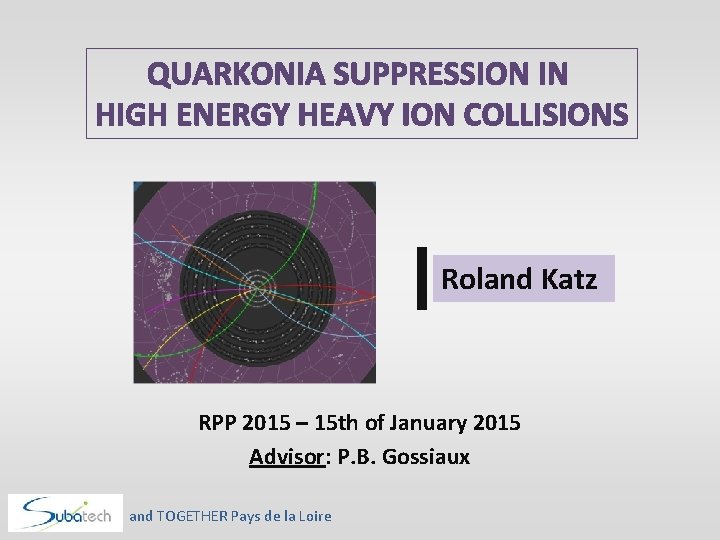
QUARKONIA SUPPRESSION IN HIGH ENERGY HEAVY ION COLLISIONS Roland Katz RPP 2015 – 15 th of January 2015 Advisor: P. B. Gossiaux and TOGETHER Pays de la Loire
Summary • • • Quark Gluon Plasma Quarkonia suppression Open questions and background Dynamical view The Schrödinger-Langevin equation Conclusion Roland Katz – 15/01/2015 2
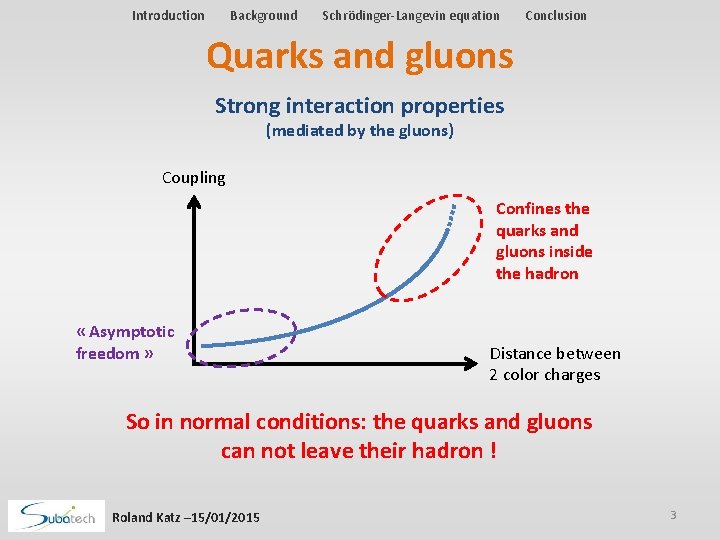
Introduction Background Schrödinger-Langevin equation Conclusion Quarks and gluons Strong interaction properties (mediated by the gluons) Coupling Confines the quarks and gluons inside the hadron « Asymptotic freedom » Distance between 2 color charges So in normal conditions: the quarks and gluons can not leave their hadron ! Roland Katz – 15/01/2015 3
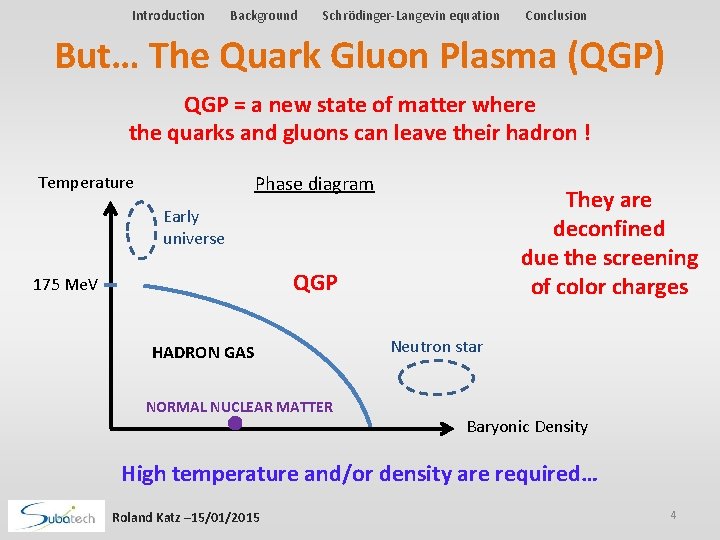
Introduction Background Schrödinger-Langevin equation Conclusion But… The Quark Gluon Plasma (QGP) QGP = a new state of matter where the quarks and gluons can leave their hadron ! Phase diagram Temperature They are deconfined due the screening of color charges Early universe QGP 175 Me. V HADRON GAS NORMAL NUCLEAR MATTER Neutron star Baryonic Density High temperature and/or density are required… Roland Katz – 15/01/2015 4
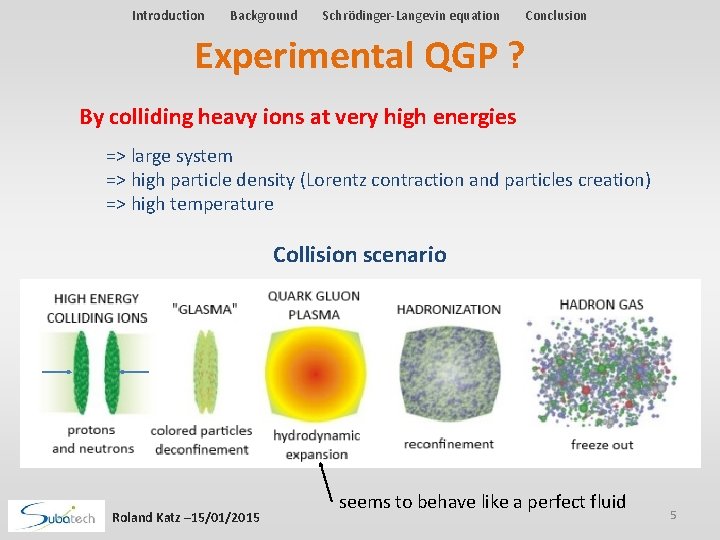
Introduction Background Schrödinger-Langevin equation Conclusion Experimental QGP ? By colliding heavy ions at very high energies => large system => high particle density (Lorentz contraction and particles creation) => high temperature Collision scenario Roland Katz – 15/01/2015 seems to behave like a perfect fluid 5
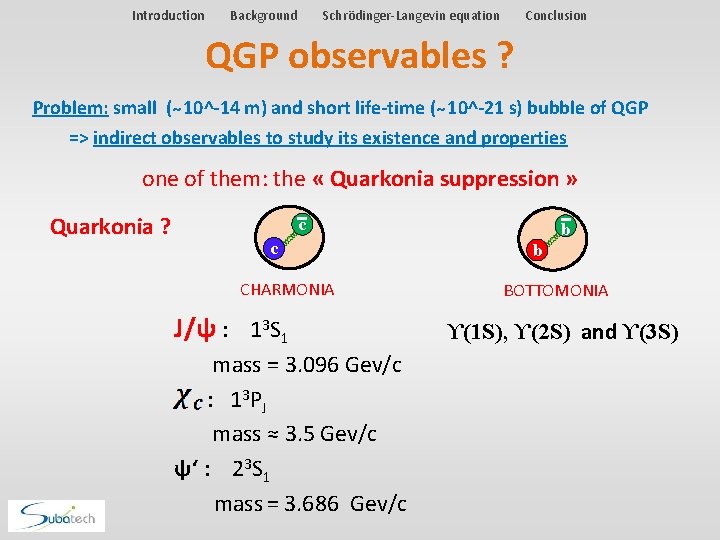
Introduction Background Schrödinger-Langevin equation Conclusion QGP observables ? Problem: small ( 10^-14 m) and short life-time ( 10^-21 s) bubble of QGP => indirect observables to study its existence and properties one of them: the « Quarkonia suppression » Quarkonia ? c c CHARMONIA J/ψ : 13 S 1 mass = 3. 096 Gev/c : 1 3 PJ mass ≈ 3. 5 Gev/c ψ‘ : 23 S 1 mass = 3. 686 Gev/c b b BOTTOMONIA ϒ(1 S), ϒ(2 S) and ϒ(3 S)
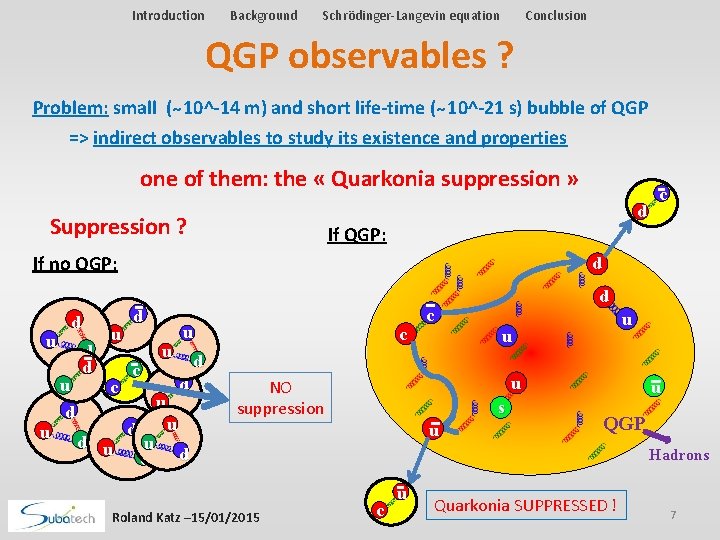
Introduction Background Schrödinger-Langevin equation Conclusion QGP observables ? Problem: small ( 10^-14 m) and short life-time ( 10^-21 s) bubble of QGP => indirect observables to study its existence and properties one of them: the « Quarkonia suppression » d Suppression ? If QGP: If no QGP: u u d d d u c c d d c u u c d c u u d d u NO suppression Roland Katz – 15/01/2015 s u u QGP Hadrons c u Quarkonia SUPPRESSED ! 7
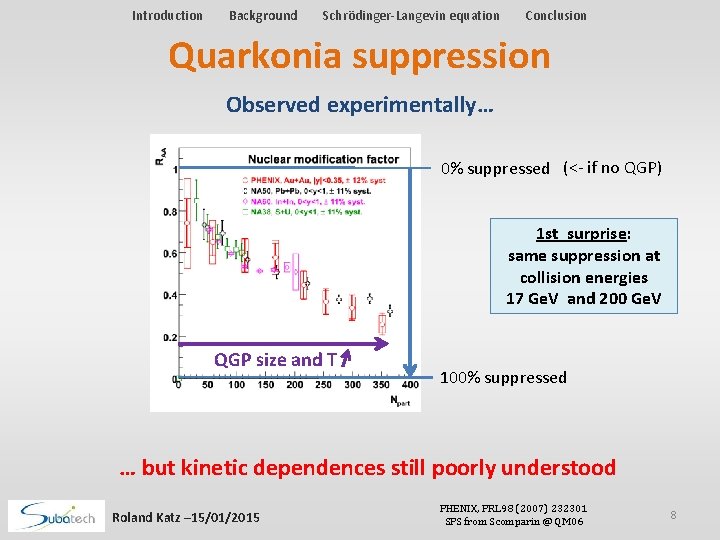
Introduction Background Schrödinger-Langevin equation Conclusion Quarkonia suppression Observed experimentally… 0% suppressed (<- if no QGP) 1 st surprise: same suppression at collision energies 17 Ge. V and 200 Ge. V QGP size and T 100% suppressed … but kinetic dependences still poorly understood Roland Katz – 15/01/2015 PHENIX, PRL 98 (2007) 232301 SPS from Scomparin @ QM 06 8
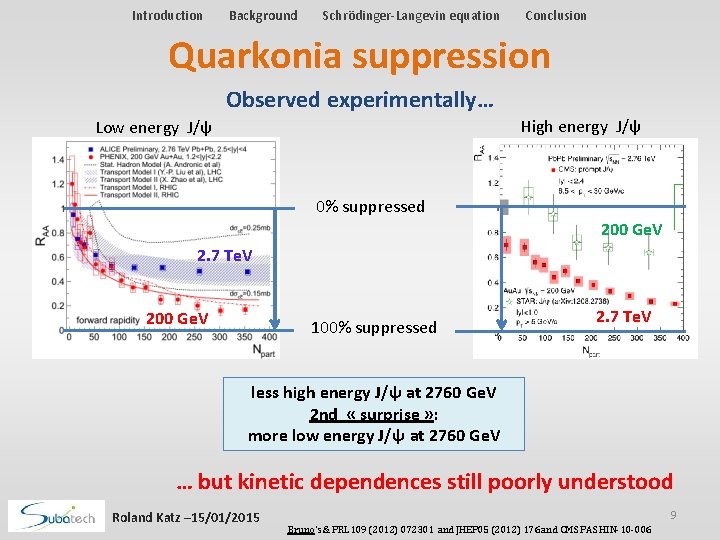
Introduction Background Schrödinger-Langevin equation Conclusion Quarkonia suppression Observed experimentally… High energy J/ψ Low energy J/ψ 0% suppressed 200 Ge. V 2. 7 Te. V 200 Ge. V 100% suppressed 2. 7 Te. V less high energy J/ψ at 2760 Ge. V 2 nd « surprise » : more low energy J/ψ at 2760 Ge. V … but kinetic dependences still poorly understood Roland Katz – 15/01/2015 9 Bruno’s & PRL 109 (2012) 072301 and JHEP 05 (2012) 176 and CMS PAS HIN-10 -006
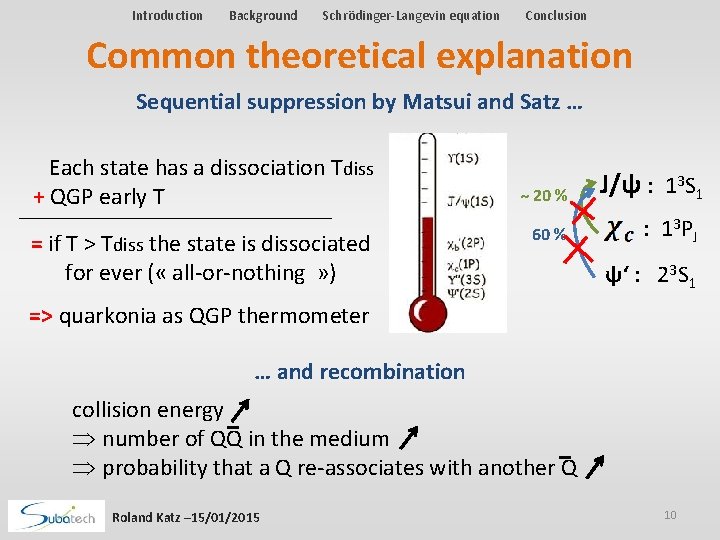
Introduction Background Schrödinger-Langevin equation Conclusion Common theoretical explanation Sequential suppression by Matsui and Satz … Each state has a dissociation Tdiss + QGP early T = if T > Tdiss the state is dissociated for ever ( « all-or-nothing » ) 20 % 60 % J/ψ : 13 S 1 : 1 3 PJ ψ‘ : 23 S 1 => quarkonia as QGP thermometer … and recombination collision energy Þ number of QQ in the medium Þ probability that a Q re-associates with another Q Roland Katz – 15/01/2015 10
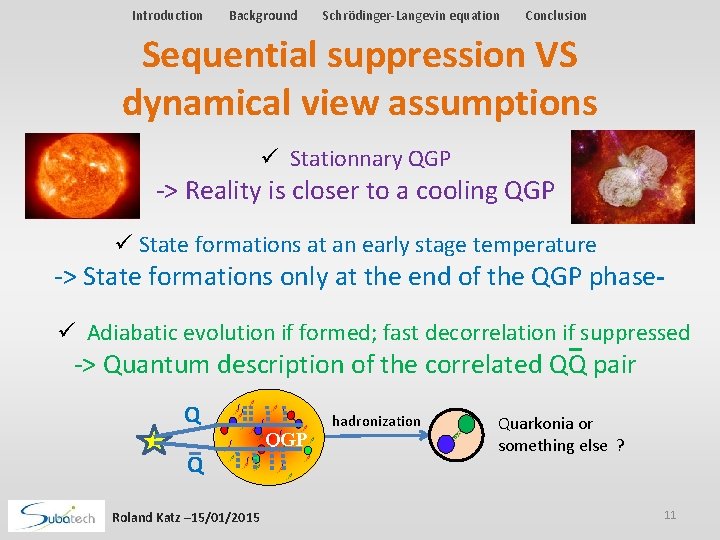
Introduction Background Schrödinger-Langevin equation Conclusion Sequential suppression VS dynamical view assumptions ü Stationnary QGP -> Reality is closer to a cooling QGP ü State formations at an early stage temperature -> State formations only at the end of the QGP phase ü Adiabatic evolution if formed; fast decorrelation if suppressed -> Quantum description of the correlated QQ pair Q Q Roland Katz – 15/01/2015 QGP hadronization Quarkonia or something else ? 11
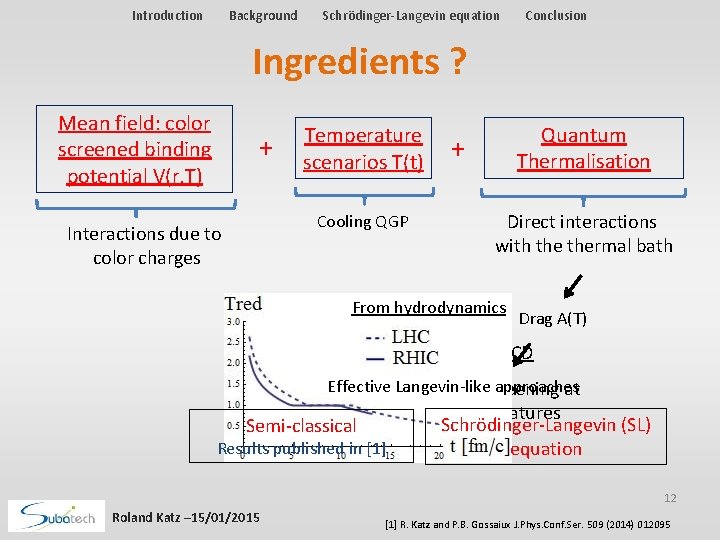
Introduction Background Schrödinger-Langevin equation Conclusion Ingredients ? Mean field: color screened binding potential V(r, T) + Temperature scenarios T(t) Cooling QGP Interactions due to color charges Quantum Thermalisation + Direct interactions with thermal bath From hydrodynamics Drag A(T) Ø From l. QCD Effective approaches Ø Langevin-like Increased screening at larger temperatures Schrödinger-Langevin (SL) Results published in [1] equation Semi-classical 12 Roland Katz – 15/01/2015 [1] R. Katz and P. B. Gossaiux J. Phys. Conf. Ser. 509 (2014) 012095
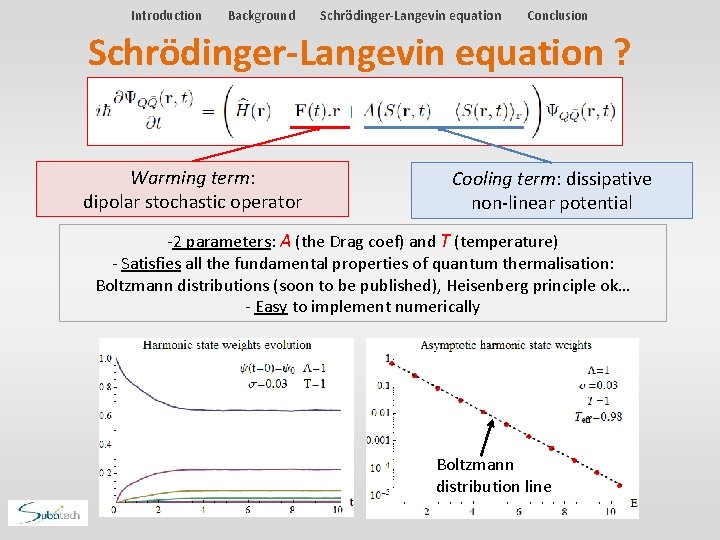
Introduction Background Schrödinger-Langevin equation Conclusion Schrödinger-Langevin equation ? Warming term: dipolar stochastic operator Cooling term: dissipative non-linear potential -2 parameters: A (the Drag coef) and T (temperature) - Satisfies all the fundamental properties of quantum thermalisation: Boltzmann distributions (soon to be published), Heisenberg principle ok… - Easy to implement numerically Boltzmann distribution line 13
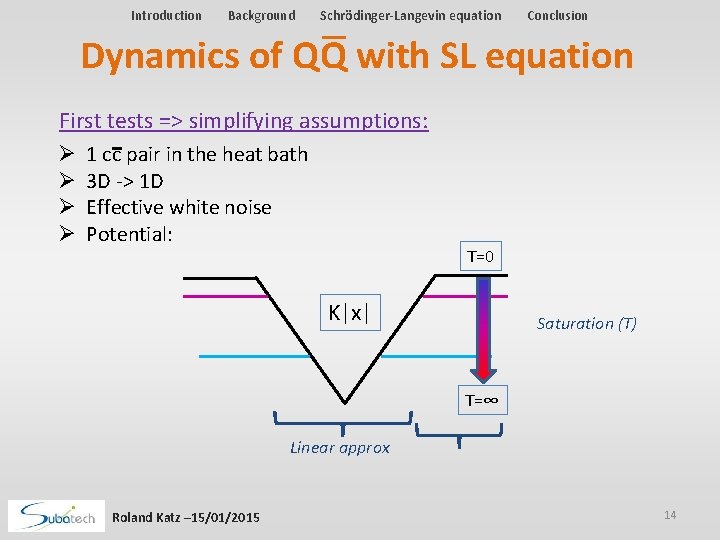
Introduction Background Schrödinger-Langevin equation Conclusion Dynamics of QQ with SL equation First tests => simplifying assumptions: Ø Ø 1 cc pair in the heat bath 3 D -> 1 D Effective white noise Potential: T=0 K|x| Saturation (T) T=∞ Linear approx Roland Katz – 15/01/2015 14
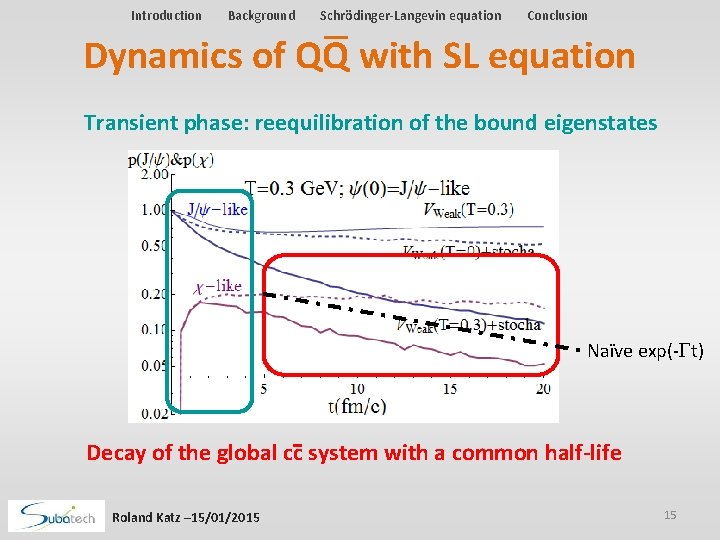
Introduction Background Schrödinger-Langevin equation Conclusion Dynamics of QQ with SL equation Transient phase: reequilibration of the bound eigenstates Naïve exp(-Gt) Decay of the global cc system with a common half-life Roland Katz – 15/01/2015 15
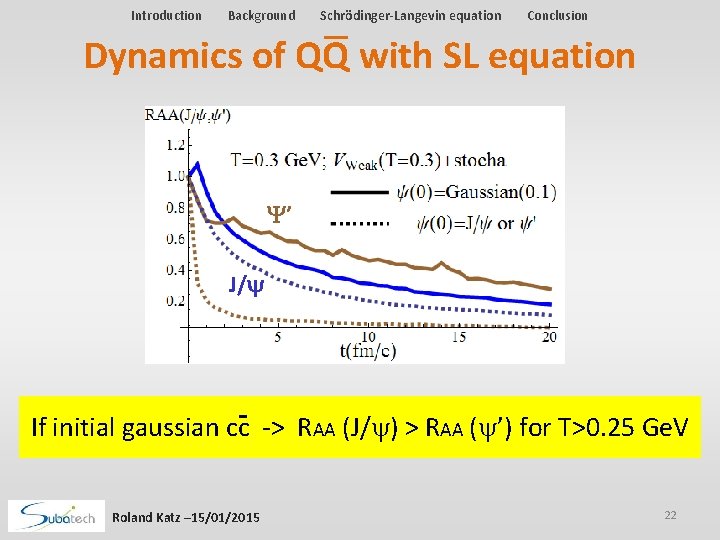
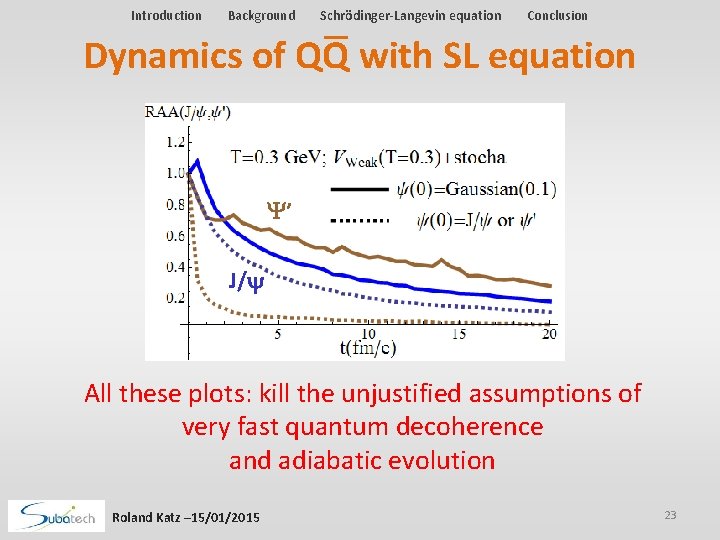
Introduction Background Schrödinger-Langevin equation Conclusion Ø First tests passed with success Ø Relevant suppression pattern related to experimental observations: ü thermal effects -> less suppression of J/y, y‘… ü RAA (J/y) > RAA (y’) for T>0. 25 Ge. V Ø Assumptions of adiabatic evolution and fast decorrelation ruled out ! Future Ø Implementation of 3 D and evolution scenario of the QGP Ø Identify the limiting cases and make contact with other models Ø Make contact with experimental results Roland Katz – 15/01/2015 – katz@subatech. in 2 p 3. fr – www. rolandkatz. com 16
BACK UP SLIDES
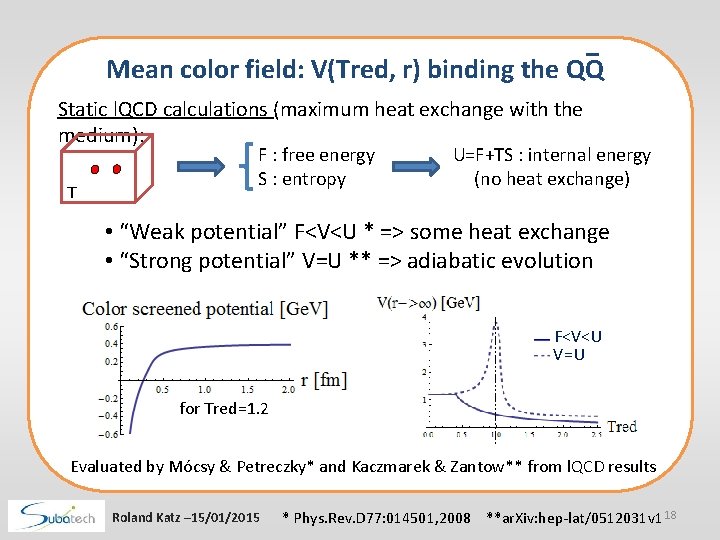
Mean color field: V(Tred, r) binding the QQ Static l. QCD calculations (maximum heat exchange with the medium): T F : free energy S : entropy U=F+TS : internal energy (no heat exchange) • “Weak potential” F<V<U * => some heat exchange • “Strong potential” V=U ** => adiabatic evolution F<V<U V=U for Tred=1. 2 Evaluated by Mócsy & Petreczky* and Kaczmarek & Zantow** from l. QCD results Roland Katz – 15/01/2015 * Phys. Rev. D 77: 014501, 2008 **ar. Xiv: hep-lat/0512031 v 1 18
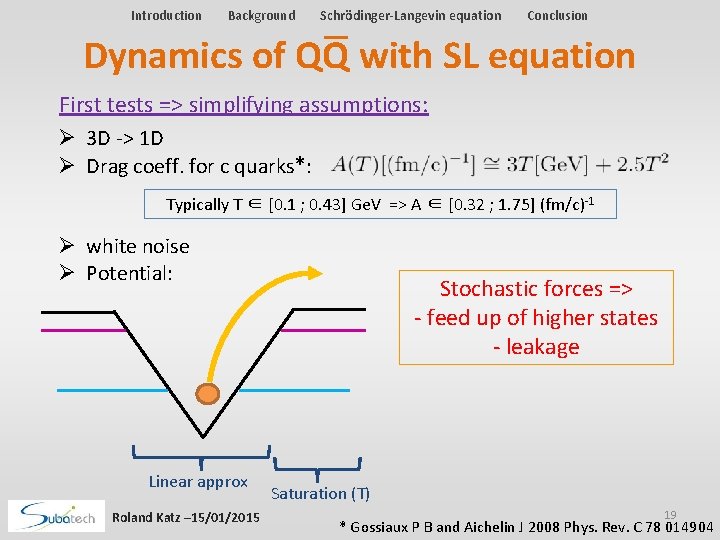
Introduction Background Schrödinger-Langevin equation Conclusion Dynamics of QQ with SL equation First tests => simplifying assumptions: Ø 3 D -> 1 D Ø Drag coeff. for c quarks*: Typically T ∈ [0. 1 ; 0. 43] Ge. V => A ∈ [0. 32 ; 1. 75] (fm/c)-1 Ø white noise Ø Potential: Linear approx Roland Katz – 15/01/2015 Stochastic forces => - feed up of higher states - leakage Saturation (T) 19 * Gossiaux P B and Aichelin J 2008 Phys. Rev. C 78 014904
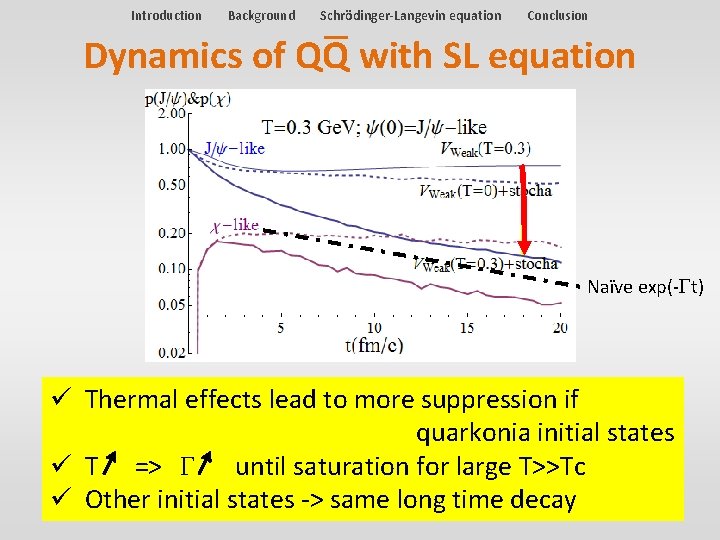
Introduction Background Schrödinger-Langevin equation Conclusion Dynamics of QQ with SL equation Naïve exp(-Gt) ü Thermal effects lead to more suppression if quarkonia initial states ü T => G until saturation for large T>>Tc ü Other initial states -> same long time decay 20
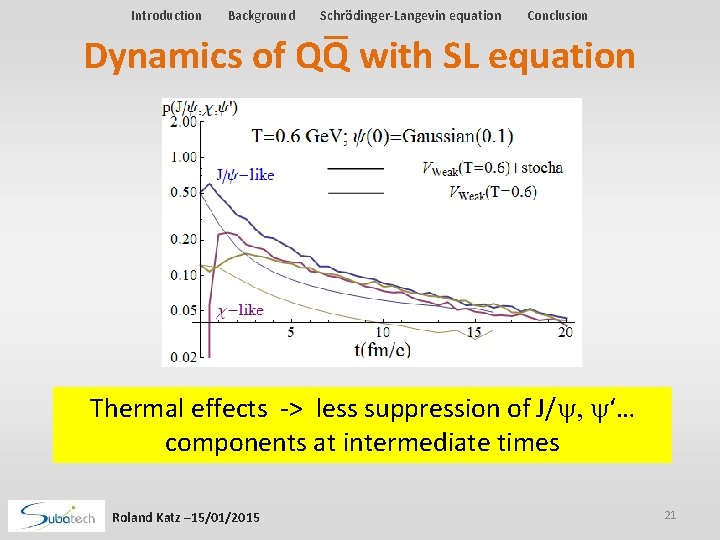
Introduction Background Schrödinger-Langevin equation Conclusion Dynamics of QQ with SL equation Thermal effects -> less suppression of J/y, y‘… components at intermediate times Roland Katz – 15/01/2015 21
Introduction Background Schrödinger-Langevin equation Conclusion Dynamics of QQ with SL equation Y’ J/y If initial gaussian cc -> RAA (J/y) > RAA (y’) for T>0. 25 Ge. V Roland Katz – 15/01/2015 22
Introduction Background Schrödinger-Langevin equation Conclusion Dynamics of QQ with SL equation Y’ J/y All these plots: kill the unjustified assumptions of very fast quantum decoherence and adiabatic evolution Roland Katz – 15/01/2015 23