
QuarkGluon Plasma Six Microseconds After the Big Bang
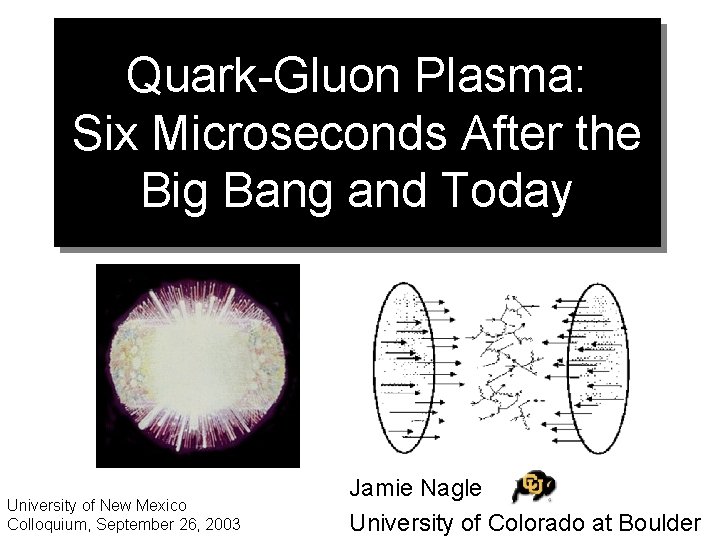
Quark-Gluon Plasma: Six Microseconds After the Big Bang and Today University of New Mexico Colloquium, September 26, 2003 Jamie Nagle University of Colorado at Boulder
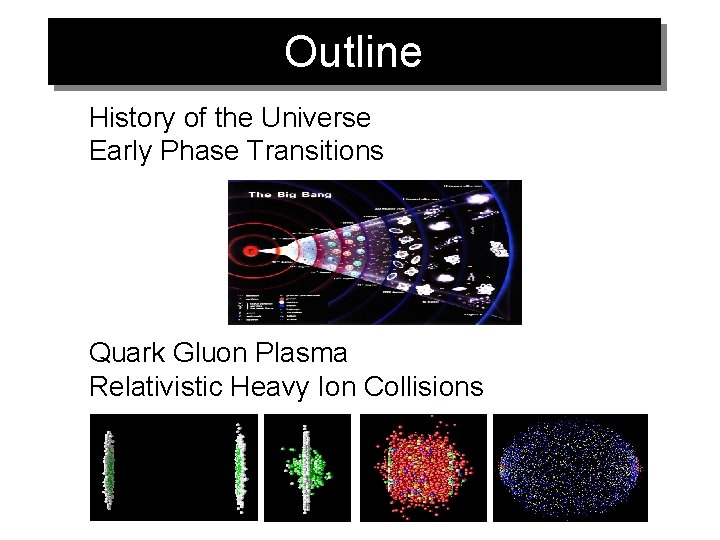
Outline History of the Universe Early Phase Transitions Quark Gluon Plasma Relativistic Heavy Ion Collisions
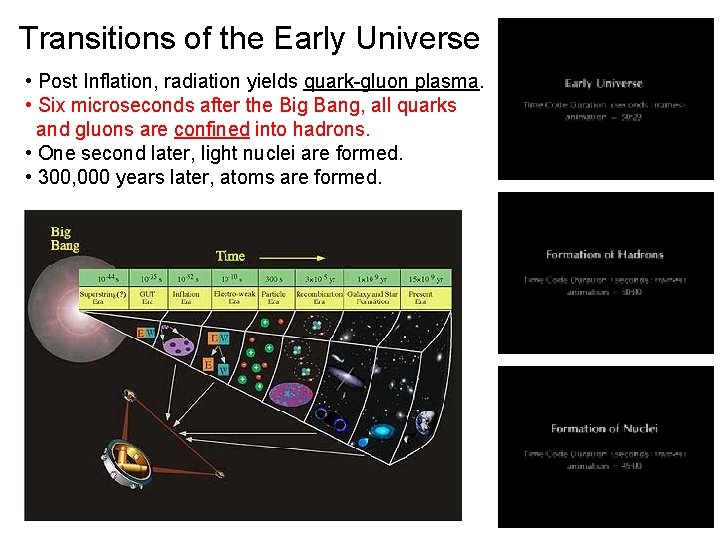
Transitions of the Early Universe • Post Inflation, radiation yields quark-gluon plasma. • Six microseconds after the Big Bang, all quarks and gluons are confined into hadrons. • One second later, light nuclei are formed. • 300, 000 years later, atoms are formed.
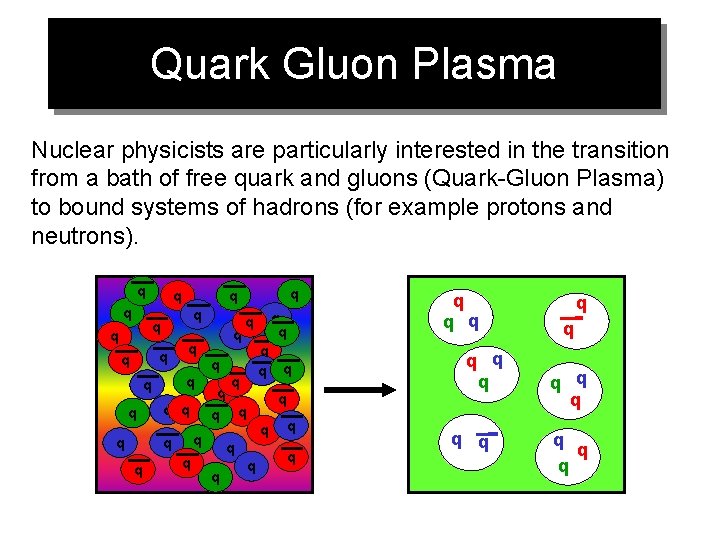
Quark Gluon Plasma Nuclear physicists are particularly interested in the transition from a bath of free quark and gluons (Quark-Gluon Plasma) to bound systems of hadrons (for example protons and neutrons). q q q q q q q q q q q q q q
“Rich Cosmological Scenario” “A first-order QCD phase transition that occured in the early universe would lead to a surprisingly rich cosmological scenario. ” “Although observable consequences would not necessarily survive, it is at least conceivable that the phase transition would concentrate most of the quark excess in dense, invisible quark nuggets. ” Ed Witten Phys. Rev. D (1984) Over 1000 citations
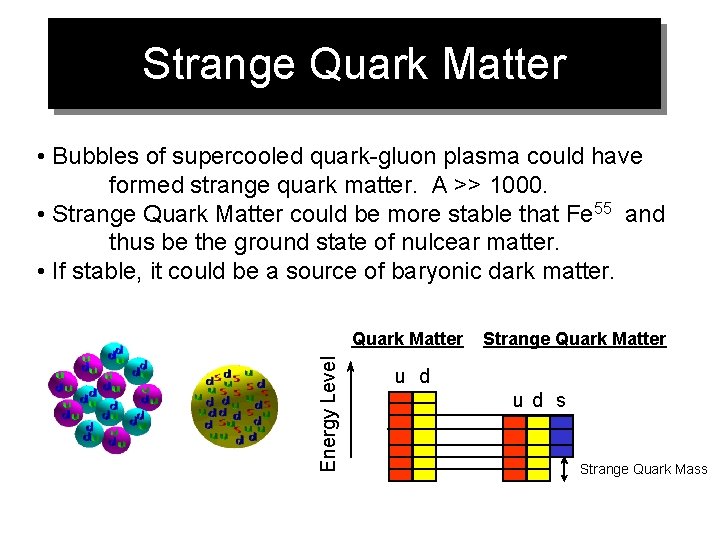
Strange Quark Matter • Bubbles of supercooled quark-gluon plasma could have formed strange quark matter. A >> 1000. • Strange Quark Matter could be more stable that Fe 55 and thus be the ground state of nulcear matter. • If stable, it could be a source of baryonic dark matter. Energy Level Quark Matter Strange Quark Matter u d ud s Strange Quark Mass
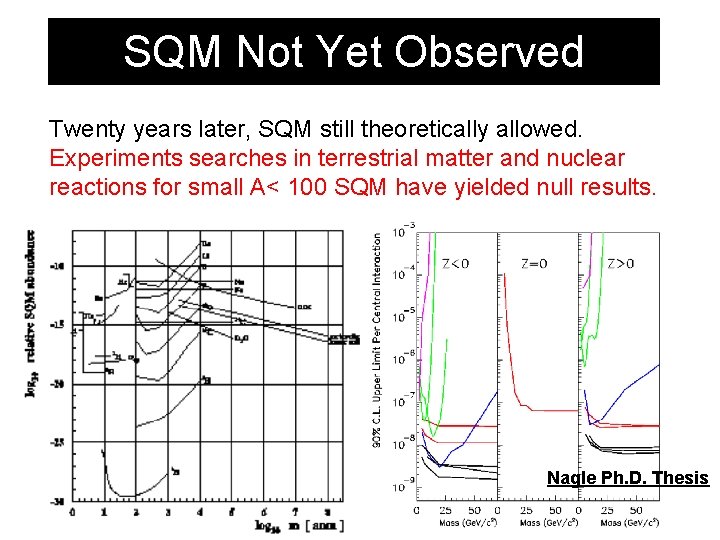
SQM Not Yet Observed Twenty years later, SQM still theoretically allowed. Experiments searches in terrestrial matter and nuclear reactions for small A< 100 SQM have yielded null results. Nagle Ph. D. Thesis
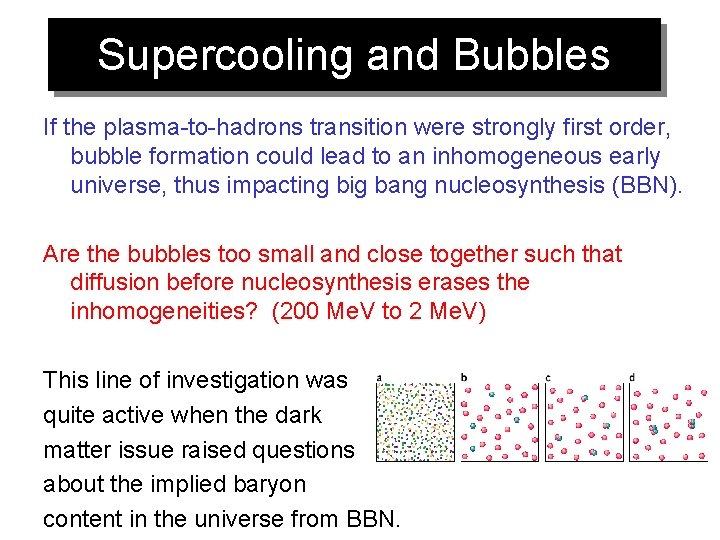
Supercooling and Bubbles If the plasma-to-hadrons transition were strongly first order, bubble formation could lead to an inhomogeneous early universe, thus impacting big bang nucleosynthesis (BBN). Are the bubbles too small and close together such that diffusion before nucleosynthesis erases the inhomogeneities? (200 Me. V to 2 Me. V) This line of investigation was quite active when the dark matter issue raised questions about the implied baryon content in the universe from BBN.
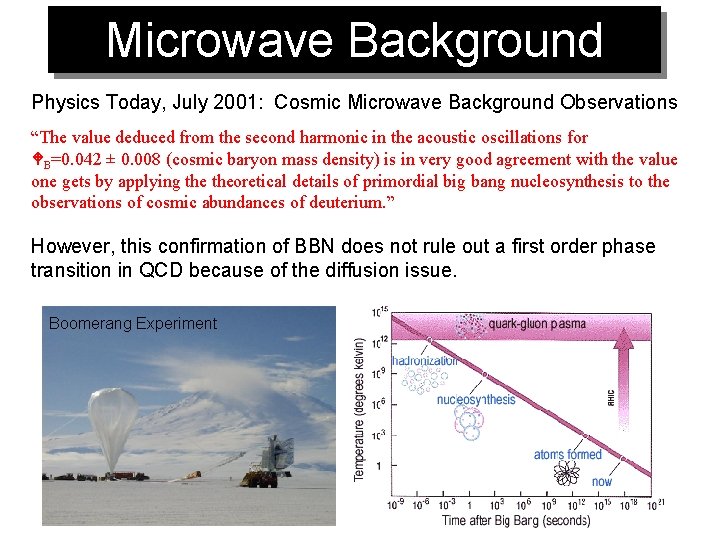
Microwave Background Physics Today, July 2001: Cosmic Microwave Background Observations “The value deduced from the second harmonic in the acoustic oscillations for WB=0. 042 ± 0. 008 (cosmic baryon mass density) is in very good agreement with the value one gets by applying theoretical details of primordial big bang nucleosynthesis to the observations of cosmic abundances of deuterium. ” However, this confirmation of BBN does not rule out a first order phase transition in QCD because of the diffusion issue. Boomerang Experiment
Universe at 300, 000 Years Old WMAP Results Age of the Universe = 13. 8 billion years Isotropic (1: 100, 000) Total Energy = 0 (Universe is flat!)
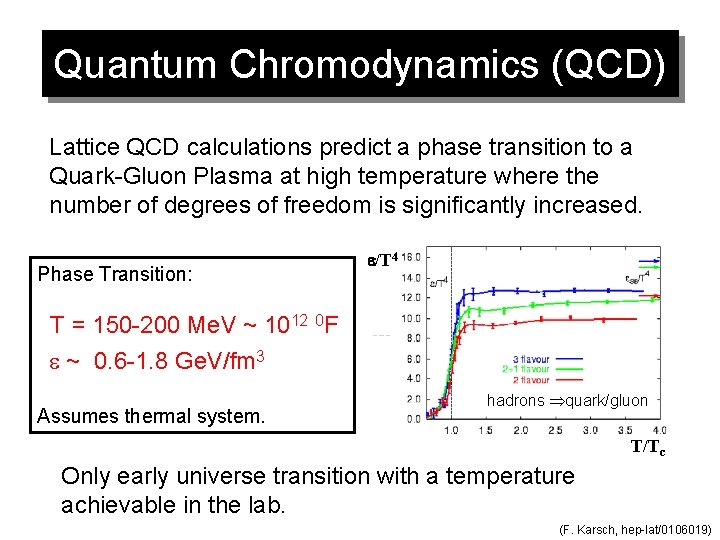
Quantum Chromodynamics (QCD) Lattice QCD calculations predict a phase transition to a Quark-Gluon Plasma at high temperature where the number of degrees of freedom is significantly increased. Phase Transition: e/T 4 T = 150 -200 Me. V ~ 1012 0 F e ~ 0. 6 -1. 8 Ge. V/fm 3 Assumes thermal system. hadrons quark/gluon T/Tc Only early universe transition with a temperature achievable in the lab. (F. Karsch, hep-lat/0106019)
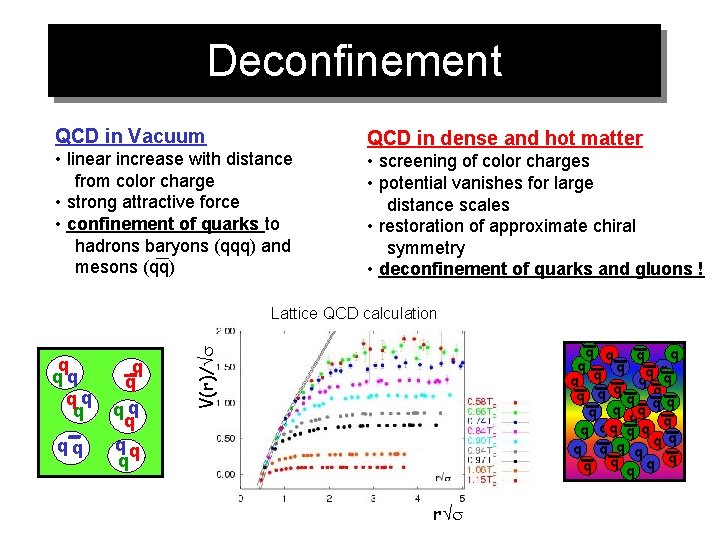
Deconfinement QCD in Vacuum • linear increase with distance from color charge • strong attractive force • confinement of quarks to hadrons baryons (qqq) and mesons (qq) QCD in dense and hot matter • screening of color charges • potential vanishes for large distance scales • restoration of approximate chiral symmetry • deconfinement of quarks and gluons ! Lattice QCD calculation qq q q q q qq q q q q q q V(r)/ q qq qq q r
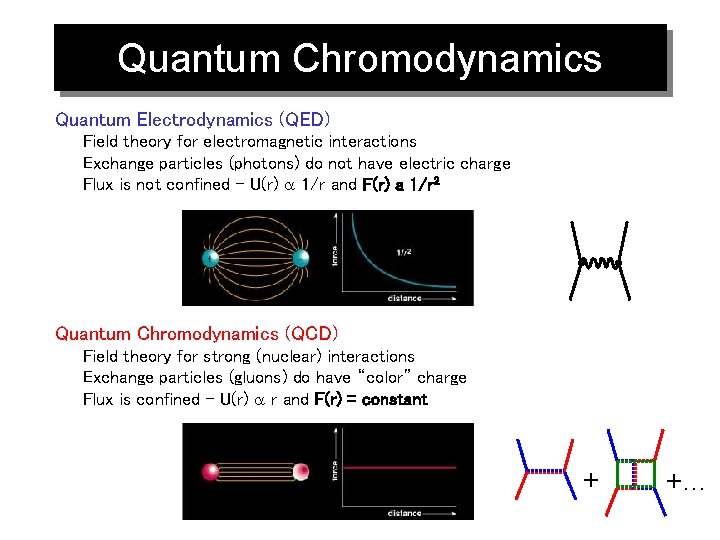
Quantum Chromodynamics Quantum Electrodynamics (QED) Field theory for electromagnetic interactions Exchange particles (photons) do not have electric charge Flux is not confined - U(r) a 1/r and F(r) a 1/r 2 Quantum Chromodynamics (QCD) Field theory for strong (nuclear) interactions Exchange particles (gluons) do have “color” charge Flux is confined - U(r) a r and F(r) = constant + +…
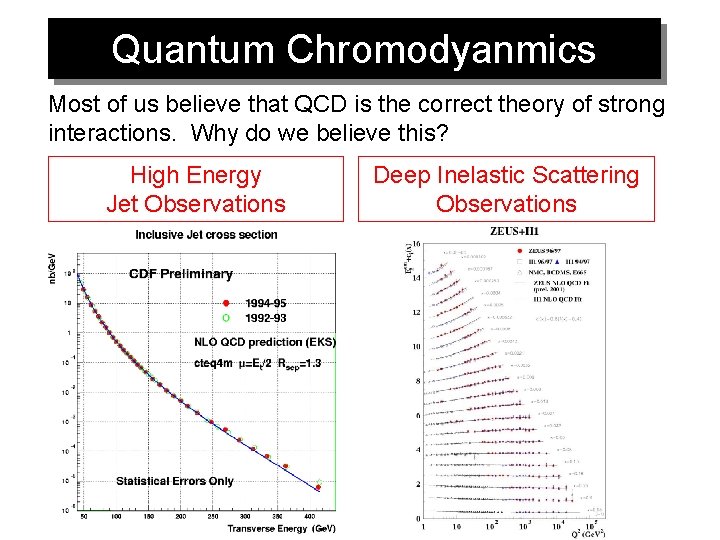
Quantum Chromodyanmics Most of us believe that QCD is the correct theory of strong interactions. Why do we believe this? High Energy Jet Observations Deep Inelastic Scattering Observations
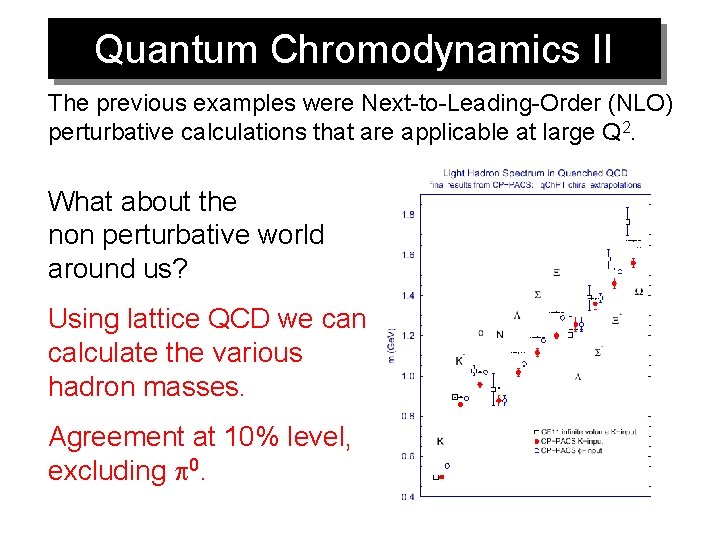
Quantum Chromodynamics II The previous examples were Next-to-Leading-Order (NLO) perturbative calculations that are applicable at large Q 2. What about the non perturbative world around us? Using lattice QCD we can calculate the various hadron masses. Agreement at 10% level, excluding p 0.
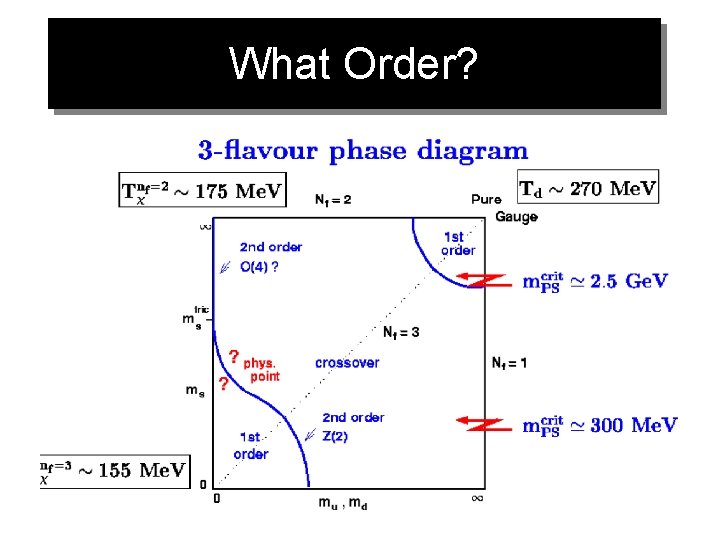
What Order?
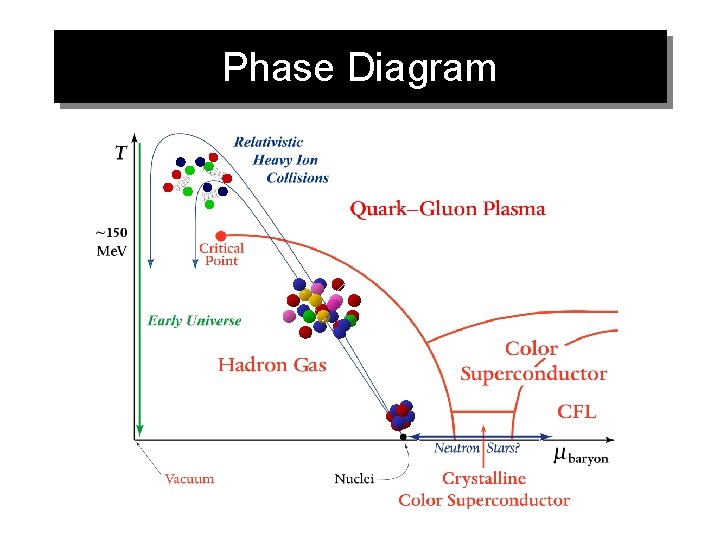
Phase Diagram
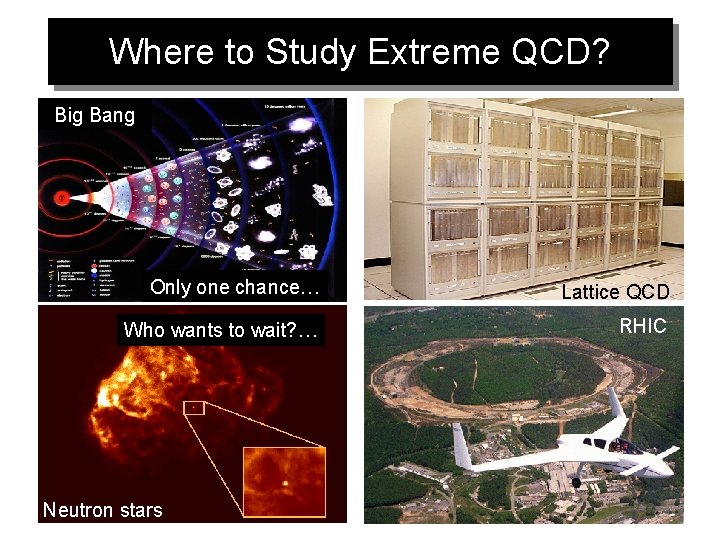
Where to Study Extreme QCD? Big Bang Only one chance… Lattice QCD Who wants to wait? … RHIC Neutron stars
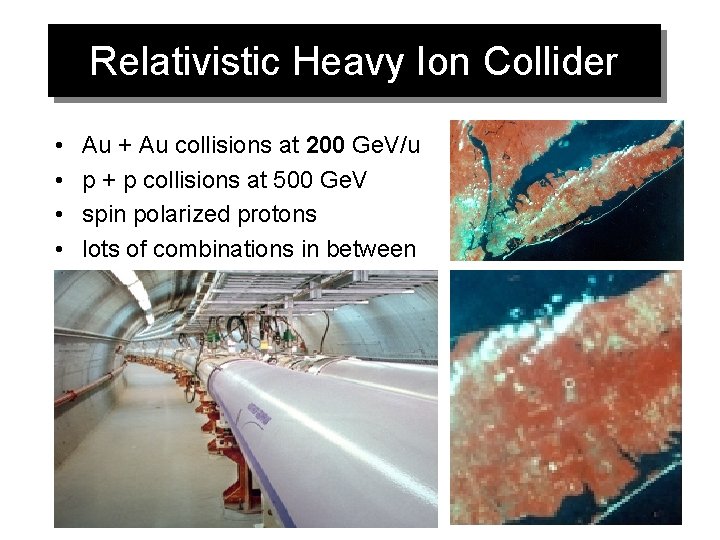
Relativistic Heavy Ion Collider • • Au + Au collisions at 200 Ge. V/u p + p collisions at 500 Ge. V spin polarized protons lots of combinations in between
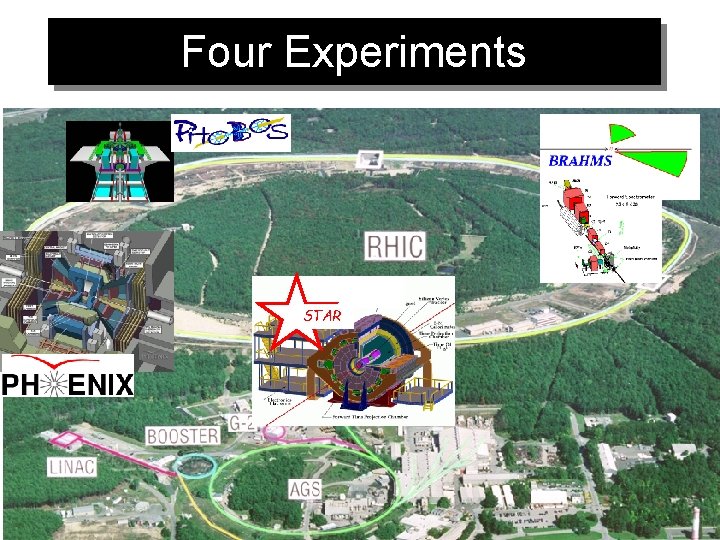
Four Experiments STAR
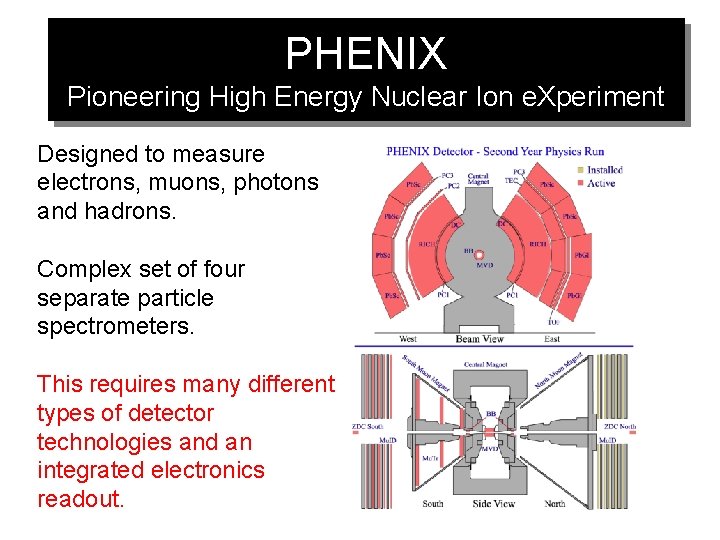
PHENIX Pioneering High Energy Nuclear Ion e. Xperiment Designed to measure electrons, muons, photons and hadrons. Complex set of four separate particle spectrometers. This requires many different types of detector technologies and an integrated electronics readout.
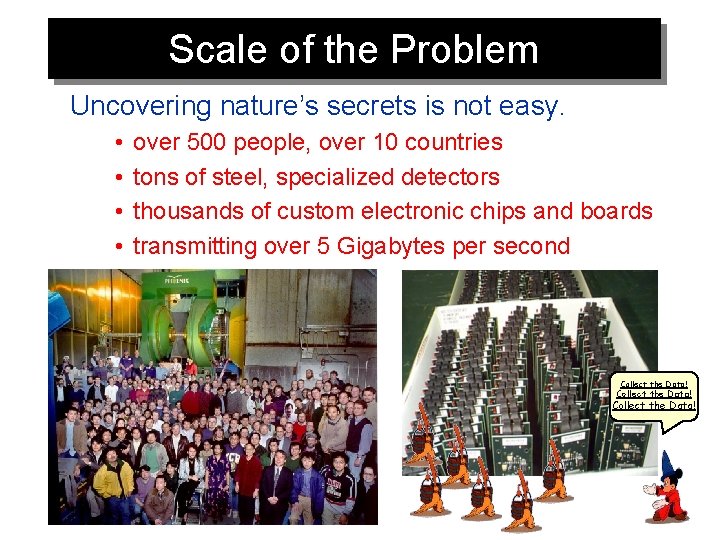
Scale of the Problem Uncovering nature’s secrets is not easy. • • over 500 people, over 10 countries tons of steel, specialized detectors thousands of custom electronic chips and boards transmitting over 5 Gigabytes per second Collect the Data!
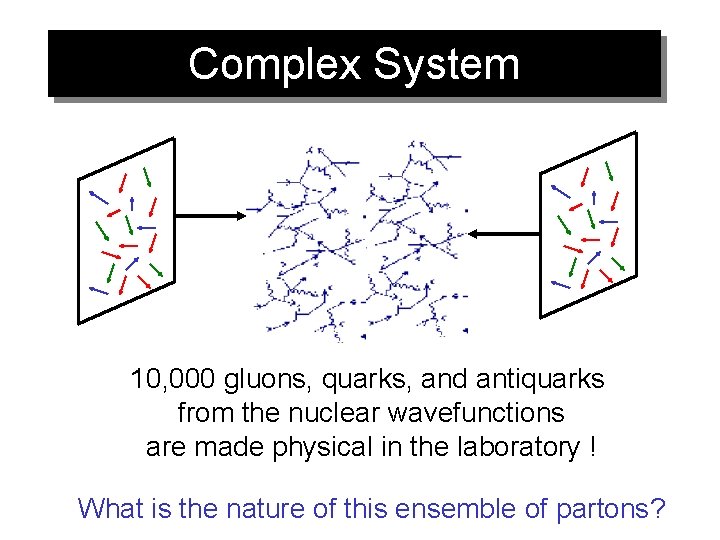
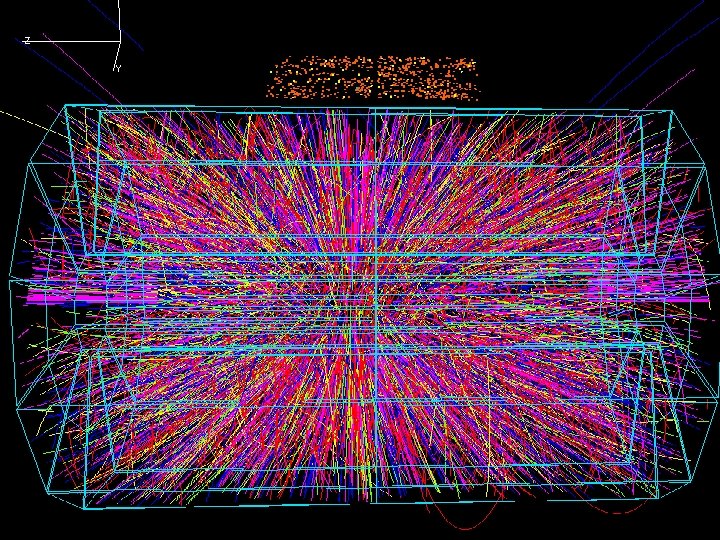
Complex System 10, 000 gluons, quarks, and antiquarks from the nuclear wavefunctions are made physical in the laboratory ! What is the nature of this ensemble of partons?
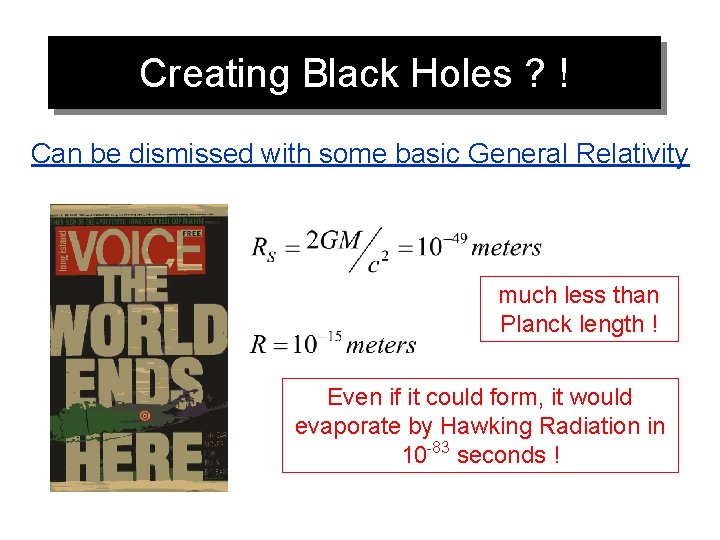
Creating Black Holes ? ! Can be dismissed with some basic General Relativity much less than Planck length ! Even if it could form, it would evaporate by Hawking Radiation in 10 -83 seconds !
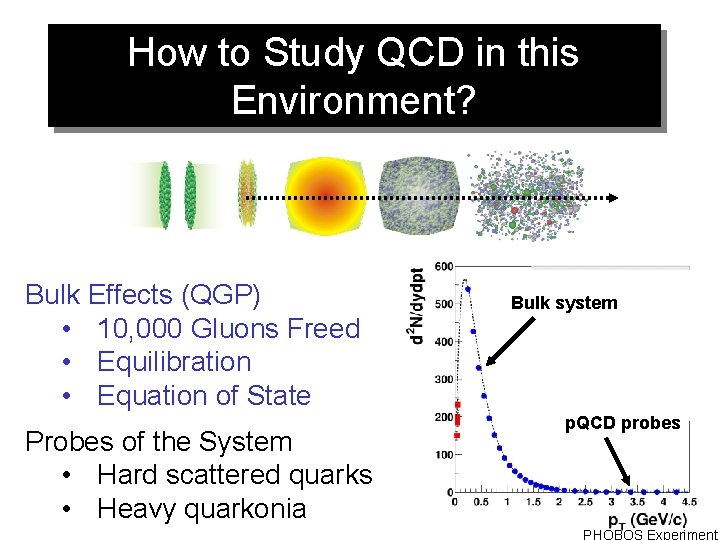
How to Study QCD in this Environment? Bulk Effects (QGP) • 10, 000 Gluons Freed • Equilibration • Equation of State Probes of the System • Hard scattered quarks • Heavy quarkonia Bulk system p. QCD probes
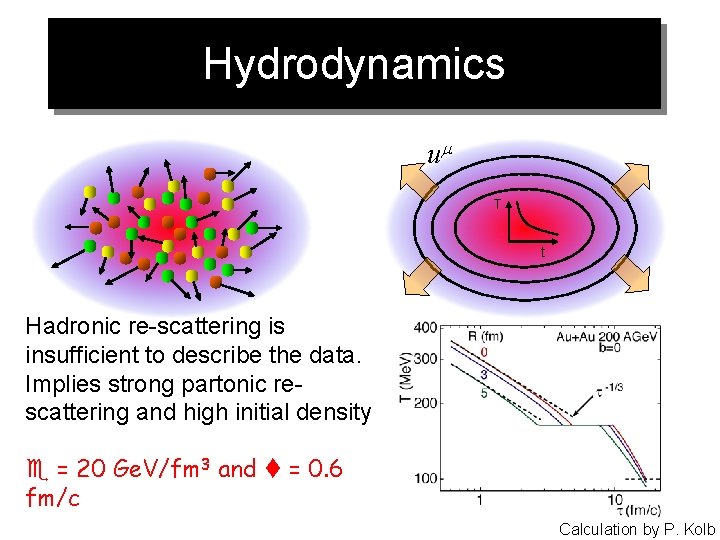
Hydrodynamics um T t Hadronic re-scattering is insufficient to describe the data. Implies strong partonic rescattering and high initial density e = 20 Ge. V/fm 3 and t = 0. 6 fm/c Calculation by P. Kolb
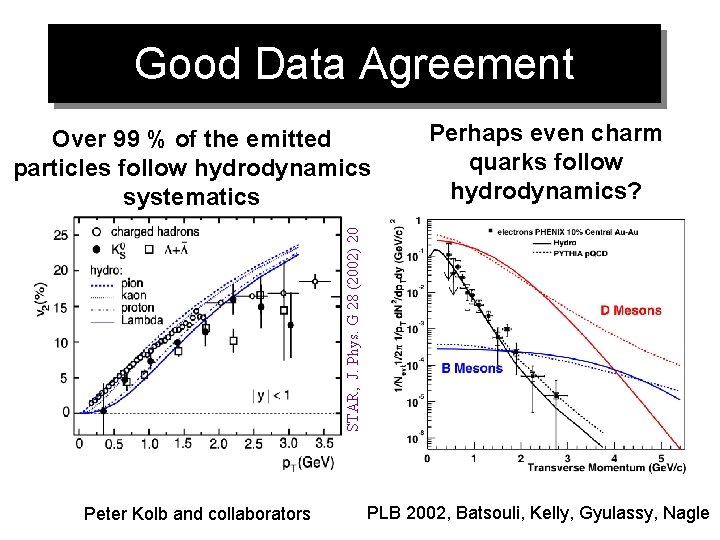
Good Data Agreement Perhaps even charm quarks follow hydrodynamics? STAR, J. Phys. G 28 (2002) 20 Over 99 % of the emitted particles follow hydrodynamics systematics Peter Kolb and collaborators PLB 2002, Batsouli, Kelly, Gyulassy, Nagle
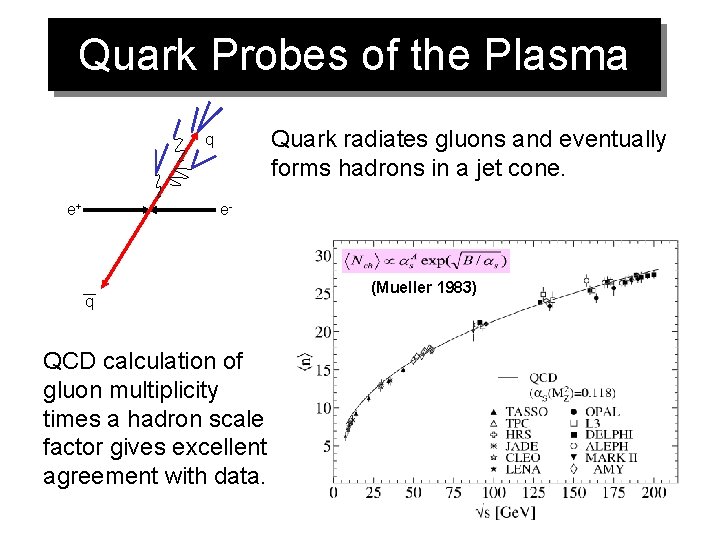
Quark Probes of the Plasma Quark radiates gluons and eventually forms hadrons in a jet cone. q e- e+ q QCD calculation of gluon multiplicity times a hadron scale factor gives excellent agreement with data. (Mueller 1983)
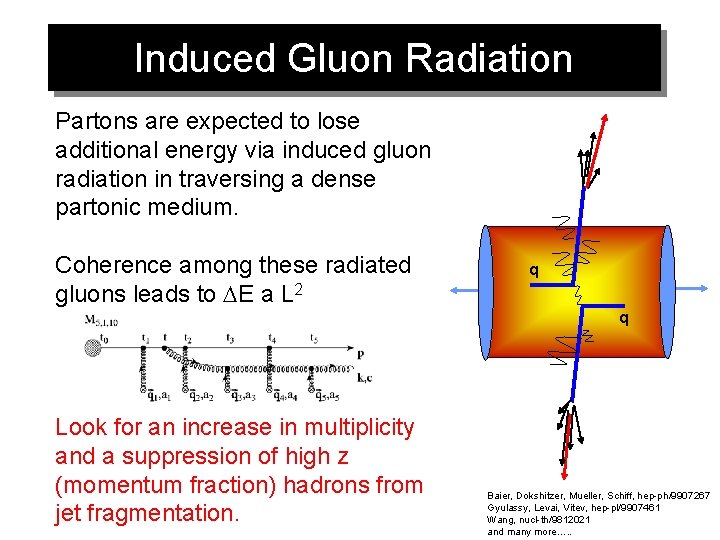
Induced Gluon Radiation Partons are expected to lose additional energy via induced gluon radiation in traversing a dense partonic medium. Coherence among these radiated gluons leads to DE a L 2 q q Look for an increase in multiplicity and a suppression of high z (momentum fraction) hadrons from jet fragmentation. Baier, Dokshitzer, Mueller, Schiff, hep-ph/9907267 Gyulassy, Levai, Vitev, hep-pl/9907461 Wang, nucl-th/9812021 and many more…. .
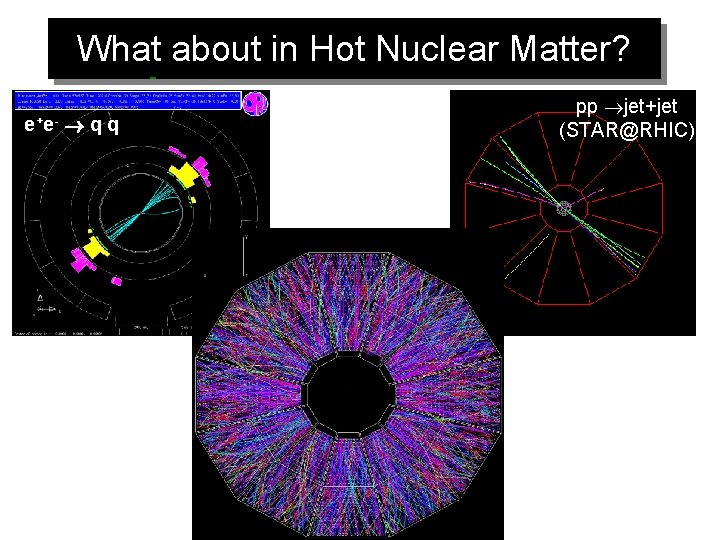
What about in Hot Nuclear Matter? e+ e- qq pp jet+jet (STAR@RHIC)
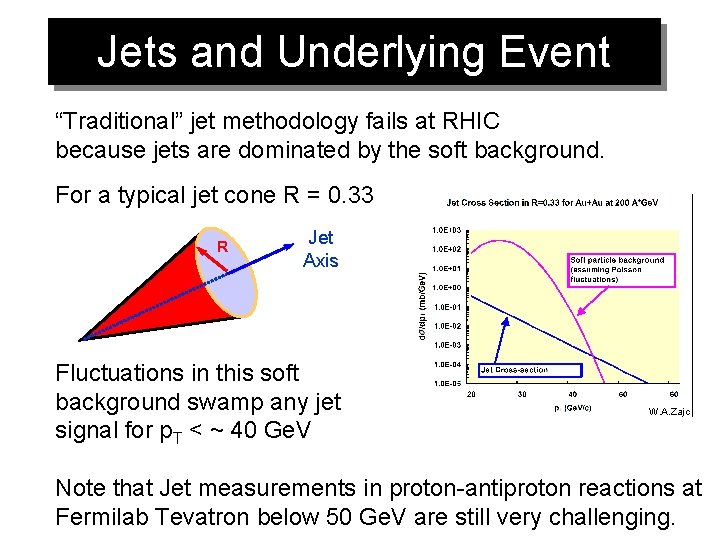
Jets and Underlying Event “Traditional” jet methodology fails at RHIC because jets are dominated by the soft background. For a typical jet cone R = 0. 33 R Jet Axis Fluctuations in this soft background swamp any jet signal for p. T < ~ 40 Ge. V W. A. Zajc Note that Jet measurements in proton-antiproton reactions at Fermilab Tevatron below 50 Ge. V are still very challenging.
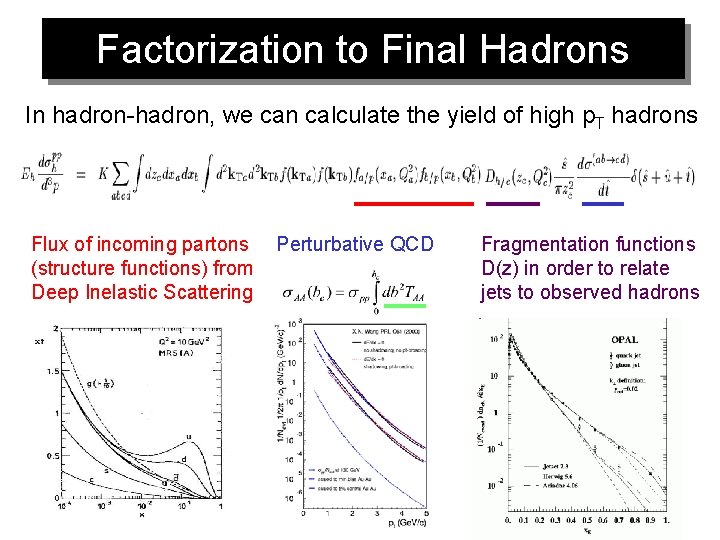
Factorization to Final Hadrons In hadron-hadron, we can calculate the yield of high p. T hadrons Flux of incoming partons (structure functions) from Deep Inelastic Scattering Perturbative QCD Fragmentation functions D(z) in order to relate jets to observed hadrons
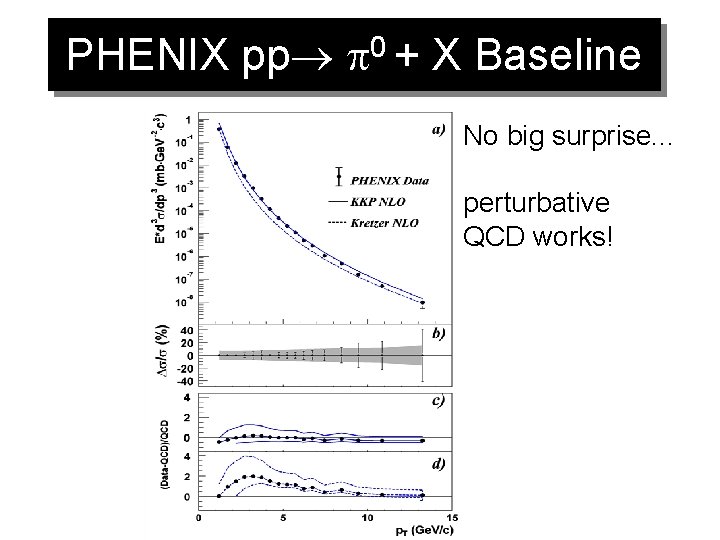
PHENIX pp p 0 + X Baseline No big surprise. . . perturbative QCD works!
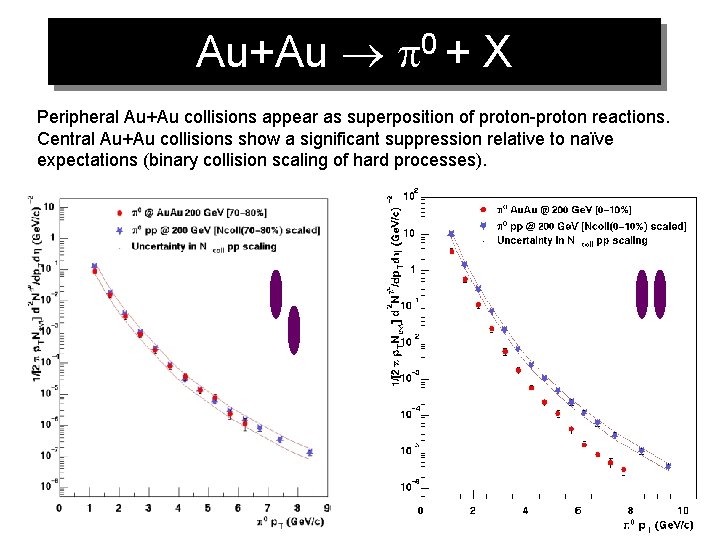
Au+Au p 0 + X Peripheral Au+Au collisions appear as superposition of proton-proton reactions. Central Au+Au collisions show a significant suppression relative to naïve expectations (binary collision scaling of hard processes).
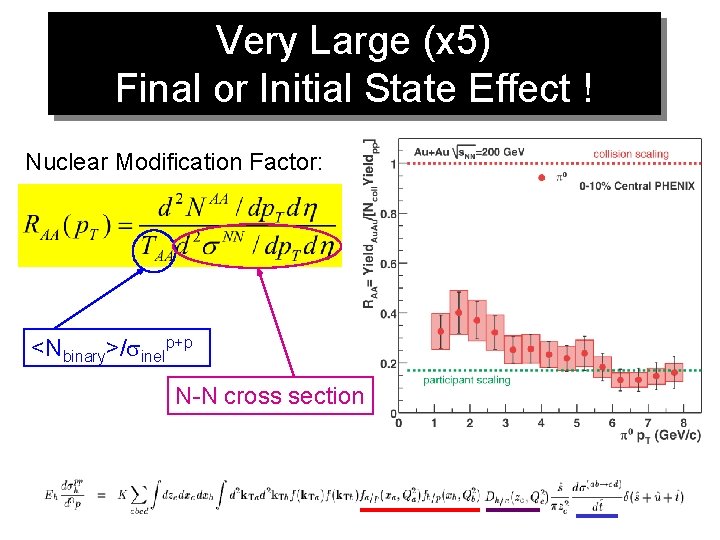
Very Large (x 5) Final or Initial State Effect ! Nuclear Modification Factor: <Nbinary>/ inelp+p N-N cross section
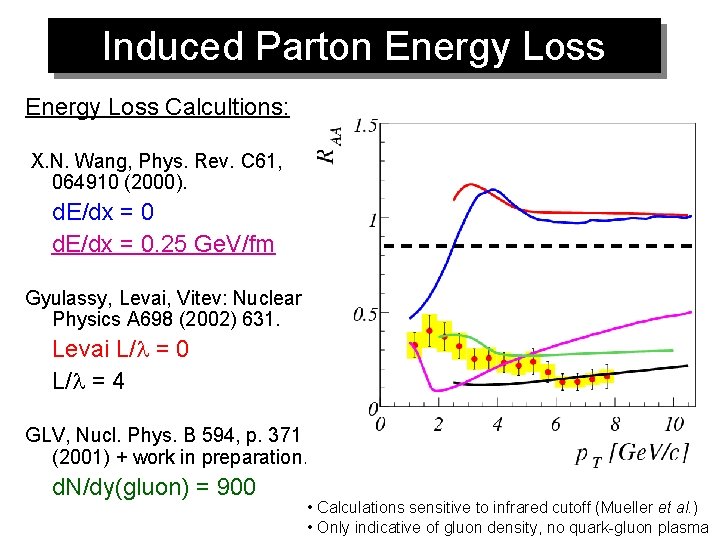
Induced Parton Energy Loss Calcultions: X. N. Wang, Phys. Rev. C 61, 064910 (2000). d. E/dx = 0. 25 Ge. V/fm Gyulassy, Levai, Vitev: Nuclear Physics A 698 (2002) 631. Levai L/l = 0 L/l = 4 GLV, Nucl. Phys. B 594, p. 371 (2001) + work in preparation. d. N/dy(gluon) = 900 • Calculations sensitive to infrared cutoff (Mueller et al. ) • Only indicative of gluon density, no quark-gluon plasma
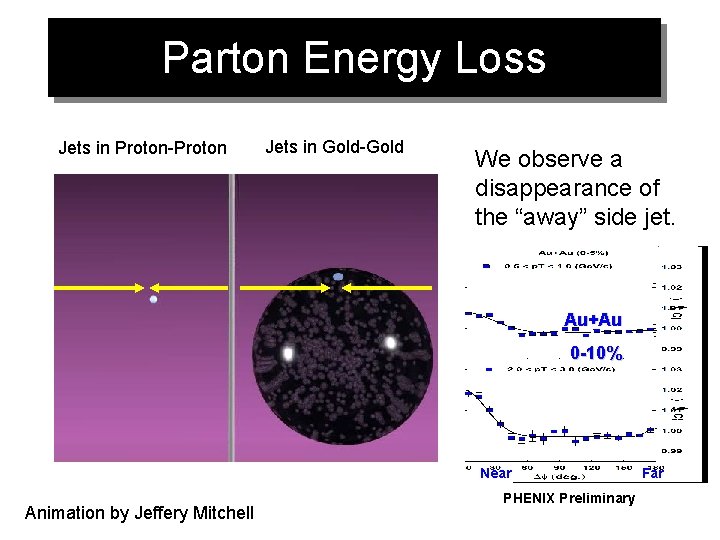
Parton Energy Loss Jets in Proton-Proton Jets in Gold-Gold We observe a disappearance of the “away” side jet. d+Au Au+Au 60 -90% 0 -10% Min Bias Near Animation by Jeffery Mitchell PHENIX Preliminary Far Near PHENIX Preliminary Far
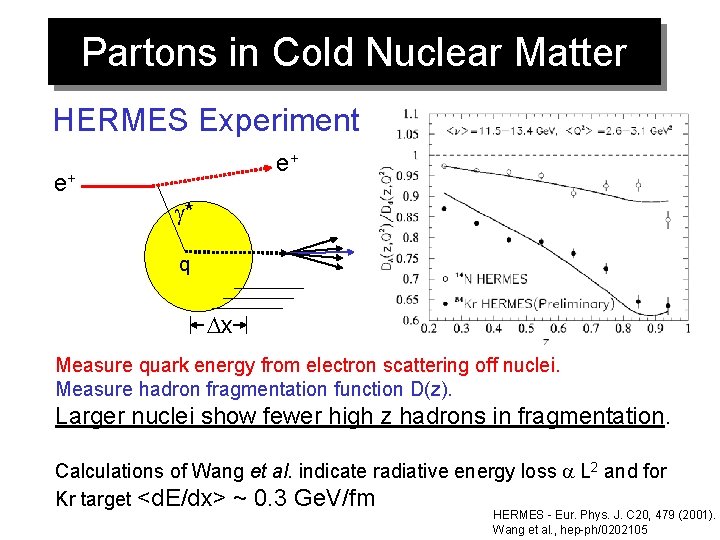
Partons in Cold Nuclear Matter HERMES Experiment e+ e+ g* q Dx Measure quark energy from electron scattering off nuclei. Measure hadron fragmentation function D(z). Larger nuclei show fewer high z hadrons in fragmentation. Calculations of Wang et al. indicate radiative energy loss a L 2 and for Kr target <d. E/dx> ~ 0. 3 Ge. V/fm HERMES - Eur. Phys. J. C 20, 479 (2001). Wang et al. , hep-ph/0202105
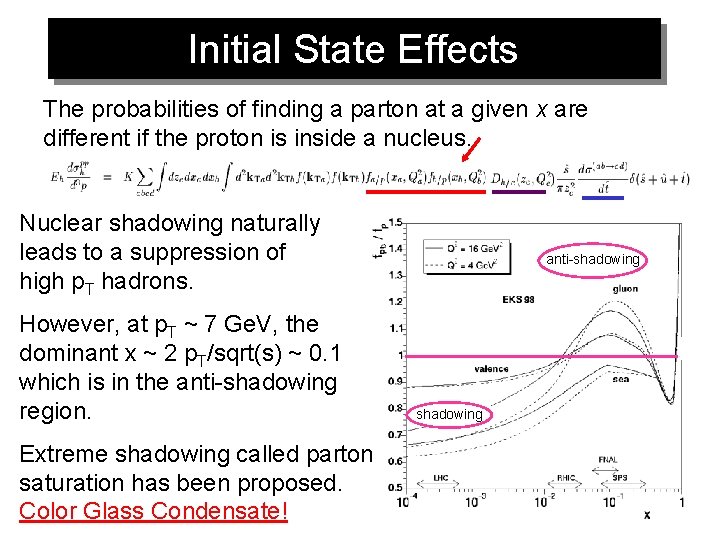
Initial State Effects The probabilities of finding a parton at a given x are different if the proton is inside a nucleus. Nuclear shadowing naturally leads to a suppression of high p. T hadrons. However, at p. T ~ 7 Ge. V, the dominant x ~ 2 p. T/sqrt(s) ~ 0. 1 which is in the anti-shadowing region. Extreme shadowing called parton saturation has been proposed. Color Glass Condensate! anti-shadowing
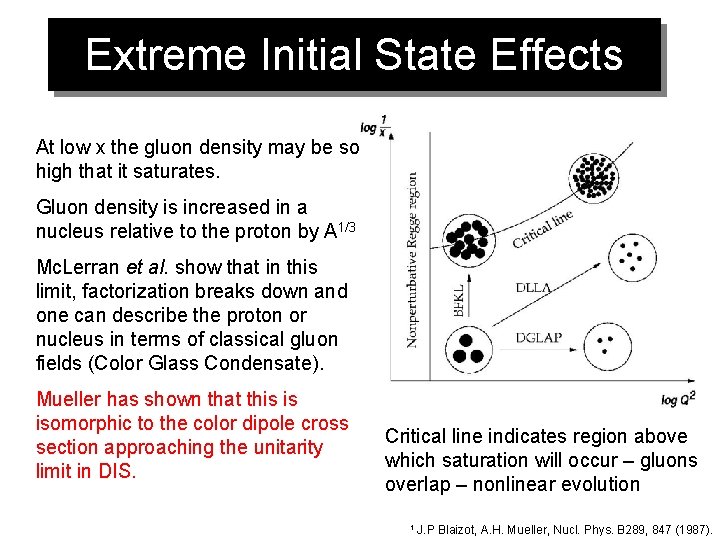
Extreme Initial State Effects At low x the gluon density may be so high that it saturates. Gluon density is increased in a nucleus relative to the proton by A 1/3 Mc. Lerran et al. show that in this limit, factorization breaks down and one can describe the proton or nucleus in terms of classical gluon fields (Color Glass Condensate). Mueller has shown that this is isomorphic to the color dipole cross section approaching the unitarity limit in DIS. Critical line indicates region above which saturation will occur – gluons overlap – nonlinear evolution 1 J. P Blaizot, A. H. Mueller, Nucl. Phys. B 289, 847 (1987).
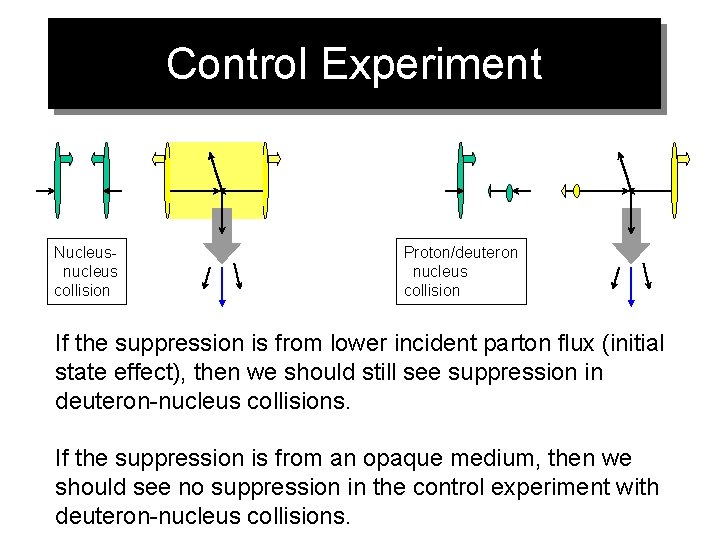
Control Experiment Nucleusnucleus collision Proton/deuteron nucleus collision If the suppression is from lower incident parton flux (initial state effect), then we should still see suppression in deuteron-nucleus collisions. If the suppression is from an opaque medium, then we should see no suppression in the control experiment with deuteron-nucleus collisions.
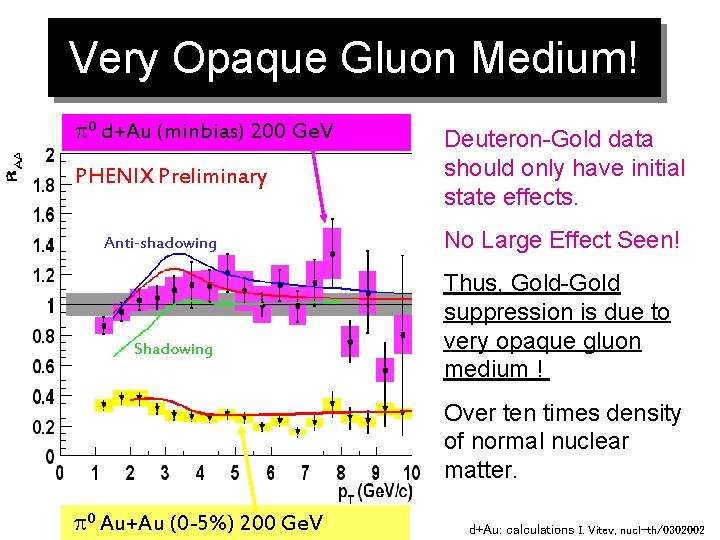
Very Opaque Gluon Medium! p 0 d+Au (minbias) 200 Ge. V PHENIX Preliminary Anti-shadowing Shadowing Deuteron-Gold data should only have initial state effects. No Large Effect Seen! Thus, Gold-Gold suppression is due to very opaque gluon medium ! Over ten times density of normal nuclear matter. p 0 Au+Au (0 -5%) 200 Ge. V d+Au: calculations I. Vitev, nucl-th/0302002
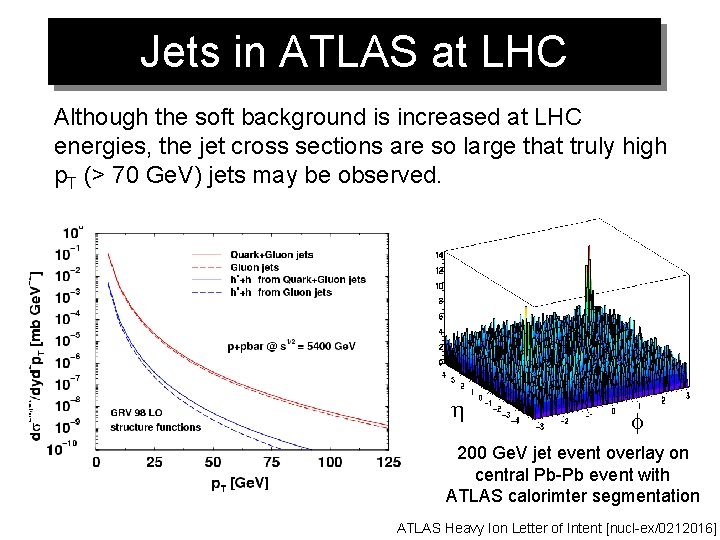
Jets in ATLAS at LHC Although the soft background is increased at LHC energies, the jet cross sections are so large that truly high p. T (> 70 Ge. V) jets may be observed. h f 200 Ge. V jet event overlay on central Pb-Pb event with ATLAS calorimter segmentation ATLAS Heavy Ion Letter of Intent [nucl-ex/0212016]
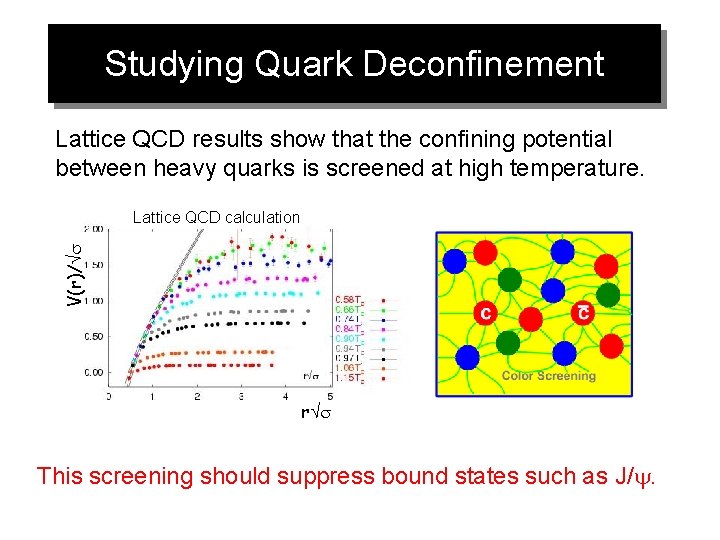
Studying Quark Deconfinement Lattice QCD results show that the confining potential between heavy quarks is screened at high temperature. V(r)/ Lattice QCD calculation r This screening should suppress bound states such as J/y.
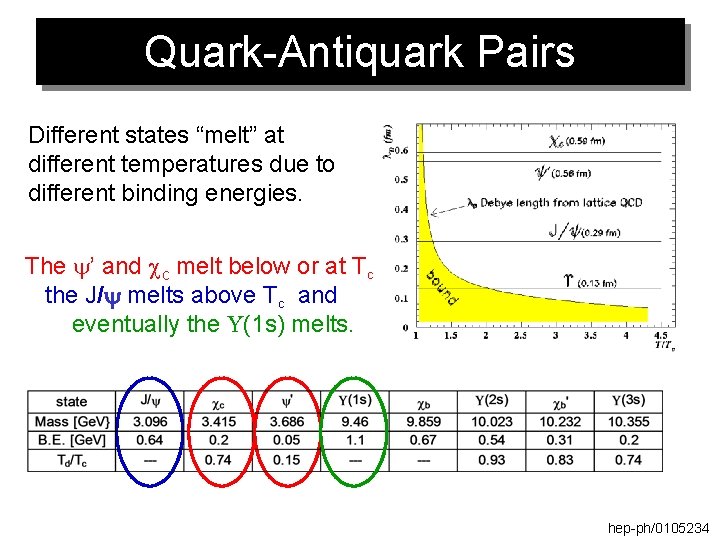
Quark-Antiquark Pairs Different states “melt” at different temperatures due to different binding energies. The y’ and cc melt below or at Tc the J/y melts above Tc and eventually the U(1 s) melts. hep-ph/0105234
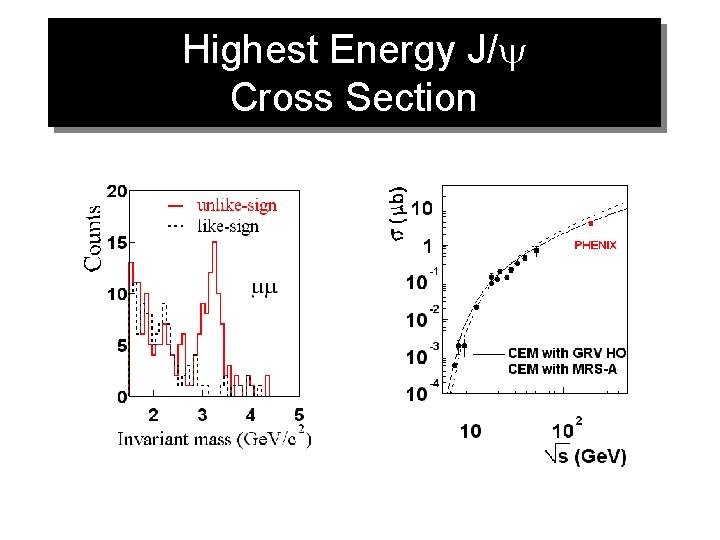
Highest Energy J/y Cross Section
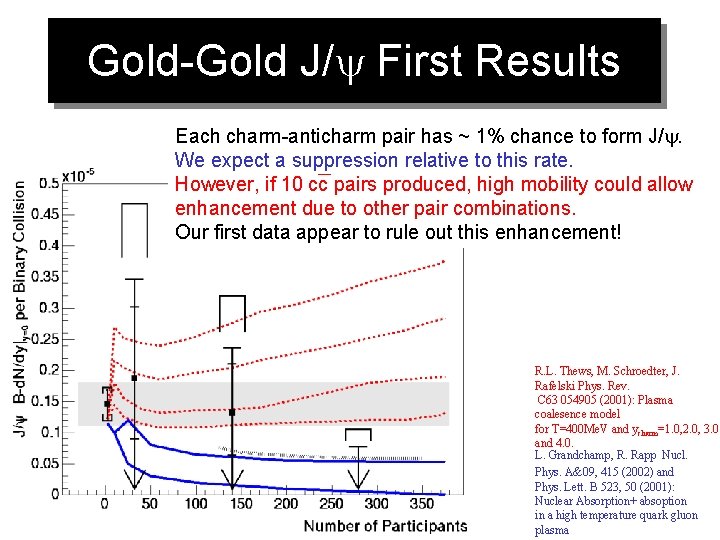
Gold-Gold J/y First Results Each charm-anticharm pair has ~ 1% chance to form J/y. We expect a suppression relative to this rate. However, if 10 cc pairs produced, high mobility could allow enhancement due to other pair combinations. Our first data appear to rule out this enhancement! R. L. Thews, M. Schroedter, J. Rafelski Phys. Rev. C 63 054905 (2001): Plasma coalesence model for T=400 Me. V and ycharm=1. 0, 2. 0, 3. 0 and 4. 0. L. Grandchamp, R. Rapp Nucl. Phys. A&09, 415 (2002) and Phys. Lett. B 523, 50 (2001): Nuclear Absorption+ absoption in a high temperature quark gluon plasma
Understanding QCD Frank Wilczek: “In the quest for evidence of the quark-gluon plasma, there are two levels to which one might aspire. At the first level, one might hope to observe phenomena that are very difficult to explain from a hadronic perspective but have a simple qualitative explanation based on quarks and gluons. But there is a second, more rigorous level that remains a challenge for the future. Using fundamental aspects of QCD theory, one can make quantitative predictions for the emission of various kinds of “hard” radiation from the quark gluon plasma. We will not have done justice to the concept of weakly interacting plasma of quarks and gluons until some of the predictions are confirmed by experiment. ” The challenge is out there to the people in the field to have this hope fully realized.
Conclusions RHIC has passed the first key test. Nuclear Physics community is capable of constructing and running world class “high-energy” type experiments and reconstructing the physics from the 10, 000 particle debris. The second phase has arrived. First exciting observations of very dense gluonic medium from jet quenching results. Gluon density well above predicted phase transition level. The third phase is next. Quarkonia measurements to test deconfinment. The spin physics program in PHENIX is starting, and will further address basic QCD questions being asked (and hopefully answered).
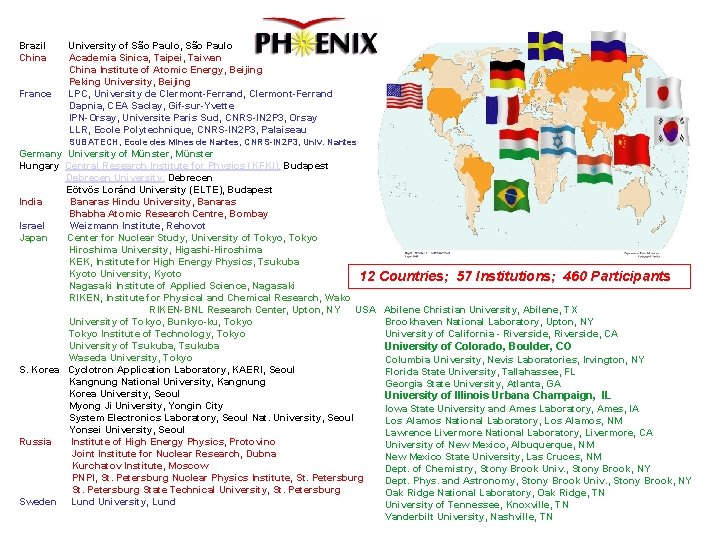
Brazil China France University of São Paulo, São Paulo Academia Sinica, Taipei, Taiwan China Institute of Atomic Energy, Beijing Peking University, Beijing LPC, University de Clermont-Ferrand, Clermont-Ferrand Dapnia, CEA Saclay, Gif-sur-Yvette IPN-Orsay, Universite Paris Sud, CNRS-IN 2 P 3, Orsay LLR, Ecole Polytechnique, CNRS-IN 2 P 3, Palaiseau SUBATECH, Ecole des Mines de Nantes, CNRS-IN 2 P 3, Univ. Nantes Germany University of Münster, Münster Hungary Central Research Institute for Physics (KFKI), Budapest Debrecen University, Debrecen Eötvös Loránd University (ELTE), Budapest India Banaras Hindu University, Banaras Bhabha Atomic Research Centre, Bombay Israel Weizmann Institute, Rehovot Japan Center for Nuclear Study, University of Tokyo, Tokyo Hiroshima University, Higashi-Hiroshima KEK, Institute for High Energy Physics, Tsukuba Kyoto University, Kyoto 12 Countries; 57 Institutions; 460 Participants Nagasaki Institute of Applied Science, Nagasaki RIKEN, Institute for Physical and Chemical Research, Wako RIKEN-BNL Research Center, Upton, NY USA Abilene Christian University, Abilene, TX Brookhaven National Laboratory, Upton, NY University of Tokyo, Bunkyo-ku, Tokyo University of California - Riverside, CA Tokyo Institute of Technology, Tokyo University of Tsukuba, Tsukuba University of Colorado, Boulder, CO Waseda University, Tokyo Columbia University, Nevis Laboratories, Irvington, NY S. Korea Cyclotron Application Laboratory, KAERI, Seoul Florida State University, Tallahassee, FL Kangnung National University, Kangnung Georgia State University, Atlanta, GA Korea University, Seoul University of Illinois Urbana Champaign, IL Myong Ji University, Yongin City Iowa State University and Ames Laboratory, Ames, IA System Electronics Laboratory, Seoul Nat. University, Seoul Los Alamos National Laboratory, Los Alamos, NM Yonsei University, Seoul Lawrence Livermore National Laboratory, Livermore, CA Russia Institute of High Energy Physics, Protovino University of New Mexico, Albuquerque, NM Joint Institute for Nuclear Research, Dubna New Mexico State University, Las Cruces, NM Kurchatov Institute, Moscow Dept. of Chemistry, Stony Brook Univ. , Stony Brook, NY PNPI, St. Petersburg Nuclear Physics Institute, St. Petersburg Dept. Phys. and Astronomy, Stony Brook Univ. , Stony Brook, NY St. Petersburg State Technical University, St. Petersburg Oak Ridge National Laboratory, Oak Ridge, TN Sweden Lund University, Lund University of Tennessee, Knoxville, TN Vanderbilt University, Nashville, TN
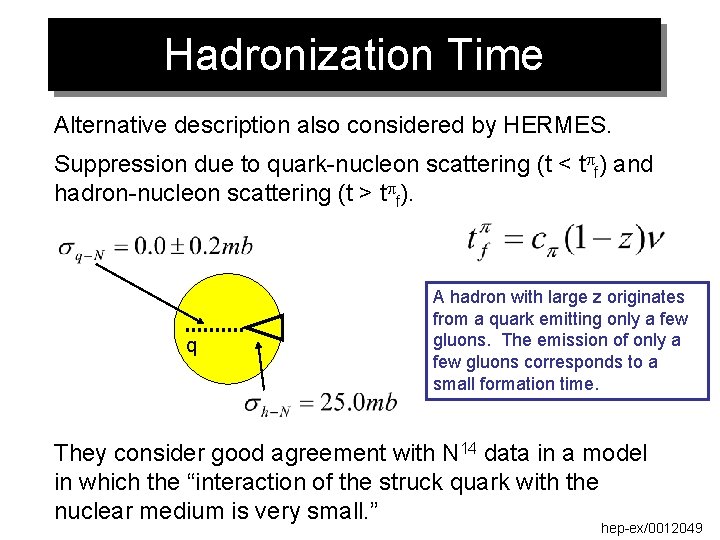
Hadronization Time Alternative description also considered by HERMES. Suppression due to quark-nucleon scattering (t < tpf) and hadron-nucleon scattering (t > tpf). q A hadron with large z originates from a quark emitting only a few gluons. The emission of only a few gluons corresponds to a small formation time. They consider good agreement with N 14 data in a model in which the “interaction of the struck quark with the nuclear medium is very small. ” hep-ex/0012049
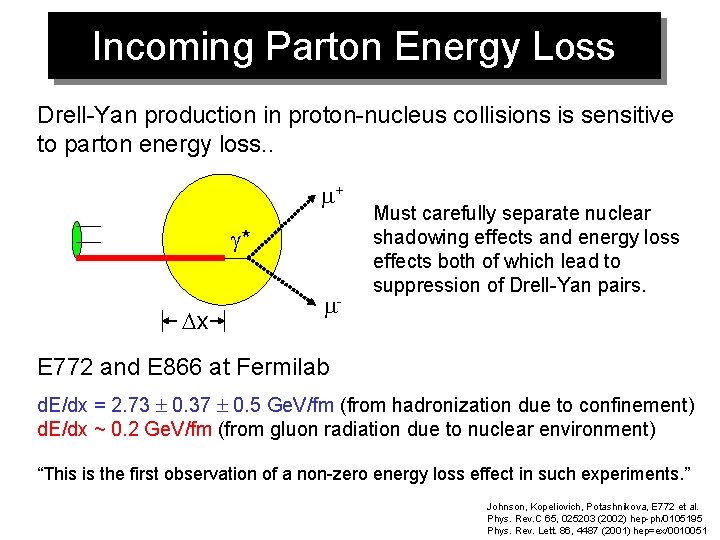
Incoming Parton Energy Loss Drell-Yan production in proton-nucleus collisions is sensitive to parton energy loss. . m+ g* Dx m- Must carefully separate nuclear shadowing effects and energy loss effects both of which lead to suppression of Drell-Yan pairs. E 772 and E 866 at Fermilab d. E/dx = 2. 73 0. 37 0. 5 Ge. V/fm (from hadronization due to confinement) d. E/dx ~ 0. 2 Ge. V/fm (from gluon radiation due to nuclear environment) “This is the first observation of a non-zero energy loss effect in such experiments. ” Johnson, Kopeliovich, Potashnikova, E 772 et al. Phys. Rev. C 65, 025203 (2002) hep-ph/0105195 Phys. Rev. Lett. 86, 4487 (2001) hep=ex/0010051
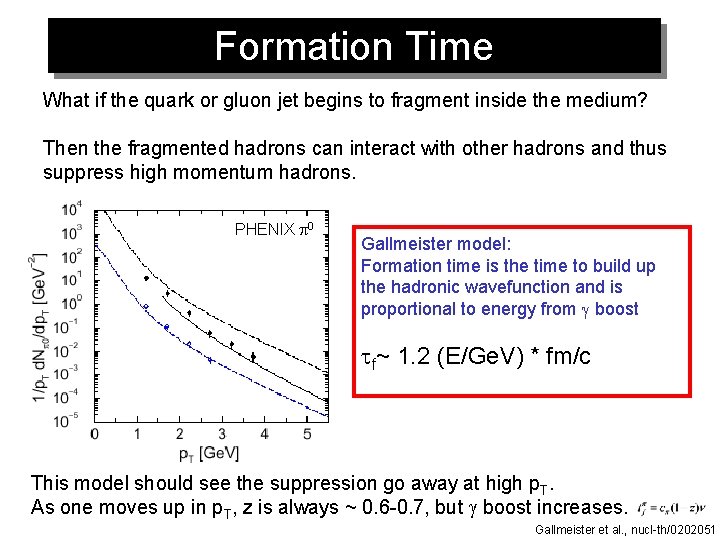
Formation Time What if the quark or gluon jet begins to fragment inside the medium? Then the fragmented hadrons can interact with other hadrons and thus suppress high momentum hadrons. PHENIX p 0 Gallmeister model: Formation time is the time to build up the hadronic wavefunction and is proportional to energy from g boost tf~ 1. 2 (E/Ge. V) * fm/c This model should see the suppression go away at high p. T. As one moves up in p. T, z is always ~ 0. 6 -0. 7, but g boost increases. Gallmeister et al. , nucl-th/0202051
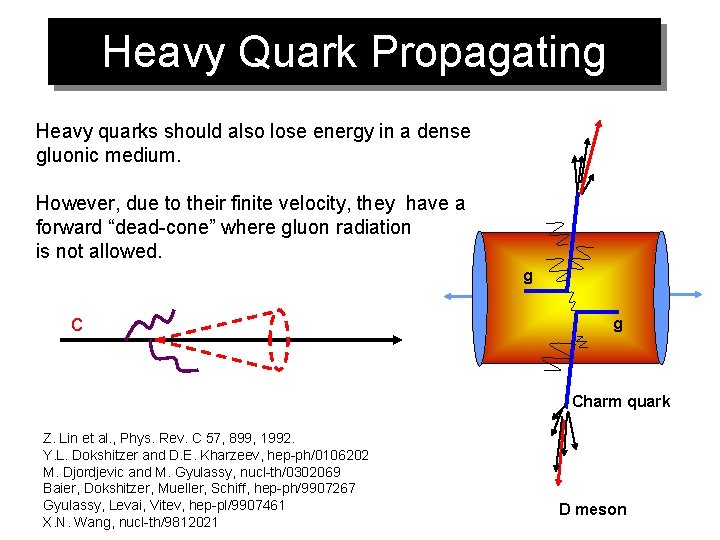
Heavy Quark Propagating Heavy quarks should also lose energy in a dense gluonic medium. However, due to their finite velocity, they have a forward “dead-cone” where gluon radiation is not allowed. g c g Charm quark Z. Lin et al. , Phys. Rev. C 57, 899, 1992. Y. L. Dokshitzer and D. E. Kharzeev, hep-ph/0106202 M. Djordjevic and M. Gyulassy, nucl-th/0302069 Baier, Dokshitzer, Mueller, Schiff, hep-ph/9907267 Gyulassy, Levai, Vitev, hep-pl/9907461 X. N. Wang, nucl-th/9812021 D meson
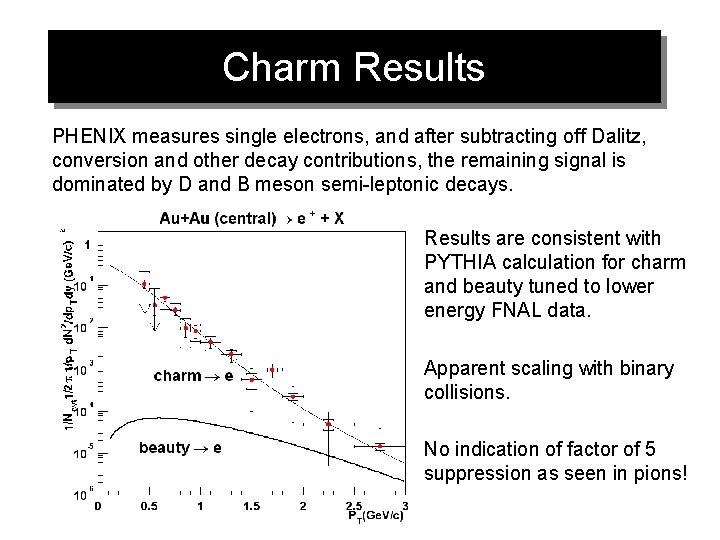
Charm Results PHENIX measures single electrons, and after subtracting off Dalitz, conversion and other decay contributions, the remaining signal is dominated by D and B meson semi-leptonic decays. Results are consistent with PYTHIA calculation for charm and beauty tuned to lower energy FNAL data. Apparent scaling with binary collisions. No indication of factor of 5 suppression as seen in pions!
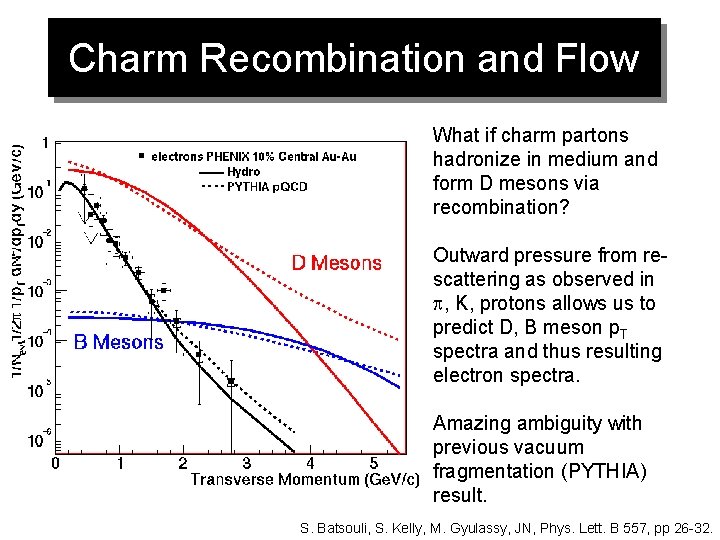
Charm Recombination and Flow What if charm partons hadronize in medium and form D mesons via recombination? Outward pressure from rescattering as observed in p, K, protons allows us to predict D, B meson p. T spectra and thus resulting electron spectra. Amazing ambiguity with previous vacuum fragmentation (PYTHIA) result. S. Batsouli, S. Kelly, M. Gyulassy, JN, Phys. Lett. B 557, pp 26 -32.
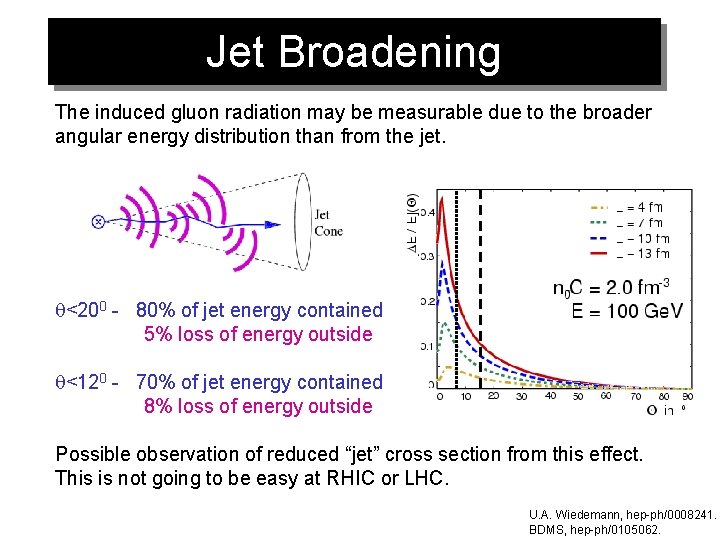
Jet Broadening The induced gluon radiation may be measurable due to the broader angular energy distribution than from the jet. q<200 - 80% of jet energy contained 5% loss of energy outside q<120 - 70% of jet energy contained 8% loss of energy outside Possible observation of reduced “jet” cross section from this effect. This is not going to be easy at RHIC or LHC. U. A. Wiedemann, hep-ph/0008241. BDMS, hep-ph/0105062.
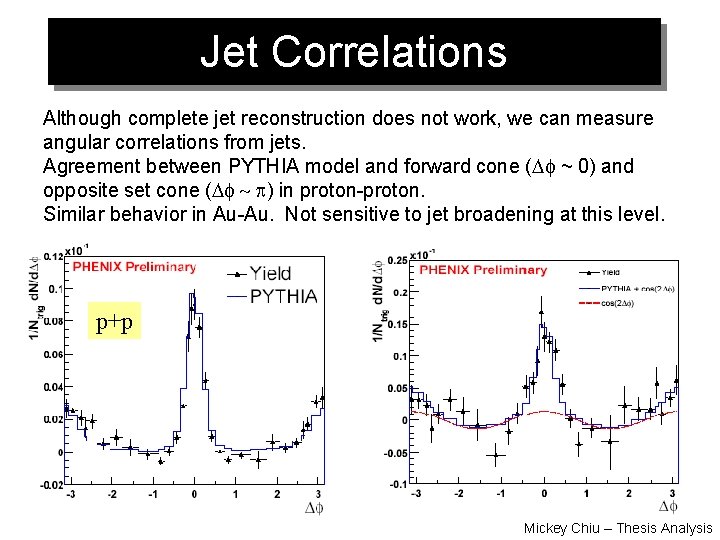
Jet Correlations Although complete jet reconstruction does not work, we can measure angular correlations from jets. Agreement between PYTHIA model and forward cone (Df ~ 0) and opposite set cone (Df ~ p) in proton-proton. Similar behavior in Au-Au. Not sensitive to jet broadening at this level. p+p Au+Au Mickey Chiu – Thesis Analysis
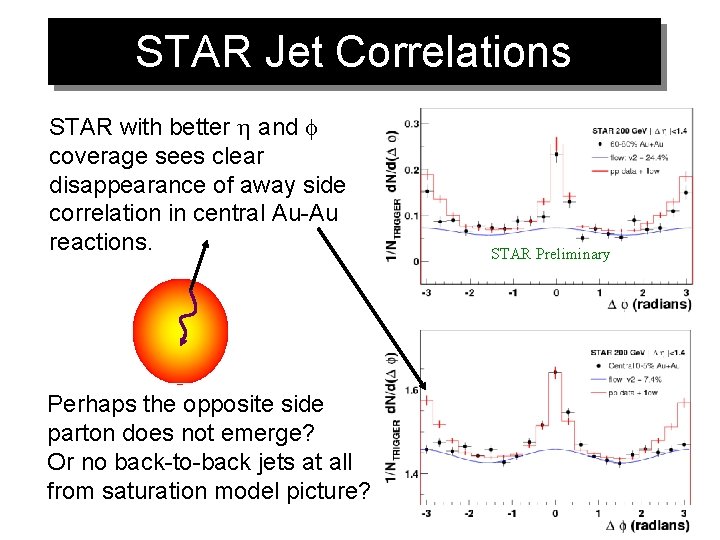
STAR Jet Correlations STAR with better h and f coverage sees clear disappearance of away side correlation in central Au-Au reactions. Perhaps the opposite side parton does not emerge? Or no back-to-back jets at all from saturation model picture? STAR Preliminary
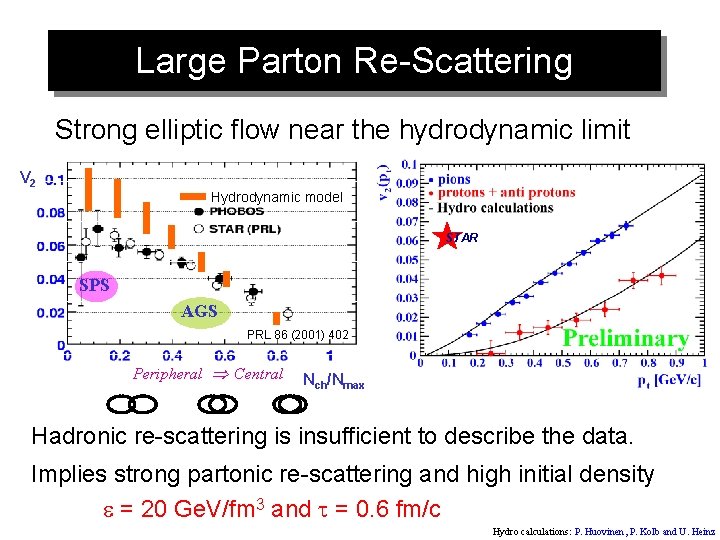
Large Parton Re-Scattering Strong elliptic flow near the hydrodynamic limit midrapidity : |h| < 1. 0 V 2 Hydrodynamic model STAR SPS AGS PRL 86 (2001) 402 Peripheral Central Nch/Nmax Hadronic re-scattering is insufficient to describe the data. Implies strong partonic re-scattering and high initial density e = 20 Ge. V/fm 3 and t = 0. 6 fm/c Hydro calculations: P. Huovinen, P. Kolb and U. Heinz
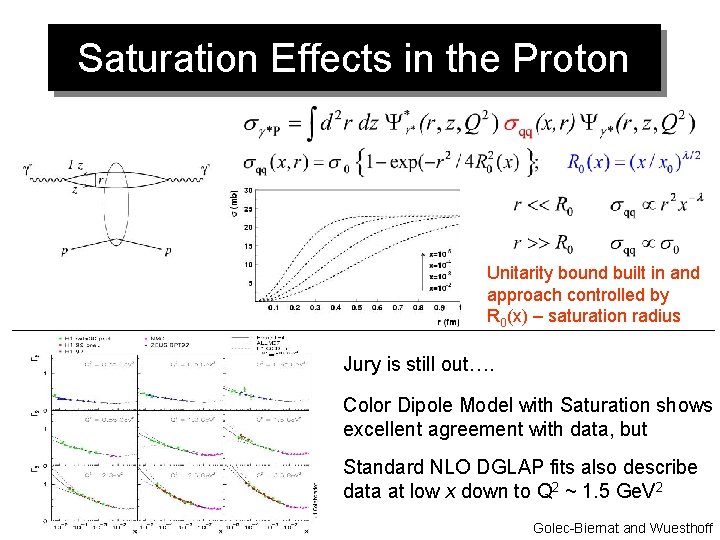
Colour Dipole with Saturation Effects. Models in the Proton saturation Unitarity bound built in and approach controlled by R 0(x) – saturation radius Jury is still out…. Color Dipole Model with Saturation shows excellent agreement with data, but Standard NLO DGLAP fits also describe data at low x down to Q 2 ~ 1. 5 Ge. V 2 Golec-Biernat and Wuesthoff
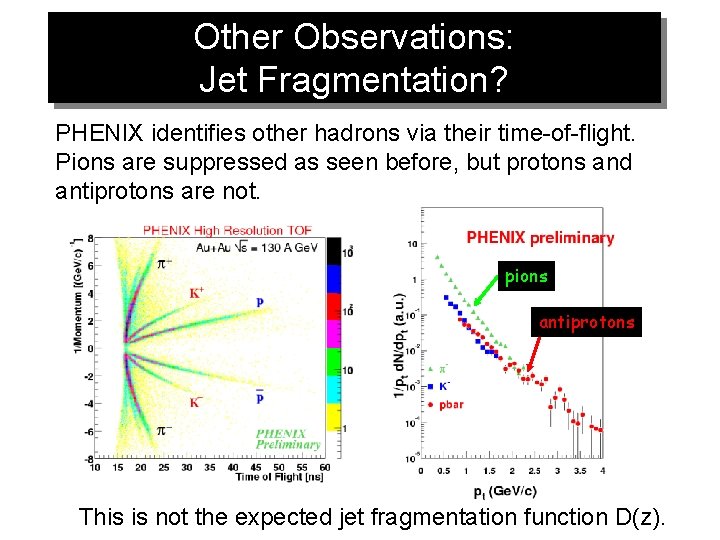
Other Observations: Jet Fragmentation? PHENIX identifies other hadrons via their time-of-flight. Pions are suppressed as seen before, but protons and antiprotons are not. pions antiprotons This is not the expected jet fragmentation function D(z).
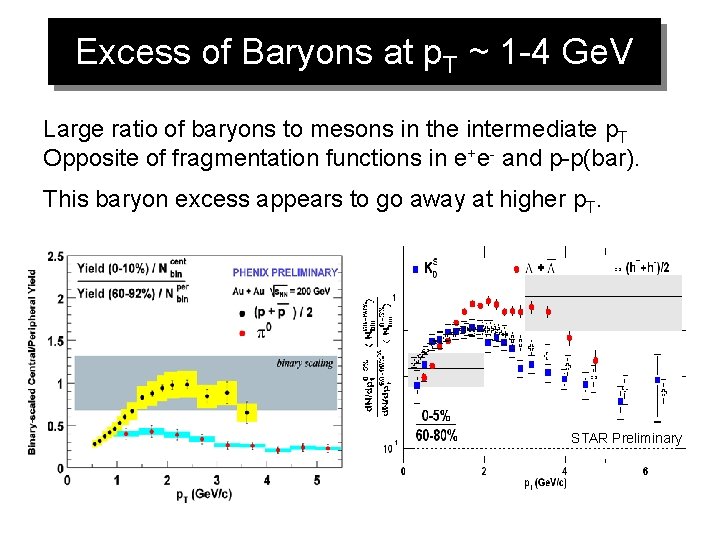
Excess of Baryons at p. T ~ 1 -4 Ge. V Large ratio of baryons to mesons in the intermediate p. T Opposite of fragmentation functions in e+e- and p-p(bar). This baryon excess appears to go away at higher p. T. STAR Preliminary
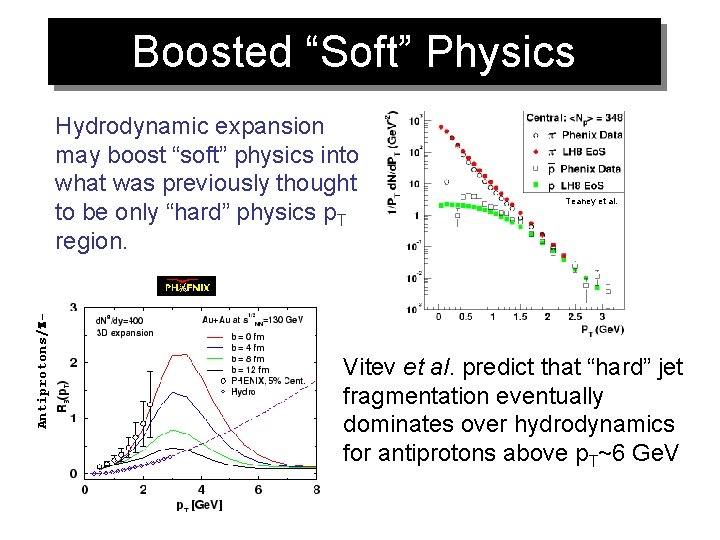
Boosted “Soft” Physics Antiprotons/p- Hydrodynamic expansion may boost “soft” physics into what was previously thought to be only “hard” physics p. T region. Teaney et al. Vitev et al. predict that “hard” jet fragmentation eventually dominates over hydrodynamics for antiprotons above p. T~6 Ge. V
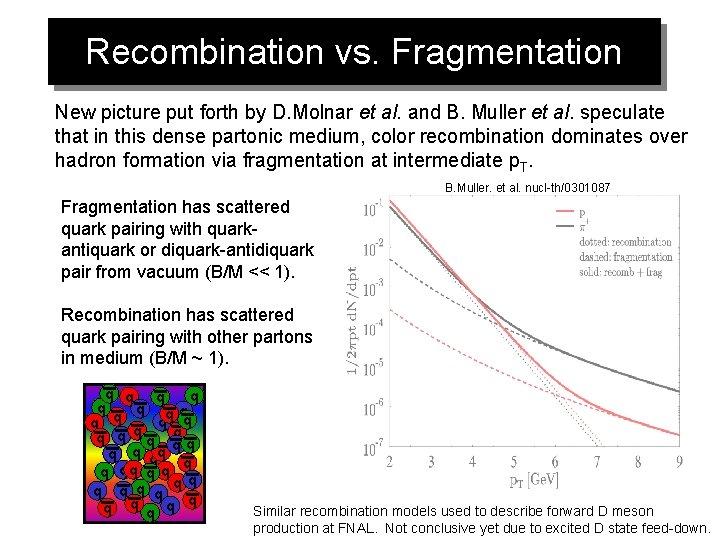
Recombination vs. Fragmentation New picture put forth by D. Molnar et al. and B. Muller et al. speculate that in this dense partonic medium, color recombination dominates over hadron formation via fragmentation at intermediate p. T. B. Muller. et al. nucl-th/0301087 Fragmentation has scattered quark pairing with quarkantiquark or diquark-antidiquark pair from vacuum (B/M << 1). Recombination has scattered quark pairing with other partons in medium (B/M ~ 1). q q q qq q q q q q q q Similar recombination models used to describe forward D meson production at FNAL. Not conclusive yet due to excited D state feed-down.
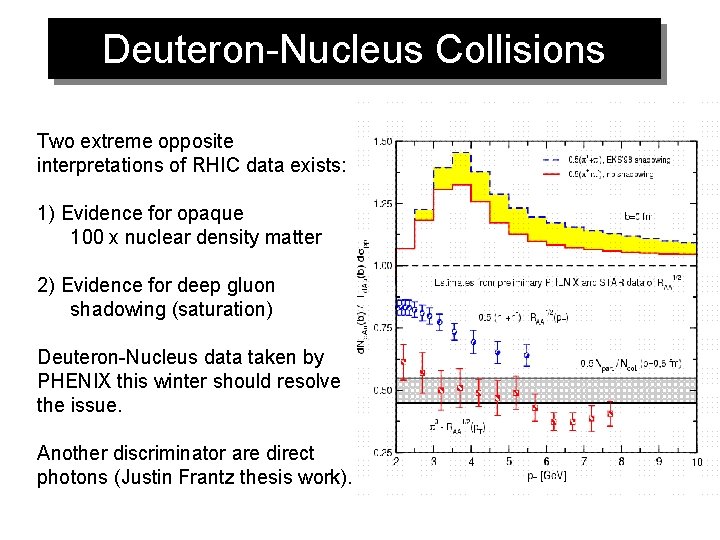
Deuteron-Nucleus Collisions Two extreme opposite interpretations of RHIC data exists: 1) Evidence for opaque 100 x nuclear density matter 2) Evidence for deep gluon shadowing (saturation) Deuteron-Nucleus data taken by PHENIX this winter should resolve the issue. Another discriminator are direct photons (Justin Frantz thesis work).
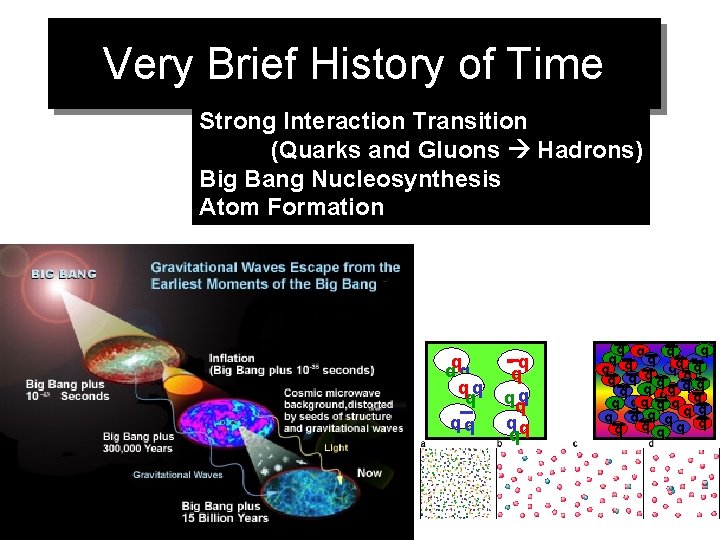
Very Brief History of Time Strong Interaction Transition (Quarks and Gluons Hadrons) Big Bang Nucleosynthesis Atom Formation q qq qq q q q q qq qq q q q q
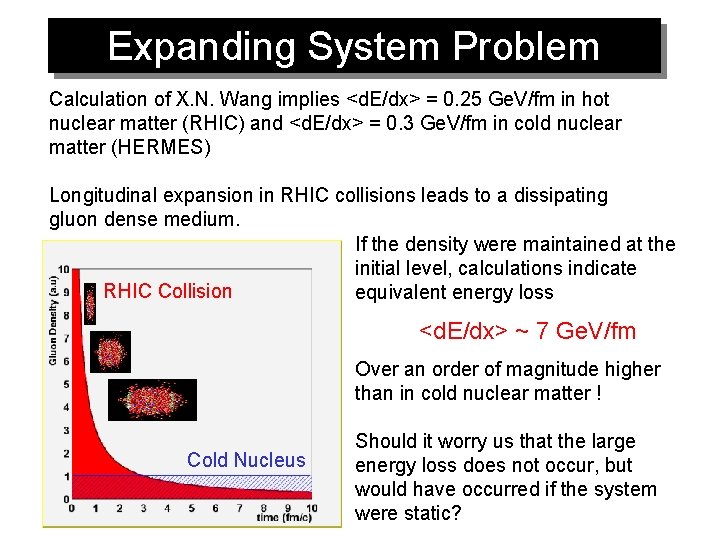
Expanding System Problem Calculation of X. N. Wang implies <d. E/dx> = 0. 25 Ge. V/fm in hot nuclear matter (RHIC) and <d. E/dx> = 0. 3 Ge. V/fm in cold nuclear matter (HERMES) Longitudinal expansion in RHIC collisions leads to a dissipating gluon dense medium. If the density were maintained at the initial level, calculations indicate RHIC Collision equivalent energy loss <d. E/dx> ~ 7 Ge. V/fm Over an order of magnitude higher than in cold nuclear matter ! Cold Nucleus Should it worry us that the large energy loss does not occur, but would have occurred if the system were static?
- Slides: 69