
QuarkGluon Plasma Presented by Paul Pryor and Michael
Quark-Gluon Plasma Presented by: Paul Pryor and Michael Byrd December 8, 2010
Overview � Definitions � Theory � Signatures � Detection � Results 2
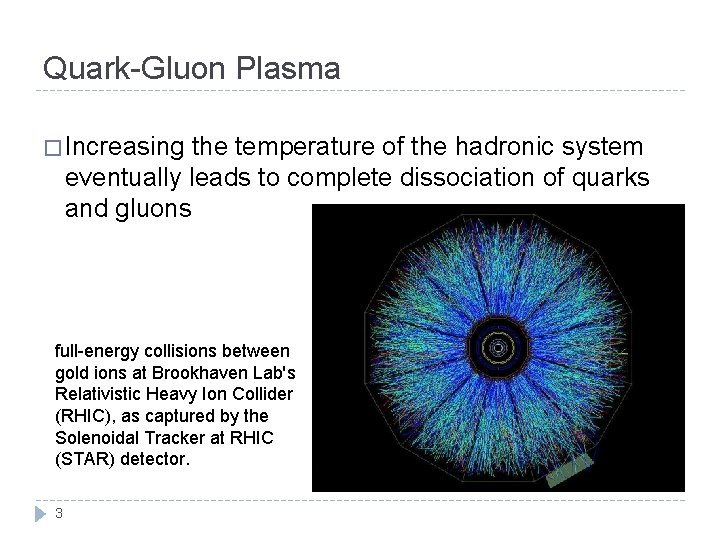
Quark-Gluon Plasma � Increasing the temperature of the hadronic system eventually leads to complete dissociation of quarks and gluons full-energy collisions between gold ions at Brookhaven Lab's Relativistic Heavy Ion Collider (RHIC), as captured by the Solenoidal Tracker at RHIC (STAR) detector. 3
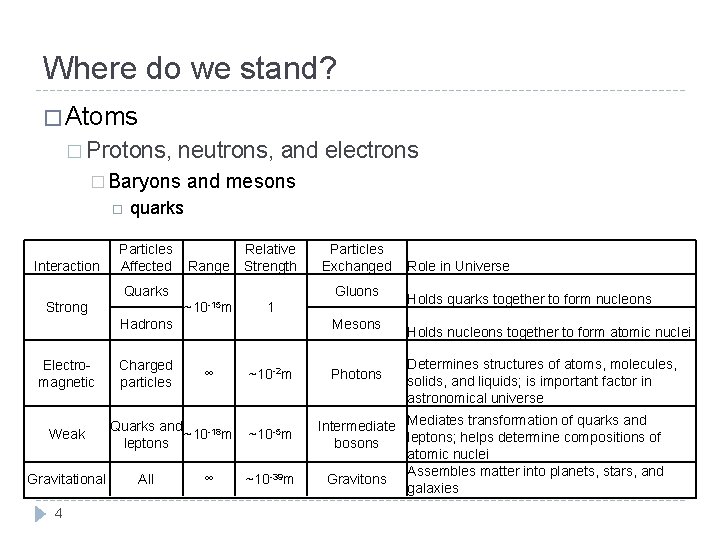
Where do we stand? � Atoms � Protons, neutrons, and electrons � Baryons Interaction and mesons quarks Particles Affected Range Relative Strength Quarks Strong Gluons ~10 -15 m 1 Hadrons Electromagnetic Weak Gravitational 4 Charged particles Mesons ∞ Quarks and ~10 -18 m leptons All Particles Exchanged ∞ ~10 -2 m ~10 -5 m ~10 -39 m Photons Role in Universe Holds quarks together to form nucleons Holds nucleons together to form atomic nuclei Determines structures of atoms, molecules, solids, and liquids; is important factor in astronomical universe Intermediate Mediates transformation of quarks and leptons; helps determine compositions of bosons atomic nuclei Assembles matter into planets, stars, and Gravitons galaxies

Strong force � Primary expression � The level between quarks � Produces quark confinement � color � gluons � Secondary � The expression level between baryons � flavor � mesons 5
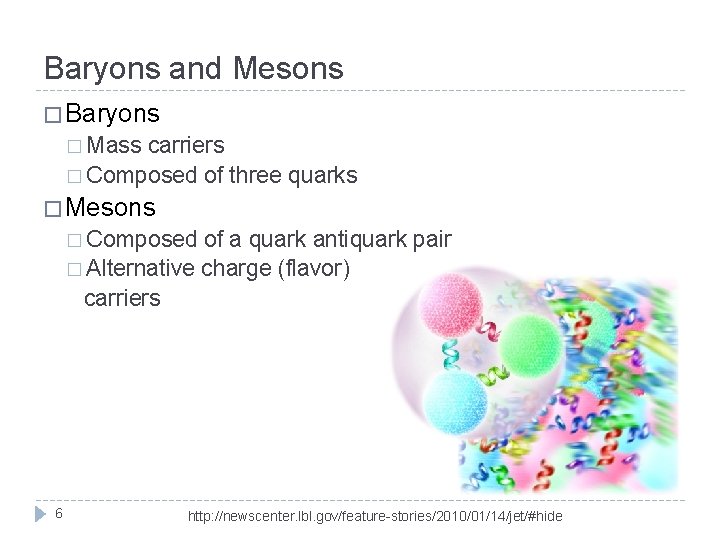
Baryons and Mesons � Baryons � Mass carriers � Composed of three quarks � Mesons � Composed of a quark antiquark pair � Alternative charge (flavor) carriers 6 http: //newscenter. lbl. gov/feature-stories/2010/01/14/jet/#hide
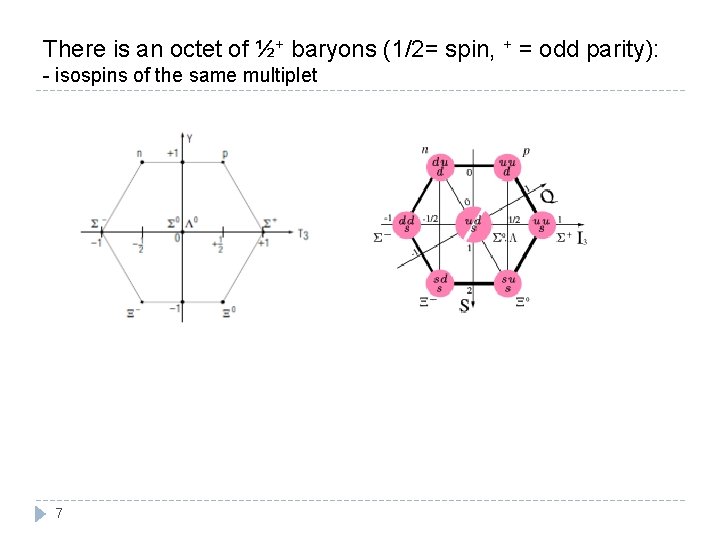
There is an octet of ½+ baryons (1/2= spin, + = odd parity): - isospins of the same multiplet 7
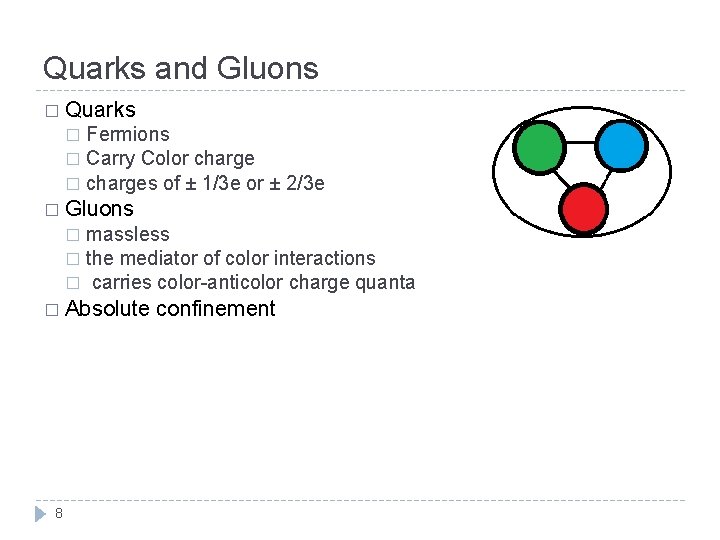
Quarks and Gluons � Quarks Fermions � Carry Color charge � charges of ± 1/3 e or ± 2/3 e � � Gluons massless � the mediator of color interactions � carries color-anticolor charge quanta � � Absolute 8 confinement
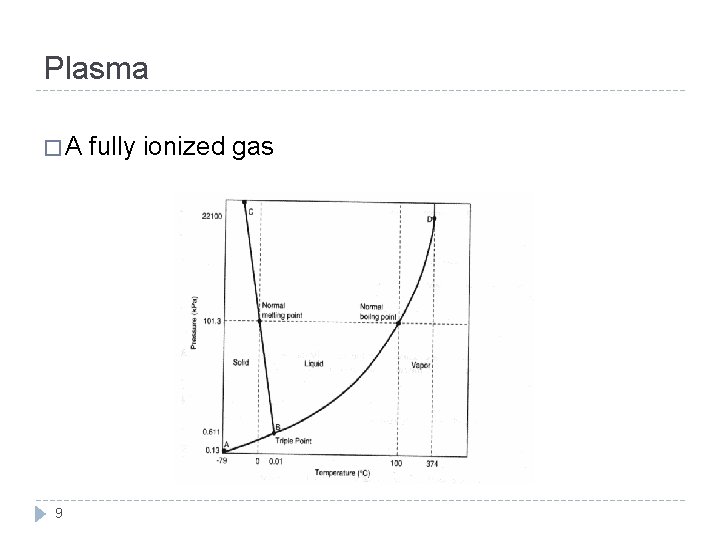
Plasma �A 9 fully ionized gas
Quantum Chromodynamics (QCD) � The dynamical theory of quarks and gluons that describes color interactions � Parton 10 model
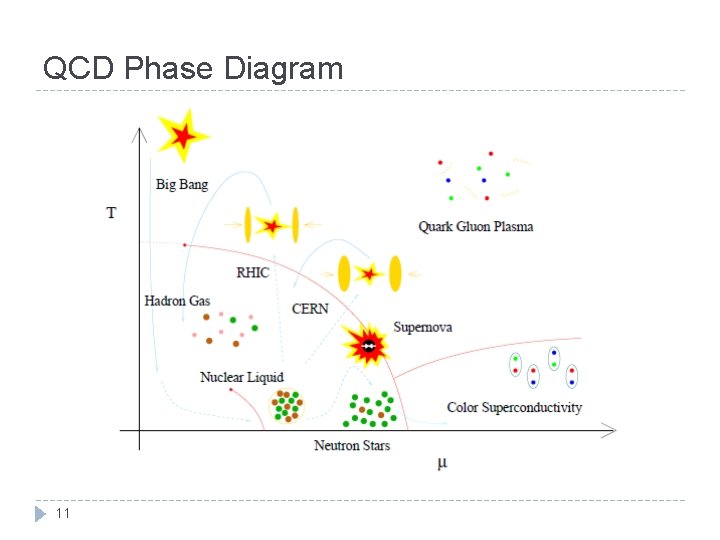
QCD Phase Diagram 11
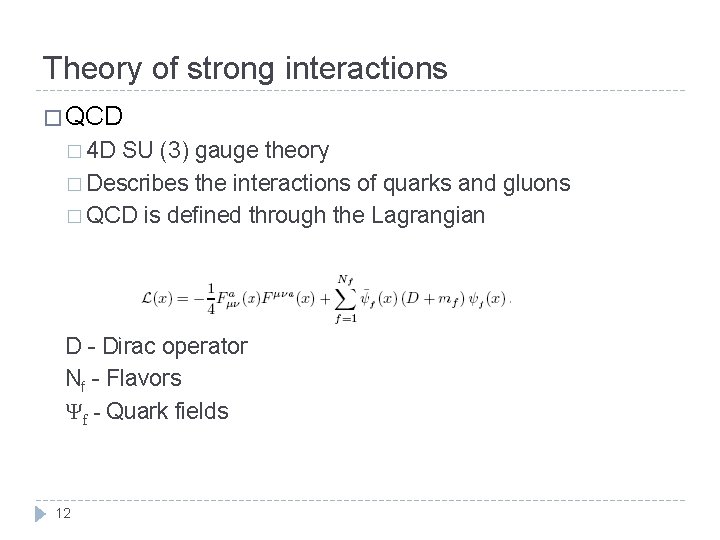
Theory of strong interactions � QCD � 4 D SU (3) gauge theory � Describes the interactions of quarks and gluons � QCD is defined through the Lagrangian D - Dirac operator Nf - Flavors Ψf - Quark fields 12
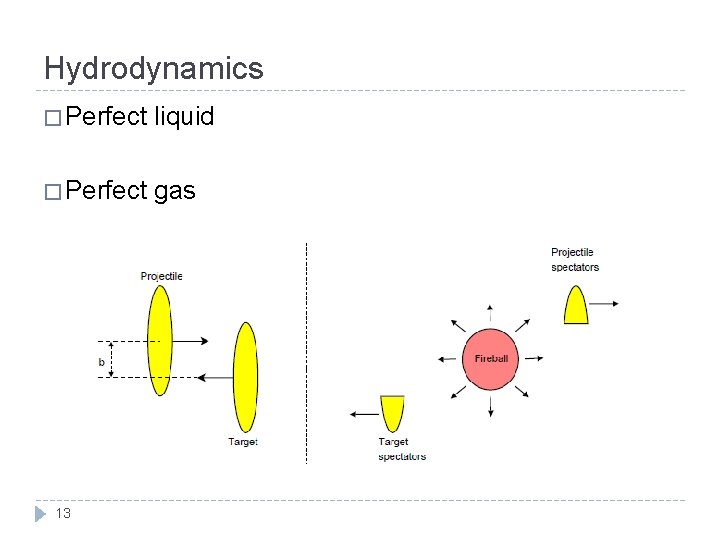
Hydrodynamics � Perfect liquid � Perfect gas 13
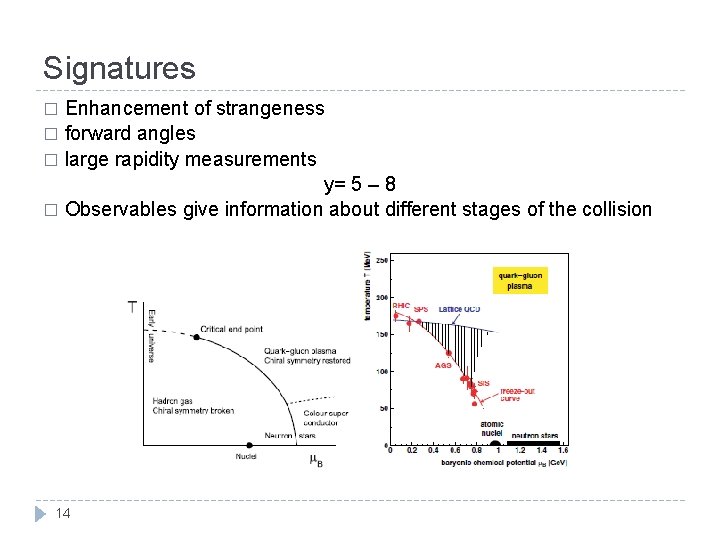
Signatures Enhancement of strangeness � forward angles � large rapidity measurements y= 5 – 8 � Observables give information about different stages of the collision � 14
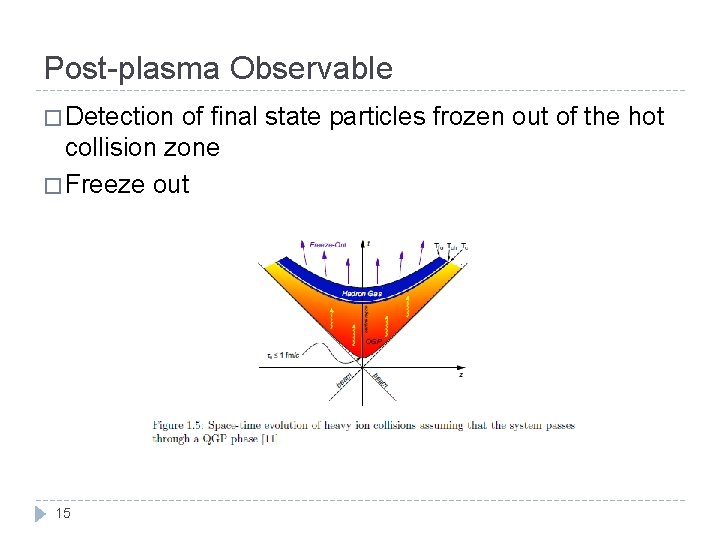
Post-plasma Observable � Detection of final state particles frozen out of the hot collision zone � Freeze out 15
Why look? � Help � If prove the validity of QCD QGP is a reality, its further study may give insight into the processes of the early universe 16
Experiment Signatures & Detection
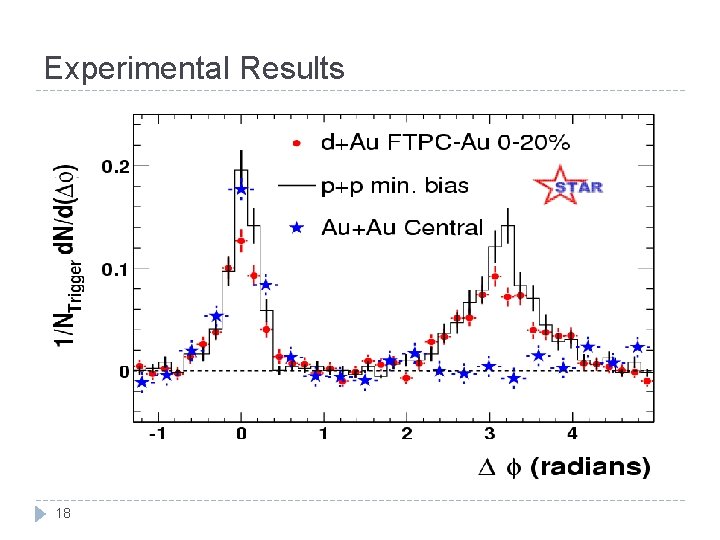
Experimental Results � 1. • • 18 Jet Quenching Jet—a narrow cone of hadrons and other particles produced by the hadronization of a quark or gluon in a heavy ion experiment According to QCD, matter undergoing a phase crossover into quark gluon plasma losses significant energy, which effectively quenches the outgoing jet Strong suppression of inclusive hadron production Pedestal&flow subtracted Disappearance of the away-side jet
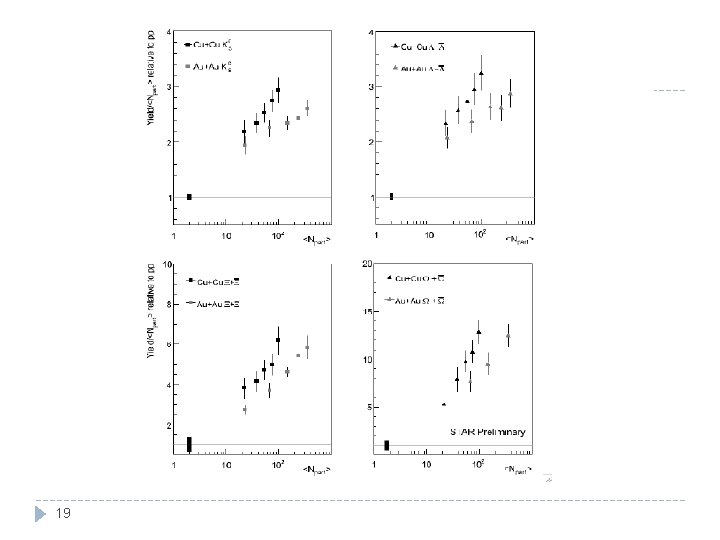
Experimental Results Cont. � 2. • • • 19 Strangeness Strange quarks are not brought into the reaction by the colliding nuclei Strange quarks or antiquarks are made from the kinetic energy of colliding nuclei Strange quarks are naturally radioactive and decay by weak interactions into lighter quarks which can be detected relatively easily (Xi baryon(dss) into a pion(d) and a Lambda baryon(uds))
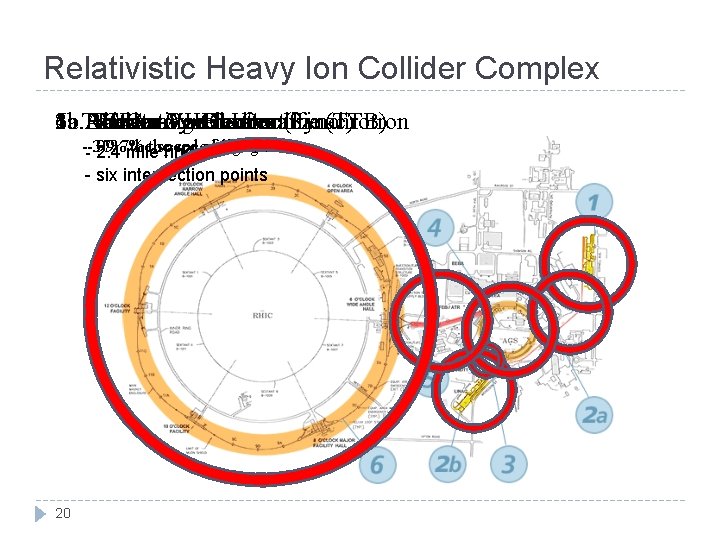
Relativistic Heavy Ion Collider Complex 2 a. Tandem 2 b. 5. 6. AGS-to-RHIC Tandem-to-Booster Linear Accelerator (Linac) line (TTB) 3. 4. Booster Alternating Synchrotron 1. Van. Gradient de. Line Graaff ---37% 99. 7% thethe speed of of light 2. 4 mile ring - six intersection points 20
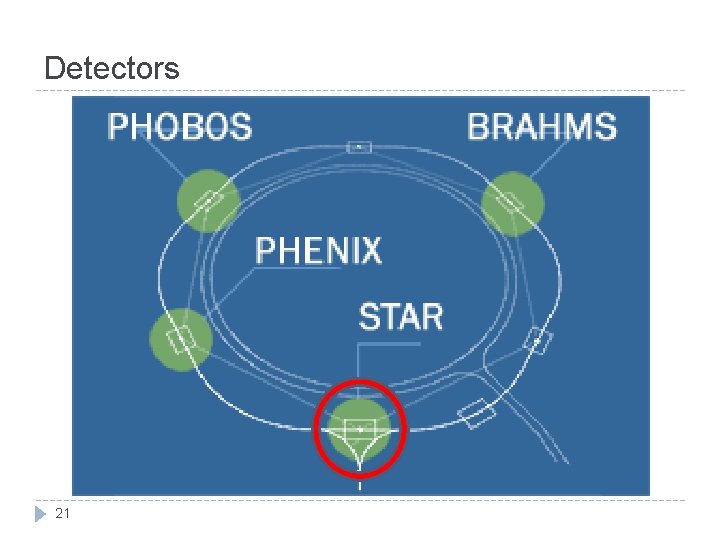
Detectors 21
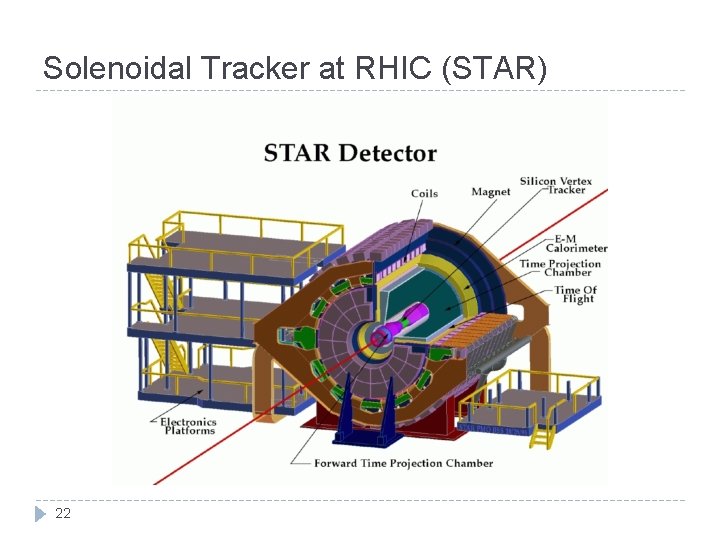
Solenoidal Tracker at RHIC (STAR) 22
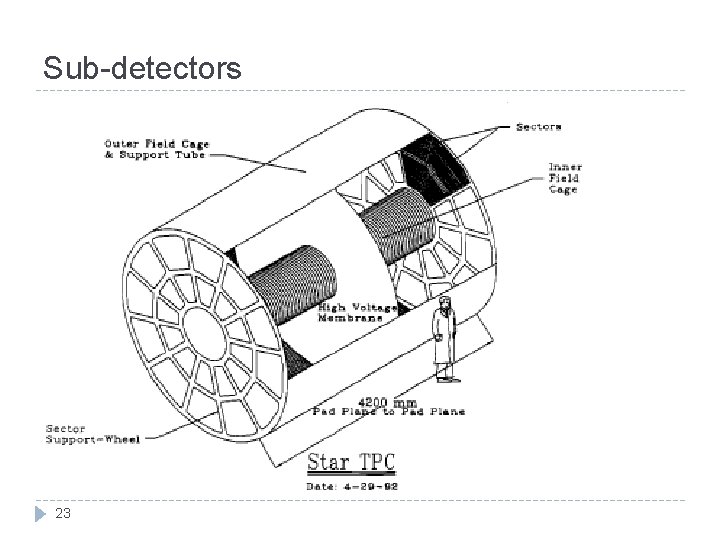
Sub-detectors � 1. • • • Strong E-field: 130 V/cm Multi-wire proportional chamber end caps Drift Gas: Argon/methane mixture (90: 10) @ 1 atm. � 2. • • 23 Time Projection Chamber Silicon Vertex Tracker Res. : 18 million pixels (72576 channels x 256 time samples) capabilities below transverse momenta of 150 Me. VIc
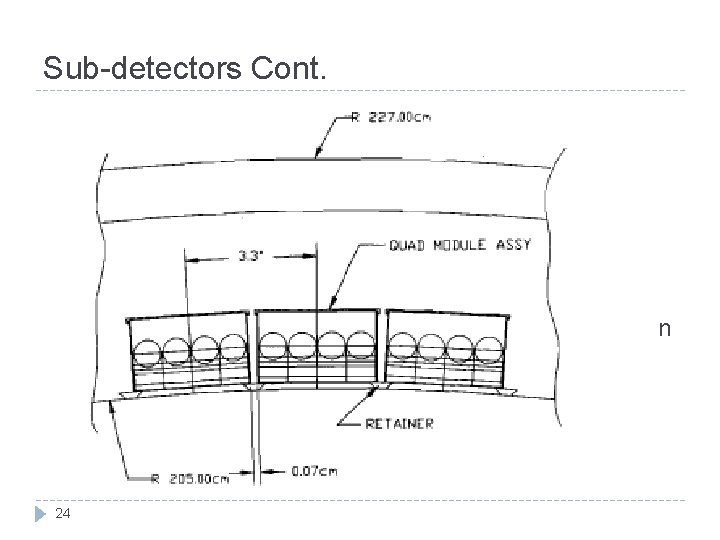
Sub-detectors Cont. � 3. • Energy Deposition Measurements � 4. • • Time-of-Flight (TOF) Detector Shingle design Tiled outer TPC cage w/ 7716 single ended scintillators in 216 trays � 5. 24 Electromagnetic Calorimeter (EMC) External Time-Projection Chambers (TPC)
What now? � Discovery of QGP not yet conclusive because signatures are indirect results predicted by theory � Develop methods and hardware for direct detection of total deconfinement � Determine if and where a definite transition exists � Charm production • • 25 Charm quarks, unlike the strange quarks, are predicted to be produced early in QGP formation at sufficient energies Looking to the LHC at CERN for detection
STAR Collaboration Institutions (49) � Argonne National Laboratory, Argonne, Illinois 60439, USA � Michigan State University, East Lansing, Michigan 48824, USA � University of Washington, Seattle, Washington 98195, USA � University of Bern, 3012 Bern, Switzerland � � � University of Birmingham, United Kingdom Moscow Engineering Physics Institute, Moscow Russia Wayne State University, Detroit, Michigan 48201, USA � � Brookhaven National Laboratory, Upton, New York 11973, USA City College of New York, New York City, New York � 10031, USA Institute of Particle Physics, CCNU (HZNU), Wuhan 430079, China � California Institute of Technology, Pasadena, California 91125, USA NIKHEF and Utrecht University, Amsterdam, The Netherlands � � Yale University, New Haven, Connecticut 06520, USA � Ohio State University, Columbus, Ohio 43210, USA � University of Zagreb, HR-10002, Croatia � Panjab University, Chandigarh 160014, India � Pennsylvania State University, University Park, Pennsylvania 16802, USA � Institute of High Energy Physics, Protvino, Russia � Purdue University, West Lafayette, Indiana 47907, USA � University of Rajasthan, Jaipur 302004, India � Rice University, Houston, Texas 77251, USA � Universidade de Sao Paulo, Brazil � University of Science & Technology of China, Anhui 230027, China � Shanghai Institute of Applied Physics, Shanghai 201800, China � SUBATECH, Nantes, France � University of California, Berkeley, California 94720, USA � University of California, Davis, California 95616, USA � University of California, Los Angeles, California 90095, USA � Carnegie Mellon University, Pittsburgh, Pennsylvania 15213, USA � Creighton University, Omaha, Nebraska 68178, USA � Nuclear Physics Institute AS CR, 250 68 ˇ Reˇz/Prague, Czech Republic � Laboratory for High Energy (JINR), Dubna, Russia � Particle Physics Laboratory (JINR), Dubna, Russia � University of Frankfurt, Germany � Institute of Physics, Bhubaneswar 751005, India � Indian Institute of Technology, Mumbai, India � Indiana University, Bloomington, Indiana 47408, USA � � Institut de Recherches Subatomiques, Strasbourg, France � University of Texas, Austin, Texas 78712, USA � University of Jammu, Jammu 180001, India � Tsinghua University, Beijing 100084, China � Kent State University, Kent, Ohio 44242, USA � � Lawrence Berkeley National Laboratory, Berkeley, California 94720, USA Valparaiso University, Valparaiso, Indiana 46383, USA � � Massachusetts Institute of Technology, Cambridge, � MA 02139 -4307 Variable Energy Cyclotron Centre, Kolkata 700064, India � Max-Planck-Institut f¨ur Physik, Munich, Germany 26 Texas A&M University, College Station, Texas 77843, USA Warsaw University of Technology, Warsaw, Poland
Sources � Adams, J. et al. The STAR Collaboration’s Critical Assessment of the Evidence from RHIC Collisions. Tech. 2008. Print � Beddo, M. E. et al. STAR Conceptual Design Report. Tech. no. 5347. Print. � Braun-Munzinger, Peter, and Johanna Stachel. "The Quest for the Quark– gluon Plasma. " Nature 448 (2007): 302 -09. Web. 15 Nov. 2010. � "Quark–gluon Plasma. " Online Reference - Information Articles & Reference Resources. Web. 22 Nov. 2010. <http: //reference. findtarget. com/search/quark–gluon plasma/>. 27
- Slides: 27