
Quark pair production using dipole formalism in neutrinoproton
- Slides: 17
Quark pair production using dipole formalism in neutrino-proton scattering at high energies * Mairon Melo Machado High Energy Phenomenology Group, GFPAE IF – UFRGS, Porto Alegre melo. machado@ufrgs. br www. if. ufrgs. br/gfpae * In collaboration with M. B. Gay Ducati and M. V. T. Machado
Outline • Lepton-nucleon collision • Color dipole formalism • Structure functions • Neutral Current (NC) process • Neutrino-nucleon cross section • Results and conclusions
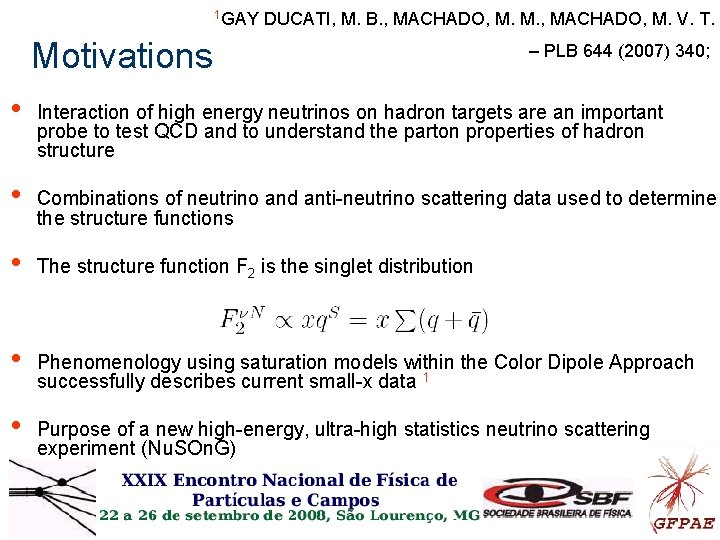
1 GAY DUCATI, M. B. , MACHADO, M. M. , MACHADO, M. V. T. Motivations • • • – PLB 644 (2007) 340; Interaction of high energy neutrinos on hadron targets are an important probe to test QCD and to understand the parton properties of hadron structure Combinations of neutrino and anti-neutrino scattering data used to determine the structure functions The structure function F 2 is the singlet distribution Phenomenology using saturation models within the Color Dipole Approach successfully describes current small-x data 1 Purpose of a new high-energy, ultra-high statistics neutrino scattering experiment (Nu. SOn. G)
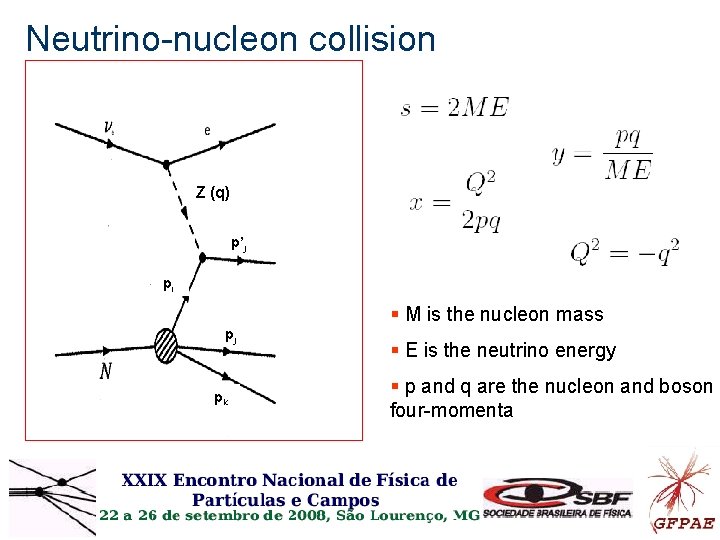
Neutrino-nucleon collision Z (q) p’j pi § M is the nucleon mass pj pk § E is the neutrino energy § p and q are the nucleon and boson four-momenta
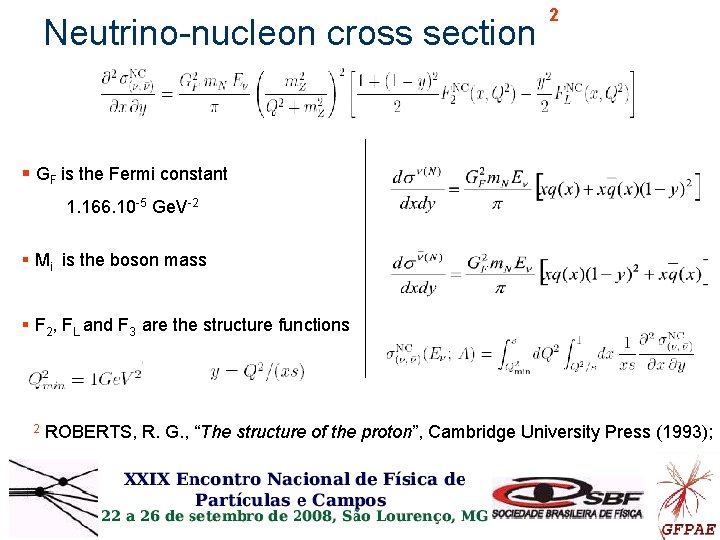
Neutrino-nucleon cross section 2 § GF is the Fermi constant 1. 166. 10 -5 Ge. V-2 § Mi is the boson mass § F 2, FL and F 3 are the structure functions 2 ROBERTS, R. G. , “The structure of the proton”, Cambridge University Press (1993);
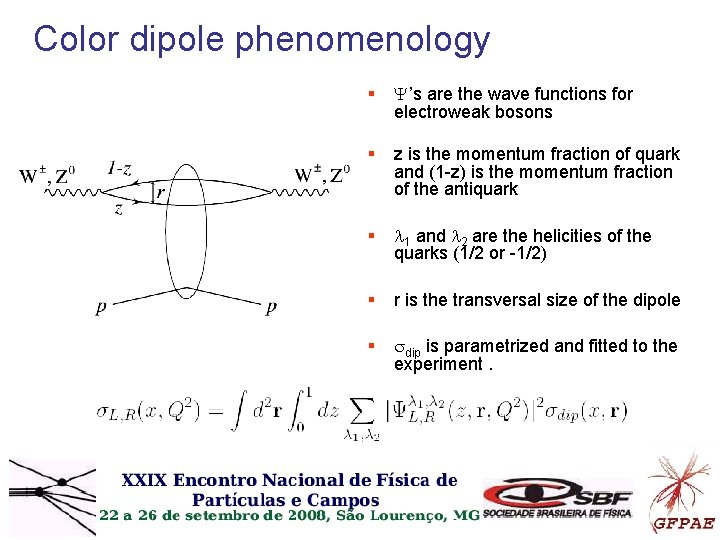
Color dipole phenomenology § ’s are the wave functions for electroweak bosons § z is the momentum fraction of quark and (1 -z) is the momentum fraction of the antiquark § 1 and 2 are the helicities of the quarks (1/2 or -1/2) § r is the transversal size of the dipole § dip is parametrized and fitted to the experiment.
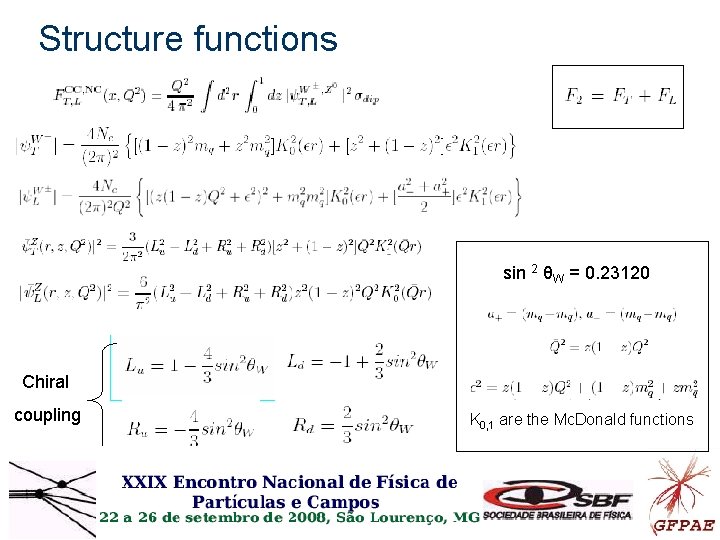
Structure functions sin 2 θW = 0. 23120 Chiral coupling K 0, 1 are the Mc. Donald functions
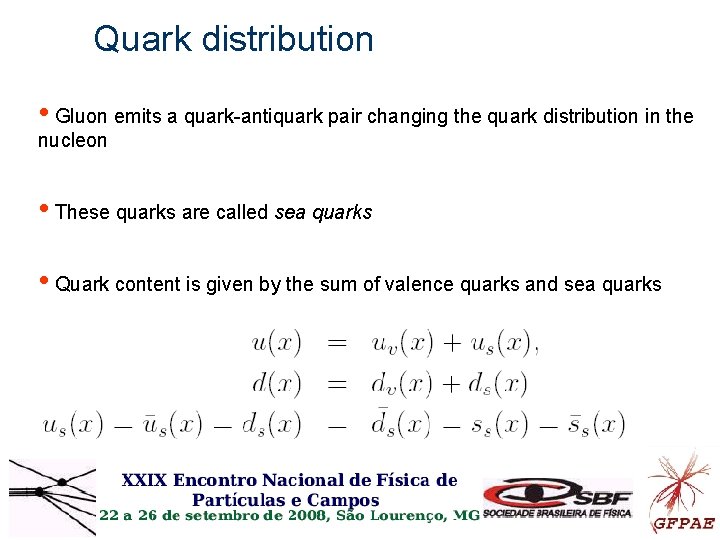
Quark distribution • Gluon emits a quark-antiquark pair changing the quark distribution in the nucleon • These quarks are called sea quarks • Quark content is given by the sum of valence quarks and sea quarks
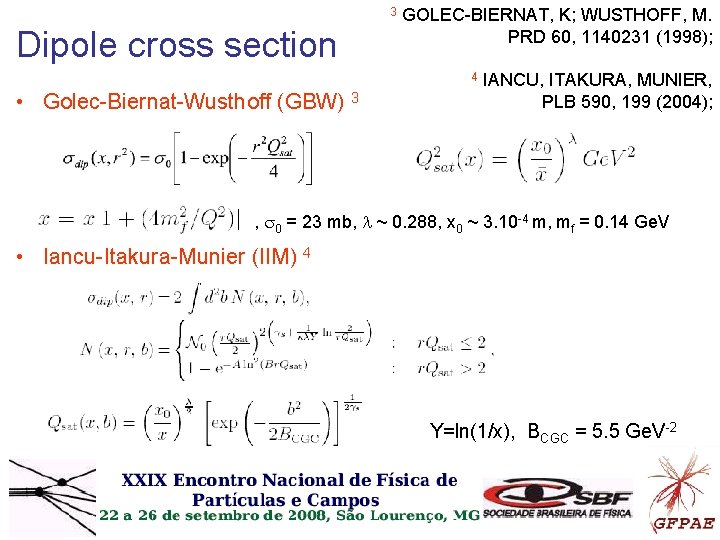
3 Dipole cross section GOLEC-BIERNAT, K; WUSTHOFF, M. PRD 60, 1140231 (1998); 4 • Golec-Biernat-Wusthoff (GBW) 3 IANCU, ITAKURA, MUNIER, PLB 590, 199 (2004); , 0 = 23 mb, ~ 0. 288, x 0 ~ 3. 10 -4 m, mf = 0. 14 Ge. V • Iancu-Itakura-Munier (IIM) 4 Y=ln(1/x), BCGC = 5. 5 Ge. V-2 HEP 08
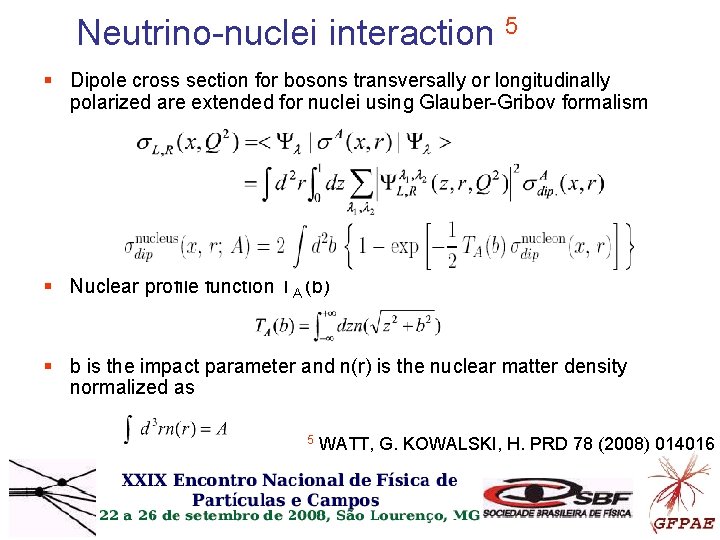
Neutrino-nuclei interaction 5 § Dipole cross section for bosons transversally or longitudinally polarized are extended for nuclei using Glauber-Gribov formalism § Nuclear profile function TA (b) § b is the impact parameter and n(r) is the nuclear matter density normalized as 5 WATT, G. KOWALSKI, H. PRD 78 (2008) 014016 HEP 08
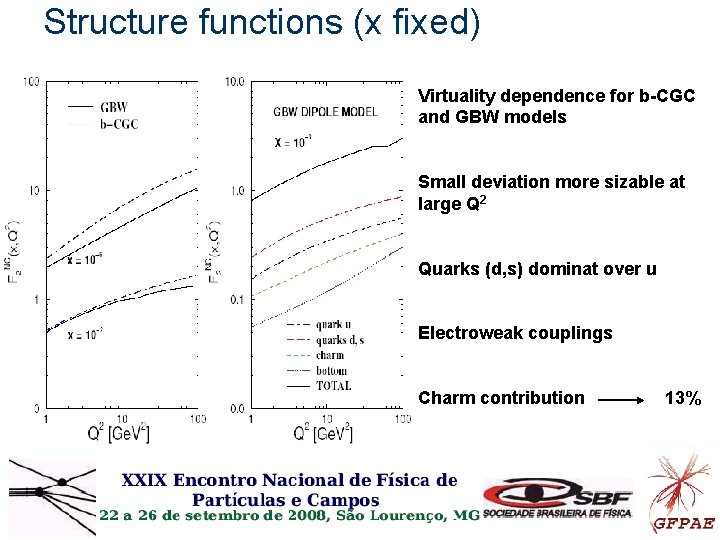
Structure functions (x fixed) Virtuality dependence for b-CGC and GBW models Small deviation more sizable at large Q 2 Quarks (d, s) dominat over u Electroweak couplings Charm contribution 13%
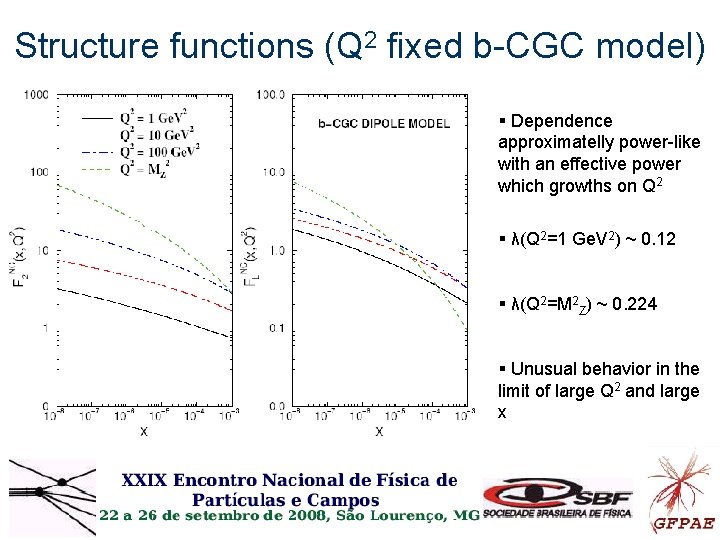
Structure functions (Q 2 fixed b-CGC model) § Dependence approximatelly power-like with an effective power which growths on Q 2 § λ(Q 2=1 Ge. V 2) ~ 0. 12 § λ(Q 2=M 2 Z) ~ 0. 224 § Unusual behavior in the limit of large Q 2 and large x
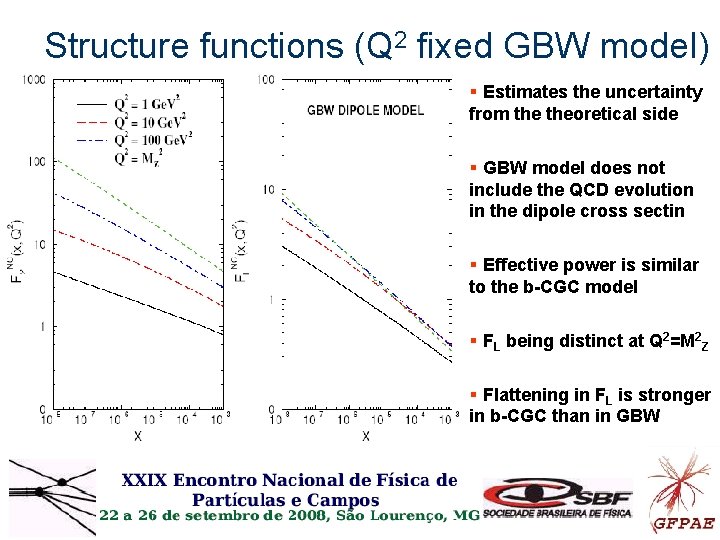
Structure functions (Q 2 fixed GBW model) § Estimates the uncertainty from theoretical side § GBW model does not include the QCD evolution in the dipole cross sectin § Effective power is similar to the b-CGC model § FL being distinct at Q 2=M 2 Z § Flattening in FL is stronger in b-CGC than in GBW
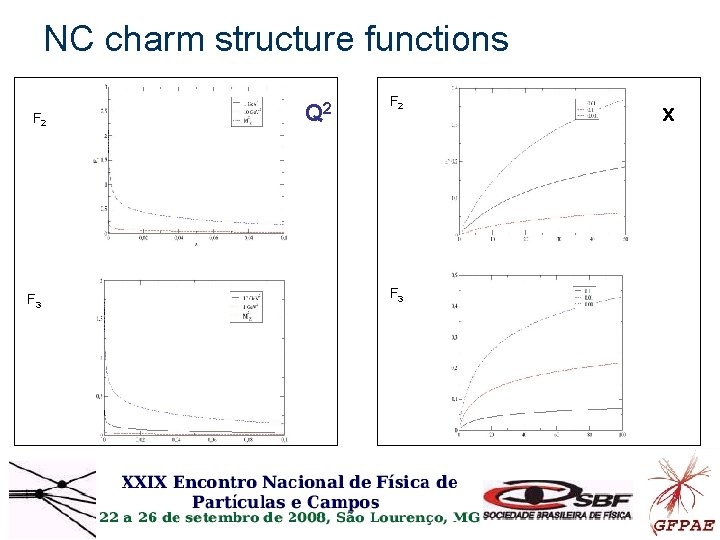
NC charm structure functions F 2 F 3 Q 2 F 3 x
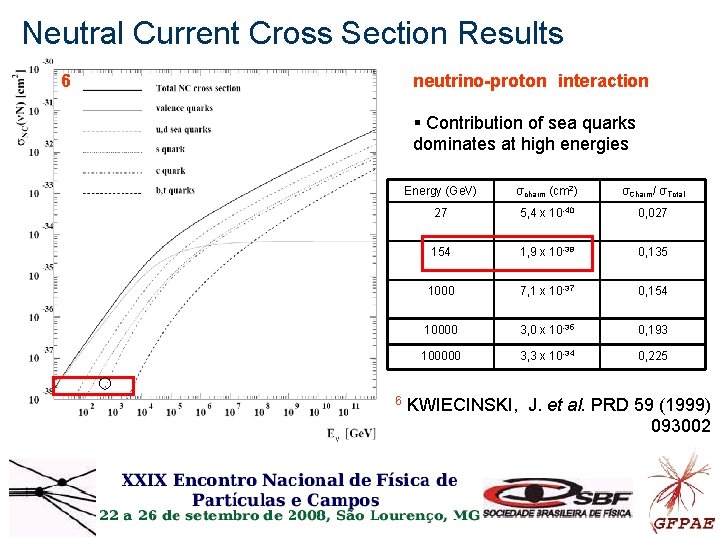
Neutral Current Cross Section Results 6 neutrino-proton interaction § Contribution of sea quarks dominates at high energies 6 Energy (Ge. V) σcharm (cm 2) σCharm/ σTotal 27 5, 4 x 10 -40 0, 027 154 1, 9 x 10 -38 0, 135 1000 7, 1 x 10 -37 0, 154 10000 3, 0 x 10 -35 0, 193 100000 3, 3 x 10 -34 0, 225 KWIECINSKI, J. et al. PRD 59 (1999) 093002
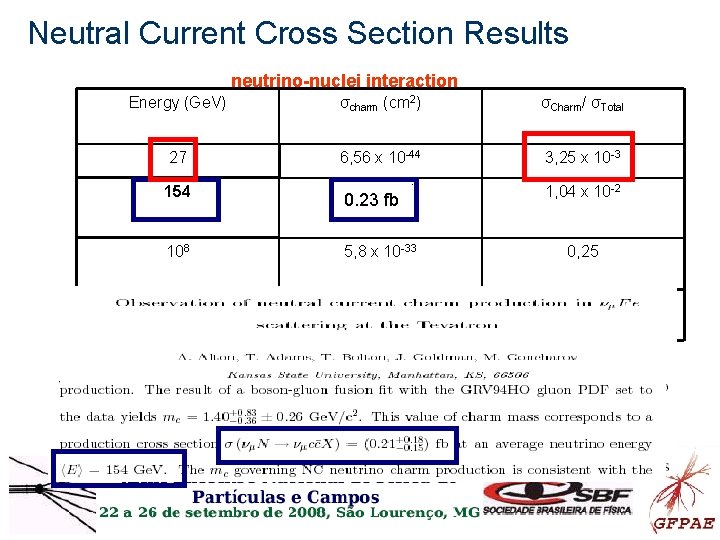
Neutral Current Cross Section Results neutrino-nuclei interaction Energy (Ge. V) σcharm (cm 2) σCharm/ σTotal 27 6, 56 x 10 -44 3, 25 x 10 -3 154 2, 33 x 10 -42 1, 04 x 10 -2 108 5, 8 x 10 -33 0, 25 109 1, 4 x 10 -33 0. 41 0. 23 fb
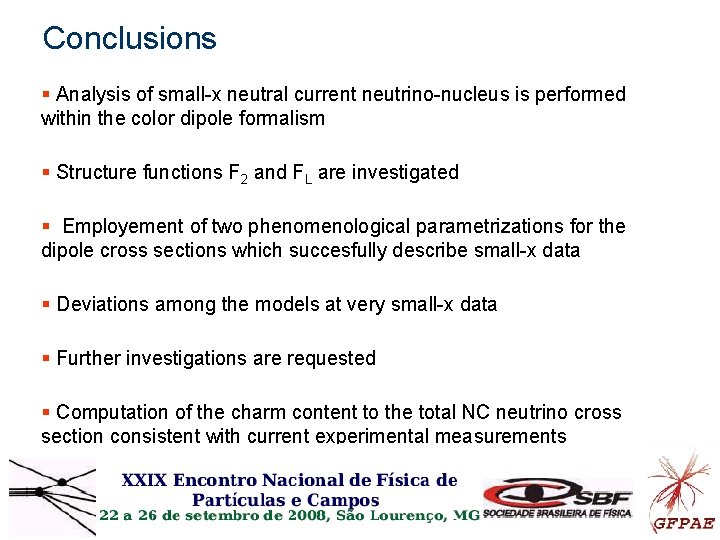
Conclusions § Analysis of small-x neutral current neutrino-nucleus is performed within the color dipole formalism § Structure functions F 2 and FL are investigated § Employement of two phenomenological parametrizations for the dipole cross sections which succesfully describe small-x data § Deviations among the models at very small-x data § Further investigations are requested § Computation of the charm content to the total NC neutrino cross section consistent with current experimental measurements