
QuantumInspired Genetic Algorithm with Two Supportive Search Schemes

- Slides: 17
Quantum-Inspired Genetic Algorithm with Two Supportive Search Schemes (TSSS) and Artificial Entanglement (AE) Chee Ken Choy (Kenny) Intelligent Computer Entertainment [ICE] Lab
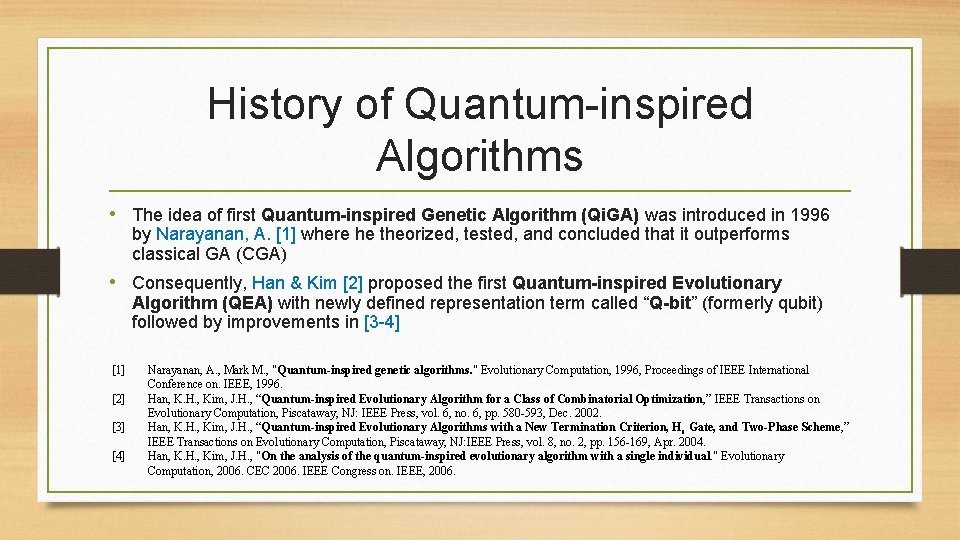
History of Quantum-inspired Algorithms • The idea of first Quantum-inspired Genetic Algorithm (Qi. GA) was introduced in 1996 by Narayanan, A. [1] where he theorized, tested, and concluded that it outperforms classical GA (CGA) • Consequently, Han & Kim [2] proposed the first Quantum-inspired Evolutionary Algorithm (QEA) with newly defined representation term called “Q-bit” (formerly qubit) followed by improvements in [3 -4] [1] [2] [3] [4] Narayanan, A. , Mark M. , "Quantum-inspired genetic algorithms. " Evolutionary Computation, 1996, Proceedings of IEEE International Conference on. IEEE, 1996. Han, K. H. , Kim, J. H. , “Quantum-inspired Evolutionary Algorithm for a Class of Combinatorial Optimization, ” IEEE Transactions on Evolutionary Computation, Piscataway, NJ: IEEE Press, vol. 6, no. 6, pp. 580 -593, Dec. 2002. Han, K. H. , Kim, J. H. , “Quantum-inspired Evolutionary Algorithms with a New Termination Criterion, H ε Gate, and Two-Phase Scheme, ” IEEE Transactions on Evolutionary Computation, Piscataway, NJ: IEEE Press, vol. 8, no. 2, pp. 156 -169, Apr. 2004. Han, K. H. , Kim, J. H. , "On the analysis of the quantum-inspired evolutionary algorithm with a single individual. " Evolutionary Computation, 2006. CEC 2006. IEEE Congress on. IEEE, 2006.
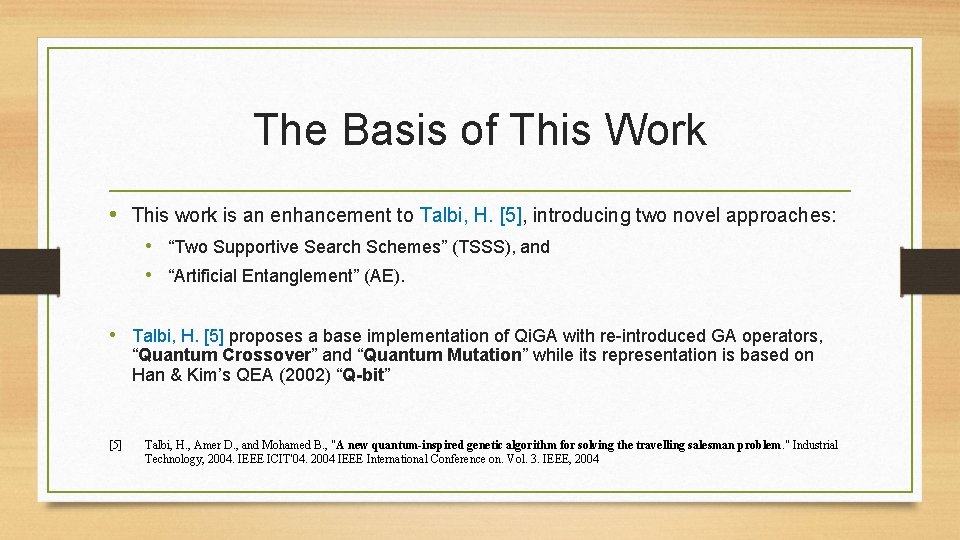
The Basis of This Work • This work is an enhancement to Talbi, H. [5], introducing two novel approaches: • “Two Supportive Search Schemes” (TSSS), and • “Artificial Entanglement” (AE). • Talbi, H. [5] proposes a base implementation of Qi. GA with re-introduced GA operators, “Quantum Crossover” and “Quantum Mutation” while its representation is based on Han & Kim’s QEA (2002) “Q-bit” [5] Talbi, H. , Amer D. , and Mohamed B. , "A new quantum-inspired genetic algorithm for solving the travelling salesman problem. " Industrial Technology, 2004. IEEE ICIT'04. 2004 IEEE International Conference on. Vol. 3. IEEE, 2004
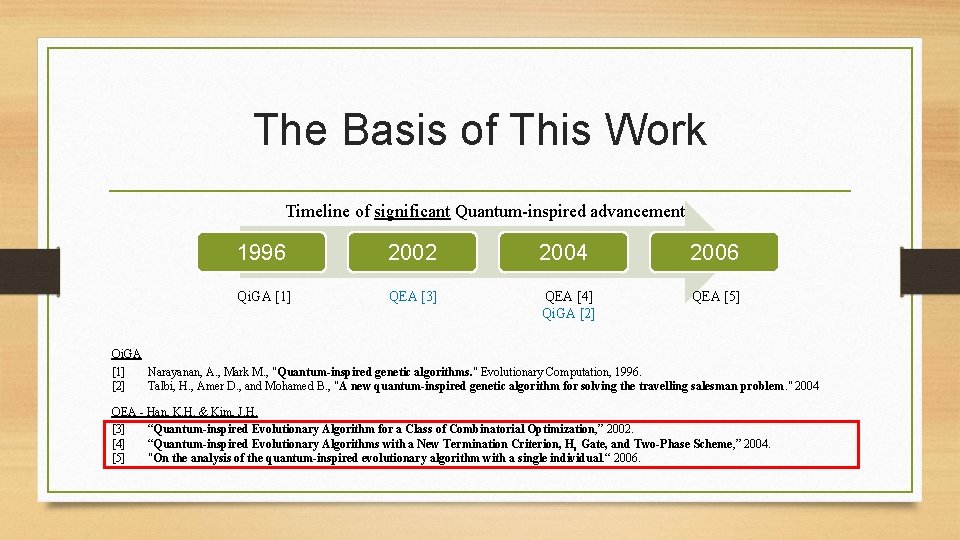
The Basis of This Work Timeline of significant Quantum-inspired advancement 1996 2002 2004 2006 Qi. GA [1] QEA [3] QEA [4] Qi. GA [2] QEA [5] Qi. GA [1] Narayanan, A. , Mark M. , "Quantum-inspired genetic algorithms. " Evolutionary Computation, 1996. [2] Talbi, H. , Amer D. , and Mohamed B. , "A new quantum-inspired genetic algorithm for solving the travelling salesman problem. " 2004 QEA - Han, K. H. & Kim, J. H. [3] “Quantum-inspired Evolutionary Algorithm for a Class of Combinatorial Optimization, ” 2002. [4] “Quantum-inspired Evolutionary Algorithms with a New Termination Criterion, H ε Gate, and Two-Phase Scheme, ” 2004. [5] "On the analysis of the quantum-inspired evolutionary algorithm with a single individual. “ 2006.
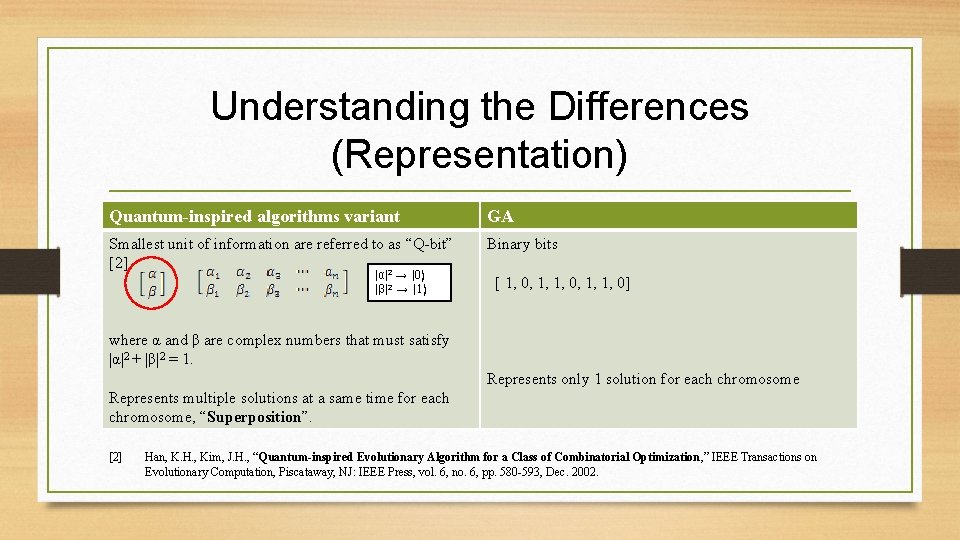
Understanding the Differences (Representation) Quantum-inspired algorithms variant GA Smallest unit of information are referred to as “Q-bit” [2] 2 Binary bits |α| → |0⟩ |β|2 → |1⟩ [ 1, 0, 1, 1, 0] where α and β are complex numbers that must satisfy |α|2 + |β|2 = 1. Represents only 1 solution for each chromosome Represents multiple solutions at a same time for each chromosome, “Superposition”. [2] Han, K. H. , Kim, J. H. , “Quantum-inspired Evolutionary Algorithm for a Class of Combinatorial Optimization, ” IEEE Transactions on Evolutionary Computation, Piscataway, NJ: IEEE Press, vol. 6, no. 6, pp. 580 -593, Dec. 2002.
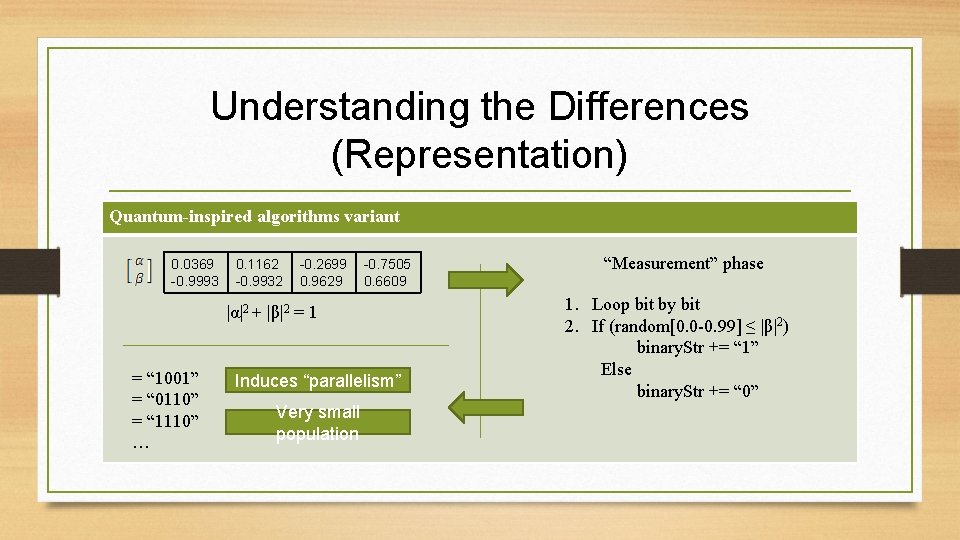
Understanding the Differences (Representation) Quantum-inspired algorithms variant 0. 0369 -0. 9993 0. 1162 -0. 9932 -0. 2699 0. 9629 -0. 7505 0. 6609 |α|2 + |β|2 = 1 = “ 1001” = “ 0110” = “ 1110” … Induces “parallelism” Very small population “Measurement” phase 1. Loop bit by bit 2. If (random[0. 0 -0. 99] ≤ |β|2) binary. Str += “ 1” Else binary. Str += “ 0”
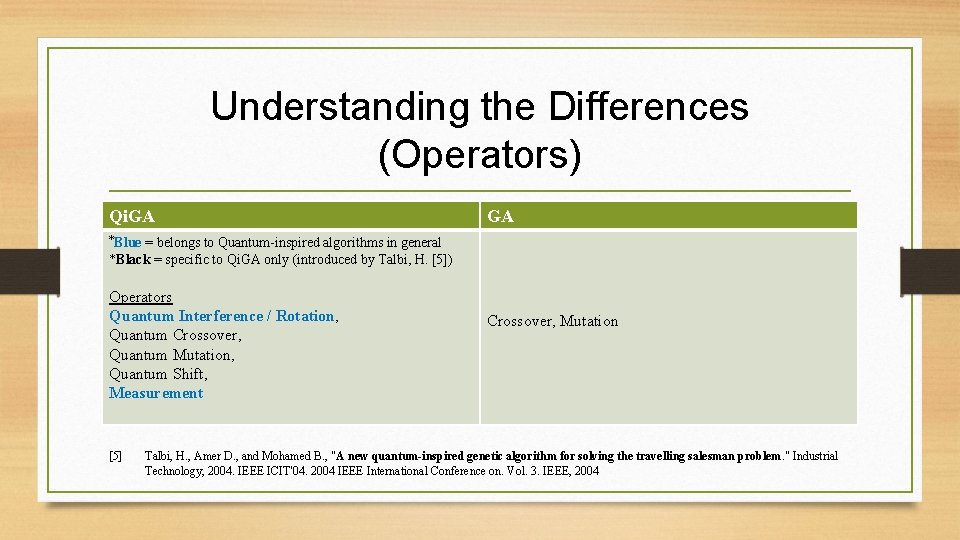
Understanding the Differences (Operators) Qi. GA GA *Blue = belongs to Quantum-inspired algorithms in general *Black = specific to Qi. GA only (introduced by Talbi, H. [5]) Operators Quantum Interference / Rotation, Quantum Crossover, Quantum Mutation, Quantum Shift, Measurement [5] Crossover, Mutation Talbi, H. , Amer D. , and Mohamed B. , "A new quantum-inspired genetic algorithm for solving the travelling salesman problem. " Industrial Technology, 2004. IEEE ICIT'04. 2004 IEEE International Conference on. Vol. 3. IEEE, 2004
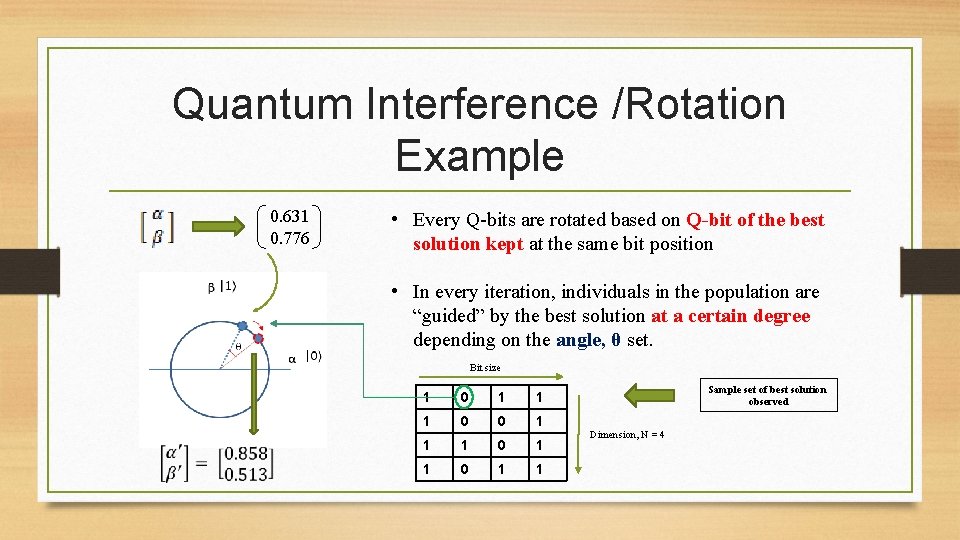
Quantum Interference /Rotation Example 0. 631 0. 776 • Every Q-bits are rotated based on Q-bit of the best solution kept at the same bit position • In every iteration, individuals in the population are “guided” by the best solution at a certain degree depending on the angle, θ set. Bit size 1 0 1 1 0 1 1 Sample set of best solution observed Dimension, N = 4
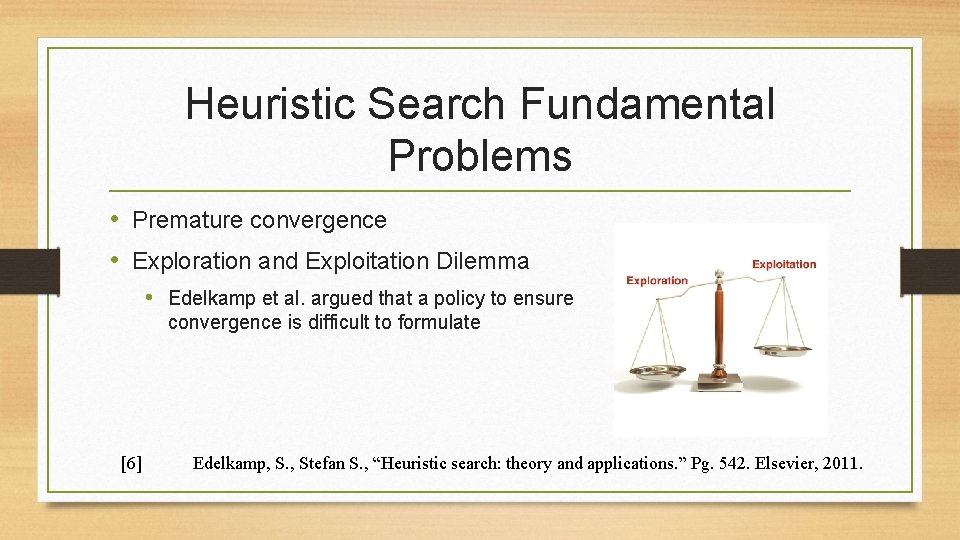
Heuristic Search Fundamental Problems • Premature convergence • Exploration and Exploitation Dilemma • Edelkamp et al. argued that a policy to ensure convergence is difficult to formulate [6] Edelkamp, S. , Stefan S. , “Heuristic search: theory and applications. ” Pg. 542. Elsevier, 2011.
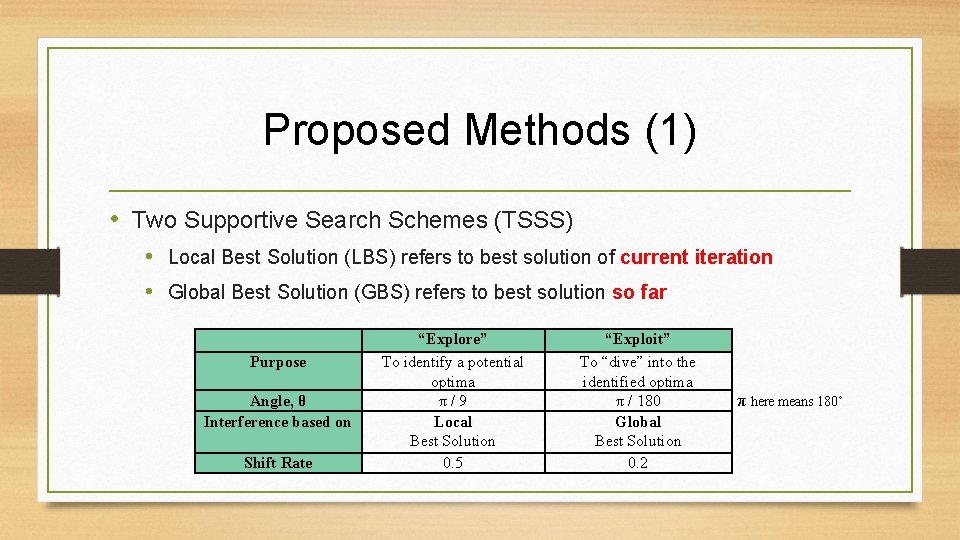
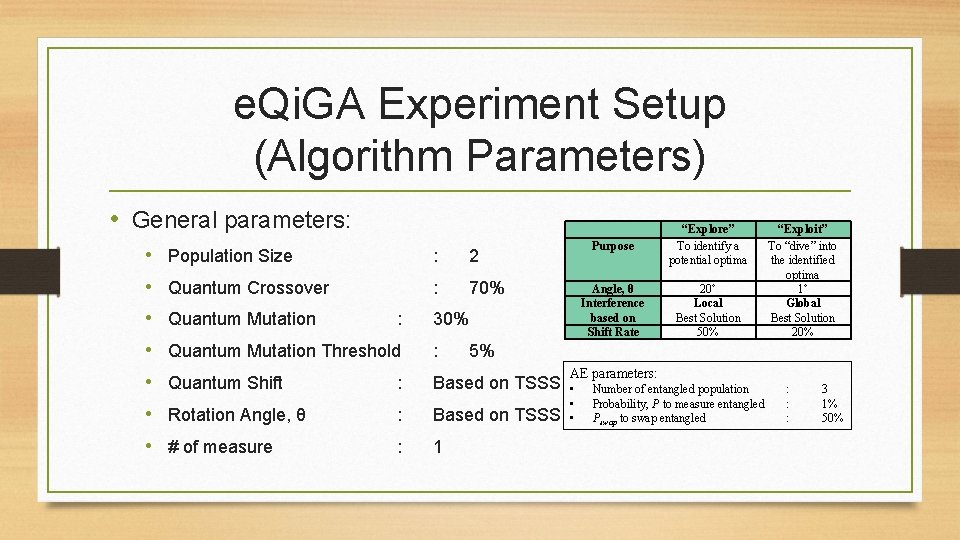
Proposed Methods (1) • Two Supportive Search Schemes (TSSS) • Local Best Solution (LBS) refers to best solution of current iteration • Global Best Solution (GBS) refers to best solution so far Purpose Angle, θ Interference based on Shift Rate “Explore” To identify a potential optima π / 9 Local Best Solution 0. 5 “Exploit” To “dive” into the identified optima π / 180 Global Best Solution 0. 2 π here means 180˚
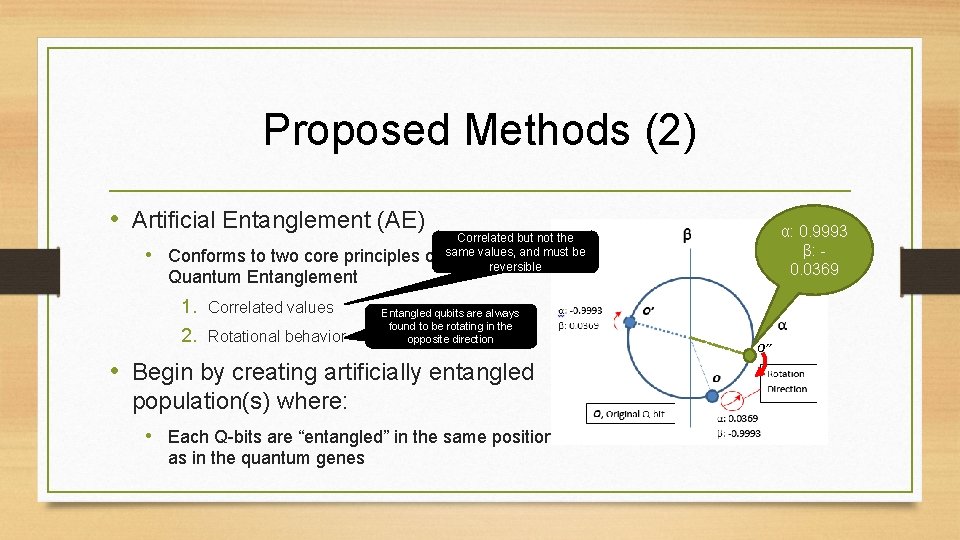
Proposed Methods (2) • Artificial Entanglement (AE) • Conforms to two core principles of Quantum Entanglement 1. Correlated values 2. Rotational behavior Entangled qubits are always found to be rotating in the opposite direction • Begin by creating artificially entangled population(s) where: • Each Q-bits are “entangled” in the same position as in the quantum genes α: 0. 9993 β: 0. 0369 Correlated but not the same values, and must be reversible O’’
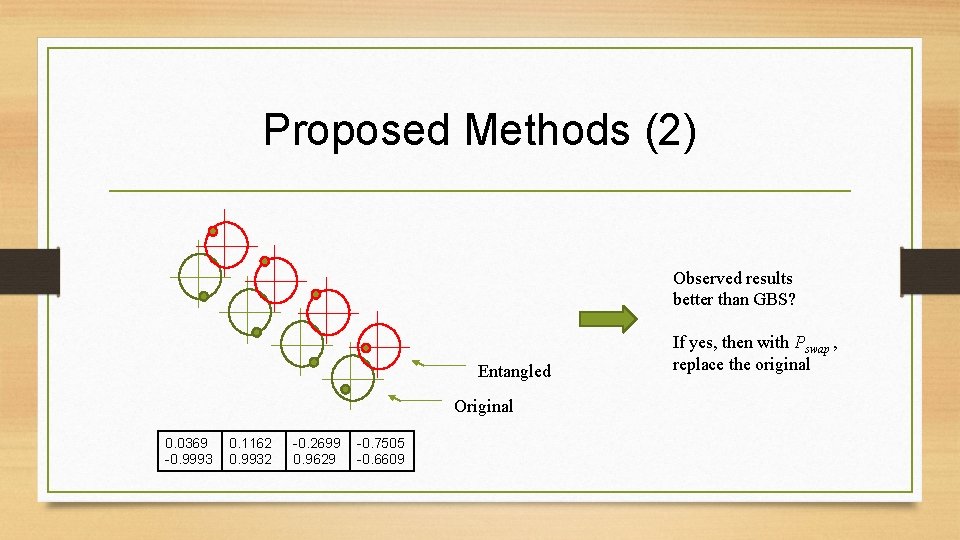
Proposed Methods (2) Observed results better than GBS? Entangled Original 0. 0369 -0. 9993 0. 1162 0. 9932 -0. 2699 0. 9629 -0. 7505 -0. 6609 If yes, then with Pswap , replace the original
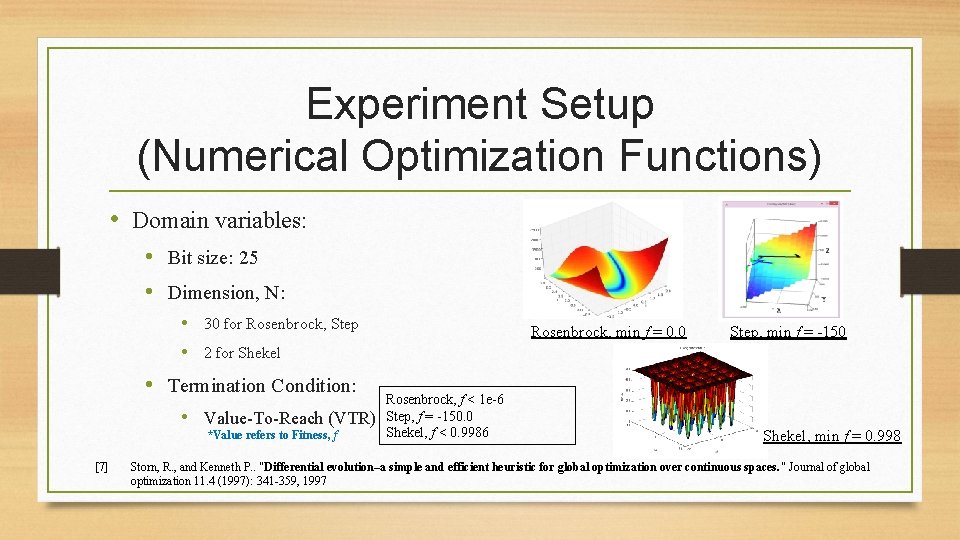
Experiment Setup (Numerical Optimization Functions) • Domain variables: • Bit size: 25 • Dimension, N: • 30 for Rosenbrock, Step Rosenbrock, min f = 0. 0 Step, min f = -150 • 2 for Shekel • Termination Condition: • Value-To-Reach (VTR) *Value refers to Fitness, f [7] Rosenbrock, f < 1 e-6 Step, f = -150. 0 Shekel, f < 0. 9986 Shekel, min f = 0. 998 Storn, R. , and Kenneth P. . "Differential evolution–a simple and efficient heuristic for global optimization over continuous spaces. " Journal of global optimization 11. 4 (1997): 341 -359, 1997
e. Qi. GA Experiment Setup (Algorithm Parameters) • General parameters: • Population Size : 2 • Quantum Crossover : 70% • Quantum Mutation : 30% • Quantum Mutation Threshold : • Quantum Shift : Based on TSSS • Rotation Angle, θ : Based on TSSS • # of measure : 1 Purpose “Explore” To identify a potential optima Angle, θ Interference based on Shift Rate 20˚ Local Best Solution 50% “Exploit” To “dive” into the identified optima 1˚ Global Best Solution 20% 5% AE parameters: • • • Number of entangled population Probability, P to measure entangled Pswap to swap entangled : : : 3 1% 50%
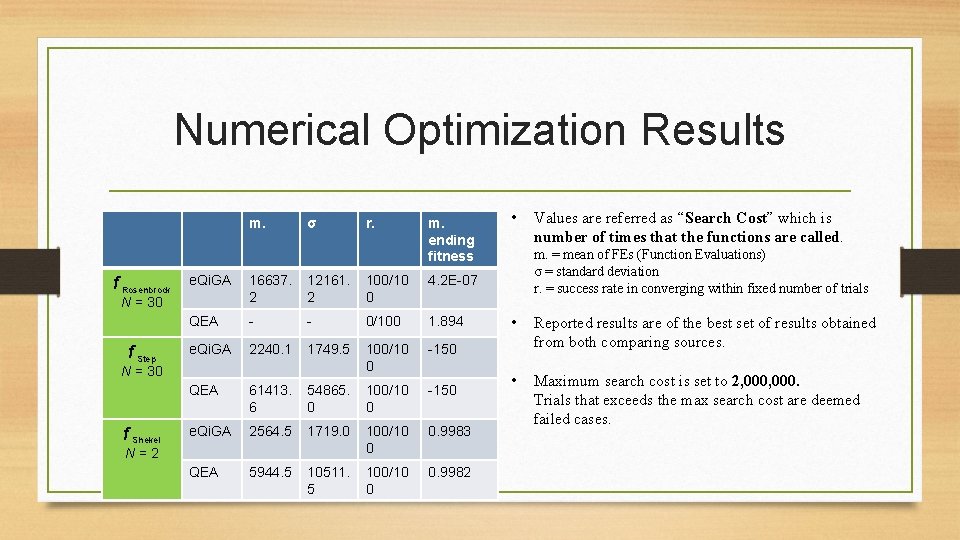
Numerical Optimization Results m. f Rosenbrock m. ending fitness 16637. 2 12161. 2 100/10 0 4. 2 E-07 QEA - - 0/100 1. 894 e. Qi. GA 2240. 1 1749. 5 100/10 0 -150 QEA 61413. 6 54865. 0 100/10 0 -150 e. Qi. GA 2564. 5 1719. 0 100/10 0 0. 9983 QEA 5944. 5 10511. 5 100/10 0 0. 9982 N = 30 f Shekel r. e. Qi. GA N = 30 f Step σ N=2 • Values are referred as “Search Cost” which is number of times that the functions are called. m. = mean of FEs (Function Evaluations) σ = standard deviation r. = success rate in converging within fixed number of trials • Reported results are of the best set of results obtained from both comparing sources. • Maximum search cost is set to 2, 000. Trials that exceeds the max search cost are deemed failed cases.
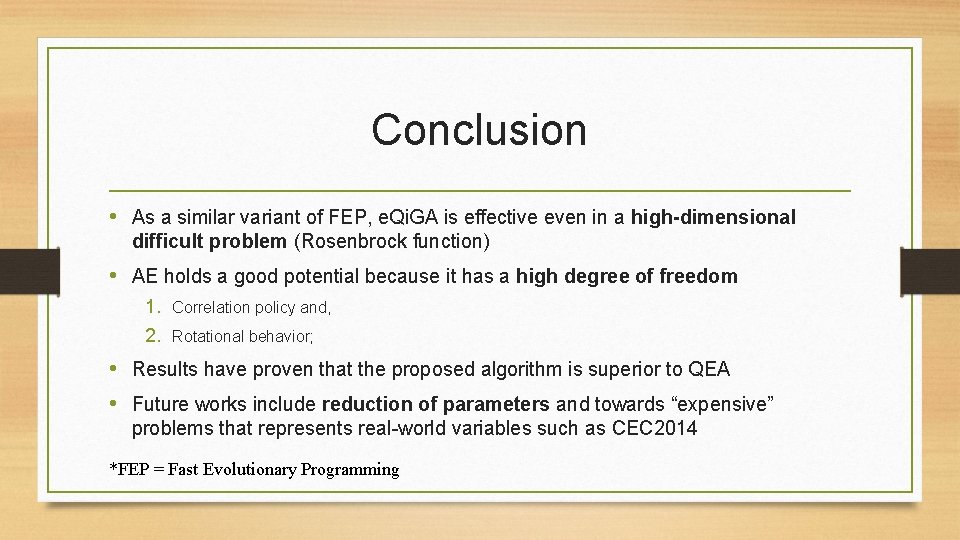
Conclusion • As a similar variant of FEP, e. Qi. GA is effective even in a high-dimensional difficult problem (Rosenbrock function) • AE holds a good potential because it has a high degree of freedom 1. Correlation policy and, 2. Rotational behavior; • Results have proven that the proposed algorithm is superior to QEA • Future works include reduction of parameters and towards “expensive” problems that represents real-world variables such as CEC 2014 *FEP = Fast Evolutionary Programming
Thank you Any questions are certainly most welcomed.