
Quantumcomputational universality and quantum phase transitions in the
- Slides: 16
Quantum-computational universality and quantum phase transitions in the ground states of spin lattices Stephen Bartlett in collaboration with Andrew Doherty (UQ)
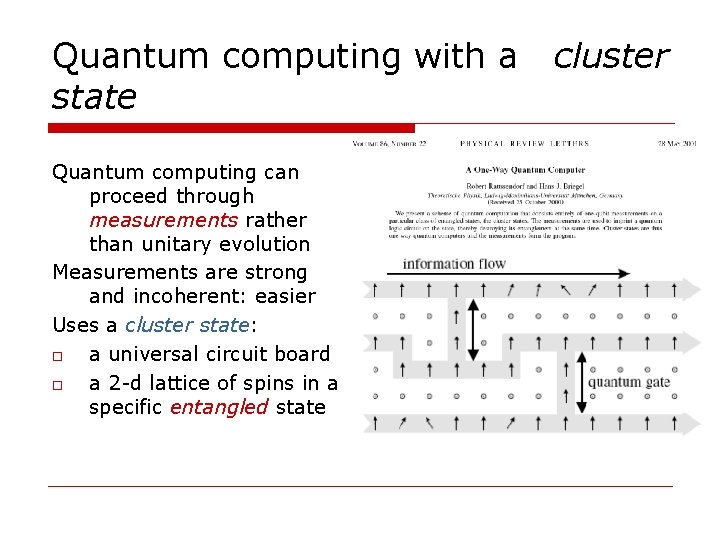
Quantum computing with a state Quantum computing can proceed through measurements rather than unitary evolution Measurements are strong and incoherent: easier Uses a cluster state: o a universal circuit board o a 2 -d lattice of spins in a specific entangled state cluster
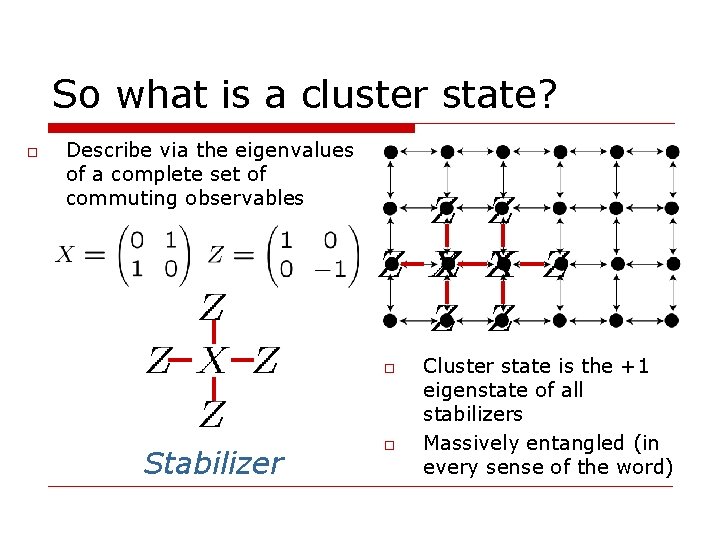
So what is a cluster state? o Describe via the eigenvalues of a complete set of commuting observables o Stabilizer o Cluster state is the +1 eigenstate of all stabilizers Massively entangled (in every sense of the word)
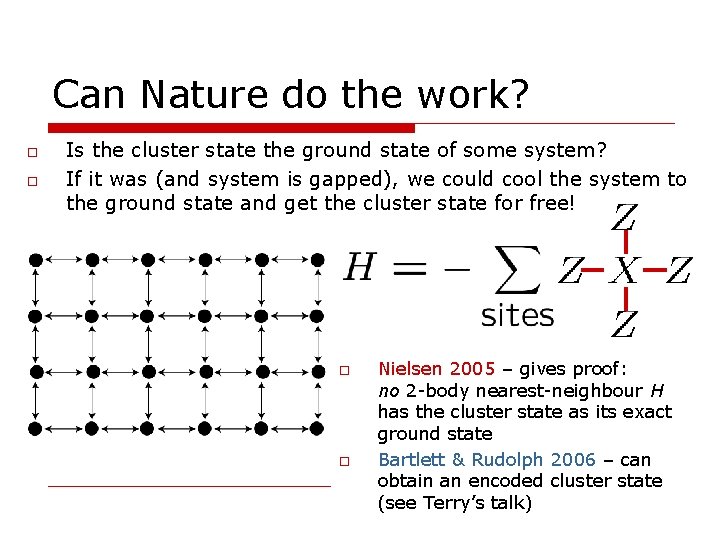
Can Nature do the work? o o Is the cluster state the ground state of some system? If it was (and system is gapped), we could cool the system to the ground state and get the cluster state for free! o o Nielsen 2005 – gives proof: no 2 -body nearest-neighbour H has the cluster state as its exact ground state Bartlett & Rudolph 2006 – can obtain an encoded cluster state (see Terry’s talk)
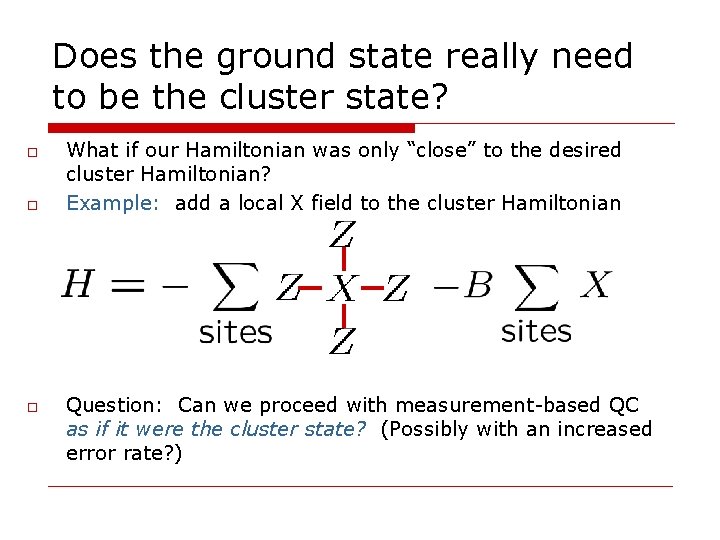
Does the ground state really need to be the cluster state? o o o What if our Hamiltonian was only “close” to the desired cluster Hamiltonian? Example: add a local X field to the cluster Hamiltonian Question: Can we proceed with measurement-based QC as if it were the cluster state? (Possibly with an increased error rate? )
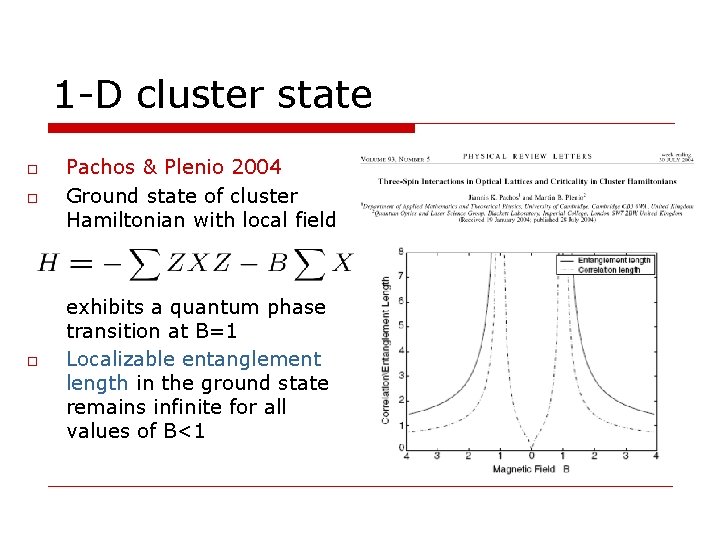
1 -D cluster state o Pachos & Plenio 2004 Ground state of cluster Hamiltonian with local field o exhibits a quantum phase transition at B=1 Localizable entanglement length in the ground state remains infinite for all values of B<1 o
1 -D cluster state redux Outline: n map the cluster Hamiltonian with local field to a (pair of) known models n relate the correlation functions and critical behaviour of the two models
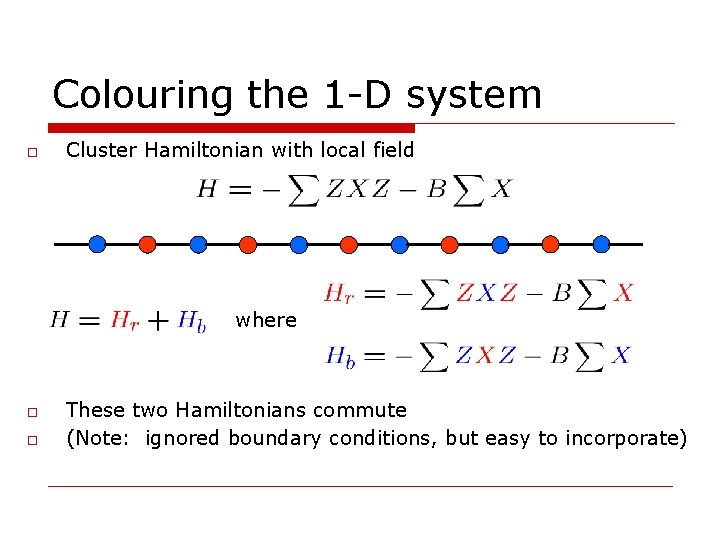
Colouring the 1 -D system o Cluster Hamiltonian with local field where o o These two Hamiltonians commute (Note: ignored boundary conditions, but easy to incorporate)
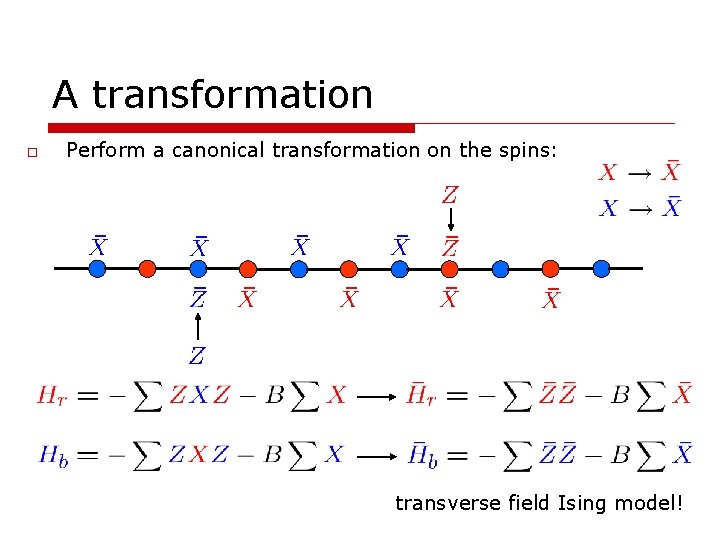
A transformation o Perform a canonical transformation on the spins: transverse field Ising model!
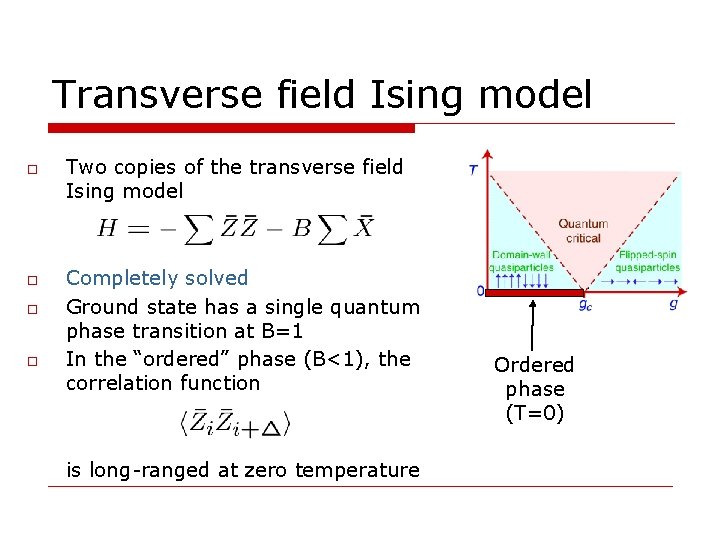
Transverse field Ising model o o Two copies of the transverse field Ising model Completely solved Ground state has a single quantum phase transition at B=1 In the “ordered” phase (B<1), the correlation function is long-ranged at zero temperature Ordered phase (T=0)
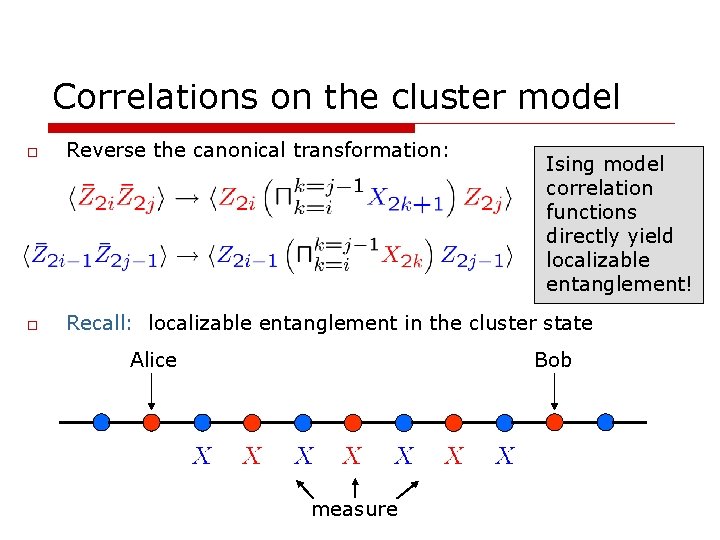
Correlations on the cluster model o Reverse the canonical transformation: o Recall: localizable entanglement in the cluster state Alice Ising model correlation functions directly yield localizable entanglement! Bob measure
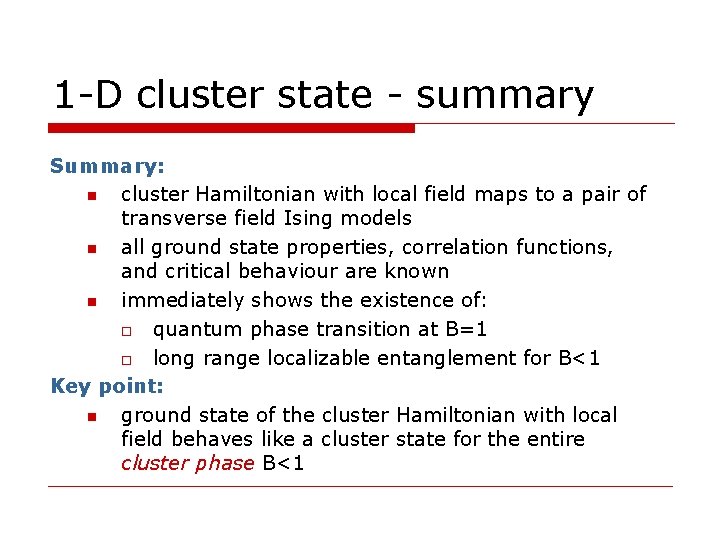
1 -D cluster state - summary Summary: n cluster Hamiltonian with local field maps to a pair of transverse field Ising models n all ground state properties, correlation functions, and critical behaviour are known n immediately shows the existence of: o quantum phase transition at B=1 o long range localizable entanglement for B<1 Key point: n ground state of the cluster Hamiltonian with local field behaves like a cluster state for the entire cluster phase B<1
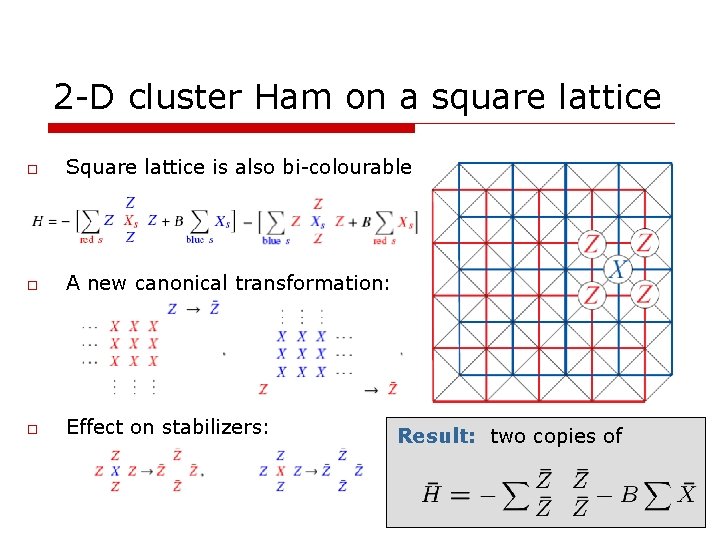
2 -D cluster Ham on a square lattice o Square lattice is also bi-colourable o A new canonical transformation: o Effect on stabilizers: Result: two copies of
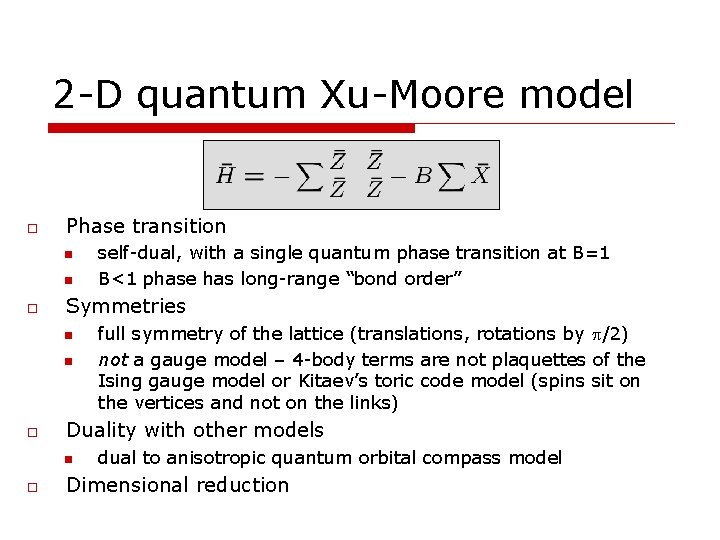
2 -D quantum Xu-Moore model o Phase transition n n o Symmetries n n o full symmetry of the lattice (translations, rotations by /2) not a gauge model – 4 -body terms are not plaquettes of the Ising gauge model or Kitaev’s toric code model (spins sit on the vertices and not on the links) Duality with other models n o self-dual, with a single quantum phase transition at B=1 B<1 phase has long-range “bond order” dual to anisotropic quantum orbital compass model Dimensional reduction
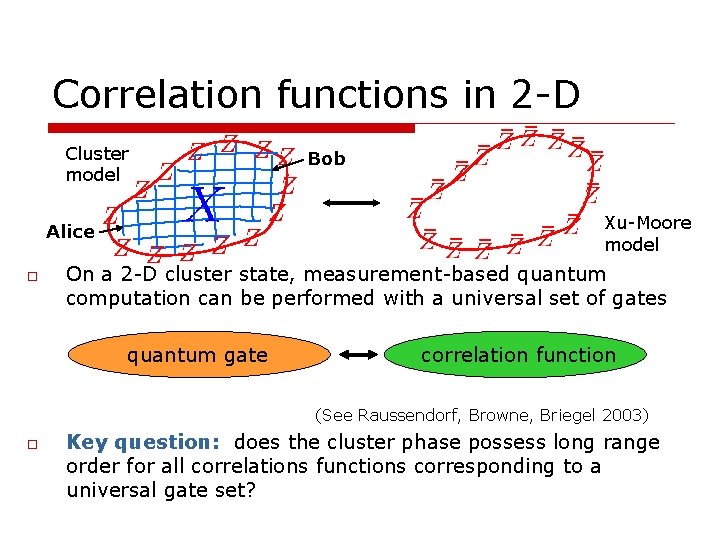
Correlation functions in 2 -D Cluster model Xu-Moore model Alice o Bob On a 2 -D cluster state, measurement-based quantum computation can be performed with a universal set of gates quantum gate correlation function (See Raussendorf, Browne, Briegel 2003) o Key question: does the cluster phase possess long range order for all correlations functions corresponding to a universal gate set?
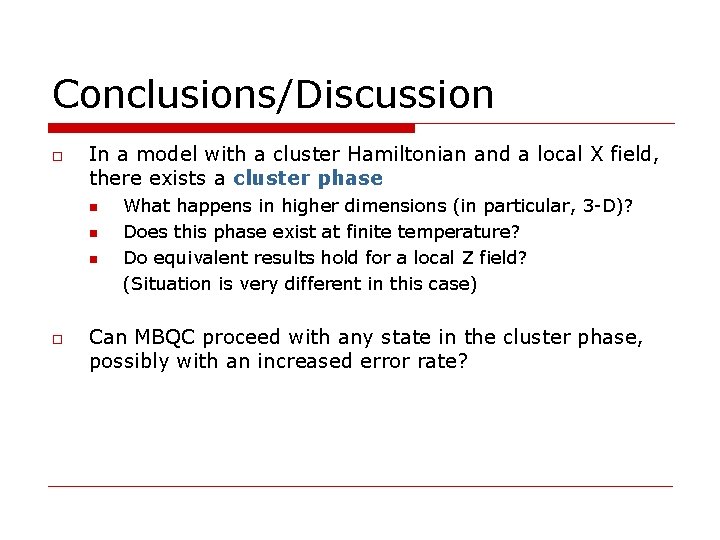
Conclusions/Discussion o In a model with a cluster Hamiltonian and a local X field, there exists a cluster phase n n n o What happens in higher dimensions (in particular, 3 -D)? Does this phase exist at finite temperature? Do equivalent results hold for a local Z field? (Situation is very different in this case) Can MBQC proceed with any state in the cluster phase, possibly with an increased error rate?