
QUANTUM SUPREMACY Post BQP Post BPP Scott Aaronson
QUANTUM SUPREMACY Post. BQP Post. BPP Scott Aaronson (MIT UT Austin) MSR, Redmond, July 15, 2016 Joint work with Lijie Chen
| #1 Application of QC: Disprove the QC skeptics (and the Extended Church-Turing Thesis)! Forget for now about applications. Just concentrate on certainty of a quantum speedup over the best classical algorithm for some task
Physicists will need to think like applied cryptographers! • Define a clear task that your quantum device performs • Think hard about how your worst enemy would perform that task (or appear to…) using classical resources only Closest historical analogue in physics: the Bell inequality • Publish benchmark challenges for classical skeptics • Isolate the cleanest possible hardness assumption that implies what you want • Leave a safety margin!

The Sampling Approach Examples: Boson. Sampling (A. -Arkhipov 2011), Fourier. Sampling/IQP (Bremner-Jozsa-Shepherd 2011), QAOA, stabilizer circuits with magic states… Consider sampling problems, where given an input x, we’re asked to output a sample (exactly or approximately) from a probability distribution Dx over n-bit strings Compared to problems with a single valid output (like FACTORING), sampling problems can be (1) Easier to solve with near-future quantum devices, and (2) Easier to argue are hard for classical computers! (We “merely” give up on: practical applications, fast classical way to verify the result)
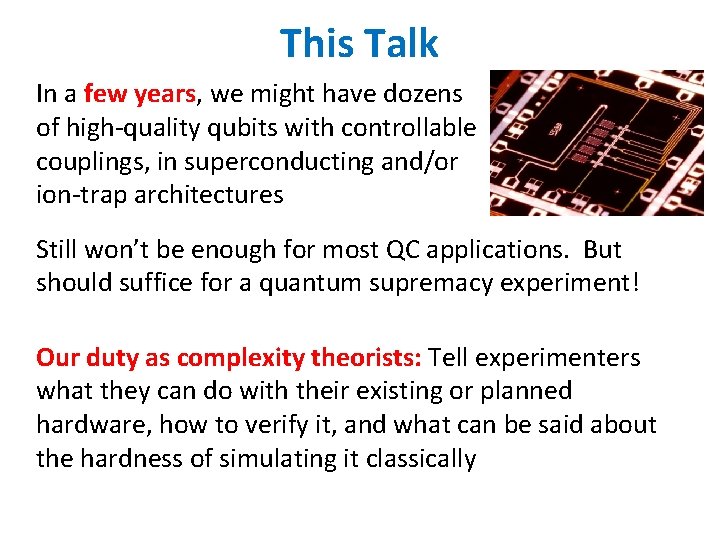
This Talk In a few years, we might have dozens of high-quality qubits with controllable couplings, in superconducting and/or ion-trap architectures Still won’t be enough for most QC applications. But should suffice for a quantum supremacy experiment! Our duty as complexity theorists: Tell experimenters what they can do with their existing or planned hardware, how to verify it, and what can be said about the hardness of simulating it classically

The Random Quantum Circuit Proposal Generate a quantum circuit C on n qubits in a n n lattice, with d layers of random nearest-neighbor gates Apply C to |0 n and measure. Repeat t times, to obtain samples x 1, …, x. T from {0, 1}n Apply a statistical test to x 1, …, x. T (taking classical exponential time, which is OK for n 40) Publish C. Challenge skeptics to generate samples passing the test in a reasonable amount of time
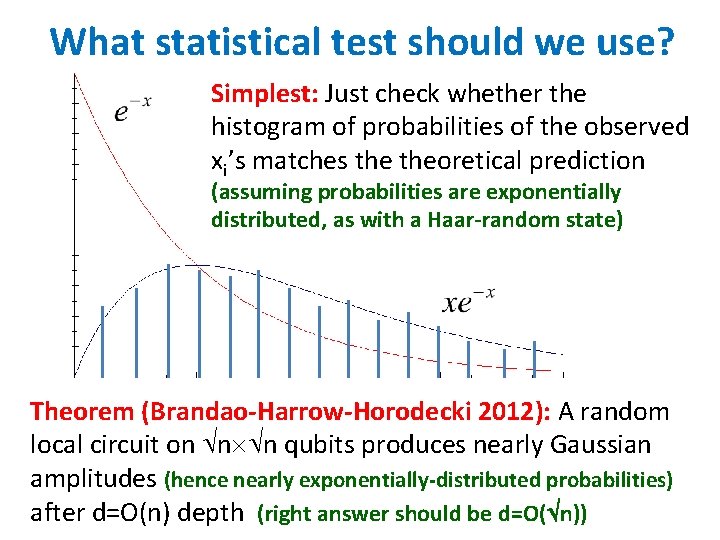
What statistical test should we use? Simplest: Just check whether the histogram of probabilities of the observed xi’s matches theoretical prediction (assuming probabilities are exponentially distributed, as with a Haar-random state) Theorem (Brandao-Harrow-Horodecki 2012): A random local circuit on n n qubits produces nearly Gaussian amplitudes (hence nearly exponentially-distributed probabilities) after d=O(n) depth (right answer should be d=O( n))
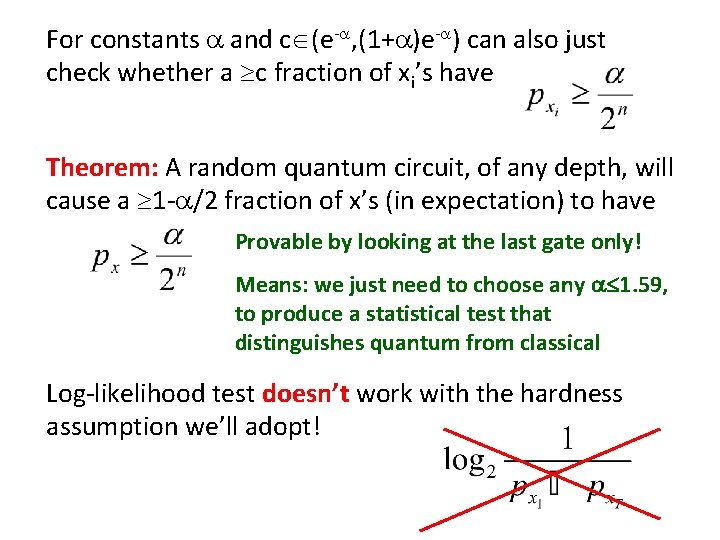
For constants and c (e- , (1+ )e- ) can also just check whether a c fraction of xi’s have Theorem: A random quantum circuit, of any depth, will cause a 1 - /2 fraction of x’s (in expectation) to have Provable by looking at the last gate only! Means: we just need to choose any 1. 59, to produce a statistical test that distinguishes quantum from classical Log-likelihood test doesn’t work with the hardness assumption we’ll adopt!
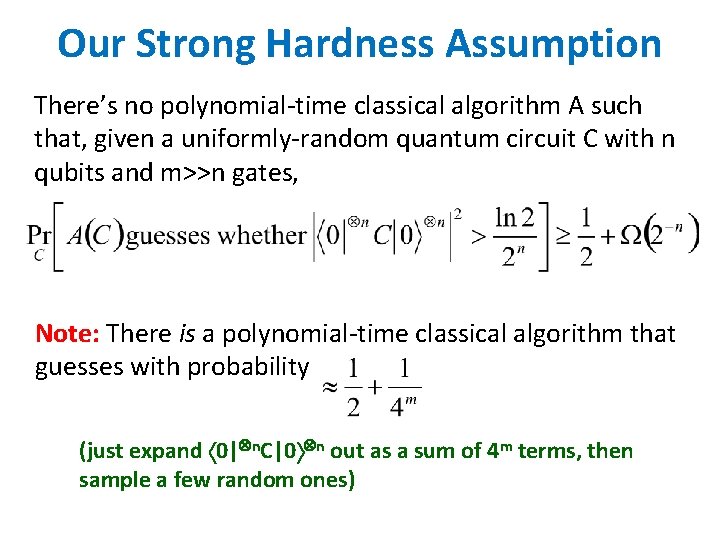
Our Strong Hardness Assumption There’s no polynomial-time classical algorithm A such that, given a uniformly-random quantum circuit C with n qubits and m>>n gates, Note: There is a polynomial-time classical algorithm that guesses with probability (just expand 0| n. C|0 n out as a sum of 4 m terms, then sample a few random ones)
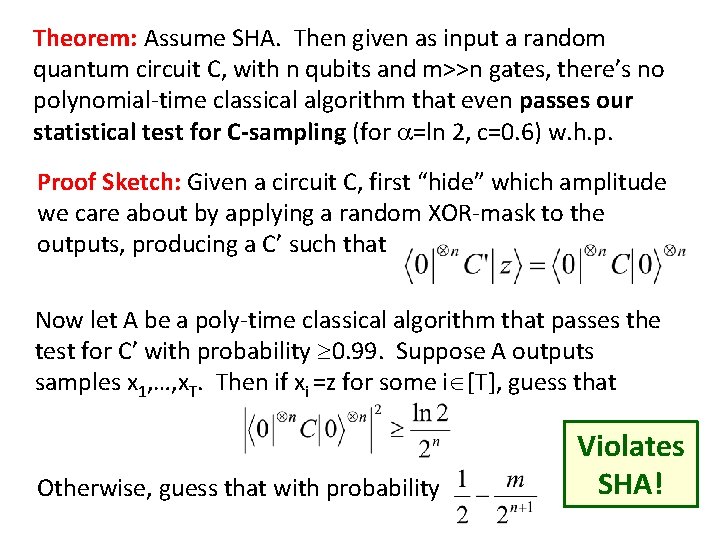
Theorem: Assume SHA. Then given as input a random quantum circuit C, with n qubits and m>>n gates, there’s no polynomial-time classical algorithm that even passes our statistical test for C-sampling (for =ln 2, c=0. 6) w. h. p. Proof Sketch: Given a circuit C, first “hide” which amplitude we care about by applying a random XOR-mask to the outputs, producing a C’ such that Now let A be a poly-time classical algorithm that passes the test for C’ with probability 0. 99. Suppose A outputs samples x 1, …, x. T. Then if xi =z for some i [T], guess that Otherwise, guess that with probability Violates SHA!
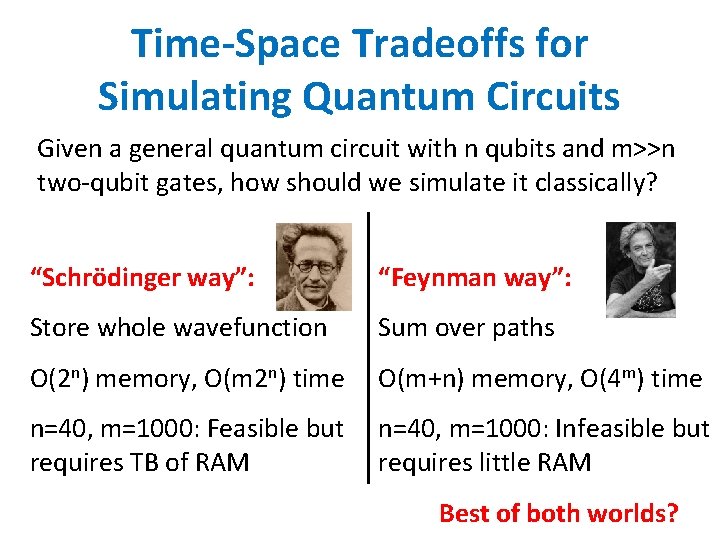
Time-Space Tradeoffs for Simulating Quantum Circuits Given a general quantum circuit with n qubits and m>>n two-qubit gates, how should we simulate it classically? “Schrödinger way”: “Feynman way”: Store whole wavefunction Sum over paths O(2 n) memory, O(m 2 n) time O(m+n) memory, O(4 m) time n=40, m=1000: Feasible but requires TB of RAM n=40, m=1000: Infeasible but requires little RAM Best of both worlds?
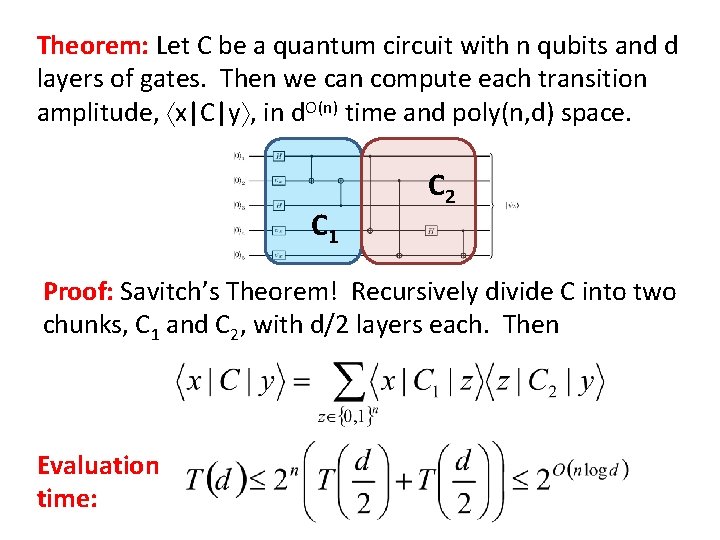
Theorem: Let C be a quantum circuit with n qubits and d layers of gates. Then we can compute each transition amplitude, x|C|y , in d. O(n) time and poly(n, d) space. C 1 C 2 Proof: Savitch’s Theorem! Recursively divide C into two chunks, C 1 and C 2, with d/2 layers each. Then Evaluation time:
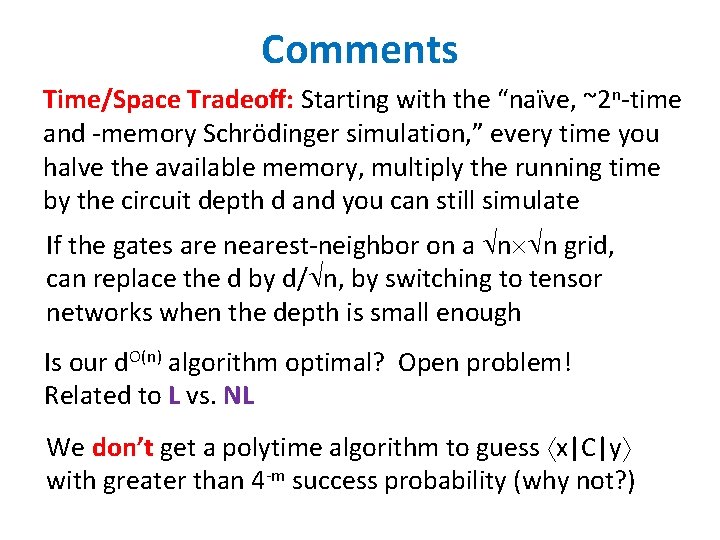
Comments Time/Space Tradeoff: Starting with the “naïve, ~2 n-time and -memory Schrödinger simulation, ” every time you halve the available memory, multiply the running time by the circuit depth d and you can still simulate If the gates are nearest-neighbor on a n n grid, can replace the d by d/ n, by switching to tensor networks when the depth is small enough Is our d. O(n) algorithm optimal? Open problem! Related to L vs. NL We don’t get a polytime algorithm to guess x|C|y with greater than 4 -m success probability (why not? )
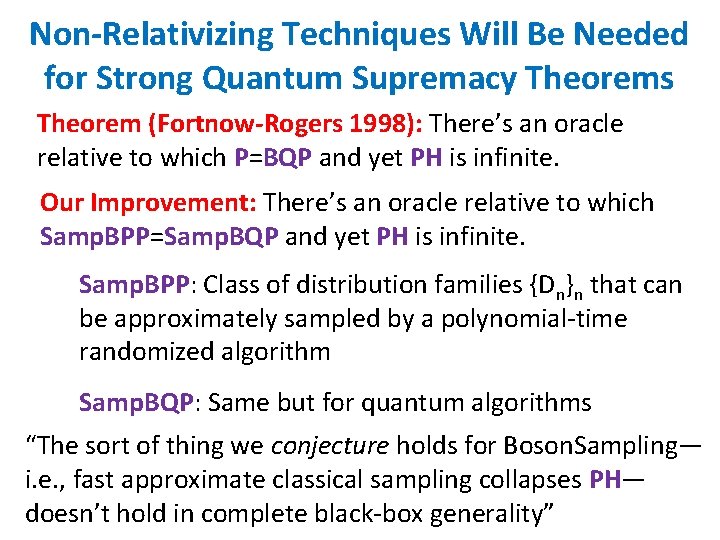
Non-Relativizing Techniques Will Be Needed for Strong Quantum Supremacy Theorems Theorem (Fortnow-Rogers 1998): There’s an oracle relative to which P=BQP and yet PH is infinite. Our Improvement: There’s an oracle relative to which Samp. BPP=Samp. BQP and yet PH is infinite. Samp. BPP: Class of distribution families {Dn}n that can be approximately sampled by a polynomial-time randomized algorithm Samp. BQP: Same but for quantum algorithms “The sort of thing we conjecture holds for Boson. Sampling— i. e. , fast approximate classical sampling collapses PH— doesn’t hold in complete black-box generality”
Theorem: There’s an oracle relative to which Samp. BPP=Samp. BQP and yet PH is infinite. Proof Sketch: Have one part of the oracle encode a PSPACE-complete language (collapsing Samp. BPP with Samp. BQP), while a second part encodes exponentially many random bits that each require an exponential search to find. This second part makes PH infinite by [Rossman-Servedio-Tan 2015], and doesn’t re-separate Samp. BPP and Samp. BQP by the BBBV lower bound
Two More “Structural Supremacy Results” Theorem: Suppose P=NP and Samp. BPP=Samp. BQP. Then Samp. BPPA=Samp. BQPA for all A P/poly. (Even to prove a quantum supremacy theorem relative to an oracle, some computational assumption is needed—if we demand that the oracle be efficiently computable) Theorem: Suppose that, for all f P/poly, there’s a polynomial-time classical algorithm that accesses f only as a black box, and passes a standard statistical test for sampling from f’s Fourier distribution. Then all one-way functions can be inverted in time (With a modest computational assumption, one can indeed get quantum supremacy relative to an efficiently computable oracle)
Conclusions In the near future, we might be able to perform random quantum circuit sampling with ~40 qubits Central question: how do we verify that something classically hard was done? There’s no “direct physical signature” of quantum supremacy, because supremacy just means the nonexistence of a fast classical algorithm to do the same thing. That’s what makes complexity theory unavoidable! As quantum computing theorists, we’d be urgently called upon to think about this, even if there were nothing theoretically interesting to say. But there is!
- Slides: 17