
Quantum Steins lemma for correlated states and asymptotic



- Slides: 33
Quantum Stein’s lemma for correlated states and asymptotic entanglement transformations Fernando G. S. L. Brandão and Martin B. Plenio ar. Xiv 0810. 0026 (chapter 4) ar. Xiv 0902. XXXX QIP 2009, Santa Fe
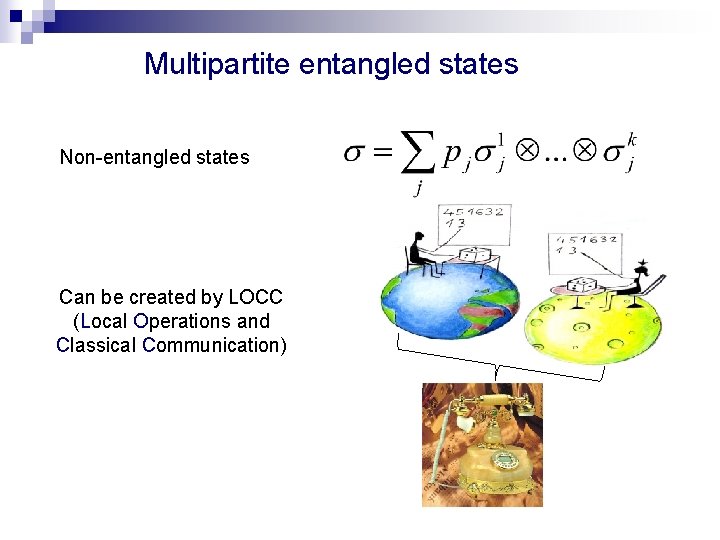
Multipartite entangled states Non-entangled states Can be created by LOCC (Local Operations and Classical Communication)
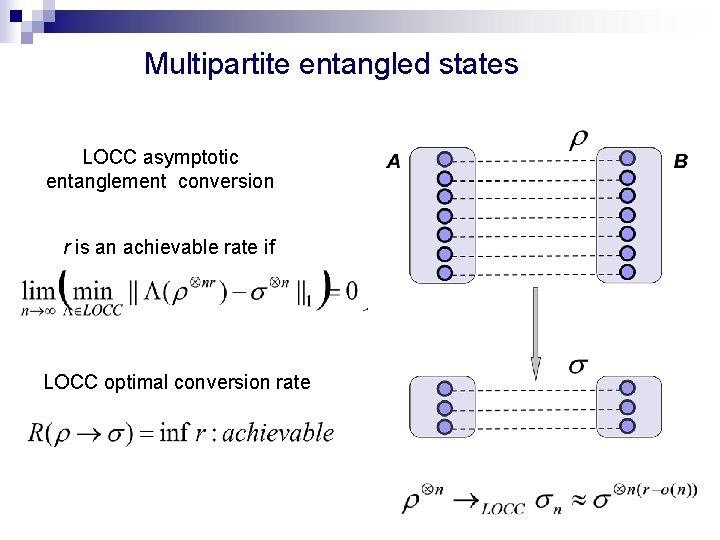
Multipartite entangled states LOCC asymptotic entanglement conversion r is an achievable rate if LOCC optimal conversion rate
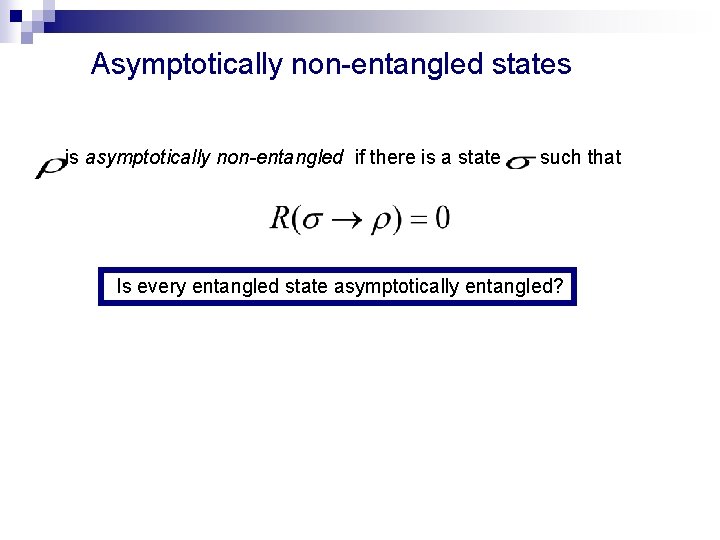
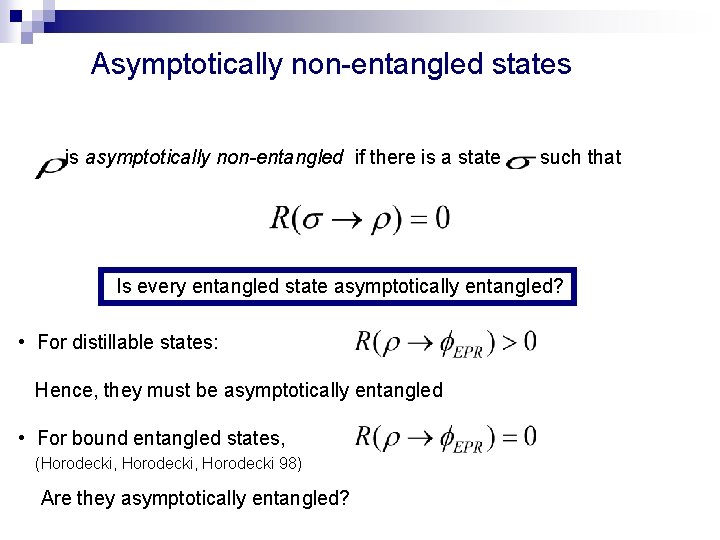
Asymptotically non-entangled states is asymptotically non-entangled if there is a state such that Is every entangled state asymptotically entangled? • For distillable states: Hence, they must be asymptotically entangled • For bound entangled states, (Horodecki, Horodecki 98) Are they asymptotically entangled?
Asymptotically non-entangled states is asymptotically non-entangled if there is a state such that Is every entangled state asymptotically entangled? • For distillable states: Hence, they must be asymptotically entangled • For bound entangled states, (Horodecki, Horodecki 98) Are they asymptotically entangled?
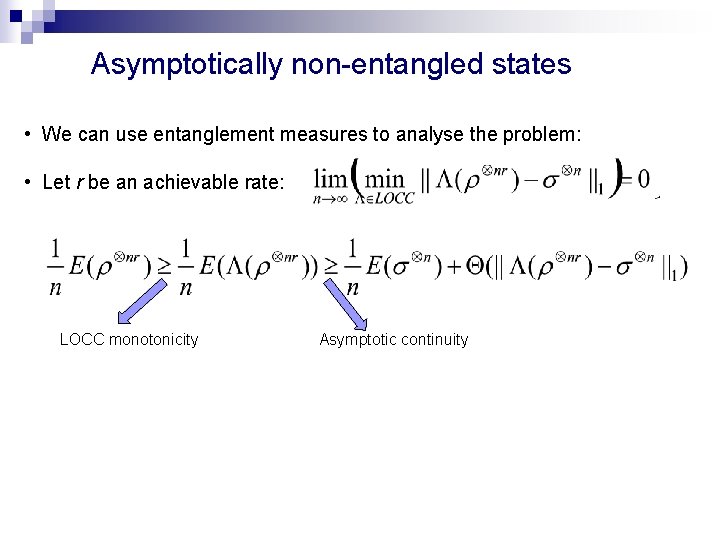
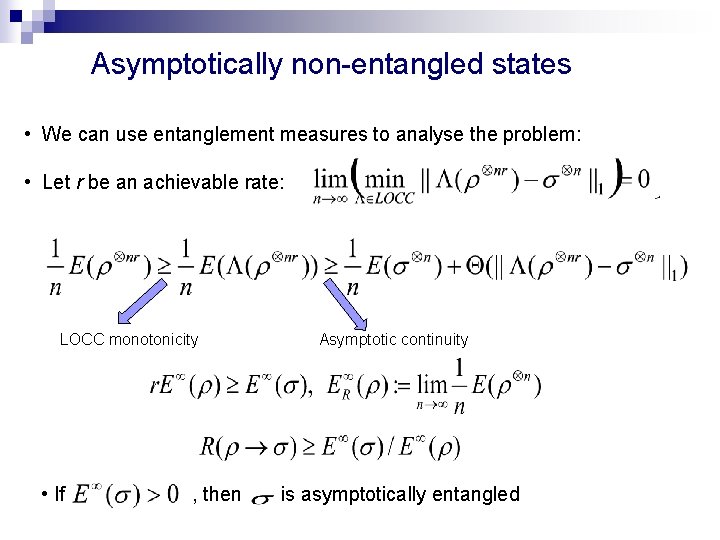
Asymptotically non-entangled states • We can use entanglement measures to analyse the problem: • Let r be an achievable rate: LOCC monotonicity • If , then Asymptotic continuity is asymptotically entangled
Asymptotically non-entangled states • We can use entanglement measures to analyse the problem: • Let r be an achievable rate: LOCC monotonicity • If , then Asymptotic continuity is asymptotically entangled
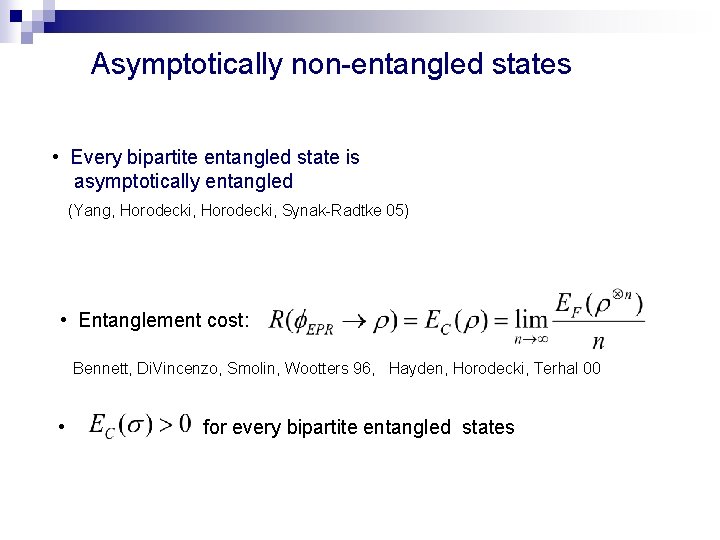
Asymptotically non-entangled states • Every bipartite entangled state is asymptotically entangled (Yang, Horodecki, Synak-Radtke 05) • Entanglement cost: Bennett, Di. Vincenzo, Smolin, Wootters 96, Hayden, Horodecki, Terhal 00 • for every bipartite entangled states
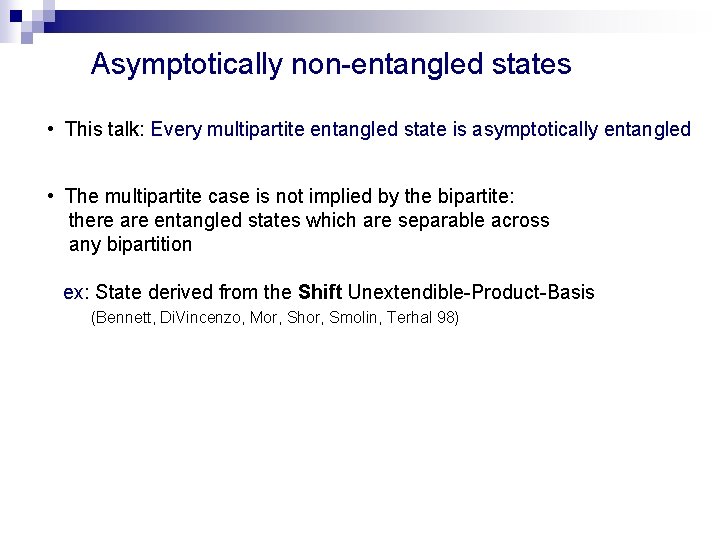
Asymptotically non-entangled states • This talk: Every multipartite entangled state is asymptotically entangled • The multipartite case is not implied by the bipartite: there are entangled states which are separable across any bipartition ex: State derived from the Shift Unextendible-Product-Basis (Bennett, Di. Vincenzo, Mor, Shor, Smolin, Terhal 98)
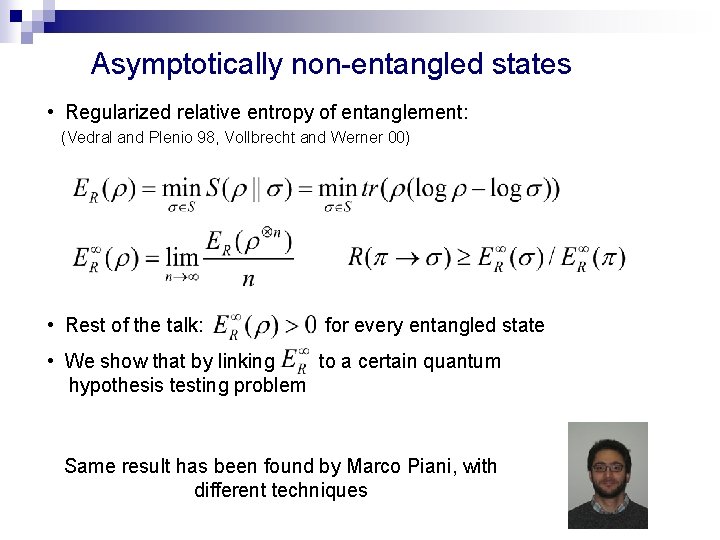
Asymptotically non-entangled states • Regularized relative entropy of entanglement: (Vedral and Plenio 98, Vollbrecht and Werner 00) • Rest of the talk: for every entangled state • We show that by linking to a certain quantum hypothesis testing problem Same result has been found by Marco Piani, with different techniques
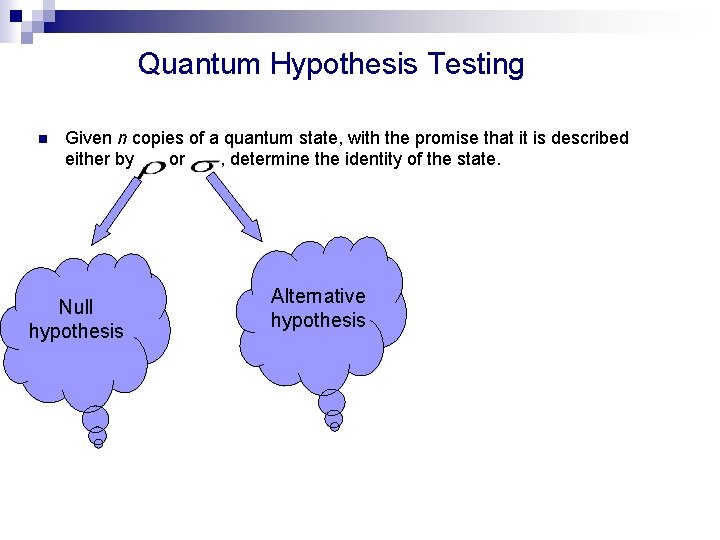
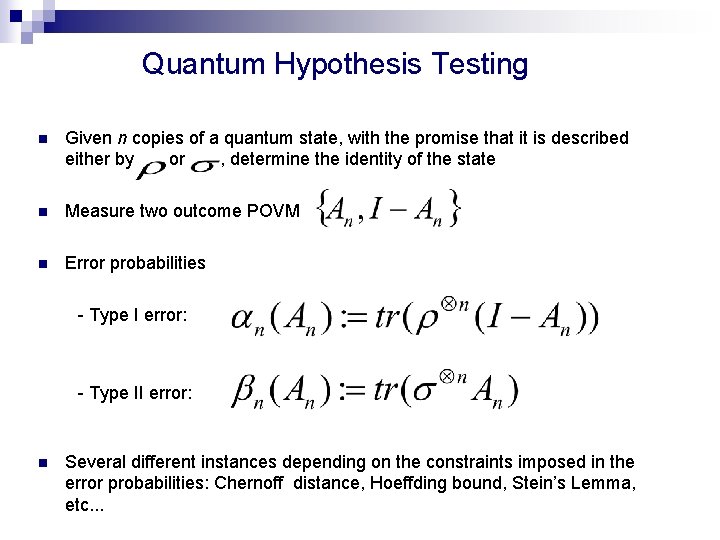
Quantum Hypothesis Testing n Given n copies of a quantum state, with the promise that it is described either by or , determine the identity of the state. n Measure two outcome POVM Error probabilities Alternative Null - Type I error: hypothesis n - Type II error: .
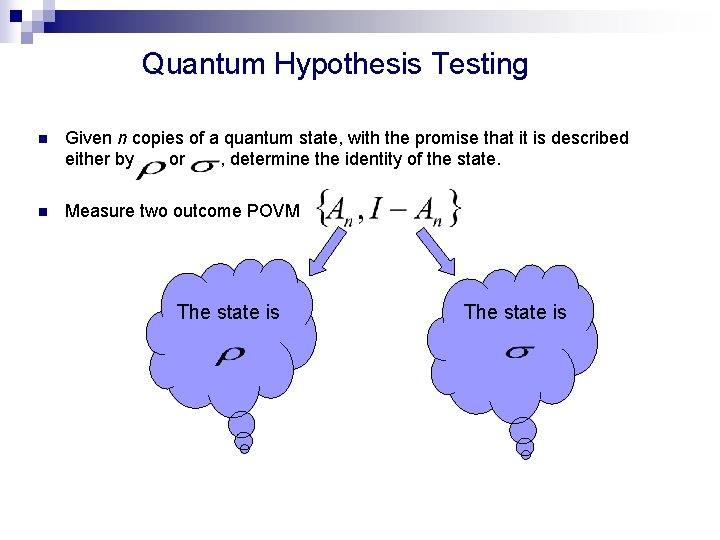
Quantum Hypothesis Testing n Given n copies of a quantum state, with the promise that it is described either by or , determine the identity of the state. n Measure two outcome POVM n Error probabilities state is - Type I The error: - Type II error: The state is
Quantum Hypothesis Testing n Given n copies of a quantum state, with the promise that it is described either by or , determine the identity of the state n Measure two outcome POVM n Error probabilities - Type I error: - Type II error: n Several different instances depending on the constraints imposed in the error probabilities: Chernoff distance, Hoeffding bound, Stein’s Lemma, etc. . .
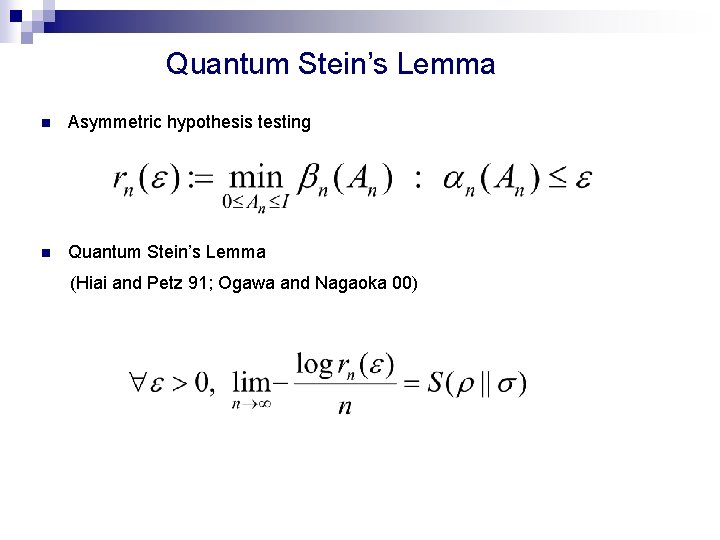
Quantum Stein’s Lemma n Asymmetric hypothesis testing n Quantum Stein’s Lemma (Hiai and Petz 91; Ogawa and Nagaoka 00)
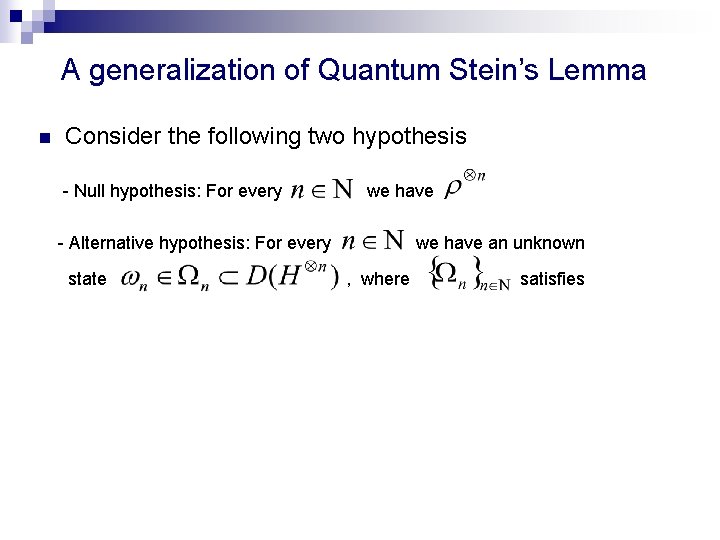
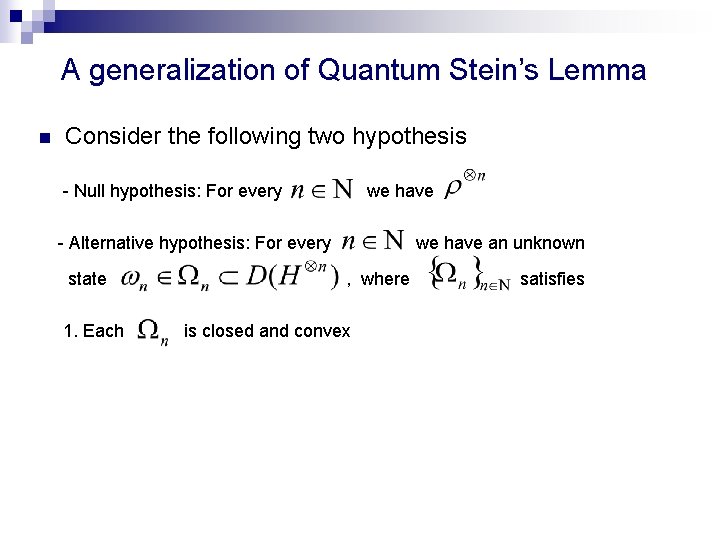
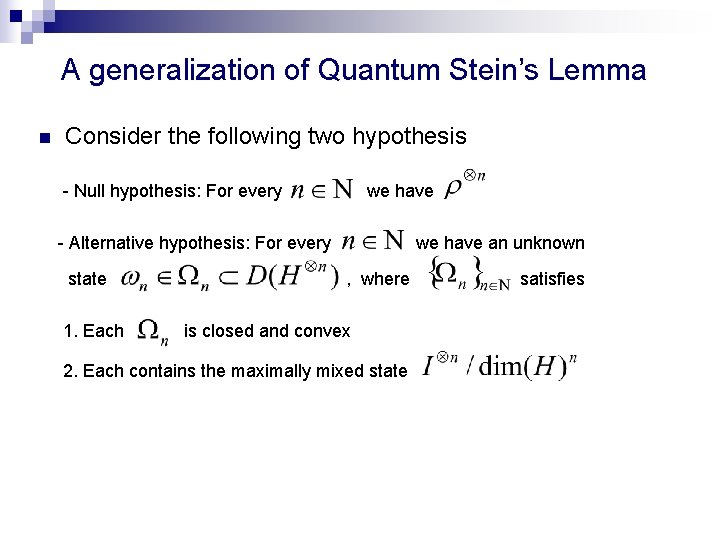
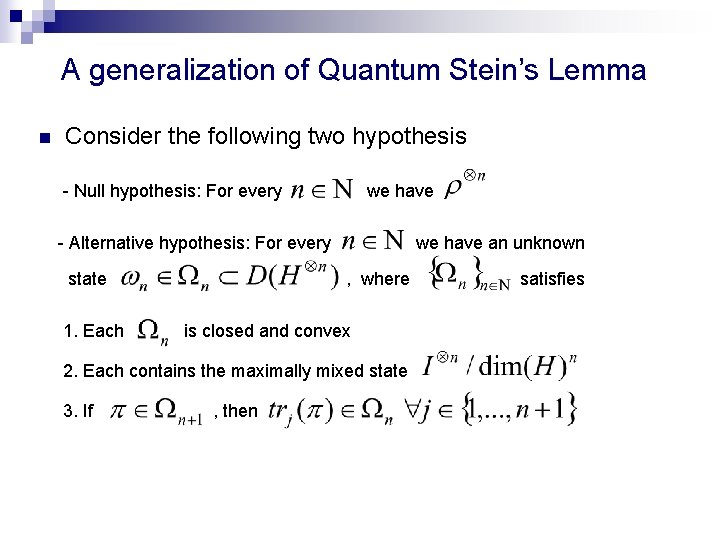
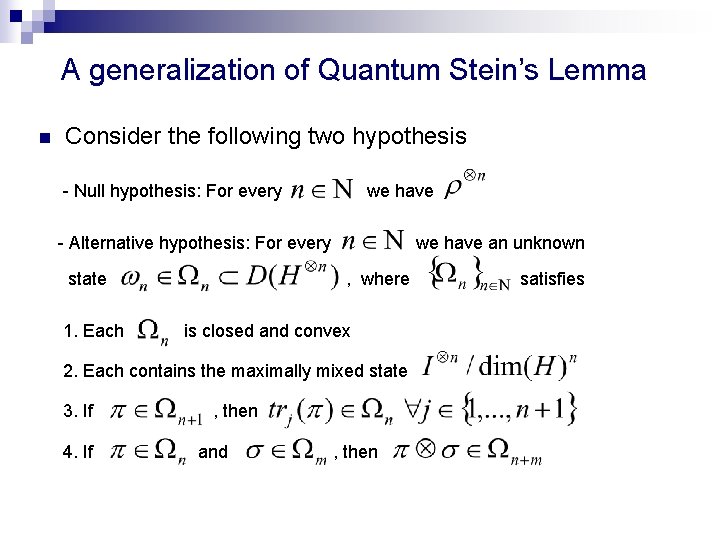
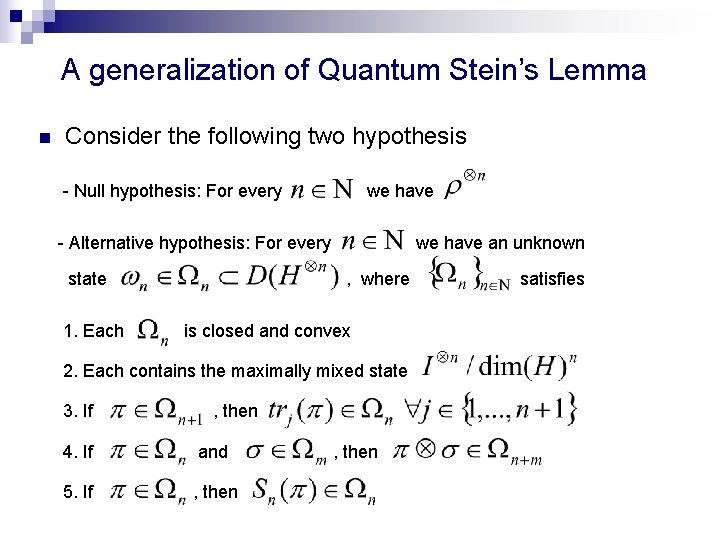
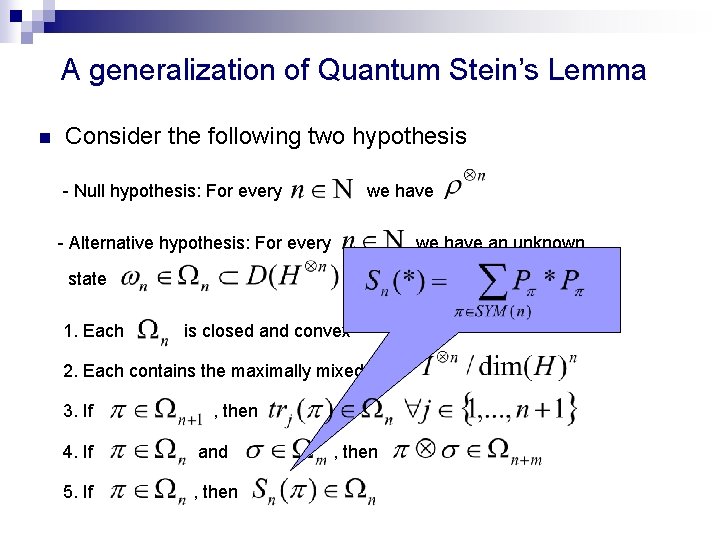
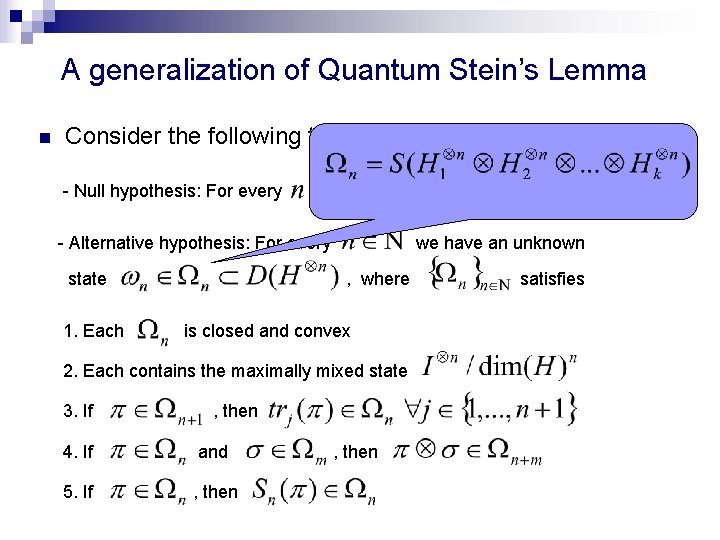
A generalization of Quantum Stein’s Lemma n Consider the following two hypothesis - Null hypothesis: For every we have - Alternative hypothesis: For every state 1. Each we have an unknown , where is closed and convex 2. Each contains the maximally mixed state 3. If , then 4. If and 5. If , then satisfies
A generalization of Quantum Stein’s Lemma n Consider the following two hypothesis - Null hypothesis: For every we have - Alternative hypothesis: For every state 1. Each we have an unknown , where is closed and convex 2. Each contains the maximally mixed state 3. If , then 4. If and 5. If , then satisfies
A generalization of Quantum Stein’s Lemma n Consider the following two hypothesis - Null hypothesis: For every we have - Alternative hypothesis: For every state 1. Each we have an unknown , where is closed and convex 2. Each contains the maximally mixed state 3. If , then 4. If and 5. If , then satisfies
A generalization of Quantum Stein’s Lemma n Consider the following two hypothesis - Null hypothesis: For every we have - Alternative hypothesis: For every state 1. Each we have an unknown , where is closed and convex 2. Each contains the maximally mixed state 3. If , then 4. If and 5. If , then satisfies
A generalization of Quantum Stein’s Lemma n Consider the following two hypothesis - Null hypothesis: For every we have - Alternative hypothesis: For every state 1. Each we have an unknown , where is closed and convex 2. Each contains the maximally mixed state 3. If , then 4. If and 5. If , then satisfies
A generalization of Quantum Stein’s Lemma n Consider the following two hypothesis - Null hypothesis: For every we have - Alternative hypothesis: For every state 1. Each we have an unknown , where is closed and convex 2. Each contains the maximally mixed state 3. If , then 4. If and 5. If , then satisfies
A generalization of Quantum Stein’s Lemma n Consider the following two hypothesis - Null hypothesis: For every we have - Alternative hypothesis: For every state 1. Each we have an unknown , where is closed and convex 2. Each contains the maximally mixed state 3. If , then 4. If and 5. If , then satisfies
A generalization of Quantum Stein’s Lemma n Consider the following two hypothesis - Null hypothesis: For every we have - Alternative hypothesis: For every state 1. Each we have an unknown , where is closed and convex 2. Each contains the maximally mixed state 3. If , then 4. If and 5. If , then satisfies
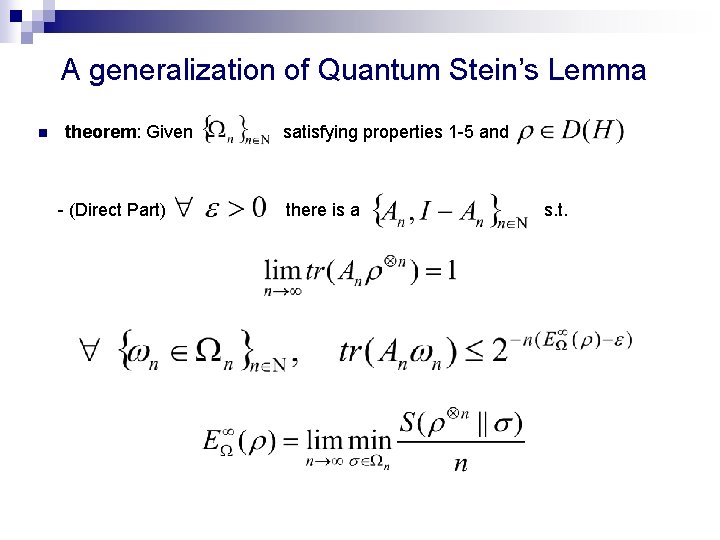
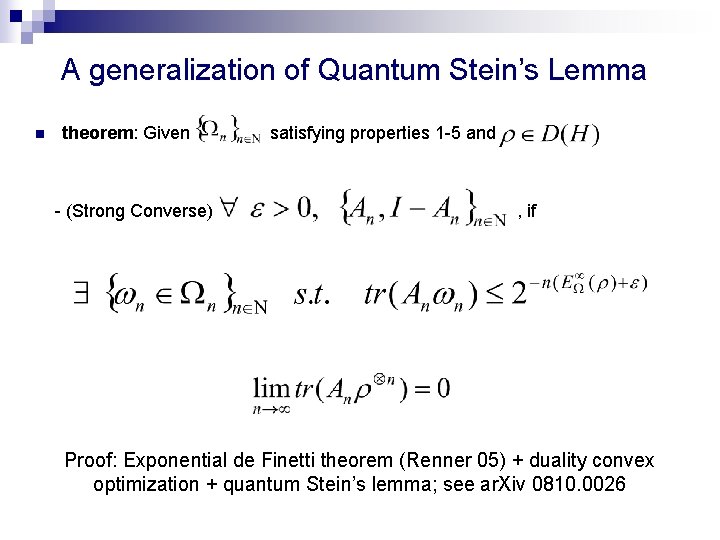
A generalization of Quantum Stein’s Lemma n theorem: Given - (Direct Part) satisfying properties 1 -5 and there is a s. t.
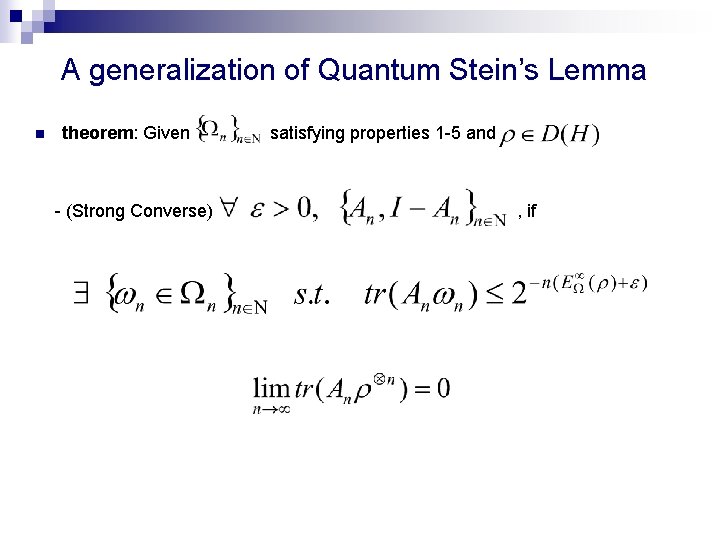
A generalization of Quantum Stein’s Lemma n theorem: Given - (Strong Converse) satisfying properties 1 -5 and , if
A generalization of Quantum Stein’s Lemma n theorem: Given - (Strong Converse) satisfying properties 1 -5 and , if Proof: Exponential de Finetti theorem (Renner 05) + duality convex optimization + quantum Stein’s lemma; see ar. Xiv 0810. 0026
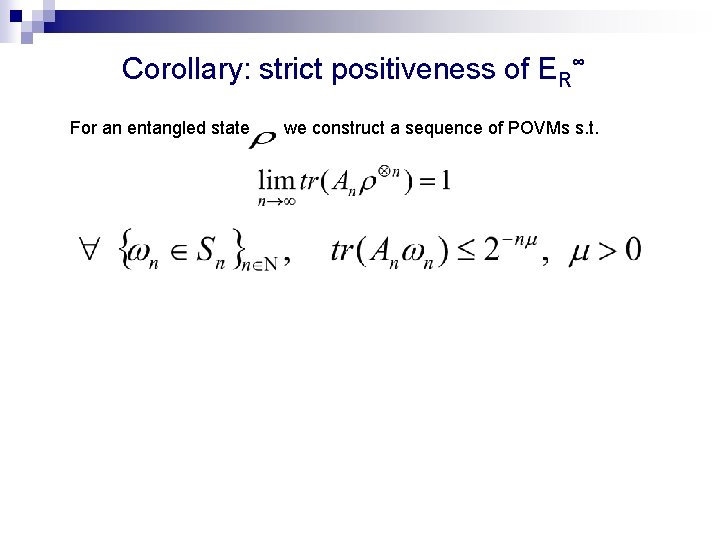
Corollary: strict positiveness of ER∞ For an entangled state we construct a sequence of POVMs s. t.
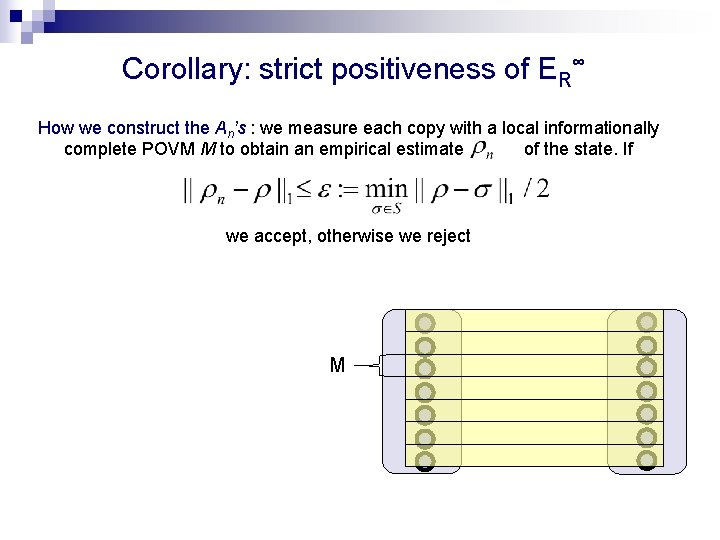
Corollary: strict positiveness of ER∞ How we construct the An’s : we measure each copy with a local informationally complete POVM M to obtain an empirical estimate of the state. If we accept, otherwise we reject M
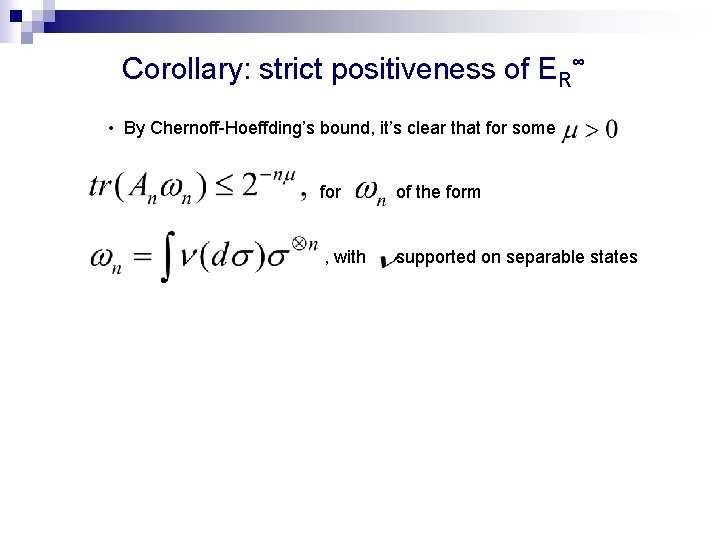
Corollary: strict positiveness of ER∞ • By Chernoff-Hoeffding’s bound, it’s clear that for some for of the form , with supported on separable states
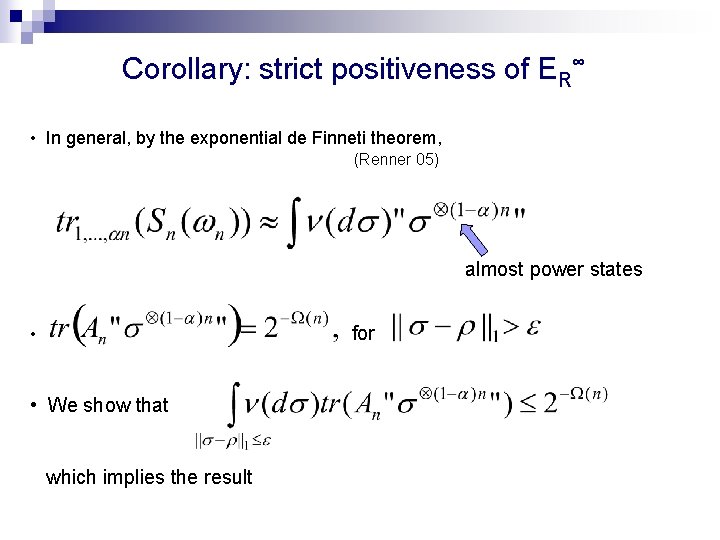
Corollary: strict positiveness of ER∞ • In general, by the exponential de Finneti theorem, (Renner 05) almost power states for • • We show that which implies the result
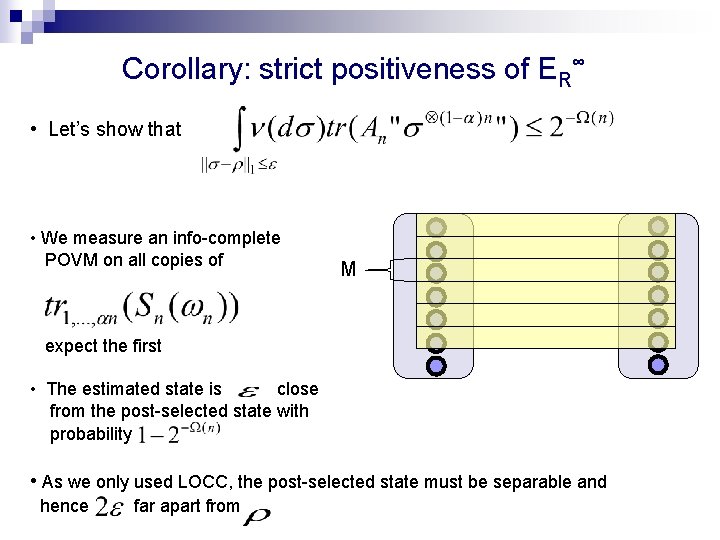
Corollary: strict positiveness of ER∞ • Let’s show that • We measure an info-complete POVM on all copies of M expect the first • The estimated state is close from the post-selected state with probability • As we only used LOCC, the post-selected state must be separable and hence far apart from
Thank you! • x