
Quantum Simulation and Optical Test for LED Photonic
- Slides: 1
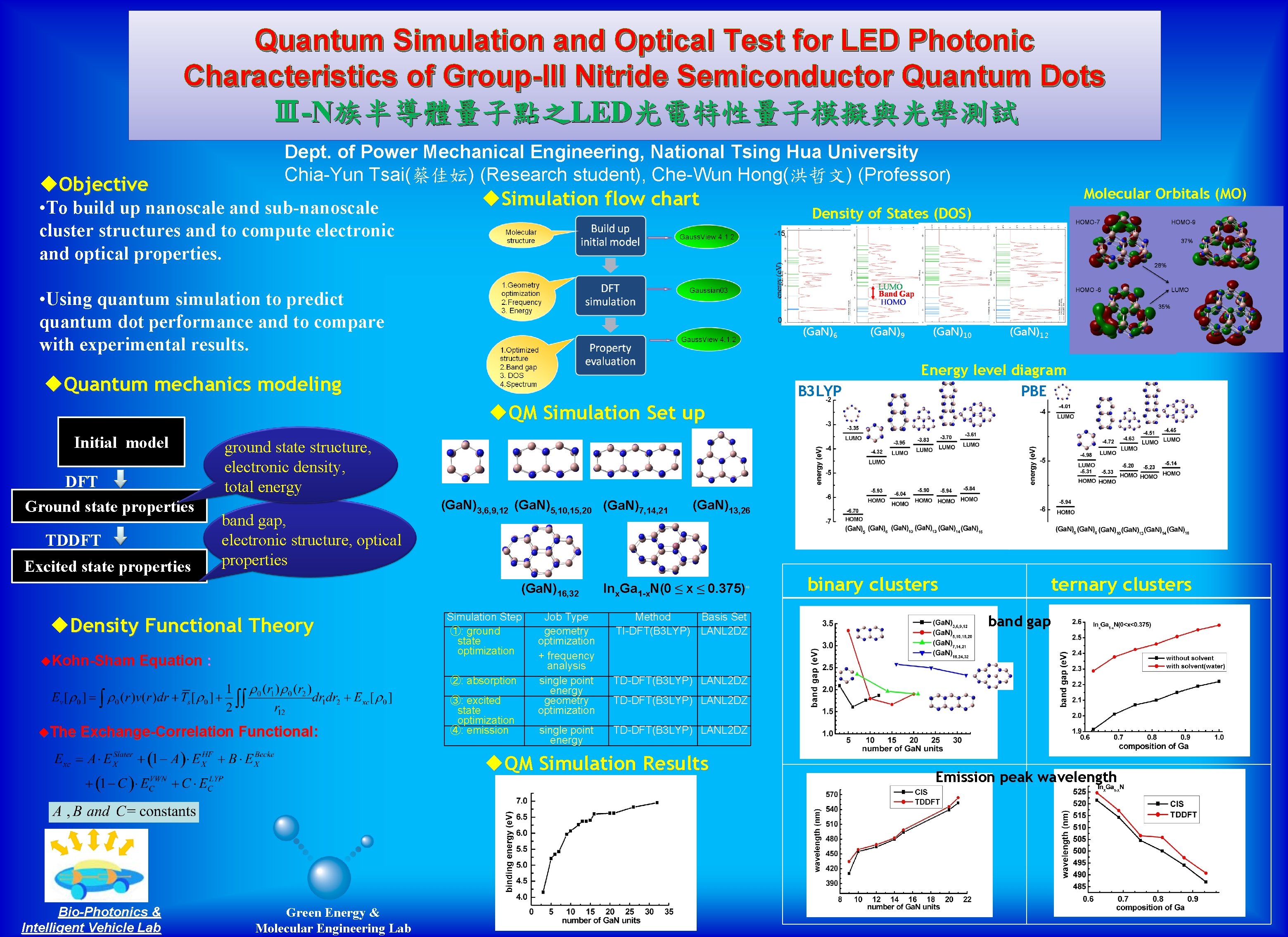
Quantum Simulation and Optical Test for LED Photonic Characteristics of Group-III Nitride Semiconductor Quantum Dots Ⅲ-N族半導體量子點之LED光電特性量子模擬與光學測試 Dept. of Power Mechanical Engineering, National Tsing Hua University Chia-Yun Tsai(蔡佳妘) (Research student), Che-Wun Hong(洪哲文) (Professor) u. Objective u Simulation flow chart • To build up nanoscale and sub-nanoscale Molecular Orbitals (MO) Density of States (DOS) cluster structures and to compute electronic and optical properties. • Using quantum simulation to predict quantum dot performance and to compare with experimental results. (Ga. N)6 u. Quantum mechanics modeling B 3 LYP (Ga. N)9 (Ga. N)10 (Ga. N)12 Energy level diagram PBE u. QM Simulation Set up Initial model DFT Ground state properties TDDFT Excited state properties ground state structure, electronic density, total energy band gap, electronic structure, optical properties (Ga. N)3, 6, 9, 12 (Ga. N)5, 10, 15, 20 (Ga. N)7, 14, 21 (Ga. N)16, 32 u. Density Functional Theory u. Kohn-Sham Equation : Simulation Step ①: ground state optimization ②: absorption u. The Exchange-Correlation Functional: ③: excited state optimization ④: emission Job Type geometry optimization + frequency analysis single point energy geometry optimization single point energy (Ga. N)13, 26 Inx. Ga 1 -x. N(0 ≤ x ≤ 0. 375) Method Basis Set TI-DFT(B 3 LYP) LANL 2 DZ Green Energy & Molecular Engineering Lab binary clusters ternary clusters band gap TD-DFT(B 3 LYP) LANL 2 DZ u. QM Simulation Results Bio-Photonics & Intelligent Vehicle Lab 10 Emission peak wavelength