
Quantum scale symmetry and the Equivalence principle Equivalence


- Slides: 51
Quantum scale symmetry and the Equivalence principle
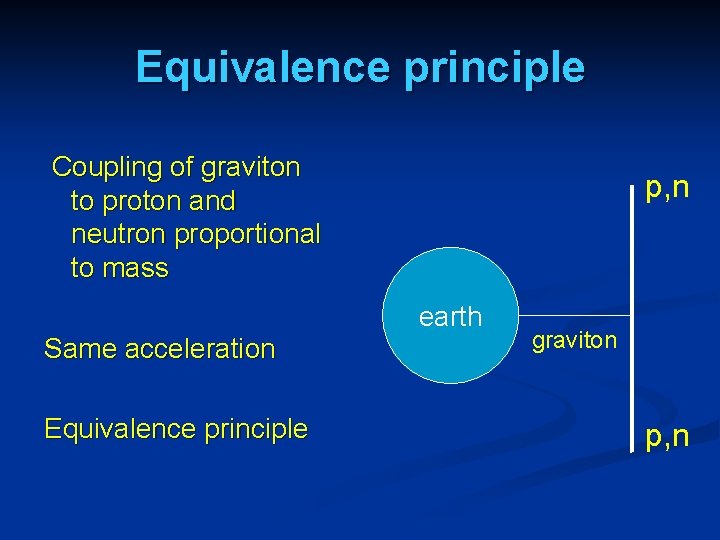
Equivalence principle Coupling of graviton to proton and neutron proportional to mass p, n earth Same acceleration Equivalence principle graviton p, n
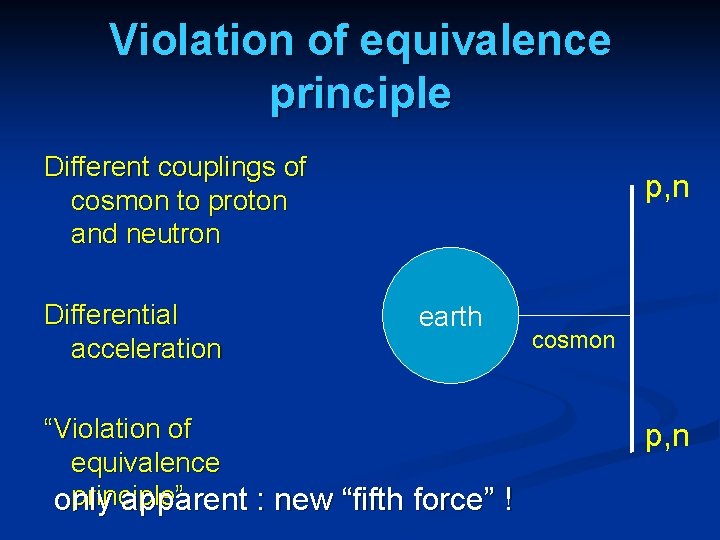
Violation of equivalence principle Different couplings of cosmon to proton and neutron Differential acceleration p, n earth “Violation of equivalence principle” only apparent : new “fifth force” ! cosmon p, n
New scalar force Spontaneously broken quantum scale symmetry predicts massless scalar ( cosmon ) n Only tiny violation of equivalence principle if scale symmetry is approximate n
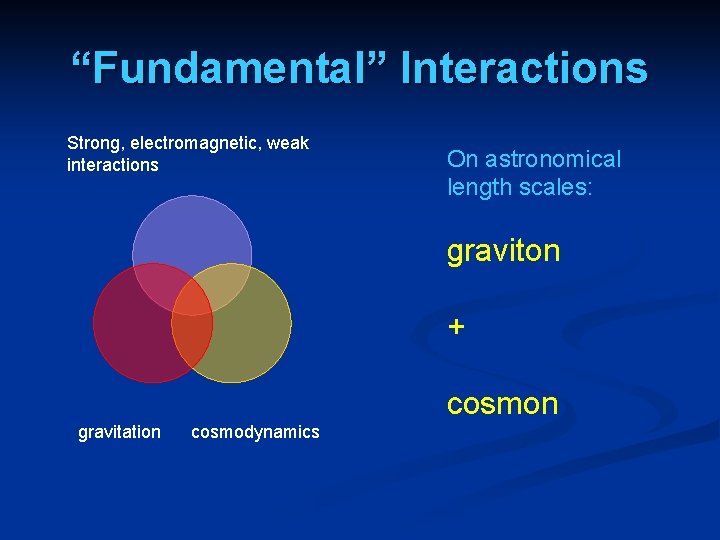
“Fundamental” Interactions Strong, electromagnetic, weak interactions On astronomical length scales: graviton + cosmon gravitation cosmodynamics
Scale symmetry
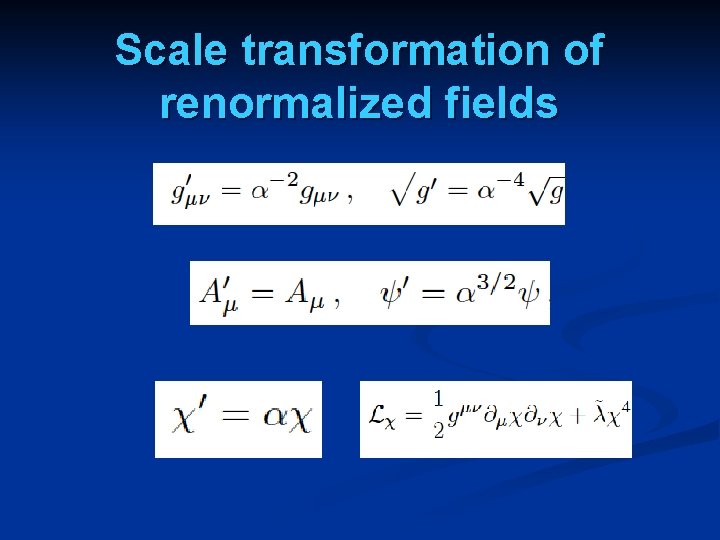
Scale transformation Scale all lengths with constant factor n Scale all masses with inverse factor n
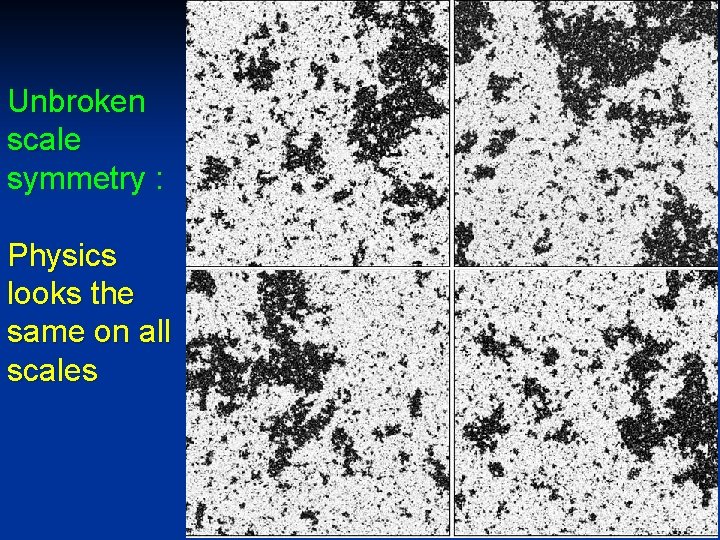
Unbroken scale symmetry : Physics looks the same on all scales Un
Scale transformation of renormalized fields
Have we observed scale symmetry ?
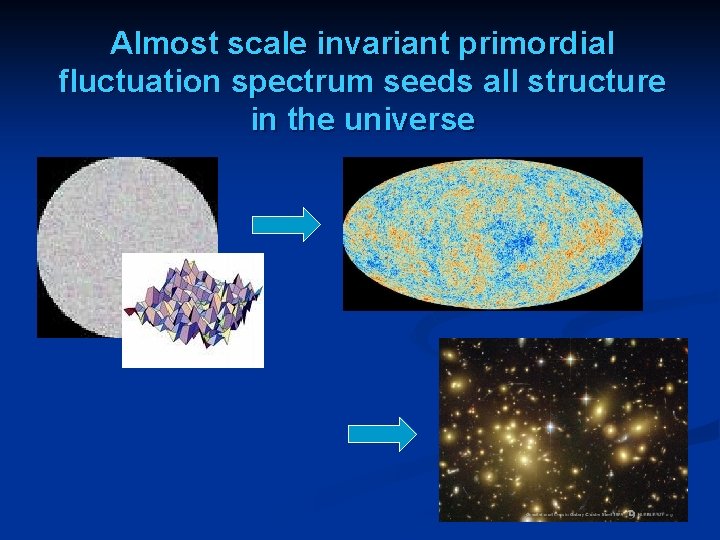
Almost scale invariant primordial fluctuation spectrum seeds all structure in the universe
Scale symmetry in elementary particle physics ? proton mass , electron mass Scales are present in particle physics, but very small as compared to Planck mass High momentum scattering almost scale invariant
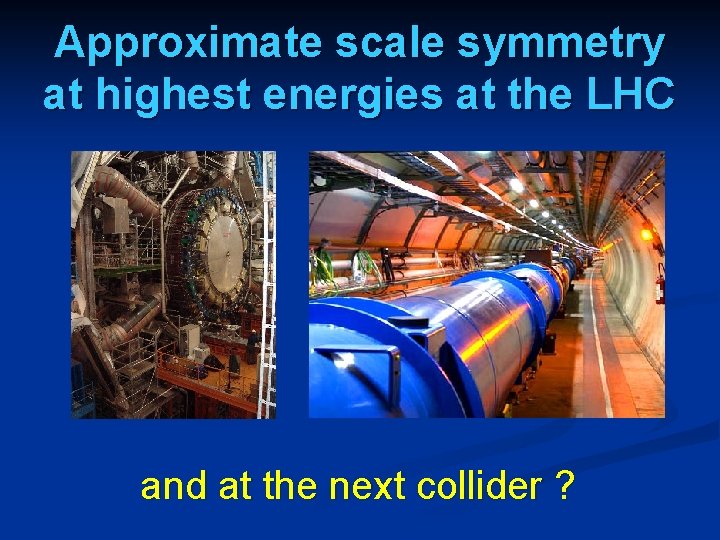
Approximate scale symmetry at highest energies at the LHC and at the next collider ?
Quantum scale symmetry
Quantum scale symmetry No parameter with dimension of length or mass is present in the quantum effective action. Then invariance under dilatations or global scale transformations is realized. Continuous global symmetry
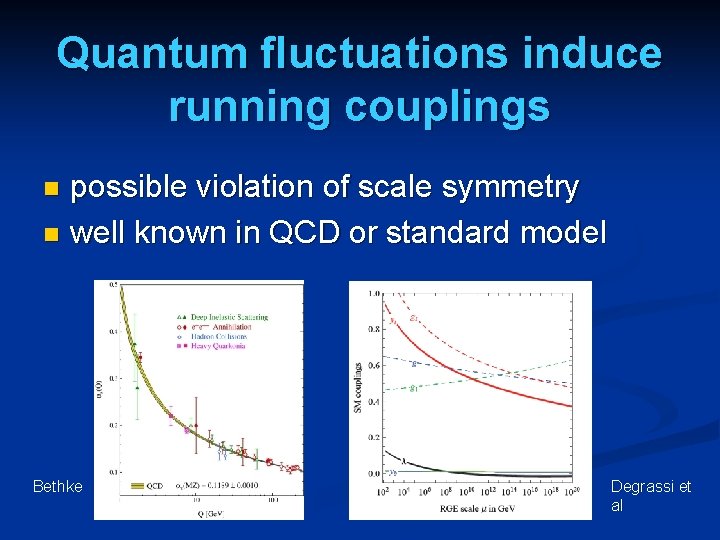
Quantum fluctuations induce running ( momentum dependent ) couplings Running fine structure constant �� = 1/137 for atoms �� = 1/128 at LEP Induced by quantum fluctuations of electrons, muons, quarks etc.
Quantum fluctuations induce running couplings possible violation of scale symmetry n well known in QCD or standard model n Bethke Degrassi et al
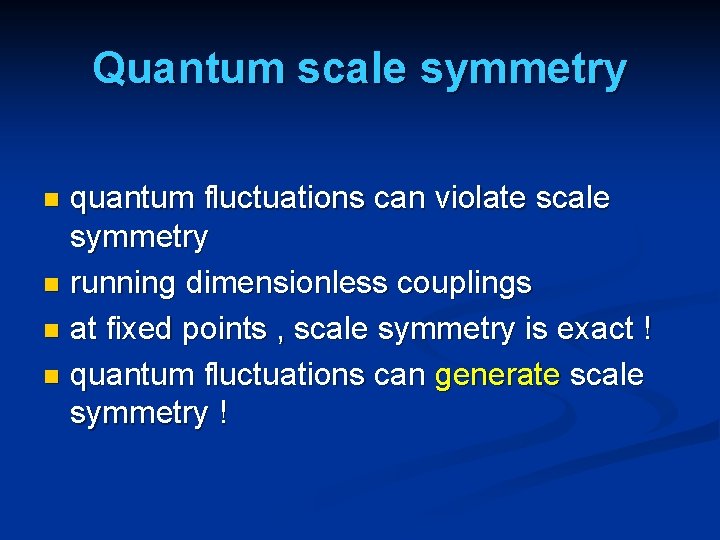
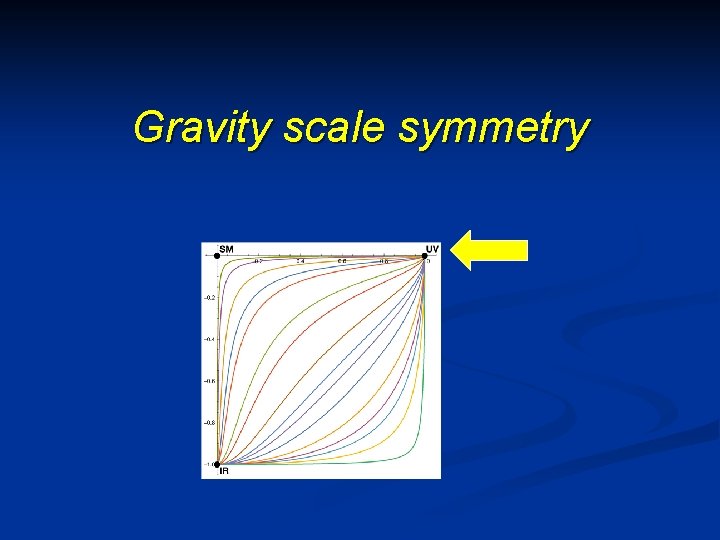
Quantum scale symmetry quantum fluctuations can violate scale symmetry n running dimensionless couplings n at fixed points , scale symmetry is exact ! n quantum fluctuations can generate scale symmetry ! n
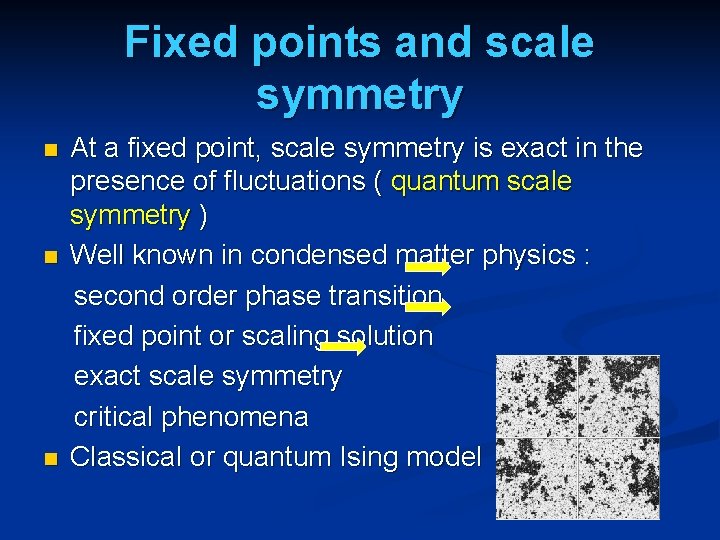
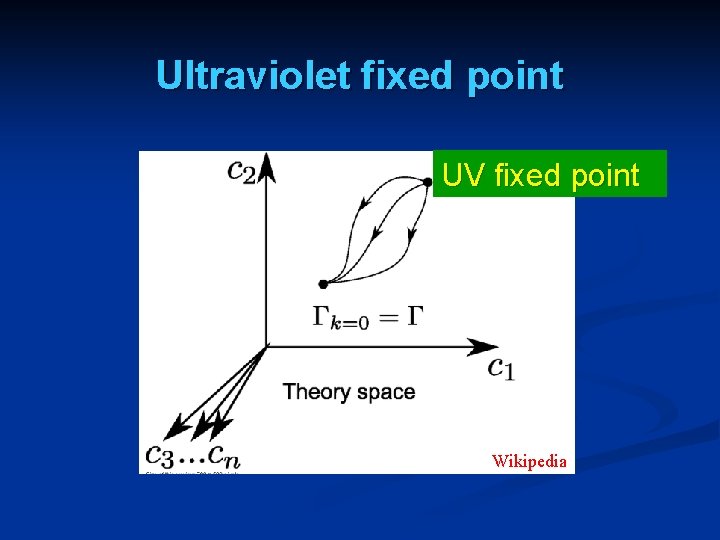
Fixed points and scale symmetry n n n At a fixed point, scale symmetry is exact in the presence of fluctuations ( quantum scale symmetry ) Well known in condensed matter physics : second order phase transition fixed point or scaling solution exact scale symmetry critical phenomena Classical or quantum Ising model
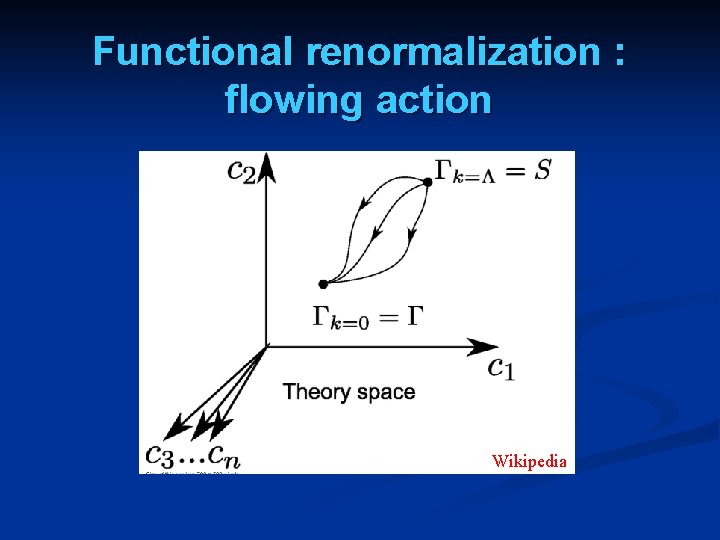
Functional renormalization : flowing action Wikipedia
Ultraviolet fixed point UV fixed point Wikipedia
Quantum scale symmetry Exactly on fixed point: No parameter with dimension of length or mass is present in the quantum effective action. Then invariance under dilatations or global scale transformations is realized as a quantum symmetry. Continuous global symmetry
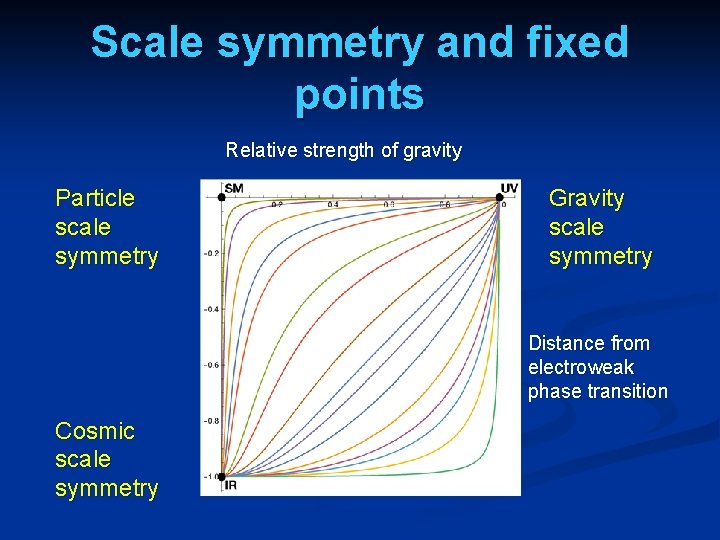
Scale symmetry and fixed points Relative strength of gravity Particle scale symmetry Gravity scale symmetry Distance from electroweak phase transition Cosmic scale symmetry
Gravity scale symmetry
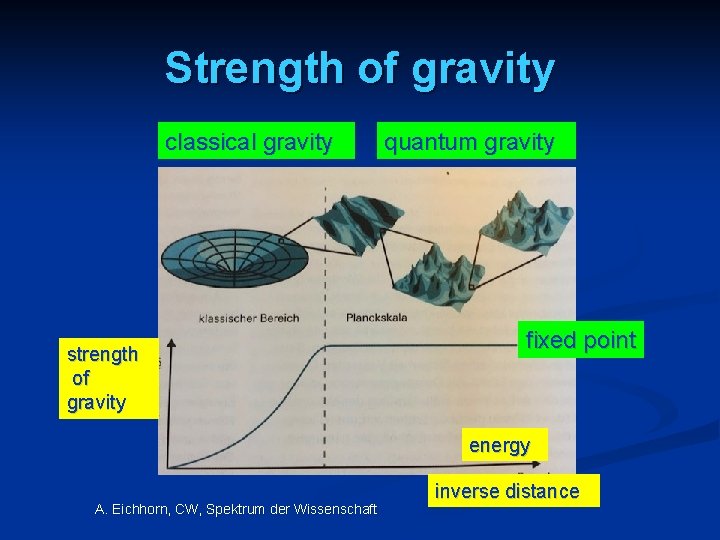
Strength of gravity classical gravity strength of gravity quantum gravity fixed point energy A. Eichhorn, CW, Spektrum der Wissenschaft inverse distance
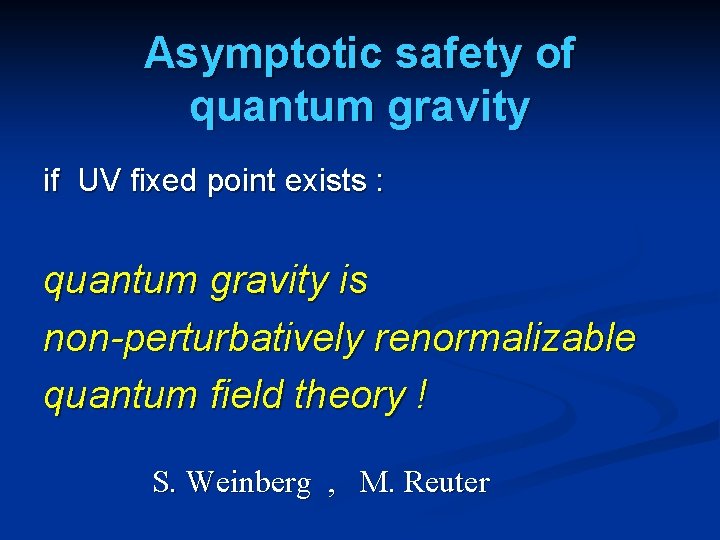
Asymptotic safety of quantum gravity if UV fixed point exists : quantum gravity is non-perturbatively renormalizable quantum field theory ! S. Weinberg , M. Reuter
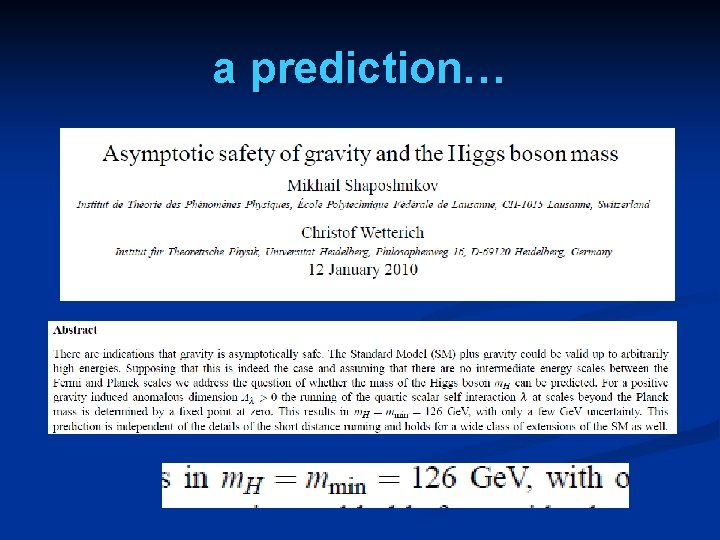
a prediction…
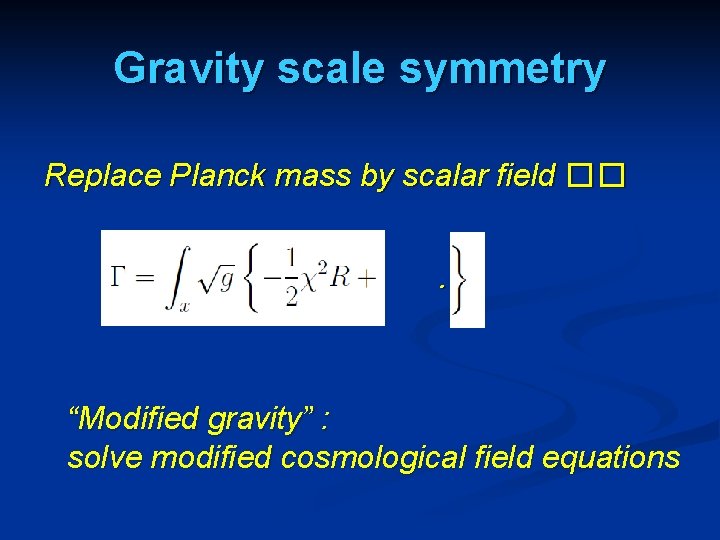
Gravity scale symmetry Replace Planck mass by scalar field �� … “Modified gravity” : solve modified cosmological field equations
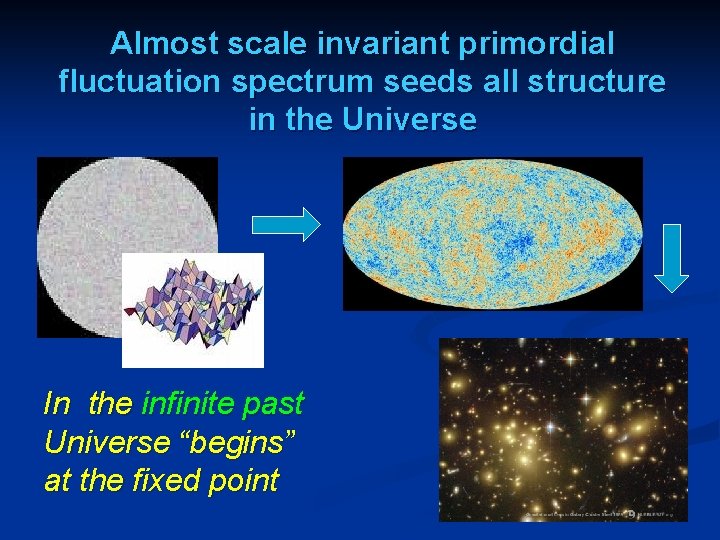
Almost scale invariant primordial fluctuation spectrum seeds all structure in the Universe In the infinite past Universe “begins” at the fixed point
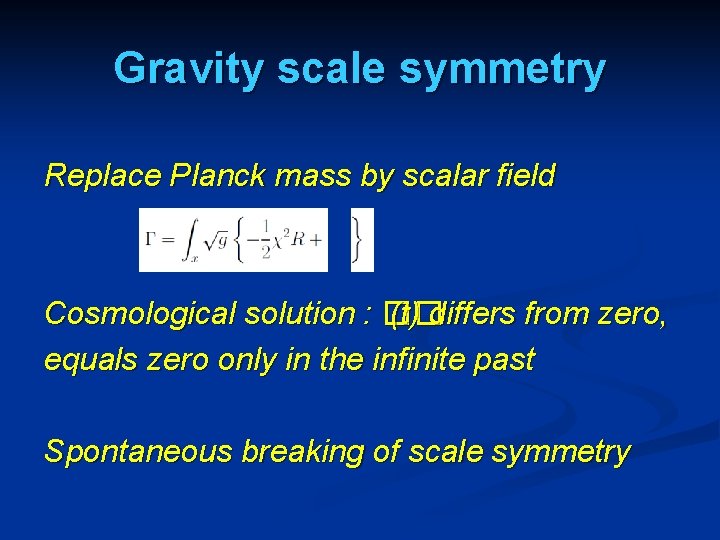
Gravity scale symmetry Replace Planck mass by scalar field Cosmological solution : �� (t) differs from zero, equals zero only in the infinite past Spontaneous breaking of scale symmetry
Scale symmetry All parameters with mass are proportional to scalar field χ Dimensionless couplings are independent of χ. n All particle masses are proportional to χ. n Ratios of particle masses remain constant. n Compatibility with observational bounds on time dependence of particle mass ratios even if χ changes with time. n
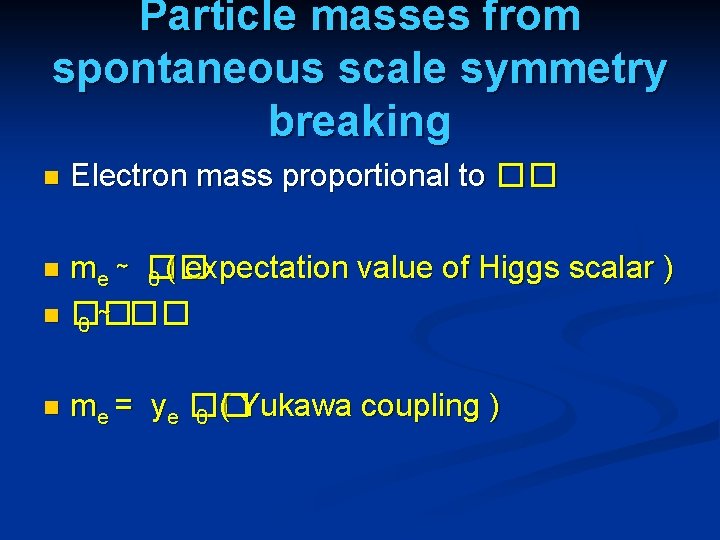
Particle masses from spontaneous scale symmetry breaking n Electron mass proportional to �� me ∼ �� 0 ( expectation value of Higgs scalar ) n �� 0 ∼ �� n n me = ye �� 0 ( Yukawa coupling )
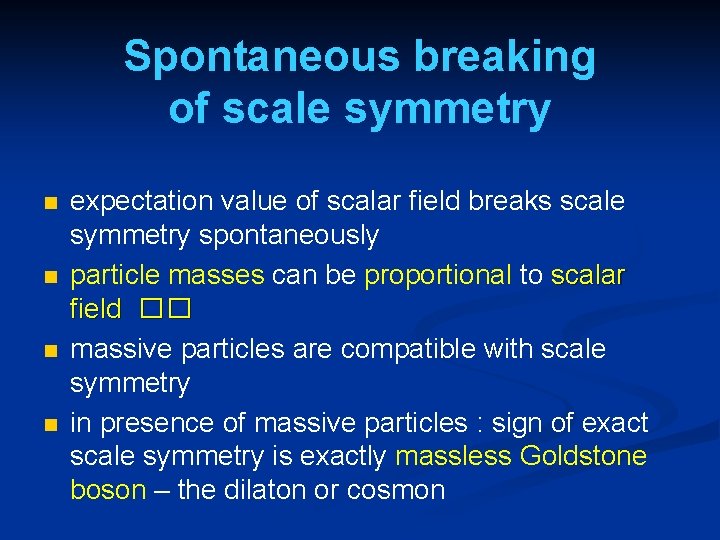
Spontaneous breaking of scale symmetry n n expectation value of scalar field breaks scale symmetry spontaneously particle masses can be proportional to scalar field �� massive particles are compatible with scale symmetry in presence of massive particles : sign of exact scale symmetry is exactly massless Goldstone boson – the dilaton or cosmon
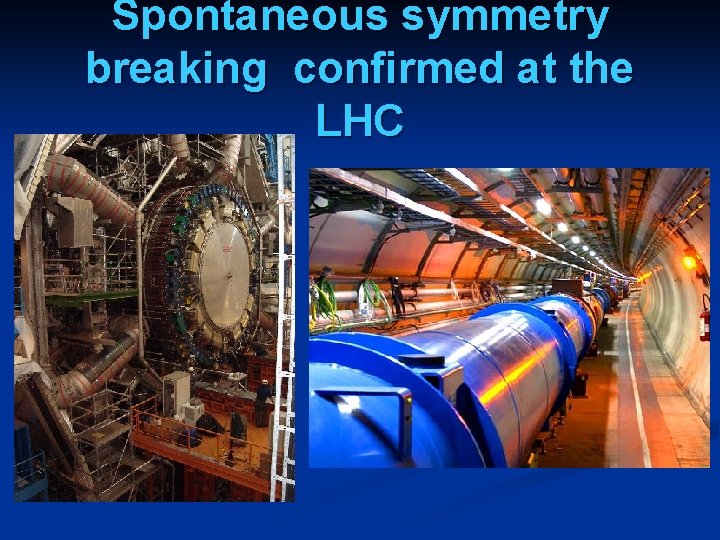
Spontaneous symmetry breaking confirmed at the LHC
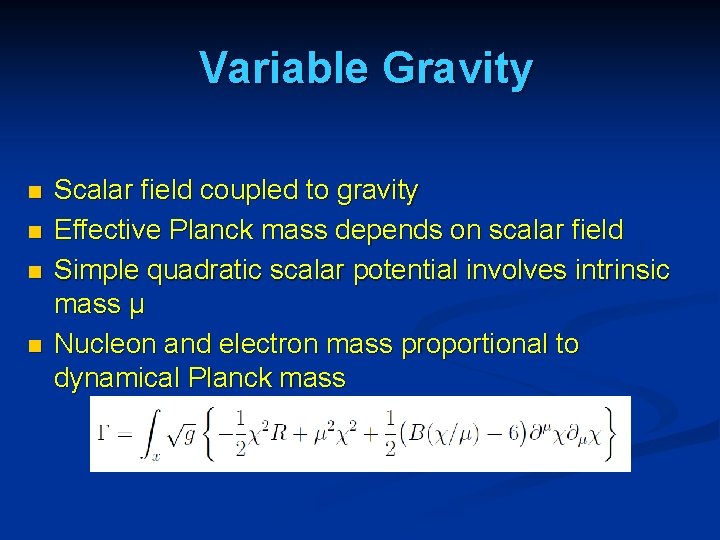
Variable Gravity n n Scalar field coupled to gravity Effective Planck mass depends on scalar field Simple quadratic scalar potential involves intrinsic mass μ Nucleon and electron mass proportional to dynamical Planck mass
Fifth force
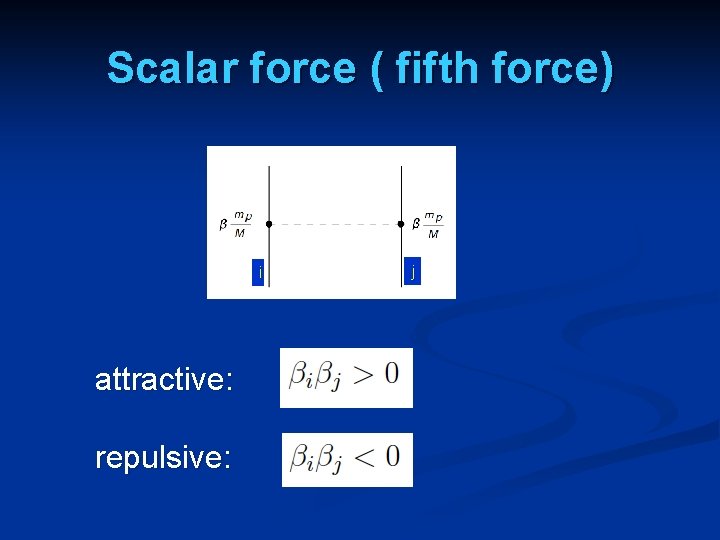
Scalar force ( fifth force) i attractive: repulsive: j
Simple mechanism for very light scalar field n Exact scale symmetry : massless Goldstone boson n Approximate scale symmetry : very light pseudo-Goldstone boson n Candidate for scalar fifth force
Simple mechanism for tiny cosmon - atom couplings asymptotic approach to fixed point for dimensionless couplings and mass ratios n at fixed point : no cosmon coupling to atoms – no time variation of fundamental constants n very near fixed point : tiny coupling n n how small ?
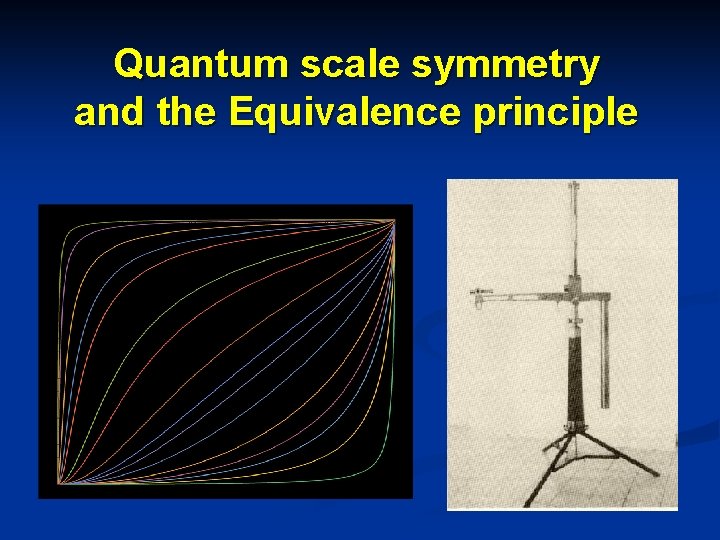
Conclusions n Quantum gravity makes predictions that can be tested by present observations and experiments n Eötvös - type experiments remain very relevant today: test of tiny violations of quantum scale symmetry
end
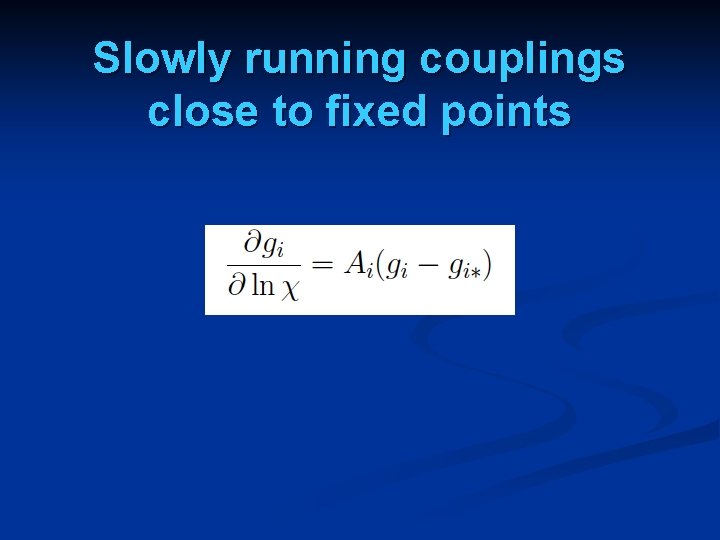
Slowly running couplings close to fixed points
Quintessence Dynamical dark energy , generated by scalar field (cosmon ) C. Wetterich, Nucl. Phys. B 302(1988)668, 24. 9. 87 P. J. E. Peebles, B. Ratra, Ap. J. Lett. 325(1988)L 17, 20. 10. 87
Prediction : homogeneous dark energy influences recent cosmology - of same order as dark matter - Original models do not fit the present observatio …. modifications ( different growth of neutrino mass )
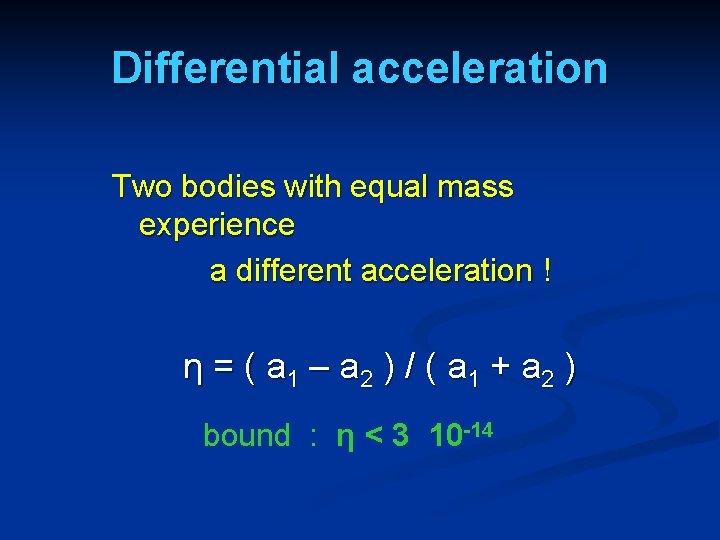
Differential acceleration Two bodies with equal mass experience a different acceleration ! η = ( a 1 – a 2 ) / ( a 1 + a 2 ) bound : η < 3 10 -14
Apparent violation of equivalence principle and time variation of fundamental couplings measure both the cosmon – coupling to ordinary matter
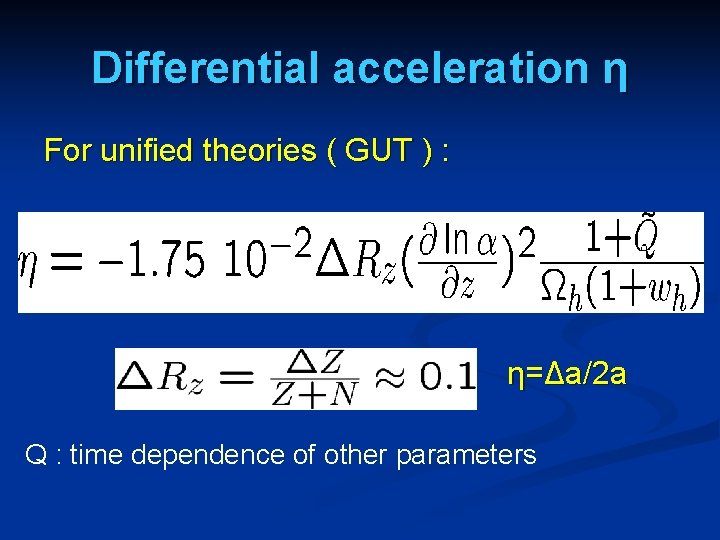
Differential acceleration η For unified theories ( GUT ) : η=Δa/2 a Q : time dependence of other parameters
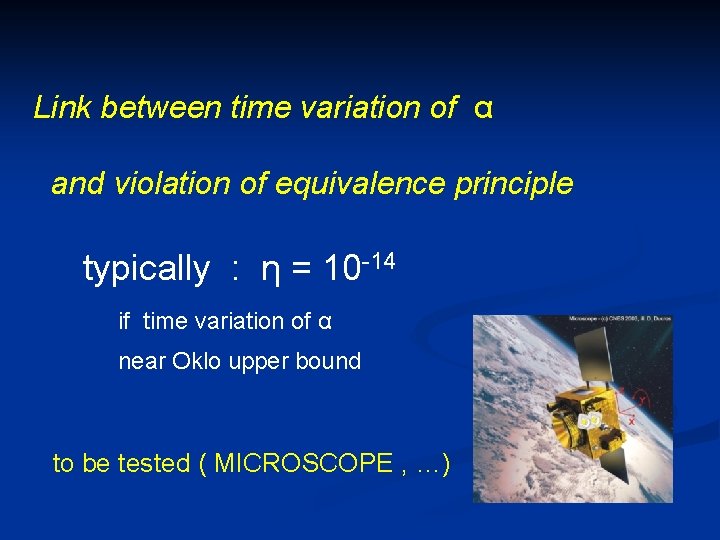
Link between time variation of α and violation of equivalence principle typically : η = 10 -14 if time variation of α near Oklo upper bound to be tested ( MICROSCOPE , …)
Cosmon coupling to atoms n n n Tiny !!! Substantially weaker than gravity. Non-universal couplings bounded by tests of equivalence principle. Universal coupling bounded by tests of Brans. Dicke parameter ω in solar system. Only very small influence on cosmology. ( All this assumes validity of linear approximation )